INTRODUCTION
Coastal lagoons and estuaries are considered to be natural nursery habitats for a wide range of marine species (Boesch & Turner, Reference Boesch and Turner1984), such as the penaeid shrimp, which is a highly significant economic resource for local communities. The pink shrimps Farfantepenaeus paulensis (Pérez-Farfante, 1967) and Farfantepenaeus brasiliensis (Latreille, 1817) represent a traditional fishery resource for the inhabitants of Conceição Lagoon, located on Santa Catarina Island in southern Brazil, since natives rely on traditional small-scale fishing for these shrimp species (Sierra de Ledo et al., Reference Sierra de Ledo, Gré, Soriano-Sierra, Sierra de Ledo and Soriano-Sierra1999).
The pink shrimp F. paulensis is native to the western Atlantic Ocean and is found from Bahia, Brazil 12°S, to Mar del Plata, Argentina 38°S (D'Incao, Reference D'Incao1991), while F. brasiliensis exhibits a wider geographical distribution, stretching from North Carolina, USA 35°N, to Rio Grande do Sul, Brazil 29°S (Valentini et al., Reference Valentini, D'Incao, Rodrigues, Rebelo Neto and Domit1991). Penaeid shrimps have a complex lifecycle, including the use of coastal lagoons and estuaries as feeding grounds for postlarvae, juveniles, and subadults, who then complete the cycle by subsequently migrating to the sea to become adults (Pérez-Castañeda & Defeo, Reference Pérez-Castañeda and Defeo2004). These environments provide both food and refuge from predators (Minello & Zimmerman, Reference Minello, Zimmerman, Deloach, Dougherty and Davidson1991), where shrimps achieve high rates of growth (Gillanders et al., Reference Gillanders, Able, Brown, Eggleston and Sheridan2003).
Despite the vital role coastal lagoons play in the lifecycle of the penaeid shrimps, few studies focused on the aspects of their biology in these areas have been reported. There is a strong connection between coastal lagoons and coastal areas (Gillanders et al., Reference Gillanders, Able, Brown, Eggleston and Sheridan2003) and understanding this ecological relation is essential to the management of fishery (Palumbi, Reference Palumbi2003; Shanks et al., Reference Shanks, Grantham and Carr2003; Kritzer, Reference Kritzer2004; Kritzer & Sale, Reference Kritzer and Sale2004). In general, shrimp studies concerning ecological factors have been carried out extensively in mangrove estuaries with Indo-Pacific species (e.g. Loneragan et al., Reference Loneragan, Kenyon, Haywood and Staples1994; Mohan et al., Reference Mohan, Selvam and Azariah1995; Vance et al., Reference Vance, Haywood, Heales and Staples1996, Reference Vance, Haywood, Heales, Kenyon, Loneragan and Pendrey2002; Rönnbäck et al., Reference Rönnbäck, Macia, Almqvist, Schultz and Troell2002; Meager et al., Reference Meager, Vance, Loneragan and Williamson2003). However, in coastal lagoons these studies were assessed only with the Atlantic species on the tropical coast of Mexico (Sánchez, Reference Sánchez1997; Pérez-Castañeda & Defeo, Reference Pérez-Castañeda and Defeo2001, Reference Pérez-Castañeda and Defeo2005) and particularly along the southern Brazilian coast (e.g. Boff & Marchiori, Reference Boff and Marchiori1984; D'Incao, Reference D'Incao1984, Reference D'Incao1991; Valentini et al., Reference Valentini, D'Incao, Rodrigues, Rebelo Neto and Domit1991; Albertoni et al., Reference Albertoni, Palma-Silva and Esteves1999; Fausto & Fontoura, Reference Fausto and Fontoura1999; D'Incao et al., Reference D'Incao, Valentini and Rodrigues2002). In the Conceição Lagoon, studies of ecological aspects of the pink shrimps, F. paulensis and F. brasiliensis, were only carried out in the early 1990s (Branco & Verani, Reference Branco and Verani1998a, Reference Branco and Veranib).
Conceição Lagoon is a subtropical coastal ecosystem that has suffered a process of modification caused by anthropogenic activities (Barbosa, Reference Barbosa2003). Speculation in real estate combined with a deficiency of public policies has resulted in a complex web of impacts that may have been reflected in the parameters of local aquatic fauna populations. In fact, during the 1970s and 1980s, mean shrimp production of Conceição Lagoon was 21,698 kg/year and 24,989 kg/year, respectively, whereas, in the 1990s, the catches were sharply reduced to 4,466 kg/year (GEP, 2006). According to Myers & Worm (Reference Myers and Worm2003), the depletion of coastal stocks may be due to both over-fishing and destruction of nursery areas. With this background in mind and considering that little has been published about spatial and temporal dynamics of the pink shrimps in inner areas, the main objective of this study was to evaluate spatial and temporal patterns of F. paulensis and F. brasiliensis in the Conceição Lagoon during a period of one year by monthly sampling.
MATERIALS AND METHODS
Study area
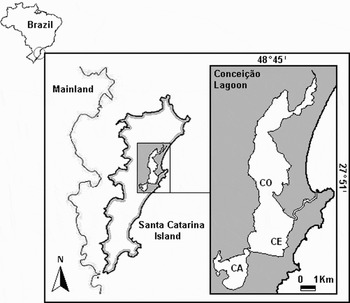
Conceição Lagoon (27°34′S and 48°27′W) is located on the east of Santa Catarina Island on the southern Brazilian coast (Figure 1), and has a total area of 20 km2. It is characterized as a semi-closed lagoon, connected to the Atlantic Ocean by a channel with an area of approximately 40 m2 and 2 m depth (Knoppers et al., Reference Knoppers, Opitz, De Souza and Miguez1984). Salinity has been gradually increasing since 1982, when the channel was dredged. According to Odebrecht & Caruso-Gomes Jr. (Reference Odebrecht and Caruso-Gomes1987), circulation and renewal of the water are controlled by variations in wind, rainfall, and evaporation patterns. The most common and most intense winds are the north-eastern and southern, respectively, and the warm months exhibit the greatest rainfall. Tide amplitudes vary by up to 25 cm and do not represent a determinant factor in this lagoon (Odebrecht & Caruso-Gomes Jr., Reference Odebrecht and Caruso-Gomes1987).
Map of Conceição Lagoon showing the location of the study areas: Canto (CA), Centro (CE) and Costa (CO).

Conceição Lagoon can be divided into three distinct areas, corresponding to its three natural subsystems: northern, central and southern (de Souza Sierra et al., Reference De Souza Sierra, Soriano-Sierra, Salim, Sierra deLedo and Soriano-Sierra1999; Barbosa, Reference Barbosa2003). The northern area, known locally as Costa (CO), has the least human population and is subject to interference from the lagoon complex's major tributary; the central area (Centro, CE) is close to the channel where the lagoon is connected to the Atlantic Ocean, while the southern area, known locally as Canto (CA), is the most urbanized area and has the greatest degree of eutrophication (de Souza Sierra et al., Reference De Souza Sierra, Soriano-Sierra, Salim, Sierra deLedo and Soriano-Sierra1999; Barbosa, Reference Barbosa2003), being the most distant from the channel out of all the areas. According to Fonseca et al. (Reference Fonseca, Braga and Eichler2002), the southern area presents the smallest water renewal rate, since the connection is narrow, thereby limiting the water exchange between the central and the northern areas.
Fieldwork procedure and sampling design
Shrimps were collected monthly for one year, from September 2003 to August 2004, at three different areas of Conceição Lagoon: CA, CE and CO, always during the evening (07:00–10:00 pm), by use of a casting net (mesh size 10 mm) to cover a total area of 50 m2 per sample (Figure 1). The casting net used was a non-standard gear, but was the only one allowed by the local environmental agency. It is minimally selective in terms of species, although it catches predominantly juveniles and subadults, missing postlarval and small juvenile shrimp. Three sites were sampled at each area each day, and sampling consisted of ten casts of the net. The depth of the sampling sites varied between 0.5 and 1.0 m, the substrate was predominantly sand and a combination of sand and silt (Porto-Filho, Reference Porto-Filho1990), along with a few observed sea grass beds in the margin. Although shrimp were sampled monthly, data were analysed seasonally and each month was considered as a replicate. Seasons were defined as spring (September 2003 to November 2003), summer (December 2003 to February 2004), autumn (March 2004 to May 2004) and winter (June 2004 to August 2004). After the sampling, the shrimps were immediately frozen and taken to the laboratory for further analysis. Specimens were counted, measured to the nearest 0.1 mm (cephalothoracic length (CL)) and weighed to the nearest 0.01 g using an analytical balance. Their sex was also determined according to the presence of a developed petasma or thelycum, for males and females respectively. Species were identified according to morphological characteristics, as described by D'Incao (Reference D'Incao1995). For general comparison with other published data, mean data were presented per 100 m2. However, data were represented graphically as absolute numbers of individuals and total weight caught by the ten casts.
Salinity and water temperature were recorded for each sampling area with a refractometer and immersion thermometer. Daily rainfall levels were obtained from the Meteorological Department (EPAGRI), and a mean of the rainfall for two weeks before each sampling period was used as an estimate for the rainfall factor.
Statistical analysis
To determine whether the abundance and the biomass of the pink shrimps, F. paulensis and F. brasiliensis, as well as the total shrimp sampled differed across sampling areas and seasons, we used analysis of variance (ANOVA) that incorporated the factors: area (fixed), season (fixed), an area × season interaction term (random) and site (random) nested with area × season. Subsequently, the Tukey test was applied when significant differences were detected. Prior to ANOVA, homogeneity of variance was checked (Cochran's C-test) and logarithmic transformation applied (Log10 x + 1) when appropriate (Underwood, Reference Underwood1999). The same model was used to investigate if salinity and water temperature presented spatial and temporal variations. Multiple linear regression was performed to explore the relationship between the abiotic factors and shrimp abundance and biomass, using data broken down by species. In this analysis we used all data together and also separate data from only the area and season where each species was more abundant. Moreover, the χ2-test was used to investigate whether the sex ratios presented the expected 1:1 ratio. Analyses were performed using Statistica 5.1 and ‘R’ software.
RESULTS
Environmental factors
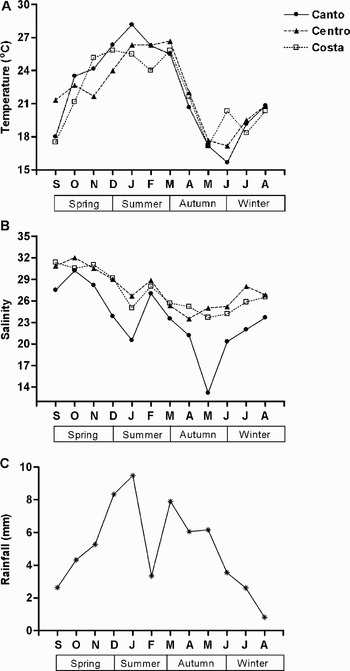
Water temperature ranged from 15°C in June to 28.5°C in January, and mean monthly temperatures were over 25°C from December to March and close to or lower than 19°C in the autumn and winter months. Mean temperature was significantly higher during summer (25.86°C) when compared to the other seasons and was statistically indifferent for the various locations (Figure 2A). Salinity ranged from 10.5 in May to 36 in July, with monthly means ranging from 20.61 in May to 30.89 in October. Salinity differed significantly between areas and seasons. Mean salinity was statistically lower at CA (23.42) when compared to CE (27.64) and CO (27.17). Peak mean salinity was registered in spring (30.22), followed by summer (26.44), winter (24.72) and autumn (22.91) (Figure 2B).
(A) Mean monthly water temperature (°C); (B) salinity recorded at the three sampling areas from September 2003 to August 2004; and (C) mean monthly rainfall (mm), as recorded by the Meteorological Department (EPAGRI).

Continuous data demonstrated that rainfall was higher in December, January and March than during the other months, with rainy periods in summer and early autumn. The lowest rainfall occurred in August, characterizing the winter as a dry season (Figure 2C).
Overall catches
A total of 744 specimens were caught, representing four shrimp species, with two species dominating in number. The penaeid shrimp Farfantepenaeus brasiliensis was the most abundant, followed by Farfantepenaeus paulensis, accounting for 455 and 274 individuals, respectively. The other two species, Litopenaeus schmitti (Burkenroad, 1936) and Sicyonia dorsalis (Kingsley, 1878), were not included in this study because of their low abundance (14 and 1 specimens, respectively). Peak F. brasiliensis density and biomass was 11.48 individuals/100 m2 and 53.11 g/100 m2, while maximum F. paulensis density and biomass was 6.91 individuals/100 m2 and 35.96 g/100 m2.
Females were more abundant than males in both species, although only for F. paulensis a statistically significant difference (χ2 = 7.69, P = 0.005) was seen.
Spatial distribution
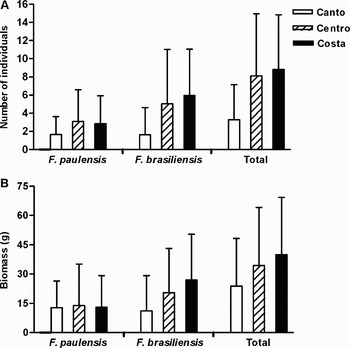
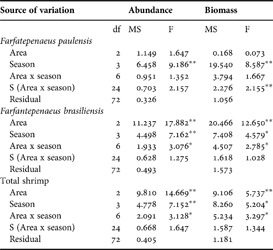
The spatial distribution of F. brasiliensis exhibited significant differences (Table 1), with lowest abundance and biomass in CA, when compared to CE and CO (Figure 3). However, there was also a significant area × season interaction for both factors (Table 1). In contrast, both abundance and biomass of F. paulensis were homogeneously distributed throughout the lagoon.
Means and standard deviations for (A) abundance in number of individuals and (B) biomass in grams for Farfantepenaeus paulensis, F. brasiliensis, and for both species together, sampled between September 2003 and August 2004 at three locations in Conceição Lagoon: Canto, Centro and Costa.

Summary analysis of variance test results for shrimp abundance and biomass with sampling area, season, interaction term and site as factors.

Significance levels: *P≤0.05, **P ≤ 0.01.
Taking all data together, lowest total abundance and total biomass were observed in CA, resulting from small numbers of both shrimp species being caught. In contrast, CO exhibited highest total abundance and total biomass (Figure 3; Table 1). These spatial patterns also showed significant interactions with seasonal patterns (Table 1).
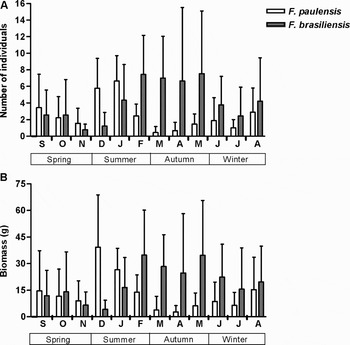
Monthly variations (mean + SD) in (A) abundance (number of individuals) and (B) biomass (g), by shrimp species.

Seasonal variation
Both penaeid species were observed throughout the 12-month sampling period, although their temporal distribution exhibited distinct patterns. Abundance and biomass of F. paulensis increased during December and January and was low from March to July, reaching intermediate levels in August. Biomass and abundance of F. brasiliensis increased gradually from January to May, then decreased from June onwards (Figure 4).
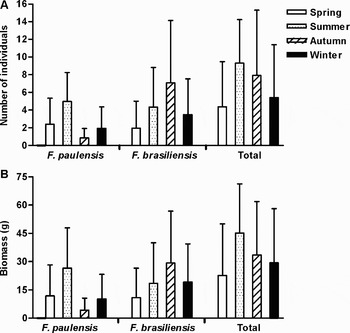
Levels of F. paulensis abundance and biomass were significantly higher during the summer. The autumn exhibited the lowest catches of this species (Figure 5; Table 1). Farfantepenaeus brasiliensis exhibited a different catch pattern in comparison with F. paulensis, whose abundance was significantly more elevated in autumn than any other season. The smallest catches occurred during spring, and this difference was significant. Biomass exhibited the same peak in autumn, although the other seasons did not differ significantly. These seasonal variations in abundance and biomass of F. brasiliensis showed a significant interaction with spatial patterns (Figure 5; Table 1).
Seasonal variations (mean + SD) in (A) abundance (number of individuals) and (B) biomass (g), by shrimp species.

The sum of both species' data, defined as total abundance and total biomass, demonstrated that summer and autumn had statistically higher abundances, with elevated occurrences of both species. Furthermore, total biomass was significantly higher in summer than in spring (Figure 5; Table 1). Low total biomass and abundance during spring in CA and high values during summer in CE and CO are a demonstration of a significant interaction between the factors.
Shrimp abundance and biomass and environmental variations
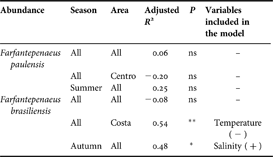
Following the multiple regression analysis we could not observe the interference of the abiotic factors rainfall, salinity and temperature on the abundance of shrimps, when considering all seasons and all areas. However, if we only consider either the season or the area in which each species was more abundant, F. brasiliensis abundance showed a negative association with temperature and a positive association with salinity (Table 2).
Results from multiple regression analysis for the relation between abiotic factors and shrimp abundance by species, considering all data or only the area and season in which each species was more abundant. We indicate the abiotic factors (variable) associated with the dependent variable and the sign of their relationship.

Significance levels: *P≤0.05, **P ≤ 0.01.
DISCUSSION
This study suggests that the two penaeid species, Farfantepenaeus paulensis and Farfantepenaeus brasiliensis, have different spatial and temporal distribution patterns. It was found that F. brasiliensis was more abundant than F. paulensis. Over the last ten years, a shift has occurred in the shrimp dominance pattern in the Conceição Lagoon, since F. paulensis was approximately four times more abundant than F. brasiliensis (Branco & Verani, Reference Branco and Verani1998a, Reference Branco and Veranib). Annual variation has been observed for F. paulensis catches in the estuarine system of Patos Lagoon (D'Incao et al., Reference D'Incao, Valentini and Rodrigues2002), and dominance has been observed to alternate over time between F. brasiliensis and F. paulensis in Imboassica Lagoon, eastern Brazil (Albertoni et al., Reference Albertoni, Palma-Silva and Esteves2003). In the Conceição Lagoon, F. brasiliensis is close to its southern limit of distribution, and the presence of this species in latitudes just a little further south is considered occasional (D'Incao et al., Reference D'Incao, Valentini and Rodrigues2002). In fact, Freire performed a study in the nearby Ibiraquera Lagoon and found that only 3% of the total shrimp caught were F. brasiliensis (personal communication). Therefore, the current dominance of F. brasiliensis at Conceição Lagoon could presumably indicate a long-term variation in the availability of larvae in the ocean; changes in abiotic characteristics of the lagoon, such as the gradual increase of salinity since the channel was dredged in the early 1980s; or special features of this ecosystem that favour the species occurrence even at this latitude.
The two pink shrimp species had different spatial abundance patterns: F. paulensis exhibited a homogeneous distribution and F. brasiliensis was more abundant in CE and CO than in CA. This difference could be attributed to variations in habitat features that may have affected the F. brasiliensis distribution. Indeed, there was a trend in observing lower salinity in CA (23.42) when compared to CE (27.67) and CO (27.17) areas. This linkage between the spatial partitioning and abiotic factor is confirmed by the partial regression coefficient, which showed that salinity influences the abundance of F. brasiliensis. The salinity range observed in this study is apparently optimum for these species' survival (Brito et al., Reference Brito, Chimal and Rosas2000; Wasielesky et al., Reference Wasielesky, Bianchini, Sánchez and Poersch2003). However, Brito et al. (Reference Brito, Chimal and Rosas2000) reported that F. brasiliensis is a species that thrives when salinity is greater than its isosmotic point (25.0), which might explain the preference that F. brasiliensis showed for some areas in the Conceição Lagoon. This tendency of F. brasiliensis to inhabit areas with high salinity has also been reported by Pérez-Castañeda & Defeo (Reference Pérez-Castañeda and Defeo2001), suggesting that salinity plays a key factor in controlling F. brasiliensis distribution at Conceição Lagoon. Moreover, CE and CO are closer to the channel that connects the lagoon to the Atlantic Ocean, and as Branco & Verani (Reference Branco and Verani1998a, Reference Branco and Veranib) have suggested, F. paulensis and F. brasiliensis abundance tends to increase within the proximity to this channel, since it displays high salinity and also constitutes the region where juveniles and subadults migrate offshore.
The different seasonal patterns of shrimp distribution, with F. paulensis being more abundant in summer and F. brasiliensis in autumn, may possibly be related to differences in the migration time to the lagoon as postlarvae and/or migration to the sea as juveniles and subadults, besides being influenced by fishing pressure. Among these factors, we consider that their decreasing abundance is an indication of migration to the sea. Farfantepenaeus paulensis grows in the estuary for 4 to 5 months until it migrates offshore (D'Incao, Reference D'Incao1991). Therefore, our data suggest that F. paulensis recruits in the lagoon in early spring, and migrates back to the sea during summer, whereas F. brasiliensis recruits mainly in summer, migrating in early winter. This pattern was also suggested by Branco & Verani (Reference Branco and Verani1998a, Reference Branco and Veranib), demonstrating that even after ten years the biological timing of the species has not changed. At Patos Lagoon the postlarvae input to estuarine waters also starts in late September, peaking in October and November (D'Incao, Reference D'Incao1983). Moreover, a seasonal variability of four Farfantepenaeus species in a Mexican tropical coastal lagoon was also associated with differences in recruitment timing (Pérez-Castañeda & Defeo, Reference Pérez-Castañeda and Defeo2001). Thus, the seasonal segregation observed in both shrimp species could also be explained by ontogenetic changes in behaviour to reduce potential interspecific interactions (Pérez-Castañeda & Defeo, Reference Pérez-Castañeda and Defeo2001; Rönnbäck et al., Reference Rönnbäck, Macia, Almqvist, Schultz and Troell2002).
The different seasons generated differences in temperature, salinity and rainfall, in which only temperature seemed to affect the seasonal shrimp distribution. Farfantepenaeus brasiliensis abundance exhibited a negative association with temperature. On the other hand, F. paulensis seemed not to be controlled by this factor, although its higher abundance tended to follow higher temperatures (Branco & Verani, Reference Branco and Verani1998b; D'Incao et al., Reference D'Incao, Valentini and Rodrigues2002). The effect of temperature on survival of juvenile penaeids has also been emphasized by Staples & Heales (Reference Staples and Heales1991), O'Brien (Reference O'Brien1994), Pérez-Castañeda & Defeo (Reference Pérez-Castañeda and Defeo2001) and Wasielesky et al. (Reference Wasielesky, Bianchini, Sánchez and Poersch2003). Thus, considering the results obtained in the present study, we can suggest that the two pink shrimp species present different patterns of temperature influence on their seasonal distribution along Conceição Lagoon. Furthermore, we can also suggest that factors other than environmental ones might control this seasonal distribution, such as the role of supply and settlement of postlarvae at the lagoon.
It is known that F. paulensis postlarvae from the Santa Catarina state coast supplies the estuary stock of Patos Lagoon (D'Incao, Reference D'Incao1991) and it is considered one of the two major congregation zones for this species along the Brazilian coast. Moreover, recent studies have described the genetic structure of the southern pink shrimp populations and demonstrated a distinct southern stock stretching from Santa Catarina State to Patos Lagoon (Gusmão et al., Reference Gusmão, Lazoski and Solé-Cava2005). However, there is little information available on the F. brasiliensis stock along the Brazilian coast and no population heterogeneity was detected in this species along 4000 km of Brazil coastline (Gusmão et al., Reference Gusmão, Lazoski and Solé-Cava2005). In the case of Conceição Lagoon, although urbanized and threatened by man-made contaminants, it seems to constitute a growing ground for both species and is probably the southern limit of the input of F. brasiliensis juveniles and subadults to the sea.
In summary, F. brasiliensis and F. paulensis presented different spatial and temporal abundance patterns along their distribution in the Conceição Lagoon. By contrast, the species presented different environment requirements regarding their occurrence in this subtropical lagoon, where F. brasiliensis spatial and seasonal distribution patterns seemed to be influenced by salinity and temperature. The temporal partitioning between the species might be a response of differential migration timing to the sea and seemed to be the greatest factor controlling the occurrence of these two pink shrimp species. This information must be incorporated into lagoon management activities, since traditionally pink shrimp management procedures do not take account of the differences between these two species.
ACKNOWLEDGEMENTS
This work was supported by the ‘Fundação de Apoio à Pesquisa Científica e Tecnológica do Estado de Santa Catarina’ (FAPESC Proc. 272-2/2003) and the ‘Conselho Nacional para o Desenvolvimento Científico e Tecnológico’ (CNPq). K.H.L. was a graduate fellow from CNPq. This study was conducted in accordance with national guidelines for the protection of animal welfare from IBAMA (Proc. No. 02026.002620/2003-28).