

Introduction
Poor cattle health reduces productivity, increases mortalities and reduces welfare. These impacts have both economic costs and thus incentives for improvement (Bennett, Reference Bennett2003). However, the environmental impacts of these losses have received little consideration (Stott et al., Reference Williams, Audsley and Sandars2010), although there are expectations for reducing greenhouse gas emissions (GHGE) from cattle production (e.g. GHG Action Plan for England). Reduced productivity can adversely affect GHGE/unit output. Veterinary or managerial interventions to mitigate the ill-effects of poor health may themselves cause additional GHGE, for example, production and delivery of medicine or civil engineering methods to improve welfare. This paper addresses the impacts of 10 endemic cattle diseases or conditions on GHGE/unit output, as well as the net benefits of interventions to reduce the impacts of these conditions, using a life cycle assessment (LCA) perspective and drawing on both statistical and expert veterinary experience. It was part of a wider project, in which the economics of abating GHGE through improved cattle health were evaluated, aiming to understand whether emissions can be reduced in the UK national cattle sector in a cost-effective way by implementing measures to control endemic diseases or conditions.
Methods
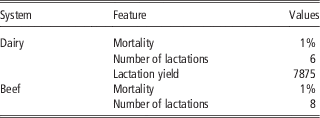
Expert surveillance and practice veterinarians used statistical and published data and expert judgement to quantify impacts on productivity, morbidity and mortality. These were translated into parameters to enhance the Cranfield Agricultural Systems-LCA model (Williams et al., Reference Williams, Audsley and Sandars2006). The systems-based nature of the model enabled these impacts to be applied as individual parameters, including increases in mortality rates, reductions in milk yield, daily liveweight gain and fecundity, and increases in feed requirements. A baseline case for healthy cattle was also established, against which the impacts of the conditions could be quantified. This still allowed for mortalities from accidents or other factors, for example, during calving as well as normal biological variability. These were developed with much veterinary input and the main features were resolved, as shown in Table 1. These represent performance that is above that of the average recorded activity data for UK cattle, as these would be expected to be affected by the 10 endemic conditions as well as others outwith this study, for example, ketosis or tuberculosis. The structure of the LCA model is such that animal production is split by system and age of animal, thus enabling the impacts of diseases to be applied to individual parts of a system or age group. For example, mastitis impacts can be applied purely to the dairy herd, whereas replacement heifers or beef calves are unaffected and can be modelled as such.
Main features of cows in the healthy cattle scenario

A set of interventions or mitigation measures was compiled by the veterinarians and the effectiveness of each measure in treating a disease was estimated. These interventions ranged from veterinary, for example, vaccination or antibiotics; management, for example, better oestrous detection or biosecurity; to engineering, for example, limestone cow tracks, improved housing ventilation or pasture drainage. These were applied in the LCA model to calculate the GHGE associated with implementing each intervention. For example, estimates were made as to the number of veterinary visits and treatments that may be required for a given condition, and quantities of raw materials such as ground limestone or sand bedding to improve conditions such as lameness and mastitis were derived. The effectiveness of each measure in treating a disease was estimated to calculate the extent of potential recovery for an infected animal or herd to be returned to the healthy baseline case.
The conditions have different impacts, which thus require different approaches. Reduced growth rate reduces intake commensurately and more time is needed to reach the same end point, so increasing the proportion of energy used for maintenance. Reduced milk yield is more complex. Although reduced (e.g. through lameness), energy demand is reduced, but after recovery, the overall lactation yield also depends on management choices. Increased mortality rates were carefully assessed and the model enhanced to allow for more time-critical specification, for example, higher calf mortality rates increase the number of calf births needed for herd replacements. These tend to occur at a lower age, rather than randomly. Thus, fewer resources are wasted and lower GHGE are incurred than if a random age at death is assumed. Reduced fertility was represented by increasing the calving interval (and increasing artificial insemination servicing in dairy cattle). This was based on a stochastic analysis of conception rates. Fighting infection through mounting an immune response demands more energy and effectively increases the maintenance demand for metabolisable energy (ME). There is a lack of evidence on the quantification of ME needs for fighting infection. Conservative estimates were thus made of the expected current levels in commercial herds and how much could be expected for each condition. It must be noted that these ME needs can be high over a relatively short time scale, but are very unlikely to affect, for example, a beef suckler cow for all her life.
Results
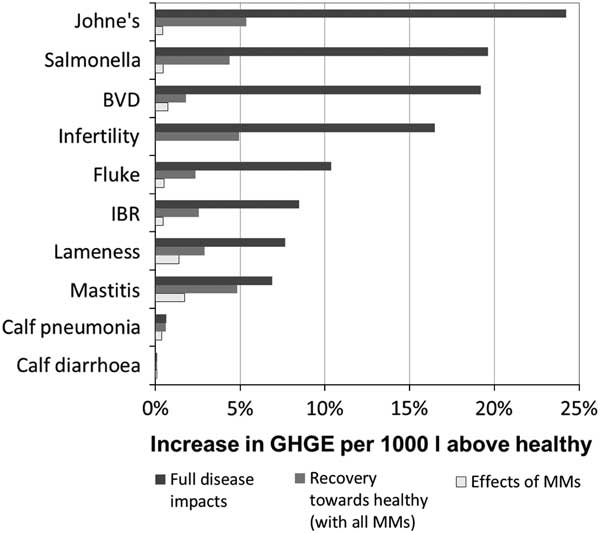
The GHGE from healthy dairy cows were 0.89 kg CO2e/kg energy and fat corrected milk. The current national herd performance is 6% higher at 0.94 kg CO2e. The overall results (ranked by impacts of each single condition) cause increase in the GHGE/unit milk of up to 24%, that is, for Johne’s disease (Figure 1). The maximum impact for Salmonella, bovine viral diarrhoea (BVD) and infertility were also high at 16% to 20%. Liver fluke, infectious bovine rhinotracheitis (IBR), lameness and mastitis have more moderate impacts in the range 7% to 10%. Calf diarrhoea and pneumonia only affect herd replacements and so have a relatively small impact on GHGE from milk production. These values are the maximum impact for a herd and do not account for prevalence rates, which would reduce the impact nationally. They do, however, indicate clearly how herds can be adversely affected by these conditions and highlights the need for interventions for both welfare and environmental reasons. Of the three highest impacting conditions, infertility is probably most affected by normal management factors, for example, identifying oestrous in early lactation.
Results for dairy showing percentage increase in GHGE/1000 l milk above a healthy baseline. GHGE=greenhouse gas emissions.

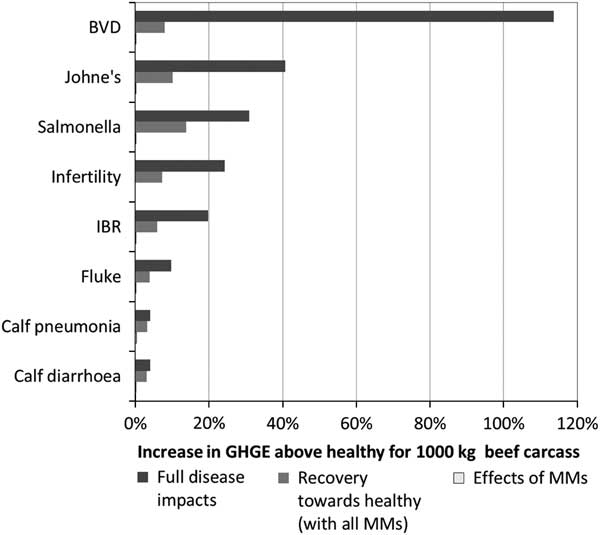
For suckler beef, the GHGE for 1000 kg beef carcass from a healthy herd was estimated to be 17.1 tonnes of CO2e. The current national herd performance is 6.6% higher at 18.2 tonnes CO2e. The overall results (ranked by impacts of each single condition) cause increases in the GHGE/unit beef carcass of up to 113% for BVD (Figure 2). This is followed by Johne’s (at 40%), salmonella, infertility and IBR (at 20% above healthy). Again, these are the maximum farm-level impacts and do not include between-herd prevalence. As with milk, the combined interventions obtained substantial benefits for most conditions. The effectiveness was varied and, for most, reduced the impacts by about 70% of the increase above healthy. Dairy beef results were significantly lower as the breeding phase is accounted for in milk production. BVD remained the worst condition, increasing GHGE by 14% of the healthy baseline for dairy beef production.
Results of the maximum effects of conditions on greenhouse gas emissions from suckler beef production together with the maximum recovery from interventions and the impacts of those interventions themselves.

Discussion
The combined interventions clearly produced substantial benefits for top eight conditions and reduced the increase in GHGE caused by the conditions in the range 2% to 5%. Apart from the two low-impacting calf conditions, mastitis is the most difficult to treat effectively and BVD is the least. This does not address economic cost, only the technical feasibility of veterinary, managerial and engineering interventions.
The sensitivity of individual disease impacts on GHG emissions per functional unit were tested by varying the value of one selected parameter in turn by ±10%. For dairy, GHGE/unit milk increased by varying amounts from 0.02% (cow mortality) to 6.2% (extending the calving interval). For beef, the effect of increasing ME requirement for both suckler cows and calves have the most substantial effects on GHGE.
A subset of mitigation measures were investigated for sensitivity of response. The results ranged from a 0.1% increase in GHGE for veterinary visits to 0.45% for more daily sand use in cow cubicles to reduce the incidence of mastitis. Increasing building replacement rate fell between these measures at 0.13%. Although the environmental investment in a new building is large per se, the lifespan is relatively long, at an assumed 25 years, so that the impacts per animal are relatively small.
The systems-based LCA model relies on the disease impact data and expert judgement on the extent to which treatments temper this. In order to provide these estimates, the concept of a healthy animal was used as a reference point and the veterinary experts in the team populated the parameters for each state – healthy, diseased and treated. These data are necessarily informed estimates and do not reflect the considerable variability that would be seen in each of these states on farms. The ambition was to provide a reasonable central estimate, which can be modelled to provide high-level analysis of GHGE between conditions.
Although previous research has indicated that lameness and mastitis are among the most economically significant endemic cattle diseases, notably in the UK dairy herd, limited GHGE abatement is offered from the controls considered in this study. This owes much to the modest change in productivity parameters that drive GHGE, notably mortality and yield; there is a reasonable degree of additional uptake of controls for these conditions (around 10%).
The key opportunities in terms of GHGE abatement available appears to be with IBR, liver fluke and Johne’s disease. These rely on levels of uptake of the controls combined with moderate to high disease impacts on GHGE, whereas BVD, salmonella, infertility and some mastitis controls offer moderate abatement levels combined with moderate to high levels of control uptake.
Conclusion
The use of systems-based LCA allowed the effect of individual disease impacts to be quantified and presents scope for application to further diseases (and species). There is further scope to extend the model to consider the interactions between conditions and also between intervention, which would require significant veterinary input and investigation. The findings show the added value in improving cattle health in terms of both productivity and reducing GHGE. The potential to improve animal health and welfare is considerable and is a good example of sustainably increasing production.
Acknowledgement
Further information
The LiveM International Livestock Modelling and Research Colloquium was hosted by the Basque Centre for Climate Change (BC3) at the Maritime Museum in Bilbao, Spain between 14 and 16 October 2014. LiveM is the livestock and grassland modelling theme of the EU knowledge hub Modelling European Agriculture with Climate Change for Food Security (MACSUR). The MACSUR project is a pilot knowledge hub started by FACCE-JPI in 2012. It provides an opportunity to explore the role and potential of multi-disciplinary networking structures to address complex regional and global issues. More information on MACSUR and the LiveM theme can be found at www.macsur.eu, with PDFs of slides from conference presentations available through the conference website (http://www.livem2014bilbao.com/).