



1. Introduction
To date, the all-sky infrared (IR) survey performed by the WISE space telescope is the main source for detecting new dusty nebulae. IR circumstellar nebulae, in combination with the blue colour of the central star, are widely used to identify evolved massive stars, including merger products (for details see Gvaramadze et al. Reference Gvaramadze, Kniazev and Fabrika2010; Gvaramadze & Kniazev Reference Gvaramadze and Kniazev2017; Gvaramadze et al. Reference Gvaramadze, Gräfener and Langer2019).
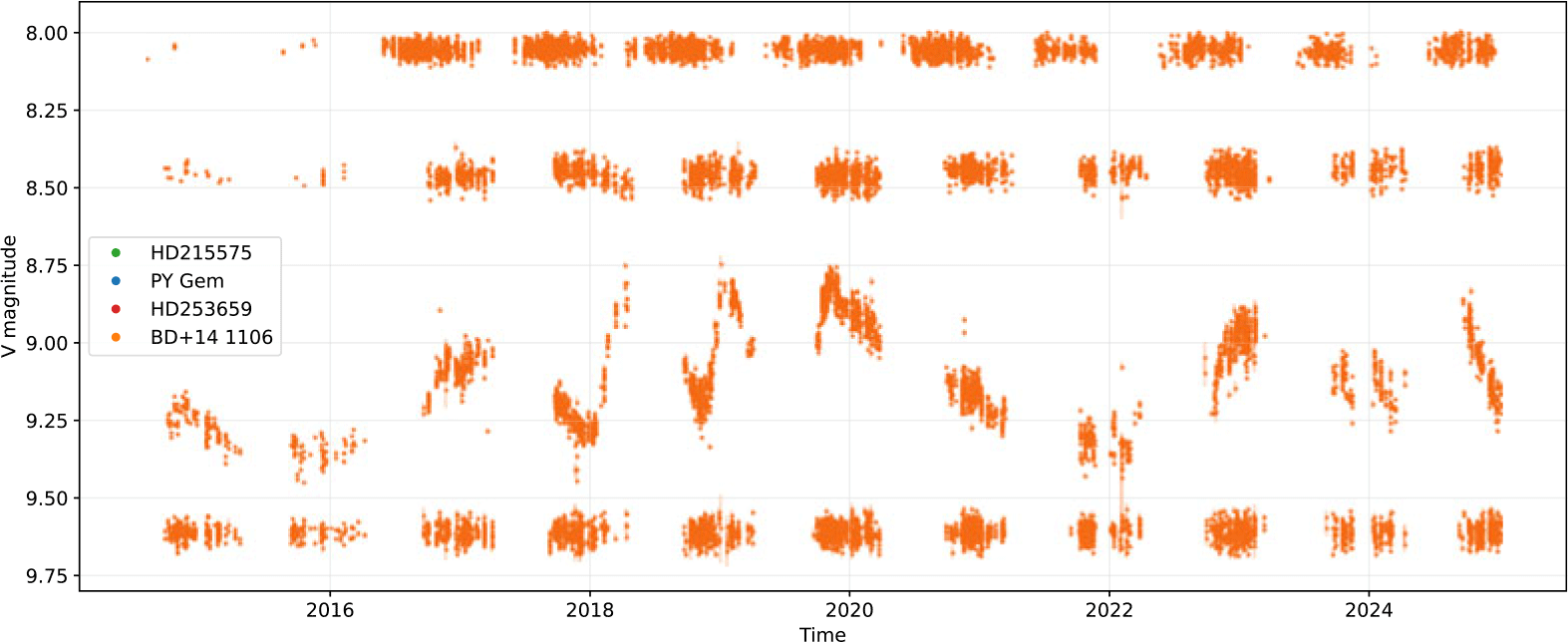
In this work, we consider four stars with newly detected circumstellar nebulae. Table 1 lists the parameters of the stars and their spectral classification taken from the literature, while Fig. 1 presents their light curves. Two of our objects – PY Gem and HD 253659 – are classical Be stars showing double-peaked emission profiles of H
 $\alpha$
and eruptive photometric activity (
 $\gamma$
Cas variables). The bump in HD 253659 light curve between 2016 and 2022 may be interpreted as a major outburst. The spectrum of HD 215575 corresponds to B1 I type but the apparent magnitude does not match the expected luminosity of a supergiant. Therefore we suggest that HD 215575 is a case of spectral mimicry, being a runaway low-mass post-AGB star with a spectral mimicry to a B1 supergiant. The TESS light curve of BD
 $+$
14 1106 displays a regular short period, which can be interpreted as intrinsic pulsations typical of
 $\beta$
Cephei (BCEP) stars. But in addition, it contains a periodicity which may be the evidence of binarity. This binarity might also explain the origin and bipolar shape of its nebula.
Stars studied in this work. Dist is the distance to the objects according to Bailer-Jones et al. (Reference Bailer-Jones, Rybizki, Fouesneau, Demleitner and Andrae2021),
 $\mu$
is the proper motions from Gaia Collaboration et al. (2021).

Table 1 Long description
A table listing parameters of four stars with circumstellar nebulae. The table has six columns: Star, Sp. type, Var. type, Dist, μ, RUWE, V, and Size. The rows are as follows: Row 1: Star, PY Gem; Sp. type, B1 Vnue; Var. type, γ Cas; Dist, 1401+48/-90 pc; μ, 1.301 mas yr⁻¹; RUWE, 0.977; V, 8.46 mag; Size, 1.83 pc. Row 2: Star, BD+14 1106; Sp. type, B2 Vb; Var. type, –; Dist, 1693+93/-83 pc; μ, 2.710 mas yr⁻¹; RUWE, 1.018; V, 9.62 mag; Size, 1.23 pc. Row 3: Star, HD 215575; Sp. type, B8; Var. type, –; Dist, 754 ± 10 pc; μ, 29.919 mas yr⁻¹; RUWE, 0.906; V, 8.05 mag; Size, 1.5 pc. Row 4: Star, HD 253659; Sp. type, B0.5 Vnne; Var. type, γ Cas; Dist, 1698+66/-58 pc; μ, 1.002 mas yr⁻¹; RUWE, 1.106; V, 9.16 mag; Size, 1.48 pc.
Light curves of the studied stars from the Mini-MegaTORTORA (Beskin et al. Reference Beskin, Karpov and Biryukov2017) archive (http://survey.favor2.info/).

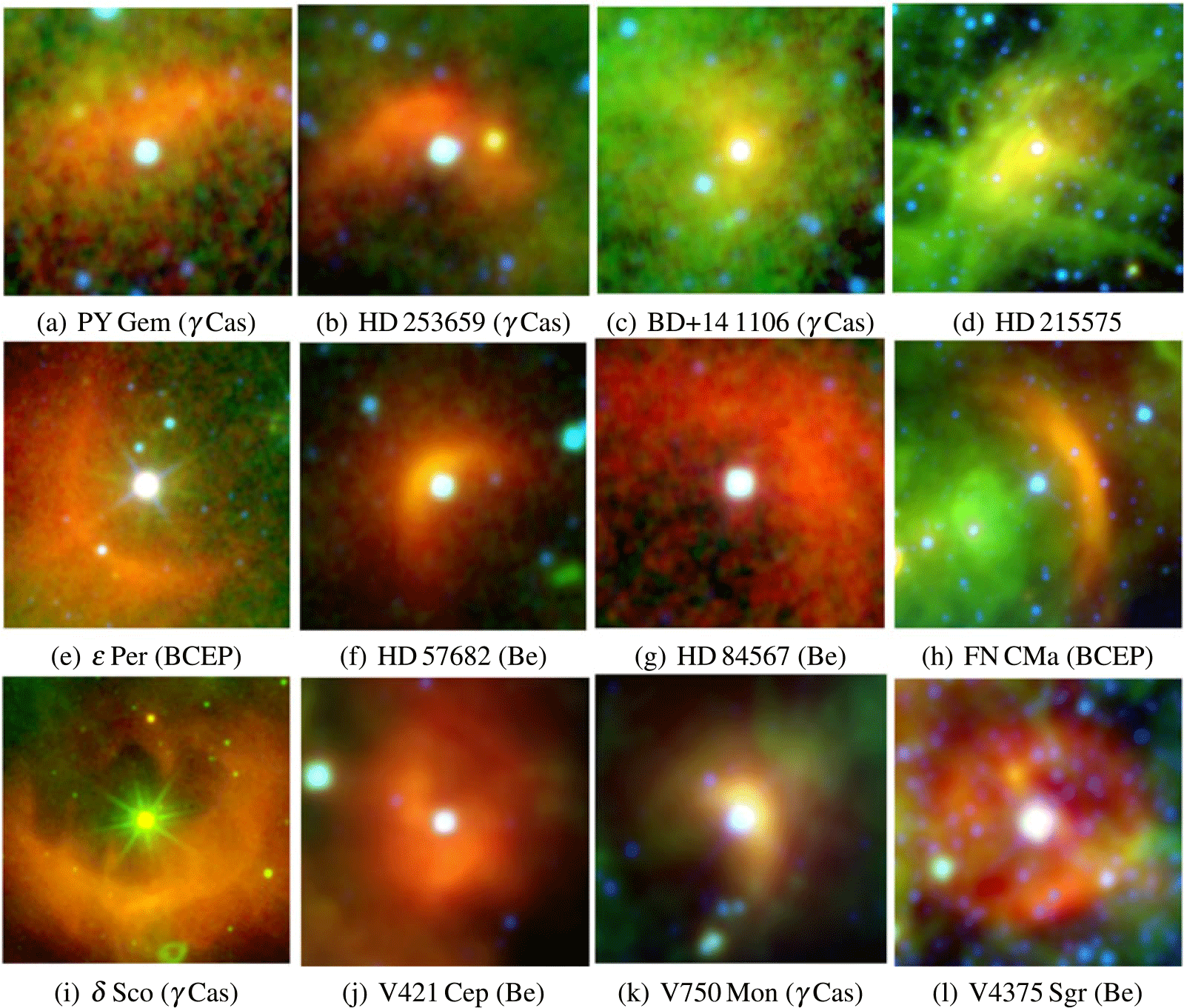
These newly discovered nebulae (upper panel of Fig. 2) motivated us to conduct a review of known galactic Be stars,
 $\gamma$
Cas variables (i.e. eruptive Be) and BCEPs. We analysed WISE IR images of 1438 Be stars, 631
 $\gamma$
Cas variables and 1405 BCEPs. As a result, we found 52/44/37 circumstellar nebulae around Be stars,
 $\gamma$
Cas variables, BCEPs respectively, and 46/27/22 of them were detected for the first time. The full list of stars with detected circumstellar nebulae, including their images, is available at https://stel.asu.cas.cz/ maryeva/Nebulae/.
Examples of RGB images with WISE 22-
 $\mu$
m (red channel), WISE 12-
 $\mu$
m (green channel), WISE 4.6-
 $\mu$
m (blue channel) bands showing structures the discovered nebulae.

A statistical analysis of the nebulae around Be and
 $\gamma$
Cas variables shows that the nebulae are characteristic for them, although mostly visible for brighter stars only. The stars with and without nebulae share the same location in the HR diagram, close to the main sequence. The fraction of binary stars among stars with nebulae is the same as in the general Be star population. We compared the multiplicity according the Gaia and Hipparcos in the Be samples with and without nebulae, and found in both the same fraction of
 $21\%\pm7.5$
, which is in good agreement with the multiplicity of Be stars (Dodd et al. Reference Dodd, Oudmaijer, Radley, Vioque and Frost2024; Guerrero et al. Reference Guerrero, Souza, Borges Fernandes and Guajardo Jurado2025). Thus, the nebulae are probably inherent to the Be phenomenon and caused by the interplay between their rapid rotation and pulsations.
The photometry is taken from the Gaia DR3 Synthetic Photometry catalogue (Gaia Collaboration et al. 2023), except for BD
 $+$
14 1106 where the photometry is from APASS DR10 (Henden et al. Reference Henden, Levine and Terrell2018). Variability type is according to AAVSO Variable Stars Index (Watson et al. Reference Watson, Henden and Price2006). Spectral types are from:
 $^{a}$
Guetter (Reference Guetter1968),
 $^b$
Ramírez-Preciado et al.Ramírez-Preciado, Roman-Lopes, Román-Zú (2020),
 $^c$
Cannon & Pickering (Reference Cannon and Pickering1993),
 $^{d}$
Morgan et al. (Reference Morgan, Code and Whitford1955).
Acknowledgements
We acknowledge support from the Czech Science Foundation GAČR 25-17532S. The Astronomical Institute in Ondřejov is supported by the project RVO:67985815. S.K. acknowledges support by the European Union and the Czech Ministry of Education, Youth and Sports (Project No. CZ.02.01.01/00/22_008/0004632 – FORTE). This project is co-funded by the European Union (Project 101183150 - OCEANS).

 μ
 μ
 μ
 μ


