Beach strandings of marine megafauna have been recorded since antiquity, although the reasons for this behaviour remain largely a mystery (but see Bradshaw et al., Reference Bradshaw, Evans and Hindell2005; Evans et al., Reference Evans, Thresher, Warneke, Bradshaw, Pook, Thiele and Hindell2005). Most recorded strandings are of cetaceans, with large events sometimes including hundreds of individuals (e.g. pilot whales Globicephala melaena (Traill, Geraci & Staubin, Reference Geraci and Staubin1977); sperm whales Megaptera novaeangliae (Borowski, Evans et al., Reference Evans, Morrice and Hindell2002); pygmy killer whales Feresa attenuata (Gray, Mignucci-Giannoni et al., Reference Mignucci-Giannoni, Toyos-Gonzalez, Perez-Padilla, Rodriguez-Lopez and Overing2000); and several species of beaked whales—(Santos et al., Reference Santos, Martin, Arbelo, Fernandez and Pierce2007)). In contrast, strandings of sharks occur infrequently, and usually comprise single individuals. Worldwide reports of shark strandings include white sharks (Carcharodon carcharias Linnaeus) (Martin, Reference Martin2004), salmon sharks (Lamna ditropis Hubbs & Follett) (Compagno, Reference Compagno2001), basking sharks (Cetorhinus maximus Gunnerus) (Whitley, Reference Whitley1940), megamouth sharks (Megachasma pelagios Taylor, Compagno & Struhsaker) (Berra & Hutchins, Reference Berra and Hutchins1990) and whale sharks (Rhincodon typus Smith) (Beckley et al., Reference Beckley, Cliff, Smale and Compagno1997).
Beach strandings of both basking and megamouth sharks have been recorded in Australia. In 1930, a 7.6 m basking shark died after stranding at Mungo Beach, New South Wales (NSW) (32°32′28″S 152°27′17″E) apparently after chasing a school of salmon (Arripis sp.) into shallow water, where it was washed ashore by heavy surf (Whitley, Reference Whitley1940). This explanation seems unlikely because basking sharks are not known to pursue fish actively, although they may become stranded when feeding on the surface in rough sea conditions (D. Sims, Marine Biological Association of the UK, personal communication). A stranded 5.2 m male megamouth shark was found at Mandurah, Western Australia (32°30′S 115°43′E) in 1988 (Berra & Hutchins, Reference Berra and Hutchins1990). This animal provides the only record of this species in Australia.
Like strandings of basking and megamouth sharks, there have been relatively few confirmed strandings of whale sharks in Australia. Only two specimens of whale sharks from Australia exist in museum collections: the remains (skin and teeth parts) of two beach-stranded specimens (AMS IB.7100; AMS IB.7314) from NSW, in the Australian Museum, Sydney.
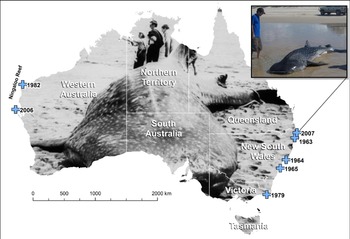
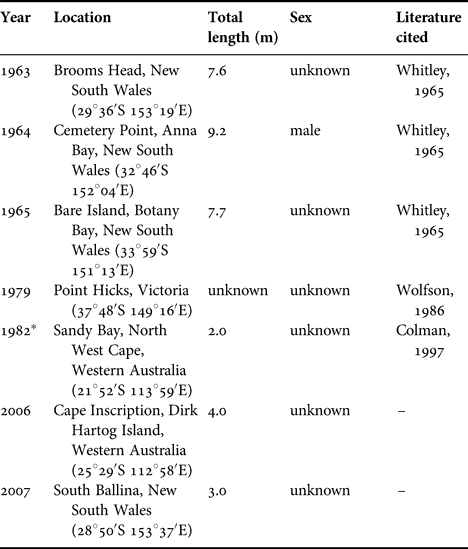
Whitley (Reference Whitley1965) reported three whale shark strandings in NSW during the 1960s: the first was at Brooms Head in 1963; the second near Cemetery Point, Anna Bay in 1964; and the third at Bare Island, Botany Bay occurred in 1965 (Table 1; Figure 1). One other whale shark stranding (beaching) also occurred at Point Hicks in Victoria in 1979 (Wolfson, Reference Wolfson and Uyeno1986), and there is an unconfirmed whale shark stranding of a 2 m juvenile at Sandy Bay, North West Cape, Western Australia in 1982 (Colman, Reference Colman1997) (Table 1; Figure 1).
Locations of whale shark strandings in Australia 1963–2007 (see also Table 1). Background photograph: whale shark stranded at Bare Island, Botany Bay, New South Wales in 1965 (photograph© Australian Museum). Inset upper right: juvenile whale shark stranded at Ballina, New South Wales in 2007 (photograph© L. Ferris).


Here we report the most recent confirmed strandings of whale sharks in Australia, both of which have occurred within the past two years. On 11 March 2006, an approximately 4 m juvenile whale shark stranded near Shark Bay, Western Australia. To our knowledge, this is the first confirmed reported stranding of a whale shark on the west coast of Australia. This individual was found alive and was returned to sea by local fishers. The carcass of the same individual was found the following day washed up on a beach at Cape Inscription on Dirk Hartog Island (Table 1; Figure 1) in an area exposed to high wave action. The second and most recent whale shark stranding occurred on 25 April 2007, when a 3 m juvenile stranded inside a sandbar at a beach in South Ballina, northern New South Wales on a rising tide (Table 1; Figure 1). Four attempts were made to assist the animal in returning to sea over three hours, before it swam off to deep water. The animal was not seen again and its fate is unknown; however, it appeared stressed and weakened at the time of release. A remora remained attached to its host throughout the stranding.
There was no obvious reason for these strandings of whale sharks. No recent scarring was evident on either animal suggesting that the strandings were not caused by predator attack, collision with a vessel or fishing gear entanglement (Gudger, Reference Gudger1940; Fitzpatrick et al., Reference Fitzpatrick, Meekan and Richards2006; Speed et al., Reference Speed, Meekan, Rowat, Pierce, Marshall and Bradshaw2008).
In contrast to Australia, strandings of whale sharks occur relatively frequently on the coast of South Africa, where 36 (mostly immature) shark strandings were reported between 1984 and 1995 (Beckley et al., Reference Beckley, Cliff, Smale and Compagno1997). That study posed two hypotheses to explain beach strandings in South Africa: (1) sudden changes in water temperature that reduce metabolic rate; and/or (2) the combination of heavy wave action and a steeply sloping continental shelf that push sharks ashore (Beckley et al., Reference Beckley, Cliff, Smale and Compagno1997).
Whale sharks generally occur in warm temperate and tropical seas that range between 21 and 25°C (Last & Stevens, Reference Last and Stevens1994). Despite their selection of warmer water, they have been found as far as 44°N in the Bay of Fundy on the eastern coast of North America in waters as cold as 10°C (Turnbull & Randell, Reference Turnbull and Randell2006). Similarly, satellite tracking studies confirm that whale sharks are capable of tolerating temperatures <10°C (Rowat & Gore, Reference Rowat and Gore2006; Wilson et al., Reference Wilson, Polovina, Stewart and Meekan2006; Hsu et al., Reference Hsu, Joung, Liao and Liu2007), at least during deep dives.
Given this apparently large thermal tolerance, it seems unlikely that the strandings on the Australian coast were caused by an abrupt change in water temperature because mean sea surface temperatures (SST) for Point Inscription in March and Ballina in April are approximately 25°C (Australian Government Department of Defence, 2007). Furthermore, no anomalies in SST were observed around either of the stranding sites during, or leading up to the events. There are no sharp declines in bathymetry close to shore of the stranding sites (Australian Government Department of Defence, 2007), indicating that these sharks would not have been able to make deep dives to cooler water immediately prior to stranding. No autopsy information was available from the dead individual, so other causes such as disease or the ingestion of flotsam cannot be excluded. The rare occurrence of whale shark strandings on Australian coasts suggests that these events require an unusual combination of factors that are thus not likely to be a major threat to this species.
ACKNOWLEDGEMENTS
We acknowledge the support of the Western Australian Department of Environment and Conservation (WA-DEC), the Australian Commonwealth Department of Environment and Water Resources (DEW) and SeaWorld. We especially thank T. Berra (Ohio State University), L. Ferris (Australian Seabird Rescue), A. Graham (CSIRO Marine Research), M. McGrouther (Australian Museum), D. Sims (Marine Biological Association of the United Kingdom), and E. Wilson (WA-DEC), for providing photographs or other information.