INTRODUCTION
Cable telegraph was introduced into China in the mid-nineteenth century. The technology detached, for the first time, the transmission of information from the physical movement of people, animals, and objects, allowing information to travel at an enormous speed. It strengthened and complicated China's connections with the outside world, and it both integrated and destabilized the Qing Empire.Footnote 1 As with most technologies, the development of cable telegraph was driven by business interests. But given its vital significance to national security, economic prosperity, and the dissemination of news, telegraph connection was never a purely commercial matter. Questions over the location of cable lines and poles, and the operation of terminal stations, involved a multilayered process of negotiations, replete with political and cultural tensions.
The development of China's telegraph networks during the late nineteenth and early twentieth centuries was tightly locked into the rivalries of powerful countries over global communication resources. Three foreign submarine cable companies—the Great Northern Telegraph Company, the Eastern Extension Company, and the Commercial Pacific Company—were key agencies involved in Chinese cable telegraph connections internally and overseas. Although they appeared to be independent, the companies were in essence what Daniel R. Headrick and Pascal Griset called “hybrid creatures,” legally private yet intimately tied to their home governments or imperial patrons.Footnote 2 By the same token, the Chinese counterpart, the telegraph bureau, also embodied dual identities, serving as both government institution and commercial enterprise. Interactions between the three companies and China's telegraph bureau were bound by contracts equivalent to de facto treaties, with disputes often becoming diplomatic issues.Footnote 3
China's quest for cable rights deserves scholarly attention. It is not only indicative of how a foreign-introduced technology transformed Chinese politics and society but also sheds light on the process of nation-building in China from the mid-nineteenth century. Among the many seminal studies, Jorma Ahvenainen's monograph has provided a detailed analysis of Western powers’ telegraph interests in China,Footnote 4 while Erik Baark has challenged the notion of technological determinism, demonstrating the vital importance of tensions among various interest groups in shaping the transfer of cable technology to China during the late Qing period.Footnote 5 Yongming Zhou has compared the introduction of telegraph with that of the Internet, arguing that new information technologies do not necessarily bring about public participation in politics. He believes that cultural and political context determines the transformative importance of a technology in society.Footnote 6
Most of the existing literature on cable telegraph focuses on the late Qing period. Developments during the Republican era have long escaped scholarly attention. It remains unclear how China managed its cable networks during a period of political turbulence and war. And yet, without a detailed study on information infrastructure, it is hard to explain why China lacked international presence during the Sino-Japanese crisis;Footnote 7 why Reuters withdrew from the Chinese domestic news market in the mid-1930s;Footnote 8 and how domestic and international interest groups behind the new wireless telegraph technology competed against the cable telegraph providers and thus reshaped the power balance in China's telegraph industry. The journey from the late Qing, when China's out-going cable rights were in the hands of foreign companies, to the end of World War II, when China obtained control over key superintendent offices of its submarine cables, was not a linear path. The process shows how a weak nation managed to maneuver through conflicts with powerful countries and successfully defend its information sovereignty.
This article seeks to fill the lacuna by examining China's interactions and rivalries with the three foreign cable companies from the establishment of the Republic of China to the end of World War II. While most scholars tend to approach rights and sovereignty issues through the lens of diplomatic history, this article avoids the dichotomy of “Chinese” and “Western” actors, which eschews the assumption that there was a unified imperialist entity in opposition to an equally unified nationalist China.Footnote 9 Instead, my analysis seeks to explore the intricate power relations between the foreign cable companies, international interest groups, and various political factions in China. By doing so, I also challenge the dichotomy of international and domestic Chinese history. Many ostensibly international affairs were extensions of domestic tensions and vice versa, as William Kirby has cogently argued.Footnote 10 Locating the international cable dispute in the context of Chinese political culture and daily political pragmatism reveals that Chinese nation-building was a highly cosmopolitan process. Modern Chinese states arose not just as central governments enforced bureaucratic hierarchies throughout clearly defined boundaries, but also as an evolving patchwork of ideals, contingencies, settlements shaped by domestic and international conflict, as well as self-interest.
Moreover, historians have tended to consider the rights recovery issue through the perspective of Chinese nationalism. This article argues that ideologies including imperialism and nationalism provided the rhetoric for diverse interest groups to advance their own agendas. It was the daily political tensions that played a crucial role in shaping how cable policies were devised. The lack of a centralized authority during the Republican period created opportunities for political factions to steer the development of cable telegraph for their own benefit. The complex circuit of power involving multiple factions and interest groups, together with a volatile political environment, undermined the ability of the foreign cable companies to maintain their business. To a degree, the Nationalist government managed to reclaim its cable rights not because of a unified central authority, but the lack of it.Footnote 11
This study analyzes the development of cable telegraph in three phases, each characterized by a particular controversy—the intra-clique struggle during the early Republic and the warlord era; the rivalry between the Nationalist Party, military, and state during the Nanjing decade; and the direct Sino-Japanese conflict during wartime. This article also explores the reaction of successive regimes to wireless telegraph, and how interest groups of the Nationalist government used the new technology to increase its leverage in reclaiming cable sovereignty.
CABLE RIGHTS DURING THE LATE QING PERIOD
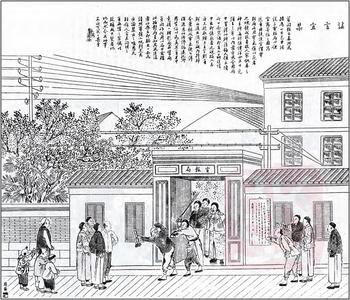
When telegraph was first introduced to China in the 1860s, common Chinese people viewed the technology with deep suspicion. An image published in the Dianshizhai Pictorial vividly captured the sense of distrust and misunderstanding: a villager was driven out of the local telegraph office after trying to sell his relative's memorial tablet. Rumors had circulated that telegraphs were sent through ghosts extracted out of the tablets of the newly dead. The villager therefore sought to earn a fortune by selling one to the telegraph bureau (See Figure 1) The image hardly exaggerated people's ignorance about this new technology. Indeed, telegraph lines were perceived as disturbance to the harmony and energies of local graveyards, fields, and landscape—the geomantic principles of fengshui. Local officials seeking to deter foreigners from installing telegraph lines illegally often invoked such popular fears.Footnote 12
“Rumors should be prohibited,” from Dianshizhai Pictorial.

From the early 1860s, foreign powers, particularly the Russians, had repeatedly requested that the central government and local authorities grant foreign companies the rights to build telegraph lines in China. Having just survived the Taiping uprising, however, the Qing court took a conservative view of the new technology, concerned about losing control over confidential military and political information.Footnote 13 Social resistance and negative official attitudes nevertheless did not stop the foreign attempts to include China in the international telegraph network. Instead, foreign companies started to avoid the state, and pushed for telegraph connections through covert operations and pressure. They installed cables secretly, then mobilized all available diplomatic resources to gain Chinese approval. In 1871, for example, the Great Northern Telegraph Company extended its line from Wusong harbor to Shanghai without obtaining permission from Chinese officials. Two years later, the company changed the underwater line to a landline, despite the agreement signed in 1870 (known as Thomas Wade's Concession) that any submarine cable should keep its terminal points in vessels off shore.Footnote 14 Similarly, the Great Northern attempted to move its submarine lines onshore in Xiamen (Amoy).
The Qing government found it difficult to lodge protests against these illegal lines through diplomatic channels. Established in 1869 and registered in Denmark, the Great Northern Telegraph Company was essentially controlled by British interest groups, who were its largest shareholders. Yet one could hardly consider it a British firm, as it was represented by Russian diplomats in Beijing. The close relationship between the Danish and Russian courts, particularly the marriage of Dagmar, daughter of the Danish King Christian IX, to the Russian crown prince, subsequently Alexander III, was a crucial factor in this.Footnote 15 With the endorsement of the Russian government, the Great Northern Company built a line across Russia to connect Europe to East Asia and the United States. The company's multi-national affiliations caused great trouble for Chinese officials, who sought to demolish illegal lines through diplomatic means. While the British Consul referred Chinese complaints to the Danish Consul to adjudicate, the Danish Consul claimed such decisions could only be made through discussion between the Zongli Yamen and the Russian minister in Beijing.Footnote 16 Indeed, the entangled relations behind the ownership and operations of cables provided foreign consuls the pretext to postpone any concrete action. The delays usually led to the Qing government dropping plans to demolish illegal lines because of their practical benefit to China's telegraph communications.
The Qing government was cautious about protecting its telegraph sovereignty on land, but had not developed a sense of maritime sovereignty. Extraterritoriality at the treaty ports further deterred the government from controlling landing stations of foreign submarine cables. By the end of the Qing dynasty, three foreign companies largely monopolized China's cable communications with the outside world: Great Northern Telegraph, the British-owned Eastern Extension Telegraph, and Commercial Pacific Cable, an American enterprise with a large proportion of its shares owned by the British. Substantial influence of British interest groups over all of the three companies eased tensions among them and facilitated the creation of a cartel system, with each company having its own sphere of influence. The Great Northern controlled cables connecting Vladivostok, Nagasaki, Shanghai, Amoy, and Hong Kong. It also operated cables in northern European waters and owned land telegraphs across Russia and Siberia, which connected its Eastern and Western cable systems. The Eastern Extension operated a cable system from Hong Kong to Singapore, where further connection with Europe was established. The company also owned the cable from Hong Kong to Fuzhou and Shanghai. The Commercial Pacific had a cable that linked Shanghai to San Francisco via Manila, Midway, and Honolulu.Footnote 17 Bound by various contracts with the foreign companies, the Qing government lost the right to build its own cable lines that might compete with existing foreign-operated ones. Nor did it claim the right to set the rate of international cable communications and its share of dividends.
CABLE RIGHTS AND INTRA-FACTIONAL STRUGGLES UNDER THE BEIYANG GOVERNMENT
The fall of the Qing Empire left a power vacuum, which attracted various political and military groups to compete for domination in the newly established Beiyang Government (1912–1928). Under the circumstances, the Communications Clique (Jiaotong xi 交通系) thrived. It had deep influence over the operations of railways, postal, shipping, telecommunication, and banking systems. The transition of power within the clique, and tensions between central and peripheral groups, strongly affected the government's relationship with the foreign cable companies. The change of authorities in the central government constantly reshuffled the power structure of the clique by breaking existing ties while creating new ones. Conflicts between the old and new leaders, and infiltration from warlords, encouraged members of the clique to trade long-term telegraphic development plans for short-term political security and financial gains.
The origin of the Communications Clique dated back to the late Qing, when Sheng Xuanhuai 盛宣懷 managed to consolidate railways, shipping, telegraph, and postal services under his own control. He cultivated personal networks based on native-place connections and patron–client relationships. Tang Shaoyi 唐紹儀 and Liang Shiyi 梁士詒 were his successful protégés.Footnote 18 Tang and Liang replaced Sheng to lead the new Ministry of Communications after Yuan Shikai 袁世凱 gained control of the government. They quickly installed their own men—politicians, technocrats, bureaucrats, and engineers—in important positions of the ministry and formulated a political group that practically controlled the financial lifeline of the Beiyang Government.Footnote 19
The Communications Clique was susceptible to political changes at the top. Tang and Liang might not have anticipated that their avenue to power—loyalty to Yuan—would eventually become their downfall. Liang had been heavily involved in Yuan's plan to revive the monarchy. When the plan failed, in 1916, Liang became a national criminal wanted by the new regime led by Li Yuanhong 黎元洪. In order to hold the clique together, Ye Gongchuo 葉恭綽, Liang's direct associate, invited Cao Rulin 曹汝霖, an official close to the then-powerful Anhui military clique, to lead the ministry. Cao was not satisfied with merely housekeeping for Ye, but was keen to establish his own power in the ministry. He demoted many of the veteran Communications Clique members and installed his own associates to head key bureaus and departments. Zeng Yujuan 曾毓雋, an important Anfu club member, for example, was promoted as vice minister to balance Ye's power.Footnote 20 Having perceived Cao Rulin's intentions, Ye used his connections with the press to undermine Cao's reputation. Yet he was unable to check Cao's expansion of his personal network in the ministry. By the end of 1918, Ye was forced to resign from the ministry, which marked the victory of the new Communications Clique.Footnote 21 Although Cao's political career was cut short by the May Fourth Movement, and Ye returned to the leadership of the ministry in 1920, he was unable to revive the prestige of the old Communications Clique. The unique combination of personnel and power mechanisms could not be completely reconstructed once the leadership waned.Footnote 22
The change of leadership in the clique weakened the connections between different sectors of the ministry. In a volatile political environment, members of the clique developed the habit of looking after immediate gains rather than establishing long-term loyalty. Cleavages between the central and the peripheral sectors of the clique widened. Tensions between interest groups affiliated with telecommunication services also undermined consensus in negotiations of cable rights with foreign companies.
Railways and banking sections dominated the agenda of the Ministry of Communications. In contrast, telegraph administration was a marginal office, because of the limited revenue it generated. Bound by contracts with foreign companies, Chinese authorities only received a small percentage of the telegraph tariff (13.5 percent for outgoing cables). But the cable's long-term political and military significance far exceeded its commercial value—it was crucial to the military security and political stability of various warlord regimes. This made the sector attractive to foreign investors. For decades, telecommunications had been sources of foreign loans to balance the loss of other sectors of the clique. In 1911, the Ministry of Communications of the Qing government signed a deal with the Great Northern, Eastern Extension, and Commercial Pacific to borrow £500,000, mortgaged on China's telegraph revenue by 1930. While the loan was supposed to improve national telegraph facilities,Footnote 23 only £50,000 was allocated to the telecommunications administration.Footnote 24 The remainder was used by officials in charge of the railways to offset their losses, or was moved to local communication banks for sub-loans. As a marginalized sector of the clique, the development of the telegraph network was not a top concern. The lack of infrastructure investment led to limited telegraphic earnings. Debts accrued quickly on the part of the telecommunication administrations. Meanwhile, warlords in control of local finances refused to remit telegraph revenues to the Beiyang government, which further reduced the solvency of the central telegraph office.
The three foreign companies used China's debts as leverage to extend their cable privileges. Knowing well that the Chinese telegraph administration was unable to make timely repayments, the companies sought to negotiate with the Beiyang government in 1926 to extend their cable privileges beyond 1930, when most of their contracts would expire. Possibly in response to bribery, Jiang Zunhui 蔣尊褘, the head of telecommunication department (dianzheng si 電政司), favored their requests. Yet whistle blowers in the department leaked the three companies’ plan to newspapers in Beijing and Tianjin, disclosing Jiang's deal to then Minister of Communications, Ye Gongchuo.
The relationship between Jiang and Ye was delicate. Jiang had entered the ministry as a member of the old Communications Clique.Footnote 25 Yet his loyalty was subject to pragmatic calculations of interests. He did not confront Cao on behalf of his old supervisor Ye, when the two competed for leadership of the clique. In fact, he survived the reorganization unscathed. He somehow managed to win Cao's trust, and led the telecommunication department without much interruption.Footnote 26 After Ye regained leadership of the Ministry of Communications, however, he did not purge disloyal clique members, such as Jiang, nor did he have any interest in protecting them. Indeed, Ye needed the support of the department heads to hold the ministry together in a volatile time. He also understood that pragmatism was the norm in clique politics, and the lines between personal, clique, and national interests were murky. For Ye, terminating the foreign monopoly of cables would increase revenues of the ministry, which was on the verge of bankruptcy. Without any intention to protect Jiang, Ye quietly denied the three companies’ request for negotiations, which left Jiang's deal without official support.Footnote 27
Ye's decision also stemmed from the lack of consensus among different levels of the clique. Because of the large scale and multi-hierarchical structure of the clique, the link between the central members and the periphery was loose. Leaders of the lower segments had their own agenda and constituencies to serve, which often resulted in the betrayal of the interests of the central members with whom they were not directly connected. Through an investigation, Jiang found that Guo Shiheng 郭世鑅 and Yu Zezhao 余則照, staff in the accounting office of his department, strongly opposed his plan. As lower-ranking members of the clique, they wished to end the foreign contracts, so that the staff in the telegraph administration would not have to deal with both Chinese and foreign supervisors at the same time. In revenge, Jiang sent Yu to inspect telecommunication construction in Hunan, in the hope that he would be trapped in a region where local warlord Zhao Hengti 趙恆惕 was in open defiance of the Beijing authorities. He also withheld funding for salaries of the lower-level staff of the telecommunication offices, and advised them to ask Guo and Yu for payment.Footnote 28
The three companies did not give up their plan for extending the cable rights. They initiated a new round of negotiations in 1927. By then, the Nationalist Northern Expedition troops had already conquered the Yangtze area and planned to go north. The three companies sought to reach a favorable deal with the faltering Beiyang regime before the Nationalists took control of the country. They secretly promised handsome rewards (said to be 200,000 yuan) to key officials who could help seal the deal.Footnote 29 The Communications Clique was then attached to the Fengtian warlords, with the head of the Fengtian military police Chang Yinhuai 常蔭槐 serving as the Minister of Communications. Jiang Zunhui, therefore, sought an alliance with Jiang Bin 蔣斌, a key figure in the Fengtian telecommunication system, and Chang's close associate Wang Xinzhang 王新章, hoping to exert pressure on other telegraph bureaus to approve the extension.Footnote 30
Upon learning of Jiang's plan, Guo Shiheng was frustrated with the lack of resources to sabotage the plan. His long-term connections with the bottom-level telegraph workers, however, provided him a channel to gain support from key officials. Guo was introduced to the head of the Tianjin telegraph administration Qiao Oujiu 喬歐九 through one of his close friends, Liu Guifang 劉桂芳. Liu was the head of the national telegraph labor union and Qiao's former teacher. Both Guo and Liu pushed Qiao to boycott Jiang's plan of extending contracts for the three companies. Qiao was a close associate of Chu Yupu 褚玉璞, general of the Zhili-Shandong Alliance Army—then in cooperation with Fengtian warlords against Feng Yuxiang 馮玉祥.Footnote 31 Although Qiao was the head of the telecommunication office of Tianjin, his power derived from Chu's support from the army, rather than from the Communications Clique. As a thirty-year-old man new to the Communications Ministry, Qiao abhorred the way veteran clique members traded national interests for private gain. Close connections with the telegraph labor union also motivated him to respond to the request to end foreign supervision. With support from both Chu and the labor union, Qiao denounced the extension of cable contracts. Given the Tianjin telegraph office's crucial position in connecting telegraph networks between North China and the Yangtze area, Qiao's opposition paralyzed the negotiations. Meanwhile, the union sent reports about the harm of foreign control of cable lines to telegraph bureaus across the nation, including those in the Nationalist-occupied regions. It also collected letters from telegraph workers, urging Nationalist leaders and the Beiyang government not to comply with the foreign companies’ plan.Footnote 32 Bolstered by popular appeals, the Wuhan government established by the Nationalists warned the three companies that it would not acknowledge any cable agreements signed with the Beiyang regime. This pushed the Beiyang government to abandon its plan of extending foreign companies’ cable rights.
While cleavages within the Communications Clique deterred the three foreign companies from extending their cable control, the considerable increase in foreign competition that the development of wireless ushered in also threatened their business in China.
WIRELESS AGAINST WIRE: THE START OF A NEW GAME
Introduced into China in the 1920s, wireless technology was soon used in the battlefield for exchange of military information. It affected intelligence collection and changed the way civilians communicated. The technology reshaped China's domestic power dimension and engendered new international rivalries. The military, the navy, and the Ministry of Communications were all involved in the construction of wireless networks, each having their own foreign partners with their own plans. Domestic interest groups intertwined with foreign powers, which opened new ways for the Chinese government to break the foreign cable companies’ information control.
In 1918, the military leader of the Anhui faction Duan Qirui 段祺瑞 supported his follower Xu Shuzheng 徐樹铮 to broker a deal with the Marconi Company and set up wireless networks in Kulun (Ulaanbaatar), Dihua (Urumuqi), and Kashgar for military communications. The Ministry of Communications signed a £600,000 loan with Marconi on behalf of the Ministry of War to support this wireless plan. Like the ministry's previous deals on cable telegraph, only half of the loan was used for wireless construction, the other half redirected to cover military expenses.Footnote 33 Although the wireless stations erected with this loan were soon destroyed in local skirmishes, the contract established British interests in China's wireless industry. In 1919, the Beiyang Government and the Marconi Company founded a limited joint-stock firm, Chinese National Wireless Telegraph Company, which granted the Beiyang government the exclusive rights to use Marconi patents and designs. In return, the government gave Marconi the preferential rights to supply equipment and service to China's public telegraphic networks.Footnote 34 This further strengthened the British position in China's wireless networks.
The navy nevertheless challenged the military's wireless plan with the support of Japan. Eager to expand its control over the wireless technology, the navy signed a contract with the Mitsui Bussan Company in 1918. Backed by the Japanese government, the company was to provide to the Chinese government a £536,267 loan to build a powerful wireless station in Beijing. The station would have the transmitting power and receiving apparatus for direct communications with Japan, America, and Europe. A secret clause, later discovered, granted Japan a thirty-year monopoly over the construction of wireless stations for China's international communications.Footnote 35
Faced with the army's and navy's expansion of wireless interests, the Ministry of Communications entered into a contract with the US Federal Telegraph Company incorporated in California. The company planned to build a powerful international wireless station in Shanghai, with secondary stations in Canton, Harbin, and Peking.Footnote 36 This domestic competition for wireless resources led to international disputes. The British Legation protested to the Chinese government that provisions in the Marconi agreement had already granted the company prior rights to sell wireless materials to the Chinese government.Footnote 37 Danish and Japanese ministers followed the UK in criticizing China for violating its treaty obligations, and demanded that China cancel the wireless contract with the US company.Footnote 38 Meanwhile, American diplomats in China kept urging the Chinese Ministry of Foreign Affairs to resist this pressure, claiming that previous monopolistic terms in various contracts had violated the Open Door policy, and thus should be ignored.
The Federal Telegraph Company regarded the foreign ministry as too “timid” and “powerless” to defend the wireless contract and decided to take the negotiations into their own hands. They approached diplomat Gu Weijun (Wellington Koo) with a US$15,000 “gift,” hoping he would speak in support of American wireless interests in China. Gu himself believed that wireless technology should be used for civilian purposes, rather than as a tool of the military. He therefore favored the Federal Telegraph's contract over that of Mitsui. Yet the promised pay-off raised Gu's concern over the credibility of the company, and he refused to get involved.Footnote 39 The company eventually signed the contract with the help of Minister of Communications official Zhang Zhitan 張志潭, who was later found to have received bribes from the company. In return, Zhang tripled the amount of joint-bonds for the construction of wireless stations, under the pretext of powering up the secondary stations.Footnote 40 It should be noted that Zhang was expected to boycott the US wireless contract, on account of his acquaintance with the pro-Japan cabinet minister Jin Yunpeng 靳雲鵬.Footnote 41 Zhang's secret deal with the company further demonstrates the unstable nature of factional loyalty and the intensity of foreign powers’ competition for the control of China's wireless networks.
The wireless dispute between Japan and the United States remained unresolved until the end of the Beiyang government. Japan even threatened to cooperate with British and French companies to block US entry into China's wireless industry.Footnote 42 Despite the intense rivalry during the 1920s, none of the high power stations challenged the submarine cables’ monopoly of China's international communications. The dispute delayed the construction of the Shanghai station, while the Beijing station, completed in 1923, did not perform well. Negotiations for further improvement were impaired by the secrecy of the terms between the navy officials and the Japanese company.Footnote 43 Even if the Beijing station had been installed successfully, its influence would still have been limited. As a project associated with the navy, the station was built primarily to serve China's military purposes. The Mitsui Bussan in its contract had specified that its service primarily targeted Chinese military, rather than public commerce and media operations.Footnote 44
Meanwhile, the misuse of wireless resources had long plagued the development of the wireless telegraph in China. Telecommunication offices gave priority to wireless telegraphs sent by government and military officials, and allowed them to do so on credit. When officials routinely abused this privilege, by stuffing the service with private messages without payment, this pushed the operators of wireless services to the verge of bankruptcy. However, the mismanagement of the wireless benefited the business of cable companies. Without access to wireless services, ordinary customers chose to send messages through trusted submarine cables.
One wireless station that challenged the submarine cable companies was the international station established by Zhang Zuolin 張作霖 in Shenyang. Fearing Japanese intervention in the region's communications infrastructure, Zhang initially resisted the idea of establishing wireless stations. As soon as Zhang Xueliang 張學良 and Yang Yuting 楊宇霆 assured him that they could rely on Chinese specialists for the construction, he became enthusiastic about the new devices. After comparing quotes from Marconi (UK) and Siemens (Germany), he decided to purchase devices from the German company.Footnote 45 He ignored protests from submarine cable companies and continued to build a short-wave station. The station managed to establish direct communications with Germany, France, and the United States. By the end of the 1920s, it took over from the submarine cable companies fifty percent of the telegraphs to Europe and forty percent of telegraphs to the United States.Footnote 46
THE NANJING GOVERNMENT'S NEGOTIATIONS FOR CABLE RIGHTS
In 1928, Chiang Kai-shek overthrew the warlord-backed Beiyang government and militarily unified China. Eager to strengthen the legitimacy of the Nanjing government, Chiang paid special attention to the revision of unequal treaties, hoping the active response to the international disputes would both cater to the anti-imperialist sentiments domestically and establish the new government's authority in the world.Footnote 47 The control over cable communications became an important issue. Instead of boosting the government's international reputation, however, the negotiations over the renewal of cable contracts revealed tensions between the Nationalist Party, the state, and the military.
Nanjing's attempts to reclaim cable rights were resolute and ambitious. As most of the cable contracts with the three companies were due to expire in 1930, Nanjing was keen to terminate all existing contracts and negotiate a new basis for future agreements. The government organized an International Communications Committee led by Zhuang Zhihuan 莊智煥, to take charge of the negotiation.Footnote 48 The committee was composed of representatives from the Ministries of Communications, Foreign Affairs, Finance, and War.Footnote 49 The structure indicated Nanjing's willingness to coordinate its political resources across ministries to solve the cable problem. The committee strove to achieve three goals: to abolish foreign companies’ rights to connect and operate landlines and submarine cables within Chinese territory; to control the operation of terminal offices that oversaw the traffic of incoming and outgoing information; and to increase China's share of the dividend of telegraphic revenue.Footnote 50
However, the Nationalist government's resolute endeavor was thwarted by its lack of funds to repay foreign debts. According to a report from the Ministry of Communications, by 1928 the telecommunication department owed the three companies £535,000, although only £153,000 was the department's own debt, generated out of the lease of the two foreign-owned landlines connecting Shanghai and Chefoo.Footnote 51 The rest was loans expropriated by members of the Ministry of Communications to cover the expense of railway development. Mortgaged on China's telegraphic revenue, the telecommunications department alone was unable to liquidate the entire amount. The insolvency provided foreign companies with a pretext to continue existing deals.Footnote 52
Meanwhile, the rhetorical commitment to the party line offered little help in reaching an agreement. The committee members regarded the cable negotiations as a political matter. They infused the rhetoric of Guomindang ideology into their statements, particularly nationalism, insisting that national independence was the principle for new cable contracts. Cable negotiations were thus no longer carried out within the realm of legal frameworks by diplomatic professionals, but by party members espousing a political agenda. They frequently cited the integrity of Chinese sovereignty as the reason why China ought to acquire full control over its cable communications, without realizing that there was no consensus on the meaning of sovereignty between Nanjing negotiators and representatives of the foreign companies. While the former considered sovereignty as the absolute implementation of the party-state's policies within China's territory, the latter perceived sovereignty as a token of authority of the Guomindang government, which the companies claimed to have no intention of challenging. The key dispute lay in the foreign companies’ rights to directly provide telegraphic services to the public and to operate terminal stations connecting China's domestic cable networks with the outgoing submarine cables. The cable companies insisted that their services were purely commercial, with the goal of bringing convenience to the public of a client country. But Chinese leaders maintained that telecommunication concerned China's political stability and that companies should fully observe the Guomindang's policy that all communications within China were to be operated by the government rather than private firms.Footnote 53
Nanjing's strong nationalistic stance stalled the negotiations and pushed them to the verge of collapse. On several occasions the cable companies threatened to “pick out cables”Footnote 54 or “take up its cables and withdraw from China altogether.”Footnote 55 The companies nevertheless understood that they could not abandon their engagement with the Chinese market. By the same token, the Guomindang government also knew that it had to rely on submarine cables for secure international connections, since wireless technology was still vulnerable to atmospheric conditions and spying. This repeatedly forced the Nanjing negotiators to tone down their demands so as to keep the negotiations going. W.D. Procter, representative of the Eastern Extension Telegraph Company, reported to the British Foreign Office that he was given the impression that the Chinese chief negotiator wanted him to understand that he had “an unpleasant task to perform in submitting the proposals and that, they were the proposals of the Kuo Min Tang party [Guomindang] and not his.”Footnote 56
The discrepancy between the adamant party line and pragmatic concerns for an agreement created opportunities for informal networking. The British Minister Miles Lampson advised Eastern Extension representatives to achieve progress through private conversations with key negotiators and offering face-saving conditions.Footnote 57 Such a strategy turned out to be effective. Approached by representatives of the companies, Zhuang Zhihuan promised in private to provide fifteen years of cable landing rights to the companies. This was much longer than the two-year contract that the Ministry of Communications publicly supported.Footnote 58 He also agreed that the Chinese government would only take over the companies’ connecting stations in Shanghai nominally, with the three companies still maintaining their own staff members.Footnote 59 Zhuang's compromise was endorsed by the negotiation committee. In a report to Chiang Kai-shek, the Minister of Communications Wang Boqun 王伯群 implied that a compromise was inevitable, because China was unable to clear debts with the companies and the wireless stations were too unreliable to replace cable services.Footnote 60 Indeed, after almost a year of negotiations, which were initially expected to conclude within three months, Nanjing leaders were keen to reach an agreement. The longer the negotiations stretched out, the more the Nanjing government compromised its reputation for being capable of solving international disputes. Proclaiming commitment to national sovereignty and the party line had nevertheless been intended for propaganda purposes. Reaching an agreement had always been the objective.Footnote 61
Nationalism soon became an uncontrollable flame that burnt the Nanjing leaders who ignited it. The submarine cable negotiations had attracted the attention of the press from the start. The government's resolute manner in dealing with the foreign companies raised public hopes for recovery of cable rights. Thus, as soon as news of Zhuang's compromise was leaked, criticism of the Guomindang's poor leadership filled the major newspapers. The most severe challenge came from local telegraph unions. Under the influence of underground communists, the Fujian telegraph union led by Chen Yiyan 陳貽衍 accused Zhuang Zhihuan of being a national traitor and demanded the abolition of all cable contracts with foreign companies.Footnote 62 The radical position soon gained support from the telegraph unions of Hebei and Jiangsu. As a result, Zhuang was removed from the negotiations committee and was subjected to investigation by the Control Yuan, the top auditory institution of the government.
Wei Yifu 韋以黻 replaced Zhuang to lead the negotiation committee. But he was unable to achieve a better deal. He only managed to reduce the landing rights to fourteen years. Foreign companies still maintained the right to decide matters of personnel appointment and protocols of the Shanghai superintendent office, which was the most important terminal office connecting China's domestic lines with foreign submarine cables. Moreover, Wei only reached a verbal agreement on preliminary principles, and proved unable to deliver a final signed contract. At the end of 1930, when previous cable contracts were expired and the new contract had not yet been signed, members of the Fuzhou telegraph union cut the Fuzhou–Chuanshi line owned by the Eastern Extension and Xiamen–Gulangyu line operated by the Great Northern.Footnote 63 Since the new contract proposed by Nanjing requested the cable companies return these cable lines and to close the connecting stations in Fujian, the companies’ complaint to Nanjing was deliberately ignored. Indeed, the union exposed Nanjing's weakness in dealing with foreign companies, and its radical move urged the government to push the companies harder. But the union's resistance only proved effective at minor terminal stations where cable telegraph traffic was insubstantial. The key terminals in Shanghai remained under the control of foreign companies.
Nanjing's “secret weapon” in the submarine cable negotiations was its drive to expand wireless networks. After the establishment of the Nanjing government, Zhang Jingjiang 張靜江, one of the most senior members of the Nationalist Party, started to take over the construction of wireless networks through his Committee of Reconstruction (Jianshe weiyuanhui 建設委員會). His involvement was motivated by a group of wireless specialists under the Committee of Military Affairs, who were frustrated with the clique culture and deficiencies of the Ministry of Communications in wireless operations. The Central Political Committee, the Guomindang's top decision-making body, endorsed the leadership of Zhang's committee in wireless development. But members of the Ministry of Communications strenuously resisted the plan.Footnote 64 They refused to move their wireless resources to Zhang's committee and continued to expand their own networks. Indeed, Zhang's involvement was conducive to maintaining the military's control over wireless. It was also a way of preventing vested interest groups within the Ministry of Communications from dominating the cable negotiations: while the military supported the party's hard line against the foreign companies, members of the Ministry of Communications favored a compromise. The latter was also reluctant to reform the current payment scheme of telegraph services, which had amassed a substantial internal debt by allowing officials to send telegrams on credit.Footnote 65
Both institutions claimed authority for wireless construction. For a while, a dual wireless development system existed, leaving foreign interest groups and companies confused about who was the right person to approach. While the Marconi Company contacted Zhang for wireless contracts, the wireless section of the Eastern Extension Telegraph chose to deal with the telegraph administration of the Ministry of Communications.Footnote 66 The division continued for a year, until the Ministry squeezed the Committee out of the market to lead the centralization of China's wireless services. The ministry's victory was nevertheless unsurprising. Still in its infant stage, wireless technology often relied on the existing cable networks to complete information transmission. The Ministry, which controlled most of the cable-based networks in China, had great advantages over Zhang's committee to make the connections.
Yet the brief division of wireless control in Nanjing dragged these British-supported cable companies into a quagmire of competition with rivals from the United States, Germany, and Japan. Despite the Ministry of Communications’ long-term cooperation with British-related firms, in November 1928 the Committee of Reconstruction concluded deals with the Radio Corporation of America for international wireless connections from Shanghai to America and Europe. Another deal was made with the German Transradio Company to open wireless traffic from China to central Europe.Footnote 67 These two wireless routes directly challenged the three cable companies’ position in monopolizing China's international communications. It should be noted that such contracts incorporated both business and political calculations. Marconi's representative, in another bid for a high power wireless station in Nanjing, discovered that although Marconi's price was the lowest, Chiang Kai-shek had intervened and demanded that “regardless of price or any other considerations, the contract must go to Germany.”Footnote 68 Indeed, Chiang's plan to diversify wireless providers had increased China's leverage at the negotiation table against the three cable companies which were mainly supported by the British Empire. Chiang's preference for German companies could also be explained by his long-term interest in German military thought and strategies, as well as his closest mentor Zhang Jingjiang's deep connections with German interests in Shanghai.Footnote 69
The biggest blow to the cable companies, nevertheless, came from the lack of support from the British government. The Great Northern and Eastern Telegraph intended to claim “perpetual landing rights” as leverage in their negotiations. Yet the British Legation refused to support the existence of such rights and warned the companies not to embark on “a barren controversy.”Footnote 70 British diplomats also refused to link the submarine cable negotiations with the abolition of extraterritoriality, the subject of a major diplomatic dispute between China and Britain in the early 1930s. Unable to take advantage of the foreign powers’ extraterritorial negotiations, representatives of the Great Northern were deeply concerned that the government was no longer behind the company as before.Footnote 71 British Minister Lampson explained that conditions had changed, and heavy-fisted action was no longer applicable.Footnote 72 Indeed, faced with rising nationalism, British diplomats, with the approval of the Cabinet, began to pursue a moderate policy so as to create a peaceful environment conducive to the expansion of trade in China.Footnote 73 Beyond that, the British government was also reluctant to fight for the outdated cable telegraph, at a time when wireless technology was fast on the rise.
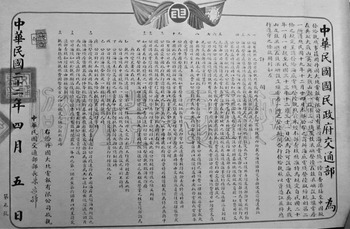
While the multinational rivalries in China's telegraph communication market provided Nanjing an opportunity to reduce the three cable companies’ leverage in negotiations, this international strategy also created trouble. When Sino-Japanese relations started to sour, in 1931, the three companies postponed signing the final contract, hoping the delay would open opportunities for changes. Meanwhile, Japan refused to negotiate with China over its control of the Shanghai–Nagasaki line, which provided the three companies a pretext to extend their cable rights. Nanjing tried to separate the three companies’ cables from those controlled by Japan, explaining that the Japanese cables were operated by the government not private companies, such as Great Northern, Eastern Extension, and Commercial Pacific.Footnote 74 Meanwhile, the Ministry of Communications was busy collecting funds through a national bond to clear its debt with the three companies. This left the companies little room for procrastination. They eventually signed the new contract in 1933 after the debt was paid (See Figure 2).Footnote 75
Cable landing license of the Great Northern Telegraph Company, 1933

LAST STRAW: WESTERN CABLE COMPANIES BETWEEN CHINA AND JAPAN
The traffic rights of the Great Northern, Eastern Extension, and Commercial Pacific companies within Chinese territory were constrained after the cable negotiations in the early 1930s. Shanghai became the only port where these companies connected China's domestic telegraph lines with international submarine cables. Traffic volume decreased continuously during the 1930s, due to restrictions of the Nanjing government, political instability, low performance of international trade, and competition from telephone and radio telegraph services.Footnote 76 The outbreak of the Sino-Japanese War boosted the cable telegraph traffic briefly, because of the high demand for war information. But the business plummeted after Japan occupied Shanghai in 1937. Cable infrastructure was frequently destroyed, and political pressure from the Japanese authorities constrained the telegraphic services. While struggling to compromise with the Japanese so as to continue business in the occupied region, the companies were also pushed by the Chinese government to confront the Japanese authorities. Here, the Western background of the three companies failed to protect them. Instead it subjected them to exploitation and opposition from both sides.
Upon occupying Shanghai, Japan immediately exercised information control. On November 28, 1937, the Japanese authorities took over several Shanghai telegraph offices previously operated by China's Ministry of Communications. Foreign cable companies were not spared either. On January 6, 1938, the Japanese authorities started to place Japanese censors in the cable companies to check telegrams sent abroad.Footnote 77 Although the three companies reported this to their respective legations, the consuls general responded that they were “not in a position to prevent such censorship under force majeure.”Footnote 78 Meanwhile, the Guomindang government in exile in Changsha pushed the three companies to take strong actions against the Japanese authorities, warning them not to encroach upon China's “sovereign rights” by accepting Japanese censorship.Footnote 79
Worse than the censorship was the rivalry between China and Japan for the cable companies’ share of terminal rates. Although the Guomindang government had abandoned Shanghai, it requested that the companies strictly observe contracts and continue to pay the Chinese government its share of traffic fees. Meanwhile, Japanese authorities pressed the companies to deposit the funds in the Yokohama Specie Bank controlled by Japan. Any transfer of funds from the companies to the Chinese authorities required prior Japanese permission.Footnote 80 Without effective means to resist Japanese demands, the companies complied, hoping a cooperative attitude would protect their business.Footnote 81 The Chinese government in return stopped repaying outstanding loans to the Marconi Company, which had merged with the Eastern Extension in 1929.Footnote 82 It demanded that unpaid loans should be charged from China's share of terminal rates in Shanghai. This neutralized the Nationalist government's loss of telegraphic revenue while putting pressure on the cable companies to confront the Japanese.Footnote 83
However, the companies’ compromise did not bring about a friendly commercial environment as they had hoped. As more and more international telegrams were forced to go through Japan, the companies suffered losses on traffic to Hong Kong and Manila. Moreover, Japanese officers demanded that the Great Northern reduce its share of the terminal rate from Shanghai to Nagasaki, and from Shanghai to Manchukuo. While the companies’ rates had been based on the gold franc so as to avoid local inflation, the Japanese authorities forced the three companies to fix their exchange rates in Japanese currency, again to the detriment of the companies’ revenue.Footnote 84 In addition, the Japanese authorities established the Central China Telecommunications Company and demanded the three foreign companies send all documents regarding international telegraph to its Shanghai office, and to update the address of their registered customers on a daily basis. This virtually amounted to the implementation of full administrative control of the three companies.Footnote 85 On March 28, 1938, the “Reformed Government of the Republic of China” supported by the Japanese was established in Nanjing. The government claimed that it would not recognize any treaties or contracts with the Nationalist government.Footnote 86 In January 1939, the collaborationist regime approached the companies, pressing them to cancel agreements with the Nationalist government or face closure.Footnote 87 In August 1939, H.P. Krogh, manager of the Great Northern Telegraph, was shot dead outside his home. It was rumored that he paid the price for refusing to abide by the rules of Japanese censorship.Footnote 88
Meanwhile, the Guomindang government instigated protests among the Chinese workers in the three companies to push for a harder line against the Japanese authorities. In November 1939, the Chongqing government claimed to increase monthly payments for workers of the cable companies, although no funding was authorized to make this happen. The telegraphic revenues in Shanghai, from which the companies’ salaries would be drawn, were controlled by the Japanese. The new wage plan was stalled by Japanese officials, who saw it as unnecessary. Having requested payments in vain, local telegraph workers blamed the Japanese authorities together with managers of the companies for withholding pay legitimately earned by staff members. To calm the situation, the companies had to use their funds elsewhere to meet the workers’ demands.Footnote 89 As strikes continued to disrupt operations, the three companies arranged with the Russian Emigrant's Committee in Shanghai to hire Russian boy scouts to deliver telegrams, in place of Chinese workers.Footnote 90 The strategy to a certain degree increased their bargaining power against workers, but it further exacerbated tensions between foreign managers and Chinese staff.
The three companies were fully aware of the danger of running a business during wartime and were secretly exploring ways of moving out of Shanghai. In 1940, the Foreign Office in London instructed the Great Northern and Eastern Extension companies to investigate the possibility of transferring all properties to the British controlled area.Footnote 91 Eastern Extension welcomed the idea and moved two cable ships jointly owned by the Great Northern and Eastern Extension to Hong Kong.Footnote 92 But the Great Northern Telegraph was not keen on moving. As a Danish company, the Great Northern entertained the hope that it would enjoy concessions from Japanese authorities, on the basis of Denmark's neutral position in the war. Given the animosity between Britain and Japan, leaders of the company worried that siding with the British government was a suicidal move, legitimizing Japan to confiscate the company's properties immediately.Footnote 93
The Danish connection, nevertheless, failed to protect the Great Northern from Japanese suppression. Germany's occupation of Denmark in April 1940 encouraged Japan to take a harder line on the Great Northern Company. In June 1940, the Japanese Ministry of Communications took over the company's operation of the Shanghai–Nagasaki line. This further constrained the connections between Great Northern Telegraph's Chinese terminals to the outside world.Footnote 94 In January 1941, the Great Northern lost its rights to send or receive messages beyond China.Footnote 95 Meanwhile, Japan centralized its control of China's domestic telecommunications through three institutions—the Central China Telecommunications, the North China Telecommunications, and the International Telecommunications. All traffic was required to go through routes under their supervision.Footnote 96 In 1942, Japan took over the entire operations of the three cable companies in China and moved many of their cables to South Asia to support its communications during the Pacific War.Footnote 97 This brought the three companies’ decades of operation in China to an end. Towards the end of the war, the three companies approached the Nationalist government and expressed their interests in resuming cable business after the war. But the government declined their applications, insisting that the outgoing cable should be controlled by the Chinese.Footnote 98
CONCLUSION
The Republican period in Chinese history is generally considered a transitional time that connects the Qing Empire and the People's Republic of China. Ridden with domestic struggles, disputes with foreign powers, and traumatic wars, it is a time when China was led by weak governments on the verge of survival. But these weak governments managed to defend China's borders and reclaim aspects of its national sovereignty. As William Kirby points out, the Qing fell but the empire remained, and became the basis of the Chinese national state after 1949.Footnote 99 Research on diplomacy during the Republican era in part explains the transition. But diplomacy alone, which focuses on relationships between states, is sometimes insufficient to understand how the process took place and why certain negotiations were successful while others failed. Moreover, diplomatic history tends to take a binary vision of “Chinese” and “Western” actors. The historical reality was that foreign relations in this era were “all penetrating, all permeating, all prevailing … ultimately forcing their way into every part of Chinese society.”Footnote 100 Issues of sovereignty rights were usually associated with internal domestic rivalries, business interests, and power plays that cut across national borders. This article challenges the conventional “China” and “Western” divide, by examining political confrontations based on pragmatism, self-interest, and power maneuvers within particular domestic and international constraints.
The internal struggles of the Communications Clique plagued cable rights negotiations during the early Republican period, while the rapid turnover of leadership in the Ministry of Communications weakened the connections between different layers of the institution. Personal loyalty was temporary, and the drive to acquire private interests was high. The rivalry between old and new leadership groups as well as tensions between central and peripheral members of the clique created both opportunities and difficulties for the foreign cable companies to extend their landing privileges. The advent of wireless telegraph technology opened new ways for the government to resist the cable companies’ pressure by inviting more foreign entities into the competition for the Chinese market. Meanwhile, the navy, the army and the Ministry of Communications were also keen to seize control of this new technology, each pursuing its own agenda with foreign partners.
Motivated by nationalism, the newly established Nanjing government was keen to reclaim China's cable sovereignty. It pushed hard for limiting foreign companies’ cable privileges through new contracts. Yet sticking to the Nationalist party's line proved to be ineffective at the negotiation table when practical issues, such as insolvency and the lack of alternative international communication channels, remained unsolved. Meanwhile, the government continued to invest in wireless technology. The rivalry between military and the state over wireless networks gave rise to a diversified multi-power competition in China's wireless development. The new technology, although unable to replace submarine cables in international communications, put pressure on the foreign companies to compromise with Nanjing, compounded by declining support from the diplomatic circle.
The volatile environment during the Sino-Japanese War, together with pressure from both sides of the conflict, eventually forced the foreign companies to give up their business in China. Instead of protecting them, their Western background was used as a target by China and Japan to exert influence in the Japanese occupied region. The companies faced severe censorship from the Japanese authorities and assassination of their key leaders. The enforced change of currency and traffic routes further burdened the revenue of the companies. Meanwhile, worker strikes, partly instigated by the Chongqing government, continued to plague their operations. The three companies were eventually pushed out of China's market at the end of World War II.
The recovery of rights and sovereignty issues have been traditionally examined from the perspective of “revolutionary diplomacy.”Footnote 101 The rise of nationalism was regarded as a main drive behind the treaty revision campaigns. This study provides a different perspective that demonstrates how a weak China was able to restore its cable sovereignty. It suggests that ideologies, such as imperialism and nationalism, provided the rhetoric for diverse interest groups to advance their own agendas. It was the inter-connections of interest groups, and the intricate domestic and international power balance that deterred the foreign cable companies from extending their privileges in China. It was partly due to the lack of a central power, and the efforts of various groups to entangle the cable issue in a complex international power struggle, that allowed China to reclaim its cable rights.