Introduction
The genus Lolium (Poaceae) includes a large number of species. Lolium perenne L. (perennial ryegrass) native from Europe and northern Africa is one of the most important forages and turf grasses in the world (Thorogood, Reference Thorogood, Casler and Duncan2002; Shen et al., Reference Shen, Xu, Jin, Chen and Lu2008).
High-quality seed is a key component of cropping systems (Egli et al., Reference Egli, TeKrony, Heitholt and Rupe2005). From an agronomic perspective, increasing knowledge on how environmental factors affect seed quality is clearly of considerable value in producing high-quality seed with the appropriate germination characteristics because the successful establishment of plants largely depends on germination (Larsen et al., Reference Larsen, Bailly, Côme and Corbineau2004). Climatic and nutritional conditions affect seed quality, mainly during seed filling and maturity in the mother plant (Gutterman, Reference Gutterman and Fenner2000; Casini, Reference Casini2007). Physiological dormancy (PD) is frequent and variable in ryegrass seed depending upon location and year (Steadman et al., Reference Steadman, Ellery, Chapman, Moore and Turner2004; Owen et al., Reference Owen, Michael, Renton, Steadman and Powles2010; Goggin et al., Reference Goggin, Steadman, Emery, Farrow, Benech-Arnold and Powles2012). The PD variability is probably the result of changes in the amount, mobility or activity of hormones (Fenner, Reference Fenner1991; Hilhorst, Reference Hilhorst1995; Goggin et al., Reference Goggin, Powles and Steadman2009). Temperature has a particularly consistent negative correlation with PD, where warm conditions favour a reduction in the level of primary seed dormancy (Steadman et al., Reference Steadman, Ellery, Chapman, Moore and Turner2004).
Under laboratory conditions, seed pre-germination treatments to reduce the PD level in ryegrass, such as pre-chilling (at 5–10°C; >7 d) or the application of potassium nitrate in the substrate (0.2%) (ISTA, 2019), may overestimate germination ability under field conditions (Hampton and Hill, Reference Hampton and Hill1990; Stanisavljevic et al., Reference Stanisavljevic, Djokic, Milenkovic, Dukanovic, Stevovic, Simic and Dodig2011). A high PD level could inhibit or delay seed germination, which prevents successful establishment (Simpson, Reference Simpson1990).
During the establishment of new pastures or turfgrass, the seedling emergence potential could be predicted successfully by vigour testing. The vigour tests are complementary analyses that allow differentiating the quality of the lots, and these are more suitable to estimate the emergence in the field conditions (Peretti, Reference Peretti2007; Marcos-Filho, Reference Marcos-Filho2015; ISTA, 2019). The type of test is variable depending on agronomic, vegetable and turf species, such as electrical conductivity, the first count in standard germination, seedling growth and cold test, among others (Matthews, Reference Matthews and Habblethwaite1980; Happ et al., Reference Happ, McDonald and Danneberger1993; Peretti, Reference Peretti1994).
Seed production of perennial ryegrass is distributed mainly in the south-west and south-east of the Buenos Aires province, Argentina. This country has become an exporter of ryegrass seed (CSBC, 2019). Due to soybean harvest which occurs during early autumn, the sowing of perennial ryegrass was necessarily delayed beyond the optimum sowing date for the species (Pincén et al., Reference Pincén, Viglizzo, Carreño and Frank2010; Bragachini et al., Reference Bragachini, Casini, Saavedra, Méndez, De Carli, Behr, Errasquin and Ustarroz2011). The delay of the sowing date in autumn reduces the seed yields (Hill and Watkin, Reference Hill and Watkin1975; Hare et al., Reference Hare, Rolston, Falloon and Hickson1988; Elgersma, Reference Elgersma1990; Warringa and Kreuzer, Reference Warringa and Kreuzer1996; Warringa, Reference Warringa1997; Kunelius et al., Reference Kunelius, McRae K, Dürr and Fillmore2004; Rolston and Archie, Reference Rolston and Archie2005). However, the impacts on seed quality and degree of PD are less known. For plants that have an extended period of seed development, variation in PD can occur between seeds maturing at different times in the same growing season. To investigate environmental effects on seed dormancy, it is necessary to stagger the sowing to produce seed at different times of the growing season (Fenner, Reference Fenner1991).
Thus, the objectives of this work were to (1) evaluate the influence of different sowing dates and environmental conditions during seed filling, on the level of primary dormancy at the time of harvest and change in dormancy over 9 months in two cultivars of perennial ryegrass, (2) estimate the effect of PD on field emergence and (3) associate the vigour tests under laboratory conditions with the emergence observed in the field.
Materials and methods
Field study site
Seed of two perennial ryegrass turfgrass cultivars (Ultra and RC) was produced in Coronel Suárez, Buenos Aires, Argentina (37°25′38″S; 61°51′37″W). There is a wide range of maturities in perennial ryegrass varieties. Thus, both diploid cultivars were chosen because that Ultra is early maturing (SC, short-cycle), while RC is a late-season genotype (LC, late-cycle). Cultural practices typical for ryegrass seed production were used (Castaño, Reference Castaño2005). Sprinkles irrigation was used only during vegetative growth. The predominant climate in this location is sub-humid temperate with 817 mm mean annual precipitation and 13.7°C mean annual temperature (http://siga.inta.gob.ar/#/p). The soil was a Typic argiudoll, silty clay loam, neutral (pH ≈ 6.8), high in phosphorus (P) content (18 ppm P available according to Bray and Kurtz, Reference Bray and Kurtz1945) and organic matter content (≈ 4.0%) at 20 cm.
The treatments consisted of five sowing dates every 15 d from mid-March to mid-June, for both cultivars, during the 2014 and 2015 growing season. The dates were 11 April, 30 April, 15 May, 30 May and 16 June; and 21 March, 7 April, 24 April, 14 May and 4 June, respectively, for the first and second years. The experiment was arranged in a randomized block design with three replications. Plot dimensions were 1.2 × 5 m (6 m2). A small-plot cone seeder was used for sowing ryegrass at 15-cm row spacing at a target plant density of 20 kg ha−1 (seed germination: >90%).
Reproductive growth stages were determined at daily intervals (Lancashire, Reference Lancashire1991), corresponding to the seed filling period, more than 90% of spikelets have completed flowering to physiological maturity when the treatments were harvested. The harvest was carried out when the seed presented a humidity of 43 ± 2%, by the indirect method, with cutting, environmental drying and manual threshing in the laboratory. All plots were harvested, except for the two rows at the edges. Air temperature and precipitation were measured at the official weather station (SMN) located 0.6 km from the experimental site.
Germination test
After harvest, seeds were cleaned by sieving, air-dried under laboratory conditions. Collected seeds (within a sowing date) were pooled and seed germination testing was assessed immediately (less than a month) according to standard seed laboratory protocols for perennial ryegrass (ISTA, 2019). Thousand seed weight (TSW) was estimated from samples of 100 air-dried seed (n = 8).
A standard germination test was conducted according to ISTA (2019), without chilling or KNO3 to evaluate the degree of PD dormancy. Four replicas of 50 seeds were sown in 15 × 25 cm clear plastic germination boxes containing filter paper soaked with distilled water. Germination was conducted in a controlled growth chamber at alternating temperatures (30/20°C) with an 8-h photoperiod (8 h light/16 h dark). This temperature is the best-characterized dormancy in ryegrass (Wiesner and Grabe, Reference Wiesner and Grabe1972). After 10 d, the total number of normal, abnormal seedlings, dormant seed (PD) and dead were counted. Ungerminated seeds (PD and dead) were confirmed by the topographic tetrazolium test, by slicing them longitudinally through the embryo and three-fourths of endosperm and further incubating in a 1% (wt/vol) tetrazolium chloride (2,3,5-triphenyl tetrazolium chloride) solution for 2 h at 35°C in the dark (ISTA, 2019). Seeds with pink- or red-stained embryos were considered viable and physiological dormant (PD).
Afterripening germination and vigour testing
Germination and vigour tests afterripened in the laboratory (9 months in dark conditions at 20 ± 2°C; HR 40%) were conducted. Germination test was carried out in the same form as after harvest. A seed was considered germinated when the radical protruded from the seed at least 2 mm, and the number of normal seedlings was determined at 5 (first count) and 10 d (ISTA, 2019). Seedlings shoot and radicle length were measured, only in normal seedlings, 10 d after germination (Cookson et al., Reference Cookson, Rowarth and Sedcole2001).
In addition, the cold and conductivity tests were evaluated. The first was performed on 4 replicates of 50 seeds in clear plastic germination boxes (15 × 25 × 3.5 cm) in a sand substrate. Seeds were buried at 1 cm depth. The substrate was moistened to 70% of it is water holding capacity (WHC). Previously, the amount of water needed to reach the WHC was determined through the difference of the air-dry sand weight and wet (saturated and drained for 12 h = WHC) (ISTA, 2019). The boxes were then placed at 5°C for 7 d in dark conditions. After that period, the boxes were transferred directly to a germination chamber with conditions identical to those for standard germination testing (30/20°C; 8 h light/16 h dark). Normal seedlings were counted on the 10 d, and the result was expressed in percentage (%). A bulk electro-conductivity test was also conducted using 3 replicates of 50 seeds of each cultivar. Deionized water (50 ml) was added to each replicate and soaked at 20°C for 24 h. After soaking, samples were shaken slightly, before the electrical conductivity reading. The value obtained was divided by the mass of the 50 seeds, and results were expressed as μS cm−1 g−1 (Happ et al., Reference Happ, McDonald and Danneberger1993).
Field emergence study
Field emergence experiments were carried out for all seed lots obtained from each sowing date (5 sowing date × 2 cultivars = 10, in both years) at the Agricultural Experimental Station (EEA) of Hilario Ascasubi (39°22′S, 62°39′W), in Buenos Aires province (Argentina) in 2015 and 2016. The predominant climate in this location is semi-arid temperate with 489 mm mean annual precipitation and 14.8°C mean annual temperature (EEA H. Ascasubi, 1966–2018). The soil was an entic Haplustoll, sandy loam, slightly alkaline (pH ≈ 7.5), high in phosphorus (P) content (≈20 ppm P Bray & Kurtz) and low organic matter content (≈1.5%) at 20 cm. Weather data from each year were registered at the nearby meteorological station (less than 400 m) (http://inta.gob.ar/documentos/informes-meteorologicos).
A randomized complete block design with three replications was used to evaluate the effect of seed vigour upon field emergence. The seedbed was disked and then levelled before sowing the plots. Each experimental unit consisted of a row of 2 m sown with 100 seed on 9 and 11 September in 2015 and 2016 (~9 months after harvest). Seeds were sown by hand at 2 m row spacing and a seeding depth at 1.25 cm (Arnott, Reference Arnott1969). Immediately after sowing, the experimental field was surface-irrigated (~20 mm) to ensure successful establishment. The seedling emergence was count after 1 month of sowing (see supplementary Table S1). Shoots 10 mm or more above ground were counted as emerged (Cookson et al., Reference Cookson, Rowarth and Sedcole2001).
Statistical analysis
To test if the sowing date and cultivars differed in the proportion of PD dormancy, a linear mixed model (LMM) was performed using the sowing date and cultivars as fixed factors and year as a random factor. The LMM was performed with R version 3.6.1 in Infostat software interface to R (Di Rienzo et al., Reference Di Rienzo, Casanoves, Balzarini, Gonzalez, Tablada and Robledo2019), using a significance threshold of P < 0.05. For analyses, the PD data were arcsin-square root transformed, and the untransformed data are presented in the figures for clarity. The PD means of each sowing date, in both cultivars, was plotted as a function of local climatic conditions [precipitation, mean daily temperature, daily thermal amplitude and heat stress units (HSUs)] during the seed development period. HSU accumulation was the sum of the daily maximum temperature above >29°C and is calculated in the following equation (Teasdale and Cavigelli, Reference Teasdale and Cavigelli2017):
 $${\rm HSU} = \sum\limits_{i = 1, n} {( T{\max }_i-29^\circ {\rm C}) } $$
A linear regression analysis was performed using GraphPad Prism Software version 6.0 (GraphPad, San Diego, CA, USA). Likewise, regression analyses were performed between PD values after harvest and afterripening, and this latter with the seedling emergence observed in the field. Pearson's correlation coefficient was calculated between the germination and vigour test afterripening, in both cultivars, and the percentage of seedling emergence in the field conditions using the InfoStat software.
Results
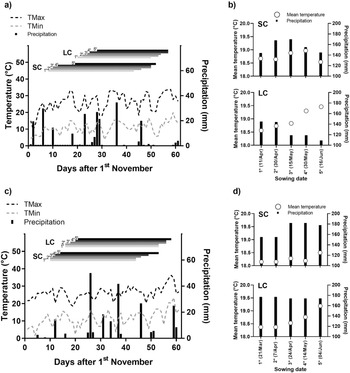
Registered precipitation (227 and 229 mm) and daily mean temperatures (18.4 ± 3.9 and 18.8 ± 3.4°C) during the seed development period during both growing seasons (2014 vs 2015) were similar (Fig. 1). However, although the mean maximum temperatures were similar (26.0 ± 5.4 and 26.1 ± 3.5°C), the number of days with maximum temperature records above 29°C during seed filling was higher in 2014 (n = 18) compared with 2015 (n = 6) (Fig. 1). These differences were quantified with HSUs (Teasdale and Cavigelli, Reference Teasdale and Cavigelli2017).
Mean daily temperatures (maximum and minimal) and precipitation in °C. Suárez during 2014 (a) and 2015 (d) seed filling periods (horizontal grey bars) for L. perenne SC (short-cycle) and LC (large-cycle) cultivars for five sowing dates (1°–5°). Mean daily temperature and the accumulated precipitation during seed filling for five sowing dates, in SC and LC during 2014 (b) and 2015 (d).

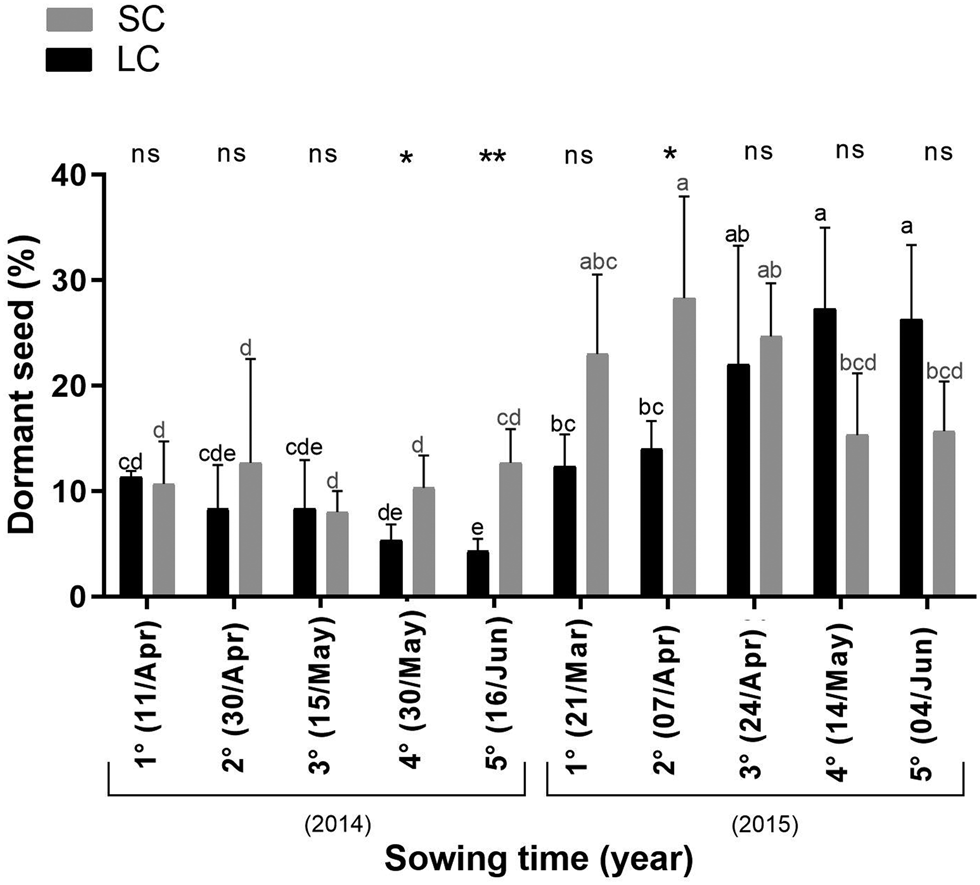
The diverse sowing dates in both cultivars resulted in a different PD level (Fig. 2). These differences were due to environmental conditions and not for the days of seed filling, with a range of 29–40 d (P > 0.05) (Fig. 1). TSW varied significantly among cultivars (P < 0.01), with 1.79 ± 0.09 g in SC and 1.48 ± 0.11 g in LC, respectively. Although slight differences were observed in the TSW between sowing dates in SC, (P < 0.01) ranging from 1.37 to 1.50 in 2014 and 1.66 to 1.80 g in 2015, and not in LC (P > 0.05), these did not show trends between sowing date.
Seed dormancy in L. perenne (mean and standard deviation) for each sowing time and year in SC (short-cycle) and LC (large-cycle) cultivars. Different letters indicate significant differences for SC (grey) and LC (black) between sowing times × years. The ‘ns’, ‘*’ and ‘**’ indicate non-significant or significant differences at P < 0.05 and P < 0.01 between cultivars for each sowing time × year.

We observed the interaction between cultivars, years and sowing date (P < 0.01). The cultivar SC showed the highest PD on the fourth and fifth sowing dates in 2014 and on the second in 2015 (Fig. 2). Inter-cultivar and inter-year variations in PD status were observed, ranging between 6–37% and 3–35%, in SC and LC, respectively, depending on the year and sowing date (Fig. 2). The rest of the seed resulted in normal seedlings (>93%), with low percentages of abnormal seedlings plus dead seed (<7%).
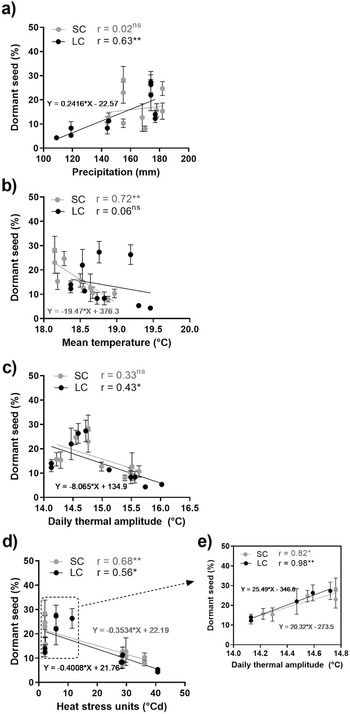
High precipitation during seed filling significantly increases the PD in LC and low mean temperatures in RC (Fig. 3a, b). Substituting the mean temperature during seed filling for the minimum or maximum temperature did not improve the regressions. The regression between HSU and PD was significant, in both cultivars. Days with maximum temperatures above 29°C reduce the PD levels (Fig. 3d). Also, higher daily thermal amplitude (maximum–minimum) increased the PD level, only for the seed that was developed with <12°C d HSU during seed filling (Fig. 3e). The maximum temperatures of <29°C with high daily thermal amplitude would increase the PD levels in perennial ryegrass.
Regression between dormant seed (PD) (mean and standard deviation) and precipitation (mm) (a), mean daily temperature (°C) (b), daily thermal amplitude (c) and HSUs (accumulated daily maximum temperature above 29°C) (d), during L. perenne seed filling for SC (short-cycle) and LC (large-cycle) cultivars. Graph (e) shows the relation between daily thermal temperature and dormant seed only for <12°C d HSU.

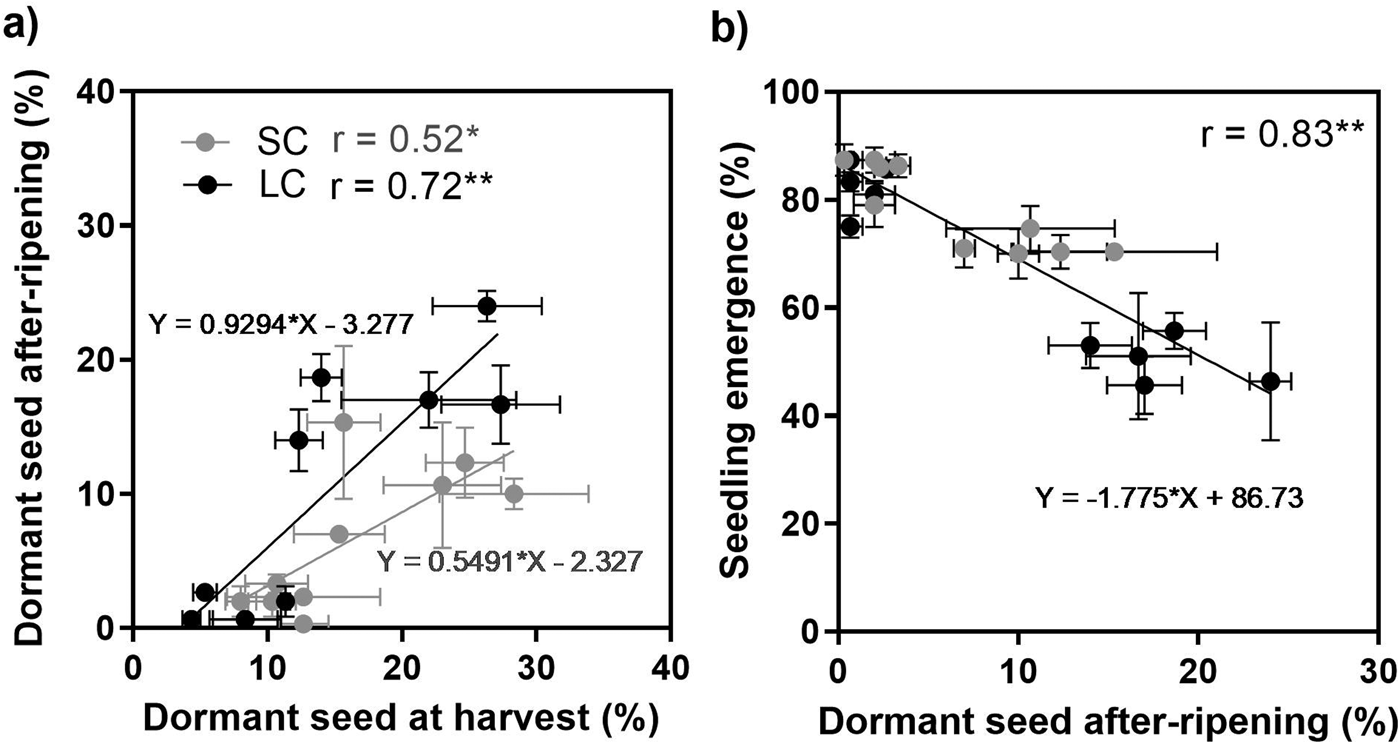
Following afterripening during 9 months, the PD release rate was higher in SC than LC (Fig. 4a). Increases in PD were associated with lower seedling emergence in the field. With 20% PD, the percentage of field emergence observed was only 50% (Fig. 4b).
Seed dormancy (PD) at harvest and afterripening (9 months at 20 ± 2°C, HR 40%) relation (a) and the seedling emergence in the field (b), in both cultivars of L. perenne (mean and standard deviation).

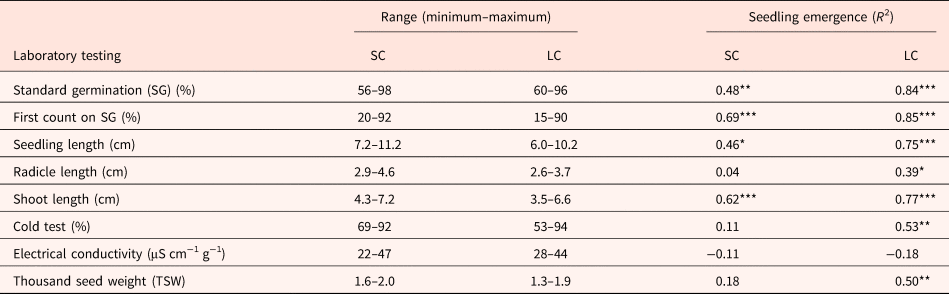
The highly significant correlations (P < 0.001) to be associated with the field emergence, in both cultivars, were the first count in the standard germination test and the shoot length (Table 1). Among the various laboratory tests performed, electrical conductivity and root radicle length were the least sensitive in association with seedling emergence field performance.
Pearson correlation (R 2) between laboratory testing (range showed) and field seedling emergence of L. perenne cultivars, SC (short-cycle) and LC (large-cycle), in 2015 and 2016

Asterisks indicate the significance of the correlation coefficients (*, P < 0.05; **, P < 0.01; ***, P < 0.001).
Discussion
Low dormancy is generally associated with high temperatures, short days, drought and high nitrogen levels during seed filling (Fenner, Reference Fenner1991). Larger-scale analyses performed in growth chambers or greenhouse demonstrated that higher temperatures and lower precipitation during seed development were correlated with lower initial PD in annual and perennial ryegrass (Wiesner and Grabe, Reference Wiesner and Grabe1972; Steadman et al., Reference Steadman, Ellery, Chapman, Moore and Turner2004; Goggin et al., Reference Goggin, Steadman, Emery, Farrow, Benech-Arnold and Powles2012). Temperatures in the field vary diurnally and increase during seed growth and development in a temperate environment (Egli et al., Reference Egli, TeKrony, Heitholt and Rupe2005). In our field study, the impact of temperature and precipitation during seed development was statistically significant only for SC and LC genotype, respectively. Probably, the PD level is determined by local environmental variability conditions and the genotype (Owen et al., Reference Owen, Michael, Renton, Steadman and Powles2010; Goggin et al., Reference Goggin, Powles and Steadman2009). In this context, HSUs could be used to estimate the possible PD status of freshly harvested seed, being more consistent for both genotypes than those associated with mean temperature, daily thermal amplitude and precipitation. Exactly how high-temperature stress reduced PD seed is not clear. Other environmental factors, such as photoperiod, light quality or intercepted solar radiation during seed filling on the mother plant, may also affect the dormancy levels (Gutterman, Reference Gutterman and Fenner2000). Analysis of these variables in ryegrass should motivate future studies.
Field emergence occurred under adequate environmental conditions (Cookson et al., Reference Cookson, Rowarth and Sedcole2001), with a mean soil temperature of 10.4°C (9.6–11.2°C) and 11.0°C (10.2–11.9°C), and precipitation of 15.2 and 10.0 mm, during the evaluation month in 2015 and 2016, respectively. However, we observed that for seeds with 20% PD, the field emergence was only 50% (Fig. 4b), under optimal conditions. Such field emergence values are much lower than that expected for optimal seedbed conditions, and although seed dormancy could be the main cause, other factors are not discarded, such as predation by ground-dwelling arthropods, rodents or soil-borne pathogens (Egli et al., Reference Egli, TeKrony, Heitholt and Rupe2005).
Certain factors are much more readily controlled than others in the field, as nutrient levels, water supply and choosing a sowing date for the crop which takes advantage of the most favourable period. Delaying sowing or moving seed production to hotter regions could be increased the temperature on seed filling and result in lower seed dormancy. The advantages of reduced dormancy induced by higher temperatures may be negated by smaller seed weight (Fenner, Reference Fenner1991). For the range of sowing dates of our study, we did not observe negative effects on seed weight (TSW; Table 1). The early or late sowing dates were variable between years and cultivar. While late dates reduced PD levels in LC during 2014, the contrary occurred in 2015, with no trends for SC in both years. Thus, our results provide little guidance to growers in selecting an optimum sowing date for avoiding high seed PD. Based on this, the HSU could be a useful approach to establish a possible PD range in the seed of perennial ryegrass after the growing season depending on the seed filling periods. The development of models to predict dormancy levels offers an enormous potential within management decision support systems for farmers and agricultural professionals. Like the models generated to estimate the rates of dormancy release in weed seed (Forcella et al., Reference Forcella, Benech-Arnold, Sanchez and Ghersa2000; Renzi et al., Reference Renzi, Chantre and Cantamutto2018). This would have to be adjusted based on growing season environmental conditions, because it is likely that the dormancy level is determined by local environmental conditions during seed development rather than by long-term climatic factors (Goggin et al., Reference Goggin, Steadman, Emery, Farrow, Benech-Arnold and Powles2012).
On the other hand, high PD can increase the persistence of seed in the soil, contaminating subsequent crops (Steadman et al., Reference Steadman, Ellery, Chapman, Moore and Turner2004). At the end of the 9-month dry afterripening period (~20°C), we did not view a high PD release, being an important factor to consider in the sequence of crops. Neither we observed evidence of secondary dormancy induction, and this effect would not be important in ryegrass (Goggin et al., Reference Goggin, Steadman, Emery, Farrow, Benech-Arnold and Powles2012).
Some studies have shown that accelerated ageing, conductivity and seedling growth can be useful techniques in determining the seed quality of turf ryegrass (Happ et al., Reference Happ, McDonald and Danneberger1993; Cookson et al., Reference Cookson, Rowarth and Sedcole2001). We observed in our study that bulk seed conductivity was less sensitive. This agrees with Cookson et al. (Reference Cookson, Rowarth and Sedcole2001), possibly due to the type of small seed covered by lemma and palea that limits the leachate of electrolyte. Solute leakage from the degradation of cellular membranes might be more significant after long storage periods. The cold test was also not adjusted for both cultivars; possibly cold season grass may not sensitive to cold stress (Happ et al., Reference Happ, McDonald and Danneberger1993). The first count (at 5 d) of the standard germination test was highly associated with field emergence, like the shoot length of seedlings (Table 1). Seedling growth has been shown to correlate well with field emergence in ryegrass (Cookson et al., Reference Cookson, Rowarth and Sedcole2001). A beneficial aspect of the speed of germination and seedling growth is simplicity, and not overly time-consuming. However, field emergence evaluation was sowed under relatively favourable field conditions in our study and should be evaluated under environmental stress in future assessment (Egli and Tekrony, Reference Egli and Tekrony1996).
Conclusion
This study demonstrated that the sowing dates in L. perenne affected the dormancy level (PD), and these differences were due to environmental conditions during seed filling. The HSU during seed filling could be a useful approach to establish a possible PD range. An increment in the seed PD level reduced seedling emergence in the field. Our results provide some guidance to growers in selecting an optimum vigour test. The speed of germination, through the first count at 5 d of the standard germination test, and the shoot length at 10 d were better associated with the seedling establishment in the field. The prediction of PD status considering local environmental parameters could be carried out in future model studies, and more genotypes must be evaluated. The models may be useful to define the techniques used for germination testing (with or without the use of a method to break dormancy) and also be applied to the setting of field history standards in ryegrass seed certification programmes (Wiesner and Grabe, Reference Wiesner and Grabe1972).
Supplementary material
To view supplementary material for this article, please visit: https://doi.org/10.1017/S0960258521000155.
Acknowledgements
The authors acknowledge Eugenio and Ignacio Ducos of ‘El Cencerro’ for providing the cultivars of ryegrass used in this study. Appreciation is extended to O. Reinoso, and M. Bruna agricultural specialists at the EEA Hilario Ascasubi, for assistance in establishing the field experiments.
Financial support
This work was supported by the Instituto Nacional de Semillas (INASE) and INTA (PE-142).
Conflicts of interest
None declared.