Introduction
Being on the land is widely interpreted as key to Inuit cultural identity, both for individuals and groups (Boas Reference Boas1888; Brody Reference Brody1975; Rasing Reference Rasing, Oosten and Remie1999; Dahl Reference Dahl2000; Gombay Reference Gombay2005; Searles Reference Searles2010). Dorais (Reference Dorais1997) lists three fundamental aspects of local identity for Inuit: family and kinship, language, and religion; noting that these are all considered to be best expressed through going on the land. Similarly Nuttall (Reference Nuttall2001) stressed the sense of belonging that arises from interacting with other people while on the land, from remembering previous land-based events and from the story-imbued geography of the local area. These observations emphasise the construction of Inuit identity through land-based activities and interactions with others. Yet for Inuit, participation in land-based activities has changed markedly over the past few decades.
The increasing interactions between Inuit and outsiders throughout the 20th century led to an expectation that Inuit participation in land activities would decline as they became more behaviourally similar to non-Inuit through wage labour and settlement life. Acculturation models, developed by both non-Inuit researchers, and by Inuit themselves, predicted that Canadian Inuit would become like southern, non-aboriginal Canadians or Qallunaat (the terms will be used interchangeably here) (Hughes Reference Hughes1965; Vallee Reference Vallee, Valentine and Vallee1968; Rasing Reference Rasing1994). Such models begin their analysis with an original Inuit identity, which is often labeled ‘Inummariit’ (real or genuine Inuit. compare Brody Reference Brody1975). This ‘traditional’ identity has been assigned since at least the mid-20th century to Inuit who live close to the land in outpost or traditional seasonal camps and conduct subsistence activities as their primary economic focus. Their exclusive use of the Inuktitut language, maintenance of pre-settlement cultural traditions and behaviours, and their considerable knowledge of, and reliance on, the local natural environment set them apart from Inuit living full time in settlements. This life style and identity however, appear to be largely economically untenable and socially undesirable under modern conditions, since few Inuit have embraced them in recent decades.
The opposing identity discussed in acculturation models, ‘Qallunaamariit’ (real or genuine people of the non-Inuit people. compare Rasing Reference Rasing1994; Searles Reference Searles2008), depicts Inuit as essentially the same as southerners, except for their aboriginal parentage. This identity can be seen as the persistence of an ethnic identity for Inuit, but a loss of cultural identity (compare Dorais Reference Dorais1994; Oosten and Remie Reference Oosten and Remie1999). One weakness of the Qallunaamariit identity idea is that it neglects the unique geographic location of the Inuit, and supposes a break from their own history. The acculturation model uses these two identities, Inummariit and Qallunaamariit, to represent the ends of an identity spectrum, and assumes intermediate positions are ephemeral and tied to the first generation to live in settlements.
Most researchers today recognise the complex aspects of modern Inuit identity as sitting somewhere between these two extremes, and the intermediate positions are seen as viable long-term identities (Nuttall Reference Nuttall1992; Dorais Reference Dorais1997; Searles Reference Searles2008). In fact, many consider that middle ground to exemplify adaptation to modern living conditions, but with connections to the past and the landscape. Acculturation is seen as the extreme situation, in which that link is broken. Wenzel (Reference Wenzel2001: 44) however, notes that researchers have found evidence of both adaptation and acculturation, and suggests instead that adaptation and acculturation ‘seem to have concurrent and, perhaps, coeval validity’. He suggests they are two characteristics of the same system, in which adaptation confers system stability and resilience, while acculturation offers self-transformation, and notes that the same data may sometimes be interpreted as supporting either adaptation or acculturation. Perhaps the most telling example of these contrasting interpretations are the papers by Condon and colleagues (Reference Condon, Collings and Wenzel1995) and by Stern (Reference Stern2000) which rely on the same data, but provide different perspectives on the role of subsistence activities in the lives of young Inuit men at Holman (Ulukhaktok), N.W.T. Wenzel's 2001 analysis allowed discussion of Inuit identity to move on from this classic dichotomy, to (re)join more recent and broader understandings of culture, space and colonial influences (compare Gupta and Ferguson Reference Gupta and Ferguson1992; Appadurai Reference Appadurai1996).
However, the fear of acculturation continues to haunt Inuit communities, as one of the participants expressed in this study:
In 50 years people won't hunt and camp as much, since they don't get involved now. They’re losing it, becoming more Qallunaat (Mary Killikti, Qikiqtarjuaq, personal communication, 28 June 2012).
The idea of being less ‘Inuit’ because of a decline in land activities persists in the minds of Inuit. Therefore the Inuit-land relationship, as an elemental aspect of identity, continues as a relevant line of inquiry for northern anthropologists and geographers. This paper then, while reporting on what Inuit (especially Inuit women) do on the land and their level of participation in said activities, is also about how Inuit in remote eastern Canadian Arctic communities construct their identity today. It examines more closely what cultural movement along the Inummariit-Qallunaamariit continuum would look like, and contrasts that with the movement away from that continuum that is exhibited by Inuit today through their choice of activities and how they think about themselves and their communities.
In addressing this topic, two other weaknesses in the academic literature are examined. The first is the combining of many aspects of the Inuit-land relationship under the umbrella of hunting. Certainly hunting served as the central economic activity of Inuit life on the land, and remains of major interest to Inuit today (Condon and others Reference Condon, Collings and Wenzel1995; Rasing Reference Rasing, Oosten and Remie1999; Dahl Reference Dahl2000). It has also been a favourite topic of research since Boas (Reference Boas1888), particularly during the mid-20th century as part of the idea of cultural evolution with hunting being perceived as the ‘original’ lifestyle of humans, and Inuit as the quintessential hunting culture (Lee and Devore Reference Lee and Devore1969). The term ‘hunting’ is often treated as synonymous with trips on the land (Rasing Reference Rasing, Oosten and Remie1999) and thus other forms of procurement (compare Shannon Reference Shannon2006) or reasons for going on the land were neglected. Further, the understanding of the term by non-Inuit readers may neglect the holistic aspect of Inuit understandings of hunting that encompass much more than the physical capture of animals. These include, for example, spiritual and psychological relationships between humans and animals, and relationships within the human community as well (Smith and Wright Reference Smith and Wright1989; Stairs and Wenzel Reference Stairs and Wenzel1992; Dowsley Reference Dowsley2010; Searles Reference Searles2010). The fact that the Inuit concept of hunting is sometimes misunderstood by non-Inuit audiences underscores the possibility that neglecting other facets of the Inuit-land relationship may cause us to overlook some important features of Inuit identity and world view. This paper tries to explore further the Inuit-land relationship by organising the analysis around the division of the suite of goods acquired from the land into the broad categories of material and non-material goods. This reduces the focus on hunting, without attempting to exclude it from the analysis.
The second weakness that this paper aims to address is the gendered nature of Inuit-land research. This is closely linked to the focus on hunting, which, as primarily a male activity, neglects the relationship between women and the land. Most land/hunting research has been conducted by male researchers with Inuit men as the main or only participants (compare Freeman Reference Freeman1976; Condon and others Reference Condon, Collings and Wenzel1995; Rasing Reference Rasing, Oosten and Remie1999). This male bias has been due to the biases of southern societies which saw far more male researchers set off for the north, the southern cultural misunderstanding of the Inuit concept of hunting, and the historic, and often still persistent, Inuit division of labour which sees men as the main leaders on the land (through their navigational and hunting skills) while women's traditional work has been more in support and in social roles, such as the processing and distribution of harvests (Boas Reference Boas1888; Guemple Reference Guemple1986; Reimer Reference Reimer1996; Matthiasson Reference Matthiasson2002; Williamson Reference Williamson2006; Duncan Reference Duncan2010). This is, however, not always the case. For example, in berry picking, men frequently serve as the supporters while women organise and conduct the harvest, and in ice fishing, men do more of the heavy physical work, such as drilling holes in the ice, while women support the group through setting up camp and preparing food, but both sexes devote equal energy to the actual harvesting of fish (Shannon Reference Shannon2006). In order to contribute to a more holistic understanding of the Inuit-land relationship, this paper explores how Inuit women interact with the land and how their relationship with the land have changed. This alternate perspective also supports the focus on an assessment of the acculturation model of community change and the ways in which the study participants are constructing their identities today.
This paper reports on field research that focused on how women relate to the land, and links that research with the predominantly male-focused literature, in order to gain a fuller understanding of how goods from the land are selected and accessed for both sexes under modern conditions. This focus on women and concomitant focus away from the physical acts of hunting, also assists in teasing apart the material and non-material goods that derive from the land, but which are often combined in studies of Inuit (male) hunting. The discussion uses this information to put to rest Inuit concerns about acculturation occurring if land-based activities decline. It then turns to the ways in which Inuit culture is being transformed through new activities that are built on past activities and an Inuit worldview. It concludes that although land-based activities of all types are valued and important in identity construction, a new identity is being forged that relies more on how Inuit think and act, than in what specific activities they do on the land.
Methods
Included here in the definition of the ‘land’ is that area outside the modern settlement, including terrestrial, ice and marine environments, and historic and current campsites and cabins. The goods were divided into material (physical) and non-material (social-cultural/psychological/spiritual) categories for analytical assessment, but it is also recognised that the material and non-material are linked into a single whole, rather than being separate. As Stuckenburger (2006:101) notes: ‘Nature is not perceived to be the “other” to society, but to be intimately connected to Inuit social, moral and spiritual life.’
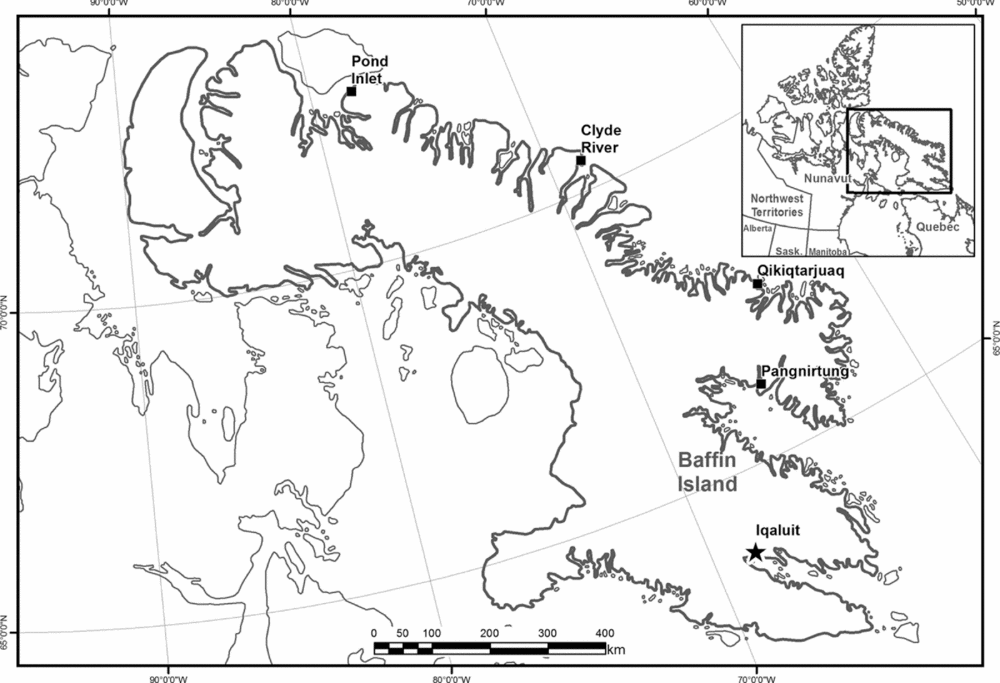
The relationships between Inuit women and the land are explored through data collected in three small neighbouring communities on Baffin Island, Nunavut, Canada (see Fig. 1): Qikiqtarjuaq, population ~ 500, Clyde River, population ~ 900 and Pangnirtung, population ~ 1300. These communities share an impressive mountain landscape and are closely related culturally, with many individuals finding spouses in one of the other communities, or living in one of the other communities at some point. These communities are not connected by roads, but are accessible by daily flights out of Iqaluit. They are considered fairly traditional in that hunting and going on the land are considered to be important activities and no other major economic development has occurred there (such as mineral extraction). In the 1970s Clyde River and Qikiqtarjuaq had similar populations, but since that time Clyde has grown to nearly twice the size of Qikiqtarjuaq. This increase has meant that different opportunities have been available to the two communities and Clyde River has been able to develop economically more than Qikiqtarjuaq. Pangnirtung, as the largest of the three communities has had various small-scale economic development projects, including the development of a print shop and weaving studio which support and train local artists. Both Pangnirtung and Qikiqtarjuaq are developing small commercial fishing operations and these two communities also border Auyuittuq National Park, with the main headquarters in Pangnirtung. Clyde River attracts some visitors for adventure tourism such as rock climbing and whale watching, has a growing knowledge economy in media, culture and education, and Qikiqtarjuaq and Clyde River have been popular destinations for polar bear sport hunts. The initial research was conducted in Qikiqtarjuaq and Clyde River as part of a larger project on women's lives. These two communities were selected because of their common history and relatedness, their perceived ‘traditional’ lifestyle, as well as their geographic proximity (about 400 km on the sea ice) that promotes a shared familiarity with the landscape of their coast line. Overland travel between Qikiqtarjuaq and Pangnirtung, (a distance of about 200 km), though frequent during the dog-sled era is no longer common. However, Pangnirtung remains the next nearest neighbour to the two communities, and many families are inter-related.
Map of Baffin Island, Nunavut, Canada showing study communities Pangnirtung, Qikiqtarjuaq and Clyde River, as well as the closest neighbouring communities of Pond Inlet and the territorial capital, Iqaluit.

A mixed-methods approach was undertaken to assess levels of land involvement using quantitative methods and to understand the meaning of such activities through qualitative approaches. Quantitative information was gathered through questions included in a larger survey conducted in 2010 (during May in Qikiqtarjuaq and August in Clyde River), focusing on women (18 years old and older) and examining their time allocation to various tasks and their links to the environment (n = 147 in Clyde River and n = 103 in Qikiqtarjuaq). Sample sizes for specific analyses varied slightly due to varying response rates for different survey questions, but all questions were answered by most of the women surveyed. Full discussion of the survey can be found in Inksetter (Reference Inksetter2012).
Qualitative information was gathered through semi-directed and informal interviews (n = 50; three of these with males in Qikiqtarjuaq, the rest with females in both Clyde River and Qikiqtarjuaq), group discussions with women in both Qikiqtarjuaq and Clyde River, and participant observation during land trips with women and men from these two communities between the years 2009 and 2012. Because the communities are small and have had a limited number of formal land trips organised around the acquisition of non-material goods, some themes emerged (especially the spiritual and psychological aspects of the land relationship) that were not saturated through discussions with participants in Clyde River and Qikiqtarjuaq. A decision was made to visit neighbouring Pangnirtung in 2012 to specifically qustion elders on these topics, due to their shared history and close cultural and social ties to the other communities, especially Qikiqtarjuaq. Seven semi-structured interviews with male (n = 2) and female (n = 5) elders were conducted in Pangnirtung, which resulted in saturation of themes in the qualitative data. Quantitative information was not collected in Pangnirtung because statistical analysis of the quantitative results from the other two communities showed few significant differences between them. It was thus felt that the quantitative data would not be significantly improved by adding another community sample.
Going on the land
Before exploring the types of goods derived from the land, it is first necessary to describe who goes on the land in the two surveyed communities and some of the context of those trips. In Qikiqtarjuaq 33.7% (SE = 0.050) of the sample of women reported going on the land regularly at least once a month. Also in Qikiqtarjuaq, 53.5% (SE = 7.6) of male partners of the women surveyed were reported by the women to go on the land at least once a month, while in Clyde River this proportion was similar at 55.9% (SE = 6.0) of men going on the land at least once a month. Women generally overnight on the land only in the company of male relatives, who reportedly have better navigational, mechanical and hunting skills (Duncan Reference Duncan2010). Further, while men often hunt alone or with other male companions, women often take their children when they travel with their male relatives and the focus of the trip is broader than trying to procure meat.
In Qikiqtarjuaq, 18.7% of women (SE = 4.4) had spent at least one night on the land in the month preceding the survey (April-May 2010), while in Clyde River 13.8% (SE = 3.1) reported overnighting on the land in the month preceding their survey (July-August 2010). Women reported through interviews in both communities that August is the busiest month for women to go on the land, due to the mild weather and availability of berries. Berry picking and camping are popular activities for women at this time of year and may involve the whole family or sometimes a group of women friends. Spring (May) is also a popular time to go on the land, because of the long days, relatively mild weather, and good ice for travelling.
In addition to overnight trips, women also venture out on day trips, often without male accompaniment either on foot or by skidoo or all-terrain vehicle. Observations of female-only trips suggest hunting is not a priority activity and women often do not carry rifles. Rather, the focus of day trips is to have a picnic with tea (often using ice or snow for water and burning heather as fuel to provide a different and preferred flavor compared to tea brewed on stoves in town). This activity is combined with berry-picking in season, walking, explorations, visits to interesting sites and general ‘hanging out’ with friends.
There were no significant differences in the average age of women going on the land in either Clyde River or Qikiqtarjuaq. This result indicates that younger women are participating in land-based activities at similar proportions to older women. However, in interviews, young women (under age 40) rarely spoke of going on the land for overnight trips. If they went on the land, it was with older generations in their family or their spouse's family. They did not speak of going out just with their spouses, which was the normal arrangement for the older generations (40 +). When younger women did go on the land for overnight excursions, they were not the leaders in land-based activities. They followed the lead of the older generation and facilitated the activities chosen by the older people. However, younger people continue to appreciate and desire land-based experiences, although there are barriers to further participation. A twenty something woman (2010) in Clyde River (29 August 2010) reported:
I don't connect with the land myself, because I don't have the transportation I need, and my family is not connected to the land the way they used to be when I was growing up. They were getting too old to travel or hunt on the land by the time I was in my teenage years. If I could, I would definitely like to connect to the land more than I do now.
Going on the land is still seen as important and valuable by women and men of all ages. However, many factors reportedly reduce the amount of time spent on the land below what women say is desirable. These include lack of skills, equipment and social support. This is an interesting change from a decade or two ago, when Rasing (Reference Rasing, Oosten and Remie1999) reported that essentially all children were exposed to land activities through trips with parents. Young adults today are not taking such trips frequently and thus their children are not experiencing the land as they themselves did. This decline in land trips extends to older people too, particularly due to rising costs. A 50-year old woman from Qikiqtarjuaq (28 June 2012) reported:
We [my husband and I] go out all year, every weekend, it's a part of our lifestyle. We hunt for our dogs and for ourselves. But there is a high cost to go on the land: gear, gas. It's a barrier for those who want to go out, they can't go as much.
Costs have gone up. It's the hardest year ever. Cost is starting to hold you in town. This is my first experience with this. We are looking into getting a smaller boat due to the expense, but we don't want to stop [going].
The qualitative data suggest that going on the land is still valued and desired by women of all ages, as well as by their male partners, however both the qualitative and quantitative data indicate that participation rates in land trips have fallen markedly from past decades. This may affect construction of cultural identity. For example, group identity has traditionally been marked by the ‘–miut’ moniker linking a group to a particular landscape (for example Qikiqtarjuarmiut for people of Qikiqtarjuaq), while personal identity is linked to attachment to the land and constructed through experiences on that land (Dorais Reference Dorais2005; Nuttall Reference Nuttall2001). Thus, an erosion of such experiences will likely affect both individual and group perceptions of who they are, and shift those to identity based more on the settlement itself.
Material goods from the land
In order to understand women's links to the land, and how these have changed, survey data will be presented for the main reported material goods and activities associated with them. These are seal skin processing, harvesting and country food consumption. This section is followed by results related to non-material goods and a discussion of the changing relationship with the land.
Seal skin processing
During the traditional and contact-traditional periods (before resettlement into centralized communities in the 1950s and 1960s) Inuit economy was primarily focused on acquiring animals for food, clothing and tools, and simultaneously reproducing the social relations that supported the production and distribution of these goods. The preparation of seal skins, first for domestic uses, and later for market sale was, for Inuit women, the major production aspect of their relationship to the land. Men caught the animals while women processed them and manufactured clothing for the family, or skins for trade. During the mixed economy period (much of the 20th century), the sale of skins (fox, seal and polar bear) provided money for items from the store and for hunting supplies and equipment, which perpetuated the traditional social economy and the economic roles of men and women (Wenzel Reference Wenzel1991). The value of seal skins has declined since an initial ban on imports to the European Union in 1983, resulting in the loss of seal skins as an economic support for hunting families. In the interviews for this study, some women reported that they consider the current prices not worth the time to clean the skins. One woman in Qikiqtarjuaq reported that she had had six seal skins in her closet and didn't have time to clean them nor could she find someone to clean them for her, so they went to waste (Anonymous, 24 May 2010).
Further qualitative evidence from observations of seal skins drying outside houses in all seasons, and women working on seal skins, suggest that although some women process numerous skins, they are in the minority. In the Qikiqtarjuaq survey (May 2010), 15.3% (SE = 3.6) of women surveyed reported cleaning at least one seal skin in the previous month, while in August 2010 in Clyde River 17.2% (SE = 3.1) of women reported cleaning at least one seal skin in the previous month. Clearly processing sealskins was not a major activity during the seasons examined in the survey, nor is it a major economic pursuit for women generally.
Harvesting
The survey of women in Qikiqtarjuaq was conducted in mid-May, which is a popular time of year to go on the land, especially to hunt ringed seal (pups and adults) and polar bears. However, only 13.6% (SE = 3.4) of the women in the Qikiqtarjuaq sample reported harvesting anything from the land themselves in the month leading up to the survey. In Clyde River, the survey was carried out in late August, when a wide range of harvesting activities occurs, due to the warm weather and lack of snow and ice. Of the sample of women for this question in Clyde River, 48.9% (SE = 4.3) reported harvesting something in the month prior to the survey (for example, fish, eggs, plants, and especially berries). These results should be interpreted as being linked to the season rather than providing information pertinent to either community. This is because both communities had similar rates of overnight trips on the land, and harvesting seasonally available plants and/or berries accounted for about half of the Clyde responses (24.5/48.9). These resources were not available in May when the survey was conducted in Qikiqtarjuaq. Thus, harvesting plants and berries continues to be more in the purview of women's activities than participating in spring hunting of seals or polar bears. As well, women typically rely on men for snowmobile transportation and the care and use of firearms, and this might explain their lower harvesting involvement during the spring compared to the summer, when women might walk or drive an all-terrain vehicle to a berry patch, freeing women from a reliance on men to access resources. Such short day trips can also more easily fit into a woman's schedule, which could include wage labour, child care, elder care or other responsibilities. Summer is also a good time to go camping with the family because there is no school; so, women can more easily engage in harvesting during that season.
Country Food Consumption
In Clyde River and Qikiqtarjuaq women were asked what they had eaten in the previous 24 hours. Nearly one half, or 47.6% (SE = 3.9) of women in Qikiqtarjuaq and 34% (SE = 4.9) in Clyde River reported eating country food. No comparisons can be made between communities from this result, due to the different time of year the two communities were surveyed. However, because both of the seasons investigated are considered good seasons for hunting and harvesting, it is expected that these rates indicate the higher end of consumption rates for the year.
The mean age of women who had eaten country food was significantly less than the mean age of women who had not eaten country food in both Qikiqtarjuaq (p = 0.003) and Clyde River (p = 0.000). In Qikiqtarjuaq the mean age of women who had eaten country food was 33.2 (SE = 1.92) years, and those who had not eaten country food was 42.41 (SE = 2.25). In Clyde the average age for women who had eaten country food was 30.46 (SE = 1.74) while for people who had not eaten country food it was 41.20 (SE = 1.67). It is a cultural practice to give country food to elders, and that there is a trend for younger people not to eat country food as often as older people. However, the survey data refute the frequency of both of these, since the average age of those who ate country food was significantly lower in both communities than the average age of those who did not consume country food in the 24 hours prior to the survey. It is not clear how to interpret these conflicting sources of information.
Non-material goods from the land
‘We see the land as a special place, so much history, so peaceful, quiet’ (Mary Killikti, 28 June 2012).
Non-material goods, such as individual benefit through psychological goods, and group benefits through increased social closeness, are also derived from the land, but are often not discussed separately from hunting in the literature on Inuit. However, in the current study, Inuit recognised and discussed several important non-material benefits from going on the land. It is again important to underscore here the inter-relation of the various non-material and material goods from the land, and then expand further on modern non-material goods.
Hunting, and procurement more generally, as understood by Inuit, was not just a necessary economic activity during pre-settlement days. Inuit also viewed it as a spiritual and social activity that involved the harvesting of animals in order to perpetuate the animals and reproduce the social relationships among humans (through sharing) and between humans and animals (through showing respect) (Stairs and Wenzel Reference Stairs and Wenzel1992; Rasing Reference Rasing, Oosten and Remie1999; Dowsley Reference Dowsley2010). Rasing (Reference Rasing, Oosten and Remie1999) further elaborates the notion of hunting by first providing evidence that the term ‘hunting’, for Inuit, is equated with going out on the land more generally, and that while on the land, a person seeks to fully immerse him or herself in the landscape, switching from rational to intuitive thought, from language to observation. Thus, going on the land, whether in the pursuit of animals or not, constitutes a more psychological and spiritual experience for Inuit than the more recreation/relaxation experience often sought by southerners.
Searles (Reference Searles2010) and Rasing (Reference Rasing, Oosten and Remie1999) see hunting (in its entirety) as the primary means for Inuit to express their identity as a people. Going on the land and hunting inuktitut (in the Inuit way) are important cultural identity markers that distinguish Inuit from non-Inuit. Living on the land, and living off the land, are considered to provide Inuit with many psychological goods, such as emotional and intellectual development, and moral stability (Searles Reference Searles2010). Both genders contribute to making such a life possible (Briggs Reference Briggs and Matthiasson1974). Men gain psychological benefit through the act of hunting, and through providing meat, housing, navigation and other skills to campmates. Women similarly gain psychological goods through their own procurement activities (such as fishing, berry picking and egg harvesting), work in camp, looking after children, maintaining gear and supplies, preparing food, organising the physical and social layout of the camp and looking after others. Men and women are linked to each other through their gender roles, family stories, social relations, to past humans through their names, and the use and occupancy of campsites and landscapes, and to the animals that provide them, and provided their ancestors with food and the opportunity to share and help others. This cosmological component of Inuit-land relations creates an ecocentric world view that contrasts sharply with Qallunaat views of the land (Stairs Reference Stairs1992). Thus ‘hunting’ is much more than harvesting animals and instead is used as short hand by Inuit for many different interactions with the land. However, given the compartmentalisation of Western intellectual tradition, non-Inuit readers have often missed these facets of Inuit use of the term.
Furthermore, for Inuit, going on the land allows for different social relations to be enacted. Mauss (Reference Mauss1906), in his seminal work on seasonality in Inuit life, discussed the contact-traditional period small summer camp as offering a type of social release from the larger winter camp where emotionally intense social and religious interactions occurred and where disagreements might build up. Similarly, Stuckenburger (Reference Stuckenberger2006), found in Qikiqtarjuaq that modern social relations are also tied to the seasonal cycle, with spring and summer as times to relax with close relatives in a camp environment and to escape the stresses of settlement life. Some of the non-material goods gained on these land trips included social bonding achieved through cooperation, and sharing; a relaxed atmosphere compared to settlement life; and personal spiritual growth attained from nearness to family, tradition, history and landscape (Stuckenburger Reference Stuckenberger2006).
To promote a better understanding of how Inuit benefit from the land, the procurement of several non-material goods will be explored specifically, to better separate them from the physical activities that they might accompany. Inuit, however might not do this. For example, Mary Killikti, (28 June 2012) was particularly articulate in her discussion of how she interacts with the land. Her list of reasons for going on the land combines different types of benefits for herself and her husband. These stress the holistic nature nature of Inuit understandings of their relationship with the land and how the land links to multiple aspects of their lives:
-
1. Learning. survival skills, preparing for global warming.
-
2. Being ready for emergencies.
-
3. Hunting.
-
4. Being alert. This is because of ice condition in winter, spring, snow, weather. It's beneficial, as you are getting older, more mature. It's important for me to be aware of what's around me. The importance of our culture. Noticing things not just on the land, but in your life too.
-
5. Training another kid. It's been a target for us. We’ve had a total of four girls and two boys from 9–12 years old come with us this year. We take them just for the weekend. Already two of the girls have called us up to take them again.
-
6. For emotional healing, we have always been doing it. If we miss time on the land, we get more stressed. We have a close cabin to escape to if we can only go for a short trip. Getting out refreshes you. To isolate yourself on the land is very helpful. It's good to not go down south or whatever on a vacation, just go out.
This list includes both material and non-material goals, both of which are often sought together. However, for non-Inuit a separation and examination of the non-material goods provides insights. In discussions with women regarding their relationship to the land from all three study communities, as well as observations during land trips out of Clyde River and Qikiqtarjuaq, three major non-material goods were frequently cited as being important. These were social-cultural, psychological, and spiritual goods.
Social-cultural goods
Social-cultural goods tend to circulate at the extended family level and are seen both historically and currently as the key to Inuit social organisation (Wenzel Reference Wenzel1981; Harder and Wenzel Reference Harder and Wenzel2012). Companions for land trips tend to be members of one's extended family, and the trips are often seen as an opportunity to grow closer to one's relatives. The trips are approached with a relaxed and happy attitude, where strict time keeping for meals and activities do not exist. Social boundaries that are seen in the community are also relaxed. People frequently encounter other parties and will interact through helping, feeding, sharing with, hunting with or socialising with people they may rarely encounter in the community. This can create new social bonds and new friendships. In the following quotes from interviews for this study, the participants combine the acquisition of various material and non-material goods in discussions of the social value of going on the land.
Hunting is relaxing. You think more while you are on the land. It helps me emotionally. I have a disabled child- it lets me process everything. Teaching our children how to hunt and survive being on the land helps a lot. When we have a successful hunt it helps the community. Through the radio we can invite people to come eat seal meat (Anonymous 15 December 2012).
For example, my daughter who is 29 or 30, went on the land a couple of weeks ago to the family cabin. In the past they knew about the land, but as they got older, the kids stopped coming. She said she didn't realize ‘what I had lost, how I was missing out’. She was thankful to her parents for taking her because she had stopped going. She wants to go out travelling this summer. Wants to refresh what she knew before, staying in a tent etc., it was the best value in her life (Anonymous 27 June 2012).
The final comment in the second quote parallels those of participants in interviews reported by Condon and others (Reference Condon, Collings and Wenzel1995) in their examination of male involvement in hunting at Holman (Ulukhaktok), N.W.T., in which one participant called hunting the best part of life. Both Condon and colleagues’ study, and this study exemplify the social aspects of land trips as part of the beneficial relationship that Inuit report having with the land.
Psychological goods
Many land activities organized by families are multi-faceted and include a psychological benefit for individuals, as expressed in the first quote in the section above. There are also land trips in which participants specify psychological goods as one of the goals, or in some cases, as the focus of the trip. Specifically seeking psychological goods is a more intense class of land experience than the family trip and such trips are typically arranged at a higher level of social organisation than the family. These formal trips are typically described as ‘healing’ trips by the Inuit women interviewed and observed in this study. It was explained that the Inuktitut term for this type of healing is ‘mamisaq’ derived from ‘mami-‘ meaning heal, and ‘-saq’ meaning process. It is a new word that is used to translate the idea of healing, not so much from physical wounds, but from psychological injury. Healing occurs through talking to camp mates, either individually or as a group, about traumatic events, including suicides, sexual assaults, relationship problems or other social and emotional traumas. Similar healing discussions also occur in the communities in sewing circles, skin cleaning or other female-centred activities. However, going on the land for such purposes makes the goal more public, and also allows women to formally withdraw from other aspects of life to focus on the healing trip as a counsellor or person seeking healing (or both). Making such a public announcement as participating in a healing trip may itself promote healing by empowering the participants.
During a women's land trip, organised as part of a larger project on Inuit women, the author spent a week on the land in August 2010 with 11 women from Clyde River and 7 women from Qikiqtarjuaq. Our goal in terms of material goods acquisition was to pick berries, while our non-material goal was to have discussions about life and how to live good lives as women, mothers and spouses. Several women from Clyde River interpreted the purpose of the trip as ‘healing’. This was manifested in three ways, which the author has also noted in other land experiences as part of this project. These are: visiting a specific site, talking about traumas one-on-one or in small informal groups, and giving accounts of traumas to a group in a more formal setting.
Visiting a specific site
While there was limited opportunity during our formal retreat in 2010 to visit specific sites for psychological reasons, one trip by a small group was made to a nearby camping location at the request of an elder who sought closure by visiting it. Visiting specific sites has also been the focus of several trips out of Qikiqtarjuaq in recent years. For example, people who were relocated to Qikiqtarjuaq from the settlements of Kivitoo and Paalavik (Padloping) in the 1960s revisited their old homes to express their sense of loss and their anger at policies of the past, as well as to find closure through acceptance of the changes and to look to the future.
Mary Killikti, a community leader from Qikiqtarjuaq was involved in organising various formal land trips focused on the acquisition of psychological goods. She described an official healing trip designed to provide closure to people who were moved to Qikiqtarjuaq during government relocations in the 1960s.
People from other communities organised trips to the former settlements around here. They went to old campsites, walking to hunting sites and graves, putting crosses on graves, cleaning them. Did a lot of walking. Had healing circles outside, the elders told stories about that area and who was related to whom. That's the most important part. It is important to reconnect with relatives and learn about your family tree. Trained counselors came from other communities who had experience with one-on-one counseling as well. It is beneficial to people, I’ve noticed it. It provided closure, participants are more at peace with themselves, and with the community. It was very great to see and experience that (Mary Killikti, 28 June 2012).
Informal trips, organised just within a family also sometimes focus on visiting specific sites such as former seasonal camps. These visits often have more of a nostalgic mood and an interest in teaching the younger generation about a particular place or person who once lived there. Hannah speaks of an informal, family trip:
Sometimes we go to old lands. I go where I was born on Padloping Island. I was two when I moved here. When I get a chance I go there by boat in the summer. My parents lived there, but moved because my two older siblings went to residential school. They had to drop them off so my parents stayed here. Two years later the government moved the whole community here. My parents were unhappy. Growing up I would notice they would get angry because they were homesick (Hannah Audlakiak, 15 December 2012).
These two examples of psychological goods deriving from the land link closely to Inuit identity as being tied to the land. Nuttall (Reference Nuttall2001) showed how both individuals and communities identify with the land through their memories of it, and continued use of it. Like him, I stress that it is not just the land itself that is important, it is the social relations that have been enacted on the land that build a sense of identity. As the two examples given here illustrate, the land brings many memories and emotions which tie people to the place and to each other.
Small group counseling
Traditionally elders advised younger people, directly or indirectly on how to deal with problems (Briggs Reference Briggs1970). This behaviour continues today both in the communities and outside them, whether on formal healing trips or as part of other land activities. Ilisaqsivik Community Wellness Centre in Clyde River trains local counselors that offer services including family counseling, land-based counseling, and trauma counseling. It is likely that the familiarity of Clyde River women with Ilisaqsivik's programmes, and knowing that this organisation was involved in sponsoring the berry-picking retreat encouraged at least some Clyde River women to interpret it as a healing trip. One-on-one counseling occurred on the retreat, typically in the form of a woman seeking counseling from another, typically older, woman. The two would engage in some activity together, such as camp chores, or for more privacy, berry picking, to discuss the problem.
Another example that was observed of informal one-on-one and small group counseling occurred when I took a spring weekend trip ice fishing with an extended family. We were accompanied by the girlfriend of one of the young men in the family, who told us that it was her birthday and also the anniversary of the suicide of one of her closest friends. Her boyfriend brought her along on the trip to cheer her up over the suicide and to celebrate her birthday. We listened to her story informally during a walk to the fishing spot and offered words of sympathy and support, both as individuals in conversations with her throughout the day, and in small groups as she expressed her memories and feelings. After fishing and enjoying ourselves for several hours, we had a picnic with freshly caught char and a store-bought cake to celebrate her birthday. The trip thus allowed her to express her emotions and to participate in positive social activities, with the hope that happy memories and social support could help ease her feelings about the suicide. These examples are clearly continuations of traditional methods for handling difficult emotions, such as avoiding being alone, staying busy, avoiding people or places that caused unhappiness and not allowing emotions too much control in one's life, due to the problems that could cause for others (Briggs Reference Briggs1970). The social and physical activities that occur on the land are so enjoyable that they are seen as recharging the participants psychologically.
Formal group counseling
The final category of psychological goods acquisition encountered in fieldwork for this project was the formal group counseling camping trip. In Clyde River, healing land trips have become institutionalised as part of the suite of programmes led by Ilisaqsivik Community Wellness Centre, and in Qikiqtarjuaq they are sometimes held through various social organisations such as the community justice department. They receive government funding, are specified as being for healing and are offered to certain sections of the population (such as women, young offenders, victims of crimes). These trips include a series of more formal group discussions and less formal individual or small group activities. There are group counseling sessions where participants tell about abuses they have suffered, or their struggles with a suicide, for example. These are typically opened with a prayer. Religious services may also take place on Sundays in the camp, but are not considered obligatory. There are also group games of chance where small prizes can be won and lost. These games allow the participants to express their feelings in certain ways, such as expressing hostility through stealing a coveted prize, but must be played with an air of fun where aggression must appear as a joke (even though, it is sometimes serious) (compare Briggs Reference Briggs and John's1998; Stuckenburger Reference Stuckenberger2006). These light-hearted social activities provide both a fun balance to the often emotional group meetings, and allow for a ritualised expression of emotion. Games also allow individuals to recognise the role of chance and change in their lives, both in terms of their environment with regards to travelling and procurement activities, but also in terms of their social interaction. Briggs (Reference Briggs and John's1998) explains that the only certainty is uncertainty both in terms of procurement and other interactions with the environment but also in terms of relationships with other people. People can change, so forgiveness of past actions is appropriate and desirable to build a strong group that works well together and ensures everyone's survival. Healing is an opportunity for victims to forgive and reintegrate themselves into the group.
For Qikiqtarjuaq though at least, while the activities that occur at healing camps are familiar, the idea of engaging in them in a camp setting is seen as a top-down idea from government.
Using the land as a way of healing started due to government budgeting it. They have land skills and youth camps. It's been growing since then. It's not a traditional thing to have healing camps (Mary Killikti 28 June 2012).
The group approach to healing is still new in Qikiqtarjuaq. Mary Killikti described it (28 June 2012) as:
For a healing circle, you sit in a circle. The elder would tell their [sic] own history and have an open session to talk about their lives. The elder shares, not all details of their history, but who has helped them, how they dealt with it. Like family issues, grief. We call it an ‘open healing session’ to send the message that people are not alone.
We’ve never had it here, but I’ve heard about it on the radio, and CBC news. Communities are more into having projects like this to keep Inuit culture. It's important to know land skills and being on the land.
Mary's quote underscores the Inuit understanding of integration between the different types of goods. Land trips organised around psychological goods often aim to meet many needs (compare Searles Reference Searles1998). For example in Qikiqtarjuaq:
The Justice Department recently got funding through Brighter Futures [a Federally funded community health and programme]. They take troubled kids fishing, seal or caribou hunting, for a week or more. Local hunters take them, not counselors. It's instead of letting them get into trouble in town. It's across Nunavut. Not only the Justice Department can apply, anyone can apply. Last time a lady got instructors to make kamiit [boots] with the kids. Troubled kids learn what hunters do and they can't learn that stuff in town (Susie Rhoda Alikatuqtuq, 27 June 2012).
Connecting to the land for psychological healing is seen as a powerful tool, not only because the direct benefits of counseling, but also the indirect benefits of reconnecting with traditions, learning new skills and self-development. The peacefulness of the land and the physical engagement in procurement activities allow people to have a mental break in which to process their emotions and contemplate their lives. At the same time they can be productive and thus contribute to the wellbeing of themselves and their campmates. Several interview participants expressed the understanding that engaging in cultural activities serves to build a person up by giving them a context, linking them to their own past and that of their family and community, and allowing them to feel valued.
Spiritual goods
The final category of non-material goods discussed in interviews for this project was spiritual goods. Both older spiritual understandings, linked to pre-Christian Inuit world views (compare Fienup-Riordan Reference Fienup–Riordan1999; Laugrand and Oosten Reference Laugrand and Oosten2010), and Christian understandings were brought up in interviews for this study.
Inuit cosmology rooted in pre-Christian traditions was most explicitly expressed in this study by Markoosie Audlakiak (2012) a male elder of Qikiqtarjuaq. He explained through several examples that negative actions and thoughts of humans regarding the environment were likely to have an effect, either on the person in question, or sometimes on people quite far removed from the incident. The offences he discussed included things such as harvesting an animal when a person should not (due to government restrictions or the directions of elders), thinking badly about a particular animal, such as a particular polar bear that had been destructive of property, or questioning the behaviours of other people who having bad luck on the land (assuming they were being punished for acting inappropriately). Negative outcomes of such transgressions included revenge on the person who had negative thoughts, comments, or actions towards an animal (resulting in events such as a polar bear attack, lack of success in hunting, injury or death), and even the deaths of people unrelated to the incident. Commenting on the actions of others, or criticising their interactions with the environment could also result in environmental accidents affecting the offender or other humans (such as accidents on the ice). Thus, he stressed repeatedly that people need to have a respectful attitude towards animals and the environment in order to maintain a proper relationship, not only between themselves and the environment, but between all humans and the environment. Going on the land and harvesting are part of a relationship that must be kept in good order so that people can continue doing these activities in the future. His words echo those of many other Inuit about their spiritual link to the land (Fienup-Riordan Reference Fienup–Riordan1990; Dorais Reference Dorais1997; Dowsley and Wenzel Reference Dowsley and Wenzel2008).
The acquisition of spiritual goods with a Christian ritual linkage was discussed in several interviews. Two broad ideas emerged. The first is the use of a cross to bring closure and healing:
From elders I’ve understood that they recommend to victims that going on the land is one of the best healing methods to change your life. The Justice Department would hire people to take offenders or victims to the land often to places they pick, where parents or grandparents went, and walk there. One person went to a site to put up a cross [though not on a grave] to have closure with the land due to bad things that happened there. Afterwards people often say they were more at peace. Some people avoided going due to bad memories.
The placement of a cross in an area of the land where something traumatic had occurred contrasts with the second idea: the placement of crosses to express thanks and invoked blessings. The next two quotes describe a single event in Pangnirtung; the first quote is from a male elder, the second from a female.
I grew up in Sauniqturuajut camp, to a ripe old age! I requested a cross be placed on the lookout point where we used to look for seals, whales, check for calm conditions (highest part of that island). There is a cross there now. Belugas, sea mammals, waterfowl, use those areas, there are nesting cliffs nearby. I was leading the way with the cross in my boat to take it there, lots of boats were following me. I wanted to put the cross there so God will maybe bless the area. It's to ask the creator to make more animals (Inusik Natsilik, age 96, 12 December 2012).
It was good that the cross was placed and the camp blessed. I participated. Tommy Evik was an ordained reverend, and he went too, lots of boats went. Everyone was happy and had a feast. It was maybe 4 or 5 years ago. The cross was put there to show the land was blessed, so it had inhabitants for a time. So to be thankful to the land. Sauniqturuajut is on an island, really rugged. We are thanking God for the abundance and the survival of people. It was the main camp of Ataguyuk, he was the camp leader (Evee Anilniliak, age 85, 13 December 2012).
The spiritual goods found through the relationship with the land integrate individual memories, social-cultural goods and psychological goods. The acquisition of non-material goods is clearly a multi-faceted endeavour, where the desire to gain these goods may or may not be part of the official reason for the land trip. However, the types of goods are sometimes expressed as the purpose of the trip and acquisition of these non-material goods are clearly recognised as being a benefit of going on the land.
Discussion
Decline and maintenance of traditional activities
A general conclusion from the quantitative survey, conducted in Clyde River and Qikiqtarjuaq, is that women are not participating in land trips or engaging in land-based activities at high rates. This supports the generally recognised trend over the past several decades that land trips are becoming less frequent. Men, although they were reported to be going on the land more often than women in this study, are also going on the land less than previous decades (Condon and others Reference Condon, Collings and Wenzel1995; Wenzel Reference Wenzel1991). As well, younger people reported in interviews that they had less access to the land than older people, and often felt they were not well prepared in terms of skills or equipment to go out by themselves. This supports the conclusions of other studies that found increasing costs, involvement in formal education, the wage economy and social activities in town (such as organised sports) reduced the time spent on the land and thus reduced the land skills of younger people, making land trips more difficult for them (Condon and others Reference Condon, Collings and Wenzel1995; Stern Reference Stern2000; Dowsley Reference Dowsley2010).
The present study, however suggests that though there is low overall participation of women in land trips in spring, the bountiful and warm late summer season still draws a large proportion of women to participate in harvesting traditional resources, most importantly berries. Women in both Clyde River and Qikiqtarjuaq mentioned this as a favourite procurement activity. Consumption of country food was also frequently mentioned in interviews as an important cultural activity. Country food is also elsewhere described as the most important element for health, and the social relations enacted through harvesting and sharing country food are part of perceptions of well-being (Kral and others Reference Kral, Idlout, Minore, Dyck and Kirmayer2011). These features of eating country food support the understanding that it remains an important part of Inuit identity. The rates of consumption reported in this study however, indicate that country food may not be consumed daily throughout the year by the majority of people. This is a reduction in the rate of consumption that participants reported from a few decades ago.
The relationship between Inuit and their land has long been a major part of their reported identity, so any declines in land activities and consumption of country food may be of concern for the persistence of Inuit culture. However, as Dorais (Reference Dorais2005) stresses, identity is constructed by individuals, as opposed to being assigned by others. Economics and physical relationships with the land and other people might be changed by outside forces, but individuals can control how they think about these changes. Dorais (Reference Dorais2005) notes that Inuit themselves focus on the individual construction of identity and recognise that the need to make a living through participation in wage labour compels people to find their own balance between making a living economically and participating in the Inuit social economy, which includes sharing and going on the land (and thus enacting such things as language and social relations, and as Nuttall (Reference Nuttall2001) notes, memory). Therefore, although overall the data suggest a decrease from several decades ago in the amount of time spent acquiring material goods from the land and reduced production using these goods (and this may perhaps be more so for the younger generation), the fact that these goods are still sought at all, as part of individual decisions regarding time and resource allocation, speaks to the desire to maintain a link to traditional activities, and an ‘Inuit’ cultural identity.
Many people in the study stated that they would like to participate more in land-based activities but lacked resources to do so. It is possible that some people report this because they know such activities are symbols of Inuit identity and they want to explain their lack of participation to a visiting researcher in order to appear as ‘Inuit’, even if they do not want to pursue such activities. However, the issues raised do seem to be genuine. One way to promote Inuit culture would be to reduce barriers to participation, especially through skills training, in order to support those Inuit who wish to go on the land.
Acculturation and the Qallunaamariit identity
This study shows that economic changes, initiated several decades ago, are still occurring in the study communities as a wage-labour and cash economy are developed. These changes might be construed as acculturation of the economic system. However, this is only partly true, because the Inuit economic system has historically been a socio-economic system in which maintenance of social relations and meeting everyone's needs was the goal, as opposed to generating a profit. The activities and behaviours of the participants of this study are evidence that acculturation has not fully infiltrated the Inuit social realm.
In the acculturation model, the next shift towards Qallunaamariit should come as a replacement of cultural traits, or day to day activities, with cultural symbols. Briggs (Reference Briggs1997) discusses how, in the face of inter-ethnic confrontation, traits can be transformed into symbols that reflect the unique characteristics of the culture and reassure the bearer that he or she belongs to that culture. A decline in opportunities to participate in cultural activities might put pressure on people to engage only symbolically in those activities, and this would illustrate a shift towards an ethnic identity and the dreaded Qallunaamariit label.
Two lines of evidence emerge that indicate this shift has not occurred. First, the women in this study participated in traditional activities they enjoy, such as picking berries, but were less engaged in other traditional activities, such as cleaning sealskins, even though cleaning sealskins is a much stronger symbol of ‘traditional’ Inuit cultural identity. Participants were aware of Inuit cultural symbols (as in Mary's quote about younger people becoming more Qallunaat because they are not going on the land as much), and might find some motivation in them to participate in cultural activities, but most activities were conducted as traits because women said they participated in them for enjoyment. This suggests that the study communities are not currently moving towards an ethnic identity in which traditional activities are used merely as symbols.
Further, rather than solely preserving old forms of interacting with the environment as a way to maintain a symbolic link to the past and the land as part of an ethnic identity, the Inuit in this study chose to participate in, and create, new activities related to the land, such as formal healing trips. These new activities and the norms of participation in them (for example Camp traditions such as prayers and games, elders teaching through stories) descend from Inuit traditions, rather than southern models. These activities do not suggest a group of people who feel their cultural identity is threatened. Rather they highlight a living culture that is open to positive change. The continuum from Inummariit to Qallunaamariit that the acculturation model suggests is interrupted well before Inuit take on an ethnic identity and drop their cultural identity. Inuit have taken a turn away from the continuum before their cultural activities become merely symbolic and are instead moving in a new direction as their changed living conditions provide both obstacles and opportunities.
Thinking and living Inuktitut
In understanding why acculturation is no longer a valid proposed end point for all change in Inuit identities, the relationship with the land again emerges to offer explanation. The land relationship, more importantly than material goods or the symbols of an Inuit identity, constitutes a way of thinking that acts as a bulwark against acculturation. All the goods discussed in this paper are situated in a broader Inuit ideology of how living things interact with each other, and an understanding that living things and the environment itself are sentient. Harvesting animals and fish, and perhaps this may be extended to other forms of harvesting in some communities, has perceived cultural value, and its decline is not just in availability of country food in the community, but also in other aspects of Inuit culture that relate to the broader ideology. This ideology is the basis for thinking and acting Inuktitut (in the manner of the Inuit).
For Inuit, sharing country food is generally considered a key identity marker, and stems from the trait of sharing food to ensure survival of the group (Wenzel Reference Wenzel1991; Stairs and Wenzel Reference Stairs and Wenzel1992; Gombay Reference Gombay2005; Dowsley Reference Dowsley2010). Sharing is also a way to show respect to the harvested animal, fish and the environment more generally. Maintaining a good relationship with the natural world is vitally important to promoting future harvests. Therefore, a reduction in sharing country food (due to a decline in hunting or a decline in sharing) might be considered by Inuit to disrupt the relationship between humans and animals. This could cause ideological problems for communities. Inuit interest in continuing to go on the land represents not only a desire to continue harvesting for the acquisition of material goods, but also for the reproduction of cultural and ideological goods such as the cyclical social relations between humans, animals and the environment and also between humans with each other that result from sharing.
The desire to share in the face of changing economic and living conditions is shown not just in sharing country food, but also in other actions. By focusing on women, this study moved the emphasis away from hunting and sharing the products of the hunt to the broader ideological importance of sharing and participation in the cycle of social relations that is exemplified through other channels. For example, as Mary mentioned in her list of reasons for going on the land, taking young people out camping is a way to share the experience of the land. Sharing one's talents and skills is an activity that is perpetuated through modern land activities, both through the traditional social organization of family camps and also through the new formal excursions where social skills, such as offering emotional support, can be enacted. The desire to share then, is not only related to the ideology of maintaining harmonious human-environment relationships, but also relates to promoting positive human-human relations (compare Fogel-Chance Reference Fogel–Chance1993). In this way, the act of sharing is Inuktitut.
Inuit identity then is shifting from being outwardly about participation in a suite of Inuit cultural activities to participation in a suite of Inuit mental and behavioural norms that derive from those physical activities and are maintained even in the absence of those activities. This perspective highlights the need to look at the non-material to understand future change in Inuit culture.
Conclusion
This study reveals an emerging identity as people who are rooted in their own local history and geography, are much more bound to the centralised settlement than previous generations, but who also consciously subscribe to a larger Inuit culture. Inuit are faced with a new economic situation that is simultaneously adding material comfort to their lives, and depriving them of opportunities to go on the land. In order to maintain some of the aspects of their relationship with the land, many Inuit are pursuing a variety of new opportunities offered by their communities and territorial government, while concomitantly striving individually to maintain interactions with the land and each other by maintaining some involvement in favoured land-based activities and through sharing country food and experiences, as well as their own skills, with others. These individual efforts emphasise both the individual desire to behave Inuktitut in the face of a changing personal relationship with the land and the desire to build and maintain an Inuktitut community through maintaining and strengthening relationships with each other and the environment. This study shows that how one thinks (and subsequently acts) is at the core of the construction of identity.
How then to label the emerging identity of the study participants? The demographic shift of Inuit from small, seasonal camps to settlements organised by the government between the 1950s and 1970s has had profound effects on their spatial relationships with the land and eroded the social mechanisms that define the idealised Inummariit identity. These places used to be commonly referred to as settlements and are now more frequently called communities, blurring the line between a physical aggregation and social aggregation (Wenzel Reference Wenzel2008). One recent idea in the literature for an emerging Inuit identity is found in Searles (Reference Searles2010). He utilises the idea of ‘urban Inuit’ as a contested label for those Inuit in Iqaluit who, some argue, display an ethnic identity, rather than a cultural one. Such a label is too far removed from the land to define the participants of this study. Its spatial focus, however, suggests an appropriate name for the identity being built in smaller communities like Clyde River, Qikiqtarjuaq and Pangnirtung. Perhaps, playing on the names of their location, rather than a ‘settlement Inuit’ label, ‘community Inuit’ should be employed. This would not only capture their physical living conditions, but it would also better capture the social and ideological aspects of the identity of the study participants and recognise that they are not cut off from the land, but continue to interact with it and draw on its many resources.
Acknowledgements
This work would not have been possible without the interview participants in all three communities. I would also like to thank translators and assistants Martha Newkingnak, Lavinia Curley, William Kilabuk and Tina Kuniliusee. Inuit women leaders Joanna Qillaq, Mary Killikti and Lissie Anaviapik also guided my understanding of women-land relationships and Markoosie Audlakiak helped me, through repeated conversations, to link the genders and learn a bit about Inuit spirituality. Local institutional support came from the Ilisaqsivik Community Wellness Centre and the Ittaq Heritage and Research Centre in Clyde River and the Naqturaliit Women's Group in Qikiqtarjuaq. Thanks to Shari Gearheard, Noor Johnson and George Wenzel for many helpful academic discussions. Two anonymous reviewers gave many insightful comments that improved the paper immensely. Funding was provided by the Social Sciences and Humanities Research Council of Canada, and Health Canada.