
I. INTRODUCTION
Ni-based superalloys possess excellent mechanical properties at elevated temperatures due to their unique composition and microstructure, which thus have been widely used in the fields of gas turbines, rocket motors, spacecraft, nuclear reactors, and so on. Reference Reed1 To further enhance the mechanical properties of superalloys at moderate temperature, the alloying methods have been applied to improve the structural stability and service temperature. Reference Donachie and Donachie2
Recently, the influence of minor alloying elements, such as magnesium, carbon, phosphorus, boron, and zirconium, have been considerably studied to improve stress rupture and creep properties of superalloys. Reference Banerjee3–Reference Sin and Dube19 Among these alloying elements, boron appears to be effective to reduce the grain boundary surface energy to improve interfacial cohesion at grain boundaries, which subsequently results in a dramatic increase in mechanical properties. Reference Wang, Guo, Guo and Zhou7–Reference Zhou, Yu, Sun, Guan and Hu10 It has been reported that the addition of 0.01–0.012 wt% B could enhance the mechanical properties and increase the service temperature by at least 30 °C. Reference Miao, Shan, Lu and Song11 However, such addition in IN718 will significantly influence the cast microstructure and solidification behavior due to the strong segregation tendency of B. Zirconium is also one of the beneficial alloying elements in superalloys. The reasonable Zr addition can significantly decrease the creep rate, and improve the creep rupture life, notch sensitivity, the plasticity, and machinability. Reference Tsai, Wang, Bor and Hu12–Reference Huang and Koo14 However, Zr addition in superalloy will significantly increase the hot tearing tendency and influence the performance. In addition, it was realized that small additions of B and Zr were extremely beneficial to the creep-rupture properties of nickel-base superalloys. Floreen and Davidson investigated the influence of B and Zr on the creep and fatigue crack growth behavior of Ni-base superalloys. They realized that additions of B and Zr markedly improved the creep properties and the threshold stress intensity values for creep crack growth. Reference Floreen and Davidson15 Zhang et al. Reference Zhang and Singer16 have investigated the effect of B and Zr on the hot tearing of Ni-based superalloy. Their results showed that high hot tearing susceptibility was found when B and Zr are present in the alloy due to the decrease of grain boundaries cohesion and the promotion of hot tearing caused by the formation of continuous liquid films at grain boundaries during the final solidification stage.
Although several above studies have been conducted to understand the effects of micro-alloying on the microstructure and mechanical properties for the superalloys, the effects of these elements such as B and Zr on the castability of superalloy have been seldom investigated. The major influencing factor for the castability of cast superalloys is fluidity, which is defined as the ability of molten metal to fill a mold at given temperature before the molten alloy is stopped during solidification. Reference Campbell17 Fluidity is therefore an important property for the successful production of casting. It is thus very necessary to obtain the molten superalloy with high fluidity and no degradation of mechanical performance by avoiding overheating. Overheating of superalloys increases the chance of successive problems, including solidification shrinkage, gas porosity and especially coarser grain size. Therefore, the aim of this work was to investigate the effects of B and Zr on the fluidity and microstructure of IN718C superalloy as well as its mechanical properties.
II. EXPERIMENTAL PROCEDURE
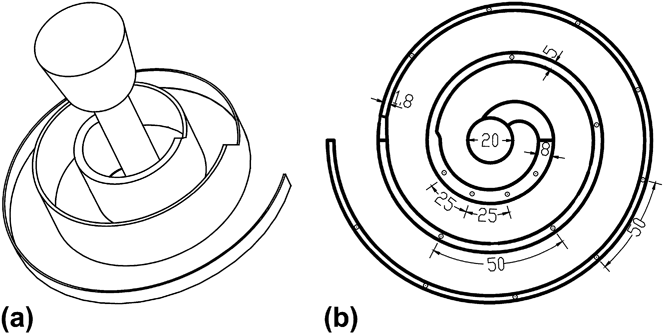
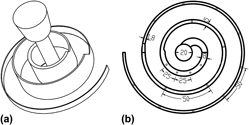
The IN718C alloy was used as the master alloy with following chemical composition (wt%): 0.056 C, 0.01 Co, 52.54 Ni, 19.15 Cr, 3.11 Mo, 0.61 Al, 0.94 Ti, 5.03 Nb, 0.0026 B, 0.028 Zr, and the rest Fe. B with different contents between 0 and 0.0044 wt% and Zr with contents between 0 and 0.021 wt% were added prior to pouring as the minor alloying elements. Each 1.5 kg ingot was investment cast into a specially designed fluidity test mold with 125, 250, and 500 mm in length and with 8, 5 and 1.8 mm in thickness (Fig. 1). These bars were processed using a vacuum induction melt furnace. The pouring temperature and mold preheating temperature were kept at 1470 °C and 900 °C respectively in all cases.
Fluidity test model: (a) the shape of model; (b) the dimensions of the test model (dimensions in mm).

The isothermal solidification samples with size of 6 × 6 × 6 mm3 were cut from the ingots and put into graphite blocks with holes. The samples were surrounded by high-purity Al2O3 crucible. This packaging can protect effective melts from flowing out and oxidation during melting and solidification. After the isothermal solidification experiment, the graphite blocks were heated up to 1360 °C and held for 15 min, followed by cooling with the rate 5 °C/min to different isothermal solidification temperatures. The samples were held at these temperatures for 10 min followed by water quenching. The isothermal temperatures were selected in the range of 1290–1350 °C at an interval of 10 °C for the temperature region. The alloy ingots were sectioned along the transverse cross-section and samples were ground, polished, and subsequently chemically etched with a solution consisting of 15 g CuSO4, 3.5 mL H2SO4, and 50 mL HCl to expose microstructures. The distribution of the alloying elements was determined with Electron Probe Micro-Analyzer (EPMA). The segregation coefficient (k) is determined to be the ratio of the value of the average composition in the dendrite core over the average composition in the interdendritic region for each element. At least 15 dendritic cores and 15 interdendritic regions in transverse section were measured for each sample.
Tensile specimens were performed using an Instron 3382 universal test machine (Instron, Norwood, Massachusetts) at room temperature. The stress life of all specimens was determined at 650 °C and 620 MPa using a SATEC M3 stress life machine (Instron). Each data represents the average value of at least three samples tested.
III. RESULTS AND DISCUSSIONS
A. Fluidity
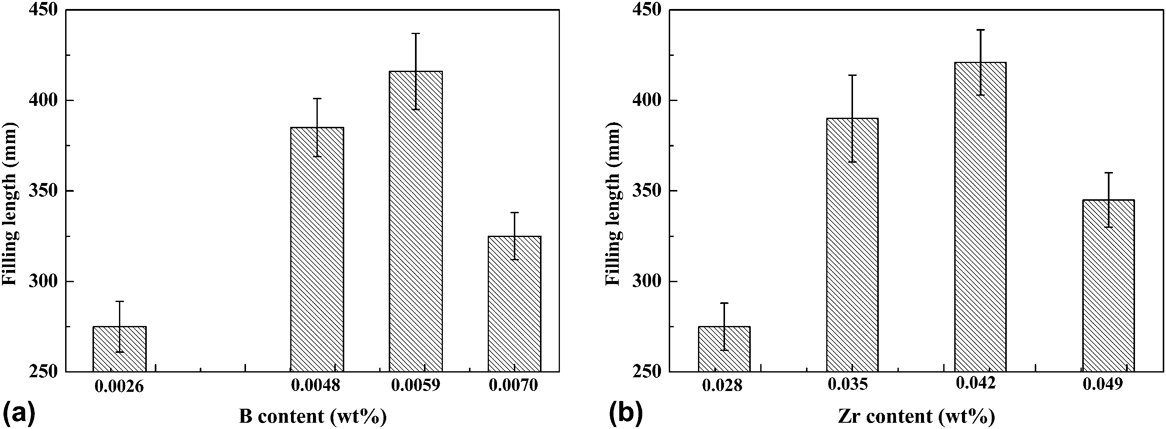
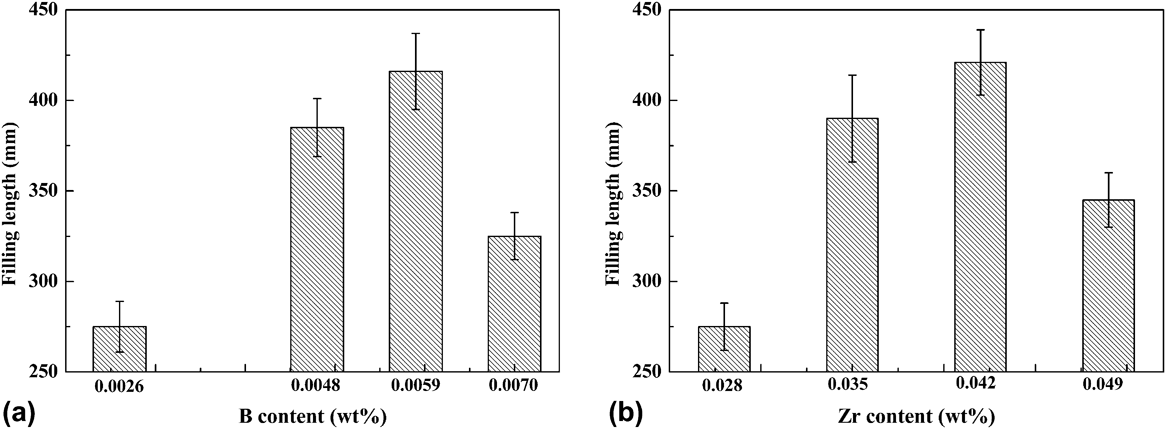
Fluidity is the distance in which a metal will flow in a test mold before it solidifies in casting terminology. Reference Campbell17 Therefore, fluidity is characterized by the flowing length of the alloy melt measured in unit of millimeters or meters. Reference Turen18 Figure 2 shows the influence of B and Zr content on the fluidity of IN718C superalloys. It can be seen that the modified IN718C superalloy presents longer fluidity length than the original IN718C superalloy, indicating that B or Zr addition can improve the casting fluidity of the alloy. When B content is 0.0059 wt%, the modified IN718C superalloy exhibits the best casting fluidity. Furthermore, adding Zr to IN718C superalloy, its filling length increases with increasing Zr content, but decrease rapidly as the Zr content exceeds 0.042 wt%.
Effects of B (a) and Zr (b) on fluidity of IN718C superalloy.
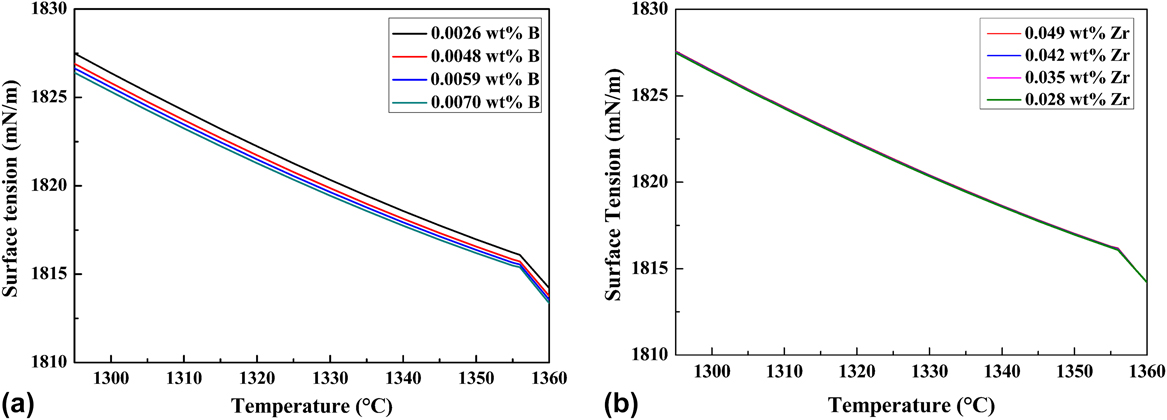
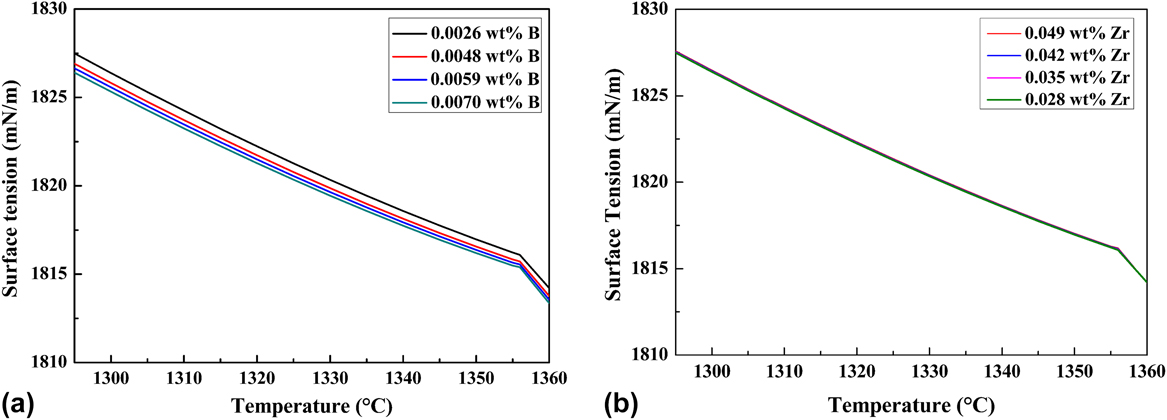
The surface tension and fraction of liquid are the most important parameters which affect the fluidity of a molten metal. Reference Sin and Dube19 During the filling process of thin sections, the surface tension of the molten metal must be reduced in order for the molten to be introduced into the mold. Reference Sin and Dube19 It is expected that B and Zr as surface active elements decrease the surface tension of molten superalloy leading to an increase in the fluidity. Figure 3 shows effect of B and Zr on the surface tension of superalloys calculated by JMatPro. It can be seen that B can reduce the surface tension of the melt [Fig. 3(a)]. However, the calculation results showed that Zr addition does not have any effect on the surface tension of the melt [Fig. 3(b)]. It is well known that the surface tension of any solvent can be markedly reduced by the presence of relatively low levels of certain solute elements that are preferentially adsorbed at the surface or interface. It means that B may lower the surface tension of residual liquid because the enrichment of B in the liquid can promote the fluidity.
Effect of B (a) and Zr (b) on the surface tension of IN718C superalloy calculated by JMatPro.
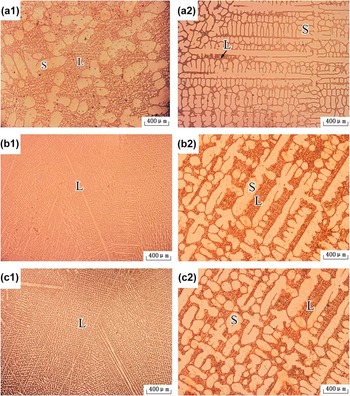
Alloys, on the other hand, solidify in a mushy manner. The melt finally stops to flow when a critical fraction solid is reached where the dendrites impinge, giving a significant increase of viscosity of the slurry. Reference Campbell17 In general, however, the flow of liquid is arrested when the volume fraction of solid is between 25 and 50%. Figure 4 shows that B and Zr influence of the microstructure after isothermal solidification followed by quenching, which reveals the relationship between the liquid volume fraction, composition, and temperature during the solidification process. The solidified (S) and liquid (L) regions are identified by the coarse dendrites and ultrafine quenched dendrites, respectively. At 1330 °C, all alloys are completely melted to become liquids. At 1320 °C, the liquid fraction of master alloy (0.0026 wt% B, 0.028 wt% Zr) drops to be 75%. However, the alloy containing 0.0059 wt% B or 0.042 wt% Zr is fully liquid (Fig. 4). At 1310 °C, the interdendritic-melt of master alloy diminishes rapidly and the liquid volume fraction reaches 15.7%. In contrast, the liquid volume fraction of the alloy containing 0.0059 wt% B reaches to 55% and the alloy with 0.042 wt% Zr drops to 51% respectively. So, it can be concluded that B or Zr increase the volume fraction of the residual liquid in B and Zr containing alloys, consequently, promoting the fluidity.
Effects of B and Zr additions on the microstructure of IN718C superalloy at different temperature: (a1) 0.0026 wt% B, 0.028 wt% Zr, 1320 °C, (b1) 0.0059 wt% B, 1320 °C, (c1) 0.042 wt% Zr, 1320 °C, (a2) 0.0026 wt% B, 0.028 wt% Zr, 1310 °C, (b2) 0.0059 wt% B, 1310 °C, (c2) 0.042 wt% Zr, 1310 °C.

B. Segregation behavior and microstructure
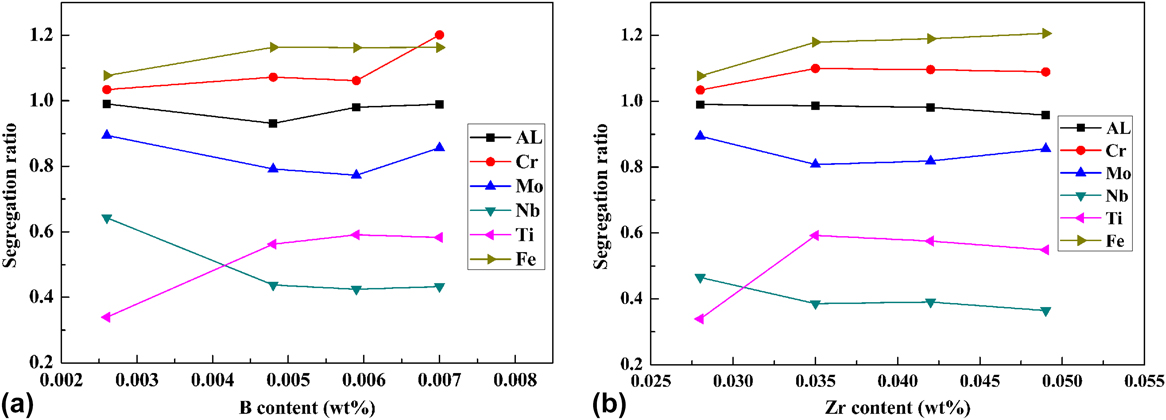
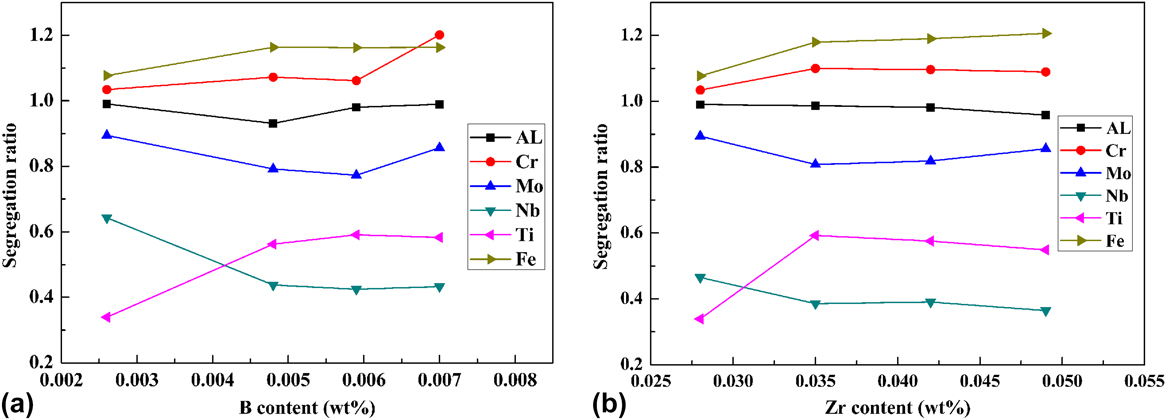
Figure 5 shows the result of the segregation coefficient tested by EPMA. It can be found that Nb and Mo exhibit strong segregation behavior in IN718C superalloy. With the proceeding of solidification, Al, Ti, Nb, and Mo segregate to the interdendrite region and the segregation of Nb and Mo are more severe. However, Cr, and Fe tend to be depleted in the dendrite core. It is also demonstrated that B and Zr have greatly promoted Nb and Mo segregation and have great impact on the last stage solidification process. However, B and Zr have alleviated the Ti segregation. B and Zr are intermittent atoms which impede elements diffusion of larger atomic radius such as Nb and Mo. Therefore, B and Zr promote segregation of Nb. Reference Ping, Gu, Cui and Harada20,Reference Dong, Zhang, Xie and Thompson21
Effects of B (a) and Zr (b) on segregation coefficients of IN718C superalloy.
Figures 6 and 7 present B and Zr on the microstructure and quantitative analysis results of IN718C superalloy. In the master alloy, two kinds of morphologies are observed regarding the Laves phase: the eutectic Laves and the blocky Laves [Fig. 6(a)]. For alloys with B addition, the volume fraction of laves phase decrease with increasing the content of boron, but B addition does not cause a change in the Laves phase morphology. It can be seen from Fig. 7, with the increase of Zr content, the morphology of Laves phase is changed. When the content of Zr increased from 0.035 wt% to 0.049 wt%, the volume fraction of eutectic Laves phase decreased, whereas the volume fraction of blocky Laves phase increased [Fig. 7(e)]. The total content of Laves phase decreased with the increase of content of Zr. It is considered that B and Zr segregate to the grain boundary area, which may reduce the diffusion rate at the grain boundary and delay the formation of Laves phase. Reference Xiao, Chen and Chaturvedi22–Reference Alam, Felfer, Chaturvedi, Stephenson, Kilburn and Cairney24
Effect of B on the microstructure and quantitative analysis results of IN718C superalloy: (a) 0.0026 wt% B, (b) 0.0048 wt% B, (c) 0.0059 wt% B, (d) 0.0070 wt% B, (e) quantitative analysis results.

Effect of Zr on the microstructure and quantitative analysis results of IN718C superalloy. (a) 0.028 wt% Zr, (b) 0.035 wt% Zr, (c) 0.042 wt% Zr, (d) 0.049 wt% Zr, (e) quantitative analysis results.

The composition of the Laves phase was investigated by EPMA, as shown in Table I. It is also noted that Zr is segregated in the Laves phase, which confirms that Zr is prone to enriching into the residual liquid. As estimated, the appearance of laves phase is the result of severe Nb segregation in the last stage of the solidification process. From Fig. 5, it can be seen that B and Zr promote the Nb segregation, which produces the massive Laves phase. It has been previously reported that the content of Nb and Mo in the blocky laves phase were higher than in the eutectic Laves phase. Reference Miao, Shan, Lu and Song11 So, the fraction of blocky Laves phase increase, while eutectic Laves decrease due to the stronger segregation of Nb and Mo. Nakagawa has found that Cr combines with Zr, Nb, and Ti elements, and TiCr2, ZrCr2, and NbCr2 Laves phase are formed due to the ideal atomic size ratio of Zr and Cr. Reference Nakagawa, Ohta, Kaneno, Inoue and Takasugi25 Therefore, Zr-bearing Laves phase is formed.
Composition of Laves phase

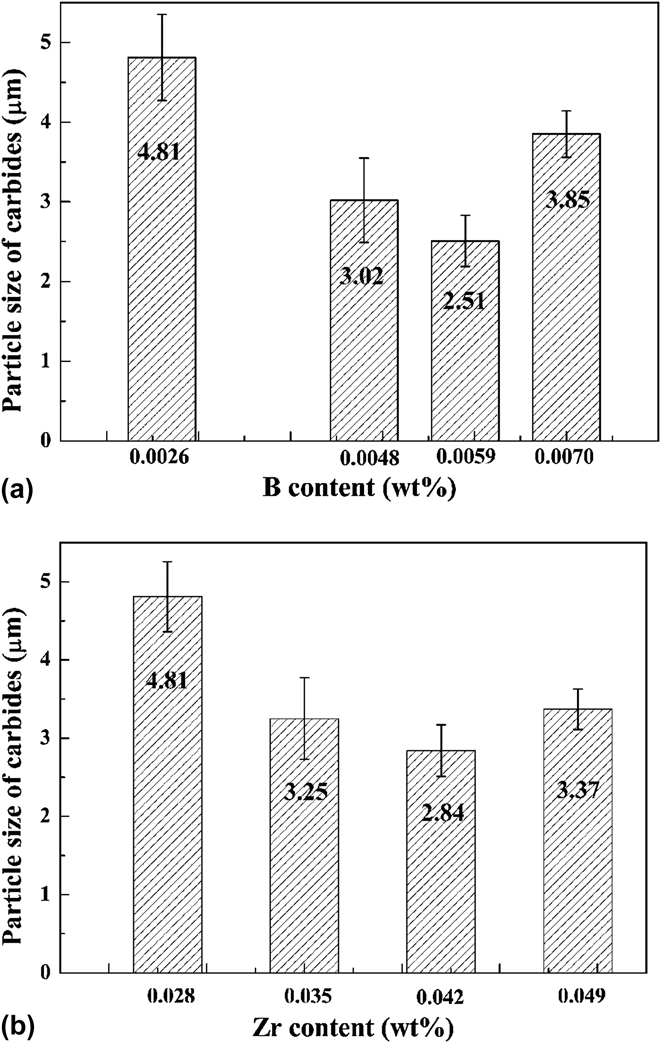
Figure 8 shows the results of the image analysis for the carbides in the IN718C superalloy with various B or Zr contents. The area fraction of the carbides (ranging from 2.56 to 2.73%) in the IN718C superalloy was not obviously affected by B and Zr content. As shown in Fig. 8(a), the carbides in the IN718C alloy with 0.0026 wt% B exhibited an average size of 4.81 μm, whereas, with 0.0059 wt% B, the particle size of the carbides in the IN718C alloy was reduced to 2.51 μm. Moreover, in Fig. 8(b), the carbides in the IN718C alloy with 0.028 wt% Zr exhibited an average size of 4.81 μm, whereas, with 0.042 wt% Zr, the particle size of the carbides in the IN718C alloy was reduced to 2.84 μm. Thus, the elongated or coarse carbides were turned into particle-like carbides due to the micro-addition of B or Zr in the IN718C superalloy. Studies have also shown that adding B or Zr to superalloy could be an effective method to refining the carbides and improving mechanical properties. Reference Tsai, Wang, Bor and Hu12,Reference Garosshen, Tillman and Mccarthy23,Reference Li, Liu, Liu, Wang and Hao26
Effects of B (a) and Zr (b) on carbides size in IN718C superalloy.

C. Mechanical properties
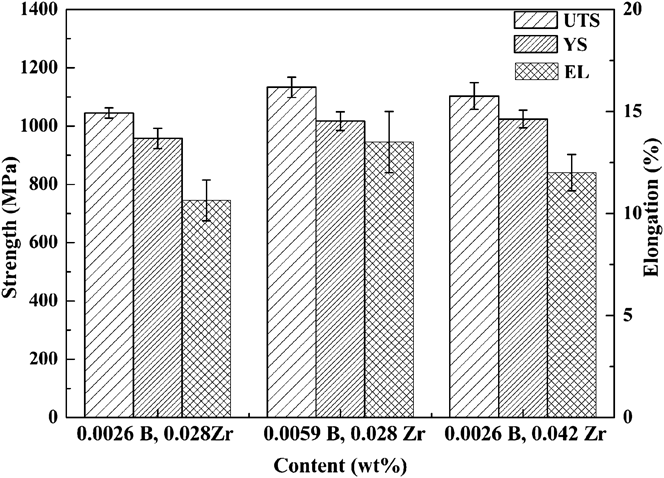
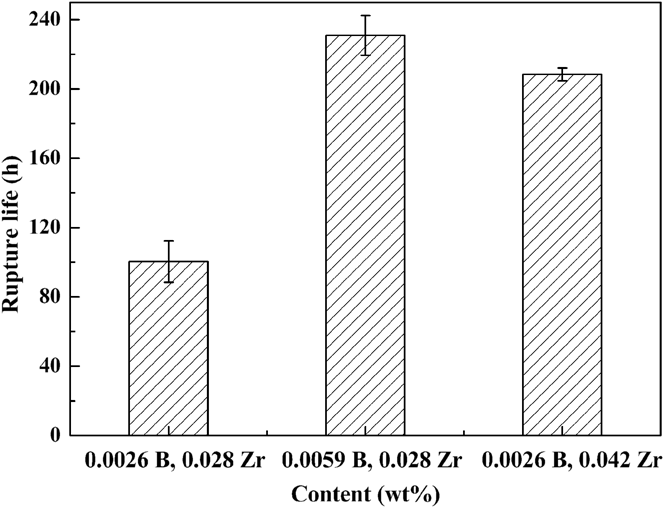
Figure 9 shows the dependence of the ultimate tensile strength (UTS), yield strength (YS), and elongation (EL) of IN718C superalloy depending on its B and Zr content, respectively. Evidently, UTS and YS increase with addition of B and Zr to IN718C superalloy. It was noted that the UTS and YS of IN718C superalloy increased from 1044 to 1133 (i.e., a 8.5% increase) and from 957 to 1017 MPa (i.e., a 6.26% increase) by 0.0059 wt% B respectively. In addition, the UTS and YS of IN718C superalloy increased from 1044 to 1103 (i.e., a 5.6% increase) and from 957 to 1024 MPa (i.e., a 7% increase) by 0.042 wt% Zr respectively. The elongation (EL) was increased slightly with the additions of B and Zr (Fig. 9). Moreover, stress rupture life, was altered notably by B and Zr additions, as shown in Fig. 10. It was noted that the time to rupture of the master alloy is 100.35 h. However, the time to rupture for the alloy with 0.042 wt% Zr increased from 100.35 h to 208.4 h at 650 °C and 620 MPa. The time to rupture of IN718C containing 0.0059 wt% B increased from 100.35 h to 230.9 h.
Effects of B and Zr on tensile properties of IN718C superalloy.

Effect of B and Zr on stress life of IN718C superalloy.

The fracture surfaces and longitudinal sections near the fracture surface of the tensile specimens are shown in Fig. 11. The SEM images of tensile fracture surfaces indicate that fracture mode exhibit a mix-fracture model. The main feature of fractural surface is some dimples at cleavage surfaces. As shown in Fig. 11(a), the dimples have a characteristic of shallow and a little. However, there are large number of finer dimples in the alloys contain B and Zr [Figs. 11(b) and 11(c)]. So, the strength and ductility of the modified alloy are increased. In addition, as can be seen from Fig. 11(d), there is porosity or Laves cracking in the matrix in the longitudinal section near the fracture surface, which means that the porosity and Laves phase show significant effect on the initiation and growth of tensile cracks in the master alloy. However, there is less porosity and Laves phase in the fracture surface, thus the strength and ductility of the modified alloy is increased by adding suitable B and Zr [Fig. 11(d)].
Fracture morphologies [(a)–(c)] and longitudinal section of fracture [(d)–(f)] of the tensile test: [(a) and (d)] master alloy, [(b) and (e)] 0.0059 wt% B, [(c) and (f)] 0.042 wt% Zr.

It was reported that additions of B and Zr increased grain boundary cohesion and prevented from microcrack formation at grain boundaries, and thus improve the strength and rupture life time. Reference Xiao, Chen and Chaturvedi9,Reference Zhou, Yu, Sun, Guan and Hu10,Reference Tsai, Wang, Bor and Hu12–Reference Huang and Koo14 Xiao et al. Reference Xiao, Chen and Chaturvedi9 reported that fraction of intergranular cracking on the fracture surface was decreased with an increase in B concentration from 0.0026 wt% to 0.006 wt% in IN718. This result supports the views that B segregation has a beneficial effect on the cracking resistance of IN718 by way of the increased grain cohesion. In addition, grain boundaries are also the barrier of dislocation movement, dislocation impinges on grain boundary to form pileups. Reference Xiao, Chen and Chaturvedi9,Reference Li, Liu, Liu, Wang and Hao26,Reference Tytko, Choi, Klower, Kostka, Inden and Raabe27 Stress and strain concentrations in the grain boundary region, induced by the lack of a sufficient number of slip systems between the grains, can be accommodated by crack propagation, depending on the cohesive strength of the grain boundaries of material. To prolong the rupture life the grain boundary cohesion can be improved by adding grain boundary strengthening elements (B and Zr). Reference Thuvander and Stiller28,Reference Richards and Chaturvedi29 The fracture surfaces of the rupture life specimens are shown in Fig. 12. It can be seen that the main feature of fractural surface is the fractural model, which is still a mix-fracture. The amount of dimples obviously increases and the characteristic of transgranular fracture becomes obvious by way of adding suitable B and Zr [Figs. 12(b) and 12(c)]. This means that there is an increase of grain boundary strength. Moreover, the influence of Zr is also believed to be involved in the removal of sulfur from the grain boundaries and the lowering of grain boundary diffusion rates. Reference Garosshen, Tillman and Mccarthy23 The optimum concentrations of B and Zr depend somewhat on the base composition of the alloy. But in most alloys that contain B and Zr, it is typically of the order of 0.006 wt% B and 0.05 wt% Zr. Reference Floreen and Davidson15,Reference Garosshen, Tillman and Mccarthy23 In our work, the amount of B and Zr is not exceeding this range.
Fracture morphologies of rupture life: (a) master alloy, (b) 0.0059 wt% B, (c) 0.042 wt% Zr.

Moreover, the addition of B and Zr greatly improves the distribution of the carbides at the grain boundary. The particle-like carbides precipitated at grain boundaries could increase the strength of grain boundaries and improve the mechanical properties, since carbides can postpone crack extension and avoid the grain boundaries sliding. Reference Bae, Lee, Kim and Jo30–Reference Yang, Zheng, Sun, Guan and Hu32 Therefore, alloys with additions of B and Zr have a higher strength and a longer time to rupture than the master alloy.
IV. CONCLUSION
-
(1) The fluidity is greatly improved by adding B and Zr, subsequently enhancing casting performance. As the B and Zr content increases, the fluidity firstly increases and then decreases. When the content of B and Zr is 0.0059 wt% and 0.0420 wt%, respectively, the optimum fluidity is obtained at pouring temperature of 1470 °C.
-
(2) B and Zr greatly promote Nb and Mo segregation and alleviate the Ti segregation. It is found that Zr additions may promote the formation of blocky laves phase and result in the existence of Zr-bearing Laves phase. However, boron does not influence the morphology of Laves phase.
-
(3) The alloy contains 0.0059 wt% B or 0.042 wt% Zr, the tensile and stress life are obviously improved.
ACKNOWLEDGMENTS
This work was supported by the Aeronautical Science Foundation of China (2015ZE53059, 2015ZF53067), National Natural Science Foundation of China (51472200, 51272211, 51331005); Research Fund of the State Key Laboratory of Solidification Processing in NWPU (93-QZ-2014, 132-QP-2015, SKLSP201302), Project of Shaanxi Provincial Youth Science and Technology Star Plan (2015KJXX-08), Fundamental Research Funds for the Central Universities (G2015KY0002) and the Natural Fund Project of the Education Department of Shaanxi Province (14JK2052).