What are the effects of international awards such as the Nobel Peace Prize on human rights? Do they improve human rights conditions? We answer those questions using psychological theories and natural experiments in the case of women’s rights. We argue that international awards can signal the reliability of a recipient women’s rights activist to citizens across the world. Although the signal pertains only to a specific recipient, it can reassure, persuade, and pressure people to express trust in women’s rights activists in general. Thus, we hypothesize that international awards have sizable impacts on public opinion and behavior.
We substantiate these claims by analyzing individual-level surveys. We exploit the as-if random coincidence between the announcement of the Nobel Peace Prize and the dates of the survey interviews (Muñoz, Falcó-Gimeno, and Hernández Reference Muñoz, Falcó-Gimeno and Hernández2020). The analysis indicates that when the Nobel Peace Prize was awarded to women’s rights activists, it increased people’s trust in women’s organizations. The analysis of causal mechanisms implies that the prize pressured conservative people to amend their attitudes. Moreover, we find that the effect was not limited to public opinion; violence against women also decreased when the Nobel Peace Prize was awarded to women’s rights activists. However, these changes did not last long. Overall, these results suggest that the Nobel Peace Prize had sizable real-world impacts, but the effects were short-lived.
The new theories and findings shed light on the crucial roles of positive symbolic actions in international relations—what we call “prize and praise.” Despite the plethora of studies about the effects of “naming and shaming” on human rights (e.g., NGOs’ blaming of human rights violations),Footnote 1 little attention has been given to positive symbolic actions such as the Nobel Prizes, the UN Human Rights Prize, Right Livelihood Award, Templeton Prize, and positive statements in the OHCHR human rights reports.Footnote 2 However, as studies on electoral campaigns suggest (Lau and Rovner Reference Lau and Rovner2009), the effects of positive and negative campaigns can differ. While negative campaigns can only denounce human rights violators and spread their negative image, positive campaigns can spotlight human rights activists and enhance their reputation. This study balances the literature by focusing on the roles of positive symbolic actions in human rights issues. Also, in contrast to Krebs (Reference Krebs2009), who has developed a typology and conducted case studies of eight Nobel Peace Prizes, we provide micro-level theories and quantitative evidence by focusing on the prizes awarded to women’s rights activists.Footnote 3
Moreover, by examining international awards, we highlight how the international community can help women’s rights activists. Previous studies have analyzed women’s rights activists and their tactics, such as demonstrations (Weldon Reference Weldon2006; Htun and Weldon Reference Htun and Weldon2012) and international campaigns (Paxton, Hughes, and Green Reference Paxton, Hughes and Green2006; Murdie and Peksen Reference Murdie and Peksen2015; Donno, Fox, and Kaasik Reference Donno, Fox and Kaasik2022). However, those tactics may not work if the women’s rights groups lack popular support. While the literature has emphasized the roles of national legislation and media in this respect (Huddy, Neely, and Lafay Reference Huddy, Neely and Lafay2000; Neumann Reference Neumann2017; Arias Reference Arias2019; Green, Wilke, and Cooper Reference Green, Wilke and Cooper2020; Htun and Jensenius Reference Htun and Jensenius2022), we examine how the international community can legitimize and thus boost the popular support across the world, suggesting an international origin of legitimacy (Finnemore and Sikkink Reference Finnemore and Sikkink1998; Keck and Sikkink Reference Keck and Sikkink1998; Ferree and Tripp Reference Ferree and Tripp2006).
Empirically, we incorporate recent innovations in public diplomacy studies—natural experiments with survey dates—into the literature on gender and politics (Muñoz, Falcó-Gimeno, and Hernández Reference Muñoz, Falcó-Gimeno and Hernández2020; Goldsmith, Horiuchi, and Matush Reference Goldsmith, Horiuchi and Matush2021). Unlike other observational studies and survey experiments, this approach allows us to achieve a crucial balance between internal (i.e., causal identification) and external validity (i.e., analysis of real-world events). In doing so, we also expand the scope of public diplomacy studies to women’s rights issues. This is particularly important as the literature on public diplomacy has rather narrowly focused on states without examining the roles of non-state actors such as women’s rights groups.
Finally, our study suggests that the Nobel Peace Prize caused social desirability biases in survey responses (Gove and Geerken Reference Gove and Geerken1977). The analysis indeed indicates that the prize pressured conservative people to tentatively express positive attitudes toward women’s organizations. The fact that the even seemingly subtle event—the Nobel Peace Prize—induced social desirability biases implies that respondents can very carefully choose their survey answers. This study therefore sheds light on a source of social desirability biases, which should help the implementation and analysis of survey data in future studies.
International Awards as Credible Symbols
Contemporary women’s rights activists—or, more broadly, norm entrepreneurs (Finnemore and Sikkink Reference Finnemore and Sikkink1998)—face problems that are different but similarly difficult as those of earlier activists. As Finnemore and Sikkink (Reference Finnemore and Sikkink1998) state in the case of suffragists in the nineteenth and twentieth centuries, the main obstacles for earlier activists were the lack of public information, popular interests, and civil organizations. Therefore, earlier activists needed to disseminate information, cultivate popular support, and create organizational platforms. In contrast, the present world is characterized by the influx of (mis)information and the abundance of diverse women’s rights organizations. Almost every country has multiple, and often numerous, women’s rights groups (Murdie and Peksen Reference Murdie and Peksen2015), and the Internet and social media provide immense information about feminism, women’s rights, and women’s organizations.
The abundance of information and organizations creates the problem of adverse selection. Even if people wish to support a women’s rights movement, they are uncertain whether a given activist is the one they would like to support. The activist can be too extreme (e.g., anarchist feminist), dissembling a feminist for other political objectives (e.g., communism), or even just a scam. Even worse, conservative opponents can spread misinformation and label the activist as a “radical feminist” or “femspeak” (Bloomfield Reference Bloomfield2016; Sanders Reference Sanders2018). With this uncertainty, people may consider that the self-claimed “women’s rights activist” may not be the one that they would like to support. For instance, in the World Value Survey (2022), 18,986 respondents chose gender discrimination as the most or second most serious issue in their countries, but only 20% of them had the highest trust in women’s organizations, and over one-third of them expressed low or the lowest trust. Without additional measures, people cannot easily trust women’s rights activists.
Women’s rights groups can address potential adverse selection by taking actions that are too costly for unreliable groups or by receiving external validation. Although the former includes petitions and demonstrations, other groups, such as extreme feminists, can also take those measures, making it difficult for reliable groups to send credible signals. By contrast, only reliable groups can receive external validation from reputable organizations, such as international awards and collaboration with reputable governments and international organizations. Thus, we focus on one of the most reputable and hence widely known approaches for external validation: the Nobel Peace Prize.
We argue that the Nobel Peace Prize credibly and symbolically signals the reliability of women’s rights activists to people across the world, thus addressing the problem of adverse selection.Footnote 4 As theories of rational updates suggest (Little Reference Little2022), the prize should boost people’s trust in recipient women’s rights activists. The Nobel Committee spends substantial money, time, and effort to select winners. The Nobel Committee would bear these costs only if they seriously intend to honor women’s rights activists (costly signaling; Fearon Reference Fearon1997). Moreover, even though the Nobel Peace Prizes have sometimes been controversial and their reputation has been occasionally tarnished (e.g., Abiy Ahmed in 2019), the committee also cares about its own reputation and, thus, is incentivized to award only reliable activists. With these incentives, the prize credibly signals the reliability of a recipient women’s rights group.
Rational Update: Null Hypothesis
However, this does not mean that people receive those signals or update their beliefs. People may not be informed of or interested in the prize. Moreover, rational peopleFootnote 5 should not hastily generalize the Nobel Peace Prize to the broader population of women’s rights activists. In fact, the “sample size” is too small; the prize is awarded to only one or a few activists. Given the abundance of women’s rights activists, people cannot make definite inferences about a population based on one or a few observations. More importantly, the Nobel Committee “cherry-picks” prominent activists (see the case section for details of the selection process). This means that the sample is not just small but biased; the Nobel laureates are systematically different from other women’s rights activists; thus, people cannot make valid inferences about the population. Overall, there are good reasons to believe that the Nobel Peace Prize does not affect people’s confidence in women’s rights activists in general.
H0: When the Nobel Peace Prize is awarded to women’s rights activists, it does not change people’s confidence in women’s rights groups.
Biased Update: Alternative Hypothesis
Psychological theories, however, suggest alternative possibilities. Generalization bias refers to the human tendency to hastily generalize from a small or biased sample (Tversky and Kahneman Reference Tversky and Kahneman1971; Kahneman and Tversky Reference Kahneman and Tversky1972). Even when a sample is small or biased, people tend to perceive that the sample is informative and thus make inferences about a population. From this perspective, people can hastily generalize the Nobel Peace Prize to a broader population, regardless of the sample size or selection biases.
Indeed, previous studies have found that women politicians are role models for women, reduce gender stereotypes (Dasgupta and Asgari Reference Dasgupta and Asgari2004), increase both women’s and men’s political efficacy (Atkeson and Carrillo Reference Atkeson and Carrillo2007; Reingold and Harrell Reference Reingold and Harrell2010; Fridkin and Kenney Reference Fridkin and Kenney2014), and thus induce various political activities such as political discussion (Campbell and Wolbrecht Reference Campbell and Wolbrecht2006; Wolbrecht and Campbell Reference Wolbrecht and Campbell2007; Mariani, Marshall, and Mathews-Schultz Reference Mariani, Marshall and Mathews-Schultz2015), electoral participation (Broockman Reference Broockman2014; Gilardi Reference Gilardi2015; Ladam, Harden, and Windett Reference Ladam, Harden and Windett2018), and demonstrations (Barnes and Burchard Reference Barnes and Burchard2013). In other words, people overgeneralize the characteristics of a single prominent figure to make inferences about women, gender, and politics. By extending this logic, we can hypothesize that the Nobel Peace Prize provides a role model of a women’s rights activist (not only a woman; an activist can be male) and thus increases people’s confidence in women’s rights activists in general.
H1: When the Nobel Peace Prize is awarded to women’s rights activists, it increases people’s confidence in women’s rights groups.
Evaluation: Causal Mechanisms
Not only do psychological biases influence how people receive information, but they can also change how people evaluate the information. Indeed, psychological studies indicate that people differently evaluate information, depending on their prior beliefs (Brashier and Marsh Reference Brashier and Marsh2020). This implies that the effect of the Nobel Peace Prize depends on people’s baseline gender values—the beliefs, attitudes, and principles about gender roles. For brevity, we refer to people who emphasize gender quality as “liberal,” those who are neutral or less interested in gender issues as “neutral,” and those who emphasize gender differences as “conservative.”
One possibility is that the prize reassures the reliability of women’s rights activists among liberal people. As is well known in social psychology, people tend to accept information that is consistent with their beliefs (i.e., confirmation bias; see Klayman Reference Klayman1995 for a review). The Nobel Peace Prize can confirm the beliefs of liberal people, reinforcing their trust in women’s rights activists. Although reassurance may not bring large changes as liberal people tend to support women’s rights activists regardless of the Nobel Peace Prize, the prize can still address the adverse selection problem and thus remove remaining concerns. The reassurance mechanism therefore suggests that the Nobel Peace Prize reinforces and thus increases liberal people’s confidence in women’s rights activists.
Another possibility is that the Nobel Peace Prize persuades people who are otherwise neutral or less interested in gender issues. Because those people tend to have less information and diffuse preferences about gender issues, there is room for change. By contrast, liberal and conservative people tend to have more information and fixed beliefs, making it difficult to alter their beliefs (i.e., ceiling effect; Gove and Geerken Reference Gove and Geerken1977). The persuasion mechanism thus implies that the Nobel Peace Prize sways neutral people’s opinions about women’s rights activists.
Yet another possibility is that the Nobel Peace Prize pressures conservative people to follow the norm of gender equality and not make discriminatory statements or acts. Although their fundamental beliefs are unlikely to change, conservative people may comply with the pressure. As the prize positively changes the opinions of liberal and neutral people, the social and peer pressures make it more difficult to openly question gender equality (social desirability bias; Gove and Geerken Reference Gove and Geerken1977). The pressure mechanism therefore expects that the Nobel Peace Prize tentatively improves conservative people’s attitudes, if not beliefs, toward women’s rights activists.
Alternatively, conservative people can backlash against the pressure and take even more conservative attitudes (Hafner-Burton Reference Hafner-Burton2008; Krebs Reference Krebs2009; Gruffydd-Jones Reference Gruffydd-Jones2019; Snyder Reference Snyder2020; Cupać and Ebetürk Reference Cupać and Ebetürk2021; Lyon Reference Lyon2023). Conservative people may feel that their traditional gender values are threatened and thus emotionally backlash (i.e., backlash effect; Hornung, McCullough, and Sugimoto Reference Hornung, McCullough and Sugimoto1981). If this is the case, even when the Nobel Peace Prize increases the average confidence in women’s rights groups, the effect can be negative for conservative people. Thus, the backlash mechanism implies that the Nobel Peace Prize aggravates conservative people’s attitudes toward women’s rights activists.
Table 1 summarizes the causal mechanisms. Although the mechanisms are not mutually exclusive (multiple mechanisms can simultaneously work) or collectively exhaustive (other mechanisms can exist), they imply that the effects crucially depend on baseline gender values. Table 1 also indicates that the effects are positive except for the backlash mechanism. Thus, unless conservative people comprise a majority of a sample, the average effect should be an increase in people’s trust in women’s rights activists.
Causal mechanisms

Notes:
 $ + $
and
 $ - $
indicate an increase and decrease in the confidence in women’s rights groups, respectively. The relevant populations are in parentheses. “Liberal” people refer to those who emphasize gender quality, “neutral” people refer to those who are neutral or less interested in gender issues, and “conservative” people refer to those who emphasize gender differences.
Case: The Nobel Peace Prize
The Nobel Peace Prize is the most distinguished among many international awards, making it the most likely case for the hypothesis. Indeed, global and local media broadcast the winners of the prize every year, and the names of the laureates are extensively tweeted and googled. It is estimated that over 350 million households in 80–120 countries watch the prize ceremony (Johnsen Reference Johnsen, de Carvalho and Neumann2014). Baram-Tsabari and Segev (Reference Baram-Tsabari and Segev2015) also show that the Nobel Peace Prize gains immediate and the most durable attention among all Nobel Prizes; the global volumes of Google searches and online news reach their peaks immediately after the announcement of the prize, and it takes 16 and 137 days until the volumes are halved from their peaks, respectively. Figure 1 presents the volume of Google searches for each day from the announcement of the Nobel Peace Prize awarded to women’s rights activists between 2010 and 2020 (global; 0–100 scale).Footnote 6 The announcements of the prizes elicited immediate attention, which, however, dissipated within a few weeks. The attention regrew two months after the announcement, reflecting the award ceremonies. These results suggest that the Nobel Peace Prize is substantively relevant at least in the short term.
Google search volume before and after the Nobel Peace Prizes

Moreover, the selection process for the Nobel Peace Prize provides plausibly exogenous, if not completely random, variation. That is, even though the award is selective and potentially biased (Krebs Reference Krebs2009; Heffermehl Reference Heffermehl2010), it is difficult to precisely predict the winners. For instance, while the director of the Peace Research Institute Oslo (PRIO) has shortlisted possible winners since 2015, only two out of eight included the actual winners of a given year.Footnote 7 This implies that even the director of the PRIO, who should have in-depth knowledge, cannot predict the Nobel Peace Prize accurately. Thus, even though the Nobel Peace Prize reflects real-world changes and can potentially be biased, it usually comes with a surprise.
The unexpectedness stems, in part, from its secret process. The selection is delegated to the Nobel Committee comprising five members. The committee members are appointed by the Norwegian parliament and are usually composed of former ministers and parliamentary members (Johnsen Reference Johnsen, de Carvalho and Neumann2014). From September to the end of January, the Nobel Committee accepts nominations from qualified individuals, such as members of the Norwegian parliament and government, international organizations, university professors, and former laureates. For the next three months, the committee narrows down the nominees from over 300 to 20–30 candidates. After an intensive discussion and adviser review from April to August, the committee decides the winners through a majority vote at the beginning of October. The winners of the Nobel Peace Prize are publicly announced on the first Friday of October. The ceremony takes place on 10 December, and the winners receive 10 million Swedish kronor (approximately $1 million U.S. dollars).
This year-long process and the majority votes by five members make it difficult to accurately predict the winners, ensuring the unexpectedness of the award. However, this does not mean that the award would be randomly assigned. The Nobel Peace Prize is intended to award people who have advanced “fellowship among nations, the abolition or reduction of standing armies, and the establishment and promotion of peace congresses” (Nobel Prize 2022). Although human rights issues were not initially considered, their scope has expanded since the 1990s (Krebs Reference Krebs2009; Heffermehl Reference Heffermehl2010). In the analysis, we leverage the unexpectedness of the Nobel Peace Prize, while statistically accounting for the non-random selection of winners.
Contexts
The Nobel Peace Prizes thus provide a unique opportunity for analyzing the effects of international awards, yet it does not mean that the effects exist without contexts. Indeed, the prize can be better considered as a catalyst in a more gradual shift in international norms. For the study period (2006–2020), the gender-equality norms have steadily spread and been gradually internalized, though they are also contested by opponents (Sanders Reference Sanders2018; Cupać and Ebetürk Reference Cupać and Ebetürk2021; Sanders and Jenkins Reference Sanders and Jenkins2022). On October 31, 2000, the United Nations Security Council adopted the resolution S/RES/1325 on women, peace, and security, emphasizing the roles of women and gender in conflict resolution. Since 2003, the United Nations has also adopted a zero-tolerance policy regarding gender violence in peacekeeping operations. The global average proportion of women representatives in legislatures increased from 16% in 2006 to 25% in 2020,Footnote 8 reflecting the growing attention to gender equality. Indeed, while 28% of the respondents in the 2006 World Value Survey (WVS) answered that women should not have equal rights, this number became less than half in 2020 (12%; global averages in the WVS).
Moreover, as Alford (Reference Alford2008) shows, the meanings of the Nobel Peace Prize— what it signals, what roles it assigns, and how it constitutes identities and interests—have changed over time. The prize was initially intended to award politicians and jurists who have advanced “fellowship among nations, the abolition or reduction of standing armies, and the establishment and promotion of peace congresses” (Nobel Prize 2022). The scope has been expanded first to humanitarianists (e.g., International Committee of the Red Cross) and then to human rights and pro-democracy activists (e.g., Amnesty International; Dalai Lama). These shifts reflect the changing meanings of peace in international relations (Alford Reference Alford2008); the meanings of peace have been broadened to include poverty (e.g., Muhammad Yunus and Gramin Bank), climate change (e.g., Al Gore and Intergovernmental Panel on Climate Change), and women’s rights (e.g., Denis Mukwege and Nadia Murad). Similarly, while the prize was initially awarded for past achievements, it has been increasingly considered as a means for future changes (Krebs Reference Krebs2009; Adams Reference Adams2012).
The following analysis is built on those contexts and, thus, is unlikely to be generalized to other contexts. Moreover, the results can differ in other domains such as the awards for environmental activists, because the underlying contexts, norms, and meanings are different. Having said that, however, the theoretical and empirical frameworks can still be applied; although the theoretical predictions and empirical results can differ, the underlying logic and designs can be used in other contexts and domains. Thus, while admitting the limitations, we leave it to the task of future studies to further explore the generalizability of our theory and empirical findings.
Research Design
We analyze the effects of the Nobel Peace Prize on citizens’ confidence in women’s rights groups (Kikuta and Hanayama Reference Kikuta and Hanayama2024). To this end, we exploit two features: the unexpectedness of the Nobel Peace Prize just outlined, and, more importantly, the as-if random coincidence of survey interviews with the announcement of the Nobel Peace Prize (Muñoz, Falcó-Gimeno, and Hernández Reference Muñoz, Falcó-Gimeno and Hernández2020; Goldsmith, Horiuchi, and Matush Reference Goldsmith, Horiuchi and Matush2021). Because the dates of the survey interviews were predetermined and unlikely to be affected by the Nobel prizes, we can assume that respondents were as-if randomly assigned to interviews before or after the announcement of the prize. This as-if randomness, combined with the unexpectedness of the prize, allows us to identify causality.
However, some problems remain. The Nobel Peace Prize is announced a few days after the other Nobel prizes. Moreover, the Nobel Peace Prize is always announced on the first Friday of October. These features make it difficult to isolate the effects of the Nobel Peace Prize from those of other Nobel prizes and days of the week. We address these problems using the difference-in-differences (DiD). That is, we compare the changes in the outcome variable after the Nobel Peace Prize was awarded to women’s rights activists, to the baseline changes after the prize was awarded to other groups. Because we compare the differences across Nobel Peace Prizes, the confounding effects of the other Nobel prizes are canceled out. Moreover, because the prize is always announced on Fridays, the day-of-the-week effects are canceled out.
Sample and Unit
The unit of analysis is respondent
 $ i $
interviewed before or after the announcement of the Nobel Peace Prize
 $ k $
. We use data from the World Value Survey (WVS 2022). To the best of our knowledge, the WVS is the only dataset that tracks people’s confidence in women’s organizations over a long period. Other surveys, such as Afrobarometer and Gallup World Poll, have questions about women’s rights but do not ask questions about women’s rights groups. Given our theoretical focus, we use the WVS as the main sample.
The sample includes respondents who answered the fifth to seventh waves of the WVS within five days before or after a Nobel Prize between 2006 and 2020.Footnote 9 We do not limit the sample to respondents living in the laureates’ original countries, as the effect of the prize is unlikely to be limited to those countries.Footnote 10 Because respondents are as-if randomly assigned within each survey, we drop a country-wave if all respondents are interviewed either before or after a Nobel Peace Prize.Footnote 11 Following Goldsmith, Horiuchi, and Matush (Reference Goldsmith, Horiuchi and Matush2021), we use the five-day windows and conduct a robustness check with different time windows.Footnote 12 The resultant sample includes
 $ \mathrm{8,028} $
respondents in 14 countries between September 30, 2006 and October 19, 2020.Footnote 13 Summary statistics are provided in online appendix A1.
Outcome Variable
The outcome variable
 $ {confidence}_i $
is respondent
 $ i $
’s answer to a question: “could you tell me how much confidence you have in [Women’s organizations]: is it a great deal of confidence, quite a lot of confidence, not very much confidence or none at all?” (World Value Survey 2022).Footnote 14 We use both continuous and discrete outcome variables. The continuous variable takes
 $ -1.5 $
,
 $ -0.5 $
,
 $ 0.5 $
, and
 $ 1.5 $
from the most negative to the most positive choices, respectively.Footnote 15 Following Goldsmith, Horiuchi, and Matush (Reference Goldsmith, Horiuchi and Matush2021), we also create a separate dummy for each response (including “Don’t know”). We do not use parametric models such as ordered probit and leave them to robustness checks.Footnote 16
Treatment Variables
The first treatment variable
 $ {after}_{ik} $
takes 1 if respondent
 $ i $
is interviewed after the announcement of the Nobel Peace Prize
 $ k $
. Following Goldsmith, Horiuchi, and Matush (Reference Goldsmith, Horiuchi and Matush2021), we omit respondents interviewed on the days of the announcements as their treatment statuses are indeterminate. The second treatment variable
 $ {prize}_k $
takes 1 if at least one of the winners of the Nobel Peace Prize
 $ k $
is a women’s rights activist. For the survey period (2006–2020), we identify three prizes given to women’s rights activists: Ellen Johnson Sirleaf, Leymah Gbowee, and Tawakkul Karman in 2011; Malala Yousafzai in 2014; and Denis Mukwege and Nadia Murad in 2018.Footnote 17 Approximately one-third of the respondents answered the surveys in those years.
Specification
With these variables, we estimate the average treatment effect local to respondents who answered the survey question, by using a regression model:Footnote 18
 $$ {confidence}_i={\alpha}_{ck}+\beta \hskip0.5em {after}_{ik}+\delta \hskip0.5em {after}_{ik}\hskip0.5em {prize}_k. $$
The quantity of interest is
 $ \delta $
, which represents the effect of awarding the Nobel Peace Prize to women’s rights activists on people’s confidence in women’s organizations. As the respondents are as-if randomly assigned within each wave, the model includes a fixed effect for country-year
 $ {\alpha}_{ck} $
(Goldsmith, Horiuchi, and Matush Reference Goldsmith, Horiuchi and Matush2021). The country-year fixed effect also accounts for the non-random selection of the Nobel Peace Prize. Even though the treatment assignment probabilities may vary across countries and years, the fixed effect accounts for country-level heterogeneity and time trends.
Results
As seen in the first column of Table 2, when the Nobel Peace Prize was awarded to women’s rights activists, it increased the support for women’s organizations. The results with the discrete variables indicate that the treatment increased the highest confidence in women’s organizations, while decreasing the lowest, low, and even high confidence. Moreover, the last column indicates only negligible changes in the proportion of “don’t know” responses.
Effects of the Nobel Peace Prize on the confidence in women’s organizations

Notes: The table shows the estimated effect of awarding the Nobel Peace Prize to women’s rights activists on the confidence in women’s organization. The quantity of interest
 $ \hat{\delta} $
is the coefficient of the interaction term. The first column does not contain “don’t know” responses and thus the sample size is smaller. The standard errors robust to heteroscedasticity are in parentheses.
 $ \ast p<0.05,\dagger p<0.1 $
.
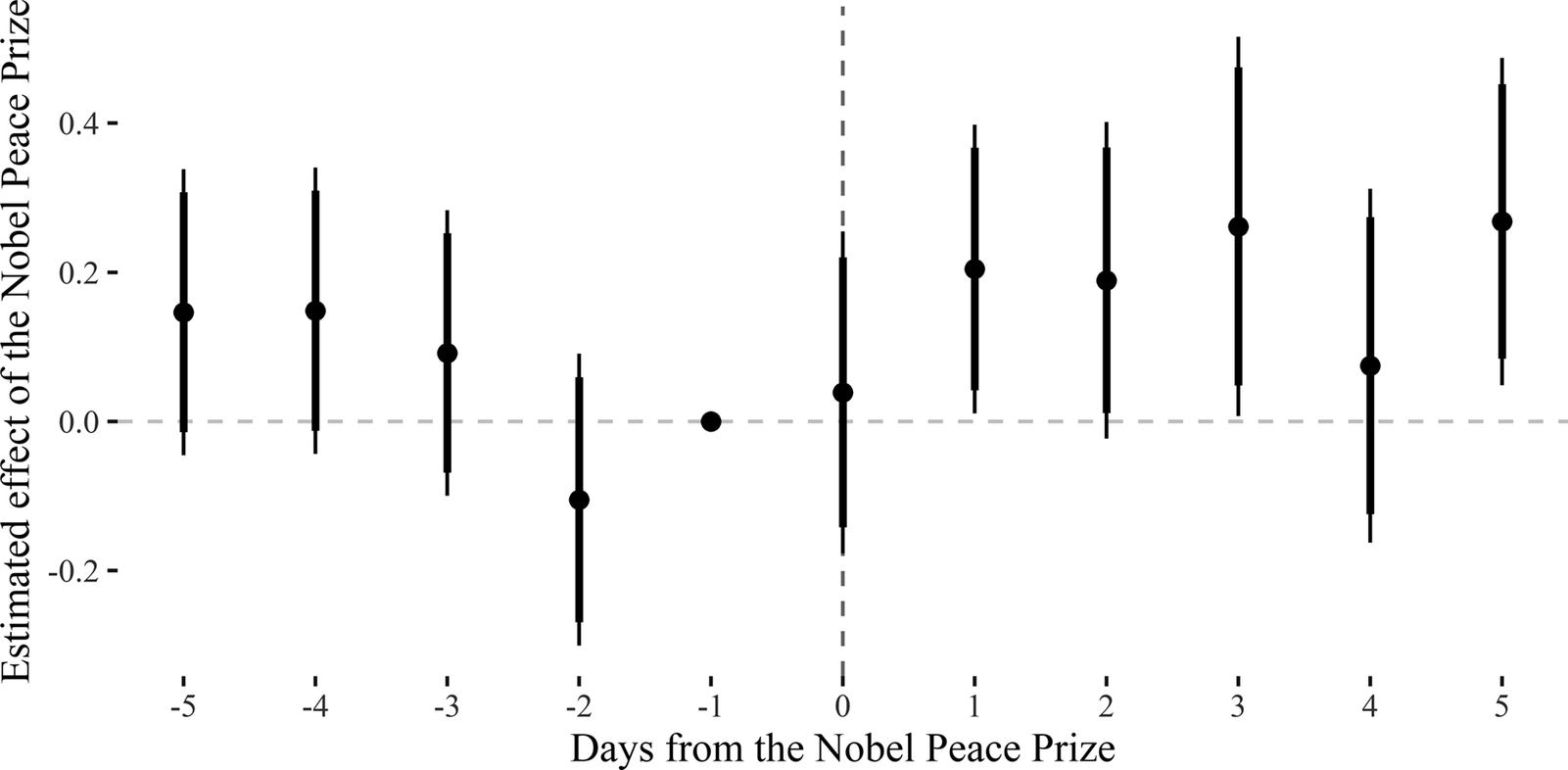
Figure 2 shows the results of the event study, where the continuous outcome variable is regressed on time dummies interacted with the treatment variable
 $ {prize}_k $
. The effects or trends were absent before the announcement of the Nobel Peace Prize (
 $ {T}_i<0 $
), indicating no clear violation of the common trend assumption. In contrast, after the announcement, the confidence in women’s organizations increased. The event study therefore also confirms the positive effect of the Nobel Peace Prize without indicating any violation of the identification assumption.
Event study
Note: The figure shows the results of the event study, where the continuous outcome variable is regressed on time dummies interacted with the treatment variable. The thick and thin vertical lines show the 90% and 95% confidence intervals, respectively. The standard errors are robust to heteroscedasticity.
 $ N=\mathrm{7,534} $
.

Moreover, in figure 3, we also compare the changes before and after the Nobel Peace Prize awarded to women’s rights activists (“Treated”) and those awarded to other groups (“Control”). As seen in figure 3, while there were no noticeable changes after the control cases, the confidence in women’s organizations increased after the prize was awarded to women’s rights groups. Figure 3 also implies that the positive differences five to three days before the prize in figure 2 reflect minor, and perhaps random, changes in the treated and control cases.
Comparison of the treated and control cases
Note: The figure compares the Nobel Peace Prize awarded to women’s rights activists (“Treated,” red solid lines) and those awarded to other groups (“Control,” gray dashed lines). The outcome variable is the continuous measure of the confidence in women’s organizations. The thick and thin vertical lines show the 90% and 95% confidence intervals, respectively. The standard errors are robust to heteroscedasticity.
 $ N=\mathrm{7,534} $
.

In figure 4, we also use different time windows for checking the robustness and, more importantly, examining long-term effects. The main results hold with 14 days or shorter time windows. However, the effects became smaller and indistinguishable from zero with larger time windows. This implies that the effect of the Nobel Peace Prize was short-lived; while the prize temporarily boosted the confidence in the women’s rights organization, the effect did not last long. This is not surprising given the transient attention to the Nobel Peace Prize (figure 1).
Results with different time windows
Notes: The figure shows the results with different time windows, where the sample contains respondents within
 $ h $
days before and after the announcement of the Nobel Peace Prize. The horizontal axis displays
 $ h $
. The thick and thin vertical lines show the 90% and 95% confidence intervals, respectively. The standard errors are robust to heteroscedasticity.

Causal Mechanisms
Although the results indicate the positive effect of the Nobel Peace Prize, it is still possible that the effects were heterogeneous across respondents. As we explained in the theory section, the Nobel Peace Prize can reassure the importance of women’s organizations among people who are already aware of gender issues, persuade neutral or less interested people, or pressure people who have conservative gender values. Moreover, conservative people can backlash against the pressure.
We examine these possibilities by creating an index of gender values and interacting it with the treatment variables. Based on four gender-related items in the WVS,Footnote 19 we apply the graded response model (GRM) to measure the latent gender values (Baker and Kim Reference Baker and Kim2004). We use the GRM because the indicators are ordinal. The resultant index is continuous with negative values for liberal gender values and positive values for conservative gender values (e.g., men are better political and business leaders, men should have more rights to jobs, and boys should be prioritized for higher education). Finally, following Hainmueller, Mummolo, and Xu (Reference Hainmueller, Mummolo and Xu2019), we calculate the tertiles of the gender value index and group the respondents into three categories of equal sizes—respondents of “liberal,” “neutral,” and “conservative” gender values—and interact the group dummies with the treatment variables in Equation.1. The histogram of the gender value index and corresponding categories are available in figure A1-1 of online appendix A1.
As seen in the left pane of Figure 5, while the effects are positive and sizable for all groups, the point estimate is larger for the conservative respondents. Indeed, the estimate is more than twice as large as those for other respondents. Even when we analyze the effect on the most conservative respondents (tenth percentile in the gender value index), the effect is positive and statistically significant. By contrast, the effects are statistically significant at a 10% level for neutral respondents, and indistinguishable from zero for liberal respondents. These results strongly support the pressure mechanism, weakly support the persuasion mechanism, are less clear about the reassurance mechanism, and are inconsistent with the backlash mechanism. Similarly, as seen in the right pane of figure 4, we also find a slightly larger effect on male respondents. The fact that male respondents tended to have more conservative gender values may explain the difference.Footnote 20 However, the difference is small. This implies that the core moderator was not the respondents’ gender but their gender values.
Effect heterogeneity by gender values and gender
Notes: The figure shows the results by different groups of gender values (left) and gender (right), The thick and thin vertical lines show the 90% and 95% confidence intervals, respectively. The standard errors are robust to heteroscedasticity.

Having said that, we cannot fully exclude the possibility that the prize persuaded the conservative respondents and thus changed their beliefs. Although we think this is less probable, we also assess whether the effect lasts for a long time among the conservative respondents. As reported in figure A4-1 of online appendix A4, although the effect on the conservative respondents becomes substantially smaller within a week, a statistically significant effect persists for a month. This might imply that the prize did not only pressure but also persuaded conservative respondents.
Alternative Explanations
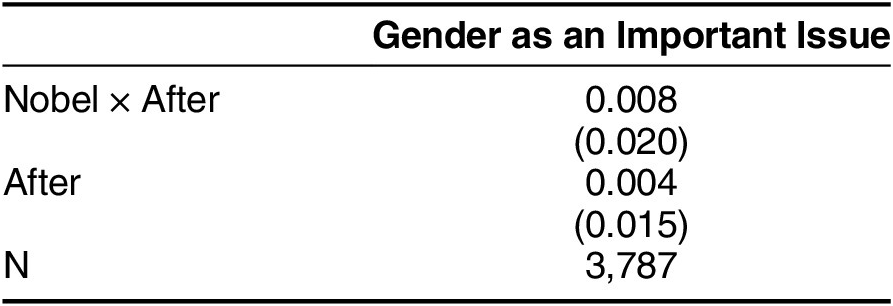
An alternative explanation is that the Nobel Peace Prize spotlighted the appropriateness and salience of activists’ cause—gender discrimination. This can indirectly increase the support for women’s organizations; the prize can draw attention to gender issues, which in turn can boost the support for women’s organizations. We therefore analyze the effect on public attention to gender issues. The outcome variable takes 1 if a respondent chose “discrimination against girls and women” as the most or second most serious issue in the world. As seen in table 3, although the sample size is limited due to missing values, the estimate is negligible and indistinguishable from zero.
The effect on the salience of gender issues

Notes: The table shows the estimated effect of awarding the Nobel Peace Prize to women’s rights activists on the probability of choosing gender issues as the most or second most serious issue in the world. The sample size is small due to missing values. The standard errors robust to heteroscedasticity are in parentheses.
 $ \ast p<0.05,\dagger p<0.1 $
.
Another possibility is that the awards for women, instead of those for women’s rights activists, drive the results. Indeed, whenever the prize was awarded to women’s rights activists, one of the laureates was women in our sample. All women laureates in our sample are women’s rights activists. We address this problem by analyzing whether awarding the Nobel Prize in Literature to women has similar effects.Footnote 21 If the laureates’ gender is the real cause, the placebo should also increase people’s confidence in women’s organizations. Although this is admittedly an informal test, table 4 indicates that the effect is not statistically significant, and the point estimate is one-sixth of the main estimate.
The effects of the Nobel Prize in Literature

Notes: The table shows the estimated effect of awarding the Nobel Prize in Literature to women on the confidence in women’s organization. The first column does not contain “don’t know” responses and thus the sample size is smaller. The standard errors robust to heteroscedasticity are in parentheses.
 $ \ast p<0.05,\dagger p<0.1 $
.
Additional Analyses
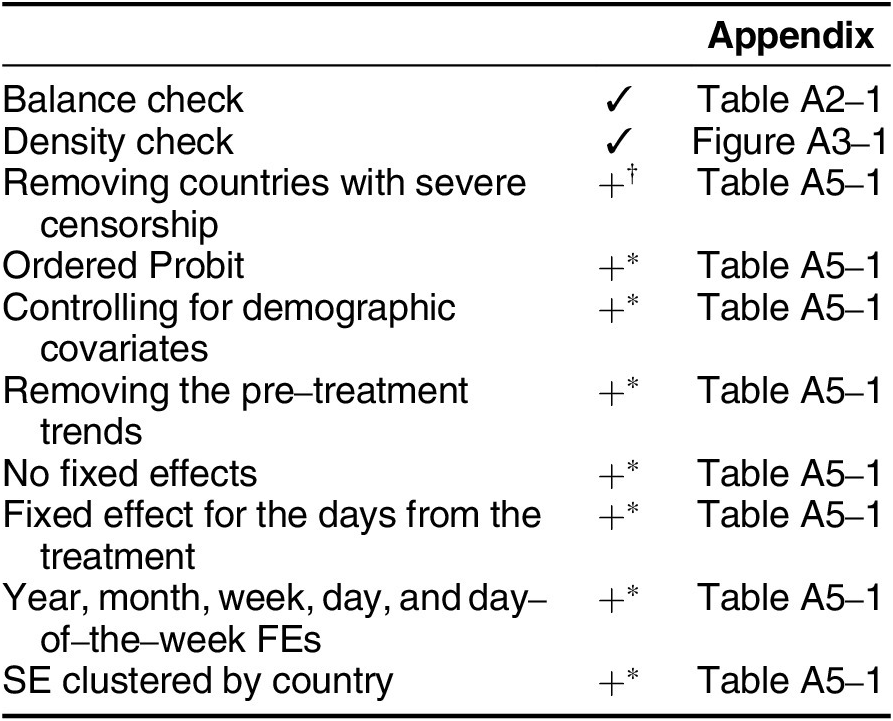
Because the main finding can potentially be a false positive, we also conduct additional analyses, which are summarized in table 5 and detailed in the appendix. First, we check the core identification assumptions—the as-if random coincidences of survey interviews and the Nobel Peace Prize—by checking the covariate balance and density (online appendices A2 and A3). Finally, the results are robust to the removal of countries under severe censorship (in which people are unlikely to know about the Nobel Peace Prize), additional control variables, removal of pre-treatment trends (Goodman-Bacon Reference Goodman-Bacon2021), fixed effects, different calculations of the standard errors, and sample composition (online appendix A5).
Additional analyses

Note: *
 $ p<0.05 $
,
 $ \dagger p<0.1 $
.
Macro-Level Implications
The main analysis indicates that the Nobel Peace Prize boosted the confidence in women’s organizations. However, a close look at the mechanisms implies that the prize pressured conservative respondents to choose positive responses. Although the social desirability bias is important for academic research, it may question the substantive importance of the Nobel Peace Prize; the prize did not alter people’s beliefs, and any change faded away within a few weeks. Nonetheless, the Nobel Peace Prize could still bring substantive changes. Given the social pressure, people and even organized groups might refrain from perpetrating gender violence. Thus, even though we are agnostic about the mechanisms, it is worthwhile to analyze the effects of the Nobel Peace Prize on violence against women at a macro level.
To this end, we analyze whether the Nobel Peace Prize changed the incidences of gender violence at a country level. The unit of analysis is county
 $ j $
in
 $ t $
days before or after the announcement of the Nobel Peace Prize
 $ k $
. The sample contains 195 countries for 1995–2019. The outcome variable is the daily incidence of violence against women in country
 $ c $
on
 $ t $
day after the announcement of the Nobel Peace Prize
 $ k $
. The data are derived from the Integrated Crisis Early Warning System (ICEWS) dataset, which machine-codes more than 38 million multilingual news sources. Metternich et al. (Reference Metternich, Dorff, Gallop, Weschle and Ward2013) even accredit it as “the current gold standard for event data” (901), though its quality is still disputed (Wang et al. Reference Wang, Kennedy, Lazer and Ramakrishnan2016; Ward et al. Reference Ward, Beger, Cutler, Dickenson, Dorff and Radford2013).Footnote 22 If the ICEWS classifies an event as coercion, repression, or assault and the names of the targets contain the word “women,” the event is considered violence against women. As a baseline, we also analyze violence unrelated to women, where the names of the targets do not contain the word “women.” The other specifications are similar to those in the earlier analysis; we use the DiD with country-year fixed effects.Footnote 23 The summary statistics are available in online appendix A6.
Although the ICEWS data are subject to reporting biases, “as long as the measurement error is uncorrelated with the independent variables, measurement error in the dependent variable is not particularly problematic in a standard regression framework other than increasing the uncertainty around the estimates we obtain” (Weidmann Reference Weidmann2016, 208). Having said that, it is still possible that the media refrain from reporting violence against women when the prize is awarded to women’s organizations. The prize can also pressure the media to follow the euphoria and thus not to report negative news. Thus, any changes in the reported number of violence can represent either the changes in the actual number of violence or the changes in reporting.
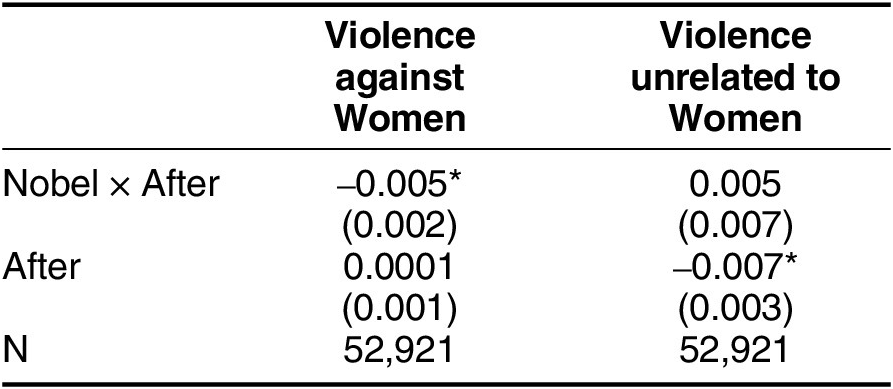
Table 6 indicates that when the Nobel Peace Prize was awarded to women’s rights activists, it reduced violence against women, while not changing violence against other targets. Although the absolute values of the point estimates are similar in table 6, the effect is actually larger for violence against women due to its rarity. The treatment reduced violence against women by 38% from its sample average (0.013), which corresponded to the reduction of 29 incidences of violence against women in the sample, while it increased violence against other targets by 2.3% from its sample average (0.217). Moreover, as seen in figure 6, the event study also indicates no clear violation of the common trend assumption, though there was a negative difference four days before the prize, probably reflecting a random change. These results imply that the effects of the Nobel Peace Prize were not limited to public opinion.
The effects on violence against women and other targets

Notes: The table shows the estimated effect of awarding the Nobel Peace Prize to women’s rights activists on the daily incidence of violence against women (first column) and violence unrelated to women (second column). The sample includes 5 days before and after the announcements of the Nobel Peace Prizes in 195 countries for 1995-2019. The standard errors robust to heteroscedasticity are in parentheses.
 $ \ast p<0.05,\dagger p<0.1 $
.
Event study (ICEWS data)
Notes: The figure shows the results of the event study, where the incidence of violence against women variable is regressed on time dummies interacted with the treatment variable. The thick and thin vertical lines show the 90% and 95% confidence intervals, respectively. The standard errors are robust to heteroscedasticity.
 $ N=\mathrm{52,921} $
.

The analysis also indicates that the media attention will not explain the findings. As far as awarding the Nobel Peace Prize to women’s rights activists increases media attention to violence against women, the reporting bias should create a bias toward a positive value. The analysis, however, indicates that the prize decreased violence against women. This implies that the reporting bias makes the findings conservative. Moreover, it is unlikely that the Nobel Peace Prize crowded out other news reports such as violence against women. Indeed, the estimate is not significant and even positive for violence against other victims (second column of table 6). Having said that, however, the prize can potentially pressure the media not to report negative news about gender. If this is the case, the prize can decrease the reported number of violent events against women even without any effect on the actual number of violent events. Given the methodological difficulty of isolating these effects (Weidmann Reference Weidmann2016), we leave the task to future studies to identify the effects more rigorously. The bottom line is that the prize did bring changes to the real world, whether they were changes in the actual number of violent events or gendered reporting of violence.
Finally, we examine the robustness to different time windows and, more importantly, the long-term effects of the prize. As seen in figure 7, similar to the survey analysis, the effect is short-lived and disappears within two weeks. This suggests that the Nobel Peace Prize brought substantive changes, but the effect was ephemeral. Although analyzing the causal mechanisms is beyond the scope of this paper, the results are consistent with the pressure mechanism; the Nobel Peace Prize pressured not only conservative people to choose socially desirable answers but also potential perpetrators not to use violence. These changes, however, did not come with corresponding changes in beliefs and thus did not last long. These results are consistent with the idea that gender violence is an expression of structural inequalities and deep-seated prejudices, which cannot be ameliorated within a short time or by international awards. Without addressing the structural problems, international awards are unlikely to bring durable changes.
Results with different time windows (ICEWS data)
Notes: The figure shows the results with different time windows, where the sample contains
 $ t $
days before and after the announcement of the Nobel Peace Prize. The horizontal axis displays
 $ t $
. The thick and thin vertical lines show the 90% and 95% confidence intervals, respectively. The standard errors are robust to heteroscedasticity.

Discussion
In this paper, we have argued that international awards promote human rights norms by signaling the presence of reliable human rights activists, and reassuring, persuading, and pressuring people to express higher trust in those activists. We have tested the hypotheses with a natural experiment and found that when women’s rights activists received the Nobel Peace Prize, it increased people’s trust in women’s organizations. Moreover, the macro-level analysis has also indicated that the Nobel Peace Prize decreased violence against women, implying that the effect was not limited to public opinion. However, these changes were short-lived and disappeared within a few weeks.
These findings provide a balanced view of the roles of international awards, and more broadly, symbolic actions in international relations (Edelman Reference Edelman2013; Linklater Reference Linklater2019). Recent quantitative studies have tended to focus on short-term changes and to emphasize the effects of symbolic actions, giving the impression that symbolic actions could change the world. Recent quantitative studies about public diplomacy, for instance, have examined changes in public opinions in a week or month (Goldsmith, Horiuchi, and Matush Reference Goldsmith, Horiuchi and Matush2021). However, these findings do not necessarily imply that symbolic actions result in durable changes. As we have shown in this study, the effects may fade away, and the status quo can persist. In the worst case, international awards might provide tentative euphoria, shifting people’s attention away from underlying deep-rooted causes of gender inequality and violence. Awarding more prizes is unlikely to be a solution to gender discrimination.
This does not mean that symbolic actions can be dismissed. International awards are not merely cheap talk. They can bring about real-world changes at least in the short term; international awards can draw public attention to human rights activists, pressure norm antipreneurs and spoilers (Bloomfield Reference Bloomfield2016; Sanders Reference Sanders2018), and reduce human rights violations. Importantly, these effects differ from those of “naming and shaming.” While negative symbolic actions increase public awareness about human rights (Davis, Murdie, and Steinmetz Reference Davis, Murdie and Steinmetz2012), they prompt both policy changes (Murdie and Davis Reference Murdie and Davis2012; Kim Reference Kim2013) and backlashes (Hafner-Burton Reference Hafner-Burton2008; Gruffydd-Jones Reference Gruffydd-Jones2019; Snyder Reference Snyder2020). It appears that while “naming and shaming” disturb the status quo and catalyze progressive or reactionary changes, “prize and praise” temporarily lull the situation without changing the structure.
Thus, a critical question for future studies lies in the long-term effects of international awards. Although the direct effects can be limited to the short term, international awards, and more generally symbolic actions, can bring more gradual changes in international norms. Real-world events (e.g., 9/11), academic discourse (e.g., Galtung Reference Galtung1969), and, most importantly, women’s rights groups’ efforts have shaped the meanings of “peace” in the Nobel Peace Prize (Alford Reference Alford2008). The prize, on the other hand, has also helped norm entrepreneurs and influenced how people conceptualize peace (Alford Reference Alford2008). Although tracing such a process of meaning-making and symbolic interactions is beyond the scope of this paper, future studies need to mobilize different empirical approaches to unveil the long-term consequences of international awards.
Supplementary material
To view supplementary material for this article, please visit http://doi.org/10.1017/S1537592724001142.
Acknowledgments
The authors are grateful to Nikol G. Alexander-Floyd, Michael Denly, Jun Goto, Takuma Kamada, Xin Nong, Hsin-Hsin Pan, Yuki Shiraito, the anonymous reviewers, and the editors of Perspectives on Politics for their thoughtful comments. This paper was presented at Hitotsubashi University, the 2023 Annual Meeting of the Southern Political Science Association, the 2023 Winter Meeting of the Japanese Society for Quantitative Political Science, the Pacific International Politics Conference Online Speaker Series, Waseda University, and the National Graduate Institute for Policy Studies. This research was supported by JSPS KAKENHI Grant Number 20K13401.
Data Replication
Data replication sets are available in Harvard Dataverse at: https://doi.org/10.7910/DVN/HS6QKI. All analyses were conducted using R statistical software.