The rise and transformation of the welfare state has been at the center of many scholarly debates. As a result of its generous welfare state, Sweden is often the key case, if not the benchmark, in comparative analysis.Footnote 1 This has influenced theory on the growth of the welfare state. Multiple explanations feature causal relationships inspired by Sweden where countries are assessed on their ability to develop comparable independent variables and achieve similar outcomes. For example, with the Swedish experience in mind, the power resource school argues that the road to a generous welfare state requires a strong union/social democratic nexus.Footnote 2 Unsurprisingly within these debates, critiques have stressed that comparative analyses are Swedocentric.Footnote 3
Very few cases possess the two core and complementary conditions deemed necessary for the development of Sweden’s generous welfare state: (1) the presence of a hegemonic social democratic party with strong union support, as theorized by the power resource theory (PRT);Footnote 4 and (2) a bureaucracy sympathetic to social democratic goals.Footnote 5 Both conditions are found in the case of the western Canadian province of Saskatchewan.
Saskatchewan represents a crucial case à la Eckstein featuring a dominant social democratic party and a bureaucracy tailor made to implement its agenda.Footnote 6 The Cooperative Commonwealth Federation (CCF) and its successor, the New Democratic Party (NDP),Footnote 7 ruled Saskatchewan for all but seven years during the period from 1944 to 1982, when the welfare state started to expand.Footnote 8 The CCF also created a bureaucratic apparatus to implement its ideas; it actually went further than Sweden, which targeted departments deemed important to establish core demands from union supporters,Footnote 9 by creating a host of institutions at the executive level to facilitate planning. In line with theoretical expectations originating from the PRT and the bureaucratic thesis, these two attributes should produce the most generous welfare state in Canada, since no other provinces benefited from similar conditions. The presence of both Swedish conditions actually transformed Saskatchewan: originally a very poor rural province with limited administrative capacities, and by 1982 it had become a social innovator and ranked first on many social indicators. The development of its public administration also had a lasting influence on other provinces and the federal government. Surprisingly, however, Saskatchewan did not perform well with such important social indicators as income equality and social spending.
Demonstrating that Saskatchewan succeeded partially to put in place a highly generous welfare state with a Swedish recipe is appealing for three key reasons. First, the comparative welfare state literature (CWS) often ranks Canada and the United States near or at the bottom of rankings regardless of how one conceptualizes and measures welfare state efforts.Footnote 10 Studying an exceptional case like Saskatchewan can help tease out which elements are specific (or not) to Sweden when assessing welfare state generosity and which ones have broader application. Second, CWS often ignores or underestimates the importance of federalism when analyzing cases like Canada and the United States; when it does, federalism is used mostly to explain policy development at the federal level with regional units representing an obstacle to overcome for federal authorities.Footnote 11 A noticeable exception is the emerging literature linking regional nationalist parties and social policy.Footnote 12 Third, the election of the CCF in 1944, the first socialist government in North America, gathered substantial interest among academics.Footnote 13 Lipset’s study of Saskatchewan formed the basis of his reflections on “American exceptionalism” when it comes to the absence of a strong left-wing party in the United States.Footnote 14 At the time, there was strong skepticism that Saskatchewan could alter the patronage legacy of the Liberal Party and develop a generous welfare state.
This article is divided into four sections. The first presents the complementary Swedish conditions (PRT and the bureaucratic thesis) associated with the creation of generous welfare states. The second discusses the methodology employed to test these conditions on the Saskatchewan case within the context of Canadian federalism. This is followed by an empirical analysis focused on four elements: program characteristics, social spending, income inequality, and labor regulations. The conclusion assesses the empirical evidence and addresses why Saskatchewan failed on some important social indicators.
The Swedish Conditions for a Generous Welfare State
There is a very extensive literature analyzing the Swedish welfare state in a comparative perspective spanning across multiple disciplines in the social sciences. For my purpose here, I will focus on two core conditions often associated with its development: the power resource theory and the bureaucratic thesis.
Prior to discussing both key conditions, two caveats are in order. First, although analyzed separately, I argue that the necessary elements associated with these approaches complement each other. This is explicitly stated in contributions associated with the bureaucratic thesis,Footnote 15 but the PRT literature has challenged the importance of the state apparatus in earlier writings. These findings are inconclusive, however, and do not represent a genuine test of the bureaucratic thesis. For example, Esping-Andersen includes the age of the social security system as a proxy for bureaucratic influence.Footnote 16 This follows Parkinson’s Law where bureaucratic authorities are by nature expansionary. This variable of age is noninfluential in Esping-Andersen’s study contradicting earlier findings by Wilensky that present a positive correlation with social security efforts.Footnote 17 Korpi also includes the bureaucracy in a comparative study examining the adoption and expansion of social citizenship via the development of sickness insurance in eighteen industrialized countries.Footnote 18 The bureaucracy variable measures the “central state personnel as proportion of the total population.”Footnote 19 The empirical analysis dismisses the influence of the bureaucracy, which is interpreted as an indication that “state officials do not control enough independent power resources” to matter.Footnote 20 Korpi acknowledges that this variable does not capture the full extent of the influence attributed by Skocpol in her U.S. analyses, but he laments the lack of an expected relationship with the bureaucracy. This is not the case with the argument proposed by Rothstein where bureaucratic capture (or lack thereof), rather than independent state capacity, influences the ability of social democratic governments to expand the welfare state (see discussion below).Footnote 21
Second, this article confines itself to the expansion of the welfare state (1944–82) and does not consider the retrenchment period, associated with the arrival of Conservative governments in the early 1980s.Footnote 22 The analysis ends in 1982, which coincides with the structural break associated with the beginning of the retrenchment period in Canada.Footnote 23 Saskatchewan did not escape this trend with the election of the Conservative Premier Grant Devine in 1982. Considerable efforts ensued to dismantle the bureaucratic legacy of the CCF/NDP and newly created crown corporations were sold to private interests. An analysis of the rise and fall of the Saskatchewan welfare state would require an analysis that would be too complex for a single article; this is why I will focus on its development.
The Power Resource Theory Condition
Inspired by the rise of the Swedish social democratic party and its impact on public policy, the Power Resource Theory (PRT) is a core approach to explain the rise of the welfare state in industrialized countries. The PRT assumes that socioeconomic cleavages, as opposed to religion and ethnicity, are the most important ones in Western democracies with labor and capital engaged in a “democratic class struggle.”Footnote 24 Generous welfare states have arisen in countries where the power resources of the working class have been the strongest, prompting major concessions from the capitalist class. The best-case scenario, that is, where the power resource can be maximized for the working class, occurs when a highly centralized union movement is present with a dominant left-wing party.Footnote 25 The electoral success of the left-wing party is crucial since the presence of a socialist government is needed to tip the balance of power between labor and capital. In this vein, Korpi is highly critical of the neo-corporatist literature, since this institutional arrangement can be utilized by the Right to restrict the power resources of labor.Footnote 26
The relationship between unions and social democratic parties matters greatly to maintain and grow power resources. In this context, the autonomy of social democratic parties and the necessary bond with the labor movement have been a constant source of debates. In Sweden, there is widespread agreement that the blue-collar union (LO) facilitated the development of the social democratic party (SAP), by providing it with a large membership base and extraordinary organizational resources.Footnote 27 Still, the SAP, on its own, played a key role that is often understated.
First, it was strong leadership in the party that led to the development of a multiclass strategy and a weakening of other Left alternatives.Footnote 28 This included a class alliance with farmers from the 1930s to the mid-1950s and the development of policies designed to attract white-collar workers under the SAP umbrella.Footnote 29 As a result, the SAP successfully expanded its electoral base beyond its working-class roots, sometimes against the wishes of its main trade-union partner.Footnote 30 For example, it adopted day-care policies even though blue-collar workers were originally opposed to its expansion within the public realm.Footnote 31
Second, LO also benefited greatly from SAP’s presence in government, since it facilitated a rapid expansion of union membership and a strengthening of labor unions. Prior to forming the government in a coalition with the agrarian party in 1932, only 36 percent of workers were unionized.Footnote 32 The rise in union membership, reaching 92 percent in 1980,Footnote 33 received strong assistance from a state apparatus that developed instruments and boards, with strong union representation, to control the labor market starting in the 1930s.Footnote 34 This would have not been feasible without the electoral success of SAP.
Finally, recent analyses by PRT supporters have also stressed that left-wing parties continue to matter despite declines in union density across industrialized countries. Left-wing governments have maintained more generous welfare states, while right-wing governments have been linked with retrenchment.Footnote 35 The most potent ingredient to increase the power resources of the working class involves a hegemonic social democratic party and powerful unions. Nonetheless, this brief review suggests that the former is more important than the latter.
The Bureaucratic Condition
Relatively few CWS studies have integrated the civil service within their analyses.Footnote 36 In his influential study comparing social policymaking in Sweden and the UK, Hugh Heclo claims that influential actors are not the ones with the most formalized power, but rather those with access to information, ideas, and solutions to resolve uncertainty. Focusing on governmental actions, he argues that “the place of civil servants in the development of social policy has been crucial.”Footnote 37 Due to their permanent status and expertise, civil servants play a key role in state-centric approaches,Footnote 38 and have been deemed essential in expanding programs such as social security.Footnote 39
PRT analyses neglect many difficulties associated with the implementation of a left-wing program to expand the welfare state.Footnote 40 Winning an election is only the first step in the policy making journey; of greater importance is the governing party’s ability to have the civil service implement its policy goals. Controlling and/or capturing the state machinery is a very difficult goal for any new government,Footnote 41 particularly for those seeking a radical departure from previous practices.Footnote 42 The status quo is a far more likely outcome than reform; German thinkers such as Weber and Michels, for example, argue that the bureaucracy would eventually capture social democratic parties.Footnote 43 It is reasonable to expect a similar outcome in Sweden, since the bureaucracy was very centralized and enjoyed high levels of independence that predated the transition to democracy.Footnote 44
What factors strongly enhance the likelihood that a leftist government’s policy agenda—or any government ideologically opposed to the prevailing values of the civil service—will be implemented? In the enactment of social democratic policies, bureaucratic complicity is a critical means to an end.Footnote 45 To change bureaucratic values, organizational culture, and the relationship between senior bureaucrats and the political executives, substantial efforts must be made to reorganize the civil service to alter policy in line with the governing party’s agenda.
As Rothstein noted in his study of two Swedish agencies, the governing party must devote significant energy to transform the bureaucracy. The National Labor Market Board underwent multiple reforms, resulting in the creation of a board devoted to achieving specific labor market goals. This resulted in the establishment of a goal-oriented institution heavily influenced by labor unions. This outcome is in stark contrast with the National Board of Education, where the traditional bureaucracy was never really challenged; hence, this lack of strong labor influence has maintained the disparity in higher education recruitment with working-class students being less likely to attend a university despite policies geared to change this outcome.Footnote 46
Given the difficulties in altering the culture and values of bureaucratic departments and agencies, the transformation of a bureaucracy also requires that the party in power hold the reins of government over a long, uninterrupted period of time. As such, the governing party must be hegemonic or dominant by winning consecutive elections. The end result is a public administration where senior civil servants and political executives share similar policy objectives.
Method of Inquiry and Hypotheses
This article presents a case study of Saskatchewan, instead of an explicit comparison between Sweden and Saskatchewan. This research design was selected for two reasons. First, Sweden is well known and thoroughly researched in the comparative welfare state literature. Similar contributions in the context of Saskatchewan are limited and not rooted within the CWS. Therefore, rather than adopting a most similar system design that develops and analyses both cases simultaneously, there is greater added value to provide an in-depth analysis of a case that benefited from similar necessary conditions.
Second, it is also essential to define the social democratic policy variable, which remains an important source of discussion in the CWS.Footnote 47 Left-wing parties such as Labour in the UK, the Social Democrats in Sweden, and the CCF/NDP in Saskatchewan had originally proposed measures to eradicate capitalism. These typically involved the state’s control of the economy—often through the nationalization of enterprises and economic planning. In reality, many state-centered economic ambitions were abandoned once the given party entered office. As a result, economies were not fully nationalized and capitalist systems did not undergo drastic reforms. Nevertheless, the establishment of a generous and universal welfare state, such as Sweden’s, represents a significant shift from the previous laissez-faire policies of the early twentieth century.Footnote 48 In line with the CWS and the power resource theory, social democratic policies can be differentiated from right-wing policies by their aim to reduce dependency on the market,Footnote 49 strengthen unions and their preferences,Footnote 50 reduce income inequalities,Footnote 51 and increase social expenditure.Footnote 52
To assess the adoption of social democratic policies in Saskatchewan, a few caveats are in order. Unlike Sweden, Saskatchewan is a province and is constrained by the federal government, which holds important fiscal instruments and is responsible for unemployment insurance and public pensions.Footnote 53 Nevertheless, among industrialized countries, Canada is the most decentralized and provinces have the primary responsibility for social policies.Footnote 54 Provinces also have multiple tools to raise their own revenues and finance new policy initiatives. This is essential for this contribution since there is a strong correlation between the capacity to generate governmental revenues, preferably in the form of nonvisible taxation, and the generosity of social program.Footnote 55 With Saskatchewan being primarily an agricultural province for many years during the period under study, the exploitation of natural resources, such as oil and potash, via the development of crown corporations provided a key source of revenue to finance the welfare state.Footnote 56 By 1982, these provided 30 percent of all governmental revenues.Footnote 57
Contrary to country analyses where policy outputs are compared across countries, this article compares the generosity of Saskatchewan’s social policy with that of the other nine Canadian provinces. Theoretical expectations derived from the CWS should apply to political units operating under similar conditions. If the CCF/NDP fulfills the two Swedish conditions, then we would expect Saskatchewan to have developed the most generous welfare state of all provinces within Canada.
Four key elements of social democratic policies are scrutinized to assess welfare state generosity: (1) the characteristics of the social programs (health, education, and social assistance) introduced in Saskatchewan and their presence (or not) in other provinces (with a primary focus on their accessibility); (2) social spending; (3) income equality; and (4) labor rights. Both qualitative and quantitative indicators are employed to assess these elements and evaluate whether the CCF/NDP succeeded in making Saskatchewan the most generous welfare state in Canada.
With regards to both Swedish conditions (PRT and the bureaucratic thesis), it is important to stress that the Saskatchewan political system operates within the Westminster tradition. As such, it relies on a first-past-the-post method to elect members of parliament. This has notable implications for the PRT conditions. The SAP in Sweden functions within a PR electoral system; thus it was able to develop a class alliance with agrarian representatives without having to form a single party. In a traditional two-party system, social democratic forces had to develop a similar coalition with farmers while constructing their political party to enhance their chances of electoral success. This was particularly true in Saskatchewan, which was even more rural than Sweden at the time with 58 percent of the labor force employed in agriculture in 1941.Footnote 58
There is no explicit comparison between farmers’ movements in Saskatchewan and Sweden. Nonetheless, the academic literature strongly suggests that Saskatchewan farmers were far more mobilized, organized economically and politically, than Swedish ones. Frustrated by the lack of political action on the part of elected representatives, Saskatchewan farmers created the Wheat Pool to regulate prices, market their product on the world stage, and facilitate the exportation of their products in 1923. The two main farmers’ organizations merged in 1926 to form the United Farmers of Canada (Saskatchewan Section) (UFC[SS]) providing farmers with a unified voice strongly committed to the cooperative movement and the Wheat Pool.Footnote 59 Socialist elements, who also favored political action, eventually succeeded in gaining the control of the UFC(SS). The political views of the UFC(SS) actually had a lot in common with those of urban social democratic parties.Footnote 60 This shift in leadership facilitated a merger with labor interests to create the CCF.
In contrast, the two main Swedish farmers’ organizations failed in their multiple attempts to merge and cooperate.Footnote 61 This represented a major hurdle in the development of cooperatives. Thus, in the aftermath of the 1929 economic crisis, the farmers’ movement was too fragmented to respond with a majority of farmers not involved in cooperatives. This prompted the Liberal/Conservative coalition to abandon its laissez-faire approach to create a compulsory neo-corporatist arrangement to control the supply and prices of farmers’ products when prices collapsed in 1932. Ironically, this delegation of power to the state made it easier to foster the 1933 agreement between the social democrats and the Farmers’ League, which undermined the dominance of right-wing parties.Footnote 62
Despite these differences with regard to political institutions and the manner in which farmers and labor joined forces, the political challenge for social democrats in both Sweden and Saskatchewan was similar—that is, extend the reach and appeal of the party to form the government—but it occurred within a different political environment. In both cases, the proletarian orientation of social democrats had to include farmers to succeed.Footnote 63
The bureaucratic thesis works also within a different context. In Sweden, the civil service was already highly centralized and professionalized prior to democratization. Thus, the challenge for social democrats was to alter the inherently conservative bias of a well-established institution.Footnote 64 Saskatchewan became a province in 1905 and its bureaucracy developed with patronage appointment. Lipset argues that it was reminiscent of the U.S. bureaucracy in the nineteenth century.Footnote 65 As a result, the challenge for social democrats was to establish—rather than change—a professional bureaucracy that would also embrace social democratic ideals.
Are Swedish Conditions Present in Saskatchewan?
The Power Resource Conditions
In light of the Swedish experience, we would expect that a hegemonic social democratic party combined with a strong union movement would produce strong power resources. To achieve these objectives, the social democratic party is expected to enhance its electoral potential with the development of policies geared to expand its class base and foster a multiclass strategy to remain in power. As discussed above, this requires the participation of farmers in Saskatchewan.
The Liberal Party dominated provincial politics following the entry of Saskatchewan into the Canadian federation in 1905 until World War II. Contrary to neighboring Alberta and Manitoba, the Liberals succeeded in maintaining the support of farmers throughout the 1920s, in part due to its close relationship with the Saskatchewan Grain Growers’ Association (SGGA). The leadership of the party attended its annual conventions and several cabinet members were recruited from this association.Footnote 66 This close relationship prevented the rise of a social democratic alternative since the SGGA was the primary tool to oppose the government.
The dominant economic position of market players, such as grain-elevator operators and traders, led to an increasing class-consciousness among farmers.Footnote 67 This prompted an increasing political mobilization on the part of left-winger farmers, who eventually gained control over the UFC(SS), created in 1926 following the merger of the SGGA and the Farmers’ Union of Canada. They turned to labor organizations to foster a political answer to improve the conditions of Saskatchewan farmers.
Collaborative efforts between farmers and labor organizations led to the creation of the Cooperative Commonwealth Federation (CCF) in 1932. The new party gained momentum in the 1930s with the deteriorating conditions of farmers in what would eventually be called the “dirty thirties,”Footnote 68 where the collapse of wheat prices had strong negative consequences on Saskatchewan farmers. Core CCF beliefs were spelled out clearly in the so-called Regina Manifesto. It included popular propositions such as the introduction of state health insurance, public pension plans, and an expansion of crown corporations, but it also included more radical elements such as the eradication of capitalism and socialized planning.Footnote 69 Following their defeats to the Liberals in the 1934 and 1938 elections, the CCF made alterations in its platform. For example, references to socialism and the nationalization of the land were omitted from the CCF program to mitigate Liberal attacks and more emphasis was placed on social security.Footnote 70
The CCF/NDP was first elected in 1944 and would rule Saskatchewan for all but seven years (1964–71) during the 1944–82 period.Footnote 71 The first five hundred days in 1944 generated 196 legislative acts, the creation of four new departments and agencies, and eleven government corporations.Footnote 72 As in Sweden, the CCF/NDP sought to extend its electoral base by appealing to white-collar workers. This occurred primarily within the public sector, where unionization and a merit system were introduced. Following a close election in 1948, the CCF would easily win the 1952, 1956, and 1960 elections, obtaining more than 70 percent of parliamentary seats in the legislature. In the aftermath of Premier Tommy Douglas’s departure for the federal CCF party and a tumultuous term featuring a long battle on the adoption of universal health care, the CCF lost the 1964 election; as the NDP, it recaptured office in 1971, winning three consecutive mandates under the leadership of Allan Blakeney, a former civil servant.
An examination of the reasons underlying the dominance of the CCF/NDP in Saskatchewan is beyond the scope of this article. There are, however, two common explanations. First, many accounts have emphasized the charisma and leadership qualities of Tommy Douglas, who ruled as Premier from 1944 to 1961, and his team.Footnote 73 Second, political culture explanations emphasize the influence of Fabian-Socialists who immigrated from the United KingdomFootnote 74 and populist legacies from neighboring American states.Footnote 75 A complementary contribution stresses the ability of the CCF/NDP to tap into core elements associated with its political codes, such as collectivism and dirigisme, which were abandoned by the Liberal Party in the 1930s.Footnote 76
The Bureaucratic Condition
The CCF leader, Tommy Douglas, was fully aware of the bureaucratic hurdle his party faced, reportedly stating that “no matter how good legislation is, if those in charge of administering it are unsympathetic or incapable of a new approach, little good will come of it.”Footnote 77 Once elected as Premier in 1944, Douglas was “determined to lead Saskatchewan into the big leagues of public administration.”Footnote 78 The CCF/NDP devoted significant energy and resources into creating a bureaucratic apparatus that could implement its policy strategies. Saskatchewan’s strategy was encompassing: it created a host of executive-level institutions specifically aimed at enacting policy planning and developed policy expertise within ministries. In line with the Swedish experience, this section demonstrates that it required substantial time and energy to achieve this outcome.
Under the stewardship of the Liberal Party, the dominant party up to 1944, the public service was primarily utilized as a tool of patronage. With very few exceptions, public-sector jobs were up for political manipulations. The center of activity remained with the Highway department, where the Minister tended to be in charge of party organization and the distribution of favors. At the local level, highway inspectors were the eyes and ears of the party. As Smith notes, “The alacrity with which such appointments were made reflected both low esteem for the public service and strong conviction that party supporters deserved recognition.”Footnote 79 During the Cooperative government, where a coalition of Progressives, Independents, and Conservatives ruled the province (1929–34), the creation of a Public Service Commission (PSC) sought to curb political appointments.Footnote 80 However, following the election of the Liberals in 1934, the Premier replaced the PSC with a single commissioner, dismissed individuals appointed by the previous government, and reintroduced vigorous patronage practices.Footnote 81
As a result, the question of the bureaucracy was front and center in the development of a governmental strategy by the CCF while in opposition.Footnote 82 CCF guidebooks on economic theory made it clear already in 1936 that “more concentration of power in the cabinet and the bureaucracy was unavoidable in the socialist state,”Footnote 83 and a central planning agency responsible to the Cabinet and the Premier was necessary to plan the economic development of the province.Footnote 84 These objectives could not be achieved without a professional bureaucracy.
Contrary to the expectation of many CCF members and supporters, the Douglas government did not engage in a drastic transformation of the civil service immediately after the CCF victory in 1944. With the exception of the Minister of Natural Resources, who laid off fifteen individuals, “most other ministers kept their staffs almost intact.”Footnote 85 Even in the case of newly created departments, three of the four deputy ministers nominated were directors in another department.Footnote 86 This inaction on the part of the government fueled strong criticism from the CCF grassroots with the introduction of multiple motions at congresses to fire Liberal supporters in favor of CCF sympathizers or proven socialists.Footnote 87
These accounts, based mostly on evidence collected shortly after the electoral victory of 1944, fail to acknowledge the daunting task faced by the CCF government. Not a single member of the cabinet had been involved in any government prior to being elected. Thus, cabinet members were in dire needs of civil servants—regardless of their political stripes—who could guide them immediately. The bureaucracy inherited by the government was also ill equipped to tackle most routine functions. There was simply no governmental machinery coordinating the activities of individual departments and no budgetary machinery as well. As a result, the rapid introduction of new policies was followed by a focus on organizational matters in the second part of the mandate.Footnote 88
The actions that the CCF took during the course of its mandates (1944–64) resulted in a fundamental alteration of the bureaucratic structure and a de facto replacement of the civil service.Footnote 89 The creation of the Economic Advisory Planning Board (EAPB), the Budget Bureau, and the Government Financial Office (with the primary function of overseeing the Crown corporations) led to the development of a strong expertise at the center of government. In addition, the creation of planning units and policy expertise within individual ministries was a key achievement of the CCF during its last ten years in power, and it led to a diminishing role for central offices such as the EAPB.Footnote 90
Ultimately, cumulative measures taken by the CCF led to fundamental alterations within the bureaucratic structure, including a de facto personnel turnover of the civil service.Footnote 91 In his account of the Liberal Party in opposition, Smith states that none of the social and political innovations compares to the “administrative revolution” that accompanied the new CCF government.Footnote 92 By the time the CCF lost in 1964, the bureaucratic structure shifted from an unaided cabinet with little coordination across departments and overall planning, to an institutionalized cabinet exercising horizontal coordination.Footnote 93
This infrastructure remained largely in place during the Wilbert Ross Thatcher years (1964–71), albeit far less utilized. As stated by Rasmussen and Marchildon: “The planning tradition was entrenched deeply enough in the civil service that it readily sprang back into action upon the re-elections of NDP administrations.”Footnote 94 The election of Allan Blakeney as Premier in 1971 sparked another eleven years of policy innovations spearheaded by an active civil service.Footnote 95
Social Democratic Outcomes?
The CCF/NDP clearly succeeded in becoming a hegemonic political party and developing a goal-oriented bureaucracy tailor-made to develop its agenda. Did these Swedish conditions generate the most generous welfare state in Canada by 1982? As stated earlier, this section analyzes four elements: (1) the characteristics of the social programs introduced in Saskatchewan and their presence in other provinces (with a focus on their accessibility); (2) social spending; (3) income equality; and (4) labor rights.
First, in the field of social policy, the CCF’s key contribution was the expansion of health coverage, despite vivid opposition from medical doctors that featured province-wide strikes. By 1965, the CCF had successfully introduced universal health insurance, with its model serving as the template upon which Ottawa assisted provinces to finance free and universal health care throughout Canada.Footnote 96 While other provinces eventually followed suit with the assistance of the federal government, it was Saskatchewan that took the necessary first step. Meanwhile, in education, noticeable changes included a 30 percent raise for teachers and a reorganization of the school administration; this reorganization created significantly larger school units with a new equalization formula to ensure sufficient funding for rural school units.Footnote 97 As for social services, in a noticeable shift from providing welfare as a form of poverty relief in favor of a more universalistic notion of benefits, a Department of Social Welfare was created with new powers to spend money.Footnote 98
The Blakeney years fostered multiple innovations in social policy, such as the introduction of a prescription drug plan and a dental plan for children.Footnote 99 The Saskatchewan Prescription Drug Plan covered the entire population (only British Columbia and Manitoba had similar coverage) and the fixed dispensing fee was waived for individuals on social assistance. The plan also contained a cost-containment strategy, unique in Canada, which fostered competition among drug suppliers with limited term contracts.Footnote 100
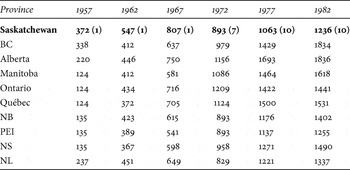
Second, with regard to social spending, there are two sources of data: Simeon and Miller’s comparative policy analysis, which includes data collected from Statistics Canada covering the period 1957 to 1972,Footnote 101 and data from Statistics Canada covering the 1971–82 period.Footnote 102 Spending data present an intriguing picture. In all three cases—health, education, and social welfare—Saskatchewan’s high-ranking position erodes quickly. Health spending data confirm Saskatchewan leadership in expanding public efforts to universalize access (Table 1). It spent the most on a per capita and as a percentage of gross general expenditure in 1957, 1962, and 1967 among all ten Canadian provinces. However, once Medicare was introduced across the country in 1969, other provinces quickly caught up and by 1982 Saskatchewan slipped to tenth place in terms of spending per capita. With regard to social assistance spending efforts as a percentage of GDP, Saskatchewan ranked third in 1957 and 1972 while it slipped below average in the 1960s.Footnote 103 On a per capita basis, Saskatchewan was slightly above average by 1982. In education, Saskatchewan was rarely above average in most categories and it ranked below average throughout the 1957–72 period on spending as a percentage of GDP, and it consistently ranked in the lower tier on a per capital expenditure basis from 1971 to 1982.
Real per capita health expenditure across Canada (rank of Saskatchewan in brackets) in 2010 dollars

Sources:
Simeon and Miller (1980) and Statistics Canada (1992).
These findings are in line with previous contributions that have stressed a strong convergence across Canadian provinces during the 1960s and 1970s. An extensive review of the causes of convergence extends beyond the scope of this article, but the literature has stressed the involvement of the federal government, changing economic conditions within provinces, and emulation.Footnote 104 Key for this study, however, is that Saskatchewan does not sustain a relatively high spending effort.
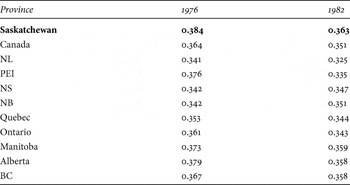
Third, Saskatchewan’s efforts at reducing income inequality are difficult to assess for a lack of data and a gap between policy output and outcome. Reliable income-inequality data are not available for the period prior to 1976. Despite the introduction of programs that have sought to manage social assistance in a universalistic manner, policy outcomes go in the opposite direction. Saskatchewan ranks last when inequality is measured with the GINI index (see Table 2). This raises important question since Saskatchewan was one of few provinces that did not levy health premiums or payroll taxes in Canada and its income tax system was among the most progressive. In 1982, while the combined provincial tax and health premiums for income at the poverty line represented 7.5 percent of earnings in Ontario and 5.3 percent in British Columbia, it stood at 1.6 percent in Saskatchewan.Footnote 105
Gini coefficients of after-tax income of individuals, where each individual is represented by adjusted household income, for all family types

Sources:
Statistics Canada, Cansim 202-0705.
Fourth, with respect to labor rights, introducing legislation to facilitate union expansion and improve minimum labor standards has been a cornerstone of socialist demands. As expected, the CCF was very active on the union front: it enacted several pieces of legislation in labor affairs and created a Department of Labor, a first in Canada, to ensure their implementation.Footnote 106 One of the first bills adopted by the CFF was the Trade Union Act in 1944, with overarching consequences. This Act allowed employees to organize and form a union of their choice, as well as instituted collective-bargaining mechanisms. It also placed restrictions on employers, such as limiting the use of lockouts during Labor Relations Board deliberations.Footnote 107 In fact, while civil servants in Saskatchewan were allowed to unionize by 1944, it would take another twenty-three years for federal civil servants to obtain the same rights.Footnote 108 During the 1946–55 period, union membership increased by 118 percent in Saskatchewan, while it rose by 68 percent overall in Canada.Footnote 109 These are impressive figures considering that farmers, a substantial proportion of the Saskatchewan workforce at the time, tended to join cooperatives rather than trade unions.
A second series of labor reforms occurred during the Blakeney years (1971–82). Saskatchewan innovated by being the first province to introduce measures such as maternity and paternity leave, provisions for equal pay for equal work, and an occupational health law allowing workers to refuse to perform tasks they deemed too dangerous.Footnote 110 This rights-based approach, embraced in Scandinavia, represented a first in North America.Footnote 111 Akin to programs designed to tackle “new” social risks, a labor market-training program was also instituted for the long-term unemployed and those on social assistance.Footnote 112 Saskatchewan’s labor standards provided generous conditions and protections during the period under study, with a top ranking on most indicators in a comparative study of labor standards in Canada and the United States.Footnote 113
Final Assessment and Conclusion
With the presence of a hegemonic social democratic party and a goal-oriented bureaucracy sharing social-democratic objectives, Saskatchewan should have developed and maintained the most generous welfare state among Canadian provinces during the 1944–82 period. No other Canadian province benefited from these Swedish conditions, which are strongly associated with the development of a generous welfare state. The evidence, however, does not fully support theoretical expectations.
On the one hand, there is strong evidence to suggest that Saskatchewan had a very, if not the most, generous welfare state in Canada by the early 1960s. It developed innovative social programs and social spending was at the top or near the top of all Canadian provinces. The government continued to innovate by launching multiple social programs in the 1970s and maintained generous labor regulations. However, there is no evidence to suggest that Saskatchewan was a leader at any point when it comes to education policies.
On the other hand, social spending data and the GINI index suggest that Saskatchewan was not able to sustain its leading position overtime in some crucial areas. There are potential explanations for this surprising outcome, which could be explored in future research. First, the federal government increased its involvement in the social sphere in the 1960s and 1970s by using its fiscal power to influence social policy within provincial jurisdictions. This explains partly why social spending differences across provinces shrank rapidly during this period.Footnote 114 Second, albeit within a different sociopolitical context, other provinces sought to expand the welfare state. A recent book actually argues that the development of Quebec’s welfare state shares important similarities with Saskatchewan.Footnote 115 This is not unique to Canadian provinces. In the comparative welfare state literature, generous social policies have also been attributed to the presence of Christian democratic parties in coalition governments.Footnote 116 Thus it would not be surprising that other political constellations could favor the development of a generous provincial welfare state.
Third, other provinces and the federal government have also emulated Saskatchewan’s policies. A highly interesting study focusing on the diffusion of twenty-five regulations stressed that Saskatchewan was the most influential innovator originating ten out of twenty-five regulations. More important for this article, it was responsible for the innovation of all policies in the socialism cluster.Footnote 117 As such, the Saskatchewan experience has a lot in common with Sweden, since neighboring countries adopted many of its innovative social policies.Footnote 118
This article also raises interesting questions for the comparative welfare state literature. First, it supports recent contributions that present a far more volatile and changing welfare state than previously implied in the CWS literature.Footnote 119 Welfare state rankings are influenced by both changes from within and from elsewhere. Second, via this case study, I have assessed four elements that have resulted in a more thorough picture than the use of a single or standardized dependent variable (although without the benefits of having a large N). This generates far more complexity in the interpretation of results, but it also contributes to obtaining a clearer picture than a single dependent variable. Third, this article is a reminder of the danger to generalize across policy areas based on a few dimensions of the welfare state. The predominance of Sweden as a generous welfare state draws heavily from studies focused on social insurance and active labor-market programs, which also coincide with the policy priorities of the labor movement.Footnote 120 The creation of the mandatory earnings-related pension plan became the golden trophy of the Swedish social democrats.Footnote 121 In the Saskatchewan case, health is the CCF’s golden trophy. The expansion of health coverage, culminating with the creation of a universal health system, appealed to all factions within the CCF and provided the party with a highly a tangible and unifying policy objective. To this day, it remains the CCF’s core legacy.