1 Introduction
In this paper we propose three different kinds of cognitive structure that have not been differentiated in the psychological and cognitive linguistic literatures: They are spatial primitives, image schemas, and schematic integrations. Spatial primitives are the first conceptual building blocks, image schemas are simple spatial stories built from them, and schematic integrations use the first two types to build concepts that include non-spatial elements. These three kinds of structure and some others as well have often come under the umbrella term of ‘image schemas’. We suggest that this term needs clarification and restriction in what it covers. Even the three types we propose differ in their content, their developmental origins, and their imageability. They are prelinguistic developments, but the first two precede the third. All, however, play an important role in meaning construction in language and other forms of representation.
Mark Johnson and George Lakoff together invented the term ‘image schema’ in their 1987 books. They did something much needed at the time, namely, to cast doubt on the common philosophical position they called the ‘objectivist paradigm’, in which concepts are considered to be symbols that constitute propositions pointing to a reality independent of the mind. In contrast to this view, they emphasized the non-propositional nature of concepts, stating that concepts are analog products of sensorimotor experience. This was important work, but it did contain one flaw: no distinction was made between information about the world that stems from perception, action, or the internal feelings involved in actions. They were all treated as alike, in the sense of constituting concepts in the same way and playing equally important roles in thought. They termed this ‘embodiment’. For example, they laid emphasis on how the experience of force structures many image schemas. Thus, image schemas were defined as dynamic analog structures arising from perception, bodily movements, manipulation of objects, and experience of force.
Gibbs and Colston (Reference Gibbs and Colston1995, p. 349) made the important point that “Image schemas can generally be defined as dynamic analog representations of spatial relations and movements in space. Even though image schemas are derived from perceptual and motor processes, they are not themselves sensorimotor processes.” However, accepting the view that image schemas are formed from a wide variety of sensorimotor input, they went on to say: “Image schemas exist across all perceptual modalities, something that must hold for there to be any sensorimotor coordination in our experience. As such, image schemas are at once visual, auditory, kinesthetic, and tactile” (p. 349). The latter point might seem to negate the first: analog spatial representations may be built from all kinds of perceptual information, but they cannot exist in all modalities and be spatial abstractions at the same time. In any case, this was the view that was widely accepted by cognitive linguists.
More recently, Gibbs also pointed out the abstract nature of image schemas across these modalities: “image schemas are more abstract than ordinary visual mental images and consist of dynamic spatial patterns that underlie the spatial relations and movement found in actual concrete images” (Gibbs, Reference Gibbs2006, p. 91). However, image schemas were still seen as emergent properties of our embodied interaction with the world, and viewed as attractors in complex human self-organizing systems. Therefore, despite the acknowledgement of the spatial nature of image schemas, Gibbs goes on to consider spatial and non-spatial schemas equally as ‘attractors’: source−path−goal stands on equal terms with balance or resistance (pp. 114–115).
All this work on image schemas was a major step forward in understanding a number of aspects of the mind, but it was for the most part done without consideration of how the conceptual mind begins, develops, and changes with the onset of language. Gibbs and Colston (Reference Gibbs and Colston1995) were the only ones we know of who attempted to relate image schemas to early conceptual development. It was an important beginning; however, at that time there was still relatively little work done on concept formation in infancy. Piaget was still the most influential developmental theorist, and he did not think that preverbal babies even had concepts. He thought they were purely sensorimotor creatures, lacking anything like an adult’s conceptual system of the sort that allows mental inferences and abstract interpretations of what is perceived to be made (Piaget, Reference Piaget1951). Sensorimotor intelligence meant that infants learn simple perceptual and motor adjustments to things rather than conceptually (or as Piaget would have said, symbolically) representing them. So before concept formation in infancy became a burgeoning field of research, linguists were lacking a vital tool for understanding adult conceptual functioning: namely, its prelinguistic foundations and development. Now that a great deal of relevant infant research exists, it is time to begin to consider in more detail how preverbal conceptualization influences language. This is what the present paper addresses.
The concepts we will be discussing are the interpretations of the events that infants observe and take part in during the first six to seven months of life. It is interpretation of what is attended that allows inferences to be made. There are no data showing that during this period infants have any concepts of internal feelings (and we know they are difficult even for adults to conceptualize). Of course infants experience internal feelings such as force, pain, and emotion, but no one has indicated how they might be represented conceptually in the early months. In a later section we discuss how bodily conceptualizations begin. However, on the basis of what is known to date about concepts in the first months of life, with the exception of eyes seeing, all the information being conceptualized appears to be spatial in nature, either describing what something looks like and how it moves or what happens in the events in which it participates.
Although some developmentalists have proposed that young infants also have concepts of causality (Leslie, Reference Leslie, Hirshfeld and Gelman1994) or energy (Luo, Kaufman, & Baillargeon, Reference Luo, Kaufman and Baillargeon2009), the extant data can more simply be explained solely in terms of conceptualizing motion of objects through space (see Mandler, Reference Mandler2012, for discussion). Note also that spatial information is usually visual in nature, but if blind, one can conceptualize space via audition or gesture (Cattaneo & Vecchi, Reference Cattaneo and Vecchi2011; Landau & Gleitman, Reference Landau and Gleitman1985). Non-spatial information about objects, such as their color, remains unconceptualized for the first year, with progress being made in the second year (Wagner, Dobkins, & Barner, Reference Wagner, Dobkins and Barner2013).
Needless to say, the interpretations of objects and events that infants make are simplifications, omitting most of the huge amount of perceptual information that is processed. It is these interpretations that enable making inferences about unseen things, determine what is recalled from past events, and which are used in problem solving and similar forms of thought. Research since Piaget’s time shows that infants do interpret what they see. As described below, as young as 2½ months infants make inferences about things they have seen when they move out of sight (Luo & Baillargeon, Reference Luo and Baillargeon2005). From 6 months of age, they can recall and reproduce simple actions seen at 3 months (Campanella & Rovee-Collier, Reference Campanella and Rovee-Collier2005), indicating the presence of an accessible iconic form of representation from an early age (Carey, Reference Carey2009; Mandler, Reference Mandler2004). By 8 months infants can solve simple problems mentally without engaging in trial and error (Willatts, Reference Willatts, Bremner, Slater and Butterworth1997). All of these are capacities above and beyond the perceptual learning that teaches what things look like and develops expectations about how they behave. No one has suggested any other format than imagery for these kinds of preverbal thinking, so image schemas can provide a common framework for preverbal as well as verbal thought.
The conceptual system begins at or near birth, and the foundations that structure it are created during the early months of life. Individual languages make changes in the conceptual system, but these changes tend to be relatively minor variations on foundational conceptual notions. For example, in Korean, words for containment obligatorily express whether it is tight or loose, as opposed to English in which the distinction is optional (e.g., McDonough, Choi, & Mandler, Reference McDonough, Choi and Mandler2003), but both languages express containment. In some languages, verbs are more apt to express paths than manner, and in others the opposite holds (Papafragou, Massey, & Gleitman, Reference Papafragou, Massey and Gleitman2007), but both express moving on paths through space. In English, time is most often considered as a horizontal path, but in Chinese it is often a vertical path as well (Fuhrman et al., Reference Fuhrman, McCormick, Chen, Jiang, Shu, Mao and Boroditsky2011). If horizontal, the path is typically pictured as a timeline running from left to right (Santiago, Román, Ouellet, Rodríguez, & Pérez-Azor, Reference Santiago, Román, Ouellet, Rodríguez and Pérez-Azor2010). A front−back orientation coherent with motion is usually adopted, although with some cross-cultural variation (Núñez & Sweetser, Reference Núñez and Sweetser2006). Nevertheless, the image schema of motion along a path is a constant in these studies of time representation.
In all languages everyday speech describes events and the things partaking in them. Therefore, to understand the origin of image schemas, regardless of the language that makes use of them, it should be useful to look at what the conceptual understanding of the world is like before any language is learned. So far, linguistic data have received vastly more attention than prelinguistic data in image schema research. Correcting this imbalance should improve our understanding of how meaning construction works. In particular, we can differentiate spatial primitives, image schemas of events, and more complex event structures.
2 Infants conceptualize simple events and a few spatial relations
2.1 objects in motion
Although far from complete there is now a large literature on what infants know about objects and events in the first six to seven months of life. The most important thing to note about early conceptual development is that, apart from people, young infants are overwhelmingly interested in events in comparison to the objects taking part in them. They attend to motion along paths, how motion starts, and what happens when it stops. For example, from birth they follow moving objects (Haith, Reference Haith1980) and prefer to look at animate rather than inanimate motion (Simion, Regolin, & Bulf, Reference Simion, Regolin and Bulf2008).
This preference directs their attention to people and their actions, as well as the kinds of path they take. They are much less attentive to the objects that people manipulate. For example, at 5 months infants remember the actions being carried out better than the objects being manipulated or the faces of the people involved (Bahrick, Gogate, & Ruiz, Reference Bahrick, Gogate and Ruiz2002). They are more accurate at this age in remembering where objects have been hidden than what the objects look like (Newcombe, Huttenlocher, & Learmonth, Reference Newcombe, Huttenlocher and Learmonth1999). Even at 6−7 months infants are more likely to remember what a hand does to an object than the sound the action produces (Perone, Madole, Ross-Sheehy, Carey, & Oakes, Reference Perone, Madole, Ross-Sheehy, Carey and Oakes2008). In short, motion along paths and locations in space are what young infants typically attend to and remember. Of course, they do gradually learn details of the objects that take part in events, but that learning lags behind learning about the structure of the events themselves.
By 2 months, infants are responsive to contingent interactions of objects. For example, they smile at objects that link (interact) with them (Frye, Rawling, Moore, & Myers, Reference Frye, Rawling, Moore and Myers1983; Legerstee, Reference Legerstee1992) and at 3 months prefer to look at objects that move contingently with one another rather than those that move randomly (Rochat, Morgan, & Carpenter, Reference Rochat, Morgan and Carpenter1997). Infants are attentive to whether objects touch each other or not, and this is part of the basis of the initial understanding of caused motion, beginning as early as 13 weeks (Leslie, Reference Leslie1982). Like adults, they see motion moving into an object when it is hit by another; although we do not know when they understand this as one object making another move, as opposed to one merely moving after the other (Mandler, Reference Mandler2012). As young as 2½ months they know that one object can block the motion of another object (Spelke, Breinlinger, Macomber, & Jacobson, Reference Spelke, Breinlinger, Macomber and Jacobson1992). They also attend to the locations where objects disappear, as shown by 5-month-olds finding objects they watched being hidden after a delay (Newcombe et al., Reference Newcombe, Huttenlocher and Learmonth1999).
Contact between objects or lack of it also contributes to infants’ first concepts of animate versus inanimate objects (Mandler, Reference Mandler2004, Reference Mandler2008). These are differentiated not only by how they move, but in terms of the kinds of events they engage in. Animates start paths on their own, whereas inanimates only start paths when contacted by another object. Similarly, when they interact, animates can do so from a distance (as in playing peekaboo) whereas inanimate objects require contact with each other for interactive events to occur. During the course of the first six months infants combine these primitives to achieve a complex concept of animal, enabling a variety of inferences. It takes considerably longer to conceptualize the different (basic level) kinds that populate the animate and inanimate worlds (Mandler & McDonough, Reference Mandler and McDonough1998). For example, 3-month-olds perceptually discriminate dogs from cats (Quinn, Eimas, & Rosenkrantz, Reference Quinn, Eimas and Rosenkrantz1993), but even at 14 months, when they observe an event with a dog and are then given a choice of another dog or a cat to imitate the event, they choose randomly between them (Mandler & McDonough, Reference Mandler and McDonough1998).
2.2 occlusion and containment
Infants begin to conceptualize occlusion and containment events at least as early as 2½ months (e.g., Aguiar & Baillargeon, Reference Aguiar and Baillargeon1999). Both kinds of event are magnets for infants’ attention. An example of early conceptualizing the event of an object going behind an occluder is provided in a study by Luo and Baillargeon (Reference Luo and Baillargeon2005). These authors found that 2½- to 3-month-olds make an inference that if an object goes behind a screen, it will not be seen, even when the screen has a wide door in it. This overgeneralization disappears by 3½ months of age.
The acts of going in and out of containers are what matter to infants, more than the containers themselves; these are not static conceptions, as they often appear in the cognitive linguistic literature (e.g., Lakoff, Reference Lakoff1987, Reference Lakoff and Ortony1993). In general, image schemas are not static structures (Kövecses, Reference Kövecses2005). For example, as Dewell (Reference Dewell and Hampe2005) suggested: “it seems unlikely that a child’s earliest image schemas related to containment will be pure static relations in timeless space … It is much more likely that the earliest image schemas will involve activities and paths” (pp. 373−374). Indeed, that is the case. Presumably infants are attracted to containment and occlusion events because the objects they are watching disappear from sight; people go out of the room, objects go into pans and cupboards. It may be these acts of disappearing that make containers the first objects we are sure that infants conceptualize (other than people and their eyes). Although involving disappearance, occluders may be too varied to be conceptually characterized.
Examples of early understanding of containment are that by 3 months Infants know that containers must have an opening if something is to go inside and that if the container moves so does what is inside it (Hespos & Baillargeon, Reference Hespos and Baillargeon2001a). At least by 4 months they distinguish loose-fitting from tight containment (Spelke & Hespos, 2002). By 4½ months (Wang, Baillargeon, & Brueckner, Reference Wang, Baillargeon and Brueckner2004), and in all probability as early as 2 months, (Spelke et al., Reference Spelke, Breinlinger, Macomber and Jacobson1992) they know that a wide object will not go into a narrow container. However, not until 7½ months do infants understand that a taller object will not disappear completely when it is put into a shorter container, even though they understand that height matters in occlusion as early as 4 months (Hespos & Baillargeon, Reference Hespos and Baillargeon2001b). Interestingly, even adults apparently still find a width discrepancy easier to discern than a height discrepancy when something is going into a container (Strickland & Scholl, in press).
The delay in infants’ understanding height in containment may be due to the difficulty of seeing how much is entering an open mouth when they see people eat and drink (and of course not seeing anything come out). Furthermore, at some point (we do not know when) they begin to understand themselves as containers, while still making no connection between what comes in and what is eliminated. We suggest that such experiences may be the initial basis of the notion that amount is irrelevant to containers. This notion is common in linguistic containment metaphors, and it is possible that seeing food endlessly go in and never come out is the root experience underlying the idea that the body can hold anything. It has been suggested that 8-month-olds think that animate things have ‘biological innards’ because they know that they are not hollow (Setoh, Wu, Baillargeon, & Gelman, Reference Setoh, Wu, Baillargeon and Gelman2013). However, it may be only that they think of animates as containers that hold food, thus not requiring any biological implications.
As Dewell (Reference Dewell and Hampe2005) suggested, the static, abstract definition of a container as a bounded region in space, commonly accepted in cognitive linguistics, does not correspond to the image schemas formed by infants, who primarily attend to motion into and out of containers, rather than worrying about regions and boundaries. The developmental view invites us to examine whether traces of the spatial features that matter most for infants can be still found in language. For example, in the case of containers, we find a myriad of metaphors in which it is perfectly acceptable for an object to be bigger than a container: a country can be in someone’s heart, or on a website for buying and selling you can put almost no matter what in your shopping cart. We also find innumerable examples in which the object, the container, or both lack size or boundaries, or these simply do not matter: you can have someone in your pocket, the whole world may be in his hand, etc. In contrast, it is difficult to find examples that reverse inside and outside, or cases in which it does not matter whether the object goes in or out of the container. This seems to indicate that the container schema keeps some of its developmentally early features in adult life, and that our earliest conceptualizations of containment experiences are more relevant for metaphor formation than abstract generalizations such as ‘bounded region in space’. Finding out whether this is true for the metaphoric projections of more or all image schemas should provide important insights about meaning construction at all ages.
2.3 goal paths
Another major kind of event that is conceptualized at least by 5 months of age is goal-directed paths. When someone reaches out and picks up an object, infants understand it as taking a direct path to the object, i.e., that the object is the goal and the path the way to get there (Woodward, Reference Woodward1998). This might be seen as an example of the source−path−goal schema much written about in cognitive linguistics. For example, Hampe (2005, p. 2) places this schema in the core of the standard inventory of image schemas. However, it should be noted that infants do not need source information to conceptualize goal paths, and we have no reason to think that sources are part of them. What matters for infants are direct paths that go to an object or location, or multiple paths that go around obstacles and end at an object or location. These are understood as goal paths even when no information is given about the source of the paths (Csibra, Reference Csibra2008; Csibra, Gergely, Bíró, Koós, & Brockbank, Reference Csibra, Gergely, Bíró, Koós and Brockbank1999).
Source−path−goal schemas are common in metaphors across languages. However, there is no evidence that infants attend to sources; they tend to focus on actions and their results. Source is also known to be less important than path and goal in children and adults (Lakusta & Landau, Reference Lakusta and Landau2004). Even at 12 months, it is only attended if it is made highly perceptually salient (Lakusta, Wagner, O’Hearn, & Landau, Reference Lakusta, Wagner, O’Hearn and Landau2007). This raises the question of whether the earliest and developmentally most relevant schemas are also the most productive in language. For example, are path−goal schemas more frequent than source−path−goal schemas in metaphors across languages?
One can ask the same question about cycle, scale, and center−periphery schemas (among ones suggested by Johnson, Reference Johnson1987, p. 126). So far as we know, infants have no such schemas, and may not attain them until considerably later in childhood. If the early cognitive habits associated with the first image schemas tend to hold in our conceptual system, an image schema such as path−goal should be found to be more productive than source−path−goal, cycle, scale, or center−periphery schemas.
The components needed to describe the understanding of events that infants have been shown to have in the first six to seven months are listed in Table 1.These primitives, some of which are known to be innate (and others either innate or learned very early) and all known to attract attention, mostly involve motion along paths. They are PATH and MOVE themselves, plus ANIMATE MOVE, BLOCKED MOVE, START PATH, END PATH, and PATH TO, as well as type of movement: BEHIND, INTO, and OUT OF. In addition there are movement results in which objects APPEAR or DISAPPEAR. EYES are a special primitive in that they are the only object part known to be innately attended (Johnson & Morton, Reference Johnson and Morton1991), although we do not know exactly when it is first understood that it is eyes that are doing the seeing when things move into sight. In addition there is LINK, which is a contingent relationship between objects or between objects and paths (see Mandler, Reference Mandler1992), and CONTAINER, and OPEN. Of course there is THING (without which motion along a path would not be seen) and also CONTACT and LOCATION (in the sense of where an object is in relation to other objects, or the path on which it is moving).
Suggested list of primitives used in building the first image schemas
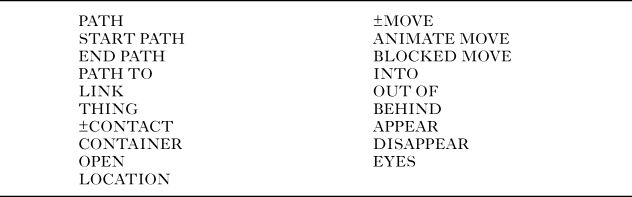
There are quite likely more primitives, such as UP and DOWN, which have not been systematically studied in the first six months but may be equally early. Furthermore, these primitives combine. For example, ANIMATE MOVE combines with THING to provide the early concept of ANIMATE THING (usually referring to people but applicable to animals as well; these are not conceptually separate until 5−7 months (Pauen, Reference Pauen2000).
The reader may notice the absence of a primitive of AGENCY, which was included in an earlier attempt to formulate the first concepts (Mandler, Reference Mandler1992), and is espoused by Carey (Reference Carey2009) and others. As indicated in a reply to Carey (Mandler, Reference Mandler2011), it seems rather doubtful that a concept of causing something to move is achieved in the first six to seven months. The onset of causal understanding is an issue still to be decided, but we suggest that an understanding of intentionality (for which there is no evidence in the early months) may be an essential part of a concept of agency.
Note that PATH TO is the main part of the source−path−goal schema, and that source does not appear in the list of primitives, consistent with its secondary role in the schema. What the list does is to express primitive events, such as containment, occlusion, and their relevant parts, motion into, direct motion to an object or place, interactions between objects or paths (LINKS), as well as a few states resulting from the various types of motion. These motion and spatial primitives are foundational. By themselves or in combination they structure the conceptual representations that describe events. Thus they form the building blocks for simple image schemas. For example, an infant watches an apple being put into a bowl and forms the image schema of THING INTO CONTAINER. Only later will this be understood as apple into bowl (while of course still being understood as THING INTO CONTAINER).
Other similar concepts will be learned in the course of the first year. For example, infants can discriminate above and below relations at 3−4 months, but do not conceptualize them (i.e., treat them as structures independent of the objects involved) until between 6 and 7 months (Quinn, Reference Quinn, Rakison and Oakes2003). Similarly, 6- to 7-month-olds discriminate the spatial relation of between, but do not do so conceptually until 9−10 months. We should not overemphasize what may be minor differences in the ages at which various spatial relations are understood preverbally. However, it is important to understand the preverbal foundations of conceptual thought, because what follows later will be influenced by them.
The most dramatic aspect of what the existing experimental literature tells us about early conceptual understanding is that, with the exception of seeing and not seeing, it is all spatial in nature. There is no indication that infants in the first six to seven months conceptualize anything about force, let alone emotions or sensory phenomena such as taste and touch. Babies at this stage seem to be conceptually unaware of their bodies in spite of the feelings the body produces. Yet this is the period when the foundations of the conceptual system are laid down. The topmost level of what will be a hierarchically structured system of object knowledge is formed during this period: global understanding of animals, vehicles, furniture, and even something about utensils are being formed, while more detailed concepts such as dog, car, chair, and spoon are (often considerably) later. The earliest understanding of events is also global: goal paths and objects moving into or out of containers or behind occluders. More detailed event understanding, for example, the sequences involved in routines such as eating or dressing, begin late in the first year (Bauer & Mandler, Reference Bauer and Mandler1992).
Of course, infants develop perceptual expectations in these early months, so they may be surprised or even distressed if daily routines are violated in some way. But our concern here is with the conceptual understanding that enables one to think about something in its absence. That requires some form of simulation. Before language, recalling or thinking about something means recreating an event in the mind’s eye – i.e., by imagery. For example, when a 5-month-old remembers where an object has been hidden, that requires some form of imagery showing an object being put at a location in a room or other delimited space. This is what image schemas allow us to do. They structure our memory for an event such as an object disappearing at a particular location. Many details of the observed scene will be lost, but the basic structure of the event is preserved and may be used to form an image – in this example, a thing disappearing into a container or behind an occluder located at a place in the scene.
It is also worthwhile to note the relatively early appearance (although later than the data discussed above) of using an image schema in an analogical fashion to understand something, as illustrated in the case of opening and closing one’s eyes. Piaget (Reference Piaget1951) gives a detailed description of his daughter at 11 months attempting to imitate his blinking his eyes, by at first opening and closing her hand, then her mouth, and a bit later by covering and uncovering her face with a pillow. This is an example of mapping a familiar schematic structure onto something different in an attempt to understand it (Mandler Reference Mandler2004, p. 116). Other examples of early conceptual mapping are provided by Wagner, Winner, Cicchetti, and Gardner (Reference Wagner, Winner, Cicchetti and Gardner1981), showing that 9- to 12-month-olds tend to look at an upward arrow when hearing ascending tones and down to descending ones, and also tend to look at dotted lines rather than at a solid line when hearing sound blips. We would say that these examples make use of schematic integration (discussed in the next section) rather than image schemas alone, because they involve blending bodily action (or auditory information) with spatial understanding.
The two major conceptual mapping approaches in cognitive linguistics, Conceptual Metaphor Theory (Lakoff & Johnson, Reference Lakoff and Johnson1980; Lakoff, Reference Lakoff and Ortony1993; see also Gentner, Reference Gentner1983) and Conceptual Integration Theory (Fauconnier & Turner, 1994, 2002) assign an important role to image schemas in making the projections involved in analogical thought and metaphor construction. However, in both theories an image schematic structure is often simply a more abstract version of an event regarded as basic, with no distinction made between spatial and non-spatial properties. Neither theory has so far provided preverbal examples of conceptual projection, or an account about how the mapping of image schemas begins.
Because such projection exists, as illustrated in the Piaget and Wagner et al. examples above, and because it also appears that concepts early in development are spatial in nature, it becomes important to ask how more complex conceptual structures that include non-spatial information come to be built. The answer to this question will affect our views about how the first correlations in our experience give rise to primary metaphors (Grady, Reference Grady1997), and also leads to further reflections about which metaphorical mappings are universal and which are culture-specific. It may also suggest ways in which the principles and goals of conceptual integration (Fauconnier & Turner, Reference Fauconnier and Turner2002, pp. 309−352) may be grounded on the early development of thought processes, and not only on sophisticated examples of adult creativity.
3 Adding embodiment via schematic integrations
3.1 force
Presumably the reason that infants’ initial understanding of the world is limited to spatial information is because they have had relatively little experience acting on the objects around them. Although they can reach out to objects, they cannot move themselves around in the first few months and have limited ability to handle objects, which in any case must necessarily be small and light. To be sure, infants feel pressure as adults care for them, but feeling force is not the same as exerting it. It seems likely that the most important input about force begins when infants begin to crawl and meet up with heavy objects that they push or push against. This development takes off in the second six months.
The first issue to address is how the feeling of force gets blended with spatial information to form an enriched structure. For example, as infants meet an obstacle in a path and push at it, they experience force while they are processing BLOCKED MOVE. They can image blocked motion, but how do they image force? They have no language and their image schemas only represent the spatial movement they are engaging in. Hence, although they have a feeling of ‘umph’ (Mandler, Reference Mandler2010, Reference Mandler2012) that will also be aroused when engaging in the activity the next time, at most it will be only mildly activated when they remember or think about the event in its absence.
The psychological process involved is a very basic one, namely, forming an association through repeated experiencing of things together. Both elements become integrated, making the feeling of force part of the BLOCKED MOVE event. The result is an image schematic structure with an added element. The feeling of force (or, for that matter, any other bodily feeling) cannot be imaged and is difficult to think about on its own. But once the forceful feeling becomes integrated with an image schema, it can play a role within an organized experience. The feeling of ‘umph’ thus becomes spatialized, and can now be conceptualized as a part of BLOCKED MOVE. This is what we call schematic integration: the enriched spatial concept that results from blending a spatial event with a non-spatial component.
This process is similar to what is called a simplex network in Conceptual Integration Theory (Fauconnier & Turner, Reference Fauconnier and Turner2002, pp. 121−122). In a simplex network, an unstructured element becomes blended with a structured input space. In the resulting blend, the unstructured element assumes a relevant role within the organizing frame imported from the structured input space. However, in the present case, the components of the blend do not have equal cognitive status, and do not become equally accessible. The spatial input, BLOCKED MOVE, is the one that structures the blend, making it the ‘topology provider’ of the schematic integration. The forceful feeling when the blocked motion occurs is a secondary part of the structure that is being built. It is experienced but it can only be partially activated when thinking, and typically will not even be consciously felt. This does not mean the blended structure is not useful. It certainly is, enriching the spatial understanding of an event with a feeling of ‘umph’. We can remember having the feeling and can move the relevant muscles, because the sensation is now part of a meaningful spatial event.
Gilles Fauconnier (personal communication) points out that the understanding of blocked motion that originally arises from seeing other objects moving must in this case be applied to the infant’s self-movement. That suggests that the structure into which the feeling of pushing is being integrated may already be complex. So perhaps the similarity is closer to a double-scope integration than to a simplex one. However, this does not change the basic point that the two (or more) parts of the integration do not have equal status.
This view contrasts with Talmy’s (Reference Talmy1988) force-dynamic analysis, widely accepted as the basis of force image schemas in cognitive linguistics today. As summarized in Mandler (Reference Mandler2010, p. 36): “Basically the patterns he described consist of three interacting tendencies: an object either moves or not (a spatial variable), it either does the moving or receives it (another spatial variable), and it is either stronger or weaker than the other object.” The spatial components were represented in diagrams, but so was the forceful component, by means of arrows. This was necessary, of course, because force cannot be represented in an image. The problem this raises is that it left open how ‘stronger’ and ‘weaker’ are represented in the mind.
When we think about force, it may include an empathetic response, i.e., the feeling of umph, but in the main it consists of spatial descriptions of events. The spatial representations contain important information: for example, speed at the time of contact, or response of the hit object, such as falling backwards or breaking apart. All these events can be learned and represented as forceful, but the notion of force itself remains abstract, with only the actual occurrence of the feeling when a forceful event occurs making it concrete. Nevertheless, adding the memory of a feeling of force to the understanding of events such as pushing and pulling should be relatively easy for infants, once they begin to carry out such acts by themselves. The spatial relations involved in each act are unique and provide the structure that force itself lacks, so that they can be thought about in the absence of the activities.
We should also note that there may be other schematic integrations that occur at the same or even earlier ages, such as integrating eating food with the feeling of swallowing. We do not yet have the data needed to answer this question, although we know that infants conceptualize food and learn words for it in the second six months (Bergelson & Swingley, Reference Bergelson and Swingley2012).
3.2 time
The question arises, then, as to whether the same thing is true of time. Infants obviously process temporal information from an early age. For example, to conceptualize MOVE INTO when one object hits another, the hit object must be seen to move immediately upon contact. Similarly, to perceive a link between two acts, such as a game of peekaboo, so popular to 4-month-olds, there must be a time limit for each act; if too slow, no link will be established. Srinivasan and Carey (Reference Srinivasan and Carey2010) found that 9-month-old infants are sensitive to correlations between spatial and temporal lengths. (Interestingly, infants as young as 8 months also relate increasing number of objects to increasing spatial length; de Hevia & Spelke, 2010). However, we have no evidence that infants at any point in the preverbal period conceptualize time. We do know that the course of children’s learning temporal concepts is prolonged (e.g., Nelson, Reference Nelson1996). It seems likely that the sequential order of familiar events will be the entrée to conceptualizing time, and the data indicate that infants are not able to remember the order of even three-item events before around 9 months (Carver & Bauer, Reference Carver and Bauer1999).
However, for both older children and adults there is a very close blending of space and time (e.g., Casasanto, Fotakopoulou, & Boroditsky, Reference Casasanto, Fotakopoulou and Boroditsky2010; Clark, Reference Clark and Moore1973; Traugott, Reference Traugott and Greenberg1978), such that the feeling of time’s passage is conceptualized spatially: a long time, my birthday approaches, behind time, etc. As noted more than a hundred years ago (Guyau, 1890/1988): “We can easily imagine space; we have an inner eye for it, an intuition. Try, on the other hand, to represent time as such; you will only succeed by means of a representation of space” (p. 99). In short, we can neither see nor feel time. Even to adults time seems more abstract than force. There are strong feelings associated with force, but there do not seem to be clear-cut feelings associated with time. Presumably this abstractness is the reason why space influences time judgments more than vice versa (Casasanto et al., Reference Casasanto, Fotakopoulou and Boroditsky2010) and spatial metaphors are so frequently used to describe temporal relationships (Lakoff & Johnson, Reference Lakoff and Johnson1980).
If there are early schematic integrations for temporal relations, differences in duration may be visualized as differences in speed or distance covered in motion events, and different lapses between events as different distances separating objects in space. Of course, the complex cultural knowledge that produces time measures and temporal references is necessary to have a proper concept of time, but imaging duration may come much earlier. Then hours, days, tomorrow, or yesterday can be integrated with landmarks or with objects moving in a (preferably) linear version of the path−goal schema (Coulson & Pagán Cánovas, 2013; Fauconnier & Turner, Reference Fauconnier, Turner and Gibbs2008). The early path−goal schema is also consistent with the irrelevance of source in the understanding of time: what is important is that Saturday is approaching or that we are approaching Saturday, not where we or Saturday are coming from.
3.3 emotion
It is not surprising that both force and time become blended with space, nor that the spatial aspect is important in enabling us to understand them. The muscular feeling involved in pushing or pulling occurs simultaneously with differences in spatial direction; pushing looks different from pulling or merely touching and these differences can be imaged. Temporal and spatial paths are both movements on a path that can be thought of in a forward or backward direction. The question arises, then, how other bodily experiences such as emotion become conceptualized. There is no relationship between space and emotion such as exists for force and time. Particular emotions become associated with this or that event, but that in itself is not enough to conceptualize them. They have no structure, only a difference in intensity, but difference in intensity does not map into a difference in space. Not surprisingly, then, emotions are understood late in development. By 18 months infants recognize by their facial expression that someone dislikes what they are eating (Repacholi & Gopnik, Reference Repacholi and Gopnik1997), and by three years can differentiate and label happy, sad, and angry facial expressions (Widen & Russell, Reference Widen and Russell2003). It is not until age four or five that they make headway in differentiating a larger variety of emotions (Widen & Russell, Reference Widen and Russell2008).
Not only do emotions have no connection to primitive spatial structures, such as PATH or CONTACT, they are difficult to differentiate one from another. They do differ in intensity from one occasion to another, but aside from feeling good or bad there is no other way to tell one apart from another other than by associating them with individual spatial events. That is part of the reason they are slow to learn. Which events, exactly, are associated with anger or feeling afraid, and how many instances of each type of event does it take to form a schematic integration? There are no simple events, such as pushing or pulling, to provide imageable structure, and the feelings themselves are virtually impossible to differentiate.
This is why one cannot image emotions, and as we all know, recreating experienced emotion or pain after the fact is extremely difficult. One can recall that one felt bad, but that is not the same as feeling it again even in reduced form. All of this tells us that there are no image schemas for emotions, no simple commonalities in events to help place a feeling in a mental structure. One may eventually learn some commonalities among the events that make one afraid or angry, and build a more general event structure, but often one uses linguistic metaphor to provide a representative event as an aid to understanding.
Emotional experiences have two parts: an event and an autonomic arousal. However, the arousal itself does not distinguish one emotion from another but is roughly the same (although varying in intensity from one occasion to another) for all emotional experiences (G. Mandler, Reference Mandler1982, Ch. 6). This makes for a very different situation from blending a feeling of force with events. The feeling of force being exerted by one’s muscles and the feeling of the body being moved by an external force are easily associated with the different events, one in which the body exerts pressure on something and the other in which something exerts pressure on the body. In contrast, the registration of arousal in the autonomic nervous system in emotion-arousing situations (for example, an increase in heart rate, and change in blood pressure) does not differ for anger, fear, or joy. This creates an understanding problem in that one is left solely with events to individuate the emotional responses one is having. Schematic integrations of spatial schemas and arousal have been created, but it is the events involved that differentiate one emotion from another. There may be lots of very different events that make one angry, afraid, or joyful. Presumably this is why it takes years to learn appropriate terms for the emotional reactions one feels on different occasions.
We would suggest this is why metaphor plays an important role. For example, we say about someone getting angry, perhaps gesturing the while, “He was so mad he boiled over”, and the child may image something pouring out of a pot on a stove. Spatial metaphors of containment, opening and closing, in and out, appearing and disappearing, are common when talking about emotions. That probably happens because this is how emotions are imagined when they are learned about in the first place. By the time children learn to differentiate emotions, they have heard many metaphors for them. It is not just abstract concepts that need metaphor; some internal feelings do as well.
Force metaphors for emotions are also very frequent across languages (Kövecses, Reference Kövecses2003). Just as in Talmy’s force dynamics, force in emotion metaphors can often be reduced to spatial terms. Many of the examples in the literature consist of things going into or out of containers, objects reaching a destination, etc. However, force metaphors may also be examples of double-scope integration networks, in which several different structures blend to produce emergent meanings not available from their components in isolation (Fauconnier & Turner, Reference Fauconnier and Turner2002). Specifically, the schematic integration that is already involved in understanding forceful events may become further blended with the feeling of intensity in emotional experiences such as extreme anger or passion. Even though frequently emotion metaphors (such as exploding with anger) suggest intensity, this kind of three-way integration of an event, a bodily feeling accompanying it, and an entirely different bodily feeling of an intense autonomic nervous system reaction, does not necessarily make it central to understanding or expressing emotion in general. The conceptualization of affective experiences is highly complex and involves a variety of inputs that result in many different metaphors. It is hardly surprising that it takes a good many years for children to learn the many ways that emotion is verbally expressed.
4 Conclusions
We have told a developmental story for meaning construction that involves three clearly differentiated cognitive structures. Each of these structures builds on the preceding ones to create early concepts and establish the first mappings between disparate experiences. The three steps are:
1. Spatial primitives. The first building blocks that allow us to understand what we perceive: PATH, CONTAINER, THING, CONTACT, etc.
2. Image schemas. Representations of simple spatial events using the primitives: PATH TO THING, THING INTO CONTAINER, etc.
3. Schematic integrations. The first conceptual representations to include non-spatial elements, by projecting feelings or non-spatial perceptions to blends structured by image schemas.
Most linguists writing about image schemas unsurprisingly use linguistic examples to make claims about conceptual structures. But we also need to consider examples that come not from language but from the conceptual system that underlies language. It is important for cognitive semantics to be aware of preverbal conceptual understanding. In particular, finding the meanings that preverbal infants ascribe to events gives us information about the most fundamental image schemas and how they differ from more complex schematic integrations.
The term ‘image schema’ is a central notion in cognitive semantics and other fields that focus on the construction of meaning. Image schemas are generally viewed as redescriptions of perceptual events, or even more broadly, as generalizations over perceived similarities. These redescriptions are then mapped onto conceptual structure (see Oakley, Reference Oakley, Geeraerts and Vuyckens2007, for an overview of definitions and applications). Regarding what image schemas are, what they are not, and their importance for meaning construction, we would like to point out the following.
First, image schemas are not just gestalts that serve the purpose of mapping spatial information from one conceptual structure to another. Image schemas are the first conceptual structures. They allow infants to simulate perceptions in their absence, enabling recall of events and inferences about them to be made.
Second, in the developmental story, so far as we know, prelinguistic image schemas are strictly spatial. Spatial information can be simulated in the mind’s eye. Neither force nor any other non-imageable information is available to the conceptual system when image schemas begin to be formed. It is true that auditory information can also have obvious structure and be imaged, making it potentially able to form image schemas. However, for sighted prelinguistic infants, auditory structures play a much more limited role in understanding what is going on around them.
Third, when non-spatial, non-imageable information begins to be incorporated into the conceptual system, the resulting concepts still have image-schematic structures, but they are not just image schemas anymore: they are blends that integrate non-spatial components into spatial events. We have suggested the term ‘schematic integrations’ for these blends. For the first time, they allow the infant to think of non-spatial perceptions in their absence, although their non-spatial elements still remain non-imageable. Needless to say, in a process boosted by language and culture, the conceptual system creates schematic integrations of ever-increasing complexity − such as double-scope networks (Fauconnier & Turner, Reference Fauconnier and Turner2002) − as well as leading to abstract concepts. Nevertheless, the early and relatively simple cognitive habits of schematic integration are still recurrent in language and thought: throughout our lives we repeatedly use mental imagery involving events of motion on paths, containment, and occlusion (and more complex image schemas resulting from them) in meaning construction.
The developmental story suggests that we should rethink our definition of the term ‘image schema’, paying more attention to what is basic and what comes later. In the linguistic literature a great many examples of image schemas have been suggested. But how should they be tested? Some of them seem to be composed of more primitive image schemas. For example, how are the center−periphery, scale, near−far, and container image schemas, described both by Johnson (Reference Johnson1987) and Lakoff (Reference Lakoff1987), related to each other? Johnson suggests a perceptual origin to a center−periphery schema, on which the others are superimposed. However, it seems unlikely that young infants have any idea of a center or periphery, whereas we know they have a container schema with an inside and outside. It seems more plausible, therefore, that the container image schema is the root source of ideas about center−periphery.
One can ask similar questions about how a scale schema is formed. Johnson (Reference Johnson1987) suggests that the scale schema has path directionality representing amount, a cumulative character, normativity, and can be open or closed. Aside from the last, which seems a minor aspect, his description plausibly does include a number of things we know about a scale. However, path directionality is most likely the initial basis of a scale schema, with amount going up (or down) witnessed on a daily basis in infancy in relation to food and drink. Cumulativity and normativity can only be added later and are also less fundamental in understanding scalarity. In contrast to Johnson’s view, Grady (Reference Grady and Hampe2005) classifies the scale image schema as non-perceptual. Like the image schemas of cycle and process it is said not to be based directly on perceptual experience, but is broader and more abstract (p. 41; see also Clausner & Croft, Reference Clausner and Croft1999, for a related view).
In contrast to either approach, what we are suggesting is that the most basic image schemas are formed from infants’ attending to motion on paths through space along with a few spatial relations, with special emphasis on containment and occlusion. The first image schemas are formed from innate spatial and motion primitives, providing infants with a way of understanding and remembering events without the burden of the infinite detail that events present. They can later be combined with feelings of force and other sensations, to create new conceptual structures, but in our view these new structures are not the same as image schemas. We suggest it is advisable to restrict the meaning of the term ‘image schema’ to imageable information, which forms the foundations of the conceptual system, and use the term ‘schematic integrations’ (or some other term) for structures that include internal feelings of force, as well as emotion and other sensory information.
Building on the spatial primitives, the ability to create image schemas enables infants to run mental simulations of spatial events. Then the ability to connect disparate experiences with these simulations and integrate them into new wholes produces the first schematic integrations, which gradually incorporate more and more non-spatial elements. Non-spatial elements still cannot be imaged, even for adults; one can think about a car crash and even shudder while doing it, but the simulation will show the break-up of the car, not the force that causes it. However, schematic integrations allow the infant, for the first time, to conceptualize non-spatial experiences as meaningful aspects of organized spatial stories. All three structures of the schematization process (spatial primitives, image schemas, and schematic integrations) are powerful tools for reducing the immense variety of perceptions and sensations to discrete kinds of event that the human mind can easily represent.
Babies are not Piaget’s sensorimotor creatures. A rich system of conceptual structures and cognitive habits is already in place before verbal activity begins. Language and culture necessarily build on this system. They boost it and change it, sometimes in dramatic ways, but they are also influenced by it. Research on image schemas often ignores the particularities of this diachrony. However, what comes earlier or later, what belongs to the stage of primitives, image schemas, or schematic integrations, can be of great importance for the analysis of later meaning construction. If we are to understand embodiment and metaphor in language and thought, we will need to see them as part of a developmental story.
Our analyses of early conceptual development suggest that image schemas, rather than non-spatial concepts requiring schematic integrations, may be the primary source of bodily metaphors in language. Children must interpret the metaphors they hear that describe time and emotion, and understanding in the early years will almost always involve spatial simulation of events; see, for example, Ozcaliskan (Reference Ozcaliskan2005) on four-year-olds’ understanding of spatial metaphors for time, ideas, and sickness. This raises the interesting question as to whether the majority of metaphors are structured by spatial image schemas rather than non-spatial materials, such as force or intensity, which themselves require schematic integrations with spatially described events to be understood. It also implies asking to what extent the image schematic structures in figurative language reflect early cognitive habits. Are preverbal attentive preferences for paths of motion, containment, and occlusion still the most likely to be used for creating metaphors later in life? Needless to say, a great deal of analysis of linguistic metaphor will be needed to answer such questions, a task that we have begun.