Traditionally, creativity has been defined as a complex phenomenon that generates ideas and new products that are useful in achieving a particular objective (Runco & Jaeger, Reference Runco and Jaeger2012). While the traditional view of creativity emphasizes its cognitive component over its affective component, recent decades have seen a noticeable rise in the number of studies focused on analyzing the influence of emotional and personal factors (motivation, emotion, and personality traits) on the cognitive processes involved in creativity (Baas, De Dreu, & Nijstad, Reference Baas, De Dreu and Nijstad2008, Reference Baas, De Dreu and Nijstad2011). From a dynamic perspective, creativity is considered an interaction between cognitive styles, emotional dispositions, and motivational preferences (Bledow, Rosing, & Frese, Reference Bledow, Rosing and Frese2013; Soroa, Balluerka, Hommel, & Aritzeta, Reference Soroa, Balluerka, Hommel and Aritzeta2015). Specifically, results from neuropsychology research indicate that emotions and cognition interact in processes such as identifying problems, generating ideas, evaluating alternatives, and decision making (Phelps, Reference Phelps2006; Scherer, Reference Scherer and Borod2000). Furthermore, recent studies have demonstrated that emotional abilities are related to creative thinking (Bakhtiyari, Alizadeh, & Rezaee, Reference Bakhtiyari, Alizadeh and Rezaee2014; Carmeli, McKay, & Kaufman, Reference Carmeli, McKay and Kaufman2014), finding that empathy and emotional control both contribute to maintaining and using positive emotions that facilitate divergent thinking (Mishra, Reference Mishra2014; Parke, Seo, & Sherf, Reference Parke, Seo and Sherf2014).
An area of research has grown out of that interest in combining emotional and cognitive factors of creativity, evaluating emotions as products of creative activity (Averill, Reference Averill, Kaufman and Baer2005; Fuchs, Kumar, & Porter, Reference Fuchs, Kumar and Porter2007). In that context, Emotional Creativity (EC) is defined as the ability to feel and express emotions in a novel, effective, and authentic way (Averill, Reference Averill1999a). Three criteria are used to determine an emotion’s level of creativity, the same three that Wallas proposed (Reference Wallas1926) to evaluate creative ideas: a) Novelty (it has to be original, different, and unique), b) Effectiveness (it has to benefit some person or group), and c) Authenticity (it has to reflect the person’s values and beliefs).
EC has been associated with Emotional Intelligence (EI) because both constructs involve a personal predisposition to focus on one’s emotions and those of other people. Furthermore, both concepts highlight how important it is for behavior to adapt to a particular context, and be useful in goal attainment. Nonetheless, the cognitive processes implicated in those two abilities differ, and so do the criteria used to evaluate them. On the other hand, EI is considered a set of emotional skills (perception, use, understanding, and regulation of emotions) that guide one’s way of thinking and acting to respond to different circumstances in the most appropriate way (Mayer & Salovey, Reference Mayer, Salovey, Salovey and Sluyter1997). EC is also associated with the ability to make creative use of emotions, combine them, and experience different emotions than other people do (Averill, Reference Averill2004). Along those lines, some researchers (Salovey, Mayer, Goldman, Turvey, & Palfai, Reference Salovey, Mayer, Goldman, Turvey, Palfai and Pennebaker1995) observed that individuals who are able to pay attention to emotions (attention) displayed high EC, scoring high on all dimensions thereof. Meanwhile, people who were able to understand emotions (clarity) were reportedly more predisposed to connect with their emotions (preparedness) and experience them in an effective and authentic manner (effectiveness/authenticity). According to that study (Salovey et al., Reference Salovey, Mayer, Goldman, Turvey, Palfai and Pennebaker1995), people who perceived themselves as capable of understanding and regulating their emotions (repair) were not necessarily considered emotionally creative.
EC’s relationship with the big five personality traits is of interest to various researchers as well (Averill, Reference Averill, Dalgleish and Power1999b, Reference Averill, Kaufman and Baer2005; Salovey et al., Reference Salovey, Mayer, Goldman, Turvey, Palfai and Pennebaker1995). Specifically, people who are open to experience exhibit high levels of every dimension of EC – especially strong was the positive correlation between openness and tendency to feel novel emotions (Feist, Reference Feist, Kaufman and Sternberg2010). People who are highly agreeable show a greater predisposition toward emotions and, to a lesser extent, toward perceiving themselves as capable of feeling effective and authentic emotions. In terms of extraversion, the only dimension of EC that was highly correlated with it was effectiveness/authenticity (Wolfradt & Pretz, Reference Wolfradt and Pretz2001). Finally, neuroticism and conscientiousness, as personality traits, were not associated with EC.
Many studies analyzing the relationship between mood and creativity have revealed that pleasant moods with a moderate level of activation (joy or happiness) correlate positively with preparedness and novelty (Baas et al., Reference Baas, De Dreu and Nijstad2011). However, there is no clear consensus about the association between unpleasant moods and creativity. Among the results detailed in one meta-analysis (Baas et al., Reference Baas, De Dreu and Nijstad2008), it was observed that unpleasant moods with moderate activation (tension or anxiety) facilitate task perseverance and the effectiveness of the result (effectiveness), but significant correlations have not been found between unpleasant moods and the EC subdimensions named preparedness and novelty (Averill, Reference Averill, Dalgleish and Power1999b).
In addition to the associations observed between EC and variables like EI, personality, and mood alluded to above, various studies have reported differences between women and men’s predisposition to connect with their emotions (emotional preparedness) and, to a lesser extent, in the dimension of EC referred to as effectiveness/authenticity (Averill, Reference Averill1999a, Reference Averill, Dalgleish and Power1999b, Reference Averill, Kaufman and Baer2005). Nevertheless, differences as a function of sex have not been found in the capacity to experience and express novel emotions (novelty). Based on those results, women show a greater tendency to think about emotions, pay attention to other people’s emotions, and live their emotional experiences more intensely and authentically. Other studies have reported similar results (Ghadiri Nezhdyan, & Abdi, Reference Ghadiri Nezhdyan and Abdi2010; Soroa, Gorostiaga, Aritzeta, & Balluerka, Reference Soroa, Balluerka, Hommel and Aritzeta2015; Walton & Kemmelmeier, Reference Walton and Kemmelmeier2012).
EC Assessment
There are three known instruments to evaluate EC. On the one hand, the Emotional Consequences Test (ECT) and the Emotional Triads Test (ETT), created by Averill and Thomas-Knowles (Reference Averill, Thomas-Knowles and Strongman1991), examine the ability to generate creative responses (fluidity, flexibility, originality, and effectiveness) in highly emotionally charged situations. Specifically, the ECT asks participants to generate a list of possible consequences of four hypothetical, highly emotionally charged situations (i.e. Situation 1: What would happen if people fell in love with someone different every day?). Meanwhile the ETT asks participants to tell four stories, each involving three different emotions (i.e. emotional triad 1: calm-disconcerted-impulsive). Responses on both tests are assessed using the interrater agreement technique (Amabile, Reference Amabile1982). On the other hand, the Emotional Creativity Inventory (ECI; Averill, Reference Averill1999a) is a self-perception instrument that measures EC using the three dimensions in Averill’s theoretical model (preparedness, novelty, and effectiveness/authenticity).
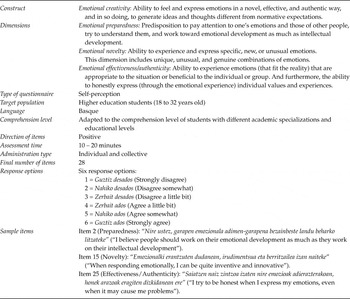
In the present study, the instrument of choice to evaluate self-perceived EC was the ECI. The ECI allows for more objective correction than the ECT and the ETT, and it facilitates saving time and effort by applying interrater evaluation (Schmidt, Le, & Ilies, Reference Schmidt, Le and Ilies2003). Moreover, the three dimensions in the theoretical model of EC provide a more complete view of the construct. Likewise, to evaluate EC, the ECI takes into account not only the assessment criteria for creative product in the verification phase of the process (novelty, effectiveness, and authenticity), but also respondents’ predisposition to connect with their emotions during the preparation phase (preparedness). The initial factor structure of the original ECI (Averill & Thomas-Knowles, Reference Averill, Thomas-Knowles and Strongman1991) included four factors: emotional preparedness (7 items); novelty (14 items); effectiveness (5 items); and authenticity (4 items). A subsequent (Averill, Reference Averill1999a) study conducted principal components analysis with oblique rotation in a sample of 489 student participants (67.68% women) from the University of Massachussets, Amherst. This gave way to a new three-dimensional structure, with effectiveness and authenticity together comprising one dimension. The three new dimensions are: Preparedness (7 items); Novelty (14 items); and Effectiveess/Authenticity (9 items).
The psychometric properties of the ECI have been analyzed in its original version (Averill, Reference Averill1999a, Reference Averill, Dalgleish and Power1999b; Gutbezhal & Averill, Reference Gutbezhal and Averill1996; Humphreys, Jiao, & Sadler, Reference Humphreys, Jiao and Sadler2008; Ivcevic, Brackett, & Mayer, Reference Ivcevic, Brackett and Mayer2007), Persian version (Ghadiri Nezhdyan & Abdi, Reference Ghadiri Nezhdyan and Abdi2010), and Spanish version (Soroa, Gorostiaga et al., Reference Soroa, Balluerka, Hommel and Aritzeta2015). The factor structure of the Persian version (Ghadiri Nezhdyan & Abdi, Reference Ghadiri Nezhdyan and Abdi2010) was analyzed through confirmatory factor analysis using LISREL 8.7 (Jöreskog & Sörbom, Reference Jöreskog and Sörbom2003). In that study, participants were 650 students (50% women and 50% men) at universities in Tehran, Iran. Furthermore, to examine the dimensionality of the Spanish version (Soroa, Gorostiaga et al., Reference Soroa, Balluerka, Hommel and Aritzeta2015), confirmatory factor analysis was conducted using SPSS, Amos 20.0 (Arbuckle, Reference Arbuckle2011). Those research participants were 1145 higher education students (650 women and 495 men) completing their studies at professional training centers (58%) or universities (42%) located in the Comunidad Autónoma del País Vasco (CAPV). Both studies replicated the original ECI’s three-dimensional structure (Averill, Reference Averill1999a).
Since this instrument has not yet been validated for use in a Basque-speaking population, the main goal of the present research was to adapt the ECI for Basque language and culture, and then to examine its psychometric properties in higher education students. First, we aimed to analyze the dimensionality of the Basque ECI using a cross-validation procedure (Refaeilzadeh, Tang, & Liu, Reference Refaeilzadeh, Tang, Liu, Liu and Tamer2009). Additionally, this study tried to obtain reliability indexes for each factor, and analyze EC’s relationship with variables like emotional intelligence, personality, affect, and sex.
Method
Participants
To examine the factor structure of the Basque version of the ECI, and to obtain reliability indexes, a sample of 594 participants was employed (388 women and 208 men) aged between 18 and 32 years old (M age = 20.47; SD = 2.48). It was also divided into two subsamples to conduct cross-validation: 1) The exploratory subsample (N exploratory = 305; M age = 20.16; SD = 1.82; 66.6% women and 33.4% men); and 2) The confirmatory subsample (N confirmatory = 289; M age = 20.79; SD = 2.98; 64% women and 36% men). A portion of the initial sample – 355 college students (176 women and 179 men) aged between 18 and 31 years old (M age = 20.79; SD = 2.18) – was used to analyze the instrument’s external validity.
All participants were completing their studies in Basque at the Universidad del País Vasco (UPV/EHU), which is public, and the Mondragon Unibertsitatea, which is private. Sample selection was accidental but participants were balanced in terms of sex.
The research received a favorable report from the University of the Basque Country Ethics Committee for Research and Teaching. Informed consent was requested from the faculty of each participating group, and from the students themselves. The study’s response rate was 100%.
Instruments
Emotional Creativity Inventory (ECI; Averill, Reference Averill1999a)
The ECI is a self-report instrument that shows a three-factor structure: a) Emotional Preparedness – this refers to having a favorable attitude toward connecting with one’s emotions (i.e. I think about and try to understand my emotional reactions); b) Emotional Novelty – this is the ability to generate an unusual, out-of-the-ordinary emotional response (i.e. I can experience a variety of different emotions at the same time); and c) Emotional Effectiveness/Authenticity – this is the capacity to honestly express emotional experiences and events that are appropriate and beneficial to the individual or group (i.e. My emotions help me achieve my goals in life). The instrument’s 30 items are answered on a Likert-type scale from 1 (strongly disagree) to 5 (strongly agree). Its psychometric properties are adequate (Averill, Reference Averill1999a). Specifically, the ECI has shown the following values of Cronbach’s alpha: .82 for preparedness, .84 for novelty, and .73 for effectiveness/authenticity. The present study utilized the Basque version of the ECI, submitting it to validation. This version’s 28 items (see Appendix 1) are answered on a Likert-type response scale from 1 (erabat desados / strongly disagree) to 6 (erabat ados / strongly agree). Its psychometric properties are presented in the Results section of this paper.
Basque version of the Short Trait Meta-Mood Scale for adolescents (TMMS-23; Gorostiaga, Balluerka, Aritzeta, Haranburu, & Alonso-Arbiol, Reference Gorostiaga, Balluerka, Alonso-Arbiol and Haranburu2011)
The TMMS-23 is a self-report instrument that, using three subscales, measures the extent to which respondents: a) Pay attention to and value their feelings (Attention: i.e. Arreta handia jartzen dut sentimenduetan / I pay a lot of attention to feelings); b) Identify and clearly understand their feelings (Clarity: i.e. Ia beti dakit nola sentitzen naizen / I almost always know how I am feeling); and c) Use positive thinking to repair negative emotional states (Repair: i.e. Batzuetan triste sentitzen banaiz ere, ikuspegi baikorra (optimista) izan ohi dut / Although I sometimes feel sad, I tend to have an optimistic point of view). It is comprised of 23 items with a 5-point Likert-type response scale ranging from 1 (erabat desados / strongly disagree) to 5 (erabat ados / strongly agree). The psychometric properties of the short version of the TMMS-23 in Basque (Gorostiaga et al., Reference Gorostiaga, Balluerka, Alonso-Arbiol and Haranburu2011) were adequate. In the present study, the following indices of internal consistency were observed: Cronbach’s alpha equal to .88, .84, and .86 for Attention, Clarity, and Repair, respectively.
Basque version of the NEO Personality Inventory – Revised (NEO PI-R; Gorostiaga, Balluerka, Alonso-Arbiol, & Haranburu, Reference Gorostiaga, Balluerka, Alonso-Arbiol and Haranburu2011)
The NEO PI-R is a self-report instrument that measures different dimensions of personality using five subscales: a) Neuroticism (i.e. Sarri arduratzen naiz gaizki irten daitezkeen gauzez / I often worry about things that might go wrong); b) Extraversion (i.e. Askotan izan naiz taldeetako liderra / I have often been a leader of groups I have belonged to); c) Openness to experience (i.e. Imajinazio handiko pertsona naiz / I have a very active imagination), d) Agreeableness (i.e. Uste dut pertsona guztien eskubideak errespetatu behar direla / I believe the rights of all people should be respected); and e) Conscientiousness (i.e. Nahiko ongi antolatzen dut neure burua zereginak garaiz amaitzeko / I organize myself pretty well to finish my work on time). Items are answered on a 5-point Likert-type scale ranging from 1 (erabat desados / strongly disagree) to 5 (erabat ados / strongly agree). The psychometric properties of the Basque NEO PI-R (Gorostiaga et al., Reference Gorostiaga, Balluerka, Alonso-Arbiol and Haranburu2011) were adequate. In the present study, the following reliability indices were observed: Cronbach’s alpha equal to .82, .81, .79, .80, and .85 for Neuroticism, Extraversion, Openess, Agreeableness, and Conscientiousness, respectively.
Spanish version of the Positive and Negative Affect Scales (PANAS; Robles & Páez, Reference Robles and Páez2003)
The PANAS is a self-report instrument made up of two scales with 10 items each that measure positive affect (i.e. I am a happy person) and negative affect (i.e. I am a nervous person). Answers are given on a 3-point Likert-type scale (1 = nunca / never, 2 = a veces / sometimes, 3 = a menudo / frequently) according to how often the person feels the emotion indicated in each item. The original version of the instrument showed adequate psychometric properties (Robles & Páez, Reference Robles and Páez2003). In this study, the reliability indices obtained were Cronbach’s alpha of .76 for negative affect, and .67 for positive affect.
Procedure
Conceptual definition of EC
The initial theoretical model proposed by Averill and Thomas-Knowles (Reference Averill, Thomas-Knowles and Strongman1991) laid the foundation for defining EC, creating items for the ECI, and validating the instrument. It is based on a social constructionist view of emotion (Averill, Reference Averill, Plutchik and Kellerman1980, Reference Averill, Stein, Leventhal and Trabasso1990) and theories of emotional intelligence (Goleman, Reference Goleman1995; Mayer & Salovey, Reference Mayer, Salovey, Salovey and Sluyter1997). Thus, EC is understood as the ability to feel and express emotions in a novel, effective, and authentic way (Averill, Reference Averill1999a). Following the suggestions of Carretero-Dios and Pérez (Reference Carretero-Dios and Pérez2005), a table of specifications for the Basque version of the ECI is included (see Table 1).
Specifications for the Basque Version of the Emotional Creativity Inventory (ECI)

Item adaptation
The ECI was adapted for a Basque-speaking population following the accepted standards of the scientific community (Balluerka, Gorostiaga, Alonso-Arbiol, & Haranburu, Reference Balluerka, Gorostiaga, Alonso-Arbiol and Haranburu2007; Hambleton & Patsula, Reference Hambleton and Patsula1999). The translation of ECI items from English into Basque was done using a back-translation design.
Every item on the English version was translated into Basque by two people independently; both individuals had mastery of both languages and were instructed about basic psychometric aspects of item construction. The two translations were compared and discussed until a version of each item in Basque was agreed upon. Using the resulting version, two different people with similar features as those who made the direct translation independently translated all the items in Basque into English, reaching a consensus about this version. Finally, the four members of the translation team compared each original item to its back-translated version, examining any non-equivalencies in meaning and making changes to the Basque ECI where appropriate.
Content validity
Having translated the initial battery of 30 items into Basque, a panel of eight experts (four women, four men) evaluated it, the goal being to generate evidence of content validity. Of all panelists, 50% were specialized in creativity, 25% in emotions, and the remaining 25% in social emotional skills. Specifically, the experts did the following two tasks: 1) Analysis of items’ suitability to measure the construct (codified into four levels: 1 = Not suitable, 2 = A little suitable, 3 = Somewhat suitable, 4 = Very suitable); and 2) Assignment of items to their respective theoretical dimensions (preparedness, novelty, and effectiveness/authenticity). Interrater agreement was estimated using Cohen’s kappa coefficient, and results indicated there was considerable interrater agreement (Banerjee, Capozzoli, McSweeney, & Sinha, Reference Banerjee, Capozzoli, McSweeney and Sinha1999) on the first task (k between .71 and .79) as well as the second (k between .76 and .82). Based on data provided by the expert panel, we selected items deemed “somewhat suitable” and “very suitable” (means greater than or equal to 3 points). Furthermore, at least 75% of the expert panel had to assign a given item to one of the three theoretical dimensions.
Thus, four items were placed in the preparedness dimension instead of novelty (item 10) or effectiveness/authenticity (items 19, 26, and 30). Heeding the expert panel’s suggestions, some items were reworded to improve item comprehension. For example: “nekez gertagarria / not likely” was substituted with “gertagaitza / unlikely” (item 19); “nire bizitzaren esanahiaren iturri / source of meaning in my life” was replaced with “zentzuaren iturri / source of meaning” (item 26). On item 10, “sumatu / to perceive” was replaced with “sentitu /to feel.” Furthermore, translating “unique manner” (item 13) as “special way” created confusion among the panelists, who were dubious as to whether that has a positive or negative connotation. It was determined that it should be considered something “genuine and original,” so the adjective “berezia / special” was substituted with “aparteko / unique.”
Additionally, to make items 4 and 30 easier to understand (they were worded in the reverse in the original ECI) their wording on the Basque version was changed to be direct. It was also decided that the original version’s 5-point response scale should be changed to a 6-point scale to prevent indecisive respondents from choosing the midpoint of the scale (Martínez-Arias, Hernández-Lloreda, & Hernández-Lloreda, Reference Martínez-Arias, Hernández-Lloreda and Hernández-Lloreda2006).
Pilot study
Using the 30-item version, a pilot study was conducted in which 120 students (88 women and 32 men) participated from the School of Education and from the School of Business at the University of the Basque Country (UPV/EHU). They all ranged in age from 18 to 25 years old (M age = 19.39; SD = 1.43). During the pilot study, a series of quantitative and qualitative analyses were conducted. First, certain terms were modified to be less complicated and more suitable for young people. For instance, on item 1, “erantzun emozional gogorrak / strong emotional responses” was replaced with “erantzun emozional biziak / deep emotional responses.” On item 8, “bakarrak / unique” was changed to “apartekoak / genuine.” On item 9, “bakartia, haserrekorra eta alaia izan / being a lonely, angry, and fun person” was switched to “triste, haserre eta pozik egon / being sad, angry, and joyful.” On item 17, “nobelagile / novelist” was changed to “idazle / writer.”
Second, a series of quantitative analyses was carried out, the goal being to select items for the version to be used in the empirical validation phase of the study. Average scores on items (ranging from 1 to 6) in the preparedness factor ranged from 4.1 to 4.52, and standard deviations ranged from 1.08 to 1.16. As for the novelty factor, mean scores ranged between 2.51 and 4.62, and standard deviations between 1.26 and 1.5. Last, mean scores on the effectiveness/authenticity factor fell between 3.67 and 4.58, and standard deviations between 1.16 and 1.37. Meanwhile, the range of discrimination indexes (corrected item-total r) was from .45 to .66 for the preparedness factor, from .42 to .61 for the novelty factor, and from .45 to .61 for the effectiveness/authenticity factor.
Thus, the results of qualitative and quantitative analyses suggested all items should be retained, including four items that should be reworded (1, 8, 9, and 17). After making the modifications derived from this pilot stage, the Basque version of the ECI was administered in the validation stage, along with other instruments needed to validate it (TMMS-23, NEO PI-R, and PANAS).
Data Analysis
Data analysis was carried out using the software SPSS v22.0. First, the dimensionality of the ECI in Basque was examined using a cross-validation procedure, randomly dividing the total sample (N = 594) into two subsamples. The first subsample, called exploratory (N exploratory = 305), was used to ascertain the factor structure of responses to the 30 items. Meanwhile, the confirmatory subsample (N confirmatory = 289) was used to confirm the model obtained in the exploratory subsample. Thus, Exploratory Factor Analysis (EFA) was applied to the first subsample using a principal axis factoring procedure and oblique rotation. Then Confirmatory Factor Analysis (CFA) was applied to the second subsample using the software SPSS Amos v.20 (Arbuckle, Reference Arbuckle2011). Robust maximum likelihood estimation (ML robust ) was used. To evaluate goodness of fit, first an absolute fit index was utilized, expressed as the quotient of chi-squared over degrees of freedom (χ2/df). An index under 5 suggests reasonable goodness of fit (Wheaton, Muthén, Alwin, & Summers, Reference Wheaton, Muthén, Alwin, Summers and Heise1977). Two comparative fit indexes (TLI and CFI) were utilized as well, along with two residual goodness of fit indexes (RMR and RMSEA). A TLI around .90 indicates a model has goodness of fit to the data (Whittaker, Reference Whittaker2011). Furthermore, a value of CFI greater than or equal to .95, RMR less than or equal to .08, and RMSEA under .06 reflect good fit to the data (Schreiber, Nora, Escenario, Barlow, & King, Reference Schreiber, Nora, Stage, Barlow and King2006). The internal consistency of the factors derived from CFA was evaluated by calculating Cronbach’s alpha coefficient, while Pearson’s correlation coefficient was used to analyze temporal stability.
The Pearson coefficient was also used to gather evidence of external validity for the Basque version of the ECI. To do so, in one part of the initial sample (N = 355), correlations between dimensions of EC, EI, personality, and affect were examined. Finally, differences between women and men on the dimensions of the Basque ECI were analyzed using Student’s t test. Cohen’s d index was used to estimate the effect size of differences in means.
Results
Factor Structure
As described in the Data Analysis section, EFA was carried out in the exploratory subsample (N exploratory = 305). Sampling adequacy was analyzed and tested using the Kaiser-Meyer Olkin index (KMO = .83) and Bartlett’s test of sphericity (χ2 435, N = 305 = 4136.74, p < .001). That analysis revealed a three-factor structure. The first, comprised of seven items, explained 27.20% of total variance. The second, with 14 items, explained 9.26% of total variance. The nine items belonging to the third and final factor explained 7.24% of total variance. Using a cut-off point of .32 (Tabachnick & Fidell, Reference Tabachnick and Fidell2001) for factor loadings, all items loaded onto their corresponding factors except item 10 (Deskribatzen errazak ez diren sentimendu eta emozioak ulertu nahi ditut / I want to understand feelings and emotions that are hard to describe) and item 21 (Saiatzen naiz emozio ezberdin asko sentitzen / I am able to experience a large number of different emotions), which loaded primarily onto the preparedness dimension (.35 and .71). Thus, items 10 and 21 were not representative of the dimension they originally belonged to (novelty). After thoroughly analyzing the content of both items, it was determined that they could be associated with both the preparation and verification stages of the creative process, making them difficult to place in any of the instrument’s dimensions. For that reason, they were eliminated.
In order to test and confirm the three-dimensional model found in the exploratory subsample, CFA was applied to the confirmatory subsample (N confirmatory = 289). Correlations between the three factors were the following: .38 (preparedness and novelty), .57 (preparedness and effectiveness/authenticity) and .18 (novelty and effectiveness/authenticity). The indexes calculated indicated acceptable goodness of fit for the oblique three-dimensional model with 28 items (see Figure 1). The value of the chi-squared statistic divided by degrees of freedom (χ2/df) was 4.44 (χ2 258, N = 289 = 1146.14, p < .001); TLI .90; CFI .95; RMR .08; and RMSEA .06 (90% CI = between .30 and .90).
Confirmatory Factor Analysis Model of the Basque ECI (N confirmatory = 289).

Table 2 presents goodness of fit indexes for three different models of the Basque ECI: four-dimensional model (preparedness, novelty, effectiveness, authenticity); three-dimensional model (preparedness, novelty, and effectiveness/authenticity); and one-dimensional model (emotional creativity).
Goodness of Fit Indices for the Different Models of the Basque ECI (Nconfirmatory = 289)

Notes about the models: (a) Items 1–7 (preparedness), items 8–19 (novelty), items 20–28 (effectiveness/authenticity); (b) Items 1–7 (preparedness), items 8–19 (novelty), items 20–24 (effectiveness), items 25–28 (authenticity); (c) Items 1–28 (emotional creativity).
Notes about the indices: χ2/df (Chi-square Likelihood Ratio Statistic), TLI (Tucker Lewis Index), CFI (Comparative Fit Index), RMR (Root Mean Square Residual), and RMSEA (Root Mean Square Error of Approximation).
As shown in Table 2, the three-factor model showed the best goodness of fit.
Reliability
Each dimension’s internal consistency was estimated using Cronbach’s alpha coefficient, the values of which were .80, .83, and .83 for the factors preparedness, novelty, and effectiveness/authenticity, respectively. The temporal stability of the ECI’s dimensions was evaluated using a test-retest procedure. The instrument was administered a second time to 60 participants (31 women and 29 men) one month after the first data collection. Pearson’s correlations were calculated for each dimension at the two points in time, and were found to be adequate: .70 (preparedness); .69 (novelty), and .74 (effectiveness/authenticity).
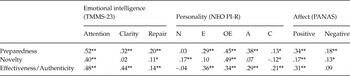
Associations between the Dimensions of the Basque ECI, Emotional Intelligence, Personality, and Affect
Results revealed statistically significant correlations of moderate magnitude for the three dimensions of the Basque ECI with emotional attention (TMMS-23) and openness to experience (NEO PI-R). Additionally, the ECI dimensions preparedness and effectiveness/authenticity were statistically significantly but less strongly correlated with clarity (TMMS-23), the personality traits extraversion and agreeableness (NEO PI-R), and with positive affect (PANAS). No statistically significant correlations were found between the novelty dimension of the ECI and the other dimensions. Those results are shown in Table 3.
Correlations between Dimensions of the Basque ECI and Emotional Intelligence, Personality, and Affect (N = 355)

* p < .05; **p < .01.
Note: N = Neuroticism, E = Extraversion, OE = Openness to experience, A = Agreeableness, C = Conscientiousness.
Differences in EC between Women and Men
As shown in Table 4, women scored higher than men on the preparedness and effectiveness/authenticity dimensions. The effect sizes associated with those differences were moderate in magnitude (Cohen’s d = .48 and .43, respectively). Differences were not observed between women and men on the novelty dimension.
Mean Scores (M), Standard Deviations (SD), Student’s t and Cohen’s d Comparing Women and Men on the Dimensions of the Basque ECI (N = 355)

Discussion
The present study’s objective was to adapt the Emotional Creativity Inventory (ECI) for Basque language and culture, and to collect evidence of its validity in students in higher education in the Comunidad Autónoma del País Vasco. Part of the validation process was to examine EC’s relationship to EI, personality, affect, and sex.
With respect to the instrument’s dimensionality, the original version’s (Averill, Reference Averill1999a) underlying three-factor structure (preparedness, novelty, and effectiveness/authenticity) was replicated, which was also corroborated for the Persian version (Ghadiri Nezhdyan & Abdi, Reference Ghadiri Nezhdyan and Abdi2010) and the version adapted into Spanish (Soroa, Gorostiaga et al., Reference Soroa, Balluerka, Hommel and Aritzeta2015). The original and Persian versions have 30 items, distributed as follows: Preparedness (items 1–7); Novelty (items 8–21); Effectiveness/Authenticity (22–30). Using the same numbering as the original version, the Spanish version of the ECI consists of 17 items, distributed as follows: Preparedness (items 1, 3, and 6); Novelty (items 9, 10, 11, 13, 17, 18, 20, and 21); Effectiveness/Authenticity (items 23, 24, 25, 26, 27, and 29). Last, the factor composition of the Basque version is slightly different from the original, because two items were eliminated from the novelty dimension (items 10 and 21). Thus, following the numbering of the original version, the composition of items in each dimension was as follows: Preparedness (items 1–7); Novelty (items 8–9 and 11–20); Effectiveness/Authenticity (22–30).
Indexes of internal consistency and temporal stability for the dimensions of the Basque ECI demonstrated that the instrument has adequate reliability.
Regarding the scale’s evidence of external validity, moderate correlations were expected between EC and some dimensions of EI (attention), personality (openness to experience), and affect (positive). Overall, it should be mentioned that the results obtained provide evidence of the instrument’s external validity.
First of all, the relations observed in our study between dimensions of the ECI and the TMMS-23 are similar to what other studies have reported. There is evidence that people who pay good attention to their emotions perceive themselves as more emotionally creative, understanding EC as the ability to connect with one’s emotions, and feel and express novel, effective, and authentic emotions (Averill, Reference Averill1999a, Reference Averill, Kaufman and Baer2005; Fuchs et al., Reference Fuchs, Kumar and Porter2007; Soroa, Gorostiaga et al., Reference Soroa, Balluerka, Hommel and Aritzeta2015). That would explain the positive correlations observed between emotional attention (TMMS-23) and all the dimensions evaluated by the ECI. On the other hand, the low correlations observed between ECI emotional novelty and TMMS-23 emotional clarity and repair, may be the result of different cognitive processes underlying each of those skills. That is, people who are capable of feeling and expressing unusual emotions will not necessary be capable of understanding and regulating those emotions, because the cognitive effort required for perception and expression is lower than what is required for reasoning and repair. In that respect, our results are similar to those of other studies (Ivcevic et al., Reference Ivcevic, Brackett and Mayer2007).
Focusing on the relationship between EC and personality traits, the present study’s results are consistent with those of various researchers (Averill, Reference Averill1999a; McCrae & Costa, Reference McCrae and Costa2004). Such studies have observed that people with openness to experience perceive themselves as: predisposed to work emotionally and intellectually (preparedness), capable of providing different, unique emotional responses from those of their peers (novelty), and capable of honestly expressing their emotions in service of achieving personal goals (effectiveness/authenticity). As expected, emotional preparedness on the ECI moderately correlated with agreeableness on the NEO PI-R.
Regarding the relationship between EC and affect, our results partially support those found in the literature (Averill, Reference Averill, Dalgleish and Power1999b). On the one hand, preparedness and effectiveness/authenticity were positively correlated with positive affect on the PANAS, but no association was found between ECI novelty and positive affect. That could be explained by the tense used in the wording of PANAS items. They reflect a person’s tendency to feel positive emotions, not the specific emotion he/she is feeling as he/she fills out the instrument. As for negative affect, as expected, the present study found no association between negative affect on the PANAS and the dimensions of the ECI. That result may be because the negative affect scale utilized in this study includes emotions with different levels of activation (i.e. ashamed, annoyed, aggressive), while other studies only included those with moderate activation (i.e. a certain level of anxiety or tension) (Baas et al., Reference Baas, De Dreu and Nijstad2008, Reference Baas, De Dreu and Nijstad2011).
Last, the relationships observed in this study between ECI dimensions and sex indicate that women scored higher than men on the preparedness and effectiveness/authenticity dimensions. Those results are consistent with those of earlier research in which the original (Averill, Reference Averill1999a) or Spanish version of the ECI (Soroa, Gorostiaga et al., Reference Soroa, Balluerka, Hommel and Aritzeta2015) was utilized.
Some of the present study’s limitations are described below. First, the sample was comprised of students in higher education in the Basque Country; to make the results more representative, it would be advantageous to expand the sample to include Basque-speaking youths and adults enrolled in professional training programs. Second, the results around external validity are limited by the correlational research design; the authors cannot infer causality from any associations observed between these variables. It would therefore be beneficial to conduct additional experimental studies or collect longitudinal data, so as to examine the relationship between the dimensions of EC and potential antecedents and effects thereof. Third, to avoid the “mono-method” issues generated by self-perception instruments, and to gather further evidence of validity, it would be wise to compare data from a self-perception instrument like the ECI to data from an ability instrument (the ECT or ETT), requiring participants to generate creative responses in situations with emotional content.
Based on this study’s results, we may conclude that the Basque version of the ECI allows for reliable and valid assessment of EC in higher education. Specifically, this study provided an instrument with 28 items divided into three dimensions (preparedness, novelty, effectiveness/authenticity), with adequate psychometric properties. Furthermore, the instrument showed evidence of external validity given the relationship between emotional creativity and emotional intelligence, personality, affect, and sex.
The Basque version of the ECI will allow researchers to determine the perceptions among youths and adults in the Comunidad Autónoma del País Vasco, of their predisposition to connect with emotions, and their capacity to feel and express novel, effective, and authentic emotions. That information is considered useful in the design of intervention programs focused on the improvement of both emotional skills (self-concept and emotional predisposition) and creative skills (seeking opportunities, and orientation toward newness) that could help people in various spheres, for instance professionally (Zacher & Johnson, Reference Zacher and Johnson2015). Finally, results derived from the Basque version of the ECI could promote the advancement of research centered on moods and creativity.
This research has been partially funded by a grant from the Basque and Multilingualism Bureau of the Universidad del País Vasco (UPV/EHU) for predoctoral training, by a grant from the Research Bureau of the Universidad del País Vasco (General Funding for Research Groups, GIU14/18), and by a grant from the Basque Government for Research Groups (IT892–16). The authors would like to thank Emoiker, S. Coop. for the support it provided to this study.
Appendix 1
Items on the Basque ECI