The flageolet – a woodwind instrument closely related to the recorder – achieved considerably popularity in nineteenth-century England but, nevertheless, has attracted little attention from either organologists or music historians. Predominantly an instrument of the amateur musician, the flageolet and its use reflected many aspects of the musical society in which the instrument flourished and from which it eventually passed into obscurity. It should be recalled that, in England at least, the recorder lay dormant during the nineteenth century, and many of the functions it fulfilled in the early eighteenth, twentieth and twenty-first centuries were taken by the flageolet: the need for a relatively simple and relatively cheap instrument for amateur use is not limited to any one century or, indeed, country.Footnote 1 In comparison with the flageolet, other instruments popular with amateurs (particularly males) such as the violin and flute were more difficult to master and were also more expensive. The flageolet attracted a small number of professional exponents who tended to favour the French form of the instrument.
The present article begins with an outline of the organology of the flageolet in both its English and French forms and its evolution into double, triple and transverse versions, before examining the instruction given for the instrument in the tutor books, many of which emphasized that the instrument could be studied ‘without the aid of master’. A brief outline of the published assigned repertoire for the flageolet precedes the dominant focus of the article, an examination of the role of the instrument within the context of musical praxis in England and its societal implications during the nineteenth century.
After consideration of matters of finance, social class and gender, the article examines the use of the flageolet by amateur and professional musicians, particularly highlighting the importance of the instrument in domestic music-making as well as in amateur public performance. Professional (and semi-professional) use of the instrument within the context of the concert hall, the theatre, the ballroom and the music hall is explored, and examples are given of prominent players and ensembles, some ensembles being composed entirely of female musicians. Final paragraphs note the playing of the flageolet by itinerant and street musicians before concluding from the evidence presented that the flageolet indeed transcended social class and gender in nineteenth-century England.
Background
Although the flageolet was first described in the early seventeenth century as a small duct flute with four finger-holes and two thumb-holes (see below) it came into particular prominence in England during the long nineteenth century. The instrument probably arrived in England from France around the time of the Restoration of the monarchy in 1660 and flourished mainly as an amateur's instrument in the closing quarter of the seventeenth century. At this time, most of the self-instruction books and repertoire were notated in a six-line tablature (corresponding to the six tone-holes on the instrument): the flageolet was very high-pitched, and both its pitch and notational system militated against widespread use in concerted music. Essentially, the flageolet remained the instrument of the solo amateur player, a prominent exponent being the diarist Samuel Pepys. As the recorder's fortunes waxed at the end of the seventeenth century, so the flageolet waned, and the last flageolet tutor (The Innocent Recreation) was published in 1699. There are few references to the use of the flageolet in eighteenth-century England, although Handel's use of the instrument in the obbligato to the aria ‘Augelletti, che cantate’ in his 1711 production of Rinaldo proves a notable exception.Footnote 2 The alto recorder was the dominant duct flute in eighteenth-century England, although small recorders (fifth flutes, sixth flutes and sopraninos) were employed when ‘octave pitch’ instruments were required.Footnote 3 Recorders became obsolete by the end of the century and the stage was set for the development of the alto recorder-pitched English flageolet and its smaller and more widespread companion, the improved octave flageolet.
Organology
The first account of the flageolet was given by Marin Mersenne in his Harmonie Universelle of 1636.Footnote 4 The instrument described was a small duct flute (measuring c. 120mm) with a recorder-like beaked mouthpiece and six tone-holes: four lay in front of the instrument and two behind. This curious arrangement was necessitated by the small size of the instrument, the lower thumb-hole taking the place of the fifth finger-hole of the recorder: the instrument had a range of two octaves from (commonly) d′′′. It was enlarged and continued to be played (albeit with modifications, particularly with the addition of a windcap and the provision of keys) until the early twentieth century, acquiring the appellation of ‘French flageolet’ in order to distinguish it from the English flageolet which appeared at the turn of the eighteenth and nineteenth centuries. The English flageolet was basically an alto recorder fitted with a windcap containing a sponge to absorb moisture from the player's breath.Footnote 5 In 1803, the ingenious English maker William Bainbridge (fl. 1802–died 1830) registered a patent ‘Improvements on the flageolet, whereby the fingering will be made more easy and notes produced that were never before produced’.Footnote 6 The original English flageolet had a sixth-finger note of g′, but Bainbridge shortened the instrument to give a sixth-finger d′′ (like a soprano recorder, and also lying an octave above the German flute) and changed the bore and tone-hole dimensions so that a diatonic scale could be sounded by simply lifting successive fingers without recourse to cross- or fork-fingering. Bainbridge partially plugged the first tone-hole so that this could be used as an octaving hole instead of the thumb-hole (thus simplifying the fingering), and in consequence of the plug, the open first finger-hole gave a minor seventh above the sixth-finger D rather than the previous major seventh. The instrument now had a nominal pitch of G (with a third finger tonic), with the keys of G and D immediately accessible, as on the transverse flute: its music was notated an octave below sounding pitch. The flute was popular amongst gentlemen amateurs in the early nineteenth century and much of its elementary music was confined to the keys of G and D. It would appear that Bainbridge intended the simplifications in the fingering to suit the needs of the amateur market, and particularly those who could not play (or afford) a flute but who could then play flute music on the simpler (and cheaper) flageolet. Bainbridge named his modified instrument the ‘improved octave flageolet’. The English type of flageolet was easier to play than the French flageolet, a point noted by the authors of several methods dating from the early nineteenth century.Footnote 7
English single flageolet stamped CLEMENTI/LONDON (active 1802–31). The ebony plug from the first tone-hole is missing: the stamp is almost certainly that of the dealer: the two interlocking keys are for d#′ and c′′′. Author's collection.

The single flageolet continued in use until the end of the century, although the instrument was developed to carry up to six keys, but flageolets with a single D# key continued to be built. D# (#I/b II) is the only note unobtainable by fork-fingering: as on the German flute, this was the first key to be added. To minimize the need for cross- or fork-fingering, keys were also added for F$, G#, B@ and C.Footnote 8 The sponge chamber remained, but the octave was sounded by overblowing rather than by venting with either the thumb-hole or the first finger-hole. Some of these instruments were supplied with an alternative piccolo head, probably to teach potential piccolo players the requisite fingering on an instrument that was played vertically and did not require a specific embouchure.
Six-keyed flageolet with alternative piccolo head stamped BUTLER/HAYMARKET/LONDON. Butler was a dealer active in the Haymarket 1898–1913: a tuning slide may be seen on the piccolo head. Author's collection.

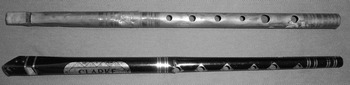
In 1876 the London dealer Journet advertised ‘silver’ flageolets, which were considerably cheaper than even the simplest one-keyed wooden flageolet.Footnote 9 These instruments had a cylindrical bore profile, in contrast to both the wooden flageolet and the tin whistle (invented by Robert Clarke in 1843), both of which had contracting conical bores. Cylindrical flageolets and tin whistles continue to be produced in the twenty-first century and are played mainly within the folk tradition. It is the existence of these instruments which has caused much terminological confusion in that the term ‘flageolet’ has been applied to a variety of metal duct flutes as well as to the traditional wooden instruments; caution must be exercised when studying the instrument, its tutors and its music to ascertain whether a wooden flageolet, a metal cylinder flageolet, or indeed a tin whistle is being described.Footnote 10 The wooden flageolet ceased to be in common use after the World War One, so most subsequent references to the flageolet will necessarily apply to metal instruments which, in the later twentieth and twenty-first centuries, may be fitted with a plastic mouthpiece. It is noteworthy, in this respect, that the flageolet was increasingly played by the less privileged as the nineteenth century wore on and it may be that the advent of the cheaper instruments (although still called ‘flageolet’) may have been a significant factor.Footnote 11
Cylinder flageolet stamped ‘BARNETT SAMUEL & SONS/LONDON’ (above) and tin whistle stamped ‘CLARKE’ (below). The cylindrical bore of the flageolet is contrasted with the conical bore of the whistle: the block of the flageolet is of lead, whereas that of the tin whistle is of wood. Barnett Samuel were London dealers and Clarke was a manufacturer. Author's collection.

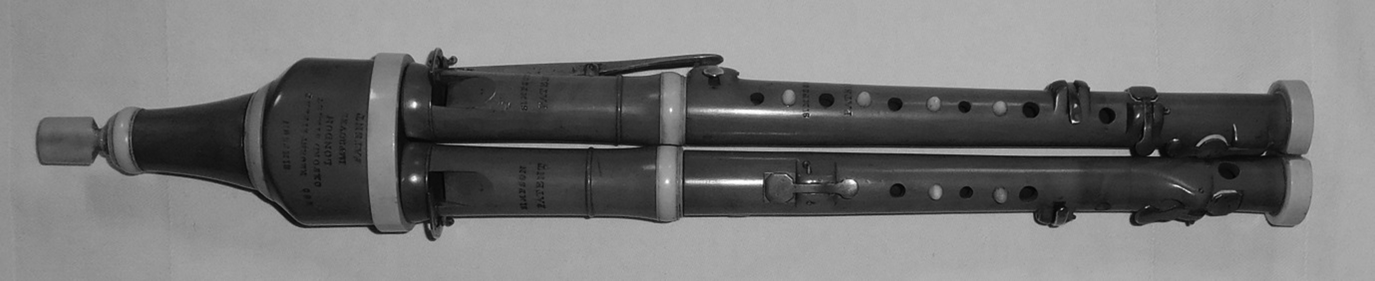
In 1802, the clarinettist and virtuoso flageolet player John Parry (1776–1851) played at Covent Garden on ‘two flageolets fixed together on a frame’ and so introduced the double flageolet to the public.Footnote 12 Double flutes are in widespread use in both European and non-European musical cultures and the concept of the double flageolet is simple: two pipes, carefully tuned a third apart, are fed from a common wind source called the stock. The player could then accompany himself (or herself) playing in simple harmony.
Octave double flageolet by John Simpson, London, (d 1869; fl. 1826–69). The windcutters are visible in the windows, and the touch for the left-hand cutter is prominent. Author's collection.

Lifting successive fingers of each hand produced a series of five thirds, and, by opening an octave key operated by the thumb on the right-hand pipe and thus inverting the intervals, sixths could be obtained. Expert players could also sound fourths and fifths. For the first five notes, the left-hand pipe took the upper notes but thereafter the right-hand pipe took this role for some intervals.Footnote 13 This technique – known as ‘hand-changing – made life very complex, and I suspect that many players, although initially attracted by advertisements describing self- accompaniment, simply gave up. This may be the reason for the large number of fine specimens surviving in instrument collections!
Bainbridge also developed a triple flageolet, the third pipe functioning as a Helmolz resonator fitted with four keys and sounding a compass of a seventh: the instrument is cumbersome, difficult to play, and has virtually no published repertoire; only twelve examples survive.Footnote 14
The single and double cross-blown flute-flageolets represent a further development by the ever-ingenious Bainbridge. As I have noted, the early nineteenth century was a period of frenetic activity in the amateur transverse flute world, and Bainbridge devised his cross-blown flageolets in both single and double versions for ‘those who by defect in the nerve or lower lip’ could not play the German flute.Footnote 15 The instrument was not a great success, probably because it was too soft to be played in an ensemble alongside the increasingly powerful German flute. Again, few flute-flageolets survive, although the term was resuscitated in the late nineteenth century to apply to vertical flageolets.
The French flageolet
Although the English flageolet was the dominant version of the instrument played in England, the French flageolet found a significant role in quadrille bands (it was frequently called the ‘quadrille’ flageolet) and, later in the century, as a virtuoso's instrument with a small but difficult repertoire. Keys were added to the instrument, beginning with a single key for the sharpened sixth-finger note and culminating in the Boehm version (modelled on Boehm's 1832 mechanism) incorporating five rings and eight keys, but the most popular keyed version had five keys: A# (#1/bII) D# (#IV/bV), two long trill keys and a sifflet (whistle) key for the highest notes (see Fig. 5).Footnote 16 Nevertheless, keyless and one- or two-keyed French flageolets continued in production.
Five-keyed French flageolet by Isidore Lot, La Couture-Boussey (fl. 1860–86). The sifflet key is seen on the left side of instrument, the two trill keys on the right. Author's collection.

In general, the later French flageolets had a more powerful and penetrating tone (a consequence of the windway design and bore profile) and were pitched higher than the English instruments, making them particularly suited to the demands of the quadrille band in the dance halls. An English flageolet would have been virtually inaudible in such an environment. It should be noted that music for the flageolet is commonly assigned simply to ‘the flageolet’: an examination of the compass of the part will usually give a clue as to whether a French or an English flageolet is required. Much of the repertoire and material in the tutors composed in the first third of the nineteenth century required an English flageolet, whereas the more virtuosic repertoire of the latter years of the century required the French flageolet.
The Flageolet in the Context of Nineteenth-Century Duct Flutes
Duct flutes have been in existence since pre-history and are a part of many musical cultures across the world. They are relatively inexpensive, they are – at least in the early stages – relatively easy to play (having no embouchure) and may be learnt to some extent without the aid of a teacher. During the nineteenth century, the flageolet, in its several forms, was of importance in western European duct flute culture, English-type flageolets also being made in Germany and Austria. The instrument was also built in the United States of America.Footnote 17 Further east, in the regions around Vienna, the csakan (a recorder-like instrument initially in the form of a walking-stick) became of significance whilst the recorder maintained a covert existence throughout the nineteenth century prior to its revival in the early years of the twentieth. Considering the potential need for a simple duct flute, it is relevant to reflect that the recorder had declined into substantial obsolescence by the end of the eighteenth century but was temporarily replaced by flageolets and csakans.
It is reasonable to assert that, during the nineteenth century, the English flageolet took on part of the role of the recorder in the eighteenth-century as far as amateur domestic music-making was concerned: in this sense, a parallel may be found in the Viennese csakan although this instrument had a much briefer existence. The history of western music shows the continued presence of duct flutes: in nineteenth-century England, that role was filled by the flageolet which, in due season, yielded its place to the revived recorder.
Pedagogy
Musicians may learn to play their instruments through the use of tutor books and/or with tuition encompassing both aural and oral teaching from an experienced player. David Golby has published an account of the history of music tuition in the nineteenth century, but he gives little information about woodwind instruction and makes no reference to the flageolet, although many tutors for the flageolet were published in the nineteenth century.Footnote 18 It should be noted that a degree of literacy is required to study from a book and that literacy skills were often limited (particularly in the case of women) in the early years of the century. The music teaching profession was unregulated, and the standard of teaching is likely to have been somewhat variable.
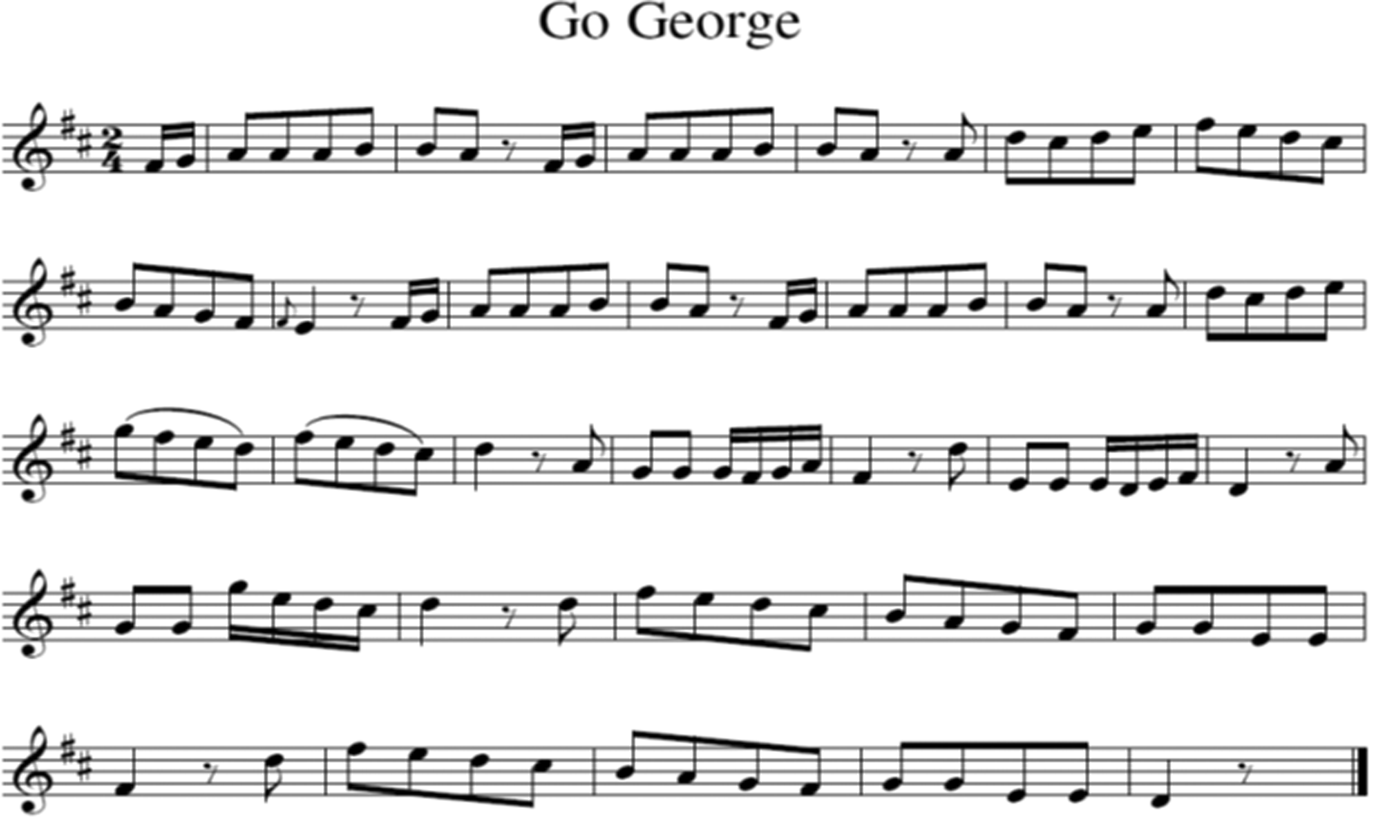
As we have seen, in the first half of the nineteenth century (and particularly in its first three decades) the English flageolet was essentially an instrument of the amateur musician, and tutor books were published in considerable numbers, often by makers of the instruments, some of whom also advertised lessons. The volumes contained instruction on the rudiments of music, both ‘natural’ (diatonic) and chromatic ‘scales’ (fingering charts) giving a two-octave compass based on a sixth-finger d′′ (notated transposed down an octave). Tunes, including folk melodies, popular songs, dances and operatic arias (mainly in G and D, the easiest keys for the flageolet) were appended.
‘Go George’, from The English and French Flageolet Preceptor, c. 1803. ©The British Library Board, shelfmark R.M.12.g.(12), p. 8.

Many of the English flageolet tutors also incorporated a fingering chart for the French flageolet, but the instructions on this more difficult instrument (and so less likely to be played by the amateur) were limited in scope. Private lessons were available, and Bainbridge appears to have had a high opinion of his own (or a colleague's) ability to teach the double flageolet:
By comparing the instrument with the book given … those not knowing music may immediately amuse themselves, and those who do, be convinced of the simplicity of acquiring the scale. The Inventor [Bainbridge] engages to get a Master to teach anyone (even not knowing music) to play duets at the first lesson.Footnote 19
Few tutors were published for the English flageolet after the middle of the century but a few tutors for the French flageolet were printed in England for simple keyless French flageolets, those with five keys or with the Boehm system of rings and keys. The exercises and tunes were more complex, reflecting the professional use of the instrument. It is curious that the publication of tutors for the English flageolet practically ceased after the middle of the century, despite the continued manufacture of instruments well into the twentieth century. Many of these flageolets had a complex key mechanism and the would-be player must have either had recourse to professional instruction (although very few teachers were advertising their services) or have attempted to adapt tutors for the simpler forms of the transverse flute on which the basic key mechanism was similar to the flageolet. Not all these tutors, however, were deemed suitable for the independent student: Roylance's Self-instructor for the Piccolo or Flageolet (with 1, 4 or 6 keys) by Edmund Forman received a somewhat mixed review in The Graphic in 1888:
a clever little work … but we question much if anyone of average ability could learn to play them unaided by a professor … we pity those who are compelled to listen to the futile efforts of the non-musical executant!Footnote 20
The practice of any musical instrument in any age is liable to irritate neighbours: even the soft flageolet is no exception, as the following extract from Bradshaw's Journal of 1842 illustrates:
Too – too – tooit – toitt – What the deuce is that? Oh! Humdrum, our landlady's second-floor lodger practising “God save the Queen” on his flageolet. What a nuisance it is! Why don't a man become a good player at once, and not grating the ears of innocent folk.Footnote 21
Repertoire
Most of the published repertoire for the English flageolet was intended for the amateur player but, as I have noted, a small repertoire of music was produced later in the century for the few virtuosi who played the French flageolet. More detailed consideration of the integration of the repertoire within a social dimension will be given below: the following paragraphs serve to introduce the published repertoire for the flageolet player, which falls into four categories:
1. Music from the tutors.
2. Songs with flageolet and piano accompaniment.
3. Pieces for flageolet solo with piano accompaniment.
4. Pieces for unaccompanied flageolet.
Inevitably, the music in the tutors was of an elementary standard, confined to the easiest keys on the instrument (G and D major) and without complex rhythmic patterns. Some of the tutors contained a few simple duets.
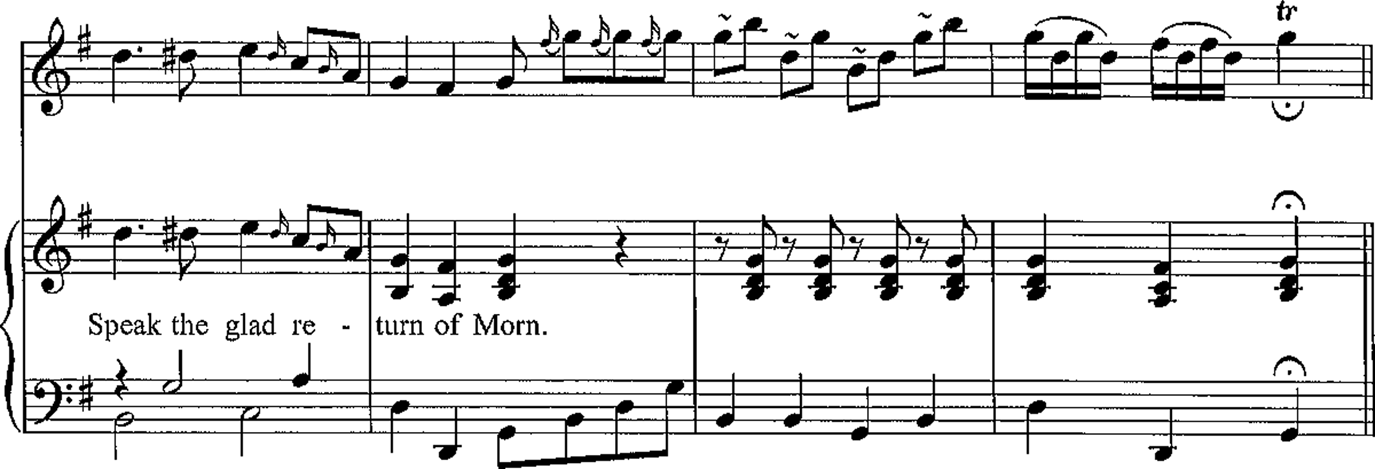
Title-pages of published music did not always specify whether an English or French type of flageolet was required, although the assignation ‘Improved Octave Flageolet’ may be encountered. The compass of the part would indicate to the player which instrument was required, and the flageolet may be specified as an alternative to the flute or violin. Nicholas Temperley and others have indicated domestic chamber music was intensely piano-centred.Footnote 22 It is hardly surprising, therefore, that much of the flageolet repertoire involved keyboard accompaniment and, as much domestic music involved women, it is equally unsurprising that songs (particularly for female voice) with flageolet and piano accompaniment were popular. The flageolet, in these songs, may be used as an obbligato instrument or to mimic birdsong:
Song with flageolet and piano: ’Tis the lark that charms mine Ear (Nicks). The ornaments in the flageolet part suggest birdsong. ©The British Library Board, shelfmark G.383.kk.(36.), p. 3.

Most of the music for flageolet with keyboard accompaniment is confined to the keys of G and D major, and is far from technically difficult, being equivalent to the present-day grades 3 to 5 recorder examinations of the Associated Board of the Royal Schools of Music. Similarly, the piano accompaniments are generally free of substantial technical difficulty although a smaller repertoire of more virtuosic accompanied music was published. There are no sonatas for the instrument, in comparison with the flute and violin: similarly, there does not appear to be repertoire of ‘accompanied sonatas’ with a simple melodic line and a more complex keyboard part. Surprisingly (at least in comparison with the recorder in the eighteenth century) there is virtually no music for two or three flageolets without keyboard accompaniment, although a substantial repertoire for the solo flageolet player was published, often in pocket-sized books.
The printing of songs with flageolet and instrumental pieces for flageolet and piano began to decrease after the first quarter of the century, strongly suggestive of a change in the pattern of domestic music-making; however, the publication of small (pocket-sized) books of solo pieces continued unabated into the second half of the century, many of these booklets running to several volumes and published on a monthly basis. Although the French flageolet became associated with quadrille bands from the 1720s, most of the music for these ensembles was imported from France. The double flageolet attracted a small repertoire in the years before c. 1830: much was written for amateur use, but several of John Parry's compositions called for an advanced technique to demonstrate the effects possible on the instrument, contrasting sections played on the solo pipe with those played on both. Despite many instruments being made, very little music assigned to the English flageolet was published after 1850.
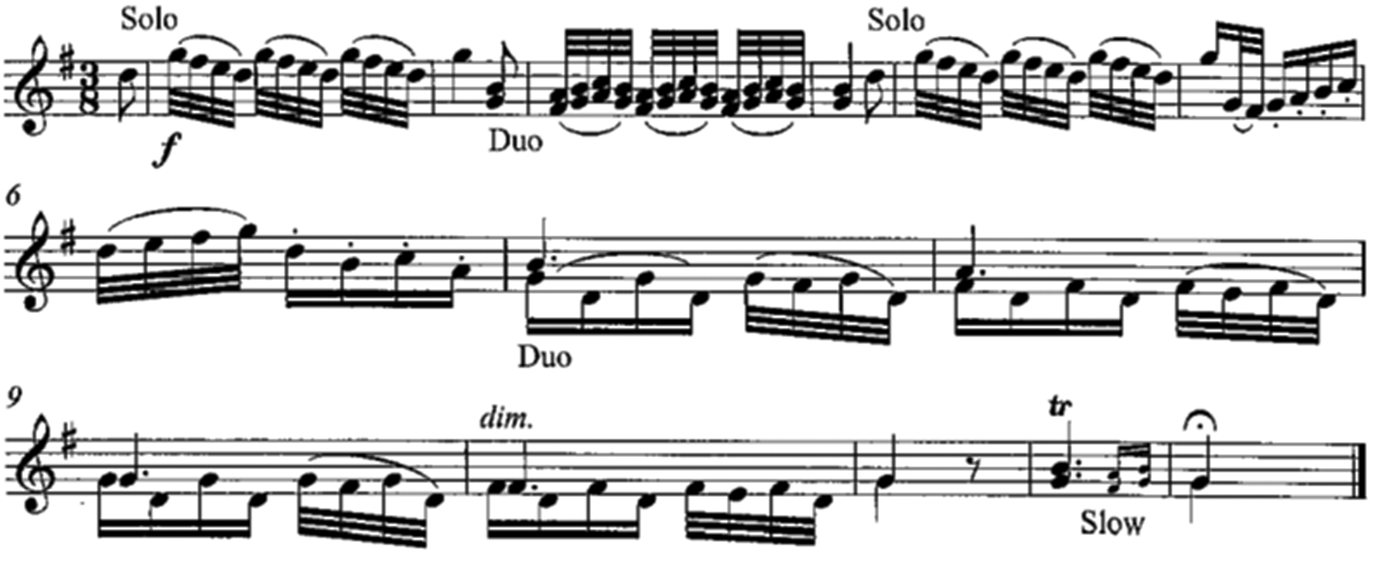
John Pary, ‘The Gunnersbury Waltz’ from A Third Divertimento. Photocopy in author's collection provided by Tony Bingham. The distinction between the ‘solo’ and ‘duo’ passages to provide dynamic contrast is seen in bars 1–6, and the sustained notes in the left-hand pipe with florid writing for the right-hand pipe is seen in bars 7–10.

The French flageolet was employed in quadrille bands (hence its alternative name of ‘quadrille flageolet’) from the 1820s. A repertoire of technically demanding music for the French instrument was introduced in the 1870s and 1880s, mainly composed (and probably performed) by émigré virtuosi such as Frédéric Bonnisseau and Narcisse Bousquet. Pieces were published with alternative accompaniment including piano, octet, or full orchestra and may assign either the French flageolet or the piccolo as the solo instrument.Footnote 23 Both the changes in the repertoire and the diminution in the publication of tutors over the course of the century are strongly indicative of a changing role of the flageolet within society.
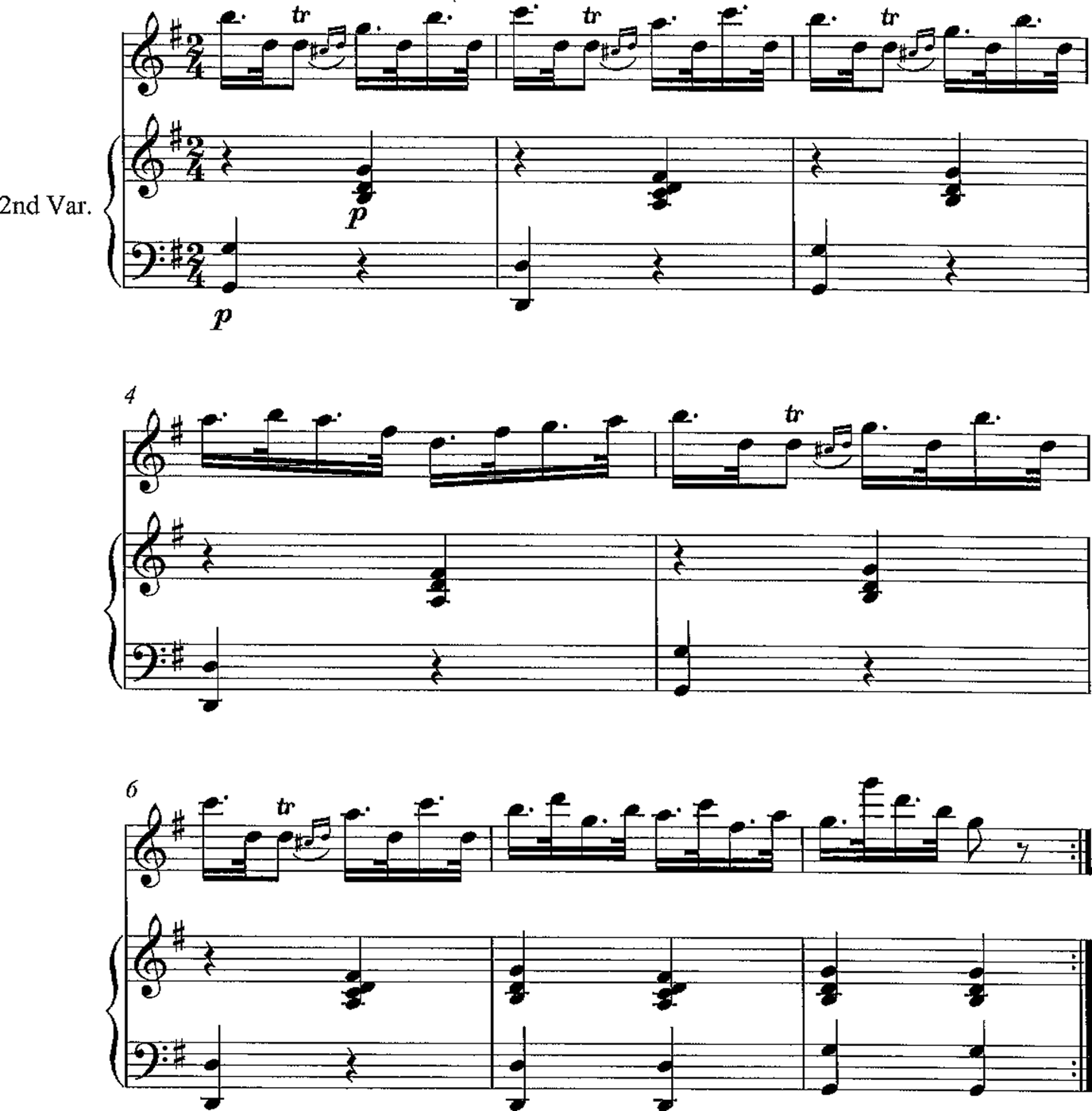
Solo French flageolet (or piccolo): Variations on ‘The Keel Row’ (Bonnisseau). ©The British Library Board, shelfmark h.3213.m.(18.), p. 3.

Social Context
Moving to a more sociological viewpoint, it is necessary to examine the question ‘who played the flageolet’: men or women, amateurs or professionals, rich or poor? As the title of this article suggests, the simple answer is ‘all of these’, but is well-nigh impossible to apply numerical statistics, primarily because we are dealing with an instrument that was predominantly played by amateurs whose musical activities are seldom well-documented.
In nineteenth-century England, social class was a matter of some importance in the field of music: different classes listened to, and played or sang, different types of music yet music itself sometimes served to break down the barriers of class in that social classes could mix in the performance of music: choral music formed a classic example. At the bottom of the social hierarchy lay the working classes, whose literacy levels were low, undermining their ability to study music from a tutor book. The middle classes (sandwiched between the working class and the aristocracy) expanded significantly during the Victorian era and, with an increasing disposable income, were enabled to indulge in cultural activities, including music. Upper- and middle-class women were seldom in employment, it being deemed that their place was in the home in order to be a wife and a mother, but music formed a substantial part of the education of these women alongside domestic skills. Men were discouraged from having more than a ‘dilettante’ involvement with music as performers.
In the relatively egalitarian world of the twenty-first century, it is perhaps difficult to comprehend the degree to which matters of social class impacted on nineteenth-century society and the effect that class had on musical activity, whether as auditors or in participating actively as a singer or instrumentalist; even so, the appreciation of musical culture cannot be assumed to be class-based. Katherine Ellis has noted that ‘segregation within musical life was at least as much class-based as it was gender-based’.Footnote 24
Inevitably, financial constraints affected the possibility of listening to or playing music. Around the middle of the century a well-off artisan could earn £70 per annum whereas a middle-class salary would range from £100 to £1000. In 1820, Bainbridge charged ten shillings for a basic single flageolet and up to four guineas for a complex double instrument.Footnote 25 Lafleur's catalogue of c. 1870 advertised ‘the cheapest’ English flageolets with one key for 2s 8d, whereas a Boehm French flageolet was priced at £12-12-0.Footnote 26 Journet's silver flageolets were priced at 1s 1d (by post) in 1876, whereas his wooden instruments cost 2s 6d.Footnote 27 From a financial point of view, it is apparent that the low cost of a flageolet would have made it possible for the poorer members of society to learn the instrument, especially if they were able to read and so teach themselves from one of the many published tutors.
Within the home environment, music was considered more appropriate for women than men, and a degree of musical accomplishment was part of the education of the young upper-class woman, whereas men were discouraged from serious musical study as the subject was not deemed manly and appropriate for the potential leaders of society.Footnote 28 Gentleman amateurs performed particularly on the flute and violin, whereas women played keyboard instruments, the harp, or the English guitar (guittar): the flageolet was not infrequently assigned as an alternative to the flute or violin in repertoire published for amateur consumption. Wind instruments were deemed inappropriate for women: the shape of the flute was considered to have phallic implications (particularly in the case of vertically blown instruments), and the facial distortion involved in playing wind instruments was considered unfeminine.Footnote 29 Ellis notes that ‘within bourgeois society, low, loud, military or wind and brass instruments were deemed inappropriate – a threat to a woman's decorous allure – particularly when they necessitated contortion of the face’.Footnote 30 However, it should be noted that the flageolet was considered appropriate for ladies as it required little facial distortion: the phallic implications appear to have been overlooked.Footnote 31 Nevertheless, the preface to a tutor published by Goulding, Phipps & D'Almaine in the first decade of the nineteenth century commented ‘The FLAGEOLET has of late become very much in use, not only by Gentlemen but also there are many Ladies, who play both French and English FLAGEOLETS very sweetly’.Footnote 32
In general, however, it was the role of the well-dressed upper or upper-middle class girl to sit decoratively at the piano where she could attract would-be suitors with her keyboard skills as well as her physical allure – and there was much music published with a more complex keyboard part yet with a simple accompaniment for flute, violin, or flageolet for the (perhaps less musically able!) man to play.
The Flageolet in the Home and in Amateur Concerts
As Stanley Sadie wrote: ‘Of all kinds of musical activity the least documented is, understandably, domestic music-making. At its extent and its social spread in England during the eighteenth century we can only guess. But there are clues that can serve as a basis for such guesswork.’Footnote 33 This observation is equally applicable to the nineteenth century.
As in any age, much relatively easy music was published for amateur use, and inevitably for the domestic environment: such music was not intended for use in professional public performance, and little of it is played today. Temperley writes that ‘enormous quantities of piano music, songs and ballads and chamber ensembles poured from the rapidly expanding publishing houses; and from about 1840 onwards, the publication of vocal part music was on almost the same scale’. He adds ‘in the early decades of the century there was still a clear distinction between concert and domestic music’.Footnote 34
The published repertoire for the English flageolet is technically undemanding, aligned more to popular musical tastes than to substantial items of ‘serious’ chamber music and, as we have seen, it comprises music with or without piano accompaniment or singer. Much of this music, unsurprisingly, came from familiar sources including folk and popular melodies, together with familiar country dances tunes and arrangements of favourite operatic arias. Folk airs and country dances allowed a connection with an often-imagined blissful rural past, and the inclusion of much-reduced operatic arias was a long-standing custom in the publication of music for amateur domestic music-making. The visits to the theatre could be recalled in reductions of whole scores for a solo flageolet: in 1807 ‘The much admired Pantomine Harlequin and Mother Goose’ by W. Ware was published for flute, violin, or flageolet by Hodgson in London.Footnote 35 The needs of the amateur for relatively straightforward music were certainly realized: players and singers could enjoy making music without too many technical problems, and a flageolet and piano would have provided a very adequate accompaniment for a small group of dancers in the drawing-room. The standard, of course, was not always good, William Archer Shee writing in his diary for 25 June 1832 that ‘as a rule, he was not very fond of amateur music as practised in London drawing rooms. It is generally of the mildest character, and is not contributed by those who, if not deficient in voice or taste, have had few opportunities of cultivating or improving the one or the other.’Footnote 36 This does not diminish the importance of recreational private amateur music-making in the home, and Shee later admits that ‘there are some amateurs whose performances are very attractive’.
Judging by the diminishing production of such music (and tutors) after c. 1830, the popularity of the flageolet amongst amateur musicians must have decreased, but there was no other simple instrument to take its place. The other popular amateur's melody instruments (the flute and the violin) were technically more demanding. It is curious, however, that English flageolets (many of high quality) continued to be manufactured as late as the early twentieth century, despite a lack of both tutors and assigned repertoire, and it can only be assumed that players made their own arrangements. Unfortunately – at least to my knowledge – there is no evidence from primary source material to support this supposition.
Amateurs not only played within the confines of their homes, but also gave public performances, although – as with domestic musical activity – these concerts are poorly documented. Family groups played the flageolet in public: the Reeve family ensemble in Norwich included an 11-year old player of the flute-flageolet, and in Liverpool the 12-year old James Tyler received a fine review in the Liverpool Mercury:
The solo on the flageolet was a composition on the theme ‘The Merry Swiss Boy’ – the quick and intricate solo passages which the youthful performer, James, played, reminded us of the best efforts of Richardson on the flute.Footnote 37
Further examples from the latter half of the nineteenth century will serve to indicate the breadth of amateur public performance on the flageolet. A ‘Catch Concert’ was given at Lambeth Baths in 1867 wherein working men came up to play on the flageolet, the penny whistle, and other instruments. Amateur church and school performances flourished: in 1872 a Mr Creasy played the ‘The Nightingale’ on the flageolet in a concert by the Ipswich Trinity Church Choir and at the annual concert of Lord Vernon's School, Sudbury, a violinist and a flageolettist duetted ‘Come into the summer wood’.Footnote 38 The Bedminster Princess Street White Ribbon Army Sunday School treat in 1883 featured a flageolet band and a concert in aid of the local church at Willoughby Waterless in 1889 featured a female flageolet player, Miss Nora Sandys, accompanied by a pianist.Footnote 39 It is important to emphasize these amateur productions: the flageolet is a relatively simple instrument to play and many amateurs who perhaps could not master (or afford) a flute or violin were enabled to play in public for their own (and hopefully their audience's) pleasure and to make contributions to charitable funds.
Amateur musicians have long been the mainstay of music in English parish churches and before the presence of church organs became commonplace in the late nineteenth century, in the years between c. 1770 until c. 1850 the singing in many Anglican churches was supported by bands of amateur musicians, placed in the west gallery of the church.Footnote 40 The bands usually numbered five or six players, wind instruments outnumbering strings, and there is some evidence for the occasional use of the flageolet in these ‘West Gallery Bands’. A biography of Canon William Greenwell (1820–1918) records that, in his boyhood, he attended a church at Lanchester, County Durham, where the services were accompanied by ‘an orchestra of bassoon, trombone, bass-fiddle, flageolet and violin’ and a flageolet is preserved in the church at Aston-on-Trent, Derbyshire which was ‘used to accompany the singing of the congregation’.Footnote 41 In his study of Sussex church bands, published in 1948, Macdermott described the use of a ‘cross-blown flageolet’ in Buxted in Sussex.Footnote 42 The instrument concerned was apparently built by the London maker John Parker (fl. c. 1770–c. 1815): the description given by Macdermott would suggest a small (584mm) transverse flute with a flageolet head. Not all lamented the passing of West Gallery Bands. The Saturday Review in 1863 observed that ‘scarcely the most Boeotian of our rural churches but has by this time got well rid of its village flageolet, fiddle and bassoon’.Footnote 43
The heyday of the English flageolet as a domestic amateur instrument lay in the years up to c. 1830, but, as we have seen, the manufacture of English flageolets continued though the publication of both tutors and assigned music diminished as the nineteenth century wore on: the reasons for this are not, at present, entirely clear. It can only be surmised that a soft duct flute such as the flageolet became unsuitable for the increasingly sonorous environment of late nineteenth-century music, and thus the flageolet became the province of those who arranged music composed for other instruments or who wished to play alone in the privacy of their homes.
Few performances on the flageolet in the early years of the twentieth century were cited in newspaper advertisements. Those that do appear strongly to suggest that they were given by amateurs, such as a concert at St. John's Schoolroom at Westcott in Surrey which featured ‘a duet, flageolet and piano’, a concert of flageolet duets at the Cottage Homes, Culceth (Cheshire), and a report of a Mr Alfred Lister singing ‘a doleful ditty to a flageolet accompaniment.Footnote 44 Indeed, in 1905 the Whitby Gazette quoted from Ye Olde Music Shoppe by Harwood Brierley: ‘Where is the flageolet gone to nowadays? Suffering from neglect, I suppose, or supplanted by the penny tin whistle.’Footnote 45 Evidently the availability of cheap tin whistles and metal flageolets continued to sound the death knell of the historic wooden flageolet: it would be another quarter of a century before the revived recorder and its music began to flood the amateur market.
Professional Performance
Despite being predominantly an amateur's instrument, the flageolet attracted a small corpus of professional players, some of whom are known to have doubled on other instruments: in addition, there was a plethora of ‘semi-professionals’ including teachers and stage artistes. The following accounts of concert, stage and ballroom use of the flageolet makes reference to many of the more significant performers on the single and double flageolet, and particular emphasis is given in these paragraphs on professional performance to players of the French flageolet. Professionals played in contrasting venues, including theatres and concert rooms, in lighter entertainments in theatres and music halls, and as members of dance and circus bands.
Concerts in Theatres and Concert Rooms
Many of the lighter concert programmes of the early nineteenth century consisted of varied items ranging from songs and solos through to choral and orchestral works rather than concentrating on the complete performance of larger-scale symphonies, choral masterpieces, and concerti. The flageolet, with its repertoire of obbligato passages in songs and short solos, provided a suitable contrast to the more substantial items in the programme, but few concerts featuring the instrument appear in newspapers advertisements during the first decade of the century. However, in 1801 The Morning Post and Gazette carried an advertisement for a benefit concert for the Choral Fund at the Theatre Royal, Haymarket, on 6 February, when a mixed programme of vocal and instrumental pieces included a performance by Mrs Mountain of Dr Arnold's ‘The Tuneful Lark’ accompanied on the flageolet by Mr Ling.Footnote 46 The great exponent of the double flageolet and collaborator with Bainbridge, John Parry, played at Exeter in 1807.Footnote 47 Parry's rival, John Purkis (1781–1849), associated with Thomas Scott and his variant of the double flageolet known as the Delecta Harmonia. He received a fine review after a performance at the Freemason's Tavern in December of the same year:Footnote 48
PURKIS'S double flageolet for duets, on which he accompanied Miss E. Pennington at the Grand Piano … is now become a very fashionable instrument; the demand for them is very great, and it is but justice to PURKIS to say, that his excellence as a player can only be equalled by his ingenuity as a maker.Footnote 49
It is perhaps difficult to support the idea of the double flageolet as a ‘very fashionable instrument’ but the novelty of the concept of ‘self-accompaniment’ would have appealed to adventurous amateurs! In 1813, John Parry received a favourable review in The Morning Post for a performance of a polacca:
The Manner he executed his beautiful Polacca on the Flageolet (which was extremely well accompanied by Mr. Braham on the Pianoforte) was exquisite. On the Double Flageolet (which, we understand is of BAINBRIDGE and WOOD'S making) he quite astonished the audience, for while one hand sustained mellifluous notes, the other played rapid passages, and the effect of the contrary motions produced repeated bravos from those who could appreciate of difficulty of them.Footnote 50
During the 1820s, the flageolet was becoming widespread in its use in concert performances and dance bands across the length and breadth of England, but the repertoire was still of short pieces, the flageolet often providing more light-hearted episodes in the course of an evening's proceedings: ‘Mr. Parry … relieved the more serious parts by performing on Bainbridge's double flute and flageolet in a manner that drew down repeated bursts of applause’.Footnote 51 Even in ‘Grand Musical Festivals’ the flageolet could be heard in its capacity as the obbligato instrument in ‘Hush, ye pretty warbling quire’ from Handel's Acis and Galatea, replacing the obsolescent sopranino recorder.
In London, the flageolet was introduced into recognized subscription concert series. Mrs Bishop ‘warbled Hush! Ye pretty with its characteristic flageolet accompaniment, very sweetly’ at one of The Ancient Concerts in 1834, and a Philharmonic Society Concert at the Hanover Square Rooms in 1839 featured Cooke on the flageolet.Footnote 52 The French flageolet virtuoso Hubert Collinet (1797–1867) arrived in London in 1818, where he became a significant exponent of the instrument for almost 50 years. Collinet performed a ‘Fantasia on the Flageolet, with Piano-forte accompaniment’ at a benefit concert for the prompter and stage manager of The King's Theatre, Haymarket, Sr. Rubbi, in 1831. In the same year a concert was given ‘For the relief of the famishing Irish’ at the Long Rooms in Southampton.Footnote 53
A new development in the 1830s was the emergence of long-running concert series featuring solos on the flageolet, usually played by Collinet or the English virtuoso Streather. The Theatre Royal English Opera House Promenade concerts à la Musard (1839–1840) featured Mr Streather on the flageolet, but in the final weeks of the season Collinet performed.Footnote 54 The Concerts d’été and Concerts d'hiver given at the Theatre Royal, Drury Lane, in 1840 featured a large orchestra including one flageolet, the former series being conducted by Eliason and Jullien, the latter by Musard. Collinet played the flageolet.Footnote 55
The programme of the second part of a concert given at Drury Lane Theatre on 31 July 1840 (conducted by Philippe Musard) included:
Beethoven's grand Septuor, for 56 instrumentalists
Fantasia, Flute, Herr Freisch
Valze, Huldigungs
Solo, flageolet, M. Collinet
Tarantella from the Ballet of Belphigor
Overture, Le Dieu et la Bayadère
Galop, The Storming of Constantine.
John Parry is described as making his last professional tour of Wales accompanied by his son and a Miss Woodham in September 1838.Footnote 56 By this time, Parry was 52 years old and was perhaps considering retirement from touring, but, with his retirement, significant public performance on the double flageolet was becoming a matter of history, as was the manufacture of double flageolets.
Moving to the fifth decade of the century, we find that the name of Collinet remains prominent; a small man, he was described as ‘the little king of that little instrument’.Footnote 57 Collinet was closely associated with the impresario Louis Jullien, who conducted the summer and winter concerts in London as well as touring extensively around the British Isles with a large orchestra and performing in important provincial towns.Footnote 58 Collinet's part in the concerts was confined to playing virtuosic variations, some of his own composition.
Collinet died in 1867, and the French immigrant composer and bandmaster Frédéric Bonnisseau (d. 1882) succeeded him as London's prominent flageolet virtuoso. Bonnisseau played under August Manns at Crystal Place, in Alfred Mellon's concerts at Covent Garden and at the revived Jullien concerts at Her Majesty's Theatre where he played one of his own compositions, The Cricket Polka.Footnote 59 Professional performances on the French flageolet continued into the 1870s, with the names of Bonnisseau and St. Jacome being prominent, but, as before, the instrument was only used in short (and often virtuosic) pieces.
By the last quarter of the nineteenth century, there is a dearth of records of the professional use of the flageolet in orchestral concerts. St. Jacome was also a virtuoso cornet player as well as an editor for Lafleur and it is possible to suspect that, with a lessening of interest in the flageolet, that he devoted himself to the brass instrument and to editing.Footnote 60 The other virtuoso of the period, Bonnisseau, had died in 1882.Footnote 61 By 1890, the instrument had ceased to appear in professional concerts, its use being largely relegated to amateurs and to the music halls.
Light Entertainments in the Theatres
It is somewhat easier to trace the use of the flageolet in stage productions and concerts promoted in the theatres than in the home as both advertisements for, and reviews of, performances were given in newspapers. As we have seen, the flageolet featured in lighter concerts, but was also in occasional use in lighter entertainments given in the London theatres from the second decade of the nineteenth century. The players were singers or actors/actresses rather than professional flageolet players. As an example, in 1818, a musical extravaganza entitled The Widow and her Grandmamma was staged at Sadler's Wells which featured impersonations and songs, one of the latter being ‘accompanied most delightfully on the flageolet by Miss Tree’, who, according to the Morning Chronicle ‘also played a waltz on the same instrument and danced to it’.Footnote 62 Miss Tree subsequently achieved success as both a singer and dancer and, in the former capacity, was admired by Rossini.
Moving forward to 1833, we find a Miss Kelly mounting a show at the Strand Subscription Theatre entitled Dramatic Recollections, in which she imitated various characters for four hours. She toured the show around the country for a further ten years, obtaining good reviews as a mimic. Of greater interest to the present discussion, however, is her performance of Henry Farmer's song ‘Hope told a flattering tale deceived’: The Morning Post reported that in ‘Hope told a flattering tale deceived’ she accompanied herself on the flageolet, first alternating the notes of her voice and those of the instrument, and at last actually singing and playing together. This feat excites roars of laughter’.Footnote 63 Miss Kelly also toured her show to Manchester and York, giving her last documented performance at York in 1843.Footnote 64 These performances can only serve as examples of the use of the flageolet in stage productions, and it is apparent that the instrument was used in lighter entertainments, and in only a few acts within the evening's entertainment.
Visiting ensembles from the continent also performed on the flageolet, including The Alpine Singers, who were active in England in the previous decade but who introduced the flageolet (played by Herr Hellwig) into a concert at Hull in 1841.Footnote 65 The family Grassl from Berchtesgaden (Bavaria) featured very small children – ‘Little Anthony, too, with his chubby legs, who played the flageolet better than the piper of a regiment’.Footnote 66
Music Halls
In the second half of the century the role of the flageolet as an instrument to be heard occasionally on the stage expanded to appear not only in the theatres, but also in the evolving world of the music hall. The music halls increased in popularity from the middle of the nineteenth century, although it is hardly the purpose of this article to give a detailed account of their enormous importance in the popular entertainment world of the late nineteenth and early twentieth centuries.Footnote 67 Suffice it to say that music hall audiences were predominantly of lower middle- or working-class origin, and that the programmes reflected popular rather than high artistic taste: they included song, dance, mime, character impersonations and instrumental music performed on a variety of instruments. In the relaxed environment of the music hall, audiences could often eat, drink, and smoke. The flageolet players were probably mainly comic actors and entertainers rather than full-time professional musicians – the flageolet is not a difficult instrument to play, especially in the early stages – and access to the cheap metal flageolets may have contributed to the popularity of the instrument amongst such performers.
The flageolet began to appear in the music halls as early as 1861. A Mr George performed at Frampton's Music Hall on both the flageolet and cornet in that year, and, as the decade progressed, more frequent references to the use of the instrument in music halls appeared in the newspapers.Footnote 68 The instrument was not always taken seriously in this environment, as shown by a review in The Era of the former factory mechanic turned singer George Leybourne's concert in February 1869: ‘Mr. Arthur Lloyd “assisted” on this special occasion, and gave his street musician song, including an excruciating flageolet performance which invalids pay not to hear’.Footnote 69 The halls were becoming widespread by the 1870s and the flageolet performances by otherwise-unknown players are reported across the country. Even ensembles visited from continental Europe: the Praeger family from Austria rendered Rossini's William Tell overture at The Royal Polytechnic Institute, with Johanna Praeger playing the flute solo on her flageolet.Footnote 70 In March 1875, The Era reported a performance at the Theatre Royal, Whitehaven, by ‘Young Kavanagh, a versatile Irish comedian … and his wonderful performances on the flageolet’ and at Mr. Wake's Popular Ball in 1888 a Mr. Mitcham ‘recites with musical accompaniment and, dressed as a pifferara, plays on the flageolet, imitates a Milanese piper’.Footnote 71
Performances on the flageolet in lighter entertainments and music halls were not confined to solo players: the Cremona Musical Union, a family group of eight musicians of the Greenhead family, was formed in the 1860s and performed in many locations across the country until the 1890s.Footnote 72 The group featured a mixed instrumental line-up, including Miranda Greenhead on the French flageolet: she was given excellent reviews, but was described incorrectly in the ensemble's programmes as the only female flageolet player.Footnote 73 The instrumental line-up included violin, viola, cello, double bass, flute, piano and cornet in addition to Miranda's flageolet, and the players dressed in antique costume. Miranda continued her performing career into the early twentieth century.
An interesting development in the ninth decade of the century was the emergence of all-female groups at a time when the playing of wind instruments in public by women was somewhat discouraged. Nevertheless, The Adamless Eden Company, composed of piano, harmonium, violin, double bass and flageolet made its appearance in 1884. To give but one example of the Company's performance, the Bristol Mercury reported on an evening at the New Theatre Royal, describing a ‘picturesquely-grouped body of young ladies with blooming faces and sparkling eyes, gracefully attired in evening costume’.Footnote 74 Another female player, Beatrice Vaughan, ‘displayed great skill on a reed instrument, the tone of which struck us as being between a flageolet and a piccolo’.Footnote 75 It is likely that the author was confusing the long ivory mouthpiece of the flageolet with an oboe reed! Marie Clifford's ‘Entertainment’ of twelve ladies in Spanish costume included the flageolet and both Pattie Cheeseman and Florence Mouland (the latter playing a Boehm French flageolet) performed with the ensemble. The band toured widely in the 1890s, performing in various towns, including The Free Trade Hall in Manchester, The Temperance Hall in Derby and the Bow and Bromley Institute. At a concert at St Leonard's Pier (Sussex) the ladies were joined by a Mr W.H. Berry who not only sang character songs but also played the flageolet.Footnote 76
By the 1860s, the flageolet had found its way in circus bands: circuses advertised for double-handed players to play the flageolet and various other instruments. It would be reasonable to assume that the French flageolet would have been played in that environment.
The Ballroom
At first thought, the idea of a soft duct flute playing in a dance band may seem extraordinary: to people familiar with the recorder, it would seem unlikely that the English flageolet (a similar instrument) would be audible over the sound of the other members of the band, the chatter of the dancers, and the noise as their feet moved across the dance floor. Apart from some country dance pieces arranged for piano and flageolet – and so suitable for small house parties – the French flageolet was the preferred instrument. The French flageolet had been known in England since the seventeenth century, but the arrival of the French player Hubert Collinet at a series of quadrilles at the Countess of Charleville's ball in 1818 led to its prominence in dance bands. This announcement placed in The Morning Post is the first indication of its use in the dance band:
The fine quadrilles, composed by M. Musard, were performed by Monsieur MICHAUD (Director of the Balls at the Court of France), and his band, assisted by the unrivalled talent on the Flageolet of M. Collinet, in a style of excellence unprecedented in this country.Footnote 77
Collinet led numerous quadrille bands, including that at the Vauxhall Pleasure Gardens, and established a fine reputation as a soloist on the flageolet; he died in 1867, and was undoubtedly the finest French flageolet player of his generation in England.
Ballroom activities were not, of course, confined to London: in the Lancashire town of Preston, Horabin's Quadrille Band of two violins, harp, flageolet, clarionet, two horns, violoncello and bass attended at the Preston Assemblies the same year.Footnote 78 In 1860, the Misses Turner attended balls and private parties in the Manchester area with piano, violin, French flageolet and harp and in both 1881 and 1890 the Mouland family (whose name we encountered in connection with Marie Clifford) announced their quartette [sic] band of harp, Boehm (French) flageolet, and first and second violins.Footnote 79
On a more domestic scale, a lady placed the following advertisement in the Morning Post in 1834:
A Professional lady … attends Evening parties for the performance of Quadrilles upon the Pianoforte … Terms from eight till one, 12s 6d or from nine till three 14s 6d … if a Flageolet accompaniment is required terms equally modest.Footnote 80
On account of its frequent appearance in dance bands, the French flageolet acquired the epithet ‘quadrille flageolet’.Footnote 81 It is perhaps surprising that a duct flute would have been audible not only in an ensemble which may have included not only violins, but also a cornet: it should be recalled, however, that the French flageolet was considerably more penetrating than the English variety but is also very high-pitched with a lowest note of (commonly) a′′.
We have seen that the English flageolet attracted few professional players but, in contrast, the French flageolet was played by small number of professional musicians: few could have made a living solely as performers on the flageolet, as few in the eighteenth century (or, indeed, in the twenty-first century) made a living working solely as recorder players. The extant repertoire highlights the difference in timbre between the English and French flageolets and between amateur and profession musicians. It is worthy of note that several prominent flageolet players (for example, Bonnisseau and St. Jacombe) also played the cornet. The music hall artistes tended to be comics or serio-comics who played the flageolet from time to time in their entertainments and are unlikely to have trained as full-time professional musicians. The semi-professional role also encompassed teachers, most of whom taught other instruments in addition to the flageolet, or who were also instrument makers such as William Bainbridge and John Simpson.
Itinerant and Street Musicians
There is substantial evidence that the flageolet was used by the poor, the blind and the destitute for playing in the streets or otherwise earning a few pence and by the 1840s clear evidence emerges of its being played by the lower social classes. The mathematician, philosopher, mechanical engineer and inventor William Babbage in his invective against street musicians in 1864 observed that the flageolet was one of the ‘instruments of torture permitted by the Government to be in daily and nightly use in the streets of London’.Footnote 82 His observations were confirmed in a pamphlet of 1869 ‘By a London Physician’ who ‘for years past, has had painful experiences of street music’.Footnote 83 The advent of cheap metal flageolets in the1870s would have made the instrument more accessible to those with little money and, as I have noted, it is not difficult to learn a very basic technique on the instrument.
Literary references help in placing the flageolet within this social context. ‘Kate Crosby's Polka Party’ by ‘F.F.R’., cited in Ainsworth's Magazine of September 1844, tells a sad tale of a poor family whose father (a violinist) is ill and cannot pay the rent ‘And I, said the little boy, can't play the flageolet without him’.Footnote 84 A report of a rather dubious place of amusement in Manchester noted the presence of a flageolet:
I looked into a place of popular amusement … up a rickety flight of stairs … admission 2d. There was music in the shape of a boy with a flageolet and fife, blown by two men at the end of the audience benches … while a lout of a boy danced a Lancashire clog hornpipe.Footnote 85
An extract from Launcelot Widge by Charles Hooton (1847) notes that the flageolet was played by street musicians: ‘When Mr. Widge entered, Launcy was still sitting over the fire blowing a cigar almost as furiously as bloweth a street musician his flageolet’.Footnote 86 Household Words, a publication edited by that great observer of nineteenth-century society, Charles Dickens, noted that, in 1855, ‘an old blind woman’ was heard playing a flageolet.Footnote 87 Not everyone appreciated street musicians.
Crossing the Boundaries
We have seen that the nineteenth-century flageolet (in both English and French forms) was an instrument that crossed the boundaries between amateur and professional, between social classes, and between the genders. Parallels may rightly be drawn with its similar use in late seventeenth-century England, with the alto recorder in the eighteenth, and with the widespread use of recorders in the twentieth and twenty-first centuries.
Much of its assigned repertoire was intended for the amateur musician, who may have studied the instrument from a tutor book rather than with lessons from a professional player, although many of the tutor books do recommend professional instruction. The tunes given in the tutors and in pocket-sized volumes of solos were far from difficult and would have appealed to the amateur playing for his or her private entertainment. As a ‘sociable’ instrument for amateurs, however, the repertoire was limited for those without access to a keyboard accompanist: apart from songs and instrumental pieces with piano accompaniment there was virtually no music published for flageolets in ensemble, contrasting substantially with the extensive early eighteenth-century repertoire (with or without keyboard accompaniment) for the amateur recorder player. Professionals – such as Parry on the double flageolet and Bonnisseau on the French flageolet – wrote their own challenging repertoire, but this was small in comparison with the amount of relatively simple music published for amateur consumption.
There is substantial evidence that the flageolet was played by all classes of society ranging from the upper and middle classes in their drawing-rooms to the impoverished itinerant musician trying to scrape a living and so the instrument could be heard right across the social spectrum. It is pertinent to reflect that the changes in both the instrument and its published repertoire may provide clues to changing fashions in domestic music-making, the marked decline in publication for both songs with flageolet and keyboard and purely instrumental pieces after c. 1830 being significant in this respect. The contrast in price and quality of instruments was marked: the price of an expensive wooden flageolet with ivory mounts and extensive keywork (which may have been of silver) stands in stark contrast to the cheap metal instruments sold in the final quarter of the nineteenth century and early twentieth. Again, the availability of cheaper instruments is relevant when considering the use of the flageolet by street musicians and children. Although the English flageolet is far from unique in its use by both the rich and the poor (compare, for example, the violin), during its brief existence in the nineteenth century it crossed societal boundaries in its use in the home, in public performance, and in the street.