INTRODUCTION
A growing body of archaeological data demonstrate that obsidian prismatic blade production across Mesoamerica was a dynamic process that varied within and between regions, and through time. Regional comparisons of data sets, especially in central Mexico, are beginning to show that the strategies of raw obsidian procurement, distribution, and prismatic blade production do not follow a single trajectory (Hirth Reference Hirth, Hirth and Andrews2002). Much of this information has come from a focus on residential craft production, which I am equating with household craft production. In focusing on the household as the basic economic unit in ancient Mesoamerica, several authors (Feinman Reference Feinman, Skibo and Feinman1999; Haines et al. Reference Haines, Feinman and Nicholas2004; Hirth Reference Hirth2006, Reference Hirth and Hirth2009a, Reference Hirth2009b) have outlined variation in intrasite obsidian commodity production and demonstrated how it links with consumption and distribution patterns of obsidian and other commodities integral to residential life and beyond. This ground-up view is providing much additional detail about the nature of the provisioning strategies exploited by individual households, how local obsidian economies are organized and their place in over-arching regional economies. It recognizes multicrafting as a residential production strategy for increasing economic outputs and the marketplace as the medium for exchange of those goods (Hirth Reference Hirth and Hirth2009a:2). It also contrasts with a sizeable body of literature that has traditionally looked to models of political economy to explain patterns of long distance exchange, workshop location and commodity production. Whether this has been framed as a political model, where the elite manipulate and control specialization and exchange for their own benefit (Brumfiel and Earle Reference Brumfiel, Earle, Brumfiel and Earle1987), an adaptationist model, where the elite gain power and prestige through their efforts to enrich the local resource base available to commoners (Brumfiel and Earle Reference Brumfiel, Earle, Brumfiel and Earle1987:2–3; Rathje Reference Rathje1971, Reference Rathje and Leone1972), or through elite controlled redistribution (Aoyama Reference Aoyama2001; Brumfiel and Earle Reference Brumfiel, Earle, Brumfiel and Earle1987:2–3; Service Reference Service1962, Reference Service1975; Stark and Garraty Reference Stark, Garraty, Garraty and Stark2010:45–52), the common thread has been that the elite benefit in some way from their control of production and preferential access to obsidian commodities and their distribution of those commodities locally and/or over great distances.
In the southern Gulf Lowlands, and elsewhere, investigations into these economic scenarios have typically been obsidian assemblage specific, that is, focused on the sources of obsidian used in production and consumption, the types of obsidian artifacts produced and consumed, and the location of these activities (Hirth et al. Reference Hirth, Cyphers, Cobean, De León and Glascock2013; Knight and Glascock Reference Knight and Glascock2009; Pool et al. Reference Pool, Knight and Glascock2014; Santley et al. Reference Santley, Barrett, Glascock and Neff2001; Stark et al. Reference Stark, Lynette, Glascock, Elam and Neff1992). Less typical are lithic studies that investigate patterns of production and consumption of several contemporaneous artifact classes from a variety of locational, ideological, and status contexts.
In this paper I explore the links between residential craft specialization in prismatic blade production and the consumption of blades, ceramics, and markers of status at the Protoclassic to early Late Classic period site of Palo Errado in southern Veracruz, Mexico. At Palo Errado, survey and excavated evidence for prismatic blade production was recovered from a number of different residential contexts. These contexts vary from one another economically, ideologically, physically and in the nature of obsidian blade production and consumption. In addition, data on the consumption patterns of ceramics and adornments between elite and nonelite contexts are presented, providing an opportunity to address several questions about residential economics and the relation of blade production and exchange. These questions include: How is production for consumption and production for export represented at Palo Errado? What are some differences and similarities between residential areas in regards to blade production? How do these relate to other indices of status, such as ceramic wares and adornment? Is multicrafting a part of elite and nonelite, domestic economies? What do intrasite variations in production and consumption say about the exchange networks the inhabitants of Palo Errado participated in?
CONTEXTUAL ISSUES
Archaeologically, any discussion on nonelite and/or elite residential commodity production must first recognize and define two critical features: evidence for production and the household residence. While this is an obvious point, the archaeological indicators of prismatic blade production have not always been clearly defined and often the context of production is questionable. For instance, a significant problem in archaeological interpretations of household economies is determining whether the refuse recovered comes from primary, secondary or tertiary contexts (Clark Reference Clark and Hirth2003:38; Schiffer Reference Schiffer1972:161–162).
Another problem is determining whether blade production is, in fact, represented by the amount and type of debitage in the assemblage. Clark (Reference Clark and Isaac1986, Reference Clark and Hirth2003:39–40) has rallied on this point, suggesting that prismatic blade production assemblages have often been mischaracterized due to lack of excavation, and a general unfamiliarity with how such assemblages should be composed. Hirth (Reference Hirth2006:296) has pointed out that the debitage reflecting blade production may have been available in markets, which could account for its inclusion in obsidian assemblages where blade production did not take place. Fortunately, several authors utilizing controlled replication experiments have developed models that describe expectations for what a blade production assemblage might look like at different stages of reduction (Clark Reference Clark1988; Clark and Bryant Reference Clark and Bryant1997; De León et al. Reference De León, Hirth and Carballo2009; Hirth et al. Reference Hirth, Bondar, Michael, Vonarx, Daubenspeck and Hirth2006). While the outcomes of these experiments should not be relied on as the only viable sequences for blade production, they are useful as general guides in analysis.
The other critical issue in this discussion is the identification of a residence. In the central Mexican Highlands, masonry architecture is much more common than in the southern Gulf Lowlands; as such, identifying residential occupation is aided by the recovery of masonry structures, plazas, walls, entryways, etc. (Carballo Reference Carballo2009; Hirth Reference Hirth2009b; Hirth and Webb Reference Hirth, Webb and Hirth2006). In the southern Gulf Lowlands elite residence is often associated with large earthen mounds that are relatively easy to observe. Non-elite domestic habitation, on the other hand, is typically extrapolated from the remains of low earthen mounds, and/or in the case where mounds have been obliterated, horizontal distributions of domestic debris, especially burnt daub (Hall Reference Hall1994:34; Hoag Reference Hoag and Pool2003:52; Pool and Ohnersorgen Reference Pool, Ohnersorgen and Pool2003:12, 21; Stark Reference Stark and Stark1991:44–45; Wendt Reference Wendt2005). The identification of individual residential units is made difficult by moundless areas of dense and widespread surface artifact concentrations, as is common at Tres Zapotes (Pool and Ohnersorgen Reference Pool, Ohnersorgen and Pool2003:21). In these cases, domestic habitation and associated activities must be discussed in terms more general than the individual household or broader house lot. In situations where population density was low or where individual residences can be identified, residential space within the house lot can still be delineated even without architecture, based on the presence and absence of discrete artifact concentrations. Killion's (Reference Killion1990) ethnographic work on the structure of residential space in the Sierra de los Tuxtlas identifies the “intermediate area,” often within 5–10 m from the household structure, as the locus of garbage disposal for activities carried out within the house lot (Killion Reference Killion1990:201–203). Such a generalized model of the use of residential space has direct applicability to the domestic craft production of obsidian tools at Palo Errado.
THE PALO ERRADO SITE
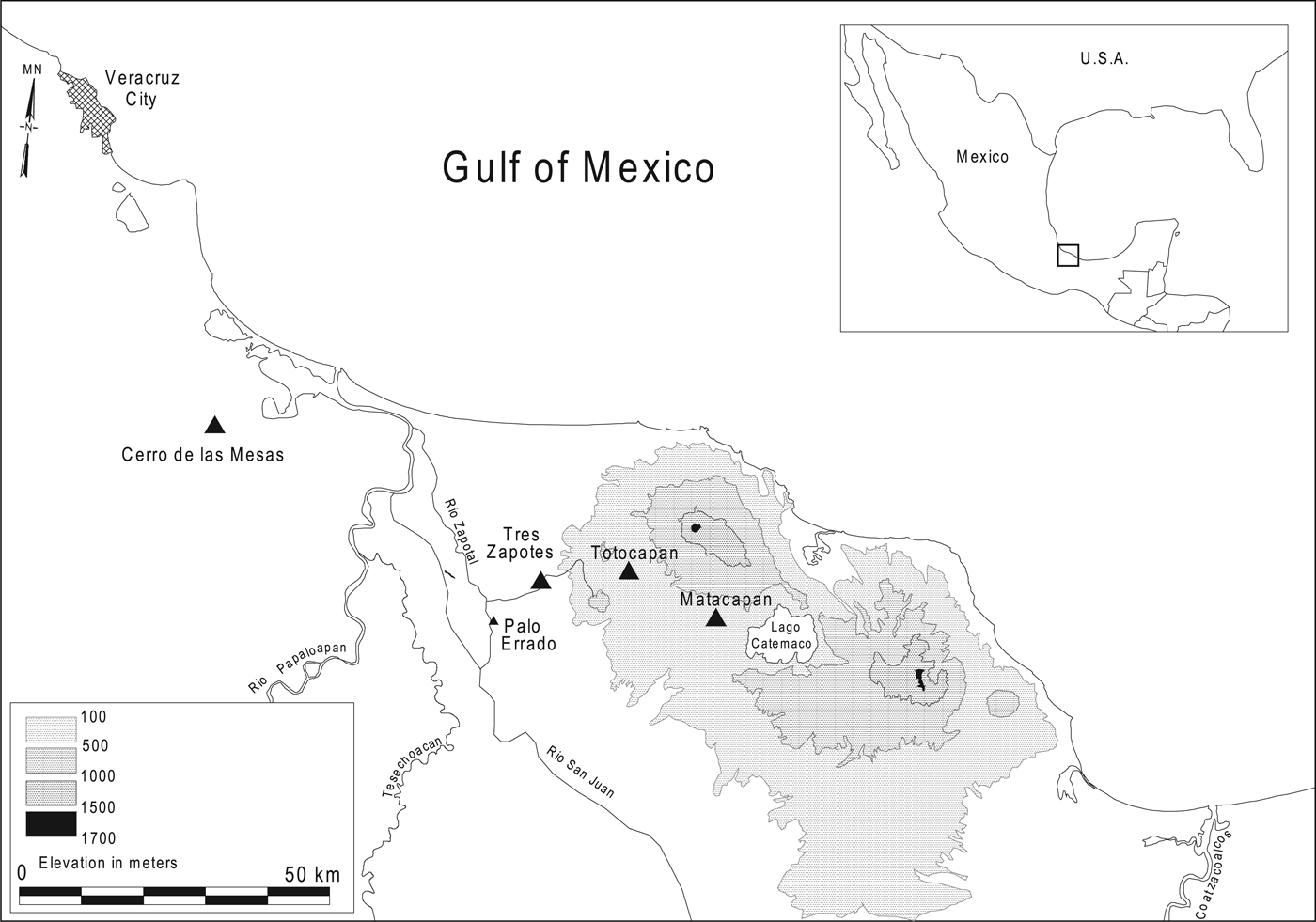
Palo Errado is a small mounded site located on the eastern levees of the Rio Zapotal, 10 km southwest of the Olmec and Epi-Olmec center of Tres Zapotes in the southern lowlands of Veracruz, Mexico (Figure 1). The site is situated between two major ecotones, the vast Papaloapan river system to the west, south and north, and the fertile plains along the base of the Sierra de los Tuxtlas to the east and northeast.
Map showing the location of Palo Errado in relation to several archaeological sites in the southern Gulf Lowlands, Mexico.

Palo Errado was principally occupied during the Early Classic period, with small, discrete occupations in the Protoclassic and the early Late Classic periods. Like elsewhere in the southern Gulf Lowlands, the inhabitants of Palo Errado relied on imported obsidian commodities for all of their chipped stone tool needs, since alternative fine-grained stone was not locally available.
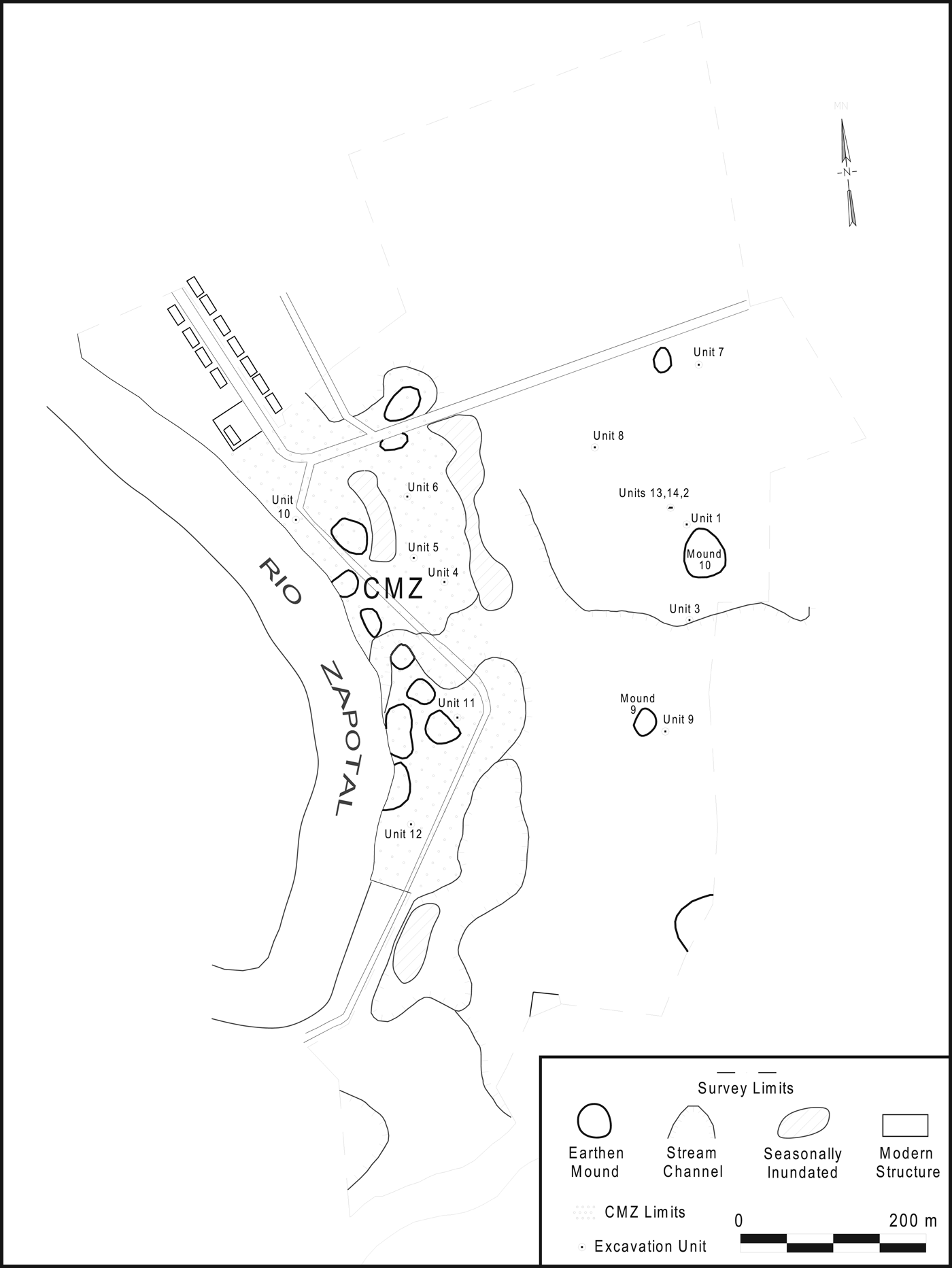
Intensive, systematic surface survey defined the limits of archaeological Palo Errado (Figure 2). The western edge of the site is delineated by the Río Zapotal, where a series of eight earthen mounds are located, several of which are eroding into the river. These mounds are located on an old river levee and are bordered by in-filled river channels, or borrow pits, to the east. Therefore, the area of these eight mounds and adjacent land is relatively elevated from the broad channel depression that surrounds them to the east and south. This elevated area is referred to as the Central Mounded Zone (CMZ). The CMZ covers 7.4 hectares and represents the principal area of habitation of the site based on the mounded architecture and the adjacent high concentration of surface artifacts (Figure 2). The rest of the inhabited portion of Palo Errado was limited to discrete surface concentrations in the east, southeast and extreme south of the survey zone on low-lying landforms that are above the level of seasonal inundation, but still lower than the lands of the CMZ.
Map showing the location of excavation units and survey limits at Palo Errado, Mexico.
The surface survey utilized a combination of systematic transect sampling and full coverage survey, a strategy replicating that employed at Tres Zapotes (Pool and Ohnersorgen Reference Pool, Ohnersorgen and Pool2003). All surface collections were made based on a 20 m site grid. All surface artifacts were systematically collected from a 3 × 3 m square every 20 m along transects spaced 100 m apart. The full coverage survey consisted of 0.5 × 0.5 m collections every 20 m along transects spaced 20 m apart between the systematic transects. Surface collections were made in a 30 ha area, with the total area collected cumulatively covering 2,380 square meters; a sampling intensity of 0.8 percent. In addition, 17.5 ha of the survey area were planted in sugar cane, where 100 percent surface coverage was achieved.
One of the principal goals of the Palo Errado Archaeological Project was to chart diachronic change in obsidian production and consumption. Therefore, deep excavation units in areas of significant surface concentration were chosen over broad, horizontal excavations. In the CMZ, a total of 6, 2 × 2 m units (Units 4–6, 10–12) were excavated, while 7, 2 × 2 m (Units 1–3, 7–9, 13) and one, 1 × 1 m (Unit 14) units were excavated outside of the CMZ. In the CMZ, Units 4, 5, and 6 were excavated in the area east of the ancient channel depression, or borrow pit, along the eastern edge of this elevated area. This area was characterized by an extremely high concentration of surface and subsurface artifacts. The high concentrations of deposited debris, over 1 m in depth, suggest that the eastern edge of the CMZ was a secondary or tertiary dump for the inhabited portion of the site, represented by the earthen mounds in the western half of the CMZ. Therefore, a major assumption of this study is that the diachronic patterns observed in the Unit 4 and 5, and to a lesser extent Unit 6, assemblages reflect the consumption habits of some, or all, of the inhabitants of the CMZ. Outside of the CMZ, Unit 1 was excavated adjacent to a large mound that defines the eastern border of the site, while Units 2, 13 and 14 were excavated in an elevated area of Protoclassic surface concentration. Unit 3 was excavated along the edge of a terrace overlooking an ancient river channel. Units 7 and 8 were excavated in surface concentrations in the plowed fields to the north, and Unit 9 was excavated next to a low-lying mound in the southeast corner of the survey.
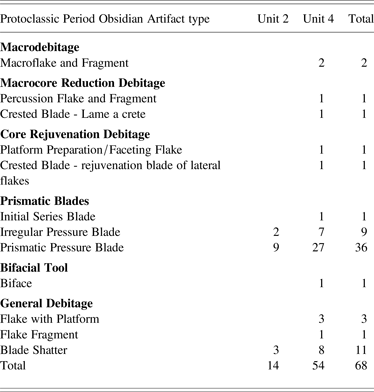
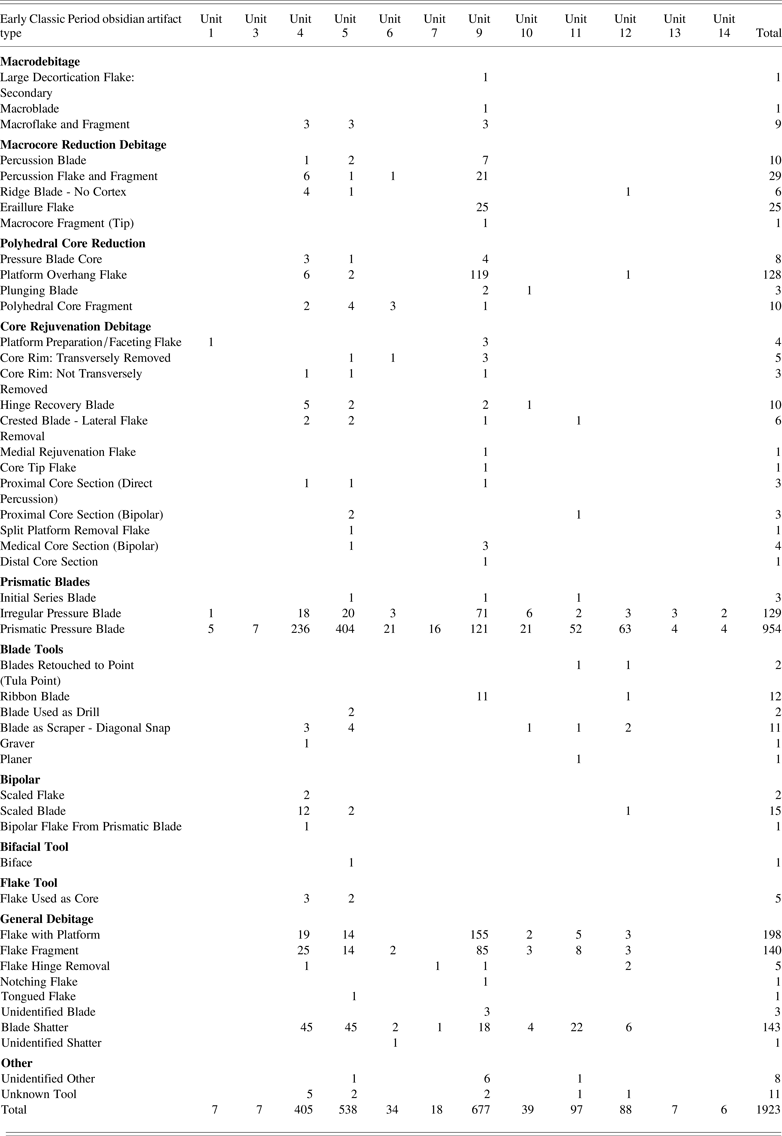
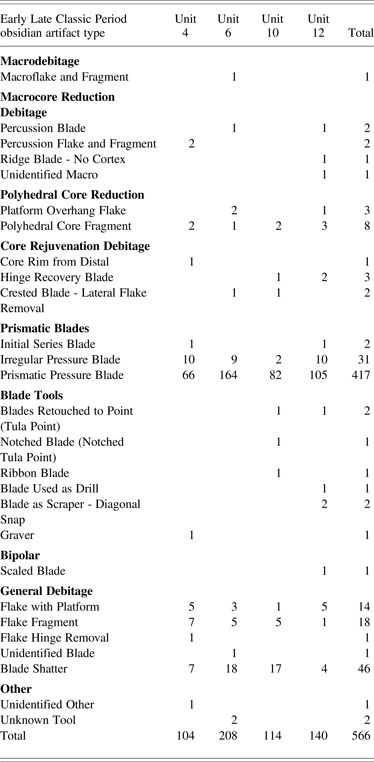
Excavation resulted in an obsidian assemblage of 2,557 artifacts weighing 2,424 grams, and is summarized by period occupation in Tables 1, 2 and 3. Only three non-obsidian chipped stone artifacts (i.e., chert) were recovered from Palo Errado, and all were from the surface. Therefore, obsidian represented 100 percent of the excavated chipped stone assemblage. A sample of excavated and surface obsidian was chemically sourced utilizing NAA, and the results indicate that the vast majority (92 percent) of obsidian used at Palo Errado came from Zaragoza-Oyameles (Knight and Glascock Reference Knight and Glascock2009:Table 2). Other sources present at the site were Pico de Orizaba, Guadalupe Victoria, Pachuca, Ucareo and Otumba.
Excavated Protoclassic Obsidian Assemblage
Excavated Early Classic obsidian assemblage
Excavated early Late Classic obsidian assemblage
SITE CHRONOLOGY
Temporal designations at Palo Errado were based on ceramic chronologies developed at the regional center of Tres Zapotes (Ortíz Ceballos Reference Ortiz Ceballos1975; Pool Reference Pool2003) and from the site of Bezuapan in the Sierra de los Tuxtlas (Pool and Britt Reference Pool and Britt2000). At Palo Errado, all rims from Units 2, 4, 6, 9, and 12 were analyzed (n = 2,191, representing a 38.5 percent sample of all excavated rims counted), which delineate a Protoclassic through late Early Classic period occupation (ca. a.d. 100–600). The Protoclassic period (previously referred to as the Terminal Formative [Knight & Glascock Reference Knight and Glascock2009]) was marked by a small surface concentration of undecorated coarse wares, polished black, and differentially fired black and tan ceramics centered on Unit 2. The Protoclassic occupation within the CMZ is present in the lowest three strata of Unit 4 (F, F/G, and G or Levels 10–14) represented there by a wide variety of plain and complexly incised coarse brown ware, including red-on-orange slipped coarse brown, differentially fired wares, polished black and, to a lesser extent, fine wares.
Occupation in the subsequent Early Classic period expands across the elevated landforms of the site, representing maximum site occupation. Fine orange ware predominates in Early Classic levels, although it is also found, to a lesser degree, throughout the entire Palo Errado occupation sequence. The Early Classic period occupation outside of the CMZ is represented by a light scattering of material along the base of Mound 10, which delineates the eastern limits of the site, and by Mound 9, a single, isolated house mound in the southeast corner of the site associated with domestic refuse and specialized prismatic blade production. At Unit 4 specifically, the Early Classic is represented by Strata B-E, or Levels 3–9. Therefore, the majority of the Palo Errado occupation occurred during the Early Classic period and within the CMZ.
An early Late Classic period occupation is inferred from a relatively high proportion of fine gray ware in the upper levels of the Unit 4, 6 and 12 excavations. In Unit 4, the early Late Classic layers also contained the largest proportion of green Pachuca obsidian recovered from the site. At Unit 4, the early Late Classic is represented by Stratum A or Levels 1–2.
DOMESTIC PRODUCTION AND CONSUMPTION AT MOUND 9
Mound 9 is a low-lying earthen mound approximately 20 × 20 m in size, located in the southeast corner of the survey zone, physically isolated from other inhabited areas of Palo Errado. It is located 160 m southwest of Mound 10, which defines the eastern limits of the site, 250 m east/southeast from the CMZ, and 200 m north from any other surface artifact concentrations in the southeast portion of the survey. Surface collections made on Mound 9 recovered only two obsidian artifacts, while surface collections made east of the mound recovered a concentration of ceramic sherds and 45 obsidian artifacts. The location of this artifact concentration 10–15 m east of the house mound conforms to expectations of an intermediate area of garbage deposition within a house lot, as outlined by Killion (Reference Killion1990:201–203). It is very unlikely that the Mound 9 midden represents anything but the refuse from activities occurring within the Mound 9 house lot.
The 2 × 2 m Unit 9 excavation was placed 12.5 m east of the eastern edge of the house mound and 1 m east of the 3 × 3 m surface collection unit. The excavation revealed three natural strata over 150 vertical cm. Artifacts were concentrated in the upper two strata, Strata A and B. Stratum A contained the vast majority of artifacts and extended throughout the entire unit for 20 cm. Below this, Stratum A was only identified in the southern half of the unit for another 10 cm, then it was isolated in the southeast quadrant of the unit for another 20 cm. Stratum B extended in half of the unit to 150 cm bd. Stratum C contained very few artifacts, all of which were likely emplaced there via the cracks produced in the clay during the dry season, and white mineralization was found throughout it. Stratum C continued to the bottom of the excavation at 150 cm bd.
Blade Production at Mound 9
A major question in reconstructing long distance exchange in obsidian is what type of artifacts, or commodities, were being exchanged. De León et al. (Reference De León, Hirth and Carballo2009:115–120) have outlined expectations for several types of commodity exchange: whole-blade trade, processed-blade trade, and local-blade production. They state (De León et al. Reference De León, Hirth and Carballo2009:114) that primary production evidence includes blade cores, exhausted cores, recycled cores, core fragments, and platform rejuvenation flakes. Secondary production evidence includes core shaping and maintenance debitage, production errors and error recovery artifacts.
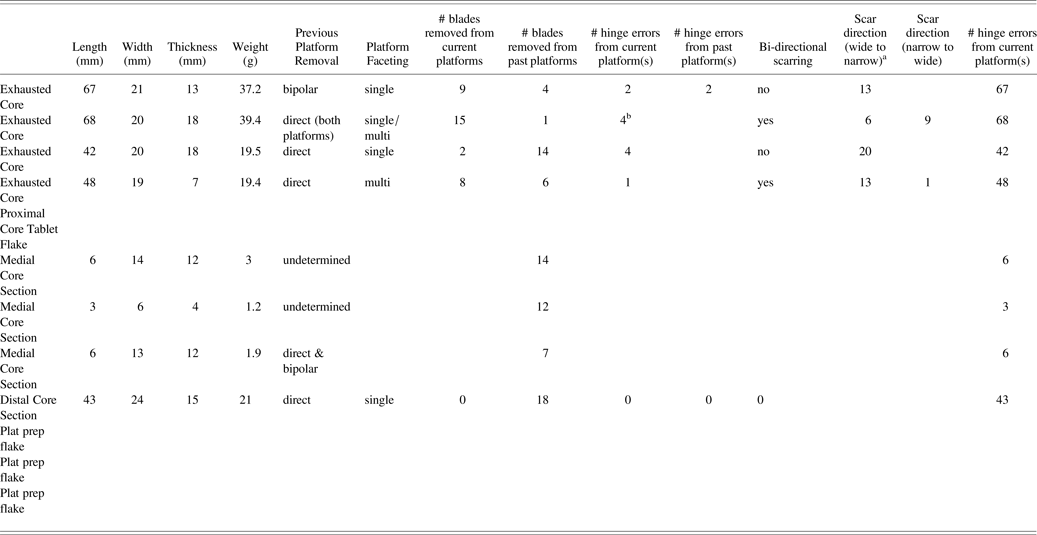
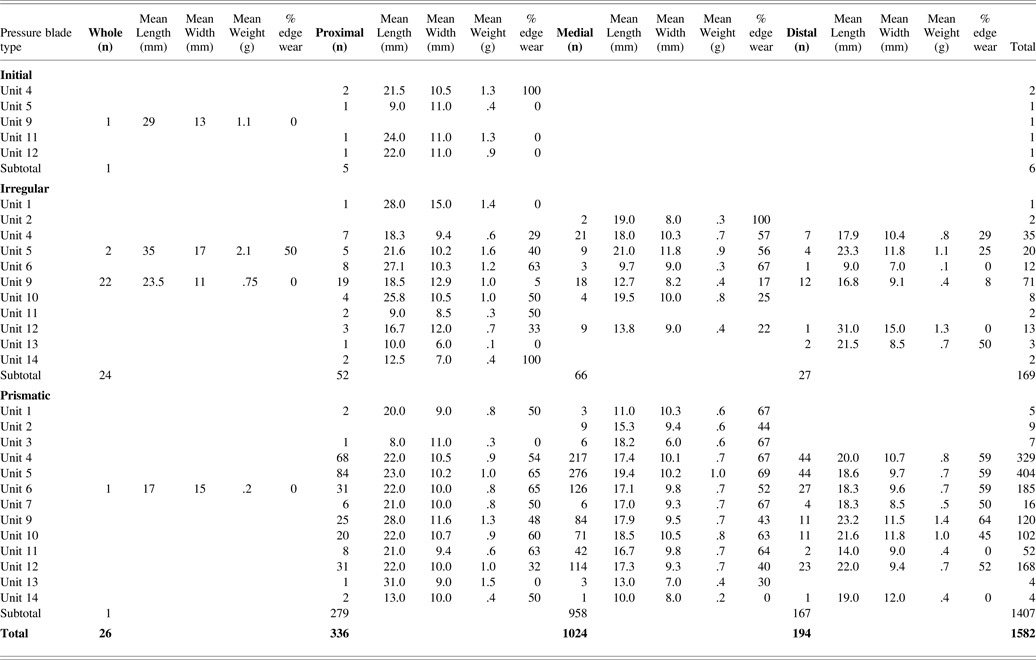
At Palo Errado, the Mound 9 inhabitants were producing prismatic blades from large polyhedral cores or macrocores. Table 2 summarizes the artifact types recovered from the Unit 9 excavation and indicates that many of the diagnostic primary production artifact types were present. Four exhausted blade cores were recovered, two of which were bidirectional and all of which exhibited evidence of rejuvenation (Table 4). Indicators of core rejuvenation include one proximal core section removed via direct percussion (a.k.a. core tablet), three core section flakes, and one distal core section, but all came from cores smaller than the four, recovered exhausted cores. This suggests the existence of one or more additional cores that were either reused or not recovered. Although the majority of core platforms were single faceted, the recovery of three platform core faceting/preparation flakes indicates the presence of at least one multifaceted core platform. Blade segment ratios deduced from Table 5 correspond to the expectations of the local-blade production model as outlined by De León et al. (Reference De León, Hirth and Carballo2009:118–20).
Unit 9 core metrics
a wide to narrow refers to wide or narrow end of core initiation of blade scar
b 3 hinge scars went in one direction and 1 went in opposite
Excavated prismatic blade segment summary
The data presented in Table 1 show that macrodebitage and macrocore reduction debitage (n = 59) constituted 8.7 percent of the obsidian assemblage. The reduction of macrocores is also deduced from the recovery of three smaller artifact types not typically discussed in core-blade assemblages in Mesoamerica: eraillure flakes, platform overhang flakes, and debitage with right angles facets.
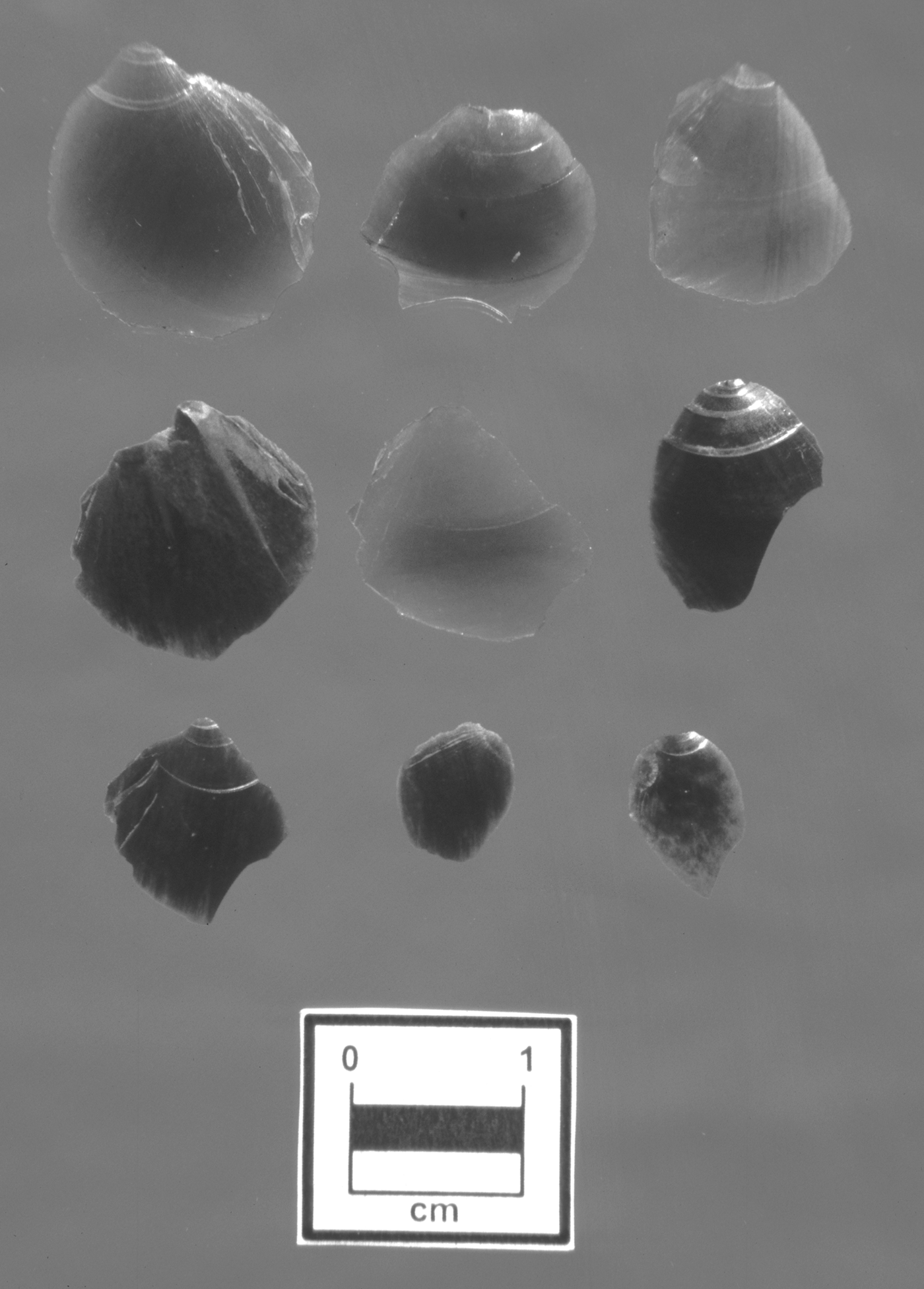
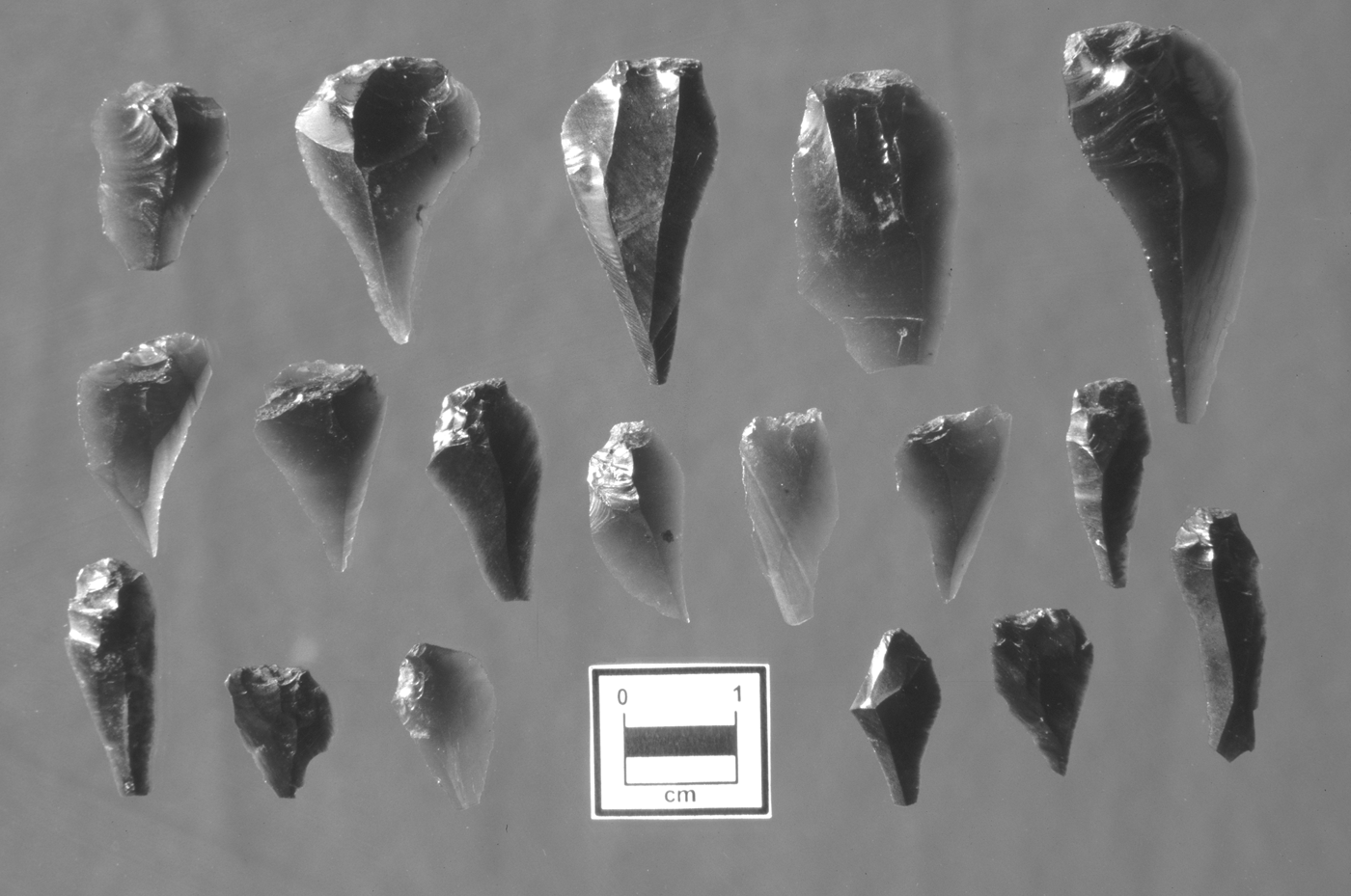
An eraillure flake is a small, platformless, secondary flake that detaches from the bulb as a result of force during flake or blade removal and often looks similar in size and shape to a contact lens (Clark and Bryant Reference Clark and Bryant1997:124; Hirth and Flenniken Reference Hirth, Flenniken and Hirth2006:306). At Palo Errado, 25 eraillure flakes were recovered from Unit 9 ranging in diameter from 4–17 mm (Figure 3). Of these, more than half (n = 14) were 10 mm or larger in diameter. Considering that the diameter of an eraillure flake must be smaller than the diameter of the bulb of percussion from where it comes, the relatively large size of the flakes and/or blades being detached that produced these eraillure flakes can be inferred. The larger eraillure flakes were produced in the reduction of large pieces of obsidian, which resulted during the final shaping of a macrocore. This would be something akin to the reduction of Clark and Bryant's (Reference Clark and Bryant1997:113) Macrocore I to a Macrocore II through the removal of II macroflakes, macroblades and small percussion flakes, all of which were recovered in Unit 9.
Sample of eraillure flakes from Excavation Unit 9.
Platform overhang flakes (overhang removal flakes) result from the removal of the protruding material that remains attached to the edge of a core's platform, located between the negative bulb scars on the lateral face (Clark and Bryant Reference Clark and Bryant1997:124; Hirth and Flenniken Reference Hirth, Flenniken and Hirth2006:311). While platform overhang flakes are produced at all stages of blade making, 8 percent (n = 10) of the platform overhang flakes recovered from Unit 9 were removed by percussion and range from 25–46 mm in length and 11–24 mm in width (Figure 4). The size of these platform overhang flakes corresponds to platforms that are larger than those expected on finished polyhedral cores and prismatic cores, such as those found on large polyhedral cores or macrocores.
Platform overhang flakes from Excavation Unit 9.
Finally, Andrews (Reference Andrews, Hirth and Andrews2002:50) has stated that one diagnostic debitage type of macrocore shaping is a macroflake with a platform to face angle of 90 degrees. In the Unit 9 assemblage, two macroflakes recovered exhibited dorsal scars at right angles to each other. Blocky dorsal scarring such as this is not expected on debitage produced during the shaping of a Macrocore II (Clark and Bryant Reference Clark and Bryant1997:113). If these blocky macroflakes were produced as part of the prismatic blade production process then they would be expected to appear earlier, such as during the shaping of a macrocore.
Blade Consumption at Mound 9
Two main indices are used to investigate whether blade production at Mound 9 was for local use, for exchange, or both. The first is the ratio of expected-to-actual-blade segments recovered. The assumption is that if blades were produced for exchange, fewer blade segments, specifically medial segments, would be recovered than could have been produced based on the amount and size of production debitage, such as exhausted prismatic cores. As discussed above, four exhausted cores and rejuvenation evidence of at least one more were recovered. Clark (Reference Clark, Johnson and Morrow1987:267) suggests that “several hundred blades” can be produced from a core of average size. His own replication experiments in blade production resulted in 100–200 blades per core (Clark Reference Clark1988:Table 152). Healan et al. (Reference Healan, Kerley and Bey1983:139) and Santley (Reference Santley and Hirth1984; and see Clark Reference Clark and Isaac1986:36) have produced similar blade amounts per core. Using smaller, rejuvenated cores Hirth and Andrews (Reference Hirth and Hirth2006:202–205) produced 60 blades per core in their experiments. In the Unit 9 examples, the average width of the four exhausted prismatic cores suggests that some blade removal potential remained on each core at the time of discard. Therefore, using a conservative estimate of 100 blades removed per prismatic core, the four exhausted prismatic cores and the core represented by the rejuvenation artifacts could have produced 500 blades and, as a result, 500 proximal blade segments.
A total of 192 irregular and fine blades and blade segments were recovered from Unit 9 (Table 5). Since several medial segments can be made from a single blade and distal segments are fragile and often underrepresented, proximal segments give better representations of a baseline count for the amount of blades in a deposit (De León et al. Reference De León, Hirth and Carballo2009:115–118, Hirth and Andrews Reference Hirth, Andrews and Hirth2006:214–216). Therefore, the combination of whole blades and proximal segments recovered account for only 13.4 percent of the 500 expected blades produced from the five exhausted prismatic cores, strongly suggesting production for exchange.
The second index used to determine whether blades were exchanged or not is the proportion of blade edge wear (Clark Reference Clark, Margarita and Clark1989:216; Hirth and Castanzo Reference Hirth, Castanzo and Hirth2006). High proportions of blades lacking edge wear at production loci would suggest that they were not used for local household consumption, but rather were produced for exchange. As indicated in Table 5, edge wear was absent on 32 percent of the 192 blade segments recovered from Unit 9. Whole irregular pressure blades were discarded without use, while less than 20 percent of any type of irregular blade segment exhibited use. For medial and proximal segments of fine blades, less than half exhibited edge wear. Compared to other excavation units, few of the Unit 9 prismatic blade segments were being used.
Obsidian Sources Consumed
Numerous visual categories were recorded in the Palo Errado assemblage (Knight and Glascock Reference Knight and Glascock2009:511). Of these, obsidian of the “clear-clear” variety was overwhelmingly found only in the Unit 9 deposits. INAA characterization determined that visual “clear-clear with clouds” obsidian sourced to Pico de Orizaba and visual “clear-clear” sourced to Guadalupe Victoria and Zaragoza-Oyameles (Knight and Glascock Reference Knight and Glascock2009:514). These two types of clear obsidian are visually distinct and easily recognizable. The recovery of the vast majority of artifacts made from these clear obsidians from the Unit 9 deposits indicates that the Mound 9 blade producers were receiving either more Guadalupe Victoria, more clear Zaragoza-Oyameles, and/or more Pico de Orizaba obsidian than other parts of the site.
Central Mounded Zone
Excavation Units 4, 5, 6 and 12 are selected for comparison with the Unit 9 assemblage, because of the quantity of artifacts recovered there and the quality of the stratigraphy in that part of the site. Excavation Units 4–6 are located immediately east of the mounded nucleus of the site, east of a small swale. Unit 12 is located in the zone of mounds along the western edge of the site. The off-mound portions of the CMZ were marked by a high concentration of surface artifacts, and thus were the most intensely sampled portion of the site.
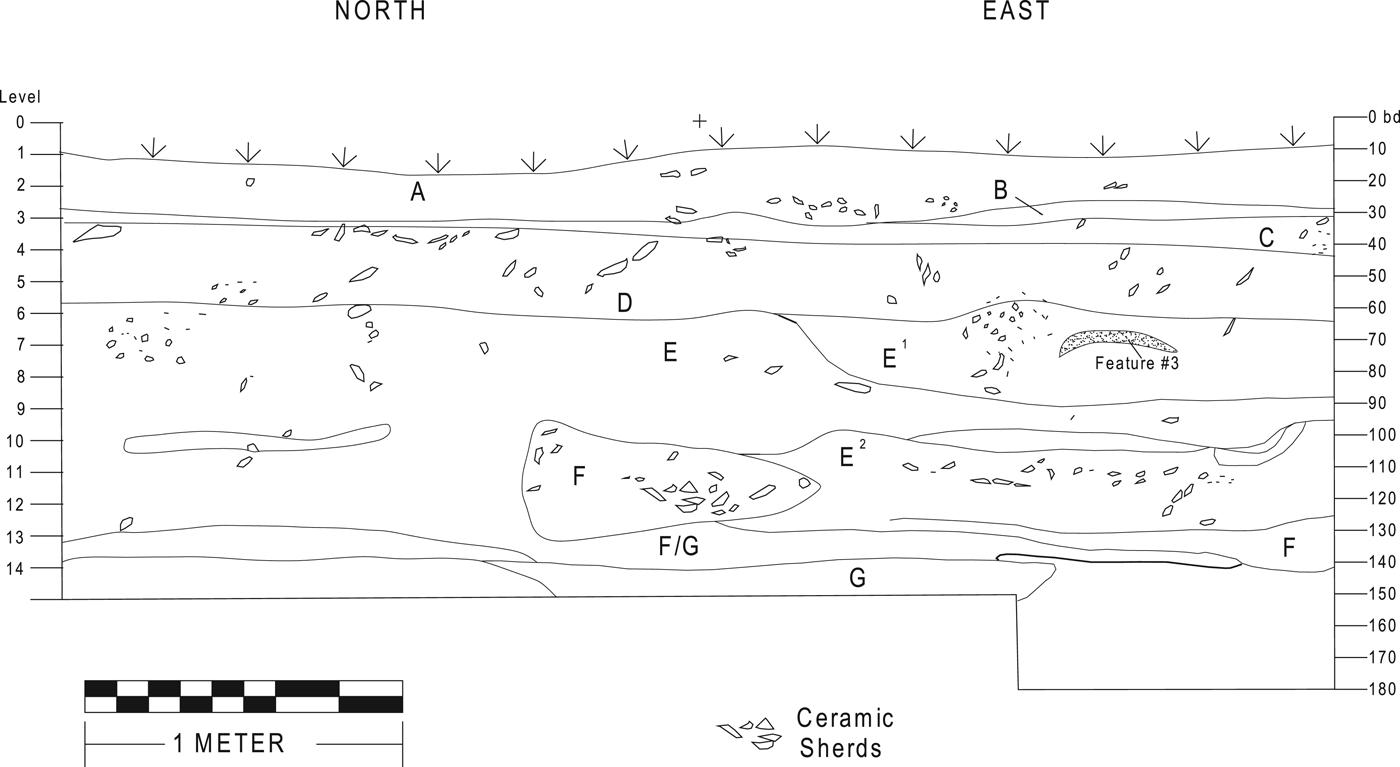
Unit 4 had the most complex depositional history, which included several intrusive garbage pits, floors, and burn features (Figure 5). The sequence of deposition there covers the entire Protoclassic through early Late Classic site occupation and is the only locus within the CMZ where the Protoclassic occupation was observed, comprising its F, F/G and G strata. The long occupation of Unit 4 means that the CMZ was occupied, to whatever degree, during the occupation of Mound 9 and that the Mound 9 household would have been entirely contemporaneous with the occupation of the CMZ.
North and east wall profile of Excavation Unit 4.
Unit 5 appears to represent a midden location, principally dating to the Early Classic period. Unit 6 contained lower quantities of artifacts than either Unit 4 or 5 and represents the northern edge of habitation in the CMZ. Unit 12 contained a high artifact concentration, and a single post mold associated with barro quemado and fire-reddened earth, suggesting the remains of some type of structure or covering.
The quantity and type of macrodebitage and macrocore reduction debitage recovered from Units 4 and 5 suggests that blade production also was carried out in the CMZ. The recovery of core section flakes, core fragments, platform overhang flakes, exhausted prismatic cores, ridge blades, and percussion blades and flakes from Unit 4 correspond to the expectations of the local-blade production model (De León et al. Reference De León, Hirth and Carballo2009). However the Early Classic period macroassemblage from the CMZ is fundamentally different from the Early Classic Unit 9 macroassemblage. First, macrodebitage and macrocore debitage accounts for 1.5 percent of the Unit 5 assemblage and 3.4 percent of the Unit 4 assemblage, while comprising 8.8 percent of the Unit 9 assemblage. Second, 45 percent of the Unit 4 macroassemblage and 75 percent of the Unit 5 macro-assemblage exhibited edge wear while only 3.4 percent of the Unit 9 macroassemblage exhibited any. Third, no eraillure flakes or any debitage exhibiting 90 degree dorsal angles were recovered from any excavation in the CMZ.
The consumption of prismatic blades between the CMZ and Unit 9 also appears to have been carried out to different degrees. From the Table 5 data several observations can be made: 1) typically 50–66 percent of all Early Classic blade segments from the CMZ exhibit some form of edge wear, except for those from Unit 12 (discussed below), while all Unit 9 blade segments, except for distal prismatic blades, have less than 50 percent with edge wear. This demonstrates a greater orientation towards obsidian consumption in the CMZ. 2) The proximal-to-distal and medial-to-distal blade segment ratiosFootnote 1, from units with significant numbers of blade segments, are higher at Unit 9 than the CMZ meaning Unit 9 had fewer expected medial segments than elsewhere at the site. This is interpreted as reflecting production for exchange. 3) Unit 9 is the only assemblage with a significant amount of whole blades recovered, albeit irregular blades. This would be expected if irregular blades, and their segments, were not considered viable commodities for exchange.
Unit 12
Unlike other CMZ excavation assemblages, a relatively low proportion of blade segments recovered from Unit 12 showed edge wear. In fact, the amount of edge wear on blade segments from Unit 12 is more similar to the Unit 9 assemblage than anywhere else. However, the principal difference between the Unit 12 and Unit 9 assemblages is the lack of evidence for blade production at Unit 12. Irregular pressure blades make up only 5.7 percent (n = 13) of the Unit 12 assemblage, less than at Unit 4 (6.2 percent) and much less than at Unit 9 (10.5 percent). The proportion of prismatic blade fragments at Unit 12 (73.6 percent) is very similar to that found at Unit 5 (75.1 percent) and Unit 6 (76.4 percent). At the Unit 9 production locus prismatic blade fragments constitute only 17.9 percent of the obsidian assemblage. The Unit 12 obsidian assemblage suggests the use of whole blades that were segmented at the locus. Unit 12 is most similar in the amount of production debitage and finished blade segments to other units in the CMZ, like Unit 6. It is very unlike Unit 9 in this regard. Therefore the low proportion of edge wear on all blade segments recovered from this unit does not reflect production for exchange. Rather, the Unit 12 inhabitants likely used blade segments for tasks that did not leave wear marks visible at low magnification, such as work with fabric or flesh.
CERAMIC ASSEMBLAGES AND SOCIAL DIFFERENTIAION
Unit 9 Ceramic Assemblage
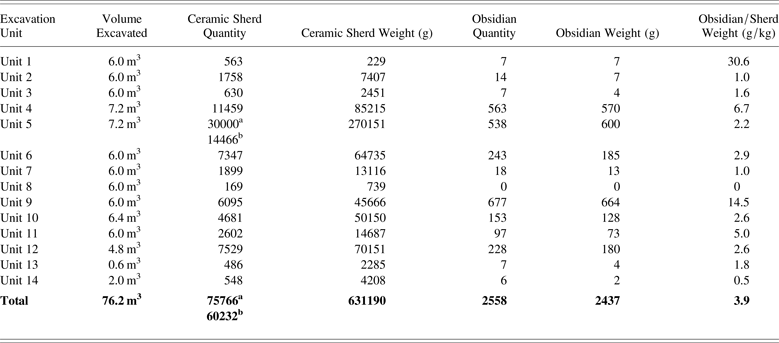
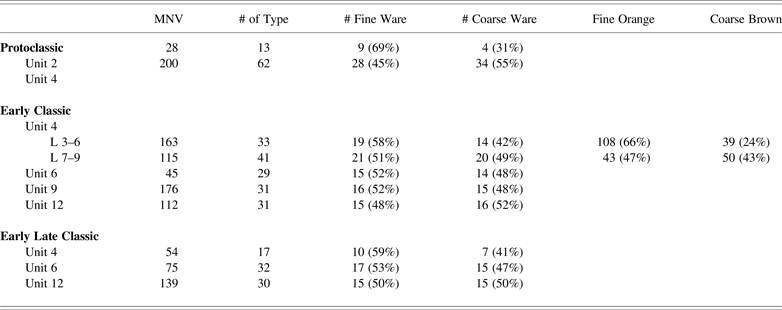
The Unit 9 ceramic assemblage consisted of 6,095 sherds; of these 458 (7.5 percent) were rims. Table 6 summarizes excavation metrics at the site. In order to standardize comparisons between excavation units, the ratio of ceramic sherd weight to obsidian artifact weight is used. With this done, Unit 9 is shown to have the highest obsidian-to-ceramic weight ratio, again reflecting the specialized obsidian production nature of the Mound 9 occupation. Two clay spindle whorls also were recovered from Unit 9. One whorl is likely mold-made and Type 1 in shape (Hall Reference Hall, Stark and Arnold1997:Figure 1). It had a red wash over a fine orange past and its base was covered in chapapote, and exhibited no other decoration. The other whorl had no decoration. These spindle whorls are the only evidence to suggest that more than one crafting activity was carried out by the Mound 9 household.
Excavated ceramics metrics
a Estimated quantity of ceramic sherds from analyzed and unanalyzed bags, all ceramics weighed.
b Quantity of analyzed sample of ceramic sherds.
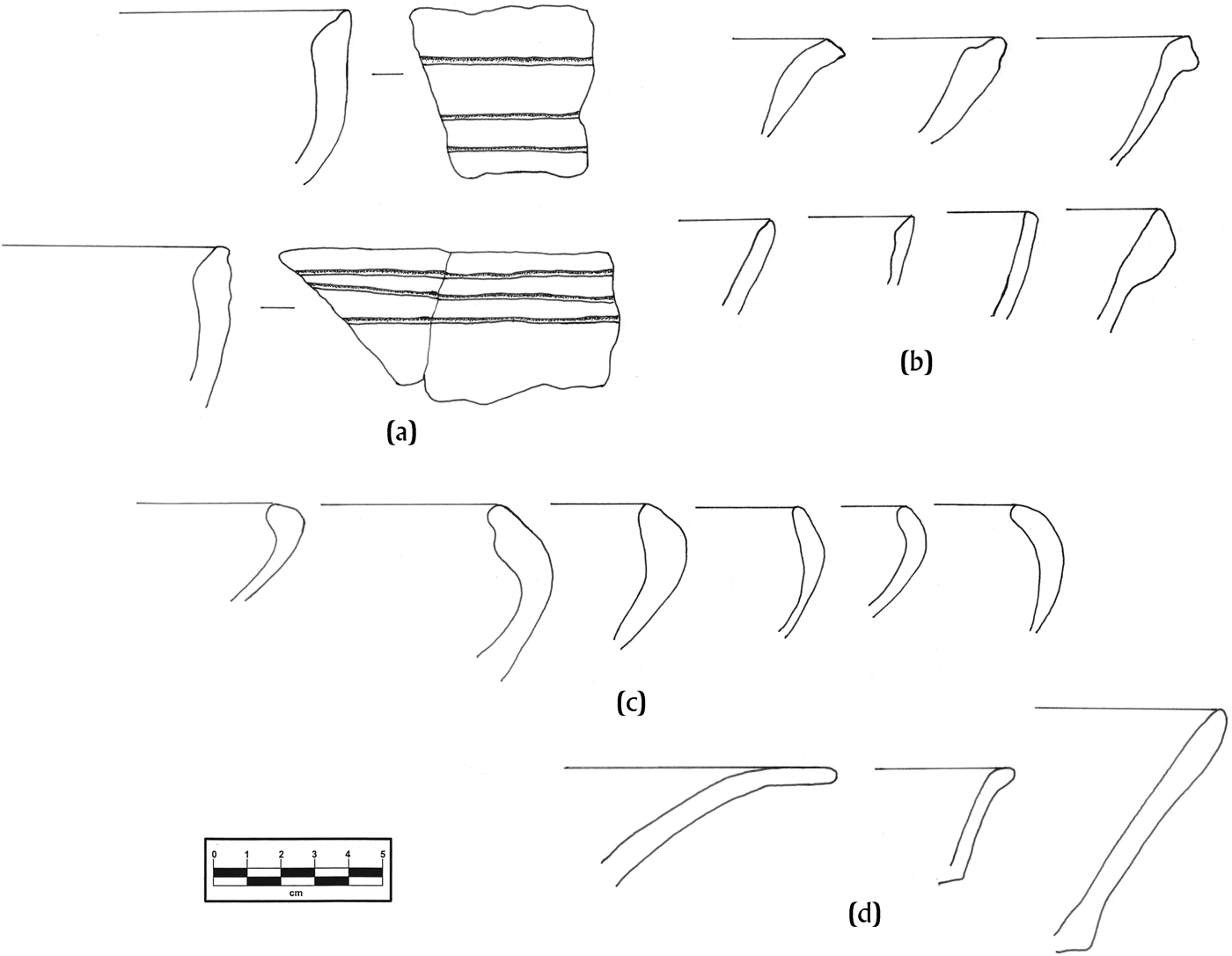
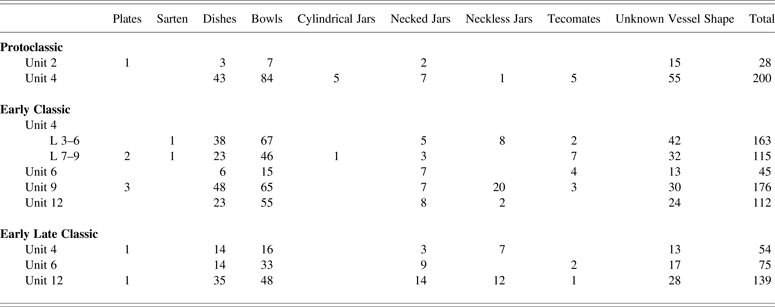
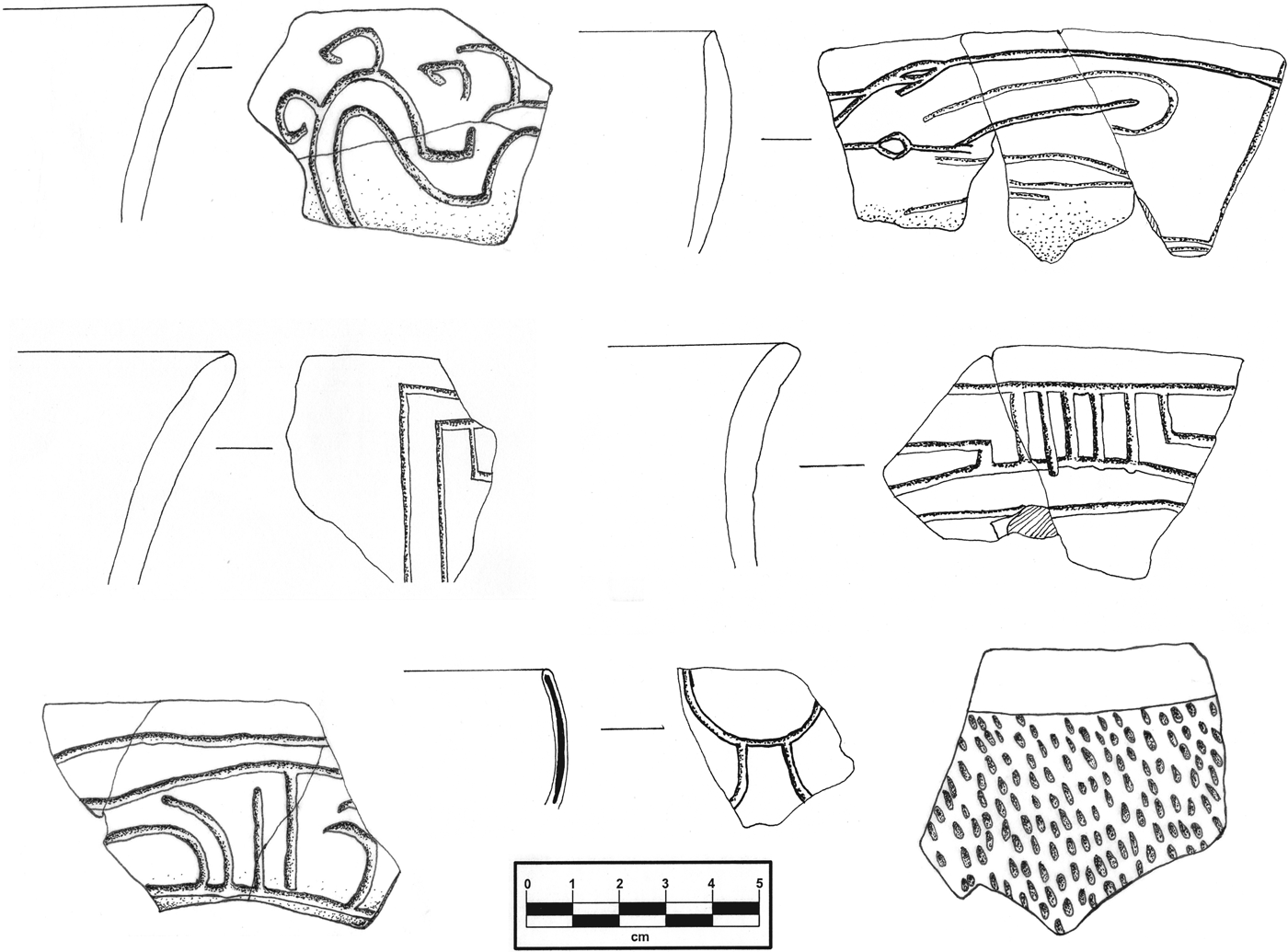
In Unit 9, fine orange wares comprised 70 percent of the ceramic rim assemblage and coarse brown wares 26.5 percent. Four specific types represent 63.3 percent of all the ceramic rim types recovered: plain fine orange (31.5 percent), white polished fine orange (16.5 percent), plain coarse brown (8.3 percent), and plain coarse brown with a dark core (7 percent). Three fine orange vessel types comprise the majority of all identifiable vessels forms: bowls (19 percent, n = 87), dishes (23 percent, n = 106), and neckless jars (10 percent, n = 47) (Figure 6). Ceramic decoration on vessels recovered from Unit 9 is limited to simple linear incisions parallel to the rim on fine orange bowls. No geometric or other types of complex incision were present on any other rim sherds. Non-vessel ceramic items consisted of a single ceramic tube bead, a possible whistle fragment, a ceramic ring, and a tablet with a hole in it. All of these items may have been a normal part of any nonelite household's assemblage.
Sample of ceramic vessel from Excavation Unit 9: a) decorated; b) bowls; c) neckless jars; d) dishes.
The Mound 9 ceramic assemblage provides the best case to determine non-elite vessel consumption, since there is little chance for it to reflect multiple household trash. The Minimum Number of Vessels (MNV) (see Rice Reference Rice1987:292) recovered from the Unit 9 excavation is 176 (Table 7). Table 8 summarizes the quantity of each vessel recovered. If it is assumed that the Mound 9 household consisted of 5–6 people (Evans Reference Evans, Santley and Hirth1993:Table 1; Pool Reference Pool, Jamieson, Abonyi and Mirau1993:402), with an average ceramic replacement rate of 13–30 vessels, based on upper and lower estimates of ethnographic examples of vessel replacement (Pool Reference Pool, Jamieson, Abonyi and Mirau1993:403–404), then the ceramic assemblage from this single 2 × 2 m unit represents between 6–14 years of occupation. Determining the upper limit of occupation however, is not as clear since the surficial limits of the Mound 9 artifact concentration were not delineated at a closer interval than the 20 m grid (see Rice Reference Rice1987:302). Nonetheless, the southwest corner of the 3 × 3 m surface unit that identified the Mound 9 concentration is located 1 m to the west of Unit 9. If it is assumed that similar deposits exist below that 3 × 3 m surface unit, as well as the 1 × 2 m of uninvestigated ground between the surface and excavation unit, then there is a total of 15 square meters of midden, of which Unit 9 represents 27 percent. Therefore, based on these broad estimates, the lower limit of the Mound 9 occupation can be extended to 61–141 years.
Minimum number of vessels by excavation unit
Type and quantity of ceramic vessels by excavation unit
CMZ ceramic assemblages
The ceramic assemblages from Units 4, 5, 6 and 12 contain a wider variety of ceramic types than found in Unit 9. Decoration on those types is more common and varied, and non-vessel ceramics are much more common. The greatest variety of vessels and other non-vessel ceramic artifacts, such as adornments, whistles, stamps, and mold-made figurines came from Unit 4. However, important markers of elevated status were also recovered from Units 5, 6 and 12. A ceramic ear plug recovered from Unit 6 matches the description of those recovered in La Mixtequilla (Stark Reference Stark and Stark2001:216) where it is believed that such fragile ornaments were restricted in distribution. In addition, the only greenstone bead from the site was recovered from Unit 12, while a 6 cm tip of a stalagmite/stalactite was recovered in a lower level of Unit 5. The latter two artifacts are exotic, long-distance imports.
Although the Units 4, 5, 6 and 12 excavated assemblages included examples of sherd decoration with simple and complex linear incision, geometric incision, appliqué, and punctate impressions, ceramic beads and pendants, and mold-made figurine fragments and whistle fragments, it was the Unit 4 excavation that recovered the vast majority and greatest variety of these types of artifacts, and which the rest of the discussion will focus on.
Diachronic Changes in Unit 4
The Unit 4 ceramic assemblage consisted of 11,459 sherds, and of these, 1,079 (9.4 percent) were rims (Figure 7). In the Protoclassic period fine orange rims (40.2 percent, n = 147) and coarse brown rims (40 percent, n = 155) were deposited in similar quantities. At some point in the Early Classic period however, there occurred a statistically significant change in the types of wares most commonly used. Fine orange rims increased from comprising 34.6 percent (n = 77) of Levels 7–9, to 69 percent (n = 255) of Levels 3–6. At the same time the proportion of coarse brown ware decreases from 46 percent (n = 102) of Levels 7–9, to 31.7 percent (n = 45) of Levels 3–6. This trajectory continued into the early Late Classic period in Layers 1–3, when fine orange rims comprised 82.5 percent (n = 129) of all ceramics and coarse brown decreased to 21 percent (n = 14). These relative changes are also explicit in the Minimum Number of Vessel counts (see Table 7). Corresponding to this change in wares is the nature of ceramic decoration. No longer are there coarse browns decorated with incision and punctuation; instead, after the Level 6–7 transition they are slipped or plain. At the site of Comoapan in the Sierra de los Tuxtlas, coarse orange and brown ware vessels were primarily utilitarian, such as containers, etc. (Arnold et al. Reference Arnold, Pool, Kneebone and Santley1993). Therefore, the decrease in use of coarse wares reflects a decrease in the consumption of utilitarian vessels and an increase in the consumption of serving vessels. This scenario is strengthened by the fact that no coarse brown necked jars were recovered from the Levels 1–6 occupation, whereas in Levels 7–14 they constituted 0.7 percent of all identified rim forms. Jars in general, regardless of ware, decreased from 1.4 percent (n = 4) in Levels 7–14, to 0.6 percent (n = 1) in Levels 1–6. Fine wares also underwent a change in surface treatment, especially with fine orange vessels. During the Levels 7–9 Early Classic occupation fine orange wares exhibited a variety of slips and surface treatments, while in Levels 3–6, and during the early Late Classic occupation, fine wares overwhelmingly exhibit the same white slipped exterior treatment, with the occasional red painted lip.
Sample of ceramic vessel profiles from Excavation Unit 4.
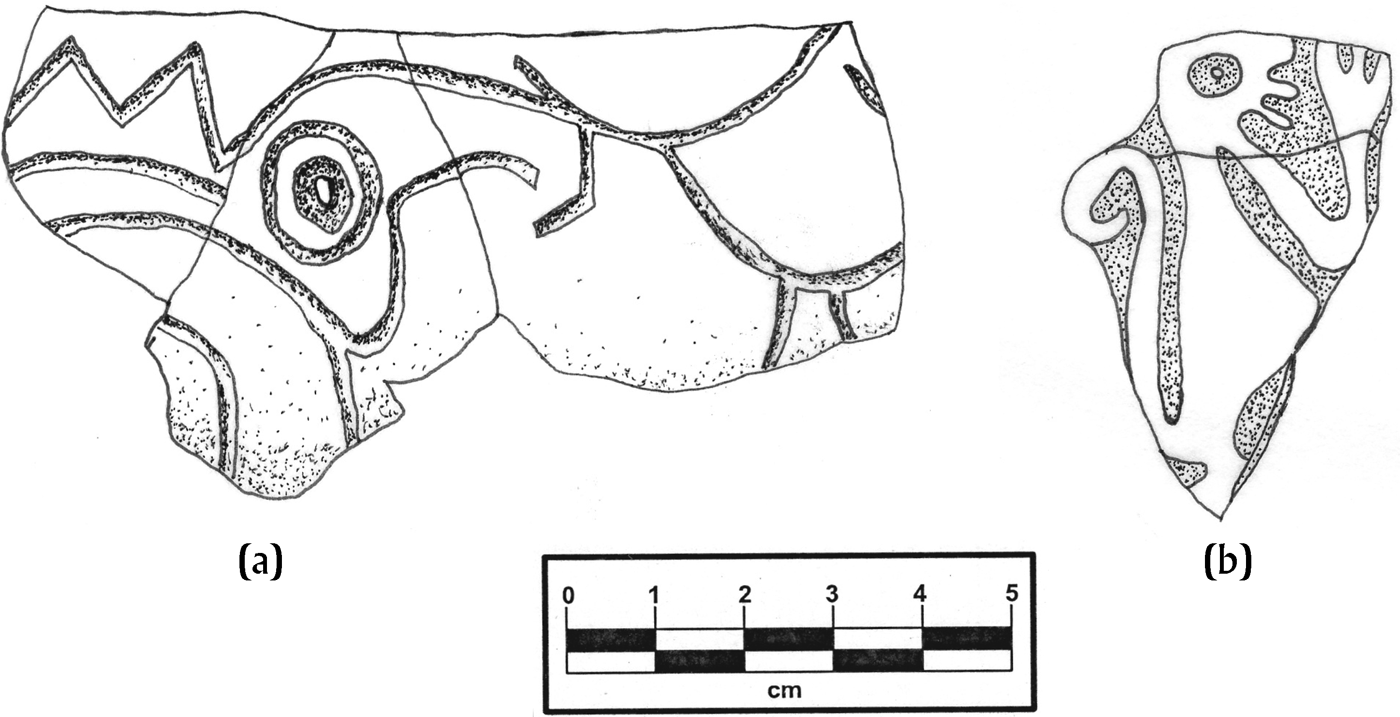
Corresponding to the changes in vessel type and surface decoration is the adoption of an intensified aesthetic reflecting elevated status. Although some degree of personal adornment and mold-made figurine consumption is reflected in the Protoclassic and early Early Classic occupation in the CMZ as seen in the Unit 4 deposits, a significant pulse in their consumption (or at least discard) is evident in the Level 6 deposits. In Level 6, fragments of ear flares, ear spools and plugs, fragments of whistles and mold-made figurines, and a variety of ceramic beads and pendants are in greater proportion than ever before. While in subsequent levels their use decreases to levels similar to the beginning of the Early Classic period, the types of pendants present beginning in Level 7 change. For instance, along with tubular and incised beads, animal effigy pendants were recovered, including a series of three duck head pendants, all of which were found in Level 6, suggesting they were discarded at the same time, likely as one ornament. Animal iconography is more common in the Unit 4 deposits than at any other locus of the site. In Level 7, a relatively large bowl fragment was recovered with an incised bird representation, possibly of a macaw (Figure 8). Of the two flat stamps recovered in Unit 4, one depicts a geometric design and the other monkey iconography (see Figure 8).
Examples of animal representations on ceramics from Excavation Unit 4: a) bird; b) monkey stamp.
Evidence for multicrafting at Unit 4 comes from the recovery of 15 ceramic spindle whorls, the majority from the Protoclassic period. All but five whorls had some sort of decoration, such as incision, chapapote, or slip. Seventy-three percent (n = 11) of the whorls come from below Level 6, thus before the observed change in status, while the three others come from Levels 3, 4, and 6. While the recovery of these whorls, and 23 others from excavations in the CMZ, indicates that spinning was carried out there in addition to some prismatic blade manufacture, spinning was an activity that was emphasized before the observed shift in elite behavior which occurred at some point in the Early Classic occupation.
Unit 4 Obsidian and Ceramic consumption
As discussed above, blade production indicators, including some macrocore reduction debitage, were recovered from Unit 4 suggesting that the inhabitants of the CMZ had access to polyhedral cores and the occasional macrocore. However, the diachronic distribution of macrocore reduction debitage is heavily skewed to the Protoclassic and early part of the Early Classic occupation. Of all 24 macrocore reduction artifacts recovered in Unit 4, 75 percent (n = 18) were recovered from layers below Level 6. Of this, all macrodebitage was recovered from the Protoclassic period, while 64 percent (n = 7) of the macrocore reduction debitage (i.e., the smaller percussion blades, ridge blades, etc.) was recovered from Levels 7–9. Macrocores were only present in the CMZ during the Protoclassic period. Through time the CMZ received more processed cores until, by the later portion of the Early Classic period, inhabitants of the CMZ were only receiving polyhedral cores.
The proportion of fine prismatic blades in the Unit 4 assemblage also changed over time. In Levels 7–9, fine prismatic blades comprise 50 percent of the obsidian assemblage, increasing to 72 percent of the assemblage in Levels 3–6. This increase in fine prismatic blades also corresponds to an increase in the proportion of edge wear on them (from 56 percent to 63 percent), and a decrease in all other obsidian artifacts that exhibited edge wear (from 54 percent to 12 percent).
Therefore, at the same time that the inhabitants of the Unit 4 area increased their consumption of ceramic fine wares and status symbols, larger production debitage decreased in proportion, while fine prismatic blades became a more prominent part of the obsidian assemblage. This shift, however, does not correspond to any significant changes in how the blades were being used. That is to say, the activities that fine prismatic blades were being used for did not change through time as represented in the Unit 4 deposits. A chi-square comparing the quantity of the types of edge wear before and after the Level 6–7 break indicate that the differences in the proportions of the types of edge wear present on fine blades between the two occupations is not significant (X2 = 18.25, p > .50). The types of edge wear on fine prismatic blades in Levels 3–6 were compared with all other obsidian exhibiting edge wear from those levels and the difference in the proportions is not significant (X2 = 11.89, p > .50). A similar comparison between the proportion of the types of edge wear of fine prismatic blades and all other obsidian with edge wear from Levels 7–9 indicated that the difference is not significant (X2 = 17.11, p > .50). So the changes that resulted in a greater consumption of fine orange wares, status symbols and decrease in spinning activities corresponds to a change in the types of obsidian artifacts being used (e.g., finer blades, less early stage production debris), but not in how they were being used.
DISCUSSION
Evidence for the involvement of the elite in the obsidian economy in the southern Gulf lowlands is not strong, but at the same time is not entirely absent. At Tres Zapotes (Knight Reference Knight and Pool2003), Palo Errado (Knight Reference Knight1999; Knight and Glascock Reference Knight and Glascock2009:520–21) and Matacapan (Arnold and Santley Reference Arnold, Santley, Arnold and Pool2008; Barret Reference Barrett2003:82; Santley Reference Santley2007) green Pachuca obsidian artifacts tend to cluster in elite sectors of the respected sites. This pattern demonstrates some preferential consumption, perhaps due to the color of Pachuca obsidian or to its connection with Teotihuacan during the Classic period, or both. In the western Tuxtlas, Stoner (Reference Stoner2012:399–400) identified preferential access to green obsidian at the site of Tilzapote near the boundary between Totocapan and Matacapan, which appears to have established special economic ties with Matacapan for this obsidian. In these cases there are no signs of blade production with Pachuca obsidian, only its consumption. The distribution of Pachuca in the neighboring Mixtequilla is not clear, since it was only recovered in very low quantities (Stark et al. Reference Stark, Lynette, Glascock, Elam and Neff1992). Obsidian from other sources was not restricted to any segment of the population in the southern Gulf lowlands. At Tres Zapotes the preferential consumption of clear, likely Guadalupe Victoria obsidian by the elite during the Protoclassic period is apparent, but in no way was the material restricted from other social segments of the site (Knight Reference Knight2009).
At Palo Errado the general pattern through time is of unrestricted access to obsidian raw materials and finished products, like blades. The intrasite distribution of blade production at Mound 9 and in the CMZ does not suggest that either location was restricted in its access. In fact, the differences in consumption rates of finished blades and the types of obsidian sources used in production and consumption between the Mound 9 producers and those of the CMZ suggest that these areas were exercising varying provisioning strategies, thus some degree of economic independence between the two areas of the site. At the Epiclassic center of Xochicalco, Hirth (Reference Hirth and Hirth2009a:83, Reference Hirth, Manzanilla and Hirth2011:189) found that individual household craftsmen developed independent obsidian provisioning networks, such as via itinerant craftsmen, which was evident in the variation of obsidian source material between household workshops. At Palo Errado, the difference in economic and ideological activity is compounded by the location of Mound 9, which is so physically separate from the rest of the site that it appears to be excluded from it. What the reason was for the Mound 9 location can never be known, but it implies that the production of obsidian blades was not an activity that necessitated close contact physically, ideologically, or economically with the site elite in the CMZ.
What then, was the nature of the relationship between Mound 9 and the rest of the site, if any at all existed? While the two locations were contemporaneous during some point in the Early Classic period, when exactly this occurred is not known. Clark (Reference Clark and Hirth2003:37) has outlined some of the shortcomings in making intrasite comparisons of obsidian use, particularly the very small likelihood of finding two contemporaneous household occupations to compare. The Mound 9 occupation appears to have lasted for at least 60–140 years, while the occupation of the CMZ may have lasted much longer. It is tempting to interpret the development of blade production at Mound 9 as a response to the contraction of blade production and growth of fine blade consumption in the CMZ at the time of the elite realignment, but chronological contemporaneity is uncertain. On the other hand, Mound 9 could have been occupied just before the elite realignment in the CMZ when macrocore reduction was more common there. While this rather unsatisfying chronological reality does not allow for a meaningful reconstruction of causality and intrasite influence, it does not affect more generalized observations of the relationship between the two areas of the site.
First, the inhabitants of Mound 9 were producing prismatic blades for exchange, and the inhabitants of the CMZ were producing prismatic blades for their own consumption. This raises the question: With whom were the Mound 9 producer(s) exchanging their blades? Second, the inhabitants of Mound 9 were receiving artifacts made from clear obsidian in greater volume than other areas of the site. Third, the inhabitants of Mound 9 were not taking part in the system of status display that occurred in the CMZ before and after the Unit 4 Level 6–7 transition.
Marketplaces provided an avenue for households to sell their surplus production (Hirth Reference Hirth and Hirth2009a:2). Hirth (Reference Hirth2009b:89–90) has outlined several physical archaeological indicators of marketplaces dealing with architecture and trace-element context (such as phosphates) in soils. At Palo Errado, there are several open areas of the site lacking in surface materials, but it is difficult to conclude from the surface survey alone that these spaces were used as the site of marketplaces. Another approach Hirth (Reference Hirth1998) has proposed to identify marketplaces is by charting the distribution of material types throughout the consuming site. At Palo Errado, Zaragoza-Oyameles obsidian makes up the vast majority of the obsidian assemblage, but important intrasite variations in the quantities of minor sources also exist. While the dominance of Zaragoza-Oyameles likely reflects the dominance of the Cantona-based distribution system of Zaragoza-Oyameles obsidian throughout all of the southern Gulf Lowlands, the variation in minor sources accords well with a system where various suppliers and/or craftsmen work contemporaneously within a single marketplace; each having their own provisioning network. Such a scenario is used to explain intrasite variation in domestic source used at Xochicalco (Hirth Reference Hirth2009b:99, Reference Hirth, Manzanilla and Hirth2011:189).
The quantities, types and sources of obsidian artifacts in the Mound 9 assemblages differs to such a degree from that found in the CMZ, that a pattern of elite redistribution of obsidian at the site does not seem plausible. Rather, the marketplace scenario, with local producers/consumers accessing a variety of exchange networks via the local, sporadic market could explain the archaeological data. Lastly, local markets may not have provisioned for all the domestic and elite needs, nor provided sufficient exchange opportunities for local craftsmen. The regional center of Tres Zapotes is located only 11 km away and would have provided expanded opportunities for Palo Errado craftsmen to peddle their wares and, at the same time, acquire raw material that was not available locally. Access to a regional marketplace would also have benefited the Palo Errado elite, who would have been able to acquire ceramic serving ware and adornment of a broader variety and imbued with greater exoticness than available at their local market. Although we have little to no information on the nature of markets at Tres Zapotes, the Tres Zapotes elite appear to have preferentially used clear obsidian blades and flakes during the Protoclassic and Early Classic, a time when the non-elite were overwhelmingly consuming black, Zaragoza-Oyameles blades and flakes (Knight Reference Knight2009). While it is impossible to determine where the clear obsidian blades produced at Mound 9 were going, a demand for clear obsidian commodities by the regional elite would have provided an independent avenue for exchange outside the local, Palo Errado-based networks.
CONCLUSIONS
Any discussion on the domestic production of obsidian commodities at consuming sites in Mesoamerica must first identify habitation loci and clear evidence for production. This has been demonstrated for Mound 9 at Palo Errado. The recovery of unequivocal evidence for prismatic blade production and several spindle whorls from a domestic midden indicates that the Mound 9 inhabitants were multicrafting. There, prismatic blades for exchange were produced from imported polyhedral cores and macrocores. The presence of macrocores of Zaragoza-Oyameles obsidian at Palo Errado indicates that whatever obsidian exchange networks they participated in were robust enough to transport these large commodities over 200 km from their source area, likely via Cantona. In the Unit 9 deposits, the recovery of large eraillure flakes, large platform overhang flakes and chunky debitage with platform to face angles of 90 degrees add to the repertoire of typically expected macrocore reduction debitage, such as decortication blades and flakes, macroblades, macroflakes, ridge blades, etc.
How the nature of blade core import and the blade export at Palo Errado was structured is not entirely clear. Marketplace exchange at Palo Errado is one option. Research in other areas of Mesoamerica has shown that residential craftsmen often provisioned themselves through independent networks. Such a scenario would account for the variation in minor sources seen throughout Palo Errado. At the same time, the near-by regional center of Tres Zapotes would have provided an opportunity to exchange locally produced crafts and acquire a wider variety of materials than locally available. The exchange networks through which clear obsidian was arriving at Tres Zapotes may also have been responsible for the acquisition of clear obsidian by the craftsmen of the Palo Errado Mound 9 workshop. Whatever method of obsidian procurement and exchange was utilized, the potential involvement of the Mound 9 producers in extra-local markets or exchange networks does not appear to have boosted their status locally. The production of prismatic blades for exchange did not afford the inhabitants of Mound 9 with any observable form of elevated status. The Mound 9 household appears to have been physically, economically and, to a lesser degree, ideologically independent from other areas of Palo Errado. While it may never be known whether such independence was by choice or the result of pressure from local elites, the obsidian economy of Palo Errado was such that residential, nonelite individuals were involved in systems of obsidian production and exchange that went beyond local consumption.
RESUMEN
La variación entre sitios de la producción y consumo de navajas prismáticas de obsidiana fue investigada en el sitio del periodo protoclásico–clásico tardío de Palo Errado en Veracruz, México. Allí, se recuperó evidencia sobre la producción de navajas prismáticas del reconocimiento de superficie y las excavaciones de un número de contextos residenciales diferentes. Específicamente, estos contextos residenciales comprenden los lotes de casas de la no elite del sitio designado Montículo 9, ubicado en la esquina sur oriental del sitio, de donde se recuperó evidencia de producción intensiva de navajas para el intercambio y del sitio de la elite de la Zona del Montículo Central (ZMC) de donde se recuperó evidencia de una producción de navajas menos intensiva, pero un consumo más intensivo. En las excavaciones del Montículo 9 la evidencia de reducción de macro núcleos y núcleos poliédricos fue evidente. Sumado a los usuales marcadores de desecho de talla de este tipo de núcleos, como las hojas con cresta, macro lascas y navajas, lascas y navajas de percusión, se presentan varios tipos de artefactos menos comunes relacionados con la reducción de estos núcleos. Estos incluyen grandes lascas de cicatriz bulbar, grandes lascas de plataforma sobrepasada y desecho de bloques con ángulo dorsal a los 90 grados. La carencia de una proporción significativa de secciones de lascas prismáticas que pudieron haber sido producidas de los núcleos recuperados y el poco desgaste del borde de los artefactos de este lugar apoya la conclusión de una producción para el intercambio. La evidencia de producción de navaja prismática de ZMC no incluyó grandes lascas de cicatriz bulbar, desecho de bloques o macro lascas de plataforma sobrepasada. Adicionalmente, los segmentos de hojas y el desecho de talla exhibieron grados relativamente altos de desgaste del borde.
Los datos de la cerámica del Montículo 9 y de la ZMC también son comparados e indican que la vasija usada por los residentes del sitio del Montículo 9 fue de diseño simple y utilitario representando poca variación en los tipos. Adicionalmente, pocos ornamentos fueron recuperados de este lugar. En contraste, los datos de la cerámica de ZMC, específicamente la excavación de la Unidad 4, indican el uso difundido de vasijas muy decoradas de numerosos tipos y formas y el consumo de una gran variedad de ornamentos y decoración personal en la forma de pendientes y joyas de cerámica y el uso de sellos cilíndricos y de estampado. En algún momento del periodo clásico temprano, la elite sufrió cambios significativos en donde intensifica el uso de marcadores de estatus, como la vajilla de servir y los adornos personales, que corresponde con una disminución en la producción de navajas por la elite y un incremento en el consumo de navajas. Sin embargo, en esta transición no es evidente que hubo cambios en la forma como la elite usó las navajas. Mientras la gran mayoría de los artefactos de obsidiana recuperados fueron hechos en obsidiana de Zaragoza-Oyameles, la variación significativa de fuentes menores, así como los tipos de navajas recuperadas y el grado de desgaste del borde hace evidente que la elite y la no elite están involucradas en la provisión de obsidiana a través de redes independientes. En el caso del Montículo 9, el conjunto de cerámica y obsidiana sugiere con fuerza que su independencia no se limitó al domino económico, sino que en sí misma se manifestó en una separación física e ideológica del resto del sitio. En general, la producción y consumo de obsidiana no sugiere su involucramiento en la política económica local. Más bien, los habitantes de Palo Errado recibían y proveían artículos de obsidiana a través de vías independientes, posiblemente correspondientes a los lugares de mercado locales y regionales.
ACKNOWLEDGMENT
Permission to carry out fieldwork in Veracruz, Mexico was granted by the Instituto Nacional de Antropología e Historia. I thank Dr. Christopher Pool for his support throughout the project and use of the lab in Tres Zapotes, and Ana Maria Boada for the Spanish translation. I thank two anonymous reviewers for their helpful comments. Portions of this paper were presented at the 2008 Chacmool Conference in Calgary, Canada. The Palo Errado Project was supported by National Science Foundation dissertation improvement grant No. 9615365. Any errors, oversights, or omissions contained herein are the responsibility of the author.