Implications
Pregnant grazing ruminants in dry season often exhibit poor growth performance due to the low nutritive value of consumed pasture, which increases the number of low birth weight offspring. Identifying dietary manipulations that mitigate low birth weights in the goat industry would improve animal production. This article describes the hormonal and metabolic status in pregnant goats fed a protein- or energy-restricted diet during late gestation, and as in postnatal male offspring. The alterations in hormonal and metabolic status provide information on potential metabolic mechanisms responsible for fetal programming, which may relate to the occurrence of low birth weight.
Introduction
Investigation into the mechanisms responsible for fetal or developmental programming induced by maternal nutritional restriction has important implications for animal agriculture and human medicine (Kwon et al., Reference Kwon, Ford, Bazer, Spencer, Nathanielsz, Nijland, Hess and Wu2004; Reynolds et al., Reference Reynolds, Borowicz, Caton, Vonnahme, Luther, Hammer, Carlin, Grazul-Bilska and Redmer2010). Reprogramming occurs in fetal tissues and organs to enable the fetus to survive in a restricted uterine environment (Barker, Reference Barker1999). Much research has been done to understand nutritional manipulation and hormonal and metabolic regulation for fetal growth and development (Jobgen et al., Reference Jobgen, Ford, Jobgen, Feng, Hess, Nathanielsz, Li and Wu2008; Yates et al., Reference Yates, Löest, Ross, Hallford, Carter and Limesand2011). Nishina et al. (Reference Nishina, Green, McGarrigle, Noakes, Poston and Hanson2003) found that plasma cortisol (Cor) was greater in the globally restricted ewes compared with control during the mid-gestation. However, it has been reported that there was no effect on plasma Cor concentration between maternal 60% globally restricted and control ewes (Vonnahme et al., Reference Vonnahme, Neville, Perry, Redmer, Reynolds and Caton2013), and even a decreased plasma Cor concentration in maternal 60% globally restricted ewes during gestation (Lemley et al., Reference Lemley, Meyer, Neville, Hallford, Camacho, Maddock-Carlin, Wilmoth, Wilson, Perry, Redmer, Reynolds, Caton and Vonnahme2014). Moreover, several reports showed that maternal nutritional restriction impaired the transfer of nutrients from mother to fetus during pregnancy (Kwon et al., Reference Kwon, Ford, Bazer, Spencer, Nathanielsz, Nijland, Hess and Wu2004; Metzler-Zebeli et al., Reference Metzler-Zebeli, Lang, Görs, Brüssow, Hennig, Nürnberg, Rehfeldt, Otten and Metges2012).
For pregnant ruminants in China, low nutritive value of consumed pasture results in low dry matter intake (DMI), and consequently the supply of metabolizable energy (ME) and CP is often below the nutrient requirements of grazing ruminants (Wang et al., Reference Wang, Feng, Lu, Ren, Li, Peter, Lindsay and Purser1997). Although a great deal of work has been done on the endocrine status of grazing cattle (Sullivan et al., Reference Sullivan, Micke, Perkins, Martin, Wallace, Gatford, Owens and Perry2009) and sheep (Vonnahme et al., Reference Vonnahme, Neville, Perry, Redmer, Reynolds and Caton2013; Lemley et al., Reference Lemley, Meyer, Neville, Hallford, Camacho, Maddock-Carlin, Wilmoth, Wilson, Perry, Redmer, Reynolds, Caton and Vonnahme2014) with maternal nutritional manipulation, the knowledge of amino acid (AA) metabolism in mother and progeny of farm livestock (especially in goats) exposed to under-nutrition in early life is scarce. In addition, little research has been done on the effects of nutritional restriction type. The objectives of this study were to investigate the effects of maternal protein or energy restriction during late gestation on hormonal and metabolic status, in particular AA profiles of pregnant Chinese goats, and determine whether maternal nutritional restriction affects hormonal and metabolic status in postnatal male kids after 6 weeks of nutritional recovery. These biomarkers may relate to the outcomes of maternal protein or energy restriction, such as in postnatal fetal growth and visceral organ mass of kids, which were reported separately (He et al., Reference He, Wu, Sun, Tan, Qiao, Ran, Tang, Zhou, Han and Wang2013).
Material and methods
The experiments were conducted according to the Animal Care and the Use Guidelines of the Animal Care Committee, Institute of Subtropical Agriculture, The Chinese Academy of Sciences, Changsha, China.
Animal management and dietary treatments
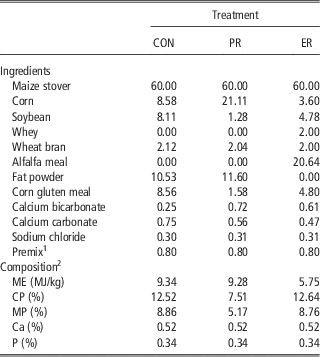
The experimental design and detailed procedures were outlined previously (He et al., Reference He, Wu, Sun, Tan, Qiao, Ran, Tang, Zhou, Han and Wang2013). Briefly, 80 female goats (Liuyang black goat, local breed) of similar age (2.0±0.3 years) and BW (20.0±1.0 kg) before pregnancy (parity 2), were provided by the Liuyang Black Goat Reproduction Centre, Liuyang, Hunan province, China. Synchronized estrus and artificial insemination were applied to ensure a consistent pregnancy date, and the insemination day was considered as gestation day 0. Throughout early (0 to 30 days) and mid-gestation (30 to 90 days), pregnant goats remained on pasture, and each goat received 300 g/day of concentrate. The concentrate (DM basis: 74.0% corn meal, 20.3% soybean meal, 1.3% calcium bicarbonate, 1.6% calcium carbonate, 0.8% sodium chloride and 2% mineral–vitamin premix) contained 11.0 MJ/kg ME and 15.4% CP. Only the pregnant goats carrying one kid (pregnancy examination by ultrasound at 60 days of gestation) were chosen as experimental subjects in this study. At 90 days of gestation, the chosen pregnant goats were housed individually in a barn with an average temperature of 24±1°C, and randomly allocated to one of three dietary treatments (15 pregnant goats per treatment) until parturition. The three dietary treatments consisted of control diet (CON; ME, 9.34 MJ/kg; CP, 12.5%), 40% protein-restricted diet (PR; 60% protein of control diet: ME, 9.28 MJ/kg; CP, 7.5%), and 40% energy-restricted diet (ER; 60% energy of control diet: ME, 5.75 MJ/kg; CP, 12.6%). The control diet was formulated to supply 120% of maintenance requirements of ME and CP according to the feeding standard for Chinese goats (Zhang and Zhang, Reference Zhang and Zhang1998). The ME value of each diet was estimated according to the data of Zhang and Zhang (Reference Zhang and Zhang1998). The ingredients and composition of the three experimental diets are given in Table 1. The amount of diet offered was 1 to 1.1 and 1.1 to 1.2 kg/day per goat during 90 to 120 and 120 to 145 days of gestation, respectively.
Ingredients and composition of the experimental diets fed to pregnant goats in late gestation (dry matter basis)

ME=metabolizable energy; MP=metabolizable protein; CON=control diet; PR=40% protein-restricted diet; ER=40% energy-restricted diet.
1 Contained per kg: 119 g MgSO4 ·H2O, 2.5 g FeSO4 ·7H2O, 0.8 g CuSO4 ·5H2O, 3 g MnSO4 ·H2O, 5 g ZnSO4 ·H2O, 10 mg Na2SeO3, 40 mg KI, 30 mg CoCl2 ·6H2O, 95 000 IU vitamin A, 17 500 IU vitamin D, 18 000 IU vitamin E.
2 CP, Ca and P were determined values; ME was calculated according to the data of Zhang and Zhang (Reference Zhang and Zhang1998) and MP was caluculated according to the data of National Research Council (NRC; 2007).
After birth, kids were ear tagged, weighed and housed together with their mothers to start the 42-day nutritional recovery period, which lasted from birth to weaning day (day 42). During the recovery period, the mothers received the control diet for ad libitum intake, whereas the kids received no supplemental feed other than their mother’s milk. All goats were fed in two equal amounts daily at 0800 and 1800 h, and had free access to water. Feed samples were collected monthly and stored at −20°C. At the end of the trial, monthly samples were composited, oven-dried, and then ground through a 1-mm screen using a Wiley mill (DF-2, Changsha Instrument Factory, Changsha, China). Ground samples were analyzed for DM, CP, Ca and P according to the procedures of Association of Official Analytical Chemists (1995).
Sampling and assays
Blood samples (10 ml) were collected from the jugular vein of pregnant goats on 90, 125 and 145 days of gestation before morning feeding and immediately injected into heparinized tubes. The blood samples were centrifuged at 3000×g for 15 min at 4°C to harvest plasma, and plasma was separated into aliquots and stored at −80°C for subsequent analysis. At week 6 (day 42) of the nutritional recovery period, blood samples from 16 male kids (CON=5, PR=5 and ER=6) were also collected according to the procedures described above. Although there is a significant difference in the way male and female offspring respond to maternal nutritional restriction (Ross and Desai, Reference Ross and Desai2005), we did not examine the female offspring in this study to prevent confounding factors related to hormone profile. Female offspring generated in this study were used in a separate series of experiments.
The plasma concentration of glucose (GLU) and triglycerides (TG) were determined using an Automatic Biochemistry Analyzer (CX4; Beckman Coulter Inc., Brea, CA, USA). The commercial available assay kits were purchased from Beijing Leadman Biochemistry Co. Ltd. (Beijing, China). The nonesterified fatty acids (NEFA) concentration was determined colorimetrically with a UV spectrophotometer (8500II; Thermo Electron Corporation, Rochester, NY, USA). The commercial available assay kits were purchased from Nanjing Jiancheng Bioengineering Institute (Nanjing, Jiangsu, China). The Cor and insulin concentrations were analyzed using commercial available RIA kits (Tianjin Nine Tripods Medical & Bioengineering Co. Ltd., Tianjin, China). The intra- and inter-assay coefficient variations determined NEFA, Cor and insulin according to the above-mentioned procedures were all below 10%.
Thawed blood samples were mixed with the same volume of 6% (w/w) trichloroacetic acid, and centrifuged immediately (4°C, 20 min, 8000×g) to remove precipitated protein. The AA concentrations were then determined by using an Amino Acid Analyzer (L-8800; Hitachi Ltd., Tokyo, Japan) as described by Li et al. (Reference Li, Piao, Jin, Wongpanit and Manabe2009). Briefly, AA concentrations, separated by cation exchange chromatography, were detected spectrophotometrically after postcolumn reaction with ninhydrin reagent.
Statistical analyses
Data were analyzed by the GLM procedure of SAS (SAS Institute Inc., Cary, NC, USA). For data from pregnant goats, the model included the fixed effects of treat (CON, PR and ER), day (90, 125 and 145) and treatment×day. When there was an interaction (P<0.05) between treatment and day, an additional analysis by day was performed to compare the differences among treatments by day. That model included only treatment as a fixed effect. When there was no interaction (P>0.05) between treatment and day, pooled means were compared among treatments using a least significant difference test. For data from kids, the model included the fixed effect of treatment (CON, PR and ER). Differences between group means were tested using the Bonferroni adjustment, and statistical significance was declared at P⩽0.05 with trends discussed at P⩽0.10.
Results
Metabolic profile of pregnant goats
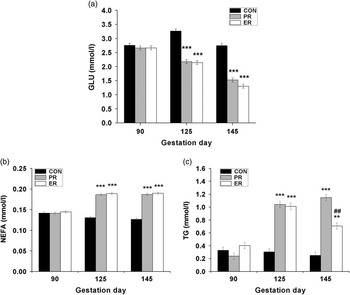
There was an interaction (P<0.01) between dietary treatment and gestation day for GLU, NEFA and TG (Figure 1). Pregnant goats subjected to PR or ER had less (P<0.001) plasma GLU concentration than control goats at 125 and 145 days of gestation (Figure 1a). However, plasma concentrations of NEFA (Figure 1b) and TG (Figure 1c) from PR and ER were greater (P<0.01) compared with those from CON at those days. In addition, plasma TG concentration from ER goats was less (P<0.01) than from PR goats by 145 days of gestation (Figure 1c).
Effect of protein or energy restriction on plasma concentrations of GLU (a), NEFA (b) and TG (c) at 90, 125 and 145 days of gestation in pregnant goats (n=15). CON, control diet; PR, 40% protein-restricted diet; ER, 40% energy-restricted diet; GLU, glucose; NEFA, nonesterified fatty acids; TG, triglyceride. **P<0.01, ***P<0.001, PR and ER compared with CON; ## P<0.01, ER compared with PR. Error bars represent standard error of the mean.

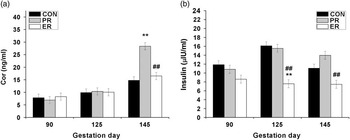
Pregnant goats subjected to PR had greater plasma concentration of Cor (P<0.01) than CON and ER goats by 145 days of gestation (Figure 2a). The plasma Cor concentration from PR goats was almost 1.9 and 1.7 times the concentration from CON and ER, respectively. Plasma insulin concentrations for ER goats were less (P<0.01) than those of CON goats at 125 days of gestation, whereas insulin concentrations of PR goats were not different from CON goats (Figure 2b). There was no difference in plasma insulin concentration between CON and PR or ER at gestation day 145.
Effect of protein or energy restriction on plasma concentrations of Cor (a) and insulin (b) at 90, 125 and 145 days of gestation in pregnant goats (n=15). CON, control diet; PR, 40% protein-restricted diet; ER, 40% energy-restricted diet; Cor, cortisol. **P<0.01, PR and ER compared with CON; ## P<0.01, ER compared with PR. Error bars represent standard error of the mean.

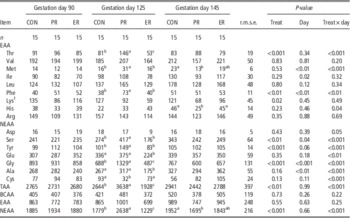
Plasma total AA (TAA) comprised about 30% essential AA (EAA) and 70% nonessential AA (NEAA; Table 2). There was an interaction (P<0.001) between dietary treatment and gestation day for TAA. At 125 days of gestation, maternal PR increased (P<0.05) TAA, whereas maternal ER decreased (P<0.05) TAA. Also at 125 days of gestation, PR goats had greater (P<0.05) plasma NEAA, whereas ER goats had less (P<0.05) plasma NEAA than CON. However, this observation was not sustained at gestation day 145, as plasma NEAA concentration was similar for CON and ER, and less (P<0.05) for PR goats compared with CON goats. There were no effects (P>0.05) of maternal protein or energy restriction for plasma EAA and branched chain AA (BCAA) either at 125 or 145 days of gestation.
Effects of protein or energy restriction and gestation day on plasma amino acid (μmol/l) at 90, 125 and 145 days of gestation in pregnant goats

CON=control diet; PR=40% protein-restricted diet; ER=40% energy-restricted diet; EAA=essential amino acid; NEAA=nonessential amino acid; TAA=total amino acid; BCAA=branched-chain amino acid (Val, Ile and Leu); r.m.s.e.=root mean square error.
a,b,cWithin the same gestation day, means with different superscript letters are significantly different (P<0.05).
1 P<0.01, PR compared with CON (average means 82.4 v. 127.5); P=0.03, ER compared with CON (average means 90.8 v. 127.5).
For plasma AA, there was an interaction (P<0.05) between dietary treatment and gestation day for many of the individual AA (Thr, Met, Phe, His, Asp, Ser, Tyr, Glu, Gly, Ala and Cys; Table 2). Plasma concentrations of Thr and Gly were increased (P<0.05) by PR and decreased by ER at 125 days of gestation, but not affected by treatment on the other days. Plasma Met concentration was increased (P<0.05) by PR at 125 days of gestation, but it was decreased (P<0.05) compared with the CON at 145 days of gestation. Similarly, plasma concentrations of Phe, Ser and Tyr were greater (P<0.05) in PR goats than in CON or ER goats at 125 days of gestation, with no treatment differences at 90 or 145 days of gestation. Plasma Glu and Ala concentrations were less (P<0.05) in ER goats than the other goats at 125 days of gestation, with no treatment differences at 90 or 145 days of gestation. Plasma concentration of Cys was less (P<0.05) in PR goats than in the other goats at 125 days of gestation, but once again there were no treatment differences at 90 or 145 days of gestation. Plasma His was the only AA affected at 145 days of gestation, with less His (P<0.05) for PR goats compared with the other goats. Plasma Lys concentration (μmol/l) was the only AA that was consistently affected by treatment on all sampling days, with less for PR (P=0.009; averaged 82.4) and ER (P=0.031; 90.8) compared with CON (127.5). In contrast, concentrations of Val, Ile, Leu and Arg were not affected (P>0.05) by maternal restriction during the experiment.
Birth weight of kids
Birth weights of PR and ER male kids were less (P<0.05) than that of CON (He et al., Reference He, Wu, Sun, Tan, Qiao, Ran, Tang, Zhou, Han and Wang2013). Comparing with the CON male kids, the PR kids and ER kids weighed 17.2% less (1.5±0.08 v. 1.8±0.08 kg; means±s.e.) and 12.9% less (1.6±0.09 v. 1.8±0.08 kg; means±s.e.), respectively.
Metabolic profile of kids
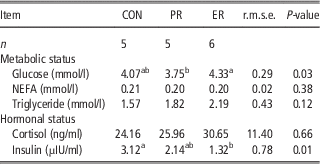
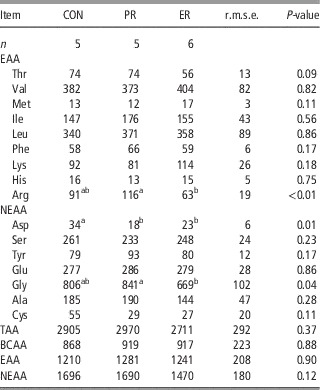
At week 6 postpartum, plasma GLU concentration in PR and ER male kids was similar (P>0.05) to CON; however, ER kids had greater (P<0.05) plasma GLU concentration than PR kids (Table 3). There was no difference (P>0.05) in plasma NEFA concentration among groups. There was no difference (P>0.05) among maternal restricted kids and CON kids for plasma Cor concentration. Plasma insulin was less for ER (P<0.05) than in CON kids, with no difference (P>0.05) between PR and CON kids. After 6 weeks’ nutritional recovery, there were no differences (P>0.05) among treatments for plasma concentrations of total TAA, EAA, NEAA or BCAA (Table 4). Most of the individual AA concentrations were not affected (P>0.05) by maternal dietary treatments, except plasma Arg, Asp and Gly concentrations (P<0.05). For Arg and Gly, treatment differences were between PR and ER kids (P<0.05), but neither differed from CON. For Asp, the concentration was less (P<0.05) in PR and ER kids than in CON.
Effect of maternal protein or energy restriction on metabolic and hormonal status of postnatal male young goats at week 6

CON=control diet; PR=40% protein-restricted diet; ER=40% energy-restricted diet; NEFA=nonesterified fatty acids; r.m.s.e.=root mean square error.
a,bMeans in the same row with different superscript letters are significantly different (P<0.05).
Effect of maternal protein or energy restriction on plasma amino acid (μmol/l) of postnatal male young goats at week 6

CON=control diet; PR=40% protein-restricted diet; ER=40% energy-restricted diet; EAA=essential amino acid; NEAA=nonessential amino acid; TAA=total amino acid; BCAA=branched-chain amino acid (Val, Ile and Leu); r.m.s.e.=root mean square error.
a,bMeans in the same row with different superscript letters are significantly different (P<0.05).
Discussion
Metabolic profile of pregnant goats
So far, the nitrogen and energy demands for the rapidly growing fetus in pregnant Chinese goats have not been well stated. Yet, they were reported to be mainly from placental uptake of AA and GLU in ewes (Husted et al., Reference Husted, Nielsen, Blache and Ingvartsen2008), the theory of which was assumed to be similar in this study because goats and sheep are both small ruminants. Therefore, being similar with the ewes, the resulting increases in maternal nutrient requirements in pregnant goats need to be supplied by increased feed intake and a series of metabolic adaptations, including increased hepatic gluconeogenesis from endogenous substrates and mobilization of fatty acids from adipose tissues (Husted et al., Reference Husted, Nielsen, Blache and Ingvartsen2008). Previously, it was reported that the daily CP intake in PR group and ME intake in ER group were decreased compared with the control group, although there was no difference of DMI among goats fed these three diets (He et al., Reference He, Tan, Sun, Beauchemin, Tang, Zhou, Han, Wang and Wu2012). Thus, the supply of AA or GLU in restricted goats was also considered to be reduced, which could not satisfy the nutrient demands during late gestation and may cause an accelerated metabolic adaptation within the goats.
The decreased plasma GLU concentration of pregnant goats induced by 40% protein or energy restriction during late gestation was consistent with the previous finding using sheep as the animal model (Yuen et al., Reference Yuen, Owens, McFarlane, Symonds, Edwards, Kauter and McMillen2002). GLU is the major energy source in pregnant mothers, not only for maintaining survival of their own tissues and organs, but also for fetal growth. In this study, the less birth weights of PR or ER kids were expected, which suggested retardation of fetal growth. Moreover, brain and heart development are usually considered to have the highest priority for nutrients compared with the other organs for a fetus challenged with an insufficient nutrient during development (Zhu et al., Reference Zhu, Ford, Means, Hess, Nathanielsz and Du2006). Thus, limited GLU supply in nutritional restricted goats would preferentially guarantee the development of fetal vital tissues, and may explain our previous finding that development of the fetal thymus, small intestine and kidney were restrained by maternal restriction using the same diets (He et al., Reference He, Wu, Sun, Tan, Qiao, Ran, Tang, Zhou, Han and Wang2013). The lower GLU concentration in PR or ER goats might be due to less gluconeogenesis, which may have resulted from a lack of propionic acid or AA substrates in the rumen caused by the nutritional restriction.
Research has been done to understand the relationship between nutritional regulation and insulin resistance associated with type II diabetes (Mcmillen and Robinson, Reference Mcmillen and Robinson2005). The most immediate response to restricted energy and protein supply was a reduced concentration of plasma insulin (Yambayamba et al., Reference Yambayamba, Price and Foxcroft1996). As expected, the reduction of insulin concentration caused by ER would improve lipolysis, as an adaptive regulation of lower plasma GLU in ER mothers. Moreover, enhanced lipolysis might partially account for the previous results of reduced ADG (56 v. 109 g/day compared with CON) in ER pregnant goats (He et al., Reference He, Wu, Sun, Tan, Qiao, Ran, Tang, Zhou, Han and Wang2013). However, the lack of difference in plasma insulin concentration between PR and CON indicated that lack of energy induced by ER during late gestation had greater impact than the lack of protein induced by PR. This observation is also reminiscent of our previous finding that PR goats were more effective in coping with nutrient utilization compared with the ER goats fed the same diets (He et al., Reference He, Wu, Sun, Tan, Qiao, Ran, Tang, Zhou, Han and Wang2013). Although no change in plasma insulin concentration occurred in PR goats in the present study, the increased plasma Cor concentration was indicative of a high glucocorticoid environment within the uterus of PR goats. This environment would restrain histological differentiation (Fowden et al., Reference Fowden, Li and Forhead1998) and retard the growth and development of the fetus (Fowden and Forhead, Reference Fowden and Forhead2009).
Plasma concentration of NEFA is correlated to energy balance (Chilliard, Reference Chilliard1993). In the present study, 40% maternal PR or ER increased plasma NEFA concentration, which is consistent with previous report using sheep as the animal model (Sosa et al., Reference Sosa, Abecia, Carriquiry, Forcada, Martin, Palacín and Meikle2009). Corresponding to a high rate of lipolysis in adipose tissue (Celi et al., Reference Celi, Di Trana and Claps2008), the increased plasma NEFA concentration suggested that the restricted goats mobilized body fat reserves in a catabolic state. It was also supported by the goats BW result, which was previously reported (He et al., Reference He, Wu, Sun, Tan, Qiao, Ran, Tang, Zhou, Han and Wang2013) that the PR goats at day 144 of gestation weighed 5.4% less (26.3 v. 27.8 kg), whereas ER goats weighed 10.8% less (24.8 v. 27.8 kg) than CON goats, respectively. Considering a higher NEFA concentration would help restrain the use of GLU to synthesize glycogen and fat, the elevated plasma NEFA, similar to lower insulin concentration or higher Cor or TG concentration, observed in the nutritional restricted mothers could be interpreted as an adjustment necessary to meet their energy demands. However, it should be noted that enhanced NEFA concentration in pregnant mothers would be accompanied by reduced utero-placental oxygen uptake (Chandler et al., Reference Chandler, Leury, Bird and Bell1985), resulting in increased production of placental reactive oxidation species. Consequently, lipid oxidation for uterine placenta was enhanced, which may have a negative impact on fetal development. Moreover, in the present study, it was surprising that PR goats had an increased NEFA, which may reflect increased lipolysis, but with no change of plasma insulin concentration. These results suggested that insulin abundance may not be the main driver of lipolysis in PR pregnant goats.
AAs are critical for embryonic and fetal development (Angiolini et al., Reference Angiolini, Fowden, Coan, Sandovici, Smith, Dean, Burton, Tycko, Reik and Sibley2006). In addition to GLU (30% to 40%) and acetic acid (5% to 10%), it has been proposed that AA supply a substantial proportion (55%) of the energy demands of fetal growth during late pregnancy in ruminants (Bell et al., Reference Bell, Forbes and France1993). Although maternal AA concentrations appear to be less important than placental transport of AA for fetal growth (Bajoria et al., Reference Bajoria, Sooranna, Ward, D’Souza and Hancock2001), these plasma AA concentrations may provide information regarding potential mechanisms responsible for fetal programming in mammals (Kwon et al., Reference Kwon, Ford, Bazer, Spencer, Nathanielsz, Nijland, Hess and Wu2004; Jobgen et al., Reference Jobgen, Ford, Jobgen, Feng, Hess, Nathanielsz, Li and Wu2008; Metzler-Zebeli et al., Reference Metzler-Zebeli, Lang, Görs, Brüssow, Hennig, Nürnberg, Rehfeldt, Otten and Metges2012). In the present study, TAA concentration in plasma from PR goats was increased, whereas that in ER goats was decreased at 125 days of gestation, indicating the pathway of protein and AA metabolism under the condition of low protein supply may be different from that under the condition of low energy supply. Yet, the exact mechanisms still remain unclear and need to be further addressed. It was interesting that the changes of TAA in restricted goats were achieved by NEAA changes, with no change of EAA in goats fed neither PR nor ER. Previous study in rats showed that the concentrations of EAA and BCAA in plasma were reduced in low-protein dams compared with control dams (Bhasin et al., Reference Bhasin, van Nas, Martin, Davis, Devaskar and Lusis2009). The lack of reduction on EAA concentration in our study was complex and likely involved the synthesis of AA by ruminal microbes. In ruminants, ruminal fermentation results in the production of microbial protein, which is supplied to the small intestine and delivers a good quality protein consisting of both EAA and NEAA. Our results indicated that NEAA had lower priority than EAA for synthesis during an imposed challenge of nutrient deficiency.
It must be noted that although the concentration of total EAA was unaffected by nutritional restriction, four individual EAAs (Thr, Met, Phe and Lys) were influenced by nutritional manipulation. Because Lys or Met are usually the first-limiting AA for ruminants (Fenderson and Bergen, Reference Fenderson and Bergen1975), the changes induced by PR or ER may directly influence the growth and development of goats. Moreover, the present study observed unchanged BCAA and Arg concentration among CON and restricted goats, which was in contrast with previous reports in sheep (Kwon et al., Reference Kwon, Ford, Bazer, Spencer, Nathanielsz, Nijland, Hess and Wu2004; Jobgen et al., Reference Jobgen, Ford, Jobgen, Feng, Hess, Nathanielsz, Li and Wu2008). Those studies reported that the concentrations of BCAA and Arg-family AAs were consistently decreased in underfed ewes at early or mid-gestation. It was suggested that variation of AA and protein metabolic responses to malnutrition may depend on the animal species (non-ruminants and ruminants), as well as the physiological state of animals when the restriction is imposed (i.e. gestation), the duration and extent of the restriction, and the type of nutrient restriction.
Metabolic profile of kids
Our results showed there was minimal difference in metabolic and hormonal profiles between maternal PR and CON kids after 6 weeks of nutritional recovery. For maternal ER kids, plasma concentrations of most metabolic and hormonal indices were similar with those in CON kids, except the decreased plasma insulin. These changes suggested a potential effect of maternal nutritional restriction on metabolic status of their offspring during the period of lactation. It was also suggested that the adverse effect of maternal ER was more severe than the effects of PR deficiency on the metabolic profile of kids, and the consequences of these effects are unknown.
This study is the first report of postnatal changes in plasma concentrations of AA in response to precisely controlled maternal PR or ER. Although maternal and fetal AA concentrations in restricted mothers have been documented (Kwon et al., Reference Kwon, Ford, Bazer, Spencer, Nathanielsz, Nijland, Hess and Wu2004; Bhasin et al., Reference Bhasin, van Nas, Martin, Davis, Devaskar and Lusis2009; Metzler-Zebeli et al., Reference Metzler-Zebeli, Lang, Görs, Brüssow, Hennig, Nürnberg, Rehfeldt, Otten and Metges2012), it has not been previously shown in any species that these changes affect the offspring. The current study showed most AA concentrations, including all the EAA, were similar with those of CON kids after 6 weeks’ nutritional recovery, except the concentration of Asp. It follows that EAA had a higher priority than NEAA as mentioned above. AA, especially EAA, play a vital role in the development and growth of kids before weaning, as building blocks for tissue protein synthesis, regulators of hormone secretion, major fuels for growth and cell signaling molecules (Flynn et al., Reference Flynn, Meininger, Haynes and Wu2002). The recovered EAA metabolic conditions aligned with the observed phenomenon of ‘compensatory growth’ for kids from restricted goats previously reported by He et al. (Reference He, Wu, Sun, Tan, Qiao, Ran, Tang, Zhou, Han and Wang2013).
However, given the differences in the way male and female offspring respond to maternal nutritional restriction (Ross and Desai, Reference Ross and Desai2005), it should be noted that our study only evaluated the effects of maternal nutritional restriction on hormonal and metabolic status of male offspring. The effects of maternal nutritional restriction on female offspring are required to be verified in further experiments.
Conclusion
Our results demonstrated that nutritional restriction during late gestation changed maternal hormonal and metabolic status of pregnant goats. Plasma GLU concentration was severely reduced in maternal PR or ER goats during the whole restriction period. On the contrary, plasma concentration of NEFA was increased in PR and ER mothers. Because of the reduced plasma insulin concentration in ER mothers and decreased plasma insulin concentration in ER kids, it appeared the effects of maternal ER were more severe than the effects of PR on the nutrient unavailability in both maternal and postnatal goats. Moreover, TAA concentration in PR goats was increased but decreased in ER goats at 125 days of gestation and the plasma TAA concentration change was achieved by plasma NEAA rather than plasma EAA. The study showed that after 6 weeks of nutritional recovery, maternal nutritional restriction did not alter most hormonal and metabolic parameters in postnatal kids, except reduced insulin (in ER) and reduced Asp (in PR and ER). The adaptive metabolic changes in the restricted mothers may be associated with the fetal programming induced by maternal nutritional restriction. These results could help to understand the information regarding potential hormonal and metabolic mechanisms responsible for fetal programming.
Acknowledgments
The present study was financially supported by the National Natural Science Foundation of China (Grant No. 31001023, 31201826, 31320103917), ‘Strategic Priority Research Program – Climate Change: Carbon Budget and Relevant Issues’ of Chinese Academy of Sciences (Grant No. XDA05020700), ‘K.C. Wong Education Foundation of CAS’ and CAS Visiting Professorship for Senior International Scientists (Grant No. 2010T2S13). The authors thank the barn staff at Liuyang Black Goat Reproduction Centre (Liuyang, Hunan, China) for their continuous help with the care of the animals.