INTRODUCTION
Diversity patterns are essential to understand the organization and functioning of organisms present in an ecosystem and their interaction with the environment (Duarte, Reference Duarte2000); this is true also in tropical coastal ecosystems, comprising links between organisms and their habitat, and also among different habitats (e.g. coral reefs, sea grass beds and mangroves). Sea grass meadows provide a complex habitat for the associated organisms, it is the basis of a complex ecosystem that is vulnerable to disturbances both natural and man-made (De Troch et al., Reference De Troch, Fiers and Vincx2001a; Gray, Reference Gray2004; Snelgrove et al., Reference Snelgrove1997).
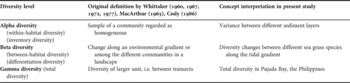
The continuum of spatial scales is divided into the following hierachical levels of biodiversity: alpha, beta and gamma diversity (Whittaker, Reference Whittaker1972; Magurran, Reference Magurran1988; Ricklefs & Schluter, Reference Ricklefs and Schluter1993). Diversity will allow ecologists to describe quantitative changes in species composition and abundances across environmental continua (Whittaker, Reference Whittaker1960, Reference Whittaker1972, Reference Whittaker1975, Reference Whittaker and M.H.1977), e.g. horizontally (between different sea grass species in the tidal zone) and vertically (between sediment layers).
The marine meiofauna (metazoans that pass through a 1 mm sieve but are retained on a 38 µm sieve) and specially harpacticoid copepods, represent an important link between primary producers and higher trophic levels (Sogard, Reference Sogard1984; Fujiwara & Highsmith, Reference Fujiwara and Highsmith1997; Sutherland et al., Reference Sutherland, Shepherd and Elner2000). In view of this crucial functional role and their high densities in detritus rich ecosystems, e.g. in sea grass beds (Bell et al., Reference Bell, Hicks and Walters1988; Bell & Hicks, Reference Bell and Hicks1991; De Troch et al., Reference De Troch, Fiers and Vincx2001a, b; Nakamura & Sano, Reference Nakamura and Sano2005) several studies tried to unravel different aspects of their ecology, such as species diversity changes within and between habitats in tropical sea grass beds (e.g. De Troch et al., Reference De Troch, Fiers and Vincx2001a), response to small-scale natural disturbance (e.g. Thistle, Reference Thistle1980), feeding behaviour (e.g. De Troch et al., Reference De Troch, Vandepitte, Raes, Suàrez-Morales and Vincx2005; Gerlach, Reference Gerlach1978), reproductive characteristics (e.g. Bell et al., Reference Bell, Hicks and Walters1988), niche segregation behaviour (e.g. De Troch et al., Reference De Troch, Fiers and Vincx2003) and colonization and recruitment of copepods in sea grass mimics (e.g. Bell & Hicks, Reference Bell and Hicks1991; Walters & Bell, Reference Walters and Bell1994; De Troch et al., Reference De Troch, Steinarsdóttir, Chepurnov and Ólafsson2005).
Studies on the ecology of harpacticoid copepods in tropical sea grass beds are scarce and restricted to certain regions (e.g. Lakshadweep Atolls of Arabian Sea, Ansari & Parulekar, Reference Ansari and Parulekar1994; Caribbean part of Mexico, Kenyan coast, Zanzibar, De Troch et al., Reference De Troch, Gurdebeke, Fiers and Vincx2001b). Particularly, the Philippines deserve some research effort because it is recognized as an epicentre of biodiversity and evolution (e.g. Carpenter & Springer, Reference Carpenter and Springer2005). Recent papers have described new species of Copepoda (Suárez-Morales, Reference Suárez-Morales2000; Walter et al., Reference Walter, Ohtsuka and Castillo2006) but the benthic meiofauna remains unstudied. In this survey we determine and analyse the spatial levels of biodiversity of harpacticoid copepods within the sea grass bed areas at Pujada Bay, the Philippines.
MATERIALS AND METHODS
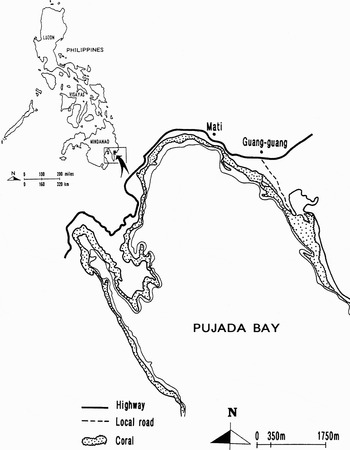
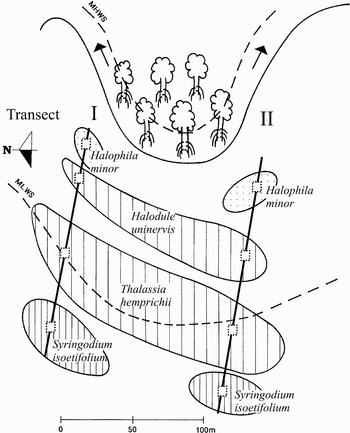
Meiofauna samples were collected in May and June 1998 in the sea grass beds near Guang-Guang in Pujada Bay (66°56′N 126°15′–17′E), located at the south-eastern part of the Philippines, on the island of Mindanao (Figure 1). Two transect lines were laid perpendicular to the beach, starting from the lowest pneumatophores of the nearby mangroves down to the subtidal zone and, thus, crossing several meadows of different sea grass species (Figure 2). Both transects were separated approximately 100 m from each other. A total of eight 5 × 5 m quadrats (area of 25 m2) were positioned along the transect lines in beds of the different sea grass species: Halophila minor, Halodule uninervis, Thalassia hemprichii and Syringodium isoetifolium (Figure 2). In each quadrat, triplicate meiofauna samples were collected in bare sediment spots adjacent to the sea grass species using polyvinyl chloride (PVC) sediment cores with an inner diameter of 3.6 cm (area of 10 cm2). This was done by snorkelling within a time range of two hours before to two hours after low tide in an average water depth of 1 to 1.5 m. Subsequently, meiocores were vertically subdivided into different depth layers using a standard Hagge corer (Fleeger et al., Reference Fleeger, Thistle, Thiel, Higgins and Thiel1988): 0–1 cm, 1–2 cm, 2–3 cm, 3–4 cm, 4–5 cm and 5–10 cm. Samples were preserved in 4% buffered formalin. In addition, two samples for nutrient and sediment analysis were taken from each quadrat in between the sea grass plants using a core with an inner diameter of 6.2 cm. These were subdivided into the same six depth layers and stored frozen for further analysis. For chlorophyll-a (chl-a) analysis, triplicate sediment samples (~1 ml) were taken within each quadrat using a syringe with the lower end cut off, and were subdivided into the same depth layers.
Map of the Philippines with indication of the sampling site in Pujada Bay.

The sampling strategy scheme applied in the sampling site.

In the laboratory, the meiofauna samples were gradually rinsed with fresh water, decanted (10×) over a 38 µm sieve, centrifuged three times with Ludox HS40 (specific density 1.18), stained with rose Bengal and identified to higher taxon level based on Higgins & Thiel (Reference Higgins and Thiel1988) using a Wild M5 binocular. Harpacticoid copepods were counted, picked out per hundred (as they were encountered during counting) and stored in 75% ethanol. Harpacticoid copepods were identified to genus level using the identification keys and reference books by Boxshall & Hasley (Reference Boxshall and Hasley2004) and Lang (Reference Lang1948, Reference Lang1965) and original genus and species descriptions. Identification of harpacticoid copepods were only restricted to the adult stage.
Sediment samples were thawed and the analyses for NO2, NO3, NH4, PO4 and SiO2 content were performed using an AII automatic chain (SANplus Segmented Flow Analyser, SKALAR). Part of the remaining sediment samples were dried at 110°C for four hours. These were used for analysis of total organic matter (% TOM), measured as weight loss after combustion at 550°C for two hours. Sediment grain size was analysed with a particle size analyser (type Coulter® LS100) on gram-aliquots dried at 60°C for twenty-four hours. Sediment characteristics obtained were median grain size, silt (<63 µm) content (%), coarse sand (850–2000 µm) content (%) and gravel (>2000 µm) content%). Pigments were extracted with 90% acetone at 4°C in the dark and separated by reverse phase liquid chromatography on a Gilson C-18 high performance liquid chromatography-chain (spectrophotometric and fluorometric detection) according to the modified protocol of Mantoura & Llewellyn (Reference Mantoura and Llewellyn1983).
Hill's (Hill, Reference Hill1973) diversity indices were used to calculate alpha diversity (see definition in Table 1) using the PRIMER 5 software (version 5.2.8): N0 = number of genera; N1= exp (H′), with H′the Shannon–Wiener diversity index based on the natural logarithm (ln).
Definitions and interpretations of different spatial levels of biodiversity.

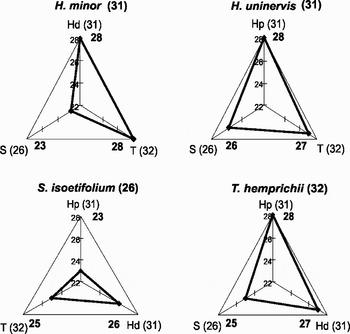
Beta diversity of harpacticoid copepods (see definition in Table 1) represents the range of species turnover along the transect line or gradient. This is measured by the number of harpacticoid genera shared between two sea grass species and all other species of sea grass based on the arbitrarily defined spatial units/intersite distance: 1 unit for the nearest neighbour, 2 units for the second nearest neighbour and so on (see De Troch et al., Reference De Troch, Fiers and Vincx2001a). The results were then plotted in a radar chart. The graphical presentation of the radar charts allows an interpretation of the relation between intersite distance and number of genera shared as the surface of the radar chart is an indirect measure for the specificity of the copepod community associated with a particular sea grass species (De Troch et al., Reference De Troch, Fiers and Vincx2001a).
Gamma diversity (see definition in Table 1) was analysed based on additive partitioning of the spatial levels of diversity using PARTITION software (true basic edition) (Crist et al., Reference Crist, Veech, Gering and Summerville2003).
Community structure was analysed through non-metric multidimensional scaling (MDS) analyses using the Bray–Curtis similarity index (data were fourth-root transformed prior to analysis) (PRIMER 5 (version 5.2.8)) and canonical correspondence analysis (CCA ordination) (CANOCO (version 4.5)). Relative abundance was expressed as percentages.
RESULTS
Meiofauna in sea grass beds of Pujada Bay
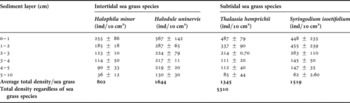
The average total meiofauna density obtained in the sea grass beds of Pujada Bay was 5310 ind/10 cm2 (Table 2). A decreasing pattern of meiofauna densities was observed from the top sediment layers towards the deeper layers (Table 2). Likewise, fluctuating meiofauna total densities in each sea grass species were observed from the intertidal to the subtidal zone (Figure 2). Meiofauna assemblages in the intertidal pioneering sea grass species (H. minor and H. uninervis) showed to be similar and formed one community, whereas the subtidal sea grass species (T. hemprichii and S. isoetifolium) formed a different community (MDS not shown).
Average total density of meiofauna (ind/10 cm2) between sediment layers and between sea grass species in Pujada Bay, the Philippines. Mean ± standard error.

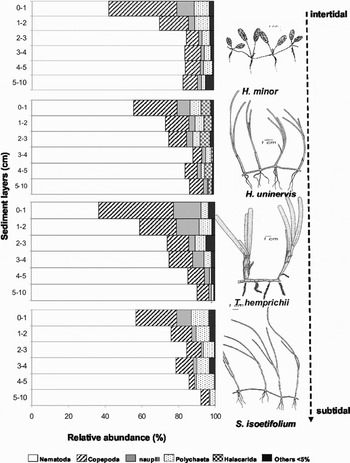
The main meiofaunal groups (>5%) encountered in the adjacent sediments of the sea grass species were Nematoda, Copepoda, nauplii and Polychaeta based on relative composition (Figure 3). Nematodes showed the highest relative abundance (37.0–92.0%) in all sea grass samples and in all sediment layers followed by copepods (3.0–40.6%), nauplii (0.3–15.3%), and polychaetes (0.5–10%). The meiofaunal assemblage associated with H. minor in the high intertidal area was nearly homogeneous throughout the sediment layers (below 1–2 cm depth). The relative abundance of Halacarida (0.8–5.5%) was found to be high only in the sediment adjacent to H. uninervis. Along the vertical sediment profile near T. hemprichii, aside from the high relative abundance of nematodes (36.8–90.5%) and copepods (40.6–6.0%), a remarkably high relative abundance of nauplii (15.3–1.4%) was observed. In the adjacent sediment layer of S. isoetifolium, relative abundance of nematodes showed no distinct pattern, yet, it still reached high percentages. In addition, relatively high abundances of polychaetes (3.0–10.0%) were observed near S. isoetifolium (Figure 3).
Average relative abundance (%) of meiofauna in sediment layers adjacent to the different sea grass species. Meiofauna groups with a relative abundance of >5% were shown while taxa with <5% of relative abundance were grouped as ‘others’.

Harpacticoid copepod composition and community structure
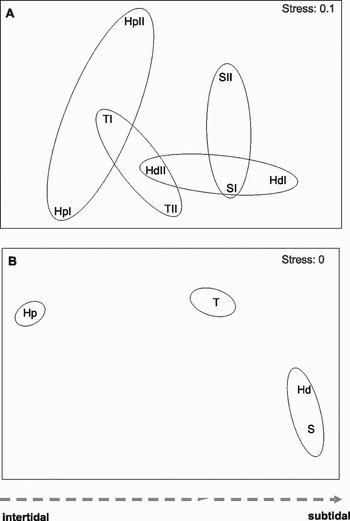
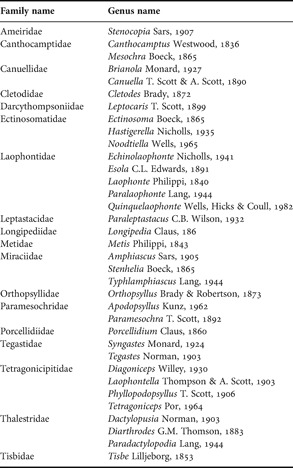
In total, 35 harpacticoid genera belonging to 18 families were identified in the sediments adjacent to the different sea grass species beds (Table 3). A non-metric multidimensional scaling (MDS, Bray–Curtis similarity index) based on the fourth root-transformed relative abundances/transect data showed no clear correspondence between copepod communities and sea grass zonation (Figure 4A). In this MDS plot, the large distance between the H. minor samples illustrates the high variance between both transects in the high intertidal zone (Figure 4A). Although the harpacticoid copepod assemblages observed for each transect per se showed indistinct assemblages along the tidal gradient, the pooled results of harpacticoid copepod assemblages (Figure 4B) followed the growth forms of sea grasses; secondary pioneer sea grasses (H. uninervis and S. isoetifolium) were more similar to each other than to the primary pioneer sea grass (H. minor) and the climax sea grass species (T. hemprichii).
Multidimensional scaling of harpacticoid benthic copepods of the different sea grass samples in (A) both transects and (B) for pooled data, based on the Bray–Curtis similarities. Data were 4th root transformed prior to analysis. Sea grass species: Hp, Halophila minor; Hd, Halodule uninervis; S, Syringodium isoetifolium; T, Thalassia hemprichii. Transects: I, Transect 1, II; Transect 2.

Harpacticoid copepod families and genera, found in Pujada Bay, the Philippines.

High intertidal pioneer association: Halophila minor
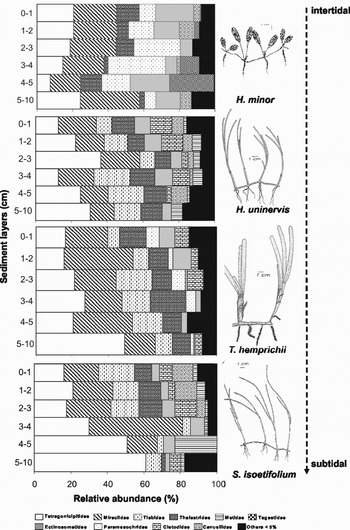
In the H. minor samples, Miraciidae, Tetragonicipitidae, Paramesochridae and Ectinosomatidae were the most abundant families along the sediment profile (Figure 5). The relative abundance of the family Tetragonicipitidae (7.5–24.5%) showed a decreasing pattern with increasing depth, except in the deepest layer. The relative abundance of the family Miraciidae changed only slightly (16.8–33.1%). Higher variance of the relative abundance of the families Paramesochridae (6.5–32.2%) and Ectinosomatidae (6.5–22.2%), and low relative abundances of Thalestridae (2.4–12.6%) were observed in the different layers. Representatives of the family Tegastidae were found in relatively high abundances in the deeper sediment layers (3 to 5 cm depth). The family Tisbidae was present in some sediment layers, but occurred in very low abundances (<5%).
Vertical distribution of harpacticoid copepods in the sediment layers: relative abundances for the four sea grass communities.

High intertidal secondary pioneer association: Halodule uninervis
The H. uninervis zone was situated in the higher intertidal area next to H. minor (Figure 2). An increase in relative abundance of Tetragonicipitidae was observed from 0–1 cm to 2–3 cm depth into the sediment (12.7–36.7%) and from 3–4 cm to 5–10 cm depth into the sediment (12.7–0.4%) (Figure 5). Relative abundance of Miraciidae varied in the upper sediment layers of 0–3 cm depth and decreased towards 5–10 cm depth. Likewise, the relative abundances of Tisbidae (8.3–20.2%) and Ectinosomatidae (10.0–10.6%) showed variation along the sediment profile. Cletodidae (2.6–12.2%) and Canuellidae (1.7–8.9%) were not present in the deepest layer (5–10 cm). The family Metidae was present in all sediment layers but with low relative abundances (1.4–6.3%).
Subtidal climax association: Thalassia hemprichii
The harpacticoid copepods occurring near T. hemprichii did not show a distinct vertical change in relative abundance with increasing sediment depth (Figure 5). The families Tetragonicipitidae (15.4–49.0%) and Miraciidae (17.0–38.4%) were relatively abundant in all sediment layers. The other harpacticoid copepod families occurred with lower relative abundances (0.6–20.2%) in the different sediment layers. The family Cletodidae was absent in certain sediment layers.
High subtidal secondary pioneer association: Syringodium isoetifolium
In the adjacent sediments of S. isoetifolium, the family Tetragonicipitidae was relatively abundant in all sediment layers (Figure 5). Representatives of the families Miraciidae and Tisbidae were of second importance but more variance was recorded in these families in comparison to the other sea grass associations. The family Thalestridae was recorded in four sediment layers (2.4–12.6%) but was absent in the sediment layer of 3 to 5 cm depth into the sediment. The families Ectinosomatidae (2.4–7.7%) and Cletodidae (1.8–12.1%) occurred in very low relative abundances along the sediment profile. Low relative abundances of the family Metidae were observed between sediment layers, except at depths 4–5 cm, where higher abundance (23.0%) was noted. In addition, the family Canuellidae (4.7–11.7%) was barely encountered in the different sediment layers.
Environmental factors
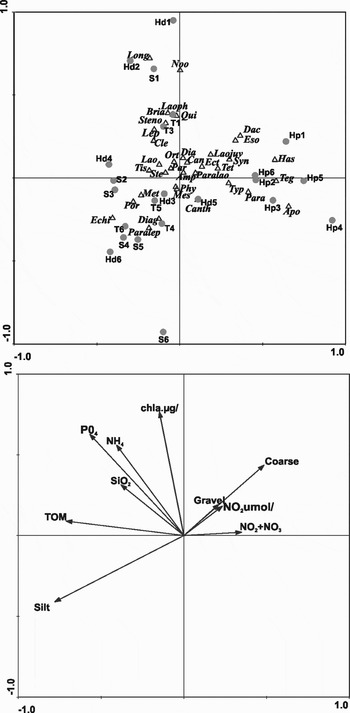
Based on the CCA analysis (Figure 6), the left side of the CCA ordination plot was largely influenced by silty sediments in the bottom sediment layers of H. uninervis, S. isoetifolium and T. hemprichii (Figure 6). Moreover, the upper sediment layers of these three sea grass stands were also characterized by % TOM, PO4, chl-a, NH4 and SiO2. The right side of the ordination plot was mainly characterized by coarse sand, gravel and nitrate concentration. These factors were associated with higher pigment contents which were mostly observed at the surface sediment layers. The sediment where the high intertidal pioneer sea grass species (H. minor and H. uninervis) grow were characterized mostly by coarser sand and gravel sediments. The adjacent sediments of the subtidal sea grass species consisted of a mixture of coarse sand and gravel in the upper sediment layers and silt in the bottom layers. High silt content governed the copepod communities in the deeper sediment layers, especially in the S. isoetifolium sediments (average silt content: 43.9 ± 0.6%). Harpacticoid genera with a higher affinity for silty sediments were Echinolaophonte, Paraleptastacus, Diagoniceps, Leptocaris and Mesochra, which were commonly found in the deeper sediment layers of H. uninervis, S. isoetifolium and T. hemprichii. While harpacticoid genera such as Dactylopodia, Esola, Hastigerella, Syngastes, Tegastes and Apodopsyllus were mostly found in the coarse sand sediments of H. minor.
Canonical correspondence analysis ordination plot of harpacticoid copepods relative abundance data and environmental variables. Symbols: Δ, harpacticoid copepods;•, sea grass species and their corresponding sediment depth. The arrows indicate the environmental variables. Sea grass species: Hp, H. minor; Hd, H. uninervis; S, S. isoetifolium; T, T. hemprichii. Sediment depth: 1 = 0–1 cm, 2 = 1–2 cm, 3 = 2–3 cm, 4 = 3–4 cm, 5 = 4–5 cm, 6 = 5–10 cm. Harpacticoid copepods genera: Long, Longipedia; Bria, Brianola; Can, Canuella; Ect, Ectinosoma; Has, Hastigerella; Noo, Noodtiella; Tis, Tisbe; Dia, Diarthrodes; Par, Paradactylopodia; Dac, Dactylopodia; Ste, Stenhelia; Amp, Amphiascus; Typ, Typhlamphiascus; Met, Metis; Para, Paramesochra; Apo, Apodopsyllus; Phy, Phyllopodopsyllus; Lao, Laophontella; Tet, Tetragoniceps; Dia, Diagoniceps; Mes, Mesochra; Cantho, Canthocamptus; Cle, Cletodes; Echi, Echinolaophonte; Paralao, Paralaophonte; Laoph, Laophonte; Qui, Quinquenlaophonte; Orth, Orthopsyllus; Teg, Tegastes; Syn, Syngastes; Lep, Leptocaris; Paralep, Paraleptastacus; Steno, Stenocopia; Por, Porcellidium. Environmental variables: nutrients (NO2 + NO3, NO2, NH4, PO4, SiO2); pigments (chlorophyll-a); total organic matter; and sediment characteristics (% gravel, % coarse sand, % silt).

Alpha diversity: variance of diversity between sediment layers
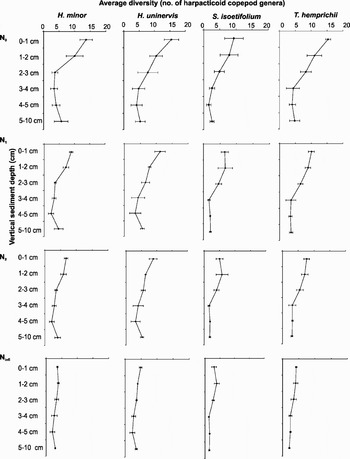
Diversity within sediment layers was checked with k-dominance curves (Lambshead et al., Reference Lambshead, Platt and Shaw1983) since these are less sensitive to differences in sample size (see De Troch et al., Reference De Troch, Fiers and Vincx2001a). The k-dominance curves (graphs not shown) revealed the highest diversity in the surface sediment layer. Likewise, Hill's diversity indices showed a high diversity at the upper sediment (0 to 3 cm) layers, as shown by N0 (3.7–15.5) and N1 (3.7–11.2). In general, average harpacticoid diversity (N1) decreased with increasing sediment depth (Figure 7). However, a slight increase of diversity in the deeper layers of sediments was observed in the intertidal zone (H. minor and H. uninervis) while in the subtidal zone (T. hemprichii and S. isoetifolium), a distinctly decreasing diversity with sediment depth was observed (Figure 7).
Average harpacticoid diversity within the different sediment layers, as shown by Hill's indices (N0, N1). N0 indicates the number of genera, N1 denotes the harpacticoid copepod diversity.

Beta diversity: harpacticoid diversity changes between sea grass species
A change in harpacticoid diversity between sea grass species or along the tidal gradient was observed. The richness and diversity of harpacticoid copepods in the adjacent sediments of H. uninervis and T. hemprichii showed higher values in comparison to the other sea grasses (Figure 7). Additionally, the calculated number of shared copepod genera between the different sea grass species (based on the arbitrarily defined spatial units, see De Troch et al., Reference De Troch, Fiers and Vincx2001a) was plotted in a radar graph (Figure 8). The radar graph of H. uninervis shows a relatively larger surface which indicates a high number of shared genera with the adjacent sea grass species (Figure 8). The adjacent sediments of S. isoetifolium (located in the subtidal area and distant to other sea grass species) showed a low number of shared harpacticoid genera. There were more shared genera between the adjacent sediments of H. uninervis and T. hemprichii. In addition, a higher number of shared harpacticoid genera were also observed between the adjacent sediments of H. minor and its neighbouring sea grass species (Figure 8).
Radar charts depicting the number of copepod genera shared between each sea grass species and all other sea grass species. The total number of copepod genera in the sediment adjacent to each sea grass species is indicated in parentheses. Sea grass species: Hp, Halophila minor; Hd, Halodule uninervis; S, Syringodium isoetifolium; T, Thalassia hemprichii.

Gamma diversity: total diversity of harpacticoid copepods in Pujada Bay
Additive partitioning of total diversity showed that alpha diversity (between sediment layers) was an important contributor for total genus richness (N0: 80.6%) in Pujada Bay (Figure 9). On the other hand, beta diversity (β1-diversity: 14.6%, β2-diversity: 4.9%) showed low contribution to total harpacticoid diversity. Furthermore, when abundance data are taken into account (with H′), the alpha diversity gained an importance (94.7%) whereas beta diversity (β1-diversity: 5.1% and β2-diversity: 0.2%) contributed less.
Additive partitioning of gamma diversity of harpacticoid copepod genera for the number of genera (No) and Shannon–Wiener diversity H′. α-diversity refers to the harpacticoid composition and diversity in the different vertical sediment layers. β1-diversity is the proportion of β-diversity due to the differences between sea grass species; β2-diversity is the proportion of β-diversity due to the differences between transects.

DISCUSSION
In the present study, the total meiofauna density is closer to the highest extreme abundance of the reported ranges of 457 to 8478 ind/10 cm2 in tropical sea grass beds (Decho et al., Reference Decho, Hummon and Fleeger1985; Ansari & Parulekar, Reference Ansari and Parulekar1994; Aryuthaka & Kikuchi, Reference Aryuthaka and Kikuchi1996; Ndaro & Ólafsson, Reference Ndaro and Ólafsson1999; De Troch et al., Reference De Troch, Fiers and Vincx2001a, b). Differences in meiofauna density and diversity patterns between regions (Kenya, Mexico and the Philippines) are mainly due to local processes (e.g. tidal regimes and input of organic matter) (De Troch et al., Reference De Troch, Van Gansbeke and Vincx2006). The meiofauna communities observed along the tidal gradient differ in sediment grain size, organic matter content and sea grass succession (Hulings & Gray, Reference Hulings and Gray1976; Ansari et al., Reference Ansari, Rivonker, Ramani and Parulekar1991; De Troch et al., Reference De Troch, Gurdebeke, Fiers and Vincx2001b). Furthermore, Da Rocha et al. (Reference Da Rocha, Venekey, Bezerra and Souza2006) found different nematofauna assemblages in macrophytes and adjacent sediments. The homogeneous distribution of the meiofauna observed in the lower layers of the adjacent sediment of the small pioneer sea grass plant, H. minor, could be explained by its position in the high intertidal zone where it is mostly affected by local disturbance (e.g. tidal currents and desiccation). However, a higher relative abundance of harpacticoid copepods was observed at the surface sediment layers of H. minor. According to Coull (Reference Coull1999), coarse sand sediments are dominated by copepods and to a lesser extent by nematodes. The leaves of H. minor overlap during low tide in order to minimize water loss (Björk et al., Reference Björk, Uku, Weil and Beer1999), thus, protecting both the associated fauna and the underlying sediment from desiccation. The climax subtidal sea grass T. hemprichii is known to store a significant amount of carbon and TOM in the sediments which represents an available food source and habitat (Duarte, Reference Duarte2000). This would explain the relatively high abundance of meiofauna in these sediments.
Among the meiofauna groups, the Nematoda, exhibited the highest relative abundance in the different sediment layers and sea grass species along the tidal gradient, followed by the harpacticoids. Their resilience to withstand perturbations (Guerrini et al., Reference Guerrini, Colangelo and Ceccherelli1998) and their tolerance to low oxygen content (Steyaert et al., Reference Steyaert, Moodley, Vanaverbeke, Vandewiele and Vincx2005) in deeper sediment layers explain their dominance in the sediment layers examined. The rest of the meiofauna groups occurred in low relative abundances (e.g. nauplii, Polychaeta, Halacarida, Tardigrada and Ostracoda) and were mostly limited to the oxygenated, upper sediment layers. Nauplii (crustacean larvae) and cnidarians were slightly abundant in the subtidal zone, where pigments, nutrients and TOM contents were high.
Harpacticoid copepods community structure
Tidal gradient
Harpacticoids constituted approximately 13% of the total meiofauna in sea grass beds in Pujada Bay. There was no clear assemblage structure per transect in the adjacent sediments of the different sea grass species (Figure 4). This indistinct pattern could be due to the emergence of harpacticoid copepods, since sampling was done at shallow depths (at most 1.5 m). Differences in the assemblage structure of copepods in the H. minor plots might be related to the position of this sea grass at the highest intertidal fringe, clearly exposed to physical and chemical disturbances. Moreover, the generic distribution of harpacticoids corresponded to the different sea grass species surveyed: H. minor, H. uninervis, T. hemprichii and S. isoetifolium.
Vertical gradient
Harpacticoid abundance and diversity was highest at the top sediment layers; both were progressively lower at deeper sediment strata (Figures 6 & 7). The slight increase of diversity related to the bottom sediment layer of the intertidal sea grass species (H. minor and H. uninervis) could be explained by the larger grain size of the sediment (e.g. coarse sand), which is known to enhance water pore permeability and habitat complexity of microbial flora (Ravenel & Thistle, Reference Ravenel and Thistle1981). This feature implies an advantageous effect for the meiobenthic fauna.
The diversity decrease at increasing sediment depths along the subtidal sea grass species (T. hemprichii and S. isoetifolium) might be caused by the silty, low permeability sediments, with lower nutrient availability. The variation of the physical properties in the sediment (Jansson, Reference Jansson1966; Gray, Reference Gray1968; McLachlan et al., Reference McLachlan, Winter and Botha1977) and the unequal distribution of food items (Joint et al., Reference Joint, Gee and Warwick1982) affect the vertical distribution of meiobenthic animals. Altogether, the granulometric characteristics of the sediment and food availability were important structuring the vertical distribution of the harpacticoid communities.
Harpacticoid copepods diversity and distribution
Alpha diversity
Members of the families Tetragonicipitidae and Miraciidae were widely dominant, they occurred in all sediment layers of all sea grass species. Representatives of these families have cylindrical, slender, or fusiform body shapes that favour burrowing, even in the deepest silty sediments of the deeper layers. The same is true for the generalist torpedo-shaped body of the family Ectinosomatidae which is well-adapted to burrowing (Hicks, Reference Hicks1980; De Troch et al., Reference De Troch, Fiers and Vincx2003), also recorded in all sediment layers as well. Representatives of the families Canuellidae (e.g. Canuella) have an elongated or cylindrical body shape that allows them to burrow in sediments in order to escape stress and predation during low tide (De Troch et al., Reference De Troch, Fiers and Vincx2003). As expected, the epiphytic Metidae, Tegastidae, Tisbidae and Porcellidiidae (Hicks & Coull, Reference Hicks and Coull1983; Bell et al., Reference Bell, Walters and Hall1987; De Troch et al., Reference De Troch, Fiers and Vincx2003) were dominant at the top sediment layers. Some of these epiphytic genera, however, were recorded even at the deepest sediment layers (e.g. Metis (Metidae) and Tegastes (Tegastidae)). Other harpacticoid families such as Thalestridae, Cletodidae, Canuellidae, Laophontidae and Longipediidae were restricted to certain sediment layers, thus confirming their ability to segregate niches (De Troch et al., Reference De Troch, Fiers and Vincx2003). These groups of harpacticoids are capable of swimming in the water column but are also considered active burrowers in detritus-rich sediments (Hicks, Reference Hicks1986; Huys et al., Reference Huys, Gee, Moore, Hamond, R.S.K. and J.H.1996; De Troch et al., Reference De Troch, Fiers and Vincx2003). The importance of the family Paramesochridae (e.g. Apodopsyllus) based on high relative abundance at the intertidal zone might be linked to their ability to dwell in anoxic conditions (Wieser et al., Reference Wieser, Ott, Schiemer and Gnaiger1974; Coull & Hogue, Reference Coull and Hogue1978) and to avoid the high-density communities of the uppermost sediment layers (Hicks & Coull, Reference Hicks and Coull1983; De Troch et al., Reference De Troch, Fiers and Vincx2003). This could also be true for the genus Paraleptastacus (Ameiridae) that occurred in deeper sediment layers near H. minor and H. uninervis. The presence of Leptocaris (Darcythompsoniidae) is typically linked to high concentrations of organic matter (Ravenel & Thistle, Reference Ravenel and Thistle1981) and decomposing material (Huys et al., Reference Huys, Gee, Moore, Hamond, R.S.K. and J.H.1996); these premises were found to be supported by our data, this genus was found only near the climax sea grass species T. hemprichii.
Beta diversity
Harpacticoid copepods are conspicuous emergers (Thistle, Reference Thistle2003; Sedlacek & Thistle, Reference Sedlacek and Thistle2006). Bell et al. (Reference Bell, Walters and Kern1984, Reference Bell, Hicks and Walters1988) documented the migration of harpacticoid copepods from the water column to the sediment and to other habitats (e.g. sea grass leaves) for feeding and as a strategic mechanism to avoid predation and competition (Hicks, Reference Hicks1986; De Troch et al., Reference De Troch, Fiers and Vincx2003). Also, hydrological factors (i.e. tidal rhythm) favour the exchange of harpacticoid copepods among habitats along the tidal gradient (De Troch et al., Reference De Troch, Fiers and Vincx2001, 2003), thus partitioning the community structure (Wisheu, Reference Wisheu1998). The high number of shared genera between the adjacent sediments of H. uninervis and T. hemprichii and the low number of shared genera between H. uninervis and S. isoetifolium could be attributed to hydrological factors (e.g. tidal currents) and distance between habitats (Figure 8). The adjacent sediments of H. uninervis were mainly composed of gravel and coarse sand in the upper sediment layers and silt in the deepest stratum. This zone is strongly structured by physical and chemical variables, but has high concentrations of fresh organic material (e.g. chl-a, % TOM), possibly originated from the adjacent detritus-rich habitat of T. hemprichii. The large sea grass plant, Thalassia hemprichii produces higher amounts of organic matter from its leaf litter (Terrados et al., Reference Terrados1998; Duarte, Reference Duarte2000), thus offering a more complex habitat for the associated fauna. In Kenya, the harpacticoid assemblage associated with S. isoetifolium (both roots and leaves) showed the highest diversity and hence shared a high number of copepod species with other sea grass species (De Troch et al., Reference De Troch, Fiers and Vincx2001a). In the present study, the highest number of shared genera with other sea grass species, as deduced from the larger surface of the radar chart, was recorded near H. uninervis, whereas this surface was clearly smaller for the S. isoetifolium community indicating a lower number of shared species. This could be attributed to differences in sediment grain size. In Kenya, the highly diverse harpacticoid community associated with S. isoetifolium was found in coarse sand sediments (De Troch et al., Reference De Troch, Fiers and Vincx2001a,b) whereas the local community of S. isoetifolium occurred at areas with higher silt percentage, which effected a decrease of the detrital load (Ravenel & Thistle, Reference Ravenel and Thistle1981), an important food source for harpacticoids. Moreover, different sea grass species with vertical and horizontal stems growth (e.g. Halodule and Syringodium) exhibit seasonality effects towards sedimentation (Vermaat et al., Reference Vermaat, Agawin, Fortes, Uri, Duarte, Marba, Enriquez and Van Vierssen1997). In these studies, temporal changes have been excluded, and higher harpacticoid diversity might be expected when different seasons or diurnal samplings are included. Nonetheless, H. uninervis and S. isoetifolium are similar in growth forms and both are characterized by high diversity of harpacticoid copepods in their surrounding sediments.
Gamma diversity
Overall, alpha (α) diversity (between sediment layers) of harpacticoids was a major contributor to the total diversity (γ-diversity) in Pujada Bay. This implies that the heterogeneous vertical distribution of the grain sizes greatly influenced the high harpacticoid diversity and composition in the sediment layers. However, the relatively smaller contribution of sea grass species (β1-diversity) to the total copepod diversity should not be neglected. The growth strategy and the role of the sea grass species in the colonization process are vital in structuring the harpacticoid copepod community as they represent the base of the detritus production. Sea grasses provide a complex habitat and available food. A comparable study in Kenyan sea grass beds (De Troch et al., Reference De Troch, Gurdebeke, Fiers and Vincx2001b), had a lower total diversity of harpacticoid genera. The relatively high gamma diversity of harpacticoids in the Philippines supports the hypothesis of an extraordinary high diversity in the East Indies Triangle (Carpenter & Springer, Reference Carpenter and Springer2005).
ACKNOWLEDGEMENTS
This research was funded by FWO-Flanders research programme 32.0086.96 and the Marine Biology Section of Ghent University (contracts BOF-GOA 98-03 12050398 and BOF-GOA 01GZ0705). The first author acknowledges a post-doctoral fellowship of the Fund for Scientific Research (FWO-Flanders). The study was a portion of the Masters thesis of the second author under the Flemish Interuniversity Council (VLIR) scholarship programme of Master in Science in Ecological Marine Management (ECOMAMA). We thank the President of the DOSCST (Davao Oriental State College for Science and Technology, Mati, the Philippines) and NSM researchers for their logistic support. Special thanks to Lawrence Liao and Gover Ebarle for their constructive assistance. Myriam Beghyn, Dirk Van Gansbeke, Danielle Schram and Annick Van Kenhove (Ghent University, Marine Biology Section) are acknowledged for their assistance to the study. Thanks to Maarten Raes and Thomas Crist for their help on the PARTITION software. Two anonymous referees are acknowledged for their detailed and valuable comments on an earlier version of this paper.