Introduction
Multiple factors impact the validity of neuropsychological assessments in clinical and research settings, but only some of these factors are widely appreciated. Most recognize that standardized administration and scoring rules are critical, but other factors that can obscure test results are often not recognized. The presence of these other factors, absent adequate empirical conceptualization, poses significant challenges to data interpretation. This is particularly concerning in situations where cognition is a primary outcome of interest (e.g., neuropsychological evaluations, forensic examinations, clinical trials investigations).
Individual and Contextual Factors That Influence Neuropsychological Performance
There is a growing body of research examining the effects of individual and contextual variables on neuropsychological performance. The adverse effects of low effort or motivation (Binder, Kelly, Villanueva, & Winslow, Reference Binder, Kelly, Villanueva and Winslow2003; Constantinou, Bauer, Ashendorf, Fisher, & McCaffrey, Reference Constantinou, Bauer, Ashendorf, Fisher and McCaffrey2005; O'Bryant, Engel, Kleiner, Vasterling, & Black, Reference O'Bryant, Engel, Kleiner, Vasterling and Black2007), symptom exaggeration/malingering (Greve et al., Reference Greve, Bianchini, Black, Heinly, Love, Swift and Ciota2006; Larrabee, Reference Larrabee2004, Reference Larrabee2007), and third-party observers (Gavett, Lynch, & McCaffrey, Reference Gavett, Lynch and McCaffrey2005; McCaffrey, Fisher, Gold, & Lynch, Reference McCaffrey, Fisher, Gold and Lynch1996; McSweeney et al., Reference McSweeney, Becker, Naugle, Snow, Binder and Thompson1998) have been well-documented. Yet examinations into variables that are particularly salient to racial/ethnic minority individuals have received very little attention in the literature. Racial/ethnic minority groups, particularly African Americans, continue to demonstrate poorer cognitive test performance when compared to Caucasians despite reporting similar levels of education (Gasquoine, Reference Gasquoine2009; Manly, Jacobs, Touradji, Small, & Stern, Reference Manly, Jacobs, Touradji, Small and Stern2002). Investigations into neuropsychological performance discrepancies among racial/ethnic minority groups have identified quality of education, SES, test-taking familiarity (Ardila, Ostrosky-Solis, Rosselli, & Gomez, Reference Ardila, Ostrosky-Solis, Rosselli and Gomez2000; Byrd, Jacobs, Hilton, Stern, & Manly, Reference Byrd, Jacobs, Hilton, Stern and Manly2005; Byrd, Touradji, Tang, & Manly, Reference Byrd, Touradji, Tang and Manly2004; Rivera Mindt et al., Reference Rivera Mindt, Byrd, Ryan, Robbins, Monzones, Arentoft and Morgello2008), and racial/ethnic identity as explanatory factors (Ainsworth-Darnell, & Downey, Reference Ainsworth-Darnell and Downey1998; Arentoft et al., Reference Arentoft, Byrd, Robbins, Monzones, Miranda, Rosario and Rivera Mindt2012). Controlling for factors such as education and SES attenuates but does not eliminate group differences in neuropsychological performance, which is problematic for the practice of cognitive assessment.
Findings of persistent performance discrepancies have led to the development of race-related norms that seek to reduce false positive rates (i.e., misdiagnosis of cognitive impairment among cognitively intact individuals), especially for African Americans. Arguments about the potential dangers of relying solely on race-based norms include (a) possible justification for inferior/superior treatment of different racial/ethnic group, (b) increases in false negative rates (i.e., cognitive deficits misdiagnosed as normal), and (c) failure to search for explanations that actually explain this discrepancy (Manly, Reference Manly2005). Furthermore, disentangling the impact of factors related to SES (e.g., educational attainment) from factors related to racial/ethnic group membership (e.g., fear of being judged because of existing stereotypes/beliefs about one's racial/ethnic group) remains a challenge. Hence, there is a pressing need to extend research beyond normative data corrections and examine other factors unique to racial/ethnic group membership that may further explain variation in test performance above and beyond education and SES.
Stereotype Threat Effects on Performance
Stereotype threat has been found to account for racial/ethnic performance discrepancies on IQ testing among populations who would otherwise be expected to perform similarly (Steele, Reference Steele1997). According to stereotype threat theory, a person who belongs to a group for which there is a negative stereotype may underperform in the domain to which the stereotype threat pertains, particularly if this domain is also an essential component of their identity. Stereotype threat has been demonstrated to negatively affect certain racial/ethnic groups when they become hyper-aware that their performance could confirm the very stereotype that they wish to avoid. The pressure to not conform to the stereotype creates anxiety, which in turn adversely affects performance.
In the classic stereotype threat study, Steele and Aronson (Reference Steele and Aronson1995) randomly assigned both African American and Caucasian college students from Stanford University to either an experimental condition (which elicited stereotype threat), or a control condition. In the experimental condition, participants were told that they would be given a test of intellectual capacity. The control group, however, was told that they would be participating in an “exercise.” African Americans in the experimental condition, in which the stereotype of underperformance was activated, performed dramatically worse compared to African Americans in the control group. No performance differences were observed across ethnicities in the control group. This effect has also been replicated with stereotypes related to age and gender (Hess, Auman, Colcombe, & Rahhal, Reference Hess, Auman, Colcombe and Rahhal2003; Spencer, Steele, & Quinn, Reference Spencer, Steele and Quinn1999). The interaction between participants’ group membership and the alleged diagnostic value of the administered test is important to understanding the concept of stereotype threat. In other words, if a test seems to assess abilities that are personally valued, threat should occur (Wheeler & Petty, Reference Wheeler and Petty2001). Although stereotype threat has been well documented in studies of IQ, math, and work performance (Ben-Zeev, Fein, & Inzlicht, Reference Ben-Zeev, Fein and Inzlicht2005; Jamieson & Harkins, Reference Jamieson and Harkins2007; Steele & Aronson, Reference Steele and Aronson1995) it has received less attention in the neuropsychological literature. However, this phenomenon is particularly relevant to advancing our understanding of race-related performance differences on neuropsychological tests.
Functional neuroimaging studies support an underlying neural basis for stereotype threat. Krendl, Richeson, Kelley, and Heatherton (Reference Krendl, Richeson, Kelley and Heatherton2008) found differential brain activation among control participants on a working memory task; participants exposed to stereotype threat task instructions demonstrated activation in the anterior cingulate cortex (involved in emotion regulation), but not the left parietal and bilateral angular gyrus. These results suggest not only that distinct brain regions are activated when participants feel threatened, but also that areas required for task completion essentially “shut down” while performing cognitively demanding tasks. Hence, underperformance on testing may be directly related to alterations in cognitive processing due to stereotype threat.
Perceived Discrimination and Cognitive Test Performance
While discriminatory institutional practices against African Americans were outlawed in the mid-20th century, simply outlawing behavior does not cause the experiences of racial discrimination to disappear. Data from the Coronary Artery Risk Development in Young Adults study showed that 89% of African Americans reported experiencing racial discrimination at some point during the 15-year study. Those who reported racial discrimination also reported feeling less control over their lives, more anger, less emotional support, and more negative interactions as well as higher rates of alcohol, marijuana, and cigarette use than those who did not report racial discrimination (Borrell et al., 2007). Perceived discrimination has also been linked to several psychiatric and medical risk factors (Barnes et al., Reference Barnes, Mendes de Leon, Wilson, Bienias, Bennett and Evans2004; Brondolo et al., Reference Brondolo, Libby, Denton, Thompson, Beatty, Schwartz and Gerin2008; Lewis et al., Reference Lewis, Everson-Rose, Powell, Matthews, Brown, Karavolos and Wesley2006) and psychological distress (Kessler, Mickelson, & Williams, Reference Kessler, Mickelson and Williams1999; Mays, Cochran, & Barnes, Reference Mays, Cochran and Barnes2007). In a large cohort of older African American adults, Barnes and colleagues (Reference Barnes, Lewis, Begeny, Yu, Bennett and Wilson2012) found that higher levels of perceived discrimination related to poorer cognitive test performance, particularly in the domain of episodic memory and perceptual speed. However, after adjusting for depressive symptoms, the strength of the relationship between perceived discrimination and cognition slightly attenuated. Therefore, it is plausible that chronic stress due to perceived discrimination adversely affects cognition. Furthermore, individuals who report high levels of perceived discrimination may be vulnerable to the effects of stereotype threat when required to perform.
Similar to an emerging neural basis for stereotype threat, functional neuroimaging has demonstrated the effects of perceived discrimination on neural processes. A recent study found that perceived discrimination was associated with less activity in neural regions associated with distress and threat perception and greater activity in neural regions associated with emotion regulation. The more that participants believed they were being excluded because of their race, the less activity they displayed in areas responsive to social threats, including dorsal anterior cingulate cortex, and the more activity they displayed in regions associated with the regulation of threat responses, specifically rostral anterior cingulate cortex (Masten, Telzer, & Eisenberger, Reference Masten, Telzer and Eisenberger2011). Study results suggest that participants under threat allocate cognitive resources to regulating emotional state, which may explain why threatened participants have denied symptoms of anxiety in previous studies on stereotype threat (e.g., Steele & Aronson, 1995).
Together, several behavioral studies have consistently found that perceived discrimination and stereotype threat adversely affect cognitive performance. They also support an underlying neural basis for this mechanism.
Examiner-Examinee Racial Discordance
Studies have investigated examiner-examinee racial similarity in several performance domains. In a study that assessed political knowledge through telephone interviews, Davis and Silver (Reference Davis and Silver2003) reported a gap of 1.07 items between Black and White respondents when told the interviewer was White. When the race of the interviewer matched that of the respondent, the gap reduced to a quarter of a standard deviation unit. Huang (Reference Huang2009) examined data from the 1998 General Social Survey which indicated that Black respondents, in comparison to White respondents, were much more likely to be tested by interviewers of a different race. While interviewer race did not appear to affect test performance for Whites, Blacks performed worse when tested by a White interviewer.
The results are mixed on research that has examined examinee-examiner racial discordance and intelligence testing. Some studies have found adverse effects of examiner-examinee racial discordance (Abramson, Reference Abramson1969; Zigler, Abelson, & Seitz, 1973), while others have not (Graziano, Varca, & Levy, Reference Graziano, Varca and Levy1982; Sattler & Gywnne, Reference Sattler and Gwynne1982). These effects have also been verified in studies that have examined cognitive testing. For instance, in a study examining racially concordant and discordant examiner-examinee dyads, African American college students tested by a White examiner performed worst on a modified version of the Graduate Record Exam (GRE) verbal subtest (Marx & Goff, Reference Marx and Goff2005). Similarly, African American children performed better on the Peabody Picture Vocabulary Test (PPVT) when assessed by an African American examiner than by a White examiner (Kim, Baydar, & Greek, 2003). However, these effects have not been examined thoroughly across cognitive domains. Kennepohl, Shore, Nabors, and Hanks (Reference Kennepohl, Shore, Nabors and Hanks2004) reported a small effect of the examiner's race on neuropsychological testing, such that African American participants performed better when assessed by an African American examiner. The impact of examiner race on neuropsychological testing in a non-clinical population remains unknown.
Present Study
The purpose of the current study was to examine the influence of stereotype threat, perceived discrimination, and examinee-examiner racial discordance on neuropsychological test performance among a sample of healthy African American and Caucasian adults. Our main study hypotheses were as follows: (1) African American (but not Caucasian) participants would perform significantly worse in the stereotype threat condition compared to African Americans in the non-threat condition. (2) African Americans would perform worse when tested by an examiner of a different race, and this would be amplified in the stereotype threat condition. We did not expect race of examiner to affect performance among Caucasian participants; (3) Within the African American group, we expected that high levels of perceived discrimination would be associated with poorer neuropsychological performance; (4) We expected examiner race to mediate the effects of perceived discrimination on neuropsychological performance. Specifically, African Americans who report high levels of perceived discrimination would perform worse when tested by an examiner of a different race than when tested by an examiner of the same race. Among African Americans who reported low levels of perceived discrimination, we did not expect race of examiner to mediate neuropsychological test performance.
Method
Participants
The sample consisted of 92 African American (n = 45) and Caucasian (n = 47) adults who were recruited through fliers distributed around local college campuses. UCLA Institutional Review Board approval was obtained before beginning study procedures and all participants provided written informed consent. Recruitment fliers stated the following “Recruiting healthy volunteers for a study examining factors involved in cognitive test performance.” There was no indication of race. If participants called who did not identify as African American or Caucasian, they were given the option to participate in another study. Participants lived in the greater Los Angeles community in predominately multi-ethnic areas. We also used a snowball sampling recruitment method whereby participants were encouraged to inform others about the study. Of note, participants were only encouraged to inform others about the study before exposure to experimental conditions. If participants provided a recommendation, the referred persons were encouraged to come in to the testing session on the same day as the scheduled participant to avoid contamination. Approximately 157 participants were screened, 65 of whom were ineligible due to neurological history (n = 5), learning disability (n = 2), cerebrovascular risks (e.g., diabetes, hypertension) (n = 9), current drug abuse (n = 10), birthplace [i.e., born outside the US (n = 15)], or race/ethnicity [i.e., did not self-identify as African American or Caucasian (n = 24]).
Measures
Perceived Ethnic Discrimination Questionnaire (PED-Q)
The PED-Q (Contrada et al., Reference Contrada, Ashmore, Gary, Coups, Egeth, Sewell and Goyal2001) is a 17-item questionnaire assessing the frequency and intensity of instances when the participant felt discriminated against based upon his or her race/ethnicity. The questionnaire includes four subscales: social exclusion, stigmatization, workplace discrimination, and threat/harassment. The PED-Q has demonstrated high reliability (Cronbach's α = 0.87) and is considered a valid measure of perceived discrimination (Brondolo et al., Reference Brondolo, Kelly, Coakley, Gordon, Thompson and Levy2005).
Neuropsychological assessment
Participants were administered a brief (approximately 1 hr) neuropsychological test battery that includes measures with demonstrated validity with respect to premorbid intellectual ability [Wechsler Test of Adult Reading (WTAR); Wechsler, Reference Wechsler2001], speed of information processing (WAIS-IV Digit Symbol and Symbol Search subtests) attention/working memory (Trail Making Test – Part A; Reitan, Reference Reitan1958, Stroop Test (Color and Word conditions); Golden, Reference Golden1978; WAIS-IV Letter-number sequencing subtest), learning and memory (Brief Visual Memory Test-Revised (BVMT-R), Benedict, Reference Benedict1997; Hopkins Verbal Learning Test-Revised (HVLT-R), Brandt & Benedict, Reference Brandt and Benedict2001), and executive functioning (Trail Making Test – Part B, Stroop Test (Color-Word Condition). All raw scores were converted to standardized Z-scores using sample generated means and standard deviations.
Study Procedures
The Principal Investigator reviewed information about study procedures with each participant upon their arrival. Each participant was given instructions similar to those reported in the original study by Steele and Aronson (Reference Steele and Aronson1995). Specifically, participants were told that the purpose of the study was to examine “Various factors that are involved in cognitive test performance.” They were also informed that their participation was voluntary and that upon completion of the study, they would be compensated $15 plus parking fees for their participation. Once informed consent was obtained, participants were given a demographic questionnaire and the PED-Q to complete. After completing the questionnaires, participants were then escorted to a testing room.
Assignment to Stereotype Threat and Non-threat Conditions
The Principal Investigator (A.D.T.) assigned participants to either the stereotype threat or non-threat condition using random assignment. Within each study condition, participants were randomly assigned to either an African American or Caucasian examiner. Both examiners were female to avoid introducing the potential confound of examiner gender differences.
Experimental and Control Conditions
Participants assigned to the stereotype threat condition were given the following instructions by the examiner, “You will be taking a series of tests that are reflective of cognitive abilities; various personal factors may lead to poor performance on these types of tasks. Your results will be compared to your peers.” In the non-threat condition, participants were told, “We are experimenting with different types of cognitive measures, so relax and try to do your best.” Following completion of the neuropsychological battery (approximately 1 hr), a manipulation check was performed. Specifically, participants were asked, “Do you remember what you were told prior to testing?” Approximately 40% of participants were able to accurately recall the experimental instructions. Participants were then debriefed and allowed to ask questions.
Statistical Analyses
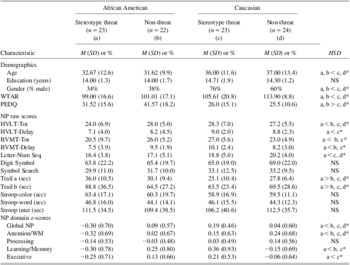
Table 1 shows the demographic characteristics of the sample (see Table 1) using means and standard deviations for continuous data and frequency percentages for nominal data. Distributions for all measures were inspected for normality and linearity. Demographic variables were examined for potential covariates by exploring their relationship to neuropsychological performance.
Demographic and Performance Characteristics by Ethnic Group and Study Condition

NS = nonsignificant; WTAR = Wechsler Test of Adult Reading; PEDQ = Perceived Ethnic Discrimination Questionnaire (Sum of items); NP = Neuropsychological Performance.
*p < .05.
There were no group differences between experimental conditions (threat vs. non-threat) on any of the demographic variables (all p's > .05; see Table 1). Also, there were no significant differences in neuropsychological performance between individuals who were able to recall the task instructions and those who were not. A 2 × 2 × 2 factorial (ethnicity × condition × examiner race) mixed design analysis of covariance (ANCOVA) was used to test the first two hypotheses, which examined group performance differences between African Americans and Caucasians within and across experimental groups. Age and WTAR score were significantly correlated with neuropsychological performance and were entered as covariates (see results below). Next, we performed a 2 × 2 (examiner race × perceived discrimination) analysis of variance within the African American group (collapsing experimental conditions) to examine the effects of perceived discrimination on neuropsychological performance. All analyses were initially performed on global neuropsychological scores and then by cognitive domain.
Results
While there were no statistically significant differences between ethnic groups in self-reported years of education, F(1,91) = 3.55; p = .07, partial η 2 = .03, African Americans demonstrated significantly lower WTAR scores than Caucasians, F(1,91) = 5.44, p = .02, partial η 2 = .05. We also observed significant ethnic group differences in age, F(1,91) = 4.99, p = .02, partial η 2 = .04, and gender χ2(92) = 9.59, p < .01. African Americans were significantly younger than Caucasians and there were more Caucasian (68%) than African American males (36%) in the overall sample (see Table 1). To determine whether the group differences noted above impacted test scores, a series of univariate analyses were performed. Performance on WTAR was significantly correlated with global neuropsychological performance (NP), r(91) = .63, p < .01. Age was inversely correlated with global NP, r(91) = −.31, p < .01. There were no significant gender differences on NP. As a result of these analyses, age and WTAR scores were entered as covariates in additional analyses.
Main Effects
There was no main effect of experimental condition (threat vs. non-threat) on global NP, F(3,89) = 1.87, p = .17, partial η2 = .02. On the perceived discrimination scale, African Americans, M = 36.54, SD = 17.0, 95% CI [31.57, 41.51], reported significantly higher levels than Caucasians, M = 25.75, SD = 13.1, 95% CI [22, 29.5], F(3,89) = 4.97, p = .03, partial η 2 = .06. There were no main effects of examinee race or examiner race on NP (all p's >.05).
Interactions
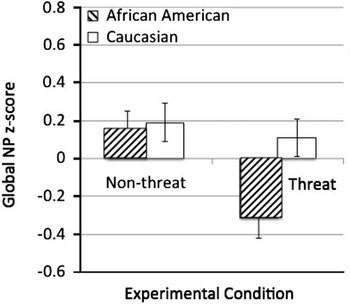
There was a significant condition × examinee race interaction such that African Americans performed significantly worse on global NP in the stereotype threat condition (Mz = −.30, 95% CI [−0.07, −0.67] than African Americans in the non-threat condition (Mz = 0.09, CI [−0.15, 0.33], F(5,87) = 4.25, p = .03, partial η 2 = .05 (see Figure 1 and Table 1). Examiner race did not mediate the relationship between ethnicity and condition (p > .05).
Interaction between examinee race and experimental condition interaction on global neuropsychological performance. Error bars represent standard error.

Subgroup Analyses
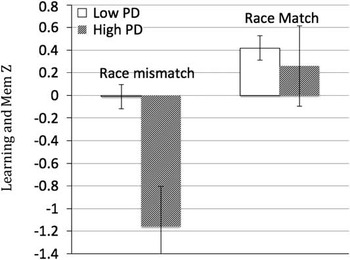
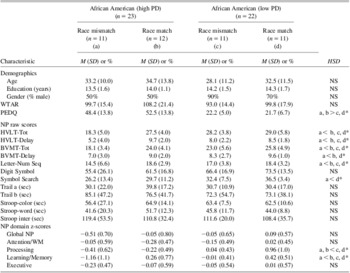
The next set of analyses examined the effects of perceived discrimination (PD) and examiner race within the African American sample. African Americans who reported high levels of PD (based upon a median split of PD scores) performed significantly worse on global NP, Mz = −.29, 95% CI [−.58, 0], than African Americans who reported low levels of PD, Mz = .02, 95% CI [−0.25, 0.21], F(1,44) = 3.74, p = .04, partial η 2 = .05. Further exploration revealed that African Americans with high levels of PD performed worse than African Americans with low PD in the cognitive domain of information processing speed, F(1,44) = 5.01, p = .03, partial η 2 = .10 (See table 2). Examiner race mediated the relationship between PD and performance on learning and memory, F(2,43) = 5.10, p = .03, partial η 2 = .12, such that African Americans who reported high levels of PD performed significantly worse on memory tests when tested by an examiner of a different race, Mz = −1.16, 95% CI [−1.78, −.54], than African Americans who were tested by an examiner of the same race, Mz = 0.24, 95% CI [−0.24, 0.72] (see Figure 2). The interaction between examiner race and PD for Global NP was non-significant (p > .05), as were cognitive domains of attention, information processing speed and executive functioning.
Interaction between perceived discrimination and examiner race on learning/memory performance in African Americans (n = 45). Error bars represent standard error.

Discussion
The current study is the first to examine the effects of stereotype threat on traditional neuropsychological test performance in a non-clinical sample of African American and Caucasian participants despite a rich history in the social psychological literature. As psychologists/neuropsychologists, it is critical that interpretations of test performance account for various test factors and characteristics of the individual being assessed (American Psychological Association, 2002). This includes, but is not limited to situational/contextual and cultural factors that may invalidate assessment findings. While considerable efforts have been made to reduce misdiagnosis of cognitive impairment among ethnic/racial minority groups (e.g., development of race-based norms), this does not “correct” for the impact of other types of cultural or contextual factors on test performance.
Our results were consistent with other studies of stereotype threat and perceived discrimination, suggesting that these are both powerful factors that extend across several investigations on group differences in performance (e.g., gender and age differences). Stereotype threat significantly affected African Americans in our sample; African Americans in the stereotype threat condition performed significantly worse on neuropsychological testing than African Americans in the non-threat condition. We also found that perceived level of discrimination negatively affected neuropsychological testing for African Americans, which is consistent with recent findings from Barnes and colleagues (Reference Barnes, Lewis, Begeny, Yu, Bennett and Wilson2012). Our study extends this work by replicating the results in a younger sample.
Interestingly, examiner-examinee racial discordance did not mediate the effects of stereotype threat (as initially hypothesized), whereas examiner-examinee racial discordance mediated the effects of perceived discrimination on neuropsychological test performance. The reasons for these findings are not entirely clear, but it is possible that the effect of stereotype threat is strong enough to emerge regardless of racial similarity between examiner and examinee. Stereotype threat showed a moderate effect size, which is consistent with effect sizes reported in the stereotype threat literature (see Nguyen & Ryan, Reference Nguyen and Ryan2008 for review). Therefore, it is possible that more explicit methods are necessary to either magnify or minimize the effects of stereotype threat. Unfortunately, we were unable to examine the effects of other variables that may mediate the effects of stereotype threat, such as introducing situational attributions for poor performance (Brown & Josephs, Reference Brown and Josephs1999), teaching participants about stereotype threat (Johns, Schmader, & Martens, Reference Johns, Schmader and Martens2005), or providing threatened participants with self-affirmation techniques (Cohen, Garcia, Apfel, & Master, Reference Cohen, Garcia, Apfel and Master2006). Future research should examine the mediating role of these variables on neuropsychological performance.
Examiner-examinee racial discordance mediated the adverse effects of perceived discrimination on neurocognitive performance; this demonstrates how individual characteristics (i.e., perceived level of discrimination) and contextual factors (i.e., race of examiner) work in tandem to affect performance. This is consistent with prior work demonstrating the interaction between examiner race and examinee mistrust (Terrell, Taylor, & Terrell, Reference Terrell, Taylor and Terrell1981).
Study Limitations
The current study was designed to replicate the methods outlined in Steele & Aronson (Reference Steele and Aronson1995), therefore, we were unable to determine if our groups were equivalent on neuropsychological performance before the experimental manipulation. In the original study by Steele and Aronson (Reference Steele and Aronson1995), SAT scores were used as baseline intellectual performance for assessing participants’ performance after the experimental manipulation. In our study, WTAR performance was used as our baseline measure; however, we recognize that WTAR performance is only a single measure of cognitive functioning and does not represent the full range of cognitive functioning. As such, examination of pre-post neuropsychological performance would have been ideal to isolate the effects of stereotype threat, and would have provided a solid baseline measure of cognitive performance. Future research examining the effects of stereotype threat should include baseline measures of cognitive functioning.
Consistent with prior investigations, our sample of African Americans demonstrated lower WTAR scores than Caucasians. Hence, it could be argued that African Americans in this sample entered with a lower “baseline” of cognitive performance. However, it is important to highlight that WTAR scores did not differ between African Americans in stereotype threat group and African Americans in the non-threat group. Therefore, the finding that African Americans in the stereotype threat condition performed worse than African Americans in the non-threat condition suggests that differences in neuropsychological performance across experimental condition was not a result of WTAR performance inequalities.
Another limitation to the current study is that both of our examinees were female which warrants discussion regarding how our participants responded to the stereotype threat instructions. It is possible that our female participants may have been more at ease with a female examinee than our male examinees, or vice versa. There have been very few investigations into the effects of examiner gender on test performance (Graziano et al., Reference Graziano, Varca and Levy1982; Pedersen, Shinelding, & Johnson, Reference Pedersen, Shinedling and Johnson1968), which provide general support for the effects of gender on performance. Ancillary analyses revealed that males performed slightly worse than females under the stereotype threat condition, although these findings did not reach statistical significance. Nevertheless, gender is an important consideration regarding examiner-examinee similarity and performance on neuropsychological testing. Future studies should include gender of examiner as a potential mediating variable to the effects of stereotype threat on neuropsychological performance.
As mentioned previously, only 40% of our participants were able to recall the instructions that were given depending upon experimental condition (stereotype threat vs. non-threat). Other factors may have interfered with instruction recall. For example, during the neuropsychological assessment, participants were given several instructions at the beginning of each test administration, which may have contributed to their failure to recall the experimental instructions. However, we did not observe any significant differences in neuropsychological performance between individuals who were able to recall the task instructions and those who were not. Nevertheless, we recognize that simply asking participants to recall task instructions was not the best approach for measuring the impact of the experimental manipulation. Perhaps using more direct measures of threat such as physiological measures of anxiety (e.g., skin conductance, functional magnetic resonance imaging scan) would have better captured the experimental manipulation.
While explicit self-report measures of anxiety have not been found to capture the effects of stereotype threat, implicit measures (e.g., Implicit Association Tests) have shown differences between experimental conditions (Steele & Aronson, Reference Steele and Aronson1995). Although the current study did not include implicit measures of stereotype activation, these measures should be considered in future studies to determine the magnitude of stereotype activation.
Finally, although we asked participants to self-report their ethnicity, we did not assess the degree of ethnic identification, which has been a criticism of prior stereotype threat investigations (Hess et al., Reference Hess, Auman, Colcombe and Rahhal2003). Nevertheless, our results demonstrate compelling evidence for the stereotype threat phenomenon.
Despite these shortcomings, we were still able to observe main effects even though participants were exposed to the assessment situation for a considerable length of time. In the original study by Steele and Aronson (Reference Steele and Aronson1995), participants were exposed to the stereotype threat condition for approximately 30 min, whereas our participants were exposed to the experimental condition for approximately 1 hr. This suggests that the effects of stereotype threat remain constant over time, even after repeated exposure to various tests. Although we attempted to counterbalance the order of most tests, given time restrictions (i.e., 1 hr), memory tests were given toward the beginning of the examination to use the time between the immediate and delayed recall trials for the administration of other tests. It could be argued that if we had begun the examination with tests that were perceived to be relatively easy and less diagnostic of cognitive ability (e.g., finger tapping), participants would have eased into the assessment and the effects of stereotype threat may have attenuated over time. Nevertheless, examination of performance across all measures demonstrates that the stereotype threat group performed lower than all other groups on most measures. Hence, certain neuropsychological measures (e.g., working memory tasks) may be more susceptible to the effects of threat, thereby requiring a higher degree of caution when interpreting results.
Conclusions
Our study results underscore the importance of being aware that stereotype threat can transcend racial stereotypes and may be applicable to other groups that have been the focus of discrimination based on infirmity, age, religion, sexual orientation, or other factors. Future studies should include other ethnic/racial groups such as Asian-Americans for which a positive stereotype is attached to group membership (i.e., good performance on NP) to determine whether the pressure to perform according to a positive stereotype would inhibit or enhance performance.
While a few international studies have replicated the effects of stereotype threat (Seibt & Förster, Reference Seibt and Förster2004; Croizet et al., 2004) on brief task performance measures, it is unclear whether stereotype threat would affect neuropsychological assessment in a similar manner. With the increasing number of linguistic minorities in the US, it would be interesting to learn how stereotype threat affects tests that are diagnostic of verbal skills. One could imagine that a host of factors such as acculturation and geographic location would modulate this relationship. Furthermore, future studies should include groups such as American Indian and Alaska Native populations, where our knowledge of cultural factors that impact this heterogenous subgroup is limited (Manly, Reference Manly2008). While the effects of stereotype threat are demonstrated to be strong, not all individuals will be susceptible to its effects. Studies have demonstrated that attributing performance to external factors and locus of control are but a few mediating variables to the effects of threat (Brown & Josephs, Reference Brown and Josephs1999; Johns et al., Reference Johns, Schmader and Martens2005). Therefore, closer examination into what factors are associated with individuals who are immune to the effects of threat versus those who are not would be of great scientific and clinical interest.
The current study extends our knowledge of how non-cognitive factors can affect performance on cognitive testing. Our results suggested that stereotype threat, perceived discrimination, and examiner race all impact neuropsychological test performance. Although the current study was focused on ethnic minority groups, stereotype threat generalizes to a wide range of populations such as traumatic brain injury (TBI), aging, and neurological disease populations.
Furthermore, the impact of racial discordance has been well-documented in the medical field, and this is particularly important given the pervasive racial disparities in health care. It is important to further investigate the role of racial discordance between clinicians/examiners and patient/examinees to determine the impact it may have on outcome measures and to evaluate techniques to mitigate its influence.
The degree to which stereotype threat affects individuals with multiple racial/ethnic or other group identities (e.g., an African American woman with a TBI; biracial individuals) is still not fully understood. In other words, how does knowledge about multiple stereotypes associated with one's identity manifest in performance? Also, what are the effects of stereotype threat outside of academic and cognitive testing? Do they extend to performance on the job and other types of “real world” outcomes? Future work in this area is needed to understand the complexity of individual and contextual factors that are involved in neuropsychological test performance. Using larger sample sizes will allow us to develop statistical models to help identify modifying variables that are salient to neuropsychological evaluations, and to determine how the importance of these variables may differ as a function of the group under study. As the number of racial/ethnic minorities in the United States increases, there is a great need to fully understand the unique factors that impact test performance. The effects of factors such as stereotype threat, perceived discrimination, and racial discordance are not subtle. Much work is needed to fully understand how these factors affect cognitive performance and other clinically relevant outcomes, such as self-disclosure and self-reported functioning.
Demographic and Performance Characteristics by Perceived Discrimination group and Examiner-Examinee race match

Note. NS = nonsignificant; WTAR = Wechsler Test of Adult Reading; PEDQ = Perceived Ethnic Discrimination Questionnaire (Sum of items); NP = Neuropsychological Performance.
*p < .05.
Acknowledgments
We acknowledge the following funding source: National Academy of Neuropsychology (PI: A. Thames). We also thank Ms. Myra Irani, Fredrica Hendrix, and Natalie Arbid for their assistance with data collection. The authors report no conflicts of interest.