Since the end of the Cold War, competitive elections have become a common feature of authoritarian regimes, and these elections increasingly involve the participation of election monitors.Footnote 1 Moreover, monitors do not always simply sign off on authoritarian elections. In fact, according to the most comprehensive data available, around one-third of all national elections since 1974 that had international monitors were declared ‘unacceptable’ by those observers.Footnote 2 Despite the frequency of observer criticism, however, the variety of responses to fraudulent elections is broad, ranging from acquiescence, to legal challenges, to protest and even violence.Footnote 3
There are many reasons why groups might act differently in response to observer allegations of election fraud, but a key part of the explanation is likely to turn on how citizens at large perceive the elections. To date, however, we know little about what affects citizen evaluations of the honesty of elections. Most of the literature on election fraud focuses on the nature of fraud and its effects on the legitimacy of the political system as a whole.Footnote 4 The literature on perceptions of the election process is thinner, and has tended to focus on the effects of fraud on support for the opposition, turnout and vote choice.Footnote 5
Among the few articles looking at what shapes differences in the extent to which people see elections as honest, Birch shows that structural features of the electoral system affect overall levels of confidence in the process.Footnote 6 However, as I argue in this article, differences in perceptions of election quality are likely to depend at least as much on the characteristics of citizens as on the characteristics of elections, and a given election is likely to generate quite different perceptions among different parts of the population. The existing literature offers some evidence in this direction. In the United States, Ansolabehere and Persily show that party identification strongly conditions perceptions of whether fraudulent voting is a major problem.Footnote 7 In Kosovo, Brancati finds that voters whose party wins elections are happier with the work of international election observers than supporters of the losing party, and in Russia, Reuter and Szakonyi demonstrate that users of opposition-targeted social media are more likely to perceive that fraud has taken place.Footnote 8
I build on these findings to develop a theory of the behavior that underlies differences in the extent to which individuals see elections as fair or fraudulent. I draw on Geddes and Zaller’s early ground-breaking work in authoritarian regimes with elections and recent work in American politics to argue that perceptions of fraud in authoritarian regimes are likely to depend heavily on pre-existing political opinions and attitudes toward the regime, and I develop an explanation of why this might be.Footnote 9
Specifically, I argue that in authoritarian regimes with widespread access to the internet, citizens operate in an information environment with considerably more choice than has traditionally been associated with such regimes. Crucially, however, more choice does not straightforwardly translate into more skeptical attitudes toward the incumbent regime. Instead, more choice means that citizens in authoritarian regimes look increasingly like citizens in democracies in terms of how they acquire and process political information.Footnote 10 Like citizens in democracies, citizens in many contemporary authoritarian regimes, I argue, practice ‘motivated reasoning’ when it comes to politics.Footnote 11 In other words, their underlying political orientations have large effects both on the kind of information they gather and on how they process this information. Opponents of the regime are more likely to be motivated to acquire information that is damaging to incumbent authoritarians, and are also more likely to believe information coming from critical or foreign sources. By contrast, regime supporters are less likely to seek out critical information or to believe such information if they come across it accidentally. Supporters are also more likely to believe pro-regime messages. This pattern of information acquisition and processing leads regime supporters and opponents to have quite divergent worldviews. The remaining citizens neither seek out critical information nor believe it, but are also skeptical of pro-regime messages. Consequently, the effects of information on attitudes depend to a considerable degree on the distribution of political orientations.
This general argument about information acquisition and processing is important because it has significant implications for broader debates in comparative politics. First, if citizens do engage heavily in motivated reasoning, then popular authoritarians may have less to fear from freedom of information in general (and the internet in particular) than many have argued, especially if the opposition is unpopular.Footnote 12 While social media are certainly important for exchanging information, building solidarities and organizing within like-minded communities, increasing the availability of critical viewpoints does not necessarily mean that these views will become widespread.Footnote 13 There are significant selection effects in terms of who exposes themselves to information that is critical of the regime. Moreover, citizens’ existing political preferences strongly influence how even accidentally acquired information shapes opinions. Consequently, while social and other media have an effect on citizen perceptions in authoritarian regimes, those effects are likely to be much greater among those already ill disposed toward the regime and may be small, or non-existent, among those who are well disposed or apathetic.
Secondly, while the literature on authoritarian regimes has identified electoral fraud as a major threat to regime stability, the arguments here suggest that the impact of a given amount of fraud on public perceptions will depend on the distribution of support for the regime.Footnote 14 Unpopular authoritarians with many enemies who are inclined to cheat may well find electoral fraud leading to mass mobilization.Footnote 15 A prominent example is Ukrainian President Leonid Kuchma, who by the end of his term in office in 2004 faced a broad negative coalition opposed to his efforts to install a successor.Footnote 16 By contrast, authoritarian regimes that have a strong base of popular support or face weak opposition, like the PRI in Mexico, are likely to enjoy much greater impunity when it comes to electoral fraud.
The findings in this article also have significant implications for the growing literature on election observers. In recent years political scientists have made considerable progress in understanding why election monitoring has become so widespread around the world, as well as the factors that affect the nature and quality of election monitors’ judgments.Footnote 17 There has also been literature on whether the presence or absence of monitors directly impacts the level of cheating that goes on in polling stations, and whether knowledge of monitors affects turnout.Footnote 18 However, we still know little about whether election observers actually influence perceptions of fraud within a country. This article suggests that election observers play a significant role in shaping opinion, but that this role is shaped by citizens’ underlying orientations toward the incumbent regime.
The article also contributes to debates among scholars of contemporary Russian politics. I look at attitudes toward fraud and election observers using data from an original survey of educated, urban, internet-using Russian citizens taken two weeks before and one month after the presidential elections of March 2012. I show that even within this key demographic, which is often thought to be hostile to the incumbent regime in Russia, opinions on the regime are divided, with significant consequences for views of electoral fraud and for the longer-term viability of the incumbent regime.
Electoral Authoritarianism, Information and Perceptions of Electoral Fraud
In this section I outline a theory of patterns of election fraud perception in electoral authoritarian regimes. I begin by discussing the information environment in contemporary electoral authoritarian regimes and argue that the availability of the internet in many of these regimes creates an information environment that allows for some element of choice in the consumption of news and information. While not completely free, this media choice creates opportunities for variation in the kinds of media and information to which different citizens expose themselves. This is a significant development that, I argue, gives rise to opinion dynamics in authoritarian regimes that echo those we have seen in long-standing democracies.
In a landmark piece at the intersection of the study of public opinion and authoritarianism, Geddes and Zaller argued that political reasoning in democracies and authoritarian regimes was likely to operate in similar ways, but that the information available on which to reason was likely to be quite different.Footnote 19 Rather than being exposed to a range of competing messages, citizens of authoritarian regimes, they argued, experience ‘an elite discourse that is “heavily loaded on one side” [which], however that one-sidedness arises, tends to induce mass support for the values embedded in the discourse – except among well-informed people who are predisposed against those values’. Thus we should expect the majority of citizens to receive and accept official pronouncements, while a minority of well-informed dissidents would reject it.
However, much has changed since the end of the Cold War, and the information choices available to citizens of most authoritarian regimes are different from those available to their predecessors. Although there was always some access to critical sources for dedicated dissidents, and while some truly isolated regimes such as North Korea still exist, citizens in contemporary authoritarian states typically have vastly broader access to information than before, either through international sources or the internet. In particular, in authoritarian regimes with at least some real competition – competitive authoritarian regimes – real (if unfair) political competition coexists with access to alternative media, whether in print form or on the radio or internet.Footnote 20 Official media and television are typically dominated by news selected and framed by the regime, but outlets do exist, especially in major cities, that are critical of the incumbents and often of the system as a whole. The question is how do citizens operate within this relatively broader information space and how do choices about media consumption affect perceptions of electoral fraud?
The answer, I argue, is that patterns of media choice and opinion formation in authoritarian regimes should take on similar characteristics as those we have seen in democracies. In part this means that a person’s political opinions should affect the kind of information they gather. In particular, politically motivated citizens will take advantage of the broader choice of media outlets to seek out information or news that bolsters their existing beliefs and to avoid news that contradicts those views.Footnote 21 Regime supporters will consume pro-regime information, while regime opponents will gather information that is critical of the regime. This means that regime supporters, regime opponents and other citizens will end up with different information sets on which to evaluate political events.
We should also expect that citizens will process the information they receive differently, depending on its nature. It has long been established that human reasoning is often affected by confirmation bias – a tendency to treat evidence that confirms existing opinions in an uncritical manner but to discount more heavily information that does not fit a person’s prevailing view of the world.Footnote 22 As studies in the United States have shown, this kind of biased information processing applies just as much to politics as to other areas of reasoning.Footnote 23 If my argument about the similarity of political reasoning in authoritarian regimes and democracies is correct, then we should see that, in addition to having different information sets, citizens will interpret even common information differently depending on their general political orientations. Those who are critical of the regime will treat information from critical sources as though it were true, and be unimpressed by regime messages. On the other hand, regime supporters will have their beliefs reinforced by pro-regime messages and will be unimpressed with critical messages.
So far, I have discussed how motivated reasoning is likely to shape the information gathering and processing strategies of regime supporters and opponents. Clearly, many (probably most) citizens are best characterized as fitting neither of these two groups, but defining them in negative terms (neither supporters nor opponents) gives us little to go on in thinking about their behavior. In reality, this group is likely to be quite mixed, and will include people who are interested in politics but turned off by the options on offer, as well as people who care little about politics. Both groups, albeit for different reasons, are likely to be quite disengaged from politics. Consequently, I follow Prior in expecting that as a group, these other citizens will be both less interested in, and less influenced by, either critical sources or regime messages.Footnote 24 As a result, they should score lower on knowledge of critical voices than both opponents and supporters, and should also be less swayed by accidentally acquired political information, whatever its source. It is worth noting that this perspective is quite different from a view that associates the ‘others’ group simply with people with low political information. If this were the case, we would expect the ‘others’ group to have less knowledge but to be more easily swayed by accidentally acquired information.Footnote 25
Research Design
I test these general arguments about information and competitive authoritarianism using data from Russia following the disputed parliamentary (Duma) elections of December 2011. The data are drawn from an internet survey focusing on a key political demographic in Russia – educated, upper-income, internet-using urbanites.
There are a number of features of the Russian Duma elections of 2011 that make them particularly interesting from the perspective of analyzing patterns of opinion on electoral fraud. First, the elections were condemned by both international and domestic monitoring organizations as unfair. Further suspicion about the results was generated by analyses that pointed to highly unusual patterns in the vote totals in different polling stations for the ruling party, United Russia.Footnote 26 After the election there were significant protests involving up to about 150,000 people in Moscow, St. Petersburg and many regional cities.
Secondly, the claims of fraud and the competing narratives of the regime and the opposition took place in a media environment that made information on fraud accusations widely available. There are many different examples. For months before and after the election, the internet site gazeta.ru ran a ‘Map of Violations’ providing detailed information on charges of irregularities. This map was known to 39 per cent of survey respondents. Blogs discussing the details of the election results were also widely known – as one popular blogger Andrey Malgin put it, ‘[my post] about cheating in favor of United Russia has been read by 45,000 people. Not bad. And this is not the only “chronicle” out there – not one, not two, but thousands’.Footnote 27 In addition to reports about the elections, there was also a great deal of coverage of the protests, both supportive and hostile, in a broad range of media. As a result, fully 97 per cent of survey respondents said that they had heard of the post-election protests and, of these, 71 per cent identified electoral fraud as the cause of the protests. Consequently, the Russian Duma elections provide an excellent case in which to examine the dynamics of attitudes to electoral fraud.
I assess attitudes using a survey conducted in two rounds: two weeks before the March presidential election and three weeks after. The survey was conducted with leading Russian market research firm, Synovate ComCon, with financing from Democracy International. Synovate ComCon invited a sample of their opt-in internet panel of 350,000 participants from cities all over Russia. The target sample was intended to be representative of upper- and middle-income internet users between sixteen and sixty-five years old, with some higher education, who live in cities with a population of more than one million. Invitations were stratified on age and gender based on internet penetration data. In round 1, no quotas were imposed on responses, but respondents were screened to include only those with some higher education, who can afford food and clothes and who live in cities of over one million residents.Footnote 28 The age-gender distribution of those who screened in matched the internet penetration data.
In round 2, the sample was stratified to match round 1 in age, gender and city of origin. People who participated in round 1 were excluded from round 2. About 1,200 respondents completed the twenty to twenty-five minute-long surveys in each round, which probed their attitudes and responses to election observation and other topical political issues.Footnote 29 In analyses that use data from both rounds, a control is included for the particular round, though any differences are small. This is not surprising, given the very predictable course of the presidential vote that separated our two rounds – only 6 per cent of respondents in round 1 thought someone other than Vladimir Putin would win the elections.
The sampling strategy we adopted offers a number of significant advantages over a classic nationally representative sample. First, in Russia (as elsewhere), urbanites play a key role in politics, particularly in protest politics.Footnote 30 Secondly, while broad national surveys indicate little knowledge of election monitoring organizations, the sampled population demonstrates considerably higher levels of knowledge of election monitoring groups. This is important, because the sample’s additional knowledge meant we can expect more meaningful answers to survey questions and greater statistical power. Thirdly, while the opinions of this group are not representative of the population as a whole in terms of generating point predictions, there is evidence in public opinion research that broader populations can be prompted by the views of opinion leaders like those who fit the demographic profile of our survey respondents.Footnote 31
Finally, and crucially, while the specific distribution of attitudes and opinions we find are not representative of patterns in the population as a whole, it is likely that the factors that shape that distribution are.Footnote 32 The principal findings – that regime supporters, opponents and other citizens differ in terms of knowledge of (and attitudes toward) electoral fraud and election observers – should hold in the larger sample, even if the proportions among the three groups are likely to be different. Similarly, we can expect the experimental part of the survey that shows how different groups respond to stimuli to hold in a broader sample. Details on how the internet sample compares with nationally representative samples are provided in the Appendix.
Hypotheses and Measures
Most obviously, given the foregoing arguments, the basic expectation is that we should find that assessments of the prevalence of fraud in the Duma elections depend heavily on general orientations to the Putin regime. Regime supporters will perceive the Duma elections to be more honest, regime opponents will be more likely to think the elections fraudulent and other citizens will lie somewhere in between.
To identify regime supporters, regime opponents and ‘others’ I use the reported vote in the presidential election of March 2012. For round 1, which took place before the presidential election, the question referred to voting intentions, while for round 2 the question referred to reported vote. Regime supporters are defined as those who voted for one of the regime-sponsored candidates – Vladimir Putin, Sergei Mironov or Vladimir Zhirinovsky. Regime opponents are those who voted for Mikhail Prokhorov, or for the Communist Party leader, Gennady Ziuganov.Footnote 33 Defining supporters and opponents in this way leaves a residual category of non-voters – people who either refused to answer, did not vote or did not know if they voted.
Basing orientation on stated vote or voting intention is not ideal. First, it confounds two separate acts – support and actually voting. Moreover, in using voting we have no information on respondents’ depth of attachment to the regime or opposition. Typically, this issue is partially addressed by looking at levels of attachment to political parties (partisanship) separately from voting. However, the partisanship approach is unsatisfactory in the Russian context, where political parties have had a notoriously hard time establishing themselves, and where much of the opposition is excluded from parliamentary politics and so is non-partisan in nature. In the absence of a more refined measure of identification, using the potentially noisy voting intention/reported vote represents a conservative test of the argument.
Attitudes to fraud were measured using answers to the question, ‘Do you feel that the Duma election in December 2011 was […]’. Response options were ‘free and fair, somewhat free and fair, not free and fair, it has no importance for me, do not want to answer and do not know’. In the analyses I created an ordered response variable for Duma fraud that ranks responses from ‘free and fair’ to ‘somewhat free and fair’ and ‘not free and fair’. Other responses were excluded. The simple bivariate data support the basic hypothesis very strongly: 72 per cent of regime opponents thought the Duma elections ‘not free and fair’, compared with 56 per cent of those who were neither supporters nor opponents, and a mere 32 per cent of regime supporters. As I show below, this pattern holds even when we control for potential confounding factors. The argument here, however, is not limited to making claims about the distribution of attitudes, but rather focuses on the mechanisms underlying those attitudes – patterns of information acquisition and information processing.
Information Acquisition
In terms of information acquisition, the general expectation is that regime opponents should be more likely to seek out critical voices, while regime supporters will be less likely to seek out the views of people who question the legitimacy of the elections. Individuals in the residual category of non-voters, who are disengaged from both the regime and the opposition, are likely to show even lower levels of knowledge.
To test the knowledge of critical voices, I collected data on awareness of the activities of Golos (Voice/Vote), the most prominent election monitoring organization in Russia. Knowledge of Golos offers us a particularly good test for measuring the differences in information acquisition. While many people know Golos from its efforts to train election observers in the 2011–12 election cycle, it has been very active as an indigenous, independent election monitoring organization and has provided evidence-based analysis of the quality of elections in Russia for the last decade. By the fall of 2011, Golos had become the ‘go to’ group for well-founded criticism of the regime’s claims to electoral legitimacy.
To measure knowledge of Golos, I used two questions. First, respondents were asked whether they had heard of Golos. Those who claimed to have at least some familiarity with Golos were then asked to identify its activities from a list of four plausible options (election monitoring, minority rights in Russia, rights of Russians abroad or ecological projects). A dummy variable was used to identify those respondents who correctly identified Golos and its activities.Footnote 34
Information Processing
My arguments about information processing are built on the general proposition that political orientation will affect not just how citizens gather information, but also how they process it. In the observational data, I examine how knowledge of critical election monitors affects fraud perceptions. I hypothesize that regime opponents who can correctly identify Golos should take that knowledge into account when thinking about election fraud, but that regime supporters and non-voters are likely to disregard the monitors. Hence, opponents who are familiar with Golos should be more likely to think the elections are fraudulent than opponents who do not know Golos, but knowledge of Golos should make no difference to how regime supporters and non-voters feel about the elections.
Alternative Explanations/Controls
In looking at the effects of political orientation on knowledge of (and attitudes to) fraud in the regression analyses, I also take into account demographic and information factors that are likely to influence attitudes. Since we might expect state and private sector workers to have different views, I use a dummy variable (Private Employment) to indicate whether a respondent works in the private sector. I control for family income using a simple three-category variable to measure whether the respondent’s family economic circumstances have gotten worse, stayed the same or improved over the last year (Family Economy), and a dummy for whether the respondent lives in Moscow. Education is measured in three categories – some higher education, complete higher education and PhD. I also control for gender and age, because women and younger people have been shown to be associated with being more anti-Western and supportive of the regime.Footnote 35
In terms of political information, I control for the fact that those who are interested in politics are more likely to have heard of Golos. Respondents were asked ‘How closely, if at all, would you say you follow news about political life in Russia’; possible responses were ‘not at all’, ‘not that closely’, ‘fairly closely’ and ‘very closely’. I also look at habits of consumption of political news. To investigate the relationship between attitudes and watching state television, respondents reported whether they used state television ‘to get political news and information’ daily, a few times a week, a few times a month, rarely or never. Finally, I control for whether respondents get political news and information from the social network sites V Kontake, Odnoklasniki and Facebook, or the blogging site Live Journal.
Information Acquisition and Processing: Regression Results
I present the results of regression analyses graphically in two stages. First, I show how political orientation, demographic characteristics and media use relate to knowledge of Golos. I demonstrate that political orientation and political engagement play a big role in shaping whether people can correctly identify this key critical voice. Secondly, I show that the effect of familiarity with Golos is different across different sub-groups by political orientation. Non-voters and regime voters who can correctly identify Golos are no different in their evaluation of the honesty of the 2011 Duma elections than non-voters and regime voters who cannot. However, regime opponents who know Golos are even more skeptical of the elections than regime opponents who do not. Together these findings strongly support the argument that political information is collected and processed differently across regime supporters, opponents and non-voters, and that these differences are politically consequential.
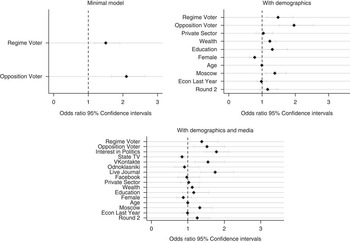
Figure 1 illustrates the results of logit regressions that examine the effect of different combinations of variables on knowledge of Golos. Panel 1 shows a minimal model with just political orientation, Panel 2 adds in the demographic factors and Panel 3 the media use factors discussed above.Footnote 36 All controls are shown. The results are presented as odds ratios with 95 per cent confidence intervals. Odds ratios are obtained by exponentiating logit coefficients, and represent the change in the odds of knowing about Golos for a one-unit change in the independent variable. Ratios greater than 1 mean that an increase in the independent variable increases the probability of knowing about Golos by that proportion, and ratios less than 1 mean increases in the independent variable decrease the odds of knowing Golos (see Supplementary Appendix F1 for tables showing the regressions underlying each model).
Knowledge of Golos and Political Orientation

Figure 1 shows the statistically significant and substantively large effects of political orientation on knowledge. In the basic model, opposition voters are more than twice as likely (2.10) than non-voters to have heard of Golos (Panel 1). Controlling for demographics makes little difference: opposition voters are still twice as likely as non-voters (odds ratio of 1.96) to be able to accurately identify Golos. Regime voters are also more likely than non-voters to be able to identify Golos, though in both the minimal and demographic models the difference is half as large as it is for opposition voters, and is statistically different. The effects of the demographic factors are consistent with conventional wisdom: better-off people within this group are somewhat more likely to know Golos, as are men and Muscovites.
In Panel 3 of Figure 1, I add a list of different measures of political engagement, including interest in politics (which is highest among regime opponents and lowest among non-voters) and whether a respondent uses state television (highest among supporters) or various online platforms (highest among opponents) for political news. Once we add in these effects, the difference between voters and non-voters remains, and the difference between regime opponents and supporters is still positive but is no longer statistically significant. This is because by including engagement and media choice, we are adding endogenous variables that are closely related to regime orientation and, indeed, are part of what it means to be an opponent, supporter or non-voter. To be the kind of person who actively votes against the regime in an authoritarian context like Russia means being more engaged with politics, following politics more online and avoiding state propaganda on television. Regime supporters, by contrast, follow state media and spend less time on politics online, while non-voters are less engaged on all of these dimensions. Consequently, it is difficult to tease out empirically the different effects of regime orientation and political engagement (see Supplementary Appendix F2).
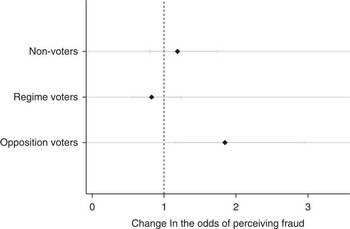
In Figure 2, I turn from information acquisition alone to look at the combined effects of acquisition and processing. The results presented are from ordered-logit models with three category-dependent variables that reflect respondents’ views of the extent of fraud in the elections – free and fair, somewhat free and fair, and not free and fair. To recap, I argued that opponents are more likely to believe critical voices, while supporters and non-voters are likely to dismiss them as biased. Consequently, we should expect that regime opponents who know Golos will be more likely to think that the Duma elections were fraudulent than similar opponents who are not familiar with the organization. However, knowledge of Golos should have no effect on the fraud perceptions of either regime supporters or non-voters, who will discount what they hear from Golos.
How knowledge of Golos affects fraud perceptions amongst different groups of voters

Figure 2 shows powerful evidence for these hypotheses. It presents data from a series of three ordered-logit regressions (see Supplementary Appendix F3). The dependent variable in each case is the degree of skepticism about the fairness of the Duma elections in 2011 and the control variables (not shown) are the same as the saturated models in Panel 3 of Figure 1.Footnote 37 The regressions use different excluded categories so that we can distinguish the effect of knowledge of Golos within groups. Figure 2 shows only the effect within each group of voters (non-voters, regime voters, opposition voters) of having accurate knowledge of Golos on the overall evaluation of the election, relative to people in the same subgroup who cannot identify Golos. Again the results shown are odds ratios, and represent the increase in the odds of expressing either some or a lot of skepticism about the elections for someone in that group who correctly identified Golos compared with someone who did not.Footnote 38 The tails represent 95 per cent confidence intervals.
The results are as we would expect, given the theory. Non-voters who know about Golos are basically indistinguishable in their views from non-voters who do not. Regime voters are also unmoved by familiarity with Golos. Opposition voters, however, are quite different. They are very much moved by knowledge of Golos. Even though this group is the most skeptical of the three by far (see above), those among the opposition who know about Golos are still about twice as likely to express skepticism about the elections than opposition voters who could not correctly identify the organization. These results are very striking, and strongly indicate that together, differences in information acquisition and processing lead to very large differences in political perspectives in the context of competing information sources.
Nevertheless, in the observational data, we cannot exclude the possibility that what we see in Figure 2 is less the effect of knowledge of Golos on opponents than a reflection of a close correlation between knowledge of Golos and the degree of opposition to the regime. It may be that those who are more extreme – and so less trusting of the elections – also gather more information, and thus come to know Golos. However, the data provide some reassurance that this is not all that is going on. First, the effect of Golos shown in Figure 2 is net of all the measures of political engagement and media use, factors that we know are related to opposition orientations. Secondly, if knowledge of Golos were simply a measure of skepticism, we should also see similar patterns for regime supporters and non-voters. After all, while 29 per cent of oppositionists knew about Golos, substantial proportions of regime supporters (22 per cent) and even some non-voters (16 per cent) were also able to correctly identify it. However, there is no difference in fraud perceptions in these groups between those who knew Golos and those who did not.
Nevertheless, it might be that knowledge of Golos is only a measure of opposition among regime opponents. To test this, I considered the relationship between knowledge of Golos and respondents’ assessments of whether the country is generally heading in the right or wrong direction. If the relationship between knowledge of Golos and assessments of the general direction of the country were straightforwardly linear, then we could not rule out the possibility that familiarity with Golos is simply a measure of the strength of the opposition rather than a factor in shaping evaluations of electoral fraud specifically. Empirically, there is a difference in the mean assessment of the country’s direction after the presidential election between opponents surveyed who knew Golos and those who did not. However, before the presidential election, the mean evaluation of regime opponents who could accurately identify Golos was no different from the mean evaluation of opponents who could not. This would not be the case if knowledge of Golos were simply an indication of a more extreme opponent of the regime. Moreover, if we rerun the regressions underlying Figure 2, controlling for evaluation of the direction of the country, the effect of knowledge of Golos on opponents’ evaluations of electoral fraud is not only still significant, it is actually larger.Footnote 39
This is not to say, of course, that there is no relationship at all between knowing Golos and general critical orientation. It would be strange if there were not; indeed, my arguments about information acquisition suggest there should be. Nevertheless, it is clear from the data that there is more to the relationship between knowledge of Golos and attitudes to fraud than simply being a measure of opposition. To further allay this concern, and to demonstrate differential information processing in action, in the next section I turn to a survey experiment that shows clear differences in how supporters, opponents and non-voters respond to the same pieces of information.
Political Orientation and Information Processing: A Survey Experiment
The analysis so far has focused on the effects of either information acquisition or information acquisition and processing taken together. In order to test my arguments about information processing specifically, the second part of each round of the survey included an experiment designed to look at how respondents with different political orientations responded to different kinds of political information. The content of the experiment focused not on fraud perceptions themselves, which had already been the subject of much public discussion by the time of the survey, but on how different kinds of messages or frames shaped respondents’ attitudes to election monitors, thus illustrating the different ways in which respondents process political information.
The experimental design focused on attitudes to election observers and exposed respondents randomly to two different kinds of information about observers: (1) descriptions used by the observers themselves that frame observers as independent, non-government actors (observer-generated) and (2) messages used by the Russian government to frame observers as foreign agents and criminals (regime-generated). Each kind of information was presented in two different ways, and respondents’ attitudes to observers were then compared with those of respondents who had been provided with no information about observers.
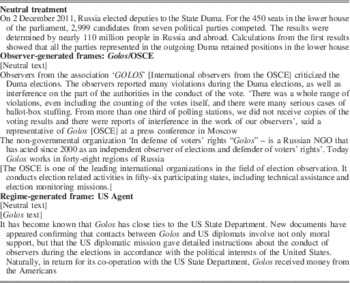
In order to have reasonable numbers of respondents in each cell, the experiment was carried out over the two rounds of the survey, with different respondents in each round. In round 1, after answering the main part of the survey, respondents were randomly allocated one of four short texts before being asked questions about observers (Table 1). The first text was neutral, simply noting some basic facts about the election. The second and third texts presented two versions of the observer-generated framing. The second text contained the neutral text, but it also mentioned Golos, detailing some of the criticisms Golos had leveled at the elections, and describing the organization using text from its own website that present Golos as an independent, indigenous and experienced organization. This is the Golos treatment. The third text was identical to the second, but instead the criticisms were presented as coming from the Organization for Security and Cooperation in Europe (OSCE), which was described using text from its website that refers to the OSCE’s experience and expertise. This is the OSCE treatment.
Round 1 Experimental Treatments

The effects of observer-generated frames are contrasted with those of regime-generated descriptions of observers. The regime-generated frame in round 1 came in a fourth text in which the description of Golos was replaced with a text from a pro-government tabloid, Lifenews, that appeared on the eve of the elections. This story described Golos as having close ties to the US State Department and receiving not just moral support, but also detailed instructions and money from the US (US Agent).
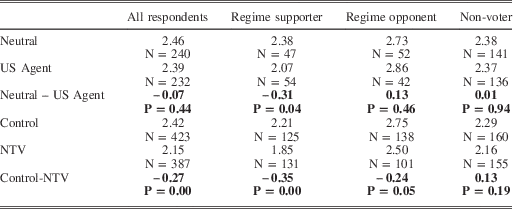
In round 2, the regime-generated frame experiment was continued by randomly assigning respondents to receive either no framing (‘Control’) or a two-minute introductory clip of a ‘documentary’ aired on the eve of the Duma elections on the pro-government news station, NTV. Entitled ‘Voice from Nowhere’ (‘Golos Niotkuda’), the clip presents two negative frames. First, Golos is presented as being engaged in illegal, extremist activities. Secondly, it is also described as a tool of the US and Sweden, evaluating elections negatively in accordance with pre-ordered instructions from Washington. This is the NTV treatment.
After the framing in each round, respondents were asked the following question: ‘Many of the complaints of fraud in the elections arose from reports by election monitors. How much do you trust election monitoring organizations?’. Possible responses were ‘trust completely’, ‘trust them a little’, ‘neither trust nor distrust’, ‘distrust them a little’ and ‘distrust them completely’. Given the theory of information processing, we should expect opposition voters to be more trusting of observers following the observer-generated frames (Golos and OSCE), while non-voters and regime voters should be unmoved by these frames. By contrast, regime-generated frames (US Agent and NTV) should make regime supporters less trusting of observers and have little or no effect on non-voters and regime opponents.
Experimental Results
The results of the experiment are presented in Tables 2 and 3. Rather than presenting the results by round, I divide the tables into the effects of observer-generated frames (Table 2) and regime-generated frames (Table 3). In order to preserve as closely as possible the ‘accidental’ nature of the information the prompts provide, the results include only those respondents who were unable to correctly identify Golos earlier in the survey. Where I hypothesize a directional effect, p-values are derived from a one-tailed test; where the hypothesis is that there should be no effect, I use a two-tailed test. Non-responses, don’t knows and refusals to answer were not included in the analysis. The effects show some interesting variation across treatments, but consistently illustrate how different kinds of respondents process information differently.
Trust in Observer Reports: Observer-Generated Frames

Trust in Observer Reports: Regime-Generated Frames

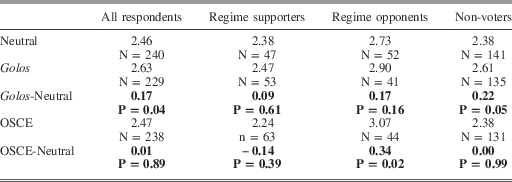
Table 2 presents the results of the observer-generated frames. Beginning with the Golos treatment in round 1, Table 2 shows that respondents who randomly received the Golos treatment had a mean trust in Golos of 2.63 on a 0–4 scale (in which 0 means ‘distrust completely’ and 4 means ‘trust completely’), compared with a mean of 2.46 for those receiving the neutral framing. This average effect is different from 0 at p=0.04 (two-tailed). As I hypothesized, however, the effects vary across regime orientations. In line with expectations, regime supporters who received the ‘Golos’ treatment are no different in trust in observers from those who did not (neutral mean 2.38, treatment mean 2.47, p=0.61 two-tailed). Opposition supporters receiving the Golos treatment are expected to trust Golos, and this was somewhat the case, though the effect is small and only borderline significant (neutral mean 2.73, treatment mean 2.90, p=0.16 one-tailed). Interestingly – and somewhat contrary to our hypotheses, but in line with Zaller – non-voters, upon being informed that Golos is an experienced, independent, Russian organization, show a statistically significant improvement in support (neutral mean 2.38, treatment mean 2.61, p=0.05 two-tailed).
Table 2 also shows the results of the OSCE frame. Here again our hypothesis is that we would not expect an effect among regime supporters or neutrals, but that we should see a positive effect among opponents. Across all respondents, there was virtually no difference between mean trust for those who received the treatment (2.47) and those who did not (2.46, p=0.89 two-tailed). However, as expected, regime opponents show a significant increase in trust with the OSCE treatment (from 2.73 to 3.07, p=0.02 one-tailed). The other groups, as hypothesized, were unaffected: regime supporters receiving the OSCE treatment did not differ statistically from those who did not (mean trust fell from 2.38 to 2.24, p=0.39 two-tailed), and non-voters were identical whether they received the OSCE frame or not (mean trust was 2.38 for both, p=0.99 two-tailed).
In Table 3, I show the results of the regime-generated frames. I expect the US Agent frame to have a negative effect on the trust levels of regime supporters and no effect on opponents or non-voters. The data support all three hypotheses. As Table 3 shows, the treatment had practically no effect across all respondents (mean trust fell 0.07 points, p=0.44 two-tailed) and on non-voters (mean trust fell 0.01 points, p=0.94 two-tailed). For regime opponents, mean trust actually increased from 2.73 to 2.86 with the US Agent frame, though the effect was not statistically significant (p=0.46 two-tailed). As expected, the US Agent frame had a large effect on regime supporters, with mean levels of trust falling from 2.38 to 2.07 compared to the neutral frame (significant at p=0.04 one-tailed).
In round 2, respondents were allocated either the NTV video treatment or no framing. Even in the presence of this strong treatment, there is still clear evidence that people with different regime orientations process information differently. However, the results also show that regime propaganda can have an effect even on regime opponents. Mean trust in the control group (2.42) was virtually identical to the neutral group in round 1 (2.41). However, as Table 3 shows, the average trust score across all respondents was 0.27 lower for those who saw the video compared with those who did not (control mean 2.42, treatment mean 2.15, p=0.00). Once more, behind this average effect was important variation across the different sub-groups in the effects of this treatment. As expected, regime supporters were most impressed – the mean trust in observers fell in this subgroup by −0.35 (control mean 2.21, treatment mean 1.85, p=0.00). However, regime opponents were also affected by the treatment – mean trust fell −0.24 (control mean 2.75, treatment mean 2.50), significant at p=0.05 (two-tailed). Non-voters conformed to the hypothesis, showing a smaller and statistically insignificant change of −0.13 (control mean 2.29, treatment mean 2.16, p=0.20 two-tailed).
Taken together, these results show that different kinds of respondents process accidentally acquired political information in different ways, though some are more consistent than others. Regime supporters are the most consistent in their responses. They disregard positive information about observers both in the Golos and OSCE frames, while at the same time they consistently show lower trust in election observers when presented with regime-generated negative information, in the form of either the US Agent frame or the NTV frame. This suggests a rather cohesive group of supporters, which is well trained in (and highly responsive to) the political rhetoric of the regime.
Regime opponents, by contrast, seem to be somewhat less coherent in their responses, which raises some interesting questions for future research. As expected, opponents responded with increased trust if observers are presented as coming from the OSCE, though there was a smaller (and only borderline significant) response to the Golos prompt. We cannot know for sure from the experimental design why this should be. It may be that this group of respondents – who by definition were not able to identify Golos – was more suspicious of an unknown Russian organization than they were of international observers. Yet we cannot be certain, since we do not have information on whether these respondents were familiar with international monitors before the survey. Opponents were also immune to written regime claims that the observers were US agents, but were moved in a negative direction by the two-minute NTV television clip. Whether this is because there is something particularly powerful about Russian television propaganda, or whether it was due to the multiple claims made against Golos in this particular clip is not clear. Given the role apparently played by Russian television in rallying support for the regime following the annexation of Crimea in 2014, this question certainly merits further research.
Finally, non-voters seem very disengaged from politics. They were entirely unmoved by negative regime messages, and were unimpressed with observers associated with the international community. Given the centrality of the ‘foreign conspiracy’ frame in Russian government propaganda, this apparent indifference is really interesting and speaks strongly of the degree to which non-voters in our sample are turned off from politics. The only prompt to which non-voters responded was the association of monitors with the domestic observation group Golos. While the Golos effect is too small and isolated a finding to bear too much weight on its own, it does suggest that non-voters might be more open to domestic civil society groups than to international ones.
Conclusion
In this article I provided evidence that citizens in authoritarian regimes think a lot like citizens in democracies. Specifically, citizens gather and process information as a function of their political preferences. As in democracies, politically active voters have more information than the politically inactive. There is also good evidence that among politically active voters, people with different attitudes to the regime acquire different information and process it differently.
The theory and evidence presented here have a number of significant implications. In terms of Russian politics, the evidence suggests that information acquisition and processing might be important sources of the polarization of politics that has taken place in the last few years. Our sample included a relatively narrow slice of the Russian population, yet despite socio-demographic similarities, there are big differences in attitudes and responses to new information that are strongly driven by basic orientations toward the regime. Given how differently these (otherwise quite similar) people seem to interpret their political environment, it will be no surprise to see Russian politics becoming ever more polarized in the years to come.
For election observers, there is good news and bad. The good news is that the population at large, and even significant proportions of regime supporters, is inclined to trust them. The bad news is that, as hard as observers might try to remain above the political fray, they are seen as politicized by supporters of one side or the other and observer reports seem to influence only those already opposed to the regime. This public perception fits well with analyses of the politicization of observer reports.Footnote 40
Most broadly, I have argued that understanding the acquisition and processing of political information has important implications for a number of aspects of contemporary authoritarianism. One element of this is the likely impact of increased access to information in contemporary authoritarian regimes. Much of the literature on authoritarianism and regime change has placed heavy emphasis on information and its control, with citizens portrayed as waiting for signs that it is safe or advisable to revolt.Footnote 41 Hence, the emergence of new technologies such as social media that make communication and information exchange easier has led some to expect that authoritarian regimes will be weakened.Footnote 42 Others object that this is not so, in part because authoritarian regimes are also able to use social media and technology to tighten control over their opponents.Footnote 43
In this article, by contrast, I show that it is not just the availability of information that matters, but also the nature of the political space in which information becomes available. How much impact a given piece of information or news source will have depends in part on the distribution of political orientations. This is consistent with previous work that finds that the existence of differing information sources on television sometimes has an effect on behavior, but sometimes does not.Footnote 44 Both findings are consistent with what I have shown here: the mere existence of information is not the only issue. Even if information is accessible, people differ in their propensity to seek out alternative sources of information. Those who are already critical of the regime are more likely to seek out information from critical sources, while neutrals and those who are supporters of the regime are likely to follow media that provide more positive information. Moreover, even if they do come across critical materials, people differ in how they process information. Popular regimes may have little to fear from negative information in general and evidence of electoral fraud in particular. Unpopular regimes, however, may have a lot to fear.
Readers might wonder how generalizable are the results presented here. There are two kinds of issues – the generalizability of this particular sample to Russia as a whole, and the generalizability of the Russian case to other authoritarian regimes. In terms of the former, the answer is quite clear. Internet samples, like the one used here, are not good at generating reliable point predictions of levels of key variables across the general population, so I do not attempt to do this here. However, the sampling frame used here is uniquely well designed to provide a large enough opposition-supporting population to make meaningful comparisons across the groups of interest, and there is no reason to think that the basic relationships between variables should be different between this sample and the population at large.
The related question of the generalizability of the Russian case is more complicated. Two scope conditions stand out most obviously. Clearly, closed authoritarian regimes that very heavily manage internet content are less likely to look like Russia than authoritarian regimes that allow a wide variety of internet content, including explicit opposition. Similarly, the degree to which my findings are significant for a particular case will depend on the level of internet penetration. Russia has very high internet use and relatively fast broadband speeds for an authoritarian regime, but it is far from the only non-democratic regime with a lot of internet users. Moreover, the number of such regimes is likely to increase over time. In the end, however, only further comparative work can really tell us how generalizable the Russian results are.
Finally, more work is needed on the issue of political learning. The evidence presented here gives a snapshot of one election; however, learning and change over time can (and does) happen. Research in the United States suggests that those with the strongest priors and highest levels of political sophistication have the strongest tendencies toward confirmation bias.Footnote 45 If this is the case, then the ‘persuadables’ may also be the least politically active – which is good news for authoritarians. Yet work on partisanship suggests that unexpected circumstances or anxiety can prompt deliberative rather than partisan responses that can lead to learning, suggesting that regime support will be conditioned by broader regime performance and that crises may be ‘teachable moments’.Footnote 46 Teasing out which of these (or other) factors are at work in public opinion dynamics in authoritarian regimes represents an important agenda.
Supplementary Material
To view supplementary material for this article, please visit http://dx.doi.org/10.1017/S0007123415000356