Introduction
In studies involving populations with normal cognition (NC), there is mounting evidence that education has protective effects in the clinical presentation of Alzheimer's pathology. Highly educated participants have a lower prevalence and incidence rate of Alzheimer's disease (AD) than poorly educated participants (Stern et al., Reference Stern, Gurland, Tatemichi, Tang, Wilder and Mayeux1994; Barnes and Yaffe, Reference Barnes and Yaffe2011). Moreover, although there are debates whether higher education predicts slower cognitive decline in community samples (Wilson et al., Reference Wilson, Hebert, Scherr, Barnes, de Leon and Evans2009), slower cognitive decline in highly educated participants was observed in at least some neuropsychological tests at the stage of NC (Evans et al., Reference Evans1993; Lyketsos et al., Reference Lyketsos, Chen and Anthony1999; Ardila et al., Reference Ardila, Ostrosky-Solis, Rosselli and Gomez2000), especially among participants who will eventually develop AD (Amieva et al., Reference Amieva2005). However, several longitudinal studies involving AD patients have reported that highly educated participants show more rapid cognitive decline than those who are poorly educated (Stern et al., Reference Stern, Albert, Tang and Tsai1999; Scarmeas et al., Reference Scarmeas, Albert, Manly and Stern2006; Bruandet et al., Reference Bruandet2008).
This education effect can be explained by the brain reserve capacity theory, which states that the brain copes with AD pathology by abundant neurons and synapses, or cognitive reserve (CR) theory, which states that the brain copes with AD pathology using preexisting cognitive processing or enlisting compensatory approaches (Stern, Reference Stern2006; Fratiglioni and Wang, Reference Fratiglioni and Wang2007). Thus, higher education may provide more plentiful CR, which may maintain cognitive function or delay the presentation of dementia in the context of AD pathology. It follows, however, that highly educated participants with AD will have a heavier pathological burden on their brains than those participants with lower levels of education at the time of clinical dementia. Furthermore, once AD begins, it should progress more rapidly in highly educated participants with AD because AD pathology is so severe that there is much less substrate remaining to function as a reserve.
Mild cognitive impairment (MCI) refers to an intermediate state between NC and dementia. Although previous studies have shown that MCI may evolve into types of dementia involving various etiologies (Winblad et al., Reference Winblad2004), most of amnestic MCI (aMCI) patients may progress to AD (Gauthier et al., Reference Gauthier2006). This raises the question as to whether highly educated aMCI patients would show faster cognitive decline than poorly educated patients with aMCI, similar to the pattern shown in patients with AD. Alternatively, it is possible that higher levels of education might have protective effects on the progression of cognitive impairment at the stage of aMCI because patients with aMCI might have sufficient levels of functional CR to overcome the pathological burden of AD. Furthermore, recent studies have shown that there is a hierarchy among aMCI in terms of the degree of cognitive impairment (Aisen et al., Reference Aisen2010). Thus, education might differentially modify the progression of disease according to differing degree of cognitive impairment in aMCI.
In this study, we aimed to evaluate whether or not highly educated participants with aMCI show faster progression of cognitive impairment than poorly educated participants with aMCI. We also sought to determine whether there were differences in the effects of education on the progression of cognitive impairment between early-stage aMCI and late-stage aMCI patients.
Methods
Participants and clinical evaluations
This study was conducted as a part of the Clinical Research Center for Dementia of South Korea (CREDOS) study, which is a multicenter hospital-based registry study. From May 2005 to February 2010, consecutive aMCI patients attending 31 memory clinics of university-based hospitals were identified. Then, we retrospectively selected all patients who underwent at least one neuropsychological follow-up until February 2011. Among 1322 participants who were diagnosed as aMCI during the inclusion period, there were 251 aMCI participants who fulfilled these criteria.
All of the aMCI patients met the following criteria proposed by Petersen et al (Reference Petersen, Smith, Waring, Ivnik, Tangalos and Kokmen1999): (1) subjective memory complaint by patients or caregivers; (2) normal general cognitive function as defined by scores on the Korean version of the Mini-Mental State Examination (MMSE) ≥ −1.0 standard deviation (SD) of the norms for age- and education-matched normal participants; (3) normal activities of daily living (ADL), as judged both clinically and on the ADL scale described later; (4) objective memory decline below the sixteenth percentile (−1.0 SD) on either verbal or visual memory tests; and (5) without dementia. The same criteria for aMCI have been used in previous papers (online-only method 1).
All of the patients underwent comprehensive interviews and neurological examinations, as described in previous studies (Park et al., Reference Park2011). Onset of symptom was determined based on the estimated date of first symptoms as stated by patients or caregivers. We used the Dementia Evaluation Package developed by the CREDOS, which is composed of the Clinical Evaluation Form and the Caregiver Questionnaire Form described in previous studies (Park et al., Reference Park2011). The details of clinical evaluations are summarized in the online only method 2. The institutional review boards at all participating centers approved this study. Written informed consent was obtained from patients and caregivers.
To evaluate the level of education achieved by participants precisely, we inquired in detail about their formal education, including whether or not they had completed each step of education (elementary school, middle school, high school, college, and graduate school). We confirmed the history of education information with patient caregivers. Previous AD studies (Lyketsos et al., Reference Lyketsos, Chen and Anthony1999; Bruandet et al., Reference Bruandet2008) on the function of education as a source of CR have found significant differences in cognitive decline between participants with high and low levels of education, with a cut-off value of eight years. Accordingly, we treated education as a dichotomized variable with cut-off value of eight years as well as a continuous variable.
Neuropsychological assessment
All participants underwent a standardized neuropsychological battery known as the Seoul Neuropsychological Screening Battery (SNSB) (Kang and Na, Reference Kang and Na2003). The scorable tests are composed of the Digit Span (forward and backward) (Kang et al., Reference Kang, Chin and Na2002), the Korean version of the Boston Naming Test (Kim and Na, Reference Kim and Na1999), Rey-Osterrieth Complex Figure Test (RCFT) (Kang and Na, Reference Kang and Na2003), which involves copying, immediate and 20-minute delayed recall, and recognition, the Seoul Verbal Learning Test (SVLT) (Kang and Na, Reference Kang and Na2003), which includes three learning-free recall trials of 12 words, a 20-minute delayed recall trial of these 12 items, and a recognition test, phonemic and semantic Controlled Oral Word Association Tests (COWAT) (Kang et al., Reference Kang, Chin, Na, Lee and Park2000), and the Stroop Test, which involves word and color reading of 112 items during a period of two minutes (Lee et al., Reference Lee, Kang and Na2000). Age-, sex-, and education-specific norms for each test, based on 447 normal participants, were used for comparison. Normal participants were identified from community-based cohort in two rural and two urban areas. They were recruited using Christensen criteria (Christensen et al., Reference Christensen, Multhaup, Nordstrom and Voss1991). So, participants with a history of psychiatric and/or neurologic illnesses and those having symptom/sign or abnormal neurologic examination suggesting underlying neurologic illnesses were excluded. Tables for normative sample (means, SDs, and cell numbers) are also described in online-only method 2. This neuropsychological battery has been used in previous papers (online-only method 1). Also, a previous study showed that SNSB total score well discriminates MCI patients from AD patients and normal controls (Ahn et al., Reference Ahn2010). Other previous study with MCI and AD patients also showed specific topography of cortical atrophy associated with cognitive impairments in specific domain of SNSB (Ahn et al., Reference Ahn2011).
Classification of aMCI
In this study, memory function was considered abnormal when delayed recall scores on either the SVLT or RCFT were lower than −1.0 SD compared to the age-, gender-, and education-matched norms. We classified aMCI participants according to the baseline memory test results. Participants with performances between −1.5 to −1.0 SD of the age-, gender-, and education-matched norms were diagnosed with early-stage aMCI, while those with performances lower than −1.5 SD were classified as late-stage aMCI. We further classified aMCI participants to their level of education: lower education (≤8 years) and higher education (>8 years).
Follow-up
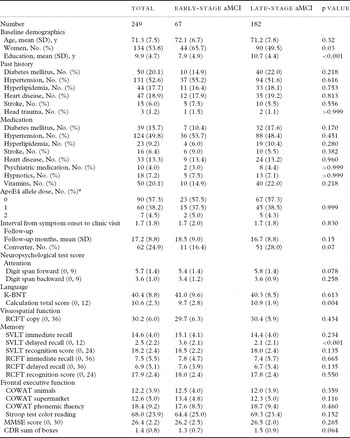
The diagnosis of dementia was based on criteria from the Diagnostic and Statistical Manual of Mental Disorders (fourth edition) and required clinical evidence of cognitive deficit confirmed by neuropsychological scores, as well as evidence of impairment in social or occupational functions confirmed by the ADL scale (online only method). For the diagnosis of probable AD, we used the criteria of the National Institute of Neurological and Communicative Disorders and Stroke—Alzheimer's Disease and Related Disorders Association (McKhann et al., Reference McKhann, Drachman, Folstein, Katzman, Price and Stadlan1984). A consensus panel also reviewed their interview record and their neuropsychological results and made an agreement with their diagnosis. Among the 251 selected aMCI participants, there were 25 participants with reversion to NC (better than −1.0 SD in all cognitive domains). Originally, a total of 28 participants reverted to NC after mean follow-up duration of 19.5 (9.8) months. Among them, three participants reverted to NC and then reentered the MCI category. However, we did not count those three participants as a reverter. Reverters were included in the further analyses as participants who did not convert to AD. Demographic and neuropsychological comparisons between reverters and non-reverters are detailed in Table S1 (available as supplementary material attached to the electronic version of this paper at www.journals.cambridge.org/IPG). There was no difference in the education level between reverters and non-reverters. In our registry, we did not include the patients who may represent degenerative dementias other than AD: for instance, patients who might have behavior and language type of frontotemporal dementia, idiopathic Parkinson's disease, diffuse Lewy body disease, corticobasal degeneration or progressive supranuclear palsy, and aMCI with extensive WMH in the initial examination. However, two participants progressed to dementia other than AD and we excluded these two participants. Specifically, we excluded one participant with a follow-up diagnosis of DLB, and the other one with a follow-up clinical diagnosis of FTD. Thus, 249 aMCI participants with follow-up were included for final analysis. The 249 participants were further classified into 67 early-stage aMCI and 182 late-stage aMCI participants. Basic demographic data, comorbidities, medication use, and neuropsychological scores are summarized in Table 1. They visited memory clinics 1.69 ± 1.81 years after their first symptom onset. Age at symptom onset was determined based on the estimated date of first symptoms as stated by patients or caregivers. The time elapsed after symptom onset was not associated with education (Spearman's R = 0.02; p = 0.749) and was not different between early-stage aMCI and late-stage aMCI (1.73 ± 1.95 years vs. 1.68 ± 1.76 years, p = 0.830).
Baseline demographics and follow-up information for patients with aMCI

Data are the result of t tests and χ2 tests performed as appropriate.
aAPOE genotyping was performed in 40 of 67 early-stage aMCI participants (59.7%) and 117 of 182 late-stage aMCI participants (64.3%).
aMCI = amnestic mild cognitive impairment; APOE ε4 = apolipoprotein E ε4; CDR = Clinical Dementia Rating; CDR-SOB = Clinical Dementia Rating Sum of Boxes; COWAT = Controlled Oral Word Association Test; K-BNT = Korean version of the Boston Naming Test; MMSE = Mini-Mental State Examination; RCFT = Rey-Osterrieth Complex Figure Test; SVLT = Seoul Verbal Learning Test.
All 249 participants had their first neuropsychological follow-up (interval from baseline: 13.6 ± 5.6 months). Fifty-five participants had their second follow-up (interval from baseline: 26.2 ± 7.7 months), eight participants had third follow-up (interval from baseline: 37.0 ± 3.5 months), and one participant had fourth follow-up (interval from baseline: 49.0 months). The overall median follow-up frequency was one and the mean duration of follow-up was 17.2 ± 8.8 months (4.3–50.0 months).
Statistical analyses
A Cox proportional hazard model was used to evaluate hazard ratio (HR) for AD progression associated with education or aMCI stage, after controlling for age at baseline evaluation, gender, and baseline MMSE scores. In Cox regression models, education was treated as a dichotomized variable with a cut-off value of eight years. Time to the event was defined as the time from study entry to the follow-up visit at which a first-time diagnosis of AD was made. Participants who did not convert to AD were treated as censored observations from the time of their final follow-up evaluation.
We applied mixed effect models to assess the relationships between education and longitudinal changes in neuropsychological test results over time. Mixed effect models enable analysis of all available data despite missing values. The participants’ performance on neuropsychological tests at each evaluation was a dependent variable. Variables, including age at baseline evaluation, gender, education (as a continuous variable), follow-up frequency, and follow-up interval (years) from baseline assessment were entered as fixed effects. We also included the interaction between education and follow-up interval as a fixed effect to test the associations between education and cognitive changes over time. These parameters provide an estimate of how the relationship between neuropsychological performance and the interval from baseline assessment varies as a function of education. To determine differential effects of education according to the subtype of aMCI, we separately performed mixed effect models for early-stage aMCI and late-stage aMCI participants.
Because highly variable follow-up duration of study participants could make this study vulnerable to bias due to attrition, we performed additional analyses with logistic regression and mixed effect model using data between 12 and 24 months after baseline evaluation. Controlling age and gender, we treated education as a continuous variable and evaluated the interaction between education and aMCI stage on AD conversion (logistic regression) or cognitive decline (mixed effect model). In these analyses, 158 (63.5%) of 249 aMCI participants were included and these 158 participants were not different from 1322 aMCI participants who were diagnosed as aMCI during the study inclusion period (regardless of whether they had follow-up evaluation or not) in terms of age, gender, education, and aMCI stage.
Results
Effects on conversion to AD
Early-stage versus late-stage aMCI
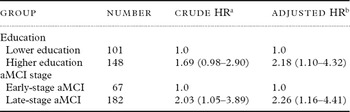
Among the 249 participants, 62 participants converted to AD and the annual conversion rate was 17.4%. A total of 11 of 67 early-stage aMCI participants converted to AD, whereas 51 of 182 late-stage aMCI participants converted to AD. Annual conversion rates were 10.6% in early-stage aMCI and 20.2% in late-stage aMCI. Cox analysis revealed that the risk of AD conversion was higher in late-stage aMCI than in early-stage aMCI (HR = 2.26; p = 0.02) after controlling age, gender, and baseline MMSE score (Table 2).
Crude and adjusted hazard ratios according to aMCI groups

aHazard ratios were based on the univariate Cox proportional hazard model.
bHazard ratios were based on the Cox proportional hazard model using age, gender, and baseline MMSE scores as covariates.
aMCI = amnestic mild cognitive impairment; HR = hazard ratio.
Lower education versus higher education
Nineteen out of 101 participants (18.8%) with lower education converted to AD, while 43 out of 148 participants with higher education (29.1%) converted to AD. Cox proportional hazard analyses revealed that participants with higher education had a higher risk of AD conversion than participants with lower education after controlling for age, gender, and baseline MMSE scores (HR = 2.18; p = 0.03) (Table 2). When we stratified participants by aMCI stage, participants with higher education had a higher risk of AD conversion (HR = 2.38; p = 0.03) in late-stage aMCI but did not in early-stage aMCI (HR = 0.56; p = 0.56).
Effects of education on longitudinal cognitive decline in Early and Late stage aMCI groups
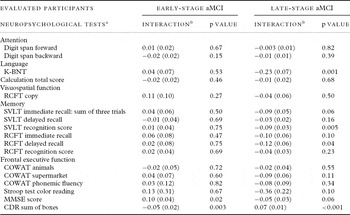
Both baseline and follow-up neuropsychological results are described in Table S2 (available as supplementary material attached to the electronic version of this paper at www.journals.cambridge.org/IPG). According to the mixed effect models, a high level of education was associated with more rapid declines in the Korean version of the Boston Naming Test (K-BNT) (estimate (standard error) = −0.15 (0.05), p = 0.002) and Clinical Dementia Rating Sum of Boxes (CDR-SOB) (estimate (standard error) = 0.03 (0.01), p = 0.002) scores. The decline of SVLT recognition scores tended to be steeper in participants with a high level of education (estimate (standard error) = −0.04 (0.02), p = 0.06). In participants with late-stage aMCI, a high level of education was associated with more rapid declines in K-BNT, SVLT recognition, RCFT delayed recall, and CDR-SOB scores (Table 3). In contrast, a high level of education was associated with slower declines in MMSE and CDR-SOB scores in participants with early-stage aMCI throughout the follow-up period. Because comorbidities and medication use can influence cognitive decline, we further adjusted those variables but the overall patterns of results were almost same (see Table S3, available as supplementary material attached to the electronic version of this paper at www.journals.cambridge.org/IPG).
Mixed effect models for the different effects of education on neuropsychological decline over follow-up intervals

Data are the results of mixed effect models for evaluating differential effects of education on longitudinal decline in neuropsychological tests, with age, gender, education, follow-up frequency, follow-up intervals, and the interaction between education and follow-up intervals as fixed effects. Only estimates and P value for fixed effects by interaction between education and follow-up intervals are shown. Estimates are expressed as the mean (standard error).
aNumbers in parentheses are the lowest and highest scores possible on each test.
bEstimates of interaction effects by education and follow-up intervals.
CDR = Clinical Dementia Rating; COWAT = Controlled Oral Word Association Test; K-BNT = Korean version of the Boston Naming Test; MMSE = Mini-Mental State Examination; RCFT = Rey-Osterrieth Complex Figure Test; SVLT = Seoul Verbal Learning Test.
Additional analyses using data between 12 and 24 months after baseline evaluation
Between 12 and 24 months after baseline evaluation, 28 of 158 aMCI (17.7%) converted to AD. In the logistic regression analysis, we found significant interaction between aMCI stage and education (as a continuous variable) on AD conversion (odds ratio (OR) = 1.38 (1.06–1.79); p = 0.02). Logistic regression analyses stratified by aMCI stage showed that a high level of education was associated with AD conversion (OR = 1.27 (1.09–1.49); p = 0.003) in late-stage aMCI, while it was not in early-stage aMCI (OR = 0.85 (0.67–1.09); p = 0.85).
Mixed effect models showed a significant interaction between education (as a continuous variable) and aMCI stage on several neuropsychological tests. In the tests including digit span backward, stroop color reading, MMSE, and CDR-SOB scores, the slope of cognitive decline between early-stage aMCI and late-stage aMCI was steeper in participants who had a high level of education (see Table S4, available as supplementary material attached to the electronic version of this paper at www.journals.cambridge.org/IPG).
Discussion
There were three major findings in our study. (1) Highly educated participants with aMCI, particularly late aMCI, had a higher conversion rate to AD than aMCI participants with lower levels of education. (2) Early-stage aMCI participants with higher levels of education showed slower cognitive decline in MMSE and CDR-SOB scores. (3) Late-stage aMCI participants with higher levels of education showed more rapid cognitive decline in several neuropsychological tests. Taken together, these findings suggest that the protective effects of education against cognitive decline remain in early-stage aMCI and disappear in late-stage aMCI stages.
In the present study, aMCI participants with higher levels of education had a higher risk of conversion to AD than those with lower levels of education. To the best of our knowledge, there are few studies evaluating the role education plays in CR among patients in stages of aMCI. Recent neuroimaging studies have shown that there are negative correlations between the duration of education and degree of brain volume (Sole-Padulles et al., Reference Sole-Padulles2009) or brain glucose metabolism (Garibotto et al., Reference Garibotto2008) in aMCI patients. These studies suggest that with more severe neurodegeneration, aMCI participants with higher levels of education show similar brain function to participants with less education and milder neurodegeneration. Additionally, our study found that the protective effect of education had already disappeared in patients with aMCI. Taken together, these findings suggest that the pathological burden of AD at the time of aMCI is so severe that the levels of neural substrate sufficient to function as CR no longer exist.
The major finding of this study is that different levels of education seem to differentially modify the progression of aMCI to dementia according to the severity of cognitive impairment. That is, Cox hazard analyses showed that in late-stage aMCI, higher education is associated with a higher risk of conversion to AD. This association was not observed in early-stage aMCI. Although insignificance of education effect in the early-stage aMCI might be caused by a lack of statistical power originated from small sample size, the significant interaction between education and aMCI stage on AD conversion was identified in logistic regression analysis using data between 12 and 24 months after baseline evaluation.
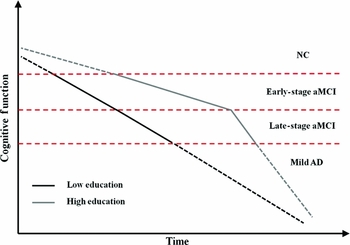
Furthermore, in terms of disease progression, early-stage aMCI participants with higher levels of education showed a slower decline, while late-stage aMCI participants with higher levels of education showed a more rapid decline. These findings suggest that participants with early-stage aMCI might have sufficient functional CR to overcome the pathological burden of AD, similar to those with NC (Evans et al., Reference Evans1993; Lyketsos et al., Reference Lyketsos, Chen and Anthony1999; Manly et al., Reference Manly, Schupf, Tang and Stern2005). Alternatively, it is possible that higher education has a direct effect on the degree and progression of AD pathology. Further longitudinal studies using amyloid imaging would be needed in order to test this hypothesis. However, when participants with higher levels of education progressed to the stage of late-stage aMCI, they experienced more rapid cognitive decline, similar to those with AD (Teri et al., Reference Teri, McCurry, Edland, Kukull and Larson1995; Stern et al., Reference Stern, Albert, Tang and Tsai1999; Amieva et al., Reference Amieva2005; Scarmeas et al., Reference Scarmeas, Albert, Manly and Stern2006; Bruandet et al., Reference Bruandet2008). These results are shown schematically in Figure 1. Thus late-stage aMCI might be the starting point of rapid cognitive decline in patients, where the AD pathology becomes too severe to be compensated for by more efficient brain activity.
Hypothetical curves of cognitive change following the clinical stages of Alzheimer's disease. In the stages of normal cognition and early-stage aMCI, the slope of cognitive decline is steeper in poorly educated participants. From the stage of late-stage aMCI onward, cognitive dysfunction progresses faster in high-education participants. AD = Alzheimer's disease; aMCI = amnestic mild cognitive impairment; NC = normal cognition.

In this study, the association between higher education and faster cognitive decline was observed only in the cognitive domains of language and memory. The reason why education plays different roles for CR according to cognitive domain is important, but not entirely known. The disparity might be due to the brain regions where neurodegeneration occurs. Previous studies have shown that participants with aMCI display cortical thinning most prominently in the medial and lateral temporal regions of the brain. That is, in late aMCI, cortical thinning in these regions is so severe that sufficient neural substrate no longer remains, which leads to faster decline in the memory and language domains. This suggestion is supported by a previous study involving AD patients whose cortical thinning might be more widely distributed than that of patients with aMCI. The previous study suggests that participants with higher education show faster rates of cognitive decline in frontal functions, such as executive speed, verbal fluency, abstract thinking, and memory function (Amieva et al., Reference Amieva2005; Scarmeas et al., Reference Scarmeas, Albert, Manly and Stern2006). Future aMCI studies about topographical differences, in terms of the impact of education on longitudinal changes in cortical thickness, may be beneficial for identifying the regions responsible for the CR by education in aMCI.
The current study has limitations. First, our participants were recruited in the memory clinic, which limits the generalization of our finding. Second, the variability in follow-up duration may also suggest a possibility of selection bias caused by high attrition rate. Although additional analyses using data between 12 and 24 months after baseline evaluation showed significant interaction between education and aMCI stage, our results should be cautiously interpreted. Third, the follow-up period was relatively short. Fourth, we did not control the possible confounders such as continuous mental activity, regular social gathering, and occupational attainment because these data were obtained from the second or third follow-up. Finally, apolipoprotein E (APOE) genotyping, which carrier of APOE ε4 allele was considered to have lower brain reserve than non-carrier (Burggren et al., Reference Burggren2008), was performed in only 157 (63.1%) of the 249 participants. However, mixed effect models separately performed for APOE ε4 carriers and non-carriers (see Table S5, available as supplementary material attached to the electronic version of this paper at www.journals.cambridge.org/IPG) showed generally similar pattern of education effect on CDR-SOB. Also, the prevalence of APOE ε4 carrier in the aMCI sample is similar to that seen in other prospective study (Ellis et al., Reference Ellis2009).
Conflict of interest
None.
Description of authors’ roles
B. S. Ye and S. W. Seo designed the study; All authors contributed to the acquisition of data and carrying out of the study; Statistical analyses and interpretation of data were performed by B. S. Ye, S. W. Seo, and Y. Lee; B. S. Ye and S. W. Seo prepared the first draft; all authors revised the content critically for important intellectual content and approved the final version.
Acknowledgments
This study was supported by a grant from the Korea Healthcare Technology R&D Project, Ministry of Health and Welfare, Republic of Korea (A102065 & A070001).