

Introduction
The environmental impact of milk production embraces several distinct components including; i) emissions of greenhouse gases to the atmosphere, ii) changes in land use which have adverse consequences for biodiversity and carbon sequestration, such as the destruction of rainforests for production of soyabean and palm oilseeds and the conversion of natural grasslands to arable cropping for grains and other human and animal food raw materials, and iii) undesirable consequences of land management on and around intensive livestock units, including pollution of water courses from high levels of fertiliser and manure application to soils, inappropriate storage and management of manure and emissions of ammonia to the atmosphere.
Greenhouse gas emissions (GHG) from livestock are principally methane (CH4) from enteric fermentations and from manure storage, and nitrous oxide (N2O) from fertiliser nitrogen (N), from grazing returns of N to soils, from manure N during storage and after application to soils. Emissions are conventionally expressed in terms of global warming potential (GWP), defined as carbon dioxide equivalents (CO2e) per unit of livestock product - whole milk in the case of dairy cows. It is difficult to measure GHG directly on farms, so indirect assessments related to GHG are often used as indicators. Indirect indicators relevant to the dairy cow include feed conversion efficiency, defined as energy corrected milk yield per day per kg of total diet dry matter (DM) consumed per day, which, since methane is closely and directly related to DM intake (Mills et al., Reference Mills, Crompton and Reynolds2008), is inversely related to methane per kg of milk (Colman et al., Reference Colman, Beever, Jolly and Drackley2011). Nitrogen use efficiency (NUE), output of N in milk as a proportion of total nitrogen intake, is an indirect indicator of nitrous oxide emissions since a low NUE indicates high excretion of N in manure. The proportion of female dairy cattle calving for the first time annually is an indicator of cow fertility and longevity – a low proportion shows that the contribution to total herd GHG from herd replacements is likely to be relatively low (Garnsworthy, Reference Garnsworthy2004).
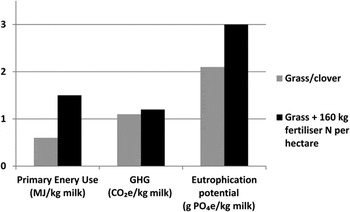
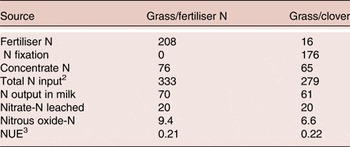
The economic strength of New Zealand milk production lies in the ability to produce milk solids (MS) at relatively low cost by controlled intensive grazing of high-quality pasture. However, there are consequential environmental weaknesses and risks associated with intensively grazed pastures. Thus the efficiency of conversion of feed N into milk N by New Zealand cows grazing high-quality pasture has been estimated at less than 0.2 for some pasture-based systems based on artificial fertiliser N, since NUE is inversely related to total N intake (Dewhurst, Reference Dewhurst2006; Ledgard et al., Reference Ledgard, Schils, Eriksen and Luo2009). However, changing from fertiliser N to a clover-based system is ineffective. In a three year study with cows yielding an average of 25 kg milk/day there was little difference in NUE between grass plus fertiliser N and a grass/clover system with minimal fertiliser N because, due to atmospheric N fixation by clover, the total N inputs to the two systems were broadly similar. Nitrate leaching was also similar between the two systems (Table 1). There may be other benefits to be gained from reducing fertiliser N, including less primary energy use and lower potential water eutrophication (Figure 1).
Primary energy use, GHG and eutrophication potential from dairy farmlet systems comprising grass/clover or grass only receiving zero or 160 kg fertiliser N per hectare per year (from Ledgard et al., Reference Ledgard, Schils, Eriksen and Luo2009).

Average1 annual nitrogen budgets (kg/ha) for grass/fertiliser N and grass/clover milk production systems (Schils et al., Reference Schils, Boxem, Jagtenberg and Verboon2000).

1 Three-year, 2 Includes purchased forages and atmospheric N deposition, 3 N output in milk/total N input.
Milk from grazing cows contains relatively higher concentrations of urea compared to housed cows given diets based on conserved grass, associated with elevated concentrations of urea in blood (Macrae et al., Reference Macrae, Whitaker, Burrough, Dowell and Kelly2006). Hence the efficiency of conversion of pasture N into true protein in milk is likely to be even lower, with implications for the production of coagulated milk products such as cheese.
In New Zealand, milk urea nitrogen content is measured routinely on farms. However, as an indictor of urine N excretion, trials have shown this to be a poor guide. Published work by Hof et al. (Reference Hof, Vervoorn, Lenaers and Tamminga1997) investigating the fate of N in dairy cows given diets with different energy: protein ratios, reported that N losses from the rumen only explained 50% of the variance in MUN and, while N losses from metabolic activity accounted for 47–100% of urine N, this was not related to MUN measurements.
Pasture composition
Grazed pasture grass in New Zealand typically contains more than 200 g crude protein (CP) per kg DM (Holmes et al., Reference Holmes, Brookes, Garrick, Mackenzie, Parkinson and Wilson2002; Dewhurst, Reference Dewhurst2006), with concentrations often exceeding 250 g CP/kg DM in leafy spring herbage (Lincoln University, 2016). By contrast, cows given total mixed rations normally receive diets formulated to contain only 170 to 180 g CP/kg DM, even when yielding up to 12,000 litres of milk (960 kg milk solids) per lactation (Chamberlain and Wilkinson, Reference Chamberlain and Wilkinson1996).
Risks to animal health from grazing leafy, high protein grass include diarrhoea (Kononoff and Heinrichs, Reference Kononoff and Heinrichs2017), bloat (Berg et al., Reference Berg, Majak, McAllister, Hall, McCartney, Coulman, Goplen, Acharya, Tait and Cheng2000), acidosis, (O'Grady et al., Reference O'Grady, Doherty and Mulligan2008) rapid weight loss, infertility (McCormick et al., Reference McCormick, French, Brown, Cuomo, Chapa, Fernandez, Beatty and Blouin1999), nitrate/nitrite poisoning (methemoglobinemia) (O'Hara and Fraser, Reference O'Hara and Fraser1975) and hypomagnesaemia (Cheeke, Reference Cheeke1995; Crawford et al., Reference Crawford, Massie, Sleper and Mayland1998). The high concentration of protein in young grass may also lead to sub-clinical ammonia toxicity as a high proportion of the protein is degraded rapidly and reduced to ammonia in the rumen (O'Hara and Fraser, Reference O'Hara and Fraser1975).
The concentration of protein in temperate pasture grasses decreases progressively as the plant matures, due to the development of plant cell wall material and accumulation of water-soluble carbohydrate (WSC) in stem tissue. The typical decline in CP is from about 330 g CP/kg DM at the three-leaf stage of growth to about 70 g CP/kg DM at full flowering (Beever et al., Reference Beever, Offer, Gill and Hopkins2000). Therefore, allowing the grass plant to enter reproductive growth and produce flowering heads prior to its consumption by the grazing animal is a possible strategy to reduce pasture CP concentrations. However, pasture digestibility, and hence ME concentration, are reduced substantially as a consequence of advancing plant maturity, especially after ear emergence (Beever et al., Reference Beever, Offer, Gill and Hopkins2000) and the grazing animal may reject plant stems in favour of leaves (Stockdale and Dellow, Reference Stockdale and Dellow1995). Topping and silage removal can maintain leaf tissue growth and high CP levels even in periods typically associated with stem growth (Waldron, Reference Waldron2016).
Selection of leaf in preference to stem results in the grazing animal consuming herbage which is of higher quality than the average for the whole sward. This difference in the composition of grazed herbage compared to the mean for the sward is known as the grazing selection differential. The grazing selection differential for CP has been quantified under Australian conditions at between 1.1 and 1.5, depending on the efficiency of pasture utilisation (Stockdale and Dellow, Reference Stockdale and Dellow1995; Jacobs et al., Reference Jacobs, McKenzie and Ward1999). Thus, at a relatively high efficiency of pasture utilisation (e.g. 75%), which would be a reasonable target under well-managed New Zealand systems, the grazing animal can consume herbage about 10% higher in CP concentration than the average i.e. 220 g CP/kg DM in the herbage DM intake when the average for the pre-grazed pasture allowance is 200 g CP/kg DM. With more mature herbage on offer and/or higher quantities of residual herbage (and lower efficiency of utilisation) the grazing animal effectively negates any reduction in overall pasture CP concentration by rejecting material of below-average CP.
Reduced pasture availability and lower herbage quality can combine to depress herbage intake later in the grazing season. Although these effects are most common as a consequence of drought in rain-fed pastures, daily pasture growth rate can also be reduced in irrigated pastures under frequent defoliation as a consequence of high ambient temperatures (Fulkerson et al., Reference Fulkerson, Slack, Bryant and Wilson2003), which can often occur in mid and late summer. The result is decreased milk production and the premature termination of lactation. Thus, the average number of days in milk over the 12-year period 2003/4 to 2014/15 was only 266 days (Livestock Improvement Corporation, 2015), 39 days lower than the typical 305-day lactation and representing a significant loss of income to the producer.
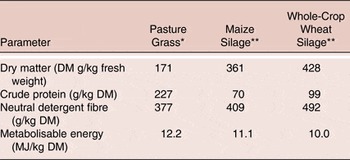
The typical composition of well-managed NZ pasture grass, maize silage and whole-crop wheat silage is shown in Table 2. Both maize and whole-crop wheat silages are typically lower in crude protein and higher in dry matter and cell wall (neutral detergent fibre) than pasture grass. Typical concentrations of ME are lower in both maize silage and whole-crop wheat silages than in pasture grass, reflecting the emphasis in NZ pasture management on offering cows young, leafy herbage at all times.
Typical composition of young pasture grass, maize silage and whole-crop wheat silage

* Mean annual values for pre-grazing samples cut to 3.5 cm residual grass height at the Lincoln University Dairy Farm between 20 September 2011 and 26 May 2015 (Lincoln University, 2016). ** De Ruiter et al., Reference De Ruiter, Dalley, Hughes, Fraser, Dewhurst, Rattray, Brookes and Nicol2007
Despite its relatively high concentration of metabolisable energy (ME; Table 2), cows grazed on spring pasture grass in early lactation can lose weight and show a prolonged postpartum anoestrous interval (Rhodes et al., Reference Rhodes, McDougall, Burke, Verkerk and Macmillan2003), which can reduce the rate of submission for mating. It is unclear whether the rapid weight loss by cows grazing high-quality spring pasture is due simply to inadequate daily herbage allowance imposed in an attempt to achieve efficient pasture utilisation, or whether the weight loss is a consequence of a rapid passage of feed and microbial protein through the rumen leading to a relatively high supply of amino acids to the small intestine. Ørskov et al. (Reference Ørskov, Reid and Tait1987) recorded major weight losses in cows in early lactation given a high forage diet supplemented with fishmeal as the animals attempted to balance the supply of amino acids and glucose to the mammary gland by mobilising more than 2 kg of body fat daily to compensate for the shortfall in energy supply relative to protein supply, in an attempt to rebalance the important ratio of energy to protein for milk synthesis. Rhodes et al. (Reference Rhodes, McDougall, Burke, Verkerk and Macmillan2003) concluded that the most predictable management strategy for reducing the postpartum anoestrous interval in cows on pasture-based systems was to improve body condition during the pre-partum period.
Nitrogen excretion by the dairy cow
Nitrogen excretion is directly related to N intake. Protein in feed is converted by rumen bacteria to ammonia, some of which enters the blood directly from the rumen and is excreted in urine, making it unavailable to the host animal for growth or milk production. Nitrogen in urine is the primary source of N excretion from dairy cows and can have a large impact on the environment via soil nitrate leaching and atmospheric N emissions (Ministry for the Environment, 2015).
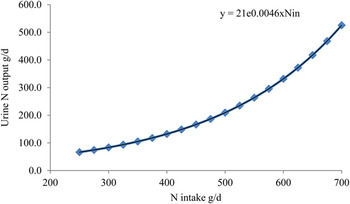
In dairy cows, between 100 and 400 g/kg of consumed N is excreted in milk, around 500 g/kg in urine and 250 g/kg in manure (Haynes and Williams, Reference Haynes and Williams1993; Jarvis, Reference Jarvis1993; Pacheco and Waghorn, Reference Pacheco and Waghorn2008). When N intake increases, urinary N output increases concurrently (Kebreab et al., Reference Kebreab, France, Mills, Allison and Dijkstra2002). It is therefore possible to predict urinary N output per cow from N intake (Gonda and Lindberg, Reference Gonda and Lindberg1994; Castillo et al., Reference Castillo, Krebreab, Beever and France2000; Figure 2).
Relationship between total N intake and predicted urine N output (Castillo et al., Reference Castillo, Krebreab, Beever and France2000).

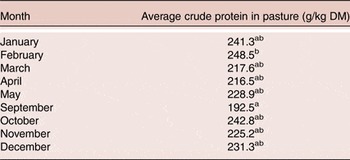
Analysis of data from the South Island Dairy Development Centre (Lincoln University, 2016) between 2011 and 2015 inclusive revealed an average pasture crude protein concentration of 227 ± 31.8 g/kg DM with a range from a minimum 170 to maximum 315 g/kg DM (Waldron, Reference Waldron2016). Protein levels vary over the growing year, due to ambient conditions, regrowth after silage production and maintenance by topping. Pasture protein levels averaged over the five-year period by month are shown in Table 3.
Average pasture protein content by month over a five-year period (adapted from Lincoln University, 2016)

Means not sharing a letter sdiffer significantly P < 0.05
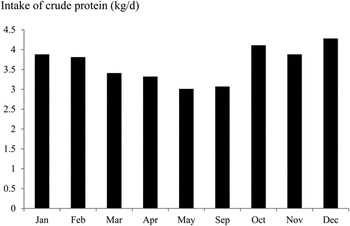
Average daily intake of CP, calculated from the reported pasture DM intake, is shown in Figure 3 for each month of the nine-month lactation period.Taking these average values for intake of CP together with the minimum and maximum levels reported in the data over the five-year period, urine N excretion was calculated assuming an average daily intake of pasture of 15.1 kg DM per cow per day (Clement et al., Reference Clement, Dalley, Chapman, Edwards and Bryant2016). Average predicted urinary N excretion (as per line equation extrapolated from the Castillo et al. (Reference Castillo, Krebreab, Beever and France2000) model) was 262 g/day (range 139 to 696 g N/day). Taking the average stocking density for 2014–15 of 2.87 cows per hectare (Dairy NZ, Reference Dairy2016), this would equate to an average daily urinary N excretion of 751 g N per ha (range 399 to 1998 g N/ha).
Average daily intake of crude protein, based on pasture crude protein concentrations in Table 3.

Feeding strategies to reduce N excretion
Including feeds in the total diet of lower protein concentration than high-protein grazed pasture would constitute a potentially useful strategy for reducing total N intake and reducing N excretion. To balance the excess protein in pasture grass, so that the whole diet contains about 180 g CP/kg DM, maize or whole-crop wheat silage DM should comprise about 300 g/kg total diet DM. For a cow eating 15.1 kg total DM per day (Clement et al., Reference Clement, Dalley, Chapman, Edwards and Bryant2016) and offered grazing containing 227 g CP/kg DM (Table 2), the level of supplementation of pasture grass with low protein maize or whole-crop wheat silage should be about 5 kg DM/cow/day to achieve a whole diet CP concentration of 180 g/kg DM. The cow will eat the supplement in preference to grazing so consumption of the supplement will reduce grazed pasture intake. At an assumed substitution rate (as an illustration of the effects) of 0.7 kg decrease in grazed herbage DM intake per kg supplement DM (Holmes and Roche, Reference Holmes, Roche, Rattray, Brookes and Nichol2007), herbage intake is reduced to 12 kg DM/day for the supplemented diet, but total DM intake is higher at 17.5 kg/day.
Several factors can affect the response in milk yield to pasture supplementation – growth rate and stage of maturity of herbage, daily herbage allowance and stage of lactation. It is essential to adjust pasture stocking rate (cows per hectare per day) to take account of the substitution of grazed herbage by the supplement, which is likely to be lower when herbage growth is reduced by low soil or ambient temperatures or lack of rainfall than when herbage growing rapidly.
A possible nutritional strategy is proposed, in which grazed pasture is supplemented with maize or whole-crop wheat silage at 5 kg DM/cow per day, as described above for three defined periods where supplementation is anticipated to be of significant benefit: i) the dry period, ii) the first 100 days of lactation and iii) the last 50 days of lactation i.e. from 255 to 305 days in milk. In the following sections the expected responses and some actual responses to supplementation are discussed, using maize silage as the primary example low-protein forage.
Expected responses to pasture supplementation
The dry period
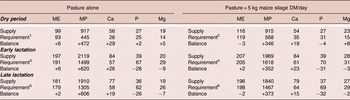
Estimated supplies of ME, metabolisable protein (MP), calcium (Ca), phosphorus (P) and magnesium (Mg), are shown in Table 4 together with estimated requirements for a 500 kg dry cow, 51 weeks post-calving and 39 weeks pregnant when grazed either on winter pasture as the sole feed or supplemented with 5 kg of maize silage DM per day. The values were generated using the RUMNUT diet formulation program (Version 5.2, Chalcombe, UK). The grazed winter pasture was assumed to contain 206 g DM/kg fresh weight, 10.7 MJ ME/kg DM and 190 g CP/kg DM. Pasture substitution rate was assumed to be 0.7 kg decrease in herbage DM intake per kg supplement DM (Holmes and Roche, Reference Holmes, Roche, Rattray, Brookes and Nichol2007). Predicted total DM intakes were 9.3 kg and 10.6 kg/day for unsupplemented and supplemented pasture, respectively.
Estimated supplies and requirements for ME, MP, Ca, P and Mg for a 500 kg cow given either well-managed grazed pasture alone or supplemented with 5 kg maize silage DM per head per day

1 Zero weight change, 2 +0.5 kg/day, 3 26 litres milk/day, 4 28 litres milk/day, 5 19 litres milk/day, 6 22 litres milk/day
Estimated supply of ME was expected to be increased by about 17% for the supplemented diet compared to the grass alone, sufficient to meet ME and MP requirements for a weight gain of almost 0.5 kg/day compared to zero weight gain on the grass-only diet. There were surpluses in the supplies of MP and Ca for both diets, illustrating the relatively low requirement of dry cows for protein and calcium. With the supplemented diet, MP supply remained substantially in excess of MP requirement even though the CP of the supplemented diet was only 135 g/kg DM and total feed intake, at 10.6 kg DM/day, was also relatively low (Chamberlain and Wilkinson, Reference Chamberlain and Wilkinson1996; Drackley, Reference Drackley2007), illustrating the relatively low requirement for MP in the dry cow (Thomas, Reference Thomas2004).
The surplus in the supply of Ca over requirement was lower, by 10 g per day, for the supplemented diet, compared to pasture grass alone, despite the higher intake of total DM, reflecting the lower concentration of Ca in maize silage compared to grass (MAFF, 1992), which might help to reduce the risk of hypocalcaemia post-calving.
By giving the cow maize or whole-crop wheat silages, which contain longer fibrous particles, the surface area of rumen papillae and their nutrient absorptive capacity may be increased, with possible benefits to rumen function in the early days of lactation (Wang et al., Reference Wang, Eastridge and Qiu2001; Castells et al., Reference Castells, Bach, Araujo, Montoro and Terré2012).
The first 100 days of lactation
Estimated supplies of ME, MP, Ca, P and Mg, are shown in Table 4 together with estimated requirements for a 500 kg cow in week 10 of lactation, not pregnant, yielding 26 litres of milk (i.e. 2.08 kg milk solids at 8% fat + protein) per day, losing weight at 0.5 kg/day and given either grazed pasture (composition as in Table 2) as the sole feed, or the same pasture supplemented with 5 kg maize silage DM per head per day (composition as in Table 2). Milk composition was assumed to be 4.5% fat and 3.4% protein.
With the unsupplemented diet, there was a substantial excess (620 g/day) of MP supply over requirement and a surplus of Ca. Supplies of P and Mg were less than estimated to meet requirements and the need for a supplementary source of these macro-minerals was indicated. Whether or not the cow achieved the milk output indicated by the supply of ME would depend on the achievement of both high pre-grazing pasture quality (as in Table 2) and its adequate consumption by the animal. Any reductions in pasture quality and in herbage intake are likely to result in further live weight loss, since milk yield is limited by energy supply rather than by protein supply at this stage of lactation (Ørskov et al., Reference Ørskov, Reid and Tait1987).
In the case of the supplemented diet, at an assumed substitution rate of 0.7 kg decrease in grazed herbage DM intake per kg supplement DM (Holmes and Roche, Reference Holmes, Roche, Rattray, Brookes and Nichol2007), predicted herbage intake was reduced from 16.0 kg DM/day for the all-grass diet to 12.3 kg DM/day for the supplemented diet, but total DM intake was increased overall to 17.1 kg/day. There was an expected increase of 10 MJ in total ME supply as a result of supplementation, equivalent to an additional 2 litres of milk or 2.24 kg MS/day compared to 2.08 kg MS/day on the unsupplemented diet. The expected response was therefore 160 g MS, or 33 g MS/kg supplement DM.
Although the CP concentration of the total diet was reduced to 177 g CP/kg DM by supplementing the pasture with 5 kg of maize silage DM/cow per day there was still a surplus of MP supply over requirement of 352 g/day. There were also deficits in supply of P and Mg, which would require rectification via supplementary minerals.
The inclusion of low-protein supplement in the diet should reduce urinary N excretion per cow due to a reduction in total daily N intake (95 g/day). But if total cow live weight per grazed hectare is increased to compensate for the reduction in herbage intake the overall effect on urinary N excretion per hectare may be negligible, especially if there is no reduction in fertiliser N input per hectare of grazed pasture (De Klein et al., Reference De Klein, Monaghan, Ledgard, Shepherd, Edwards and Bryant2010).
At lower substitution rates, total ME intake would be increased more significantly, but the effect on reducing total intake of CP and potentially on urinary N excretion would be less. Additionally, the increased total energy intake during this period may be expected to increase milk protein yield (Chamberlain and Wilkinson, Reference Chamberlain and Wilkinson1996). Other expected responses may include a more rapid return to oestrous cycling and an increase in the percentage of cows that are confirmed pregnant at 150 days in milk (i.e. a lower empty rate).
The final 50 days of lactation
The main objectives in supplementing pasture at this late stage of lactation are to maintain output of milk solids and achieve an increase in cow live weight when pasture quality and quantity are decreasing. A target weight gain of 0.25 kg/day should be achievable at this stage of lactation. Together with weight gained in the dry period the overall strategy should be to reach a similar body condition to that at calving 12 months previously (Chamberlain and Wilkinson, Reference Chamberlain and Wilkinson1996).
Estimated supplies of ME, MP, Ca, P and Mg, are shown in Table 4 together with estimated requirements for a 500 kg cow in week 38 of lactation, 26 weeks pregnant, yielding 19 litres of milk (1.52 kg milk solids) per day comprising 4.5% fat and 3.4% protein and gaining weight at 0.25 kg/day. These cows are given either grazed pasture (composition shown in Table 2) as the sole feed, or the same pasture supplemented with 5 kg maize silage per head per day (composition as in Table 2). Supplemented cows are estimated to be yielding 22 litres of milk (1.76 kg milk solids) per day of 4.5% fat and 3.4% protein. Total DM intakes are assumed to be 14.5 and 16.3 kg DM/day for the grass-only and the supplemented diets, respectively, at an assumed pasture substitution rate of 0.7 (Holmes and Roche, Reference Holmes, Roche, Rattray, Brookes and Nichol2007).
In the case of the unsupplemented high-quality pasture, there is still a large excess of MP supply over requirement (606 g/day) because the CP concentration is assumed to remain in excess of 200 g/kg DM (Table 3). If less fertiliser N is applied to the milking platform at this late stage of the season, the CP concentration in the pre-grazing herbage might be reduced somewhat. Pasture CP would have to be as low as 140 g/kg DM for MP supply to match the requirement for MP for a milk yield of 19 litres/day. Supplies of P and Mg were less than the estimated requirements, and hence the cows would require a supplementary source of these minerals.
With the supplemented diet, there is an estimated increase of about 15 MJ in total ME intake as a result of supplementation with maize silage, equivalent to about 3 litres of milk (22 litres compared to 19 litres of milk per day on the unsupplemented diet), or 240 g milk solids (48 g MS/kg DM). The excess of MP supply over requirement is reduced somewhat to 373 g/day, with deficits in the supply of P and Mg remaining.
Effects of supplementation on nitrogen use efficiency
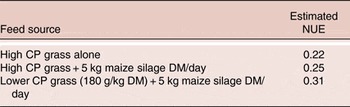
Estimated NUE for high CP grass alone, high CP grass plus maize silage and lower CP grass plus maize silage are shown in Table 5 for a 500 kg cow, eight weeks post-calving, not pregnant and not changing in weight, with milk solids yield of 2 kg/day. Grass alone (227 g CP/kg DM) gave a large surplus of MP and a relatively low NUE. Supplementing pasture with maize silage was reflected in a small increase in NUE, because grass was still 0.7 of total daily DM intake. A greater increase in NUE was achieved if the CP of the pasture was reduced to 180 g/kg DM. NUE may be increased by using grass cultivars with higher levels of water-soluble carbohydrate to improve the balance between rumen-degradable protein and fermentable energy (Miller et al., Reference Miller, Moorby, Davies, Humphreys, Scollan, Macrae and Theodorou2001).
Effect of grass crude protein (CP) concentration and supplementation on estimated NUE.

Overall effects of supplementation
In summary, supplementation of grazed pasture with 5 kg maize silage DM/head per day may be expected to:
-
• Reduce the CP concentration of the total diet and reduce total daily intake of N.
-
• Increase NUE and reduce nitrate leaching due to reduced N excretion in urine and manure.
-
• Increase ME intake and milk output in early and late lactation by 160 to 240 g milk solids respectively, a per-cow response of 33 to 48 g MS/kg supplement DM, assuming a pasture substitution rate of 0.7.
-
• Reduce the risk of excessive loss in body weight in early lactation and improve submission rate for mating.
-
• Reduce the excess in the supply of MP protein over MP requirement by between 25 and 40%.
-
• Increase the supply of available pasture as the result of supplementation.
Actual responses to pasture supplementation
Holmes et al. (Reference Holmes, Brookes, Garrick, Mackenzie, Parkinson and Wilson2002) and Holmes and Roche (Reference Holmes, Roche, Rattray, Brookes and Nichol2007) found that responses of 50 to 100 g MS/kg supplement DM were seen in experiments where stocking rate had been increased to account for reduced pasture intake, with some of the additional energy from the supplement being partitioned into weight gain. The type of supplement had little effect on response when calculated as g MS per MJ of supplement ME. They concluded that supplements could reduce the post-calving anoestrous interval.
Roche et al. (Reference Roche, Kay, Rius, Grala, Sheahan, White and Phyn2013) found that cows offered a generous allowance (up to 45 kg DM per cow per day) of spring pasture (220 g CP/kg DM) and supplemented with a pelleted concentrate (920 g crushed grain/kg DM, 129 g CP/kg DM) at either 3 or 6 kg DM/day for the first 12 weeks of lactation produced an average of 3.6 and 7 kg additional milk/day respectively, compared to cows given no supplement. Further, there were residual responses in weeks 13 to 15 inclusive of 2.3 for cows given 3 kg DM and 4.5 kg milk per day for cows given 6 kg concentrate DM daily. The immediate response was higher (1.19 kg milk/kg concentrate DM consumed) than the average recorded in a meta-analysis of grazing studies of 1 kg milk/kg concentrate DM (Bargo et al., Reference Bargo, Muller, Kolver and Delahoy2003) and the residual response was an additional 0.19 kg/kg concentrate DM. There were no effects of supplementation on milk composition, cow weight or body condition score. The higher level of supplementation reduced the diet CP concentration from 220 to 190 g CP/kg DM. Estimated NUE at peak milk yield of 29 kg/day in cows fed no supplement and 35 kg milk/day for cows given 6 kg concentrate DM/day were 0.27 and 0.36, respectively.
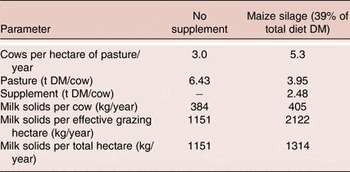
Glassey et al. (Reference Glassey, Jensen, Macdonald and Clark2007) recorded an average whole-lactation response of 97 g MS/kg supplement DM in a four-year farmlet trial in which groups of cows were stocked at 85 kg live weight/tonne of feed DM (including supplement) on perennial ryegrass-white clover pastures either with or without a daily supplement of maize silage. On a total hectare basis (i.e. including the area needed to grow the maize silage) the average whole-lactation response was 66 g MS/kg supplement DM. These responses were relatively high because the stocking weight per hectare of grazed pasture was increased in the supplemented group to account for the associated reduction in herbage intake. There was a 14% increase in output of milk solids per hectare of total feed input i.e. including the land area used to grow the maize silage (Table 6). However, the fertiliser N input to the grazing area was maintained at the same total input (200 kg/ha) for both groups. Consequently, annual N input per grazed hectare was estimated to be 67% higher for the supplemented group compared to the unsupplemented control group. Calculated nitrate leaching losses were high (70 kg N/ha per year) on the area of land used to grow the supplementary maize crop due to fertilser N input to grow the crop and increased soil porosity and oxygen diffusion following cultivations, which most likely increased nitrification (Ledgard et al., Reference Ledgard, Schils, Eriksen and Luo2009). The work highlighted the significance of integrating maize and cereal silage with grazed pasture in forage production strategies designed specifically to give an overall reduction in total N input to the system.
Responses to the strategic supplementation of grazed New Zealand dairy cows with maize silage (from Glassey et al., Reference Glassey, Jensen, Macdonald and Clark2007).

Clearly, the cost of the supplement and the price of milk paid to the producer are crucial to the success of any pasture supplementation strategy. Roche and Horan (Reference Roche and Horan2015) related break-even cost to response to supplement. At a response of 80 g MS/kg DM, the break-even cost was 0.05 x milk payout (NZ$/kg MS) but at a response of 40 g MS/kg DM the break- even cost was 0.025 x milk payout (NZ$/kg MS).
Potential constraints
An increase in the number of cows per hectare of pasture, to account for the substitution of grazed herbage by supplemental silage, can result in a greater number of paddocks requiring to be cut for pasture silage unless herd size is increased, especially if the fertiliser N input is maintained at the same level as that for paddocks grazed by unsupplemented cows. Excess herbage must be cut in a timely manner to maintain the required pattern of grass cover for future grazing. This places a premium on the availability of contractors and/or farm labour to undertake the cutting of relatively small areas of land at the correct time, which may not always be achievable. Thus a simpler way of accommodating the need for increased stocking rates when the supplement is being offered is to increase herd size while keeping paddock size and numbers constant.
The additional costs of purchasing and using maize and whole-crop cereal silages are critical factors, together with the value of milk solids, in determining the break-even response to supplementation. Potential effects of supplementation on cow fertility should also be included in any economic analysis.
It is vital that the supplement has a low CP concentration. Oilseed by-products such as palm kernel meal or soyabean meal are inappropriate, as they typically contain relatively high concentrations of protein, e.g. solvent-extracted palm kernel meal contains 187 g CP/kg DM (Feedipedia, 2017). Previously, in New Zealand use of palm kernel meal as a supplementary feed for dairy cows was unregulated. Levels have now been set at a recommended daily maximum of 3 kg fresh weight/head (NZARN, 2015) due to the risk of copper and mycotoxin toxicosis as well as an inappropriate fatty acid composition that affects milk quality (Morgan et al., Reference Morgan, Grace and Lilley2014). Delagarde et al. (Reference Delagarde, Peyraud and Delaby1997) illustrated the futility of using high-protein supplements such as soyabean meal or palm kernel meal, since urinary N excretion is increased as a result, thus defeating one of the main objects of the exercise.
The relatively poor aerobic stability of maize and whole-crop wheat silages is well known (Wilkinson, Reference Wilkinson2005). If this supplement is going to be used on farm successfully, care must be taken to ensure that the exposed feed face of silage does not remain exposed to air for long periods of time. A target rate of removal of 120 cm face depth per day in cool weather and 300 cm face depth per day in warm weather has been suggested (Wilkinson, Reference Wilkinson2005), though in practice this may not be achievable unless the silo is long and relatively narrow. Additives such as bacterial inoculants are available to assist in the control of aerobic spoilage and should be used if there is a past history of mouldy silage on the farm.
Conclusions
There are opportunities to increase output of milk solids per cow and per hectare of feed input and, theoretically, to improve efficiency of nitrogen use in intensive New Zealand milk production systems by using a simple strategy of supplementing grazed pasture with maize or whole-crop wheat silage in the winter dry period, during the first 100 days of lactation and for the final 50 days of lactation. Under good management the strategy should be economically worthwhile so long as the value of the milk payout justifies the extra cost of the supplement and the extra labour involved in its daily distribution to the animals. Care must be taken to ensure that the silage does not go mouldy during the feed-out period.
Acknowledgements
The authors would like to thank the New Zealand Foundation for Arable Research for assisting in the funding of Professor Wilkinsons fact-finding visit to NZ in 2015.
Declaration of interest
None