INTRODUCTION
The family Scorpaenidae comprises 219 valid species, 17 of which were only identified in the last ten years (Eschmeyer & Fong, Reference Eschemeyer and Fong2013). This family is divided into three sub-families with Scorpaeninae being the largest (195 valid species). The black scorpionfish, Scorpaena porcus (Linnaeus, Reference Linnaeus1758), is present in the Black Sea, in the Mediterranean Sea and in the eastern Atlantic from the British Isles to Azores, Canary Islands and Morocco (Hureau & Litvinenko, Reference Hureau, Litvinenko, Whitehead, Bauchot, Hureau, Nielsen and Tortonese1986; Eschmeyer & Fricke, Reference Eschmeyer and Fricke2013). This species is commonly found in inshore waters among rocks and seagrass beds (Hureau & Litvinenko, Reference Hureau, Litvinenko, Whitehead, Bauchot, Hureau, Nielsen and Tortonese1986).
MATERIALS AND METHODS
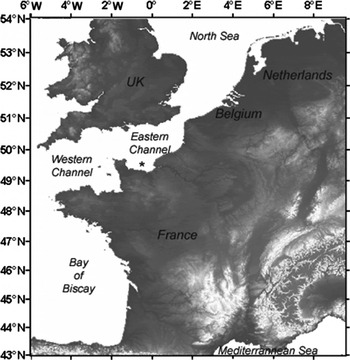
One specimen was caught on 15 October 2012 near the French coast off the port of Courseulles-sur-mer (France) at a depth of 27 m, in the eastern English Channel (Figure 1) by a French trawler fishing from the harbour of Port-en-Bessin, Normandy, France. The measurements and meristic characteristics were recorded in the fisheries laboratory of the French Research Institute for Exploitation of the Sea (IFREMER) at Port-en-Bessin. DNA barcoding of the specimen based on COI (cytochrome oxidase subunit 1) sequence was obtained for 652 bp. The sequence is registered in the BOLD Systems (http://www.boldsystems.org). The obtained sequence showed identity with sequences available in the BOLD confirming the species identification made using morphological characters.
Location of sampling site (star) of black scorpionfish (Scorpaena porcus) in the eastern English Channel.

The otoliths were removed, cleaned and sent to the IFREMER Sclerochronology Centre in Boulogne-sur-mer in order to estimate the age. The sagittal otoliths were selected and prepared for ageing. These are the largest otoliths, showing the widest increments for the clearest resolution of growth patterns. Age estimation was made by examining the sectioned otoliths under a compound microscope using the TNPC software (digital processing of calcified structures, www.tnpc.fr) with transmitted light.
RESULTS
SYSTEMATICS
Order SCORPAENIFORMES
Family SCORPAENIDAE
Subfamily SCORPAENINAE
Genus Scorpaena
Scorpaena porcus, Linnaeus Reference Linnaeus1758
The specimen measured 31.6 cm (total length ± 1 mm; standard length = 25.7 cm) and weighted 800 g (total weight ± 1 g).
DIAGNOSIS
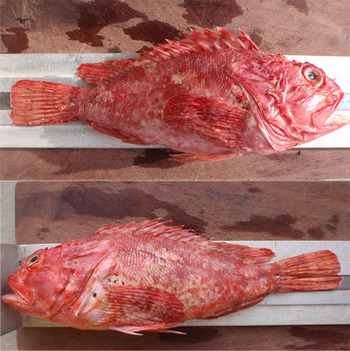
The fin meristics for this specimen are: the dorsal fin has 12 spines and 9 rays; and the pectoral fin has 16–18 rays and reaches to the second anal spine at most. The head has no fleshy strips, is large with the snout slightly smaller than orbit diameter and the scales on the body are small (Figure 2). All these characteristics correspond closely to those listed by Hureau & Litvinenko (Reference Hureau, Litvinenko, Whitehead, Bauchot, Hureau, Nielsen and Tortonese1986).
The specimen of black scorpionfish (Scorpaena porcus) caught in the eastern English Channel.

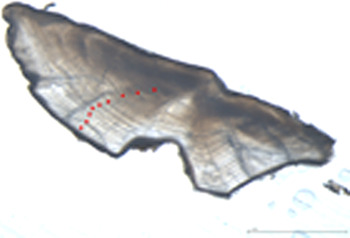
The sagittal otoliths were used for age determination (Jardas & Pallaoro, Reference Jardas and Pallaoro1992; Ünsal & Oral, Reference Ünsal and Oral1996; Koca, Reference Koca2002; Silvestri et al., Reference Silvestri, Voliani and Zucchi2002; Bilgin & Çelik, Reference Bilgin and Çelik2008; Demirhan & Can, Reference Demirhan and Can2009; La Mesa et al., Reference La Mesa, Scarcella, Grati and Fabi2010). This specimen was nine years of age (Figure 3).
Black scorpionfish (Scorpaena porcus) sectioned otolith observed under the transmitted light with the annotation of growth rings (red circles).

DISCUSSION
Scorpaena porcus are present in the Black Sea and in the Mediterranean Sea. There are two publications which identify this species in the north-eastern Atlantic, particularly the Azores (Borges et al., Reference Borges, Costa, Cunha, Gabriel, Gonçalves, Martins, Melo, Parente, Raposeiro, Rodrigues, Santos, Silva, Vieira and Vieira2010) and south of the British Isles (Hureau & Litvinenko, Reference Hureau, Litvinenko, Whitehead, Bauchot, Hureau, Nielsen and Tortonese1986). This study documents the first confirmed identification of a specimen, north of Azores and in the eastern English Channel along the French coast. The specimen has been registered in the collection at the Muséum National d'Histoire Naturelle (MNHN 2013-0840).
The age was determined using the otoliths as in previous Scorpaena porcus growth studies (Jardas & Pallaoro, Reference Jardas and Pallaoro1992; Ünsal & Oral, Reference Ünsal and Oral1996; Koca, Reference Koca2002; Silvestri et al., Reference Silvestri, Voliani and Zucchi2002; Bilgin & Çelik, Reference Bilgin and Çelik2008; Demirhan & Can, Reference Demirhan and Can2009; La Mesa et al., Reference La Mesa, Scarcella, Grati and Fabi2010). The age of this 31.6 cm-long specimen is estimated to be 9 years old. It is one of the largest and oldest specimens recorded. One recorded specimen was observed in the Black Sea with a total length of 31.7 cm and total weight of 693 g (Bilgin & Çelik, Reference Bilgin and Çelik2008). The age, length and weight of this specimen, compared to established growth models from different areas, shows a comparable mean value to the growth model for the Mediterranean Sea and the Black Sea (Bilgin & Çelik, Reference Bilgin and Çelik2008; Demirhan & Can, Reference Demirhan and Can2009; La Mesa et al., Reference La Mesa, Scarcella, Grati and Fabi2010). Fish growth in shallow waters is principally influenced by seawater temperature (Wootton, Reference Wootton1990). This environmental factor could explain observed growth differences between sea areas or latitudes (Munch & Salinas, Reference Munch and Salinas2009; Pauly, Reference Pauly2010). Therefore this specimen is not thought to be part of an established population in the eastern English Channel. This theory has been applied to other rare species observed in the eastern English Channel (Mahé et al., Reference Mahé, Cochard, Quero, Sévin, Bailly and Tétard2012, in press). Individuals that live at the boundary of their normal range might migrate from as far south as the Azores to the north when the environmental conditions, such as sea temperature, salinity and food availability, allow for it (Poulard & Blanchard, Reference Poulard and Blanchard2005; Rose, Reference Rose2005). Another possible explanation of the presence of this one specimen in the eastern English Channel could be anthropogenic—a release from an aquarium for example. Either way this specimen seemed to have adapted to the environmental conditions in the eastern English Channel.
ACKNOWLEDGEMENTS
We are grateful to Mr Carl Marie, the fisherman who provided the sample to IFREMER, from his boat ‘Regarde Ailleurs’. This study was supported by IFREMER. We would especially like to thank Jon Elson, Cefas, for his valuable help in improving the English in this manuscript. We also thank all the anonymous referees for their comments and suggestions.