Part I: The Find
The process of recovering the carving began in 2003–2004, when a team consisting of Ladakhi urban planner Diskit Dolker, Tibetan photographer Lhala and André Alexander compiled an inventory of historic structures in the town of Leh for the Tibet Heritage Fund (THF).Footnote 1 In the yard of the old Tak house in Leh, a stone Buddha, partly buried in the soil, was recorded by the survey team. The stone was about two metres high, but it was impossible to guess how much was still underground. The carved figure was buried from below its knees. Most of the face was missing, but parts of a crown were visible. On the right (the Buddha's left) side was a kneeling figure and an inscription in Tibetan that appeared to be illegible. The stone was quite flat, only about 25 centimetres deep, and the carving did not have a very deep relief.
The Tak house stands prominently along the Stalam path leading from the Manikhang area to Leh palace, and has been an abandoned ruin for more than a generation. The Tak family are Ladakhi Muslims, but the house must have originally belonged to a Buddhist family. Some of the walls have remnants of Buddhist-style decorative wall paintings, such as can often be found in the homes of wealthy Buddhist Ladakhis. The Buddha image stood in the courtyard of the house, which had become an open dumping ground where stray dogs lived. This revelation gave rise to some concern, but at the time this matter could not be addressed.
Emergency Conservation
In 2008, stone and wall painting restorers Christine and Patrick Jürgens were hired by THF to work on mural paintings in Serkhang monastery in the Amdo region of Tibet, presently the Chinese province of Qinghai. However, due to the massive Tibetan uprising in the spring of 2008, the entire region was closed to foreigners. Stuck in Nepal, the two restorers agreed instead to come and work in Ladakh for THF's conservation programme, managed by André Alexander. The programme included both the rehabilitation of the old town of Leh and the conservation of mural paintings in Alchi Tsatsapuri and other outlying temples. When Patrick Jürgens was shown the Buddha image in the Tak courtyard, he happily agreed to investigate it.
The stone photographed in 2008

Jürgens gave the following analysis of condition and damage. The stone was local granite, probably quarried in the vicinity, as granite is still quarried today towards Shey town. The stone was affected by scaling and flaking, with small pieces and larger stone layers becoming detached from the surface. This was probably caused by the reaction of salt deposits to humidity. There was also some discoloration of the stone, probably caused by migrated iron components in the stone. The decision was made to perform emergency consolidation to avoid further loss of the carving. As ideal conservation materials were not available at that time, Patrick Jürgens performed emergency pointing at the edges of the affected areas with epoxy and polyurethane-bounded mortar, and soft-cleaned with toothbrushes. Details of the image and parts of the inscription became more legible. Readings were not attempted at this stage, as questions about the stone's future conservation had priority. Also, it was possible that more text might be found on the portion still buried. The conservator strongly recommended that the image should be lifted out of the soil to prevent further decay by salts and humidity, and also to avoid vandalism. The Tak family said they would be happy to have the statue moved. The question was: where to move it to?
In 2009, the Ladakhi researcher Sonam Phuntshogs from Achinathang was shown the stone image by the THF team. He agreed to contact the Ladakh Buddhist Association (LBA) to find out whether they could offer it a new permanent home. The LBA welcomed the idea of recovering the image, but were at a loss regarding the location of a new home. The families living in the vicinity were then consulted about what was to be done. The Tak family actually had a mixed Buddhist-Muslim heritage, and family members were concerned that the statue should be moved to an appropriate new home. They suggested shifting it about 40 metres to the north-west, to the front of the Sankar Labrang.
The Sankar Labrang
The Sankar Labrang (Bsam dkar bla brang) is a small, two-storeyed building owned by Sankar monastery. Sankar monastery is the seat of Bakula Rinpoche, immediately to the north-west of Leh. The monastery's Labrang building is located in the old town of Leh, in the Manikhang neighbourhood. Manikhang is the area between the main bazaar of Leh and the historic Stalam path that leads up to the royal palace. Four huge stūpas standing at this point mark the beginning of historic Leh. In recent memory, the Sankar Labrang had a metalsmith's workshop downstairs, while upstairs lived the monk caretaker of the White Maitreya Temple (Byams khang dkar po), also known locally as “Street Maitreya”. The White Maitreya Temple dates back to the reign of King Drakpa Bumdé (Grags pa 'bum lde, r. ca 1410–1435), following the arrival of a mission sent to Ladakh by the Tibetan lama Tsongkhapa.Footnote 2
Over a decade ago Sankar monastery withdrew the caretaker, and the White Temple has since been in the care of the local Goba family. Subsequently, except for the metalsmith's workshop, the Labrang stood empty. The Leh-based THF team surveyed the building in 2005, and André Alexander proposed to convert it into a gallery which could serve as a point of introduction for visitors to the old town. Sankar monastery agreed to lease out the building for a nominal fee, and in 2006 THF rehabilitated the building. The workshop on the ground floor was kept, but the upstairs space was completely rearranged. All dividing walls were taken out and the ceiling raised, creating a larger room suitable for exhibitions. Below this room, and behind the metalsmith's workshop, is another room with interesting features. The door frame is carved with lotus patterns in a traditional monastic style, and in the interior stand five slightly less than lifesize stone Buddhas. As they are wider than the door frame, it appears that the Labrang was built around these images. Stylistically, they do not appear to date from before the fifteenth century.
Moving the Stone
The residents’ suggestion to move the stone by just 40 metres allowed the image to face in the same direction as before, and still serve as a place-marker for the edge of the historic town. The residents of the Manikhang area would thus still feel that they ‘owned’ the image. Therefore, The suggestion was accepted and preparations for the move began. First of all, the image had to be dug out from the ground carefully. With this done, the size could be determined: it was 2.8 metres high, 1.6 metres wide, and about 25 centimetres deep, with its weight estimated to be over three metric tons. The emergency consolidation treatments from the previous year were checked again before additional stabilising pointing was done by Sebastian Kolbe, a student of restoration from Germany. The image was then wrapped in foam mats for protection.
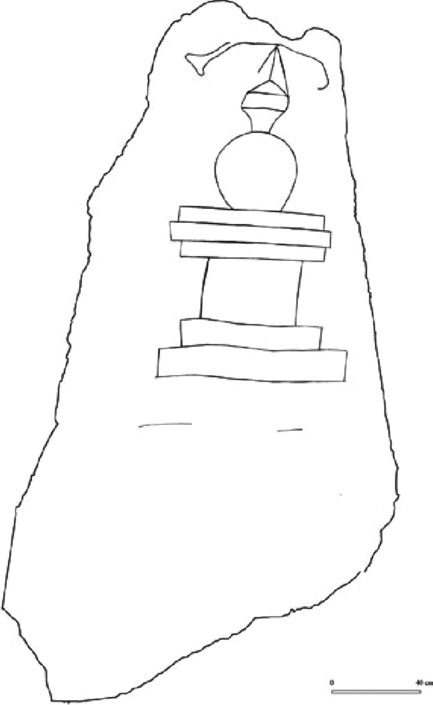
Sketch of the stūpa on the reverse of the stone

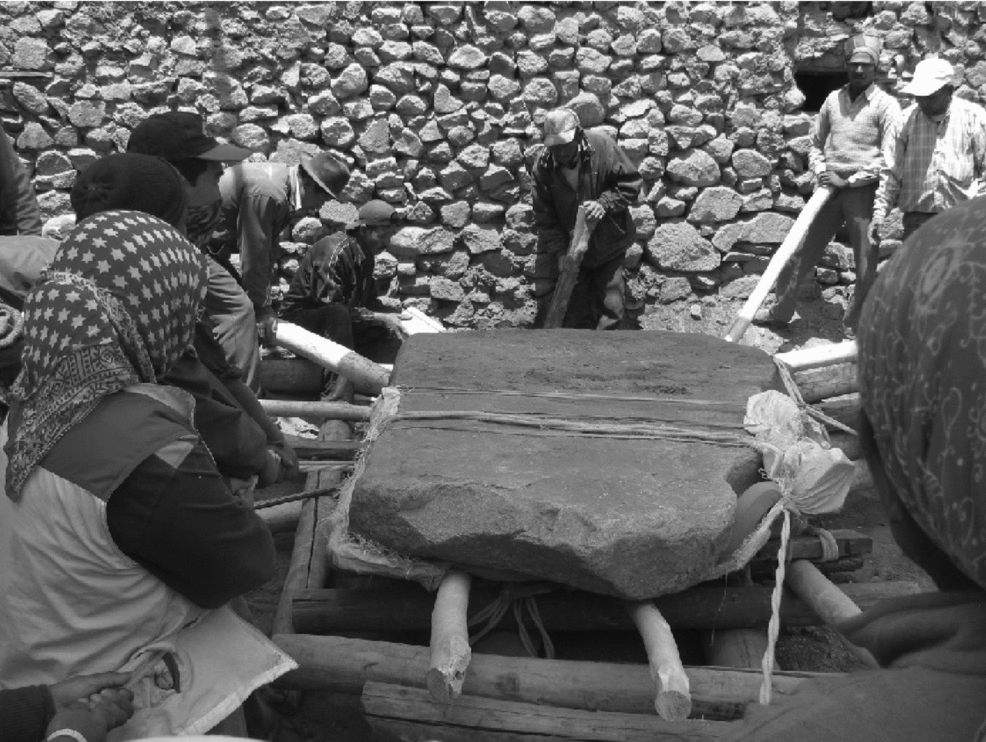
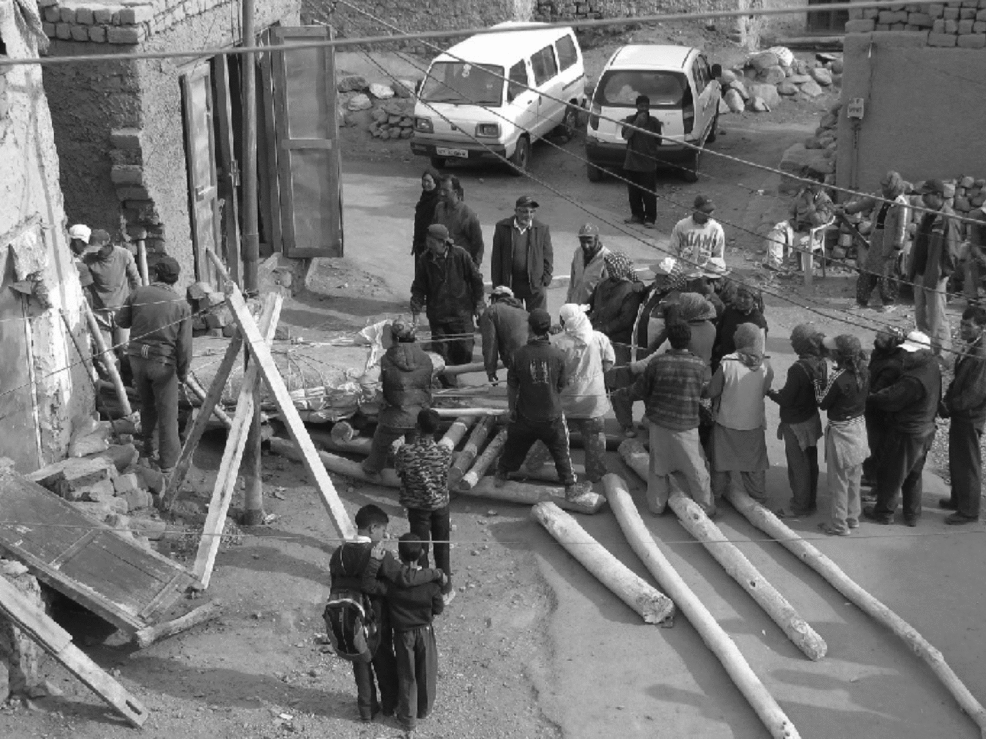
Everyone agreed that the image would be too heavy to be lifted, and too inaccessible for a crane or similar equipment. Therefore, round pieces of timber (rdung ma in Ladakhi) were prepared and laid on the ground, so that the image could be rolled. Six people then carefully lowered the image down onto the prepared beams. THF engaged its entire team of 45 artisans for the process. Every hand was needed to both push and pull the image over a path of round beams, with the image resting on a second layer of traverse beams.
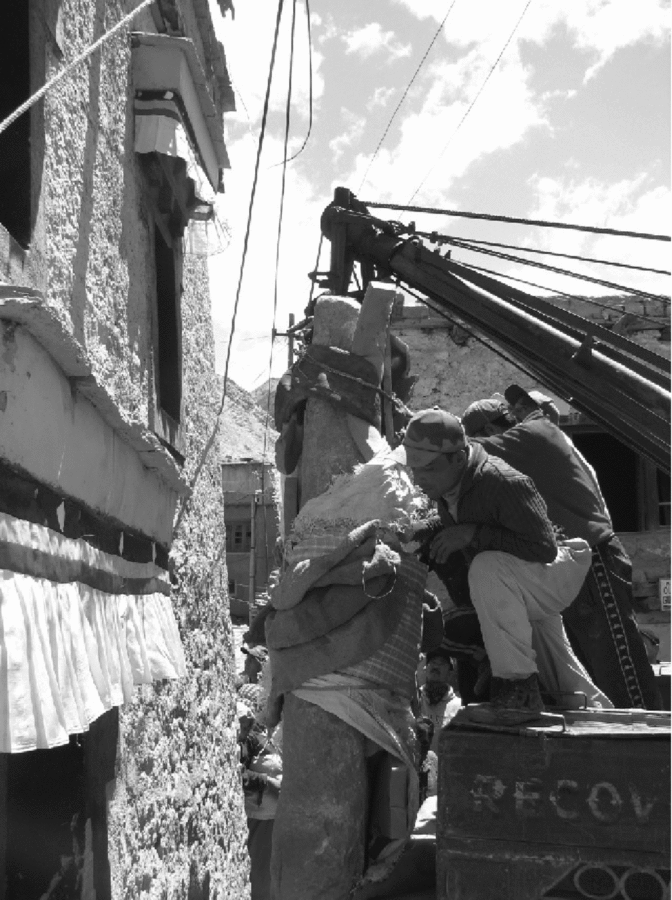
One of the walls of the Tak property had to be temporarily demolished, along with the doorway leading to the courtyard of the neighbouring Kamal Khan house. Both were subsequently rebuilt. One telephone pole also had to be moved. It took the entire day to bring the image to the front of the Sankar Labrang where, at six o'clock in the evening, it was left by an exhausted team. The next morning it was decided to enlist the help of a tow truck to lift, turn and properly place the image. With proper precautions to protect the image and care taken while lifting, this was time consuming and again took most of the day. The Nepali mason Lal Singh had simultaneously prepared a stone plinth, so that the image could stand above ground and so be protected from ongoing salt infiltration. During the work, it was discovered that there was carving on the back of the image. This was documented by Melodie Bonnat, a restoration student from France. The entire two-day project was supervised by André Alexander, restorer Patrick Jürgens, engineer Michel Radon and carpenter Tsering Dorje.Footnote 3
Understanding the Stone
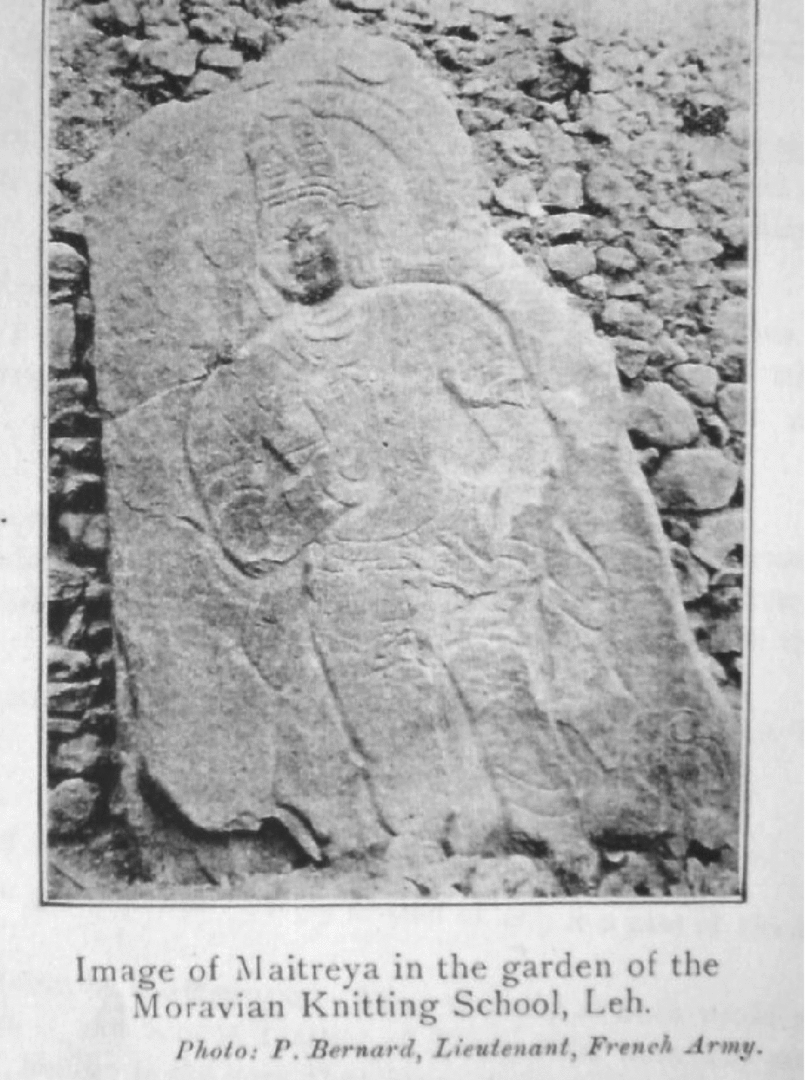
Another important discovery was that the stone Buddha had been previously noticed and photographed at the beginning of the twentieth century. A photograph entitled “Image of Maitreya in the garden of the Morovian Knitting School, Leh (Photograph by P. Bernard, Lieutenant, French Army)” had been published by the eminent German missionary scholar A.H. Francke in 1907.Footnote 4
Plate from Francke 1907a

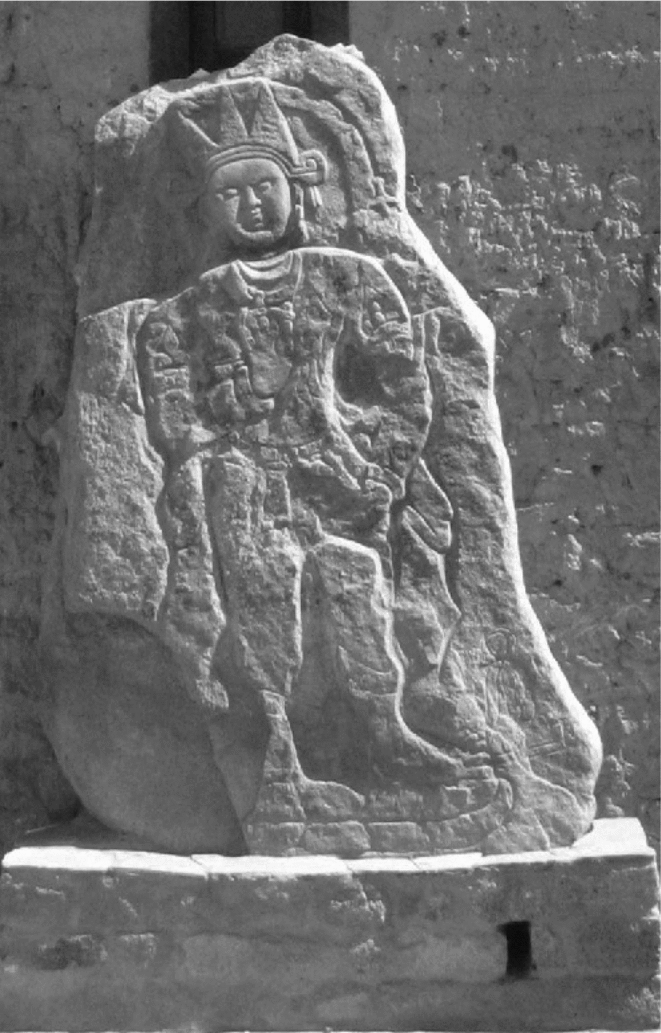
The stone carving in its new location with restored face

The local residents immediately commented on the figure's broken face; the old photograph showed the image in exactly the same position, buried at the same level in the ground, but with the face intact. The caption added the interesting information that the Moravian missionaries had used the property at the time; thus it seems to have passed from a Buddhist owner (as the wall painting fragments suggest) to a Christian and then a Muslim one.
With the historic photograph for reference, restorer Patrick Jürgens was able to reconstruct the face. He first sculpted it out of mud. After several discussions with Sonam Phuntshog and improvements of facial details, he made a gypsum mould, and finally cast the missing half of the face, mixing finely ground stone with polyurethane. This new face was then attached to the image, but it could be removed again without damage to the original, as UNESCO guidelines suggest.Footnote 5
The position of the image confirms information from residents and architectural research about the historic extensions of the town of Leh. Until about 60 years ago, the statue marked the edge of town, with fruit orchards and fields beyond. However, its existence gives rise to new questions. According to local research, there is little evidence of historic urban structures within the present old town of Leh before the reign of King Sengé Namgyal in the early seventeenth century (Seng ge rnam rgyal, r. ca. 1616–1642). He completed the construction of the royal palace which was begun under his father Jamyang Namgyal (‘Jam dbyangs rnam rgyal, r. ca. 1595–1616), and also erected the massive rammed earth walls that marked the extension of Leh at the time.Footnote 6 Next to the White Maitreya Temple and the five Sankar Labrang stone images, the stone carving seems to be further evidence for the existence of an early Buddhist community at Leh. It is possible that the image was moved there from elsewhere, however. We now turn to the inscription on the image, its identification and its place in the early religious traditions of western Tibet.
PART II: Inscription and Iconography
The Inscription
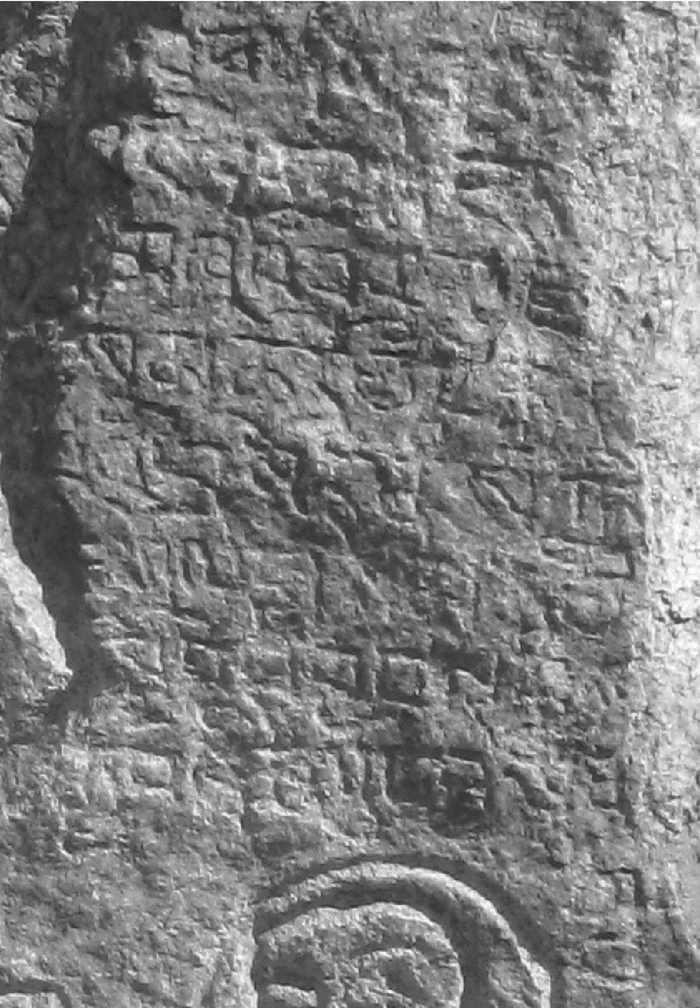
To the left of the main figure's feet is a kneeling female donor, which is similar to other images of donors in western Tibetan art dating from around the eleventh century.Footnote 7 On the right side, which is more badly damaged, there are fragments of Tibetan writing, but it is no longer possible to know whether there was a corresponding donor image. On the left side, below the donor image, is a lengthy inscription with the letters traced in red paint (the latter being a recent addition). The ends of each line seem to be missing, and on the whole the writing is not very legible. It is clear that the inscription was written after the image was carved, as its left side begins in the depression formed by the outline of the image. It also appears that there was no space left for the inscription at the time the image was carved, since the inscription has had to be fitted into the remaining space between the main figure and that of the donor. Thus the inscription is probably not a formal record of the creation and dedication of the image, but a later graffito.Footnote 8
The inscription

Although some local people believed the image to be a form of Avalokiteśvara (Tib. Spyan ras gzigs), A.H. Francke, as we have seen, believed that it was Maitreya, the future Buddha (Tib. Byams pa). However, he gave no reason for this identification. Francke also proposed a first reading of the inscription.Footnote 9 His version could not be corroborated on site, and attempts at producing an accurate rubbing proved to be unsuccessful, as the surface was too damaged. Instead, the inscription was photographed and sent to a number of experts.Footnote 10
The inscription
1 'phags pa byaMs [pa] . . .
2 su 'di zhar la na dzom . . .
3 te nam zhi'i bar du rje . . .
4 kyis mchod cIng rky[e]n . . .
5 pa'i bsod naMs kyis . . .
6 rje gol da+ng/sems c[an] . . .
7 sgrib pa byangs kyIs . . .
8 chab sri[d] chen lung +du stsa[l] . . .
9 gru[b] . . .
10 . . . byon dang . . .
The lower part of the inscription was not visible when Francke took his reading, and it became clear his reading of the upper part was unsatisfactory. However, his identification of the image as Maitreya was confirmed by our revised reading of the first line, which identifies the image as “Ārya Maitreya” (’Phags pa byams pa). The second line appears to refer to a meeting ([’]dzom) held in the presence of the image, rather than to its construction. This makes sense if the inscription is, as we suggest, graffito added at some point after the image was made. The remainder of the inscription records an aspiration that the merit of the offerings made by the lord (rje) should purify the defilements of the lords and their servants, and sentient beings in general. The phrase “lord and servants” (rje gol) is an archaic one. The final part of the inscription becomes more difficult to decipher, but seems to conclude the prayer with a request that the purification of defilements will result in favours being granted to the kingdom (chab srid).
Palaeographical Analysis
The style of the inscription is closely related to stone inscriptions from central Tibet dating from the late eighth to early ninth centuries, and inscriptions from eastern and western Tibet dating from the ninth and tenth centuries. Geographically, the closest forms for comparison are the rock graffiti at the Ladakhi sites of Saspol and Khalatse.Footnote 11 A similar inscriptional style is also found in eastern Tibet, in sites like Denma Drak and Lebkhog, from the ninth century.Footnote 12 Archaic features clearly visible in our inscription include the reversed gi gu vowel, and the positioning of the final letter in the syllable dang below, rather than to the right of the initial letter. Other features indicative of an early date include the following:
(a) All lines lack shading – that is, any differentiation in the width of the line.
(b) All of the letter forms in the inscription are angular: for example, the lower strokes of nga and ra are not curved.
The letters nga and ra.

(c) There is less variation in the length of the lines forming the letters than in the later Tibetan script. This is obvious in the length of the ‘heads’ of many letter forms. This feature also gives the letters a rather crude appearance compared with later examples of Tibetan writing, where there is much more variation in length. For example, the lines of the ‘head’ of the ka and ga extend almost as far downwards as the ‘leg’ at the far right of the letter. The same principle means that the area of ca described by curved strokes is large, and extends right up to the ‘head’. We also see the diagonal line in pha extending almost from one corner of the letter to the other.
The letters ga, ka, ca and pha.


The basis for most of these letter forms can be seen in the pillar inscriptions of the eighth century, rather than those of the ninth century like the Lhasa treaty pillar in which there is more variety in curvature and length of line.Footnote 13 Most of the letter forms in our inscription may be identified as rough versions of the forms seen in these eighth-century inscriptions. This does not mean that our inscription must be dated to the eighth century; rather, like the rock graffiti found elsewhere in Ladakh, it preserves many features of the epigraphic style of the early central Tibetan inscriptions.Footnote 14
Lowering the stone

Removing the stone

Transporting the stone

Lifting the stone

The carving in its new location

The team in Leh

Map showing location of Leh

Iconography
The carved figure is standing. Though the details of the crown or headress are no longer visible, the photograph published by Francke suggests a three-peaked design with a stūpa in the middle. The head is surrounded by a halo. The right hand is raised in a variant of the vitārkamudrā in which the ring finger, rather than the index finger, is bent and overlaps the thumb. The left arm is lowered with the hand turned sharply upwards in the varadamudrā, apparently also holding an object. To the side of the left shoulder is the top of a flask. Much of the left side of the image is damaged, but it is likely that the flask would have been sitting on a lotus, the stalk of which would have been held in the left hand. The upper part of the body is ornamented with necklaces and bands on the upper arms, and there is a suggestion of drapery. The lower part of the body is clothed in what may be an antelope skin.Footnote 15
Several other images in Ladakh share a similar iconography. Perhaps the closest is the standing Maitreya at Shey, which has been dated by Phillip Denwood to between the eighth and tenth centuries.Footnote 16 Other very similar Maitreyas include a statue at Sarni and a rock carved figure in the fields near Muni village.Footnote 17 A far more ornate rock-carving, which also shares many iconographic features, is the vast (10 metres high) bas-relief Maitreya at Kartse in the Suru Valley. The wooden Maitreya image from Alchi should also be mentioned, as it was subjected to C14 dating, with a result of 1035–1345.Footnote 18 Other Maitreya stone images are found around the area described by the triangle of the Indus, Doda and Zanskar rivers; not all of these have been published.Footnote 19
There are some clear stylistic antecedents for these Ladakhi Maitreya figures. Standing figures of Maitreya have been found in Gandhara, probably dating to the second or third century. However, the iconography of these figures is somewhat different. The raised right hand is generally in the varadamudrā, with the lowered left hand holding the vase directly, rather than holding a stalk of a lotus supporting a vase. Later rock carvings in Gilgit and the surrounding region show more similarities, but the particular iconography of our stone Maitreya seems to be shared only with other images from western Tibet. Thus we can include the Leh Maitreya within a group of iconographically similar images in stone, wood and bronze, all from Ladakh. These have been dated, where dating is possible, to the tenth and eleventh centuries. This, along with the inscription, suggests a date for the image no later than the early eleventh century.Footnote 20 Though we do not intend to present here a study of the Maitreya images of Ladakh, we will offer a few preliminary notes on the early cult of Maitreya in central and western Tibet.
The Cult of Maitreya in Early Tibet
The place of Maitreya in the early Buddhist cult of the Tibetan Tsenpos is well established. The central shrine in the first Buddhist temple built in Tibet, Khadruk (Kha 'brug), was known as Jampa Mingyur Ling (Byams pa mi 'gyur gling), ‘site of the immutable Maitreya’. This and several other temples built in the seventh century are said to have had statues of Maitreya as their central support.Footnote 21 The most famous Maitreya statue in Tibetan Buddhist histories is the one known as Maitreya Dharmacakra (’Byams pa chos kyi 'khor lo), said to have been brought to Tibet by the Nepalese princess bride of Songtsen Gampo (Srong brtsan sgam po), and placed in the temple of Rasa Trülnang (Ra sa 'phrul snang).Footnote 22 This statue seems to have been revered in equal measure with the statue of Akṣobhya also said to have been brought by the Nepalese princess, and the statue of Śākyamuni said to have come to Tibetan with Songtsen Gampo's Chinese bride (these latter two being known as the two Jowo statues).Footnote 23
Later, after the fall of the Tibetan empire and the splintering of the Yarlung dynasty in the second half of the ninth century, these statues became the centre of a pseudo-Buddhist cult. The sixteenth-century author of the Scholar's Feast states:
They performed a ceremonial enthronement of the two Jowo statues and the statue of Maitreya Dharmacakra, and made offerings to them. Then, adopting the characteristics of the statues, they wore cassocks with collars, tied up their hair on top of their heads and shaved the rest. Saying that they were performing the three months’ summer retreat, they stayed in the temples while observing the five rules for laypeople. Then, saying that they had performed the closing ceremony of the retreat, they returned to the villages as householders. Many of these—who came to be known as “arhats with topknots”—appeared, acting as priests for the ordinary people.Footnote 24
Turning now to western Tibet, while the patronage of Buddhism during and after the reign of Yeshé Ö (Ye shes ‘od) in the late tenth century is well attested in the historical sources, little has been written about the religious activities of the preceding kings. We do have what Roberto Vitali has called “a rare and significant insight” in the Genealogy of the Kings of Ngari. In this it is stated that the King Trashi Gön (Bkra shis mgon) erected a statue of Maitreya in the Yudra Lhakhang (Gyu’ sgra lha khang), along with wall paintings and stūpas. The centrality of the figure of Maitreya in this rare description of religious activity in tenth-century western Tibet is very interesting when placed alongside the presence of the ancient stone images of Maitreya in the area.Footnote 25
Two stone images of Maitreya at Shey, with inscriptions that have been published by Francke, also seem to derive from this same royal line. The first is recorded as being a religious offering (sku yon) by “the great king, the Tsenpo, the divine son” (rgyal po chen po [b]tsan po lha sras). The second records an aspiration for the happiness and eventual Buddhist enlightenment of the Tsenpo and his descendents (btsan lha sras gdung rabs). Though the king in these inscriptions is not mentioned, Francke suggested a connection with the royal line of Yumten (Yum brtan) originating in central Tibet, and suggested that it dated from the last quarter of the tenth century.Footnote 26 These seem to be reasonable assumptions. More evidence for the creation of Maitreya images by this royal line in western Tibet is a bronze image of Maitreya, inconographically very similar to the stone-carved figures, inscribed with the name of one of the kings of Ngari, Nāgārāja (Na ga ra dza), one of the sons of Yeshé Ö, who was ordained as a Buddhist monk in the year 998.Footnote 27
The large number of Maitreya statues found in Ladakh, concentrated in a relatively small area, that was also one of the early domains of the western Tibetan kings, suggests that a cult of Maitreya was supported by these kings in the tenth and eleventh centuries. When we take the histories of the Tibetan Empire and its aftermath into account, this cult may be linked to earlier Maitreya worship during the imperial period in central Tibet, and its revival after the fall of the empire. The specific attributes and mudrā of the Ladakh Maitreya figures may derive however more directly from Gilgit and other regions to the west. Thus the stone-carved Maitreya now uncovered and preserved in Leh is a important piece of new evidence in our understanding of the early development of Buddhism in western Tibet.