


Policymaking institutions vest an individual or a dominant coalition with the right to construct and enact a policy agenda. However, constructing and enacting such an agenda is a time-consuming process. Because time is generally scarce, the agenda setter has to make difficult choices about which policy items from a potentially large set of worthy causes make it onto the agenda. Opposing factions in the institution exacerbate this problem by exercising selective acts of obstruction via dilatory tactics. Adding delay to the already time-consuming policymaking process forces the agenda setter to abandon some otherwise agenda-worthy projects for want of time. It is, therefore, hardly surprising that obstruction is one of the single most acute irritants among critics of the “dysfunctional” contemporary U.S. Government (Mann and Ornstein Reference Mann and Ornstein2016; Smith Reference Smith and Smith2012; Loomis Reference Loomis and Loomis2012).
Notwithstanding the bad reputation of obstruction, this article suspends judgment about the normative properties of the politics of delay while seeking instead a preliminary, positive (explanatory) understanding of obstruction as an important but understudied set of strategies that is generally available to opponents of policy initiatives. We develop a flexible, parsimonious model whose core intuition carries over to many settings.
In the model, an agenda setter has the right to pass any bill from a predefined set of policy alternatives. But, because time is scarce, the agenda setter must choose only a subset of these bills. A strategic obstructer, in contrast, has only the right to engage in dilatory tactics that, if exercised, delay passage of a given bill but do not kill it. We call this limited obstruction and show that this modest procedural right gives the obstructer considerable influence over the agenda that is technically set by a so-called monopolist. Our model provides a useful starting point for understanding the role of obstruction in many institutional contexts, including lawmaking in legislatures, veto bargaining, and policymaking in government bureaucracies.
PRELIMINARIES
For the sake of concreteness and specificity, we motivate and interpret the model in the institutional context of the U.S. Senate. The Senate is a useful setting because senators’ use of the filibuster is among the most infamous of dilatory tactics. Yet, lacking a sharp definition of types of obstruction and a precise analytic framework in which to evaluate the consequences of obstruction, political scientists continue to struggle to answer various wheres, whens, and whys of deliberate delay. Although several researchers have set forth necessary conditions under which an obstructer attempts to kill a bill (via filibuster, for example), few or none have addressed more challenging and empirically relevant questions of when and why a potential obstructer sometimes declines to delay a bill at all, and other times delays the bill half-heartedly but eventually allows it to pass. It is also unclear why the Senate is unwilling to enact reforms that would reduce the amount of time required to propel bills to final passage. We illustrate how both of these puzzles arise naturally by reviewing the politics of obstruction during the 111th Congress and its lame-duck session.
Limited Obstruction: Recent Examples
During the 111th Congress (2009–10), Democrats were triply blessed: their party’s leader, Barack Obama, occupied the White House; they held a commanding 256-178 majority in the House of Representatives; and, most unusually, the size of their Senate caucus at times reached the coveted filibuster-proof 60-40 majority.Footnote 1 Liberals leveraged their party’s numerical dominance by enacting Barack Obama’s economic stimulus package, funding health insurance for poor and middle-class children, setting aside public lands for wildlife preservation, strengthening protections against pay discrimination, reforming the American financial sector, and passing the Patient Protection and Affordable Care Act. Some of this legislation passed the Senate relatively swiftly and quietly over mild Republican objections, but other bills were subjected to blistering public attacks and concomitant aggressive use of dilatory tactics. Most notably, the Senate had to stay in session for over a month to pass President Obama’s crown jewel, the Affordable Care Act, because filibuster-determined Republicans forced the Democrats to invoke cloture at nearly every opportunity. Even though Democrats had the votes to invoke cloture, delay persisted due to layover requirements and to Republicans’ insistence on consuming the full 30 hours of postcloture debate.Footnote 2 While the Affordable Care Act was the most salient demonstration of limited obstruction in the 111th Congress, the Republicans engaged in smaller scale obstruction on several other bills.
The Republicans scored major victories in the 2010 elections, seizing control of the House and substantially reducing the Democratic majority in the Senate. In this political context, expert observers predicted that the ensuing lame-duck session would be uneventful, as Republicans would have an incentive to stall until their newly elected majority in the House was seated (Austin Reference Austin2011). To the surprise of these observers, the lame-duck session proved to be productive. Most notably, the Senate ratified the New Strategic Arms Reduction Treaty (New START) and repealed Don’t Ask, Don’t Tell (DADT). Even though the majority of Republicans voted against these measures, these bills passed without strong resistance or delay. Over the previous two years, Republicans had shown the willingness and capacity to drag floor debates out for many weeks, as they did with the Affordable Care Act and the Dodd-Frank Act. Why didn’t the Republicans generalize this strategy by using obstruction still more aggressively to run out the clock and prevent the Democrats from passing at least one of these two bills?
Puzzles
In addition to the immediate question of why the Republicans did not run out the clock, the 111th Congress in general and its lame-duck session in particular raise two broader puzzles for which existing literature has no satisfactory solution.
1. Variation in the degree of obstruction. The passage of the Affordable Care Act and the Dodd-Frank Act each consumed about a month of floor time. Other controversial items that were opposed by the majority of Republicans, such as a bill to expand the ratification of New START and the Small Business Jobs and Credit Act of 2010, encountered relatively little obstruction and took only a few days each. Early in the session, the Republicans had filibustered several noncontroversial bills that eventually passed unanimously or near unanimously. These bills collectively consumed several weeks of floor time (Mann and Ornstein Reference Mann and Ornstein2016). Why—especially in a unified government with a filibuster-proof Senate—is there so much variation in the degree of obstruction encountered by different bills that is not explained simply by the extent of disagreement in the legislature, the intensity of the preferences of individual legislators, or, in a word, polarization?
2. Unwillingness to adopt streamlining reform. Most observers of the contemporary Senate agree that passage of most legislation requires 60 votes de facto. Even so, the modern filibuster procedure, as laid out by Senate Rule XXII and its associated precedents, is much more complex and time-consuming than a hypothetical streamlined process of simply bringing a bill to the floor, debating it for a limited time, and finally subjecting it to a 3/5 super-majority vote.Footnote 3 Given that the rules of the Senate are endogenously determined under Article 1 Section 6 of the Constitution, why doesn’t the Senate drastically reduce its collective costs of delay by eliminating the holds/filibuster/cloture rules and precedents and replacing them with a simple streamlined 60-vote requirement for final passage?
Literature: Some Hints
Scholarly interest in obstruction in representative assemblies goes back at least as far as Rutherford (Reference Rutherford1914), who found that dilatory tactics were part and parcel of plenary action in the English House of Commons. In a similar vein he made frequent references to strategies of obstruction in the U.S. Senate, Canadian House of Commons, and both the French and Italian Chambers of Deputies. His description of “transient obstruction” is essentially synonymous with our conception of limited obstruction. Bücker (Reference Bücker1989, 243–4) extends Rutherford’s list to include 33 parliaments worldwide and finds forms of obstruction in nearly all of them. Döring’s (Reference Döring and Doring1995) extensive comparative essay titled, “Time as a Scarce Resource: Government Control of the Agenda,” affirms with greater specificity that the main ingredients of our analytic approach are of interest well beyond the U.S. Senate. Similarly, there is no shortage of excellent works on the filibuster, the earliest of which, from 1940, is Burdette’s dated yet still keenly insightful book, Filibustering in the Senate.
Leaping forward in time, Cox and McCubbins (Reference Cox and McCubbins2007), Cox and McCubbins (Reference Cox, McCubbins, Edwards, George and Schickler2011), and Johnson and Lewis (Reference Johnson and Lewis2017) come closest to our checklist of theoretical desiderata when they, like Döring (Reference Döring and Doring1995), emphasize the joint consideration of scarce floor time and agenda setting. However, in contrast with our framework, they do not consider the role of obstruction or any other form of resistance to their agenda setter, and they take variation in the time required to pass bills as exogenous.
Other studies that have some bearing on variation in the degree of obstruction encountered by bills (Puzzle 1) can be grouped according to four focal points in the broader study of Senate behavior: end-of-session effects, party polarization, preference intensity, and signaling.
First, a number of studies contend that delay tactics are most potent near the end of the session (Binder, Lawrence, and Smith Reference Binder, Lawrence and Smith2002; Wawro and Schickler Reference Wawro and Schickler2004; Oppenheimer Reference Oppenheimer1985).Footnote 4 Perhaps the time until the end of the session is related to the amount of obstruction a bill encounters. However, it is unclear whether this observation holds in equilibrium. An agenda-setting majority should anticipate that obstruction is more potent near the end of the session and factor this into which bills are proposed and when. It is difficult to discern precisely what this research implies about the degree of obstruction that a given bill encounters.
A second possibility is that obstruction is driven by partisan conflict. Binder, Lawrence, and Smith (Reference Binder, Lawrence and Smith2002) find a strong positive relationship between the frequency of filibusters and the strength of the majority party. Woon and Anderson (Reference Woon and Anderson2012) likewise find a positive relationship between polarization and the delay in the passage of appropriations bills. Koger (Reference Koger, Dodd and Oppenheimer2013) carries this line of reasoning to its logical conclusion: an obstinate minority can delay bills to reduce the majority’s total productivity over the course of the session, and so the minority has an incentive to drag its feet. However, most conceptions of partisan polarization in legislatures suggest that it changes relatively slowly; indeed, polarization is typically measured at the level of an entire session. So, while polarization may explain variation in the time needed to pass bills across sessions, it offers little leverage in explaining variation within a given session.
Third, perhaps obstruction is related to the intensity of preferences of individual legislators. Wawro and Schickler (Reference Wawro and Schickler2006) present a model of the filibuster in the Senate before the adoption of cloture (Rule XXII). In their model, obstruction is a mechanism for a minority to communicate the intensity of its preferences to the majority. In turn, the majority is responsive to intense preferences out of respect for a variety of Senate norms. Broadly consistent with this hypothesis, Black, Madonna, and Owens (Reference Black, Madonna and Owens2011) find that Senators are more likely to issue blue slips (a kind of hold on judicial nominations) when they are ideologically distant from—hence, in intense opposition to—the president. But, if so, why did Republican senators significantly slow down several bills that ultimately passed unanimously but allow the ratification of the New START, which most Republicans opposed, essentially unimpeded?
Fourth, as in Patty (Reference Patty2016), obstruction might offer legislators a costly opportunity to signal their grit or ideological purity to constituents outside of the legislature. We agree that legislators often obstruct in order to send signals to their constituents.Footnote 5 However, although Patty’s signaling model provides useful results as to the types of legislators who will be inclined toward obstruction, it is not clear which bills will be obstructed if the legislator is given a choice among many bills. Extending Patty’s model slightly, legislators should choose the bill that is least costly to obstruct. But as we have seen, if preference intensity determines the cost of obstruction, then the models predictions are not consistent with the data.
Collectively, these hypotheses and claims beg the question of why the agenda-setting majority tolerates rules that allow individual Senators to slow the pace of legislation. This is our second puzzle, and its possible solutions can be divided into two categories.
One possibility is that obstructers restrain themselves out of respect for norms and/or out of fear that the rules will be changed. This is the position taken by Overby and Bell (Reference Overby and Bell2004) as well as Wawro and Schickler (Reference Wawro and Schickler2006). It is also considered but rejected by Wolfe (Reference Wolfe2004) in a study of the Japanese Diet. Furthermore, Wawro and Schickler are admittedly and understandably reluctant to apply this logic to the polarized and partisan milieu of the modern Senate. The norms that formed the foundation of their analysis seem to have eroded. Indeed, Sinclair (Reference Sinclair, Dodd and Oppenheimer2013, 22), citing an interview with a Senate staffer, dismisses the role of norms of civility and reciprocity in sustaining unanimous consent agreements in the modern Senate.
The second possible explanation is that a sufficiently large coalition of the Senate prefers the policies that are chosen when limited obstruction is permitted to those that would prevail in its absence (Binder and Smith Reference Binder and Smith1997). Koger (Reference Koger2006) finds that the minority party and those far from their party medians on both sides—that is, those with preferences farthest from the presumptive agenda setter—are consistently less likely to support filibuster reform. We agree with this assessment, but it leaves an important question unanswered. If a requisite majority or supermajority coalition can agree regularly to enact an agenda of desirable legislation, and if scarce time prevents that supermajority from passing all of the bills it would like to pass, why is it unwilling or unable to change the rules so that it can pass legislation more quickly?
Diagnosis
Although existing research on obstruction in the form of dilatory tactics provides a broad base of empirical knowledge on which to build, it is less directly helpful in terms of theoretical guidance. Specifically, we still lack a sufficiently explicit theory that explains why some bills encounter more obstruction than others, and why self-governing organizations such as the Senate exhibit strong reluctance to adopt reforms to streamline their processes.
Our initial diagnosis and subsequent operating premise is that too little effort has been devoted to understanding the strategic position of senators on the losing side of policy-making. When considered at all, proposal-opposing minority factions or parties are portrayed either as potted plants that passively accede to the will of the majority, or as bulls in a china shop that wreak havoc on the majority’s agenda. No model has imbued these presumed losers with procedural rights and strategic sophistication comparable to that attributed to the canonical, ever-influential agenda setter. We uniquely consider the possibility that obstructers, like the agenda setter, try to influence which bills ultimately pass and which bills are effectively obstructed.
A THEORY OF LIMITED OBSTRUCTION
We model the politics of obstruction as a game between two players: an agenda setter and an obstructer. For ease of exposition, we begin with a special case in which decision-makers have only two periods to pass bills.
The agenda setter (a female) is assumed to have not only the exclusive procedural right to determine what is brought to the plenary body for consideration but also the unilateral right to pass her proposal without the possibility of amendments. This assumption embodies an extraordinarily high degree of agenda setting, spanning selection or rejection of all legislation for consideration, monopoly proposal rights on such proposals, and a guarantee that all such proposals can and will pass, if the requisite time is allotted. The agenda-setting assumption is essentially three independently valuable legislative luxuries rolled into one: a gatekeeping right, a closed rule, and presumptive support by a disciplined winning coalition.
In contrast to the setter, the obstructer (a male) is allowed only to make one decision for each bill: whether to let it pass quickly in one unit of time, or whether to delay it via dilatory tactics so that passage of the setter’s bill takes two units of time.Footnote 6 At the risk of repetition, we emphasize that even in the case of delay, the obstructer does not possess a veto. The most he can do is introduce a finite amount of delay into the process, slowing but not stopping the throughput of bills taken from the setter’s agenda.
In this short game, a session of collective decision-making consists of only two moves. The obstructer begins by stipulating how long it will take each bill to pass if the agenda setter chooses to put the bill on the agenda. The agenda setter responds by deciding precisely which of an abundant set of bills to place on the agenda for consideration and presumed passage during a short, finite session.Footnote 7 (Although we assume that the obstructer can commit to threats to impede the flow of legislation, the Online Appendix considers a variation on the game without the commitment assumption. That model shows why the obstructer has a powerful incentive to devise and deploy commitment devices and to maintain the credibility of his threats. It also provides three mechanisms by which the obstructer can credibly commit to how long he will delay the passage of each bill.) Some formalization is now useful.
Players and Payoffs
-
• B is the countable set of all possible bills that the agenda setter, s, can pass if time permits.
-
•
 $u^{s} : B\rightarrow \mathbb {R}$
is a function that maps each bill, b ∈ B, to the utility that the agenda setter, s, accrues if b passes.
-
•
$u^{o} : B\rightarrow \mathbb {R}$
is a function that maps each bill, b ∈ B, to the utility that the obstructer, o, accrues if b passes.


Strategies
-
• A⊆B is the agenda—a set whose members are the bills that pass during the session. This subset is chosen by s.
-
• t : B → {1, 2} is the amount of obstruction o engages in if s puts bill b on the agenda. These values are chosen by the obstructer, o.
Game Form
-
1. The obstructer, o, announces a delay schedule t : B → {1, 2}, which specifies whether each bill will require one or two periods to pass.
-
2. The agenda setter, s, chooses an agenda A⊆B subject to the constraint ∑ b ∈ A t(b) ≤ 2.
-
3. Payoffs are awarded. The setter s gets utility U s (A; t) = ∑ b ∈ A u s (b), while the obstructer o gets utility U o (A; t) = ∑ b ∈ A u o (b).
We offer three interpretations of the parameters in the model as they apply to the U.S. Senate.
First, although the agenda setter, s, is referred to as a unitary actor both for purposes of empirical motivation and analytic convenience, the game is structured so that s implicitly represents a filibuster-proof coalition that collectively possesses the powers ascribed to the model’s agenda setter. An obvious example of such a coalition is the union of (a) most majority party members with (b) the cloture-invoking requisite number of relatively moderate minority party members. Such a coalition might form, for instance, when, in accordance with Senate Rule XXII, a 3/5 supermajority votes to invoke cloture (i.e., to close debate).
Second, the obstructer, o, can be interpreted as either a lone-wolf obstructer or as the floor manager of a bill-opposing coalition. Like the agenda setter(s), the obstructer(s), too, have readily available party interpretations. It bears emphasis, however, that the model readily accommodates situations of bipartisanship and/or nonpartisanship, too. We will later show how to model o as a coalition of obstructers with different preferences.
Third, B consists of the set of all bills that are passable, meaning that, given sufficient finite time not greater than the duration of the full legislative session, the setter s and coalition she represents can invoke cloture or circumvent any other dilatory tactics and pass the bill. Although a modicum of mind-stretching is required, B can be thought of as all forms of all bills, including potential substitute bills, logrolls, sweeteners, and omnibuses. To keep things tractable, we do not explicitly model bundling and amendment strategies on the floor but instead conceive of these as all possible forms and versions of legislation that are included in B along with all conventional bills as introduced.Footnote 8
Finally, no assumption is needed on the structure of the payoffs, u s and u o . This is an asset because it allows for flexibly diverse interpretations of several different institutional settings. For instance, this is not a spatial model nor is it necessarily a model of parties in legislatures. As such, although the model is amenable to partisan and spatial interpretations, concepts such as party polarization, party discipline, party-based coalition composition, and so on, are not presumed in model or in its interpretation. Similarly, due to the minimal structure on the payoffs, the model can implicitly incorporate the actions of other institutions. The payoff is accrued when the Senate brings the bill to a final vote. Thus, the utility can be interpreted as a lottery over whether the bill passes the House, is vetoed by the president, is implemented faithfully by the bureaucracy, survives judicial scrutiny, and is well received by the electorate. It can also capture the returns from passing the bill in the current session over waiting and trying to pass it in some future session.
Equilibrium for T = 2
To illuminate the core logic of limited-obstructive behavior as an equilibrium phenomenon, first consider the setter’s problem of constructing an optimal agenda conditional on the obstructer’s choice of t. Suppose there are at least two bills that the agenda setter can pass in one period each.Footnote 9 The agenda setter contemplates two possibly viable strategies. She can pass two bills, each of which consumes only one period. Or, she can pass one bill that consumes either one or two periods. Therefore, in describing the agenda setter’s best response to an obstructer’s schedule t, three bills are critical: the setter’s two most-preferred bills that can pass in one period each and her single most-preferred bill among all bills.
Formally, let
 $\bar{b}_1^s$
be the highest utility bill (for s) that can be passed in one period, let
 $\bar{\bar{b}}_1^s$
be the second highest utility bill that can be passed in one period. Next, let
 $\bar{b}^s$
be bill that gives the highest utility to the agenda setter out of all bills in B.Footnote
10
Note that it may be that
 $\bar{b}_1^s = \bar{b}^s$
. Parsing the notation, the subscript shows how many periods the bill takes to pass, and the superscript shows whose utility is under consideration. The absence of a subscript in
 $\bar{b}^s$
indicates that the bill may take either one or two periods to pass. One bar denotes the most-preferred bill that the agenda setter can pass in the subscript-denoted number of periods. Two bars means that it is the second most-preferred bill in the specified set.
If the setter prefers passing both
 $\bar{b}_1^s$
and
 $\bar{\bar{b}}_1^s$
to passing only
 $\bar{b}^s$
, then her optimal agenda is to pass the pair of bills that consume one period each. Otherwise, her optimal agenda is to pass only
 $\bar{b}^s$
, whether that takes one or two periods. Formally:
 $$\begin{eqnarray*}
\bar{b}_1^s &=& {\mathop{\rm argmax}_{b \in B}}\; u^s(b)\;\; \text{ subject to: } t(b) = 1 \\
\bar{\bar{b}}_1^s &=& {\mathop{\rm argmax}_{b \in B \setminus \lbrace b_1^s\rbrace }}\; u^s(b)\;\; \text{ subject to: } t(b) = 1 \\
\bar{b}_2^s &=& {\mathop{\rm argmax}_{b \in B}}\; u^s(b)\\
a^\ast (B,t) &=& \left\lbrace \begin{array}{@{}l@{\quad }l@{}}\lbrace \bar{b}_1^s, \bar{\bar{b}}_1^s\rbrace & \text{if } u^s(\bar{b}_1^s) + u^s(\bar{\bar{b}} _1^s) \ge u^s(\bar{b}^s) \\
\lbrace \bar{b}^s\rbrace & \text{otherwise} \end{array}\right.
\end{eqnarray*}$$
Now consider the obstructer’s problem of choosing the optimal delay strategy t*. If he obstructs every bill, then the setter spends the entire session of this simple two-period game passing her most-preferred bill. Accordingly, the challenge for the obstructer is to find a pair of individual bills that both he and the agenda setter prefer to spending the entire session passing only the agenda setter’s most-preferred bill.
To derive the equilibrium strategies, it is helpful to define distinct pairs of bills b′ and b″ that, as a pair, are preferred by both players to the setter’s most-preferred of all bills
 $\bar{b}^s$
(i.e., the highest utility bill for the agenda setter).Footnote
11
Formally,
 $$\begin{eqnarray*}
\mathcal {C} &=& \lbrace \lbrace b^{\prime },b^{\prime \prime }\rbrace : u^s(b^{\prime }) +u^s(b^{\prime \prime }) \ge u^s(\bar{b}^s) \text{ and } u^o(b^{\prime })\\
&&+\,u^o(b^{\prime \prime }) > u^o(\bar{b}^s) \rbrace .
\end{eqnarray*}$$
 $\mathcal {C}$
is the set of pairs of bills for which (a) the setter is willing to give up her most-preferred alternative, and (b) the obstructer is willing to facilitate as a compromise by assigning t = 1 to the bills in the pair. For the sake of brevity and mnemonic convenience, we refer to
 $\mathcal {C}$
as the compromise set.Footnote
12
If
 $\mathcal {C}$
is empty, then the obstructer’s optimal strategy is to obstruct every bill and to anticipate that the setter responds with
 $a^*(B,t)= \lbrace \bar{b}^s\rbrace$
, her most-preferred bill.Footnote
13
If
 $\mathcal {C}$
is nonempty, however, then the obstructer should choose the pair of bills within the compromise set,
 $\mathcal {C}$
, that gives him the greatest utility; proclaim a willingness to accept those bills without delay (i.e., assign both of them values of t(b) = 1); and state his intention to obstruct all other bills in B (by setting t(b) = 2). This strategy ensures that the setter opts for inclusion of the obstructer’s favorite pair of bills from
 $\mathcal {C}$
—namely,
 $\lbrace \bar{b}_{\mathcal {C}}^o, \bar{\bar{b}}_{\mathcal {C}}^o\rbrace$
—and aborts the setter’s pursuit of her favorite bill,
 $\bar{b}^s$
. This reasoning is summarized in the following proposition.
Proposition 1. A subgame perfect Nash equilibrium to the game is a pair of strategies (t*, a*) that meet the following conditions.
-
• t : B → {1, 2} is a mapping that assigns a level of obstruction to each bill. It is chosen by the obstructer.
-
• a : (B, t) → {0, 1}|B| is a mapping that says which bills in B are placed on the agenda, conditional on an obstruction schedule t. Chosen by the agenda setter, a must satisfy ∑ b ∈ a(B, t) t(b) ≤ 2.
-
• a* is a best response by the agenda setter to every choice of t.
-
• t* yields the highest utility for the obstructer in a*.
The subgame perfect Nash equilibrium of the two-period obstruction game is:Footnote 14
 $$\begin{eqnarray*}
t^\ast (b) &= \left\lbrace \begin{array}{@{}l@{\quad }l@{}}1 &\text{if } \mathcal {C} \ne \emptyset \text{ and } b \in \lbrace \bar{b}_{\mathcal {C}}^o, \bar{\bar{b}}_{\mathcal {C}}^o\rbrace \\
2 & \text{otherwise} \end{array}\right.
\end{eqnarray*}$$
 $$\begin{eqnarray*}
a^\ast (B, t) &= \left\lbrace \begin{array}{@{}l@{\quad }l@{}}\lbrace \bar{b}_1^s, \bar{\bar{b}}_1^s\rbrace & \text{ if } u^s(\bar{b}_1^s) + u^s(\bar{\bar{b}}_1^s) \ge u^s(\bar{b}^s) \\
\lbrace \bar{b}^s\rbrace & \text{ if } u^s(\bar{b}^s) > u^s(\bar{b}_1^s) + u^s(\bar{\bar{b}}_1^s)\end{array}\right.
\end{eqnarray*}$$
Proof. The proof straightforwardly parallels the backward-induction verbal derivation that precedes Proposition 1.
Proposition 1 illustrates that the outcome hinges on
 $\mathcal {C}$
, the set of compromise agendas. If it is nonempty, then the equilibrium agenda has two bills; otherwise, the equilibrium agenda has only one bill. Each player’s procedural rights and preferences determine the composition of
 $\mathcal {C}$
. The agenda setter’s right to pass any bill from B implies that she always has the option to pass her most-preferred bill,
 $\bar{b}^s$
, even if doing so requires two periods. This makes the agenda setter’s most-preferred bill,
 $\bar{b}^s$
, the benchmark against which all potential compromise agendas must be compared. Every compromise agenda must yield a higher utility to the agenda setter than
 $\bar{b}^s$
alone, because otherwise she passes
 $\bar{b}^s$
instead of putting a cumulatively less-liked pair of bills on the agenda. Similarly, every compromise agenda must yield a higher utility to the obstructer than
 $\bar{b}^s$
alone, because otherwise he would not allow the bills in the compromise agenda to pass in one period each. Finally, because the obstructer selects which bills are allowed to pass in one period, he ultimately chooses which compromise agenda from
 $\mathcal {C}$
is available to the agenda setter.
 $\Box$
The Lame-Duck Session of the 111th Congress
Earlier, we highlighted seemingly aberrant behavior in the lame-duck session of the 111th Congress: Senate Republicans allowed the Democrats to repeal DADT and ratify the New START relatively quickly even though they opposed both bills. In the language of the model, they allowed these bills to pass in one period each even though they had the power to make passing either bill take both of the remaining periods in the session. Why?
The model clarifies that there is an important piece of information missing from the exposition of the lame-duck session: B, the set of bills that the Senate Democrats could have passed given sufficient time. One bill in particular stands out as particularly important: the Democracy Is Strengthened by Casting Light On Spending in Elections (DISCLOSE) Act. This campaign finance reform bill was vehemently opposed by Republicans. The Democrats had attempted to bring this bill to the Senate floor earlier in the session. The motion to invoke cloture failed (by only one vote), but so too had the first three attempts to bring the Dodd-Frank Act to the floor. The Democrats had demonstrated their ability to overcome initial setbacks before, and the Republicans had reason to fear that a determined Democratic caucus would be able to pass the DISCLOSE Act over their objections.
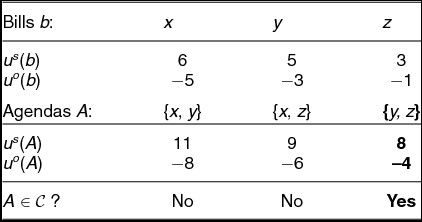
Table 1 provides a numerical example that illustrates how the model can explain the perplexing outcome of this lame-duck session. The scenario is one with three bills: the DISCLOSE Act (x), the DADT Repeal (y), and the New START Ratification (z), which the two players rank in opposite order with a modicum of lumpiness in their utility assessments (top panel). Such cardinality can be interpreted as reflecting intensity of preference. All possible two-period agendas are shown in the bottom panel. Each cell entry is the sum of the utilities for the two items on the agenda.
Example of Equilibrium in the Two-Period Game*

*The upper-left-most cell entry, u
s
(x) = 6, represents
 $\bar{b}^s$
, which plays a key role in the algorithms. The bold-faced column {y, z} describes the equilibrium agenda and payoffs. This agenda maximizes the obstructer’s utility u
o
within the three-element set of agendas
 $A \in \mathcal {C}$
(which in this example happens to be a singleton).
In the example, the basis for comparison is the setter’s most-preferred singleton
 $\bar{b}^s$
, which is bill x (the DISCLOSE Act). Next we identify the set of compromise agendas, namely the set of 2-tuple agendas that both players prefer to the singleton {x}. The first two of these agendas do not meet this condition; the obstructer prefers passing only x to {x, y} or {x, z}. The third agenda, {y, z} (both the DADT Repeal and the New START ratification), does satisfy the condition, providing a utility of 8 to the agenda setter and –4 to the obstructer. Although the agenda setter is unable to pass her most-preferred bill, she prefers to pass both
y and z to only x. Even though he dislikes both of these bills in an absolute sense, the obstructer allows y and z to pass in only one period each, because by doing so he is able to prevent the passage of his most-dreaded bill x.
To review, in equilibrium, the obstructer sets t*(x) = 2 and t*(y) = t*(z) = 1. The agenda setter responds by passing the agenda {y, z}. Substantively, the Senate Republicans would have subjected the DISCLOSE Act to maximum permissible obstruction had it been brought to the floor, but they instead agreed to refrain from subjecting either of the other two bills to excessive delay. While the Senate Democrats would have preferred to pass the DISCLOSE Act to either of the other two bills, they preferred those two bills combined to the DISCLOSE Act on its own. Accordingly, they used the lame-duck session to repeal DADT and to ratify the New START.
The preceding analysis is not intended to be either an empirical test of the model or a comprehensive account of the lame-duck session. Rather, it is intended only to illustrate that the model can help explain otherwise anomalous behavior by drawing attention to abandoned bills that, given sufficient time, could have been enacted. The key feature in our model that is missing from other theories of obstruction is its taking into account not only the pro–con preferences of the players but also their relative intensities of preferences within and across all bills. Such is the essence of optimal limited obstruction.
The example also illustrates another unique and subtle insight of the model: limited obstruction gives the obstructer substantial influence over the putatively setter-monopolized agenda. In the absence of limited obstruction, the agenda setter is able to pass any pair or singleton she likes. But with limited obstruction, the obstructer takes most of the two-bill agendas off the table by imposing delay on most bills. While the agenda setter indeed has the right ultimately to choose the agenda, rationality dictates that she choose from a limited menu that is determined by the obstructer’s execution of optimal delay. The agenda setter’s so-called monopoly agenda setting right is, in fact, dramatically circumscribed by limited obstruction.
Implications
The model shows that equilibrium behavior is driven by the composition of B—those bills that the agenda setter could pass given sufficient time (up to T units). Several implications with real-world empirical referents can be derived directly by examining substantively important properties of B. The first implication addresses the relationship between legislative productivity and the availability of bipartisan bills. A byproduct is revelation of a distinctive form of agenda power that can emerge under limited obstruction.
Implication 1.
Bipartisanship and Productivity. If
 $\exists \; b \ne \bar{b}^s \in B$
such that u
s
(b) > 0 and u
o
(b) > 0, then |a*(B, t*)| = 2
Proof.
 $u^s(b) + u^s(\bar{b}^s) > u^s(\bar{b}^s)$
and
 $u^o(b) + u^o(\bar{b}^s) > u^o(\bar{b^s})$
, so
 $\mathcal {C} \ne \emptyset$
. By Proposition 1,
 $\mathcal {C} \ne \emptyset \Rightarrow \exists \; \lbrace b^{\prime }, b^{\prime \prime }\rbrace$
such that t*(b′) = t*(b″) = 1 and
 $u^s(b^{\prime }) +u^s(b^{\prime \prime }) \ge u^s(\bar{b}^s)$
, so |a*(B, t*)| = 2.
 $\Box$
To facilitate interpretation of Implication 1, define a bipartisan bill as one from whose passage both players receive positive utility, and define productivity as the number of bills that pass during the session. Under our assumptions, the legislature is productive if it passes two bills in one period each; it is unproductive if one bill consumes both periods. Implication 1 says that the existence of a bipartisan bill is sufficient for high legislative productivity.Footnote 15
The logic may not be transparent immediately. The obstructer sifts through bills b ∈ B hoping to find a bill other than
 $\bar{b}^s$
(the setter’s most preferred bill) that both players prefer to no bill at all. Should she find such a bill, legislative productivity is guaranteed in the simple case of T = 2. As an illustration, consider the worst case for the obstructer. Suppose there is only one qualifying b > 0 for both players and that its payoff to the obstructer is only negligibly positive u
o
(b) = ε. In sharp contrast, the obstructer’s payoff under the setter’s most preferred bill
 $u^o(\bar{b}^s)$
is large and negative. Even in this scenario, the obstructer is better off assigning t = 1 to these bills than delaying either or both of them. The reason stems from the interplay of finite time and limited obstruction. The obstructer can slow but not kill
 $\bar{b}^s$
by assigning t = 2. However, given that this bill will pass regardless of the obstructer’s strategy, the obstructer may as well expedite the disdained bill’s consideration to make room on the agenda for the compromise bill that gives the obstructer a small but positive payoff. Of course, other compromise agendas may exist that are better for the obstructer than this purposely pessimistic example, and a rational obstructer would steer the setter into selecting one of these. But the more immediate point is that as long as at least one compromise agenda exists, the legislature will be productive. In summary, these conditions for legislative productivity under limited obstruction seem fairly weak.
The second implication begins to untangle the relationship between polarization and gridlock. Define polarization as the extent to which players’ preferences for or against bills are qualitatively opposite one-another. That is, if the setter is in favor of passing a bill (u s (b) > 0), then the obstructer is against it (u o (b) < 0), and vice versa. Suppose the obstructer opposes every bill in B, while the setter favors every such bill. In other words, the body is highly polarized.Footnote 16 Conventional wisdom seems strongly to suggest obstruction (t = 2) and/or gridlock occurs in the presence of such high polarization. In contrast, our model shows why this is not necessarily the case.
Implication 2. Polarization and Gridlock. u o (b) < 0∀b ∈ B is not a sufficient condition for |a*(B, t)| = 1.
Proof. See the counterexample described in Table 1.
 $\Box$
Current research makes strong, confident, rarely contested claims about a strong positive relationship between polarization (of parties and preferences) and gridlock (low or no legislative productivity). Implication 2 cautions against making such sweeping generalizations. In effect, it shows that, even in an extreme case in which the obstructer (alternatively, a sizable minority coalition) dislikes any and all possible bills that the agenda setter (backed by a majority coalition) would like to pass, the obstructer does not necessarily use gridlock-enhancing obstruction.
With a stronger notion of polarization based on preference intensity, however, we can obtain an implication of the model that comports better with conventional wisdom. Suppose players’ preferences were mirror images of one another bill-by-bill without exception, so u
o
(b) = −u
s
(b)∀b ∈ B. Clearly, this is an extreme conception of zero-sum polarization; the obstructer abhors each bill precisely as much the agenda setter adores it. The important analytic effect of the condition is that it renders crucial compromise set
 $\mathcal {C}$
empty. As such, no productive negotiation, reciprocity, or compromise between players is possible. The resulting equilibrium agenda is a singleton that takes two periods to pass, hence the expected result: polarization (of an extreme, perfectly counterbalancing form) leads to gridlock.
Implication 3. Intense-Preference Polarization and Gridlock. If u o (b) = −u s (b) for all b ∈ B, then there exists an equilibrium in which |a*(B, t)| = 1.Footnote 17
Proof. For any b′ and b″,
 $u^o(b^{\prime }) + u^o(b^{\prime \prime }) \ge u^o(\bar{b}^s) \Rightarrow u^s(b^{\prime }) + u^s(b^{\prime \prime }) \le u^s(\bar{b}^s)$
. Thus,
 $\mathcal {C} = \emptyset$
, which by Proposition 1 implies that t*(b) = 2 for all b ∈ B.
 $\Box$
Implications 2 and 3 illustrate that relative intensities of preferences are crucial elements of the model. Our final implication elaborates under more realistic conditions. A key, more specific feature for determining whether gridlock or legislative productivity prevails under specified preference conditions is the abhorrence level of the obstructer with respect to the setter’s most-preferred bill,
 $\bar{b}^s$
. Implication 4 states that legislative productivity is weakly increasing in the intensity of the obstructer’s disdain of the agenda setter’s most-preferred bill
 $\bar{b}^s$
. In other words, the more baneful
 $\bar{b}^s$
is to the obstructer, the greater is his desire to find a pair of bills from the compromise set that can be passed without delay. Formally:
Implication 4.
Top Priorities and Elicited Obstruction. If
 $\tilde{B}$
is the same as B except with
 $\bar{b}^s$
replaced with
 $\tilde{b}^s$
such that
 $u^s(\tilde{b}^s) = u^s(\bar{b}^s)$
and
 $u^o(\tilde{b}^s) < u^s(\bar{b}^s)$
, then the compromise agenda set associated with B is a subset of the compromise agenda set associated with
 $\tilde{B}$
and
 $|a^\ast (B,t^\ast )| \le |a^\ast (\tilde{B}, t^\ast )|$
.
Proof. Define
 $\mathcal {C}(B)$
as the compromise agenda set associated with B, and define
 $\mathcal {C}(\tilde{B})$
analogously. Consider b′, b″ ∈ B such that
 $\lbrace b^{\prime }, b^{\prime \prime }\rbrace \in \mathcal {C}(B)$
and
 $\bar{b}^s \not\in \lbrace b^{\prime },b^{\prime \prime }\rbrace$
.
 $u^s(b^{\prime }) + u^s(b^{\prime \prime }) \ge u^s(\bar{b}^s) = u^s(\tilde{b}^s)$
and
 $u^o(b^{\prime }) + u^o(b^{\prime \prime }) > u^o(\bar{b}^s) > u^o(\tilde{b}^s)$
, so
 $\lbrace b^{\prime }, b^{\prime \prime }\rbrace \in \mathcal {C}(B) \Rightarrow \lbrace b^{\prime }, b^{\prime \prime }\rbrace \in \mathcal {C}(\tilde{B})$
. Now suppose
 $b^{\prime \prime } = \bar{b}^s$
. Then trivially
 $u^s(b^{\prime }) + u^s(\bar{b}^s) \ge u^s(\bar{b}^s) \Rightarrow u^s(b^{\prime }) + u^s(\tilde{b}^s) \ge u^s(\tilde{b}^s)$
and
 $u^o(b^{\prime }) + u^o(\bar{b^s}) > u^o(\bar{b}^s) \Rightarrow u^o(b^{\prime }) + u^o(\tilde{b}^s) > u^o(\tilde{b}^s)$
, so
 $\lbrace b^{\prime }, \bar{b}^s\rbrace \in \mathcal {C}(B) \Rightarrow \lbrace b^{\prime }, \tilde{b}^s\rbrace \in \mathcal {C}(\tilde{B})$
. These conditions exhaust all elements of
 $\mathcal {C}(B)$
, so for every element in
 $\mathcal {C}(B)$
, there is a corresponding element in
 $\mathcal {C}(\tilde{B})$
. From Proposition 1, it is clear that |a*(B, t*)| = 2 if and only if
 $\mathcal {C} \ne \emptyset$
, which combined with the previous statement implies
 $|a^\ast (B,t^\ast )| \le |a^\ast (\tilde{B}, t^\ast )|$
.
 $\Box$
Informally, this comparative static characterizes the change in obstruction due to changes in the intensity of the obstructer’s distaste for the agenda setter’s most-preferred bill or top priority. The more the obstructer dislikes this bill, the larger is the set of compromise agendas. Since legislative productivity (here meaning passing two bills rather than just one) is high if and only if the set of compromise agendas is nonempty, this implies that legislative productivity is weakly increasing in how intensely the obstructer dislikes the agenda setter’s most-preferred bill.
Summary
The obstructer is preoccupied with the possibility that the agenda setter will pass her most-preferred bill. This is the focal outcome against which all other outcomes are compared. Sometimes, as in the case of extreme polarization, this outcome is unavoidable. The implications above identify two forces that help avert an unproductive legislature that passes only the agenda setter’s most preferred bill. First, there may be bills that the obstructer actively wants the agenda setter to pass: bipartisan bills that, if passed, provide both the agenda setter and the obstructer with positive utility. If such a bipartisan bill exists, then the obstructer does not want an outcome in which the agenda setter passes only one bill. He would be better off striking a deal in which the agenda setter agreed to spend one period passing the bill that she would have been willing to pass even if it absorbed two periods, and spend the freed up second period passing a bipartisan bill. Second, the obstructer may be especially determined to prevent the agenda setter’s top priority from passing. In such cases, the obstructer will be desperate to strike a deal that entices the agenda setter to spend the session passing other bills. The obstructer may even allow two bills that he dislikes to pass without obstruction, because by doing so he avoids the more grievous harm of seeing the agenda setter’s most preferred bill pass. Together, the obstructer’s desire to see some bills pass and to avoid the passage of the agenda setter’s most preferred bill determine the size of the set of compromise agendas and, by extension, the productivity of the legislature.
EXTENSIONS
Proposition 1 and its four implications rely on a simple model with only two players and two periods. Of course, in the U.S. Senate, every senator has the right to obstruct and more than one or two bills are passed each session. Fortunately, the model readily extends to more general settings with the core logic of the limited-obstruction equilibrium remaining in tact. Although we do not explicitly re-derive the counterparts to the implications stated above, close cousins of these results hold true under more general conditions, too.
Multiple Obstructers
The game readily extends to instances with n obstructers.
-
1. Obstructer o 1 announces a delay schedule t i (b) : B → {1, 2}.
-
2. Repeat Step 1 for i = 2, . . ., n.
-
3. The setter, s, chooses agenda A⊆B subject to the constraint ∑ b ∈ A max i t i (b) ≤ 2.
-
4. Payoffs are awarded. The setter, s, gets utility U s (A; t) = ∑ b ∈ A u s (b), while obstructer o i gets utility U oi (A; t) = ∑ b ∈ A u oi (b).
This game is the same as the original game except that a bill requires two periods to pass if any of the obstructers decides to slow down the passage of that bill. Setting t(b) = max i t i (b), the agenda setter’s best response function is the same as before.
The final obstructer, o
n
, faces a strategic situation similar to the obstructer’s in the original game, except that he operates under the constraint that
 $t(b) \ge {\max \atop i = 1, \dots , n - 1} t_i(b)$
. Qualitatively, he behaves just as the obstructer behaves in the original game if some subset of bills automatically required two periods to pass.
Formally,
 $$\begin{eqnarray*}
\bar{b}^s &=& {\mathop{\rm argmax}_{b \in B}}\; u^s(b)\\
\mathcal {C}_n &=& \lbrace \lbrace b^{\prime }, b^{\prime \prime }\rbrace \;:\; u^s(b^{\prime }) + u^s(b^{\prime \prime }) \ge u^s(\bar{b}^s) \text{ and } u^{o_n}(b^{\prime })\\
&&\quad + u^o(b^{\prime \prime }) > u^{o_n}(\bar{b}^s) \\
&& \qquad\text{ and } {\mathop{\max}_{i = 1, \dots , n - 1}} t_i(b^{\prime }) \\
&&\qquad= {\mathop{\max}_{i = 1, \dots , n - 1}} t_i(b^{\prime \prime }) = 1\rbrace \\
t_n^\ast (b) &=& \left\lbrace \begin{array}{@{}l@{\quad }l@{}}1 & \text{if } \mathcal {C}_n \ne \emptyset \text{ and } b \in \lbrace \bar{b}_{\mathcal {C}_n}^{o_n}, \bar{\bar{b}}_{\mathcal {C}_n}^{o_n}\rbrace \\
2 & \text{otherwise} \end{array}\right.
\end{eqnarray*}$$
Intuitively, some bills cannot be used to construct compromise agendas because other obstructers have already committed to obstruct them. If any agendas that both o
n
and s prefer to
 $\bar{b}^s$
in two periods remain by the time o
n
takes his turn, then he obstructs all bills except for the two in his most-preferred compromise agenda. Otherwise, he obstructs every bill. The preceding obstructers, of course, must anticipate o
n
’s behavior. Collusion or cooperation is not presumed among obstructers. They must obstruct bills that are unacceptable to them, but they must beware of the possibility that o
n
does not tolerate a compromise agenda that leaves him worse off than passing only
 $\bar{b}^s$
.
Iterating this logic yields the subgame perfect equilibrium strategies. If there are any compromise agendas that are acceptable to o
i
and all subsequent obstructers, then o
i
obstructs all bills except her most-preferred agenda in this set. Otherwise, he obstructs every bill. The outcome can be inferred from the strategy of o
1. If there is at least one compromise agenda that the agenda setter and every obstructer prefers to the
 $\bar{b}^s$
in two periods, then the first obstructer’s most-preferred agenda in this set is the realized agenda. Otherwise, the agenda is
 $\lbrace \bar{b}^s\rbrace$
.
Formally, o 1’s strategy (as well as the equilibrium schedule of delay) can be written as follows:
 $$\begin{eqnarray*}
\mathcal {C}_1 &=& \lbrace b^{\prime }, b^{\prime \prime }\rbrace \;:\; u^s(b^{\prime }) + u^s(b^{\prime \prime }) \ge u^s(\bar{b}^s)\\
&&\quad \text{ and } u^{o_i}(b^{\prime }) + u^{o_i}(b^{\prime \prime }) > u^{o_i}(\bar{b}^s) \\
&&\qquad \forall \;\; i = 1, \dots , n\\
t_i^\ast (b) &=& \left\lbrace \begin{array}{@{}l@{\quad }l@{}}1 & \text{if } \mathcal {C}_1 \ne \emptyset \text{ and } b \in \lbrace \bar{b}_{\mathcal {C}_1}^{o_1}, \bar{\bar{b}}_{\mathcal {C}_1}^{o_1}\rbrace \\
2 & \text{otherwise} \end{array}\right.
\end{eqnarray*}$$
Thus, the multiple obstructer equilibrium is almost identical to the original equilibrium. The only difference is that compromise agendas must be acceptable to every obstructer. Implications analogous to those presented above therefore hold in the multiple obstructer case as well.
Additionally, the extension to multiple obstructers clarifies the relationship between the size of the compromise agenda set (and, by extension, the prospects for passing two bills) and the number of obstructers.
Proposition 2.
If
 $\mathcal {C}^1$
is the compromise agenda set for a one obstructer game and
 $\mathcal {C}_1^n$
is the first obstructer’s compromise agenda set for an n obstructer game in which the bill set and the preferences of s and o
1 are as in the one obstructer game, then
 $\mathcal {C}_1^n \subseteq \mathcal {C}^1$
.
The proof is trivial from the equilibrium of the multiple obstructer game. Perhaps counterintuitively, this suggests that the prospects for passing two bills are better when the minority party acts like a unified actor.
Our model, therefore, begins to solve our first of two puzzles: Why is there so much variation in the degree of obstruction encountered by different bills? Obstructers deliberately and predictably create this variation to induce the agenda setter to select an agenda that is more to their mutual liking.Footnote 18
Streamlining Reforms
This leaves the second puzzle: Given that the Senate can change its own rules, why does a coalition that is large enough to pass legislation over a filibuster allow obstructers the right to delay the passage of legislation? Why doesn’t the Senate replace Rule XXII with a simple 60-vote requirement for passage of Senate bills? In the terms of the model, such a reform would remove the first step of the game and instead set t(b) = 1 for every bill.
Analysis of the possibility of reform is uninteresting for a two player game, so we consider a slightly modified game with three players. The players are a liberal agenda setter s, a moderate m, and a conservative obstructer o. Player s requires m’s support in order to pass bills (equivalently, all bills in B satisfy the condition u s (b) > 0 and u m (b) > 0). Because this requirement can be cast as a constraint to the space of parameters, it does not affect the equilibrium strategies or the game form. Players m and o have the ability to obstruct. Finally, s needs the support of either o or m to change the rules, so the support threshold for changing the rules is the same as that for passing bills. Their votes to streamline the rules by prohibiting limited obstruction are given by r m and r o , where one indicates a vote in favor the reform and zero indicates a vote against. We assume that s votes for the reform because it always makes him weakly better off.
Formally,
-
1. o announces r o ∈ {1, 0}
-
2. m announces r m ∈ {1, 0}
-
3. If r o + r m = 0, then o announces t o :B → {1, 2}
-
4. If r o + r m = 0, then m announces t m :B → {1, 2}
-
5. If r o + r m = 0, then s chooses A⊆B subject to ∑ b ∈ A max{t o (b), t m (b)} ≤ 2. Otherwise, s chooses A⊆B subject to |A| ≤ 2.
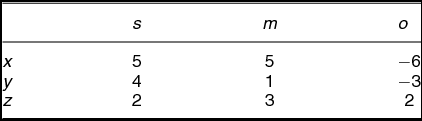
To make the example concrete, suppose there are only three bills—x, y, and z—and the three aforementioned players whose preferences are given in Table 2.Footnote 19
Payoffs in a Three-Player Obstruction Game

Note that the setter s and the moderate m have similar preferences. Their most-preferred bill is x and they both assign positive utility to all bills. The more extreme obstructer, o, on the other hand, dislikes x and y and likes only z. The equilibrium outcome of the subgame in which obstruction is permitted is {x, z}, because this is the only agenda that all three players prefer to x alone (i.e. {x, z} is the only pair in
 $\mathcal {C}$
). The equilibrium outcome of the subgame in which limited obstruction is forbidden is {x, y}, the pair that is most appealing to s. Because m and o both prefer {x, z} to {x, y}, neither votes to change the rules and limited obstruction is the equilibrium institution.
This example falls short of a full-fledged theory of endogenous institutional choice, but it offers a helpful lead as to how the filibuster could survive internal reform attempts, which it has many times since the Senate’s adoption of Rule XXII in 1917. Moreover, the configuration of preferences and the resulting agenda in the example are intuitively plausible. The bill most-preferred by both the agenda setter and the moderate passes even though obstruction is permitted. However, limited obstruction essentially eliminates from the agenda the setter’s second-highest priority (which the obstructer dislikes and which the moderate finds only slightly appealing) and replaces it with a bill that appeals to all players. In this example, limited obstruction is aggregate welfare enhancing, and the only net beneficiary of the streamlined procedure is the agenda setter.
In our repeatedly useful case of the 111th Congress, for example, a liberal agenda setter might enact universal healthcare and create a cap-and-trade system in a no-obstruction Senate. Because of obstruction, the liberal agenda setter must settle for enacting universal healthcare and cutting taxes on the middle class. This is to the advantage of conservatives and moderates, both of whom prefer the tax cuts to cap-and-trade. Therefore, the conservative and moderate band together to prevent any changes of the rules. Critically, this does not require the moderate liberals to actively obstruct the agenda of their own party. Recall that there is an equilibrium in which the first obstructer (whom we suppose is the conservative) is the one who effectively sets t, and in doing so, he anticipates the preferences of the other obstructers. The conservatives can (and happily will) do all of the actual obstructing, secure in their knowledge that the moderates support them if the extreme liberal agenda setter attempts to eliminate the filibuster.
The conditions necessary to sustain the endogenous institution of limited obstruction can be stated precisely. For expositional simplicity, assume there are at least two bills that provide the agenda setter with positive utility. Let
 $\mathcal {C}_o = \lbrace \lbrace b^{\prime }, b^{\prime \prime }\rbrace \;:\; u^i(b^{\prime }) + u^i(b^{\prime \prime }) > u^i(\bar{b}^s) \text{ for $i$ = $o$, $m$, $s$} \rbrace$
, the set of compromise agendas from the perspective of the first obstructer. Let
 $\lbrace \bar{b}_{\mathcal {C}_o}^o, \bar{\bar{b}}_{\mathcal {C}_o}^o\rbrace = {{\rm argmax} \atop \lbrace b^{\prime }, b^{\prime \prime }\rbrace \in \mathcal {C}_o }\; u^o(b^{\prime }) + u^o(b^{\prime \prime })$
, o’s most-preferred pair in the compromise set.
Proposition 3.
Limited obstruction survives in equilibrium if and only if either (1)
 $\mathcal {C}_o \ne \emptyset$
and m and o both prefer
 $\lbrace \bar{b}_{\mathcal {C}_o}^o, \bar{\bar{b}}_{\mathcal {C}_o}^o\rbrace$
to
 $\lbrace \bar{b}^s, \bar{\bar{b}}^s\rbrace$
or (2)
 $\mathcal {C}_o = \emptyset$
and m and o both prefer
 $\lbrace \bar{b}^s\rbrace$
to
 $\lbrace \bar{b}^s, \bar{\bar{b}}^s\rbrace$
.
Proof. Because either m or o can change the rules by voting in favor of the rule change, limited obstruction survives in the subgame perfect Nash equilibrium if and only if both m and o prefer the subgame where the rules are not changed. From the analysis of the multiple obstructer game above, (1) and (2) describe the conditions under which both m and o prefer the subgame where the rules are not changed to the subgame where the rules are changed.
 $\Box$
The proposition states that limited obstruction as an endogenous institutional feature survives if it induces an agenda that both m and o prefer to the agenda that would result from giving s unfettered agenda control (the agenda setter’s two most-preferred bills).
Finitely Long Agenda
The model can also be extended to cases where the number of periods in the session, T, takes an arbitrary but known value. The details of this extension are complicated because the players’ equilibrium strategies must be characterized algorithmically rather than in closed form, but the logic of their strategies are straightforward extensions of their strategies in the two period case. We assemble and explicate the specifics in the Online Appendix and, therefore, provide only a brief sketch of them here.
The agenda setter iteratively applies the logic of her two-period strategy; she decides whether she prefers to pass the two best one-period bills or the single best two-period bill. If she prefers the pair, she adds the better member of the pair to the agenda; if she prefers the singleton, she adds the singleton to the agenda. She then repeats this procedure until the time required to pass her concatenated agenda equals the session length.
The obstructer, in contrast, optimizes by constructing a generalized version of the compromise set. He considers all agendas that are politically feasible (i.e., that are the agenda setter’s best response for some choice of t) and chooses t to induce the agenda setter to pass his most-preferred strategy in this compromise agenda set. The key to identifying whether an agenda is politically feasible is that the agenda setter must prefer the two worst bills (from the perspective of s) that pass in one period to the best two-period bill that does not make it onto the agenda.
This more general game clarifies an important point about obstruction. Dislodging the agenda setter’s most-preferred bill is difficult. Doing so requires large number of attractive pairs, because the agenda setter must prefer least attractive of these pairs to her most-preferred bill. Limited obstruction typically does not prevent the agenda setter from passing her most-preferred bills. It more commonly replaces her secondary priorities with compromise pairs that are attractive to the agenda setter but not so distasteful to the obstructer.
DISCUSSION
Dilatory tactics have a bad reputation. Academics and lay observers alike have bemoaned their role in impeding the flow of policymaking responses to pressing public problems. Predicated on a simple but rich model of limited obstruction under monopoly agenda setting, our analysis suggests that the negative perspective on dilatory tactics is unduly one-sided. The ability to delay but not veto policy proposals gives all of the relevant actors in the organization a credible mechanism for discovering compromises and ensuring that they survive the inevitable winnowing process that is the defining characteristic of agenda setting. Furthermore, minimal rights of obstruction have the equilibrium effect of favoring such compromises by displacing more contentious policies from the active agenda. The survival of villainous dilatory tactics even within political organizations that have the ability to strongly curtail them is an implicit testament to the largely unrecognized virtues of limited obstruction.
Using a simple game, we considered situations in which a monopoly agenda setter and a limited obstructer self-interestedly seek favorable policies in collective choice settings with scarce time. Subject only to the time constraint, the agenda setter has the unlimited right not only to choose what goes on the agenda but also to guarantee its passage in the allotted time. In contrast, the obstructer’s procedural right is limited; he cannot fully stop any proposal of his choosing but rather, at most, can delay its passage by one unit of time. In spite of this built-in seemingly unlevel playing field, we found that limited obstruction can significantly constrain the value of agenda setting while increasing the payoffs of the limited obstructer. The obstructer achieves this via credible threats to deploy dilatory tactics. These threats induce the setter to construct an agenda composed of mutually favored proposals rather than the agenda setter’s favorite proposals.
We have shown how this model rationalizes variation in the degree of obstruction encountered by various bills within legislative sessions generally, as well as how it explains puzzling behavior in the 111th Congress as a specific example. We have also offered an explanation for the Senate’s failure to replace Rule XXII with a simpler 60-vote rule. The framework can be evaluated according to several additional criteria: its relationship to previous research, its amenability to empirical scrutiny, and its ability to generalize to other institutional settings.
Research reconsidered
Another positive feature of our theoretical approach is that its complementarity with extant research. In many cases, we must credit the intuitions and insights of our forerunners while claiming only to have invented ex post a formal and analytically tractable logical underpinning for prior claims and arguments. For instance:
-
• As Cox and McCubbins (Reference Cox, McCubbins, Edwards, George and Schickler2011) note, scarce floor time plays an important role in structuring legislative outcomes. Our approach introduces a precise mechanism through which time scarcity provides obstructers along with agenda setters with specifiable degrees of agenda power.
-
• As Sinclair (Reference Sinclair, Dodd and Oppenheimer2013) argues, because of time constraints, the majority must take into account the minority’s preferences, even when it has the votes to pass whatever legislation it pleases. Our agenda setter does exactly this.
-
• Likewise, Koger (Reference Koger, Dodd and Oppenheimer2013) conjectures that sometimes obstructers deploy dilatory tactics on every bill in order to reduce the majority’s productivity. Our model allows for this possibility, finds it to be possible but not general, and suggests conditions under which it is logically sustainable.
-
• A number of scholars believe that polarization of various forms plays an important role in the politics of delay, obstruction, and gridlock. Our theoretical framework, by requiring precise definitions of these concepts, can help to assess the logical—and ultimately the empirical—validity of such claims. The same holds with respect to the relationship between polarization and zero-sumness (Binder, Lawrence, and Smith Reference Binder, Lawrence and Smith2002; Woon and Anderson Reference Woon and Anderson2012).
-
• Our model is also consistent with the insight of Ainsworth and Flathman (Reference Ainsworth and Flathman1995) that bargaining over unanimous consent agreements opens a channel of communication between the agenda setter and potential obstructers. In our model, the relevant parameter is t through whose assigned value obstructers communicate the time costs they intend to impose on each bill.
A final point of intersection with several works concerns how limited obstruction serves as a mechanism by which the minority can credibly communicate its preferences to the majority. Wawro and Schickler (Reference Wawro and Schickler2006) ascribed this function to the historic filibuster but deliberately did not extend this attribution to the modern Senate. Their analysis was predicated on norms of restraint and reciprocity, and they reasonably worried that these norms had been eroded by mounting partisan polarization in the Senate (see also Mann and Ornstein Reference Mann and Ornstein2016). Our model suggests, somewhat differently, that obstructers’ communication of the intensity of their preferences has survived in spite of the likely erosion of these norms. The key issue is: what is the source of the restraint? Wawro and Schickler, like many others, considered bills one at a time, but scarce time means that the agenda setter and obstructer must also be mindful of the relative opportunity costs of passing large sets of bills. The resulting interconnectivity is the key force that drives restraint on the part of the obstructer and thereby elicits the intensity of the minority’s preferences.
Measurability and testability. Perhaps the most significant limitation of our theoretical framework is that it is, for all practical purposes, impossible to test directly and systematically with large samples. In principle, sharp empirical predictions could be tested with a dataset that included B, the set of all bills that could theoretically passed, given sufficient time. Identifying B is all but hopeless, though, because it is not possible to know whether specific bills that were introduced failed because they could not have attracted 60 supporters or because there was not enough time to achieve passage within the given session. Furthermore, if B were somehow to be compilable, the analyst would still need to measure the utility each legislator attaches to passing each bill. Additionally, the obstructer’s behavior is hard to observe, because t can at best be observed only for bills the agenda setter attempts to bring to the floor. If there is any counteracting upside, it is that these arguments do not rule out the possibility of formulating creative indirect tests. Regrettably, this is beyond the scope of the existing paper, and, so, for now, we must settle for a more modest claim to have established a plausible connection to the empirical literature.
Non-Senate applications. As we asserted above, the model is potentially applicable to non-Senate institutions, too. In principle, it can be applied to any setting in which there is a agenda setter, time is scarce, and an opposing actor has the ability to influence time costs of the setter’s proposals.
While precise mechanics of Rule XXII are unique to the Senate, the right to impose delay is not. Some upper chambers of bicameral legislatures, such as the British House of Lords and the French Sénat, explicitly possess the right to delay legislation without vetoing it outright (Tsebelis and Money Reference Tsebelis and Money1997, 34). Green (Reference Green2015) argues that the minority party can impose delay on the majority’s agenda by moving to adjourn or suggesting the absence of a quorum. Clark (Reference Clark2015) echoes and extends many of these points in the context of U.S. state legislatures and assemblies. If time is scarce, the right to delay confers seemingly weak actors with some measure of agenda power.
Heclo (Reference Heclo1977) characterizes the American civil service as the interaction of short-lived political appointees and careerist bureaucrats who will far outlast the appointees. This setting squares nicely with the assumptions of our model. Appointees usually occupy the highest positions within the hierarchy and thus have the legal authority to command subordinate careerists. In this sense, appointees are monopoly agenda setters. However, appointees serve relatively short terms, so time is scarce. Moreover, the careerists have important information and institution-specific know-how regarding how long administrative decisions will take to implement. They can can also control these assets to selectively speed or impede the appointee/setter’s agenda, thereby helping or hindering the appointee’s attempts to navigate the complexities of the bureaucratic milieu. Broadly consistent with the predictions of the model, Heclo finds that the most successful appointees prefer to get buy-in from the careerists. He quotes one appointee as saying, “[A careerist subordinate] was a great civil servant, not because he did what you told him to, but because he would tell you how to solve problems, what you couldn’t do and why. With him I could get the changes through in one year instead of it dragging on until I’m out of the picture” (Heclo Reference Heclo1977, 215–16).
Finally, the logic of our model also provides a fresh perspective on presidential vetoes. When presidents find themselves in opposition to large majorities in both chambers of Congress, it seems at first blush that the power conferred by the veto shrinks to an opportunity for position-taking and little else. But, as we and many others have argued, time is scarce in Congress, and overriding a veto can be a time-consuming ordeal, particularly if the president has allies in the Senate. The threat of a veto may, therefore, be potent. Even when congressional leaders could round up the votes necessary to override, they could also spend that time producing valuable legislation. In terms of our model, congressional leaders are the agenda setter, the president is obstructer, and the veto threat is the president’s limited-obstruction mechanism for manipulating time costs to influence the congressional agenda.
More compelling theories of any of these alternative settings is likely to require analytic tailoring to fit better the institution under scrutiny. Our model provides a simple and flexible framework with which more specialized models can be built.
SUPPLEMENTARY MATERIAL
To view supplementary material for this article, please visit https://doi.org/10.1017/S0003055417000387






Comments
No Comments have been published for this article.