Introduction
Major depression is prevalent and disabling in the general population (Broadhead et al. Reference Broadhead, Blazer, George and Tse1990; Ustun & Kessler, Reference Ustun and Kessler2002; Kessler et al. Reference Kessler, Berglund, Demler, Jin, Koretz, Merikangas, Rush, Walters and Wang2003a; Patten et al. Reference Patten, Wang, Williams, Currie, Beck, Maxwell and El-Guebaly2006). Some episodes that meet the criteria of major depression in the general population are mild and/or brief (Patten, Reference Patten2008) and may resolve quickly without clinical interventions. However, individuals with mild major depression are at a higher risk of having more episodes of depression subsequently than non-cases (Kessler et al. Reference Kessler, Merikangas, Berglund, Eaton, Koretz and Walters2003b). Clinical and population health decisions related to the management of major depression and prevention depend on knowledge of the longitudinal course of the disorder and its predictors. At the international level, there are few population-based longitudinal studies with repeated assessment of major depression.
Several analyses have investigated predictors of the outcomes of major depression (Sargeant et al. Reference Sargeant, Bruce, Florio and Weissman1990; Spijker et al. Reference Spijker, Bijl, de Graaf and Nolen2001; Patten et al. Reference Patten, Wang, Williams, Lavorato, Khaled and Bulloch2010; Skodol et al. Reference Skodol, Grilo, Keyes, Geier, Grant and Hasin2011), based on data from population-based longitudinal studies, namely the Epidemiologic Catchment Area (ECA) study, the Netherlands Mental Health Survey and Incidence Study (NEMESIS), the Canadian National Population Health Survey (NPHS) and, recently, the National Epidemiologic Survey on Alcohol and Related Conditions (NESARC). In the ECA (n=423) and the NEMESIS (n=305), among participants with a major depressive disorder (MDD), the proportion having an MDD 1 year later was 23.5% (Sargeant et al. Reference Sargeant, Bruce, Florio and Weissman1990) and 28.3% (Spijker et al. Reference Spijker, Bijl, de Graaf and Nolen2001) respectively. In the NESARC (n=1996), the rate of persistence and of recurrence of MDD over 3 years was 15.1% and 7.3% respectively (Skodol et al. Reference Skodol, Grilo, Keyes, Geier, Grant and Hasin2011). Clinical factors including severity, duration of previous episodes (Sargeant et al. Reference Sargeant, Bruce, Florio and Weissman1990; Spijker et al. Reference Spijker, Bijl, de Graaf and Nolen2001; Skodol et al. Reference Skodol, Grilo, Keyes, Geier, Grant and Hasin2011), family history and co-morbid physical illnesses (Patten et al. Reference Patten, Wang, Williams, Lavorato, Khaled and Bulloch2010) and personality disorders (Skodol et al. Reference Skodol, Grilo, Keyes, Geier, Grant and Hasin2011) are predictors of poor outcome. Younger age (Spijker et al. Reference Spijker, Bijl, de Graaf and Nolen2001) and women over 30 years old (Sargeant et al. Reference Sargeant, Bruce, Florio and Weissman1990) are more likely to have persistent/recurrent MDD. The NEMESIS also reported that the presence of anhedonia and early awakening, external locus of control and multiple negative life events are associated with poor outcome (Spijker et al. Reference Spijker, Bijl, de Graaf and Nolen2001).
These studies are important because they provide compelling evidence on the predictors of future depression using longitudinal rather than cross-sectional data. However, the predictors examined were largely demographic and clinical in nature with few social–environmental variables. Adults in the workforce are a population vulnerable to depression because of exposure to multiple sources of stress (Blackmore et al. Reference Blackmore, Stansfeld, Weller, Munce, Zagorski and Stewart2007). The impact of depression on working adults is sizable in terms of economic costs and level of suffering. The study we report here used a representative sample of the working population to examine both individual and work-related factors related to 1-year outcomes of DSM-IV-defined MDD. Research has shown that work environmental factors including job strain, effort–reward imbalance and work–family conflicts are related to the risk of major depression and other psychiatric syndromes (Frone, Reference Frone2000; Chandola et al. Reference Chandola, Martikainen, Bartley, Lahelma, Marmot, Michikazu, Nasermoaddeli and Kagamimori2004; Wang, Reference Wang2004b, Reference Wang2005, Reference Wang2006; Blackmore et al. Reference Blackmore, Stansfeld, Weller, Munce, Zagorski and Stewart2007; Wang et al. Reference Wang, Affifi, Cox and Sareen2007, Reference Wang, Lesage, Schmitz and Drapeau2008, Reference Wang, Schmitz, Dewa and Stansfeld2009). As such, it is possible that these workplace psychosocial factors play a role in the prognosis of major depression.
The objectives of this study were to, among a cohort of individuals with a lifetime diagnosis of MDD, (1) estimate the proportions of persistent and recurrent MDD over 1 year, and (2) identify demographic, socio-economic, workplace psychosocial and clinical factors associated with the outcomes.
Method
In January 2008, we started to build a longitudinal cohort representative of the working population in the province of Alberta, Canada. The target population of the study included employed persons who were aged between 25 and 65 years and who were residing in Alberta at the time of recruitment. The participants were recruited using the method of random digit dialing (RDD). To be eligible for inclusion in the cohort, participants had to be working at the time of interview, agree to be contacted for two follow-up interviews and provide their names and a method of contact for follow-up (mailing address or email). With RDD, once a household was reached, we first identified the number of eligible household members. If there were more than one potentially eligible household member for the study, one was randomly selected for the interview. At baseline (T0), 4239 were eligible to be included in the longitudinal cohort. As of the 12-month interview (T1), 3280 (77%) were followed successfully.
T0 involved two stages. The first stage included sampling, recruitment and screening for depressive and anxiety disorders. At the second stage, participants who screened positive for depressive and/or anxiety disorders were selected for structured diagnostic interviews. At both stages, data were collected using the of the Computer Assisted Telephone Interview (CATI). Detailed information about the study design and recruitment can be found in previous publications (Wang et al. Reference Wang, Schmitz, Smailes, Sareen and Patten2010a, Reference Wang, Smailes, Sareen, Fick, Schmitz and Pattenb).
Assessment of mental disorders
In participants who screened positive for MDD, bipolar disorders, dysthymia, social phobia, panic disorder and generalized anxiety disorder, the World Health Organization's (WHO) Composite International Diagnostic Interview CIDI-Auto 2.1 (WHO, 2011) was administered by lay interviewers who were trained by the team members (J.L.W. and S.P.). The CIDI-Auto is a computerized program developed and supported by the WHO's training center in Australia. After completion of the interview, the scoring algorithm program in the CIDI-Auto automatically generated diagnoses based on DSM-IV criteria (APA, 1994) and the severity levels (mild, moderate and severe) of a long-lasting episode that the participant had experienced in the past.
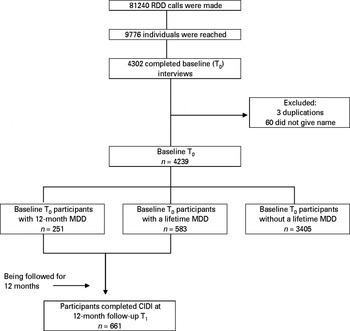
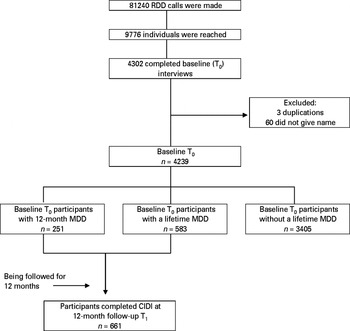
At T0, the lifetime version of the CIDI-Auto was used to assess mental disorders over the lifetime. At the end of each interview, based on information provided by the participant, the lifetime version of CIDI generates a recency code that indicates whether the most recent episode occurred in the past 12 months, or more than 1 year ago. We used the recency code to identify participants with current MDD (which we defined as having an episode in the past 12 months prior to T0). For this analysis, we included participants with lifetime MDD at T0 (n=834). Among them, 251 had current MDD and 583 had had their most recent depressive episode more than 12 months prior to T0. A flow chart describing the recruitment and follow-up is shown in Fig. 1. At T1, the 12-month version of the CIDI-Auto was used to determine whether mental disorders had occurred in the past 12 months. The diagnosis of MDD referred to having at least one major depressive episode over the life course without a history of manic, mixed or hypomanic episodes. Additionally, the diagnosis required meeting clinical significance criteria (i.e. distress or impairment), excluded substance-induced or general medical conditions, and ruled out bereavement.
A flow chart of the participants included in this longitudinal analysis. RDD, random digit dialing; MDD, major depressive disorder; CIDI, Composite International Diagnostic Interview.
Depressive symptoms
Depression in the past 2 weeks was measured using the nine-item Patient Health Questionnaire (PHQ-9; Kroenke et al. Reference Kroenke, Spitzer and Williams2001) at both T0 and T1. The PHQ-9 is a dimensional scale derived from the Primary Care Evaluation of Mental Disorders (PRIME-MD) diagnostic instrument for common mental disorders. The α value of the PHQ-9 was 0.83 in this study. In this analysis, we examined the association between the PHQ-9 score (ranging from 0 to 27) and each of the nine symptoms and the 1-year outcomes.
Workplace psychosocial factors
Work environment was assessed by the full version of the Job Content Questionnaire (JCQ; Karasek et al. Reference Karasek, Brisson, Kawakami, Houtman, Bongers and Amick1998) and the Effort–Reward Imbalance (ERI) questionnaire (Siegrist et al. Reference Siegrist, Starke, Chandola, Godin, Marmot, Niedhammer and Peter2004). These instruments were administered in all participants.
The JCQ assesses work stress in five dimensions, namely skill discretion (six items), decision authority (three items), psychological demand (five items), job insecurity (three items) and supervisor/co-worker social support (eight items). For each question, one of four answers was possible: strongly disagree, disagree, agree and strongly agree. Each answer was scored from 1 (strongly disagree) to 4 (strongly agree). Reversed coding for some items was used. The dimensional scores were calculated using the formula provided in the JCQ manual (Karasek et al. Reference Karasek, Brisson, Kawakami, Houtman, Bongers and Amick1998). In this study, the α values for the five subscales were 0.72, 0.71, 0.67, 0.52 and 0.85 respectively. Using the scores for psychological demand, skill discretion and decision authority, we created a job strain ratio (JSR) variable as: JSR=psychological demand/[(skill discretion+decision authority)/2]. The JSR was calculated in a way that was consistent with definitions provided by Statistics Canada (2010) . A JSR of 1 means balance between psychological demand and decision control; a JSR >1 means psychological demand is greater than decision control.
The ERI questionnaire used in our study focused on two elements: perceived effort (five items) and rewards (11 items). The imbalance between effort and reward is determined by a ratio according to the formula suggested by the developers (Siegrist et al. Reference Siegrist, Starke, Chandola, Godin, Marmot, Niedhammer and Peter2004). A higher ERI ratio score indicates a higher level of effort–reward imbalance. In the analysis, the cut-off for the ERI ratio was 1 (e.g. ⩽1 v. >1). In this study, the α values of the effort and rewards scales were 0.79 and 0.80 respectively.
Work–family conflicts
Work–family conflicts were assessed using the eight-item Work–Family Conflict (WFC) questionnaire (Chandola et al. Reference Chandola, Martikainen, Bartley, Lahelma, Marmot, Michikazu, Nasermoaddeli and Kagamimori2004), which has separate scales for work-to-family conflict and family-to-work conflict. Work-to-family conflict occurs when efforts to fulfill the demands of the employee role interfere with the ability to fulfill the demands of the roles as a spouse, parent or care provider (Frone, Reference Frone2000). Conversely, family-to-work conflict refers to a situation in which family demands become an obstacle to successfully meeting work-related demands and responsibilities, thereby undermining a person's ability to construct and maintain a positive work-related self-image (Frone, Reference Frone2000). Each scale contains four questions. Each question assesses potential conflict based on a possible answer of ‘not at all’, ‘to some extent’ and ‘a great deal’. Each subscale had a possible summary score ranging from 4 to 12. The α values of the two subscales were 0.56 and 0.73. Both work-to-family and family-to-work conflict scores were highly skewed. To make meaningful comparisons, the scores were dichotomized by median values.
Demographic and socio-economic characteristics
The variables included sex, age (continuous variable), marital status (married/common-law/partnership, single/never married, separated/divorced/widowed), educational level (less than high school, high school and college, university), personal annual income (<$30000, $30000–$59999, $60000–$79999, ⩾$80000 (all currency values are in Canadian dollars), average weekly working hours (⩽35 h, 35.5–40 h, ⩾40.5 h), job type (full-time, part-time, other) and job gradient (ordinary worker, supervisor, manager/executive).
Statistical analysis
For the objectives of this analysis, participants with a lifetime diagnosis of MDD based on the CIDI (n=834) were classified into two groups: group 1, participants with current MDD at T0 (n=251); and group 2, participants without current MDD at T0 (n=583).
Using the data from T1, MDD cases identified over 1 year in group 1 (persistence) and group 2 (recurrence) were identified. Bivariate analysis was conducted to identify factors associated with the outcomes. Significant factors were included in multivariate logistic regression models. Potential effect modification among the factors was examined using interaction terms in these models; no effect modification was found.
Sampling weights were used in estimating proportions and in regression modeling. We first developed post-stratification weights accounting for the effects of number of telephone lines in the household and gender/age distributions in Albertans who were working and who were between the ages of 25 and 65 years, based on the 2006 census data collected by Statistics Canada. Over the follow-up period, some participants refused to participate or were unable to be contacted after the baseline assessment. We compared the refusals, those who were not able to be contacted and participants who were followed successfully. There were no differences between the refusals and those who were followed successfully. Those who were unable to be contacted were more likely to have a mental disorder and to be at a low level of personal income, compared to the participants who were followed successfully. Therefore, new weights were developed to account for the effects of baseline status of mental disorder and personal income levels. The sampling weights used in the longitudinal analyses were the product of the post-stratification weights at baseline and the new weights developed to account for dropouts. All percentages and the results of the logistic regression were weighted. The analysis was conducted using Stata 10.0 (StataCorp, 2010).
Results
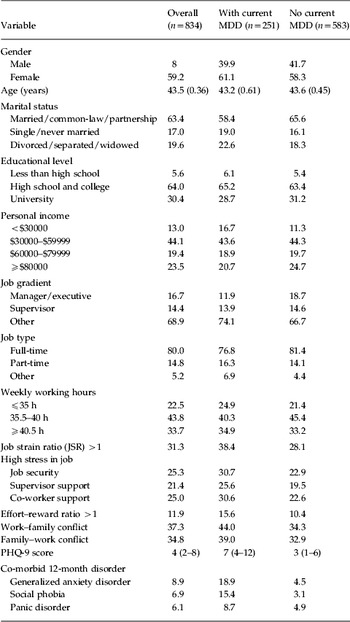
Of the 251 participants with current MDD at T0, 186 completed the CIDI (74%) at T1, and of the 583 participants without current MDD, 475 completed the CIDI (81%) at T1 (see Fig. 1). Participants with missing CIDI data at T1 were more likely to have had current MDD (p=0.03) and to have reported high job strain (p=0.02) at baseline than those who completed the CIDI at T1. The baseline characteristics of included participants and those with and without current MDD at T0 are described in Table 1. The proportion of persistent MDD in 1 year was 38.5% (95% CI 31.1–46.5) in group 1. The proportion of recurrence of MDD was 13.3% (95% CI 10.2–17.1) in group 2.
Baseline demographic, socio-economic, work environmental and clinical characteristics of participants with a lifetime diagnosis of major depressive disorder (MDD)
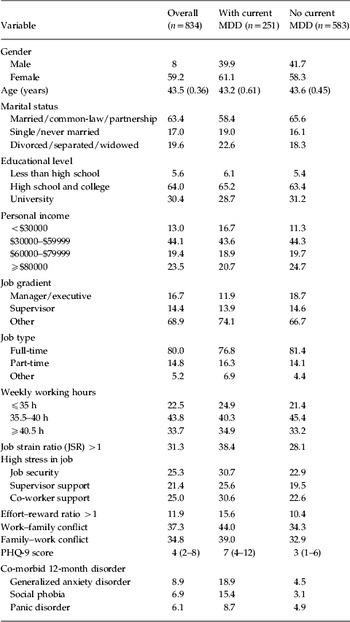
PHQ-9, nine-item Patient Health Questionnaire.
Values given as percentage, mean (standard error) or median (25th–75th percentile).
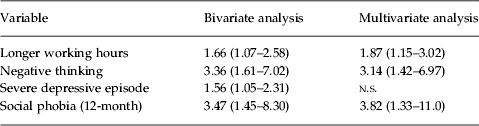
Factors associated with the persistence of MDD are presented in Table 2. Bivariate analysis showed that having co-morbid social phobia, having experienced a moderate/severe depressive episode, having reported ‘feeling bad about yourself or feeling that you have let your family or yourself down’ (an item of the PHQ-9, referred to as ‘negative thinking’ thereafter) and having worked more than 35 h/week at T0 were all associated with the persistence of MDD (Table 2). Sex-/age-adjusted multivariate logistic regression revealed that, compared to others, participants who reported having worked more than 35 h/week were 1.87 times more likely to have had persistent MDD; those with negative thinking were 3.14 times more likely to have had persistent MDD; and participants who had co-morbid social phobia were about four times more likely to have had persistent MDD.
Factors associated with major depressive disorder (MDD) in 1 year among participants with current MDD (n=185), adjusted by gender and age
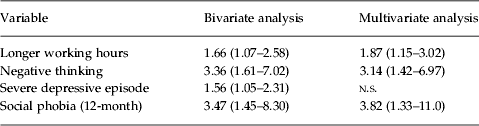
n.s., Not significant.
Values given as odds ratio (95% confidence interval).
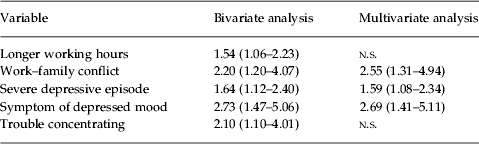
Factors associated with recurrent MDD are presented in Table 3. In the bivariate analysis, significant factors for MDE included having worked more than 35 h/week, perceived work–family conflict, having experienced a moderate/severe depressive episode, feeling ‘down, depressed, or hopeless’ (symptom of depressed mood) and having ‘trouble concentrating on things, such as reading the newspaper or watching television’ (trouble concentrating) in the past 2 weeks (PHQ-9 items) (Table 3). In sex-/age-adjusted multivariate logistic regression modeling, the associations between long working hours, trouble concentrating and recurrent MDD became non-significant. The associations between perceived work–family conflict, having experienced a moderate/severe depressive episode, depressed mood in the past 2 weeks and MDD persisted.
Factors associated with major depressive disorder (MDD) in 1 year among participants without current MDD (n=470), adjusted by gender and age
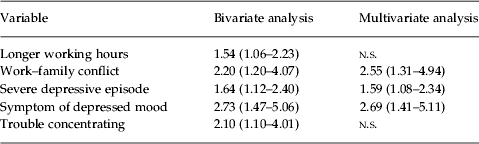
n.s., Not significant.
Values given as odds ratio (95% confidence interval).
Discussion
With a random sample of the working population, we found that the proportion of persistent MDD was 38.5% and the proportion of recurrent MDD was 13.3% in 1 year. Demographic, socio-economic and most of the workplace psychosocial characteristics were not associated with the outcomes, although long working hours were associated with the persistence of MDD and perceived work–family conflict was significantly associated with recurrent MDD. Clinical factors played an important role in the outcomes. Specific clinical factors associated with MDD differed by outcome. Negative thinking and co-morbid social anxiety disorder were associated with persistent MDD; severity of depressive episode and symptom of depressed mood were associated with recurrent MDD.
The proportion of persistence of MDD observed in this study (38.5%) was higher than the figures reported in the NEMESIS (28.3%) and the ECA study (23.5%). The discrepancy in the findings could be due to study time difference and sample composition. Both the NEMESIS and the ECA data were collected more than 10 years ago. In addition, our cohort consisted of individuals who were working at baseline. The proportions of persistence and recurrence of MDD could not be compared directly with the NESARC results because the NESARC assessed persistence and recurrence over 3 years. However, it is noteworthy that the proportions of persistence and recurrence of MDD observed in our sample were about two times higher than those of the NESARC. Given that similar diagnostic instruments were used, one possible explanation for the difference is study time. The NESARC was conducted between 2001 and 2005; our data were collected from 2008 to the present in a working population who had been undergoing a period of economic uncertainty, which might have contributed to the higher rate of MDD prevalence (Wang et al. Reference Wang, Smailes, Sareen, Fick, Schmitz and Patten2010b).
Our results are consistent with the conclusions of some previous studies (Sargeant et al. Reference Sargeant, Bruce, Florio and Weissman1990; Skodol et al. Reference Skodol, Grilo, Keyes, Geier, Grant and Hasin2011; Spijker et al. Reference Spijker, Bijl, de Graaf and Nolen2001), in that clinical factors played an important role in the outcomes of MDD. We found that the severity of a major depressive episode was not significantly associated with the persistence of MDD in multivariate analysis. In the NESARC, the number of previous episodes were very weakly predictive of persistence and the duration of a recent episode did not predict persistence at all (Skodol et al. Reference Skodol, Grilo, Keyes, Geier, Grant and Hasin2011). In contrast to the NESARC, which found no clinical features that were predictive of recurrence, we found that the severity of a major depressive episode was associated with recurrent MDD, which was consistent with the NEMESIS (Spijker et al. Reference Spijker, Bijl, de Graaf and Nolen2001). Similarly, the NESARC found that specific phobia and panic disorder were associated with persistence but not with recurrence. Our data revealed that only social phobia was associated with persistence, but not with recurrence. Population-based longitudinal studies have demonstrated that social phobia is a significant risk factor for MDD (Stein et al. Reference Stein, Fuetsch, Muller, Hofler, Lieb and Wittchen2001; Beesdo et al. Reference Beesdo, Bittner, Pine, Stein, Hofler, Lieb and Wittchen2007). This highlights the importance of clinical factors in the prognosis of MDD and the need for more large longitudinal studies.
Because this cohort consisted of employees, one of the strengths of the study was its ability to examine the effects of both clinical and work environmental factors on the outcomes. Job strain, effort–reward imbalance and work–family conflicts have been found to be associated with major depression (Wang, Reference Wang2004b, Reference Wang2005, Reference Wang2006; Blackmore et al. Reference Blackmore, Stansfeld, Weller, Munce, Zagorski and Stewart2007; Wang et al. Reference Wang, Affifi, Cox and Sareen2007, Reference Wang, Lesage, Schmitz and Drapeau2008, Reference Wang, Schmitz, Dewa and Stansfeld2009). The results of this study showed that certain elements of work environment may also affect the outcomes of MDD in the short term. Individuals with current MDD often have symptoms of insomnia and fatigue. Consistently high work demand, which usually leads to longer working hours, may interfere with improvement in depressive symptoms. As such, it is possible that long working hours becomes a contributing factor to the persistence of MDD. By contrast, work–family conflict was predictive of the recurrence of MDD but not the persistence of MDD, even in the presence of other risk factors. This finding is encouraging because work–family conflict, similar to long working hours, is a modifiable risk factor. The chances of MDD reoccurring could potentially be reduced by targeting work–family conflict in persons with a history of MDD.
This study has several limitations. First, the data collection relied on self-report, so that recall and reporting biases were possible. Second, because data were collected using CATI, detailed information about mental health service use was not obtained. Although the CIDI asked questions about seeing health professionals for the symptoms, it was not possible to determine the timing of such visits because the lifetime version of the CIDI was used at T0. The NESARC and our previous research showed that individuals who used mental health services were more likely to have had persistent or recurrent depression (Wang, Reference Wang2004a; Skodol et al. Reference Skodol, Grilo, Keyes, Geier, Grant and Hasin2011), which may be partly due to the severity of the episode. Finally, the number of prior MDD episodes, anxiety disorders and substance-related disorders may be important factors for persistence and recurrence. Because this was a telephone-based study, detailed information about these factors was not collected and should be considered in future studies.
In summary, clinical and psychosocial factors are important in the prognosis of MDD. However, the factors associated with persistence and recurrence of MDD may be different. More large longitudinal studies on this topic are needed so that clinicians can predict potential outcomes based on the clinical profile and provide treatments accordingly. They may also provide suggestions on changing relevant psychosocial factors to minimize the chance of persistence and/or recurrence of MDD.
Acknowledgements
This study was funded by an operating grant from the Canadian Institutes of Health Research (CIHR; grant no. MOP84308. PI: J. L. Wang). S. B. Patten was supported by a Population Health Scholar award from Alberta Innovates – Health Solutions. J. Sareen was a recipient of a CIHR New Investigator award and the Manitoba Health Research Council Chair Award.
Declaration of Interest
None.