Introduction
This article is an attempt to forge connections between two vibrant domains of current scholarship: visual anthropology and the anthropology of morality and ethics. Its concern is with representations of achieving moral citizenship in Vietnam's visually spectacular capital, Hanoi. Building on long-term ethnographic research in one of the city's fast-changing residential neighbourhoods, it is an account of how the householders with whom I have conducted my fieldwork perceive and engage with the state's moralizing images. I hope to show that the experiences these Hanoians have shared with me can tell us significant things about the ways in which both younger and older urban citizens can seek to navigate the dilemmas of marketization in today's Vietnam.Footnote 1
What I deal with in particular is what my interlocutors feel may be inferred about them from the state iconography that pervades their public spaces. The Hanoians I have worked with are troubled by their knowledge that there are fellow citizens as well as foreigners who think of a propagandized citizenry as a populace rendered voiceless and infantilized, devoid of what I refer to here as ‘moral agency’. This view is close to what the Soviet studies scholar Petre Petrov has said about the ‘trueing’ effects of Stalinist propaganda, arguing that these are ‘generative’, swallowing people up as uncritical inhabitants of the reality it manifests and materializes (Petrov Reference Petrov2011).
What I have observed in the course of fieldwork is more active and experiential. My inner-city fieldsite is a mixed-income neighbourhood I call West Lake. With its non-stop tearing-down and infilling, and the ever-changing mix of occupations and livelihood strategies pursued by its established residents and more recent incomers, the locality is a booming little microcosm of the enormous changes the city has experienced since the onset of marketization in the late 1980s. I say more below about what has made it such a fruitful site for my research.
In seeking to understand how my West Lake interlocutors perceive the Party-state's visual cues and symbols, I have been helped by important works on the semiotics of socialist iconography, especially those stressing the highly gendered nature of its imagery.Footnote 2 I am also indebted to Christopher Pinney's (Reference Pinney2004; Reference Pinney, Edwards and Bhaumik2008) accounts of what he calls corpothetics. This is his term for the mustering of a viewer's full array of sensory capacities when engaging with images of the Hindu gods, with effects that Pinney also calls generative. What he means by this is a very active process of agency and embodiment that can be discerned in the special kind of devotional viewing known as darshan (auspicious seeing).
My interest too is in the active and sensory aspects of images, but focusing on the moral concerns that may arise when viewers and images connect. What I wish to show is that there can be agentive moral life in what are often referred to as scopic contexts (Jay Reference Jay1988).Footnote 3 To understand images as both source and product of ethical action is not to deny that images can be tools of oppressive power depriving subjects of the capacity to speak and act. But I believe that the insights of authors including Pinney, Stasch (Reference Stasch2011), and Strassler (Reference Strassler2010) on the diversity and dynamism of people's visual lives show how much there is to gain from taking the study of visuality beyond issues of subjugation and hegemony.Footnote 4 This includes, as in Strassler's work, exploring how perceptions of state iconography impact on and interact with the use of images in domestic and ritual contexts.
My focus is a puzzle in which the visual and the moral are intertwined, this being how to make sense of the two very different ways in which the people I have worked with think about public images. My West Lake interlocutors are both very silent and very vocal about their city's visual economy.Footnote 5 I am asking why this is so, and why items I had expected to be viewed neutrally or even favourably evoke reactions of a very different kind. The argument I present here focuses on the notion of silence as an active moral strategy, rather than a deprivation of voice and agency.
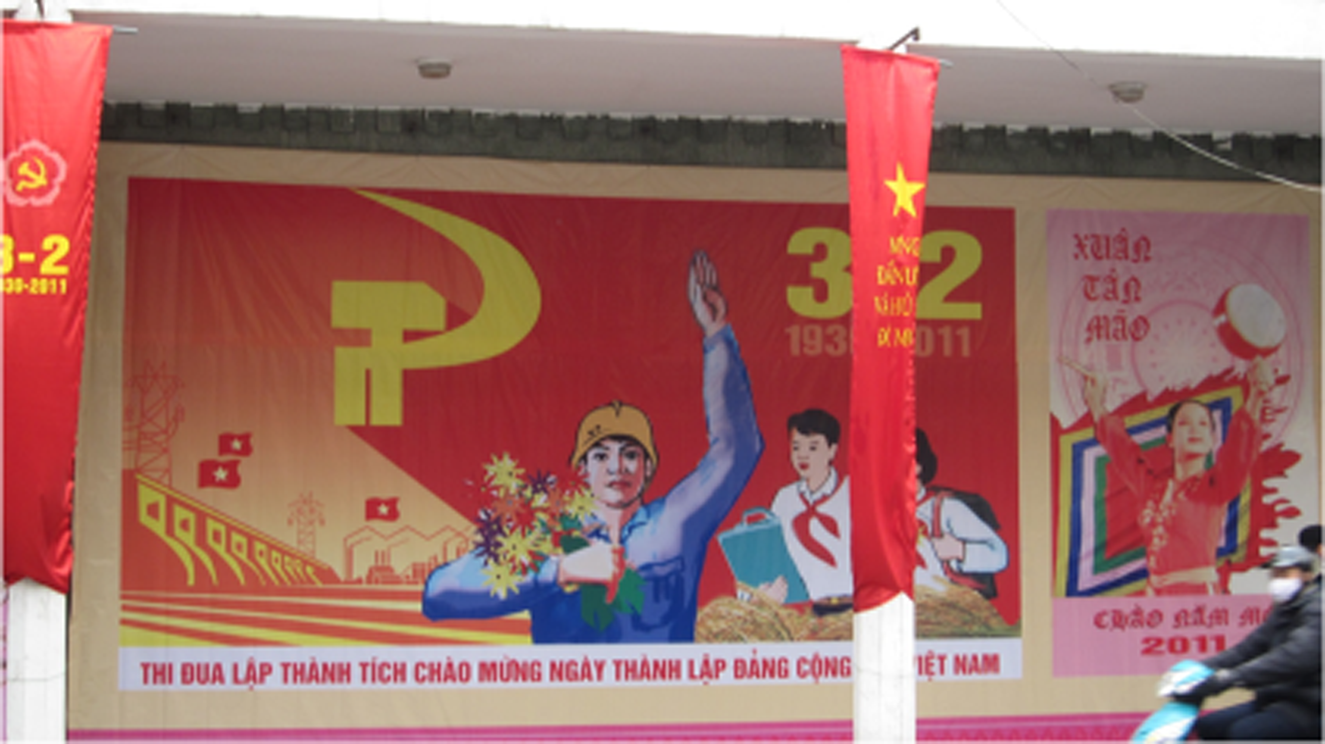
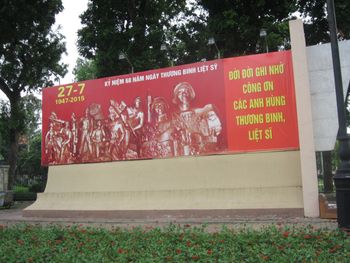
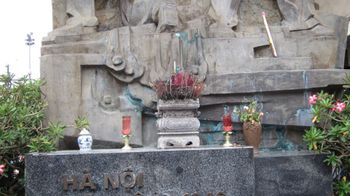
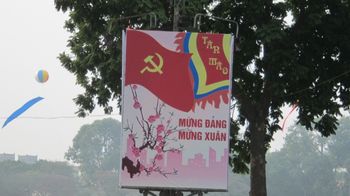
Two key examples are Figures 2 and 3, below. One is a poster marking the important annual occasion known as TBLS (Ngày Thương binh – Liệt sĩ), the day of national remembrance for those killed or disabled in the nation's modern wars, together with the women known as ‘Heroine Mothers’.Footnote 6 The other is a Vietnam Communist Party birthday poster.
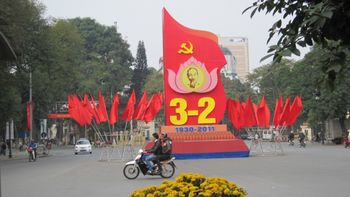
A celebration display marking the birth anniversary of the Vietnam Communist Party with an image of the nation's founding father, President Hồ Chí Minh. Source: Photo by the author.

Marking TBLS, National Remembrance Day, 27 July. Source: Photo by the author.

A Party birthday poster. Source: Photo by the author.

I have been intrigued by how very differently such apparently similar images are perceived by the people I know. In what follows I offer an answer to the question of why there are items of state iconography that West Lakers speak of unhesitatingly as good, attractive, and rich in communicative virtue, while responding initially to what I had thought of as very similar material with silence or a cry of ‘I don't see them – we never look at them.’ What I have learned from this is that both speaking and not speaking about such images can be reflective of a wish to appear to oneself as well as to others as an active moral agent, that is, as a person of feeling and conscience who makes creditable moves and choices in a world of risks and challenges.Footnote 7
In exploring these connections between the visual and the moral, I build on a notion of images as active and morally compelling, not mere illustrations or reflections of things or experiences. I stress particularly how images, both personal and official, can work either to provide or deny the viewer a quality of moral agency which they feel to be their due. I hope to show that exploring these issues in a Hanoi context can help to establish Vietnam as a source of fruitful comparison with other sites of visuality studies, including India and post-socialist Eurasia. I am also hoping to add to our methodology literature on the use of photographs in field research, sharing as I do with other scholars an interest in how we can make pictures taken during fieldwork an active research tool, rather than mere adjuncts to our analytical points
To achieve these ends, I begin with an account of how I have conducted my research. I then discuss what I refer to here as moral agency – a set of goals and values framing thought and action in my interlocutors’ everyday lives. This discussion highlights the significance of visual artefacts to the things my West Lake friends say and do in the pursuit of goals that have ethical salience for them within and beyond the home. It also points to the interpenetrations linking the personal and the official in my interlocutors’ image use, which is why it is important to include material about such items as devotional altar pictures in my account.
In this part of the article I also stress the importance West Lakers attach to effective speech as one of the hallmarks of a morally agentive life. This leads on to the central puzzle addressed in the remaining sections, which is how to understand my interlocutors’ silences, as well as the moments when they resume the role of energetic verbalizers in response to the iconography that pervades their visual world.
A final point to make here is about the balance I have decided to strike between discussion of the formal or compositional features of the images I discuss, and my account of how personal and educational experiences and familial concerns shape my interlocutors’ responses. I believe that my focus on these experiential aspects of visual life give the article its distinctiveness. But of course this does not mean a lack of interest in the ways in which images themselves make and convey meanings by virtue of such key compositional features as their scale, colour palette, and perspectival qualities. In what follows I do take note of these agentive aspects of the artefacts my friends engage with, while still concentrating on the moral reflections that animate their experiences of a diverse and complex visual world.
Goals and methods
My methodology is that of a social/cultural anthropologist, meaning qualitative ethnographic research conducted through long-term participant-observation, working intensively with interlocutors to establish the relations of trust and confidence that are fundamental to our discipline's research practices.Footnote 8 My current research on images is an outgrowth of my work on other aspects of the marketization experience among the Hanoians who have generously welcomed me into their homes, including me in everyday activities which often have a strong visual dimension.
West Lakers I know particularly well, like my friend Mai whom I first met when her undergraduate daughter Phuong was in primary school, like me to attend occasions such as the visits to her home during TBLS/remembrance week by the workplace Party delegates who come to light incense at her household ancestor altar as a token of respect for her war-martyr (Liệt sĩ) father.Footnote 9 TBLS is a time of public reflection on matters of national morality; its iconography plays a major role in these reflections, as I explain below.
Other key parts of their home life that friends like to share with me include the daily burning of incense (thắp hương) through which contact is made with the ancestral dead, and occasions such as the marking of death anniversaries (ngày giỗ) and the divinatory searches for lost family gravesites known as đi tìm mộ (‘tomb-seeking’).Footnote 10 All these are morally critical actions in which images play a central role. My interlocutors document occasions such as divinations and tomb-searches with their cameras and smartphones, and urge me to do so too, so I can share my own pictures with them. And in the richly diverse assemblages of visual materials collected in family albums and mounted on household walls and ancestor altars, items such as official award-ceremony photos and military death certificates mix and interpenetrate with intimate images such as wedding photos and the poignant studio portraits taken before a lost soldier son went off to war (compare Hien Reference Hien2007). All these are frequent reference points in our conversations; so too are items such as the newspaper photos I discuss below. There are rarely any hard-and-fast boundaries for my interlocutors between the official, the devotional, and the personal in the morally salient image contexts discussed here, as when I comment on the ways in which my friends use state media images to make points about intimately personal moral matters.
Other key instances of these interpenetrations include the moments I describe when a monument my West Lake friends know to be a memorial to a major event in national public life lives for them as well as a site of intimate communion with the departed heroes it both represents and instantiates. Indeed, it was the significance of such items for these expressions of care and feeling warmth (tình cảm: discussed below) that first gave me the idea for this project. More specifically, it made me see that a study of visual life in a Hanoi context had to take account of the intertwining of the personal and the official in people's experiences of the visual world, which is why I include both in the analysis presented here.
As I show below, my West Lake friends have also been enthusiastic about taking me out and about to places they consider interesting and meaningful, both in the city and beyond. At these and other times, both collectively and one-to-one, these Hanoians have shared thoughts with me about matters that relate closely and sometimes unexpectedly to the concerns of other scholars researching the giant changes wrought by Vietnam's 25-year market entry process (known officially as Renovation: Đổi Mới). I have been especially interested in what older as well as younger people feel they have gained or lost in the struggle to make creditable educational and career choices for both themselves and those in their care as they navigate the perils and challenges of the fast-changing Hanoi world.Footnote 11
In focusing here on how sight and images can evoke and challenge that sense of being morally active in an uncertain world, I hope to enrich our understanding of moral life, particularly in relation to the varied modes and registers in which the sense of self is experienced, within and beyond Vietnam (Laidlaw Reference Laidlaw2014: 101–111; Leshkowich Reference Leshkowich2014). It is widely agreed that in Vietnam selfhood is expressed relationally, and causality is a matter of the cosmic and fated interacting with willed action and intention (Hy Van Luong Reference Hy Van Luong1988; Kelley Reference Kelley2003).Footnote 12 This does not mean that individuals lack a sense of personal responsibility for their conduct. What I have learned in the course of my fieldwork is that for West Lake mothers especially, the setting of a child's moral compass is central to parenthood (compare Kuan Reference Kuan2015). One learns in youth to be answerable for one's actions, and in later life, to fulfil the responsible adult's many duties of exemplification and care. Taking note of the agentive aspects of image use helps us to see what I am calling moral agency as a continual interaction between the active and answerable individual and the wider realm of persons and collectivities with which ties of feeling and attachment are made and sustained at the levels of home, community, and nation.
Moral agency in West Lake
I am using the term moral agency to sum up what I have observed about my interlocutors’ often-fragile sense of themselves as people behaving well and creditably in a world of challenge and uncertainty. This entails the efforts of will and conscience that Mattingly (Reference Mattingly2014) refers to as moral striving. What I want to highlight is the distinctiveness of such striving for the Hanoians I know, including their efforts to impart good values to the young, and their worries about whether others, including ancestors, recognize them as ethically refined and discerning in speech and action. Before turning to the ways in which state images connect with these concerns, I provide below some illustrations of how my interlocutors seek to establish themselves as moral agents in everyday family life.Footnote 13
There are no everyday idioms used in West Lake that equate directly to the terms moral agent and moral agency. But ethical matters are much spoken of in my fieldsite, as is the importance of being sensitive and discerning as a maker of moral moves and choices. The word for morality/ethics (đạo đức: lit. ‘way of virtue’) is widely used by my interlocutors. But it is usually thought of as a reference to the ways in which the schools and state media sum up the virtues of Vietnameseness, beginning with the proverbs and wise-saw aphorisms taught to every child as expressions of đạo lý (ancestral core values) in the compulsory school subject known as ‘morals education’ (giáo dục đạo đức) (Bayly Reference Bayly, Long and Moore2013b). My friends use idioms of goodness/beauty (tốt/đẹp) as well as conscience (tâm) and mutuality or ‘feeling with’ (tình cảm) for that which is creditable, selfless, and worthy, rather than the more formal đạo đức (morality/ethics).
The parable-like schemas taught in the schools’ official đạo đức syllabus present idealizations of the answerable though also ‘feeling’ citizen-subject manifesting patriotism, filiality, community-mindedness, and so on. These virtues are conveyed as absolutes, with no suggestion of ambiguity or dilemmas in the conduct of moral life (Bayly Reference Bayly2014). The parents I know say they think it a good thing that the schools teach morality in this formally structured way, even though what elders prompt and nurture at home comes first: the capacity to feel with and for others, which is the basis of moral awareness.Footnote 14 I discuss below what can happen when there are dilemmas and painful tests of this awareness, especially in situations when a family's needs require engagement with state agents, hence delicate action in the realm of ‘relationship’ (quan hệ) a concept comparable to the webs of gift and favour exchange known as guanxi in China (Yang Reference Yang1994; Kipnis Reference Kipnis2007).
For the individual, what I am calling moral agency begins in West Lake with the awakening of a child's capacity to express feeling warmth (tình cảm) towards others, which my friends use more often than morality/ethics (đạo đức).Footnote 15 In commenting on the obligations of parents and other elders to impart good values to the young, what my interlocutors stress is the understanding of rightful action as interactive sensibility (tình cảm) arising from the promptings of heart/conscience (tâm) and ‘guts’ (ruột, lòng). This is ‘gut’ as sensitivity, a finely tuned will and awareness, not that of ‘gut instinct’. The truly moral actor is a person with the warmth of heart and humanity that is ‘kindled’ (khơi dậy) by loving kin, and thereafter manifested as warm-hearted interactions with family and wider community: meeting needs, assuaging pain, sharing sadness (chia buồn) (Rydstrom Reference Rydstrom2003; Marr Reference Marr2000). The key feature of this sensibility is its mutuality. This is not just ‘feeling with’ others, but recognizing in those others that they too possess the sensitivities and discernment of a properly developed moral agent.
My friends are also emphatic that truly ethical action cannot be a product of convention or ‘rule’ (lấy lệ ) or a cold calculation of costs and benefits. The power of reason (lý trí ) is essential to humanity. But its use must be prompted by the heart if one is to lead the proverbial good life, which, in the words of one much-quoted aphorism, is ‘a life lived feelingly/dutifully/ethically’ (sống có tình có nghĩa).
The householders I work with equate coldly rule-bound action with non-Vietnameseness and often use visual images to make their points. In the course of a conversation about ‘living feelingly’, my friend Quyên's son Minh, an early-career state service worker, showed me a newspaper photo of two Japanese ‘salarymen’ bowing to one another. ‘Like robots,’ Minh said (rô bô or rô bốt in Vietnamese), their action stiff and soulless, an anxious following of what he called protocols rather than the promptings of a feeling heart. That which is ‘robotic’ is thus antithetical to the qualities of refined will and sensibility that my friends think essential to good conduct in everyday life, which I am summing up here as the basis of moral agency.
The West Lakers I know also say it is self-evident that the Vietnamese capacity to engage feelingly with others is far more profound than that of other peoples. They often express this by pointing to the distinction widely made in Vietnam between the rationalizing ‘think-feel’ (cảm nghĩ) of Western foreigners and the warm-hearted ‘feel-see’ (cảm thấy) of a fellow Vietnamese. I have been told too, though circumspectly because the topic is ‘sensitive’ (that is, political), how different a Chinese sensibility is from that of a Vietnamese. ‘We never did those things to teachers,’ my friend Mai said. She herself is a cheerfully voluble West Lake early secondary school teacher. Her war-martyr (Liệt sĩ) father, a production worker in the fishing cooperative before he was called up for war service, went to China with a ‘friendship’ delegation during the Cultural Revolution and told her what he saw.Footnote 16
On these matters too my friends use a wide variety of images to convey their thoughts. They say they can readily distinguish Vietnamese faces from those of other Asians, especially those from China. And they speak of it as right and proper that the country's graphic artists make Vietnamese countenances look strikingly unlike those of figures they want recognized as Chinese (compare Hien Reference Hien2013: 13). A compatriot's face must be shown as fair skinned and with mild, expressive features, never ‘Oriental’ in eye shape or colouring, and never fierce or aggressive like the faces in Chinese propaganda posters. A point I return to below in relation to state iconography is that it is because being Vietnamese is so widely spoken of as possessing superior qualities of warmth and feeling that it is thought so very shaming and shameful if one is found deficient in matters of sensibility, that is, wrongly thought of as lacking the will to feel and act with sensitivity and moral discernment.
Moral agency in the home
What Quyên's son Minh said he saw in the newspaper photo image of Japanese men bowing was a matter of formal codes and rules, thus wholly different from what he sees when his mother takes pains with the placing of the items that adorn their household ancestor altar (bàn thờ tổ tiên), including its all-important incense bowl and the photos of his paternal grandparents. Both bowl and images must be present for an altar to perform its crucial function as portal and point of contact with the ancestral dead.Footnote 17 As in many West Lake homes, the photos on the altar his mother tends so devotedly are tinted blow-ups of his paternal grandparents’ state identity card photos. Quyên made the shop redo them several times before she was satisfied with the colouring. There are also the home-cooked foods set out on their household altar on the eve of each grandparent's death-anniversary. It is out of loving warmth, not rules or convention, Minh says, that his mother cooks his grandfather's favourite dish for the occasion – peanut-flavoured ‘sticky rice’ (xôi lạc) – and ensures that the brightly coloured apples and tinned brand-name drinks that accompany it are well polished and unblemished.
Together they have made clear to me where they see the agentive element in such practices. When Minh was a mildly obstreperous teenager, he told me, he cheekily asked Quyên why she bothered to cook the xôi lạc herself instead of buying it ready-made. She was quick to make sure he grasped why this would be unfeeling and wrong, an easy option cop-out – like the Japanese bow, just a semblance of a moral agent's care and warmth, not the real thing.Footnote 18
Quyên has also told me how as a young bride she knew she had to be observant in her new marital home; ‘eyes always open’, she said, trying to see without needing to be told what were the right foods and votive-goods for these key occasions in their household. She did not want me to see these as stories about how hard it was to avoid being carped at by censorious marital kin, even though she has told me on other occasions about her mother-in-law's high-handed ways. In this case her point was about the principles she has worked hard to instil in her own children – that is, taking pains to get such things right, and doing so with grace and goodwill, reflects both a refined sensibility and a good upbringing.
The view here is one that I have regularly encountered: without a mother's nurture, children will not realize their potential as moral actors. This means both the will to be attentive and take care, and the innate capacity to take in what observation conveys. It is this mix I am referring to when I use the term moral agency, which for my interlocutors means both having and acting on a capacity to show care and ‘feel with’ others.Footnote 19
My fieldsite
Since 2010 my main fieldsite has been the densely populated Hanoi neighbourhood for which I use the pseudonym Hồ Tây (West Lake).Footnote 20 It is in no sense an elite or privileged enclave. In precolonial times a typical peri-urban village with decorative stucco entrance gates, brick-paved lanes, and a sizeable community house (đình) enshrining the local place-gods, the area is now an urban ward (phường) within one of the inner-city core-zone quarters (quận).
Most of the neighbourhood's householders are descendants of old West Lake fishing, market-gardening, and craft-specialist lineages with strong connections to the inner-city market area known as the Old Quarter (Phố Cổ).Footnote 21 Even in the planned-economy ‘subsidy’ (bao cấp) years (1973–1986) when the state's official policy was free education for all, West Lake was a poor locality with notably low rates of literacy. Today almost all its families live at a level of modest comfort that would have been unimaginable a generation ago, when most households’ livelihoods came from the sclerotic operations of the area's lake-based freshwater fishing collective.
For many West Lake households, the beginning of these gains preceded the onset of marketization/Renovation in the mid-1980s, thanks to the seed money amassed by their elder members in the preceding decade when many of its demobilized soldiers were recruited for gruelling factory work in the labour-hungry ex-Soviet ‘satellite’ states (Bayly Reference Bayly2013a).Footnote 22 These elders, including a number of retired Communist Party members, are still an active presence in many of the locality's multi-generational households. Their perspectives on how moral lives should be led in changing times have been a critical source of my thinking about the issues explored here.
Like many such Hanoi neighbourhoods, Hồ Tây also has a sizeable minority of first- and second-generation incomers from a variety of urban and rural localities in Vietnam's deltaic North. These are typically high achievers from modest backgrounds who made it through the brutally competitive university admissions process, graduating from one of Hanoi's big-name universities and then securing white-collar employment in the city. One of the ways other West Lakers can enhance their household incomes is by renting accommodation to such people.Footnote 23 I say more below about the moral concerns arising from such incomers’ struggles to acquire the documented status of a registered Hanoi resident.
The old West Lake families still live where their forebears resided, though, in most cases, in glossy four- and five-storey multi-generational new-builds, rather than the tiny clay-walled houses of 30 years ago. The handsome old stucco gateway pillars and community shrine house (đình) have thus far escaped demolition, but all around them intensive high-rising and infilling have transformed the area into a booming microcosm of the enormous changes the city has experienced since the onset of marketization. Today every Hồ Tây child goes to school and all the householders I know, hope – and even expect – that their sons and daughters will attend a college or university. Beyond this is the dream that their young will secure high-tech knowledge-economy employment and lead the good life they see all around them in their increasingly glossy, cosmopolitan city (Drummond Reference Drummond, Nguyen-Marshall, Drummond and Bélanger2011). These quests for employment credentials in what parents think of as the desirable arenas of the globalized knowledge economy have made West Lake a place where many of the challenges and paradoxes of today's Vietnam are made visible in its residents’ concerns.
Silence and speech
Since my argument about speech and silence relates to what I have learned about West Lakers’ sense of themselves as moral agents in contexts within and beyond those of state iconography, I turn here to some of the ways my friends have communicated with me about these concerns. My teacher friend Mai is normally keenly forthcoming about matters of moral agency, including the dos and don'ts involved in acting through ties of quan hệ (‘relationship’) connections with a well-placed official or ‘big man’ to access scarce state services for one's child. Mai has stressed the sensitivity such situations require and is insistent about the importance of a well-tuned sense of what to say and not say when seeking to meet an urgent need through the workings of quan hệ. This notion of discerning speech is important for my interlocutors in a wide range of contexts, including those of visual economy, as I show below. It is also important to stress how forthcoming my friends have been about these matters, lest it be thought that I encountered silence in regard to state images simply because my interlocutors regard talking about state-related matters as too sensitive to discuss with a foreign researcher.
Like other West Lakers, Mai is insistent that one must never use a crass language of instrumentality when there are kin to help through ‘relationship’. There should be no hint of transaction or favour exchange, even when money changes hands, as it often does with quan hệ. One might say that there is an art to its practices, as in Yang's (Reference Yang1994) account of its Chinese counterpart, guanxi. But this must not be the artfulness of calculation or cunning – and one must certainly not be so clumsy and unfeeling as to suggest, even indirectly, that the help one receives is a deal done for gain.Footnote 24
Mai laughed when I tried to construct what I imagined was an idiomatic Vietnamese phrase referring to ‘using’ quan hệ connections in a time of need. ‘We avoid that,’ she said, meaning verbs like ‘use’ and even direct references to the notion of quan hệ. The fact of having a ‘relation’ with someone like a well-placed former classmate where a word in the right ear will help a working-age son's or daughter's promotion prospects, or a child's admission to an oversubscribed infant school, is something one does not speak of in terms of ‘use’. And my friends also avoid anything like the idioms younger people are familiar with from Western-style business jargon, like ‘networking’ and making ‘contacts’. The person one reaches out to in a case of need is a ‘relative’ (người thân: lit. ‘dear one’), though the connection need not be a blood tie. Even to the traffic cop angling for a payoff at a speed trap one says politely, ‘Please wait while I call my người thân.’
My West Lake incomer friend Hạnh said the same thing to the ward official who was clearly signalling to her that the elaborate paper trail required to establish the Hanoi resident status she had been struggling to obtain for herself and her elderly mother was still in limbo because they had not paid an adequate ‘sweetener’. She too had a ‘relation’ who solved the problem for her.Footnote 25
During a stay in my West Lake fieldwork site in the summer of 2018, my teacher friend Mai and her mother, a retired ward-level Party official, were much involved in a series of anxious family conversations about how to advise Mai's sister's son and his young wife Quỳnh, who was pregnant with their first child. Quỳnh is another West Lake graduate. She too did well at school and university, and after graduation secured a teaching post in one of the city's prestigious selective-entry ‘gifted student’ schools. Fearful about the state of her pregnancy, the family were much taken up with the issue of how to obtain quality prenatal care for her.
As in urban China (Fu and Chan Reference Fu and Chan2016), families put tremendous effort into the securing of appointments at whatever overcrowded state hospital has their preferred specialist on its staff. Officially, Quỳnh would have had to join the early morning scrum for one of the numbered appointment slips issued by the hospital's newly installed automated ticketing machines. Their use is supposed to guarantee fairness and transparency. But my friends say the system is chaotic, and even with a ticket for an early time-slot there is no guarantee of being seen or of being treated by the doctor one wants. Hence the path of quan hệ/‘relationship’ with all its perils and anxieties. One ‘knows someone’, or one's friends and family members do, and a delicate process of accessing help/giúp is set in train.
What makes the process a test of moral agency in the West Lake contexts I have observed is the degree of sensitivity everyone is expected to display when help is sought from a ‘relation’/người thân. This means ensuring that the seeker of help comes across in both speech and action as a person of refined sensibility acting out of selflessness and warmth. My friends have made clear to me that to act as a moral agent one must also treat those one deals with in matters of quan hệ as full moral agents. This means signalling that whatever help one receives is provided on a basis of selfless generosity and feeling, not for gain and not out of compulsion. The help-giver must be the initiator of her good actions, not a ‘robot’ acting from fear or greed, or the compulsion of ‘rule’.
The handling of money requires particular care in these situations. To ensure that one comes across unmistakably as imputing the qualities of a moral agent to one's help provider, my interlocutors have made it clear that the cash gifts commonly presented in such situations must be conveyed as graceful materializations of tình cảm/feeling, not a ‘thank you’ for a specific service – and definitely not a pay-off or bribe. But there is much more to decide about when these moves are made, and it is in taking this kind of trouble about nuances of sensitivity and rightness of tone that we can see the force and logic of moral agency at work in West Lake.
Although what they were telling me about were issues that had worried them, Mai and her mother clearly enjoyed taking me through all they did to ensure that what Quỳnh did and said would impute full moral agency to everyone in the relationship chain they brought into play to secure her hospital care. This involved extensive discussion with other family members by phone and at home. What sum should she give the doctor that would be neither insultingly mean, nor showily too much? Should it be handed to him in its elaborate gift bag before or after the initial treatment session? And what to say and not say when doing so? It was important to decide the right form of words to signal that the money was an appreciation of the doctor's selflessness and warmth in taking her on as a patient, not a phong bì (bribe).Footnote 26 And it was crucial to know what to leave unsaid. So they gave much thought to whether she should refer to anyone else in the chain of help/giúp that had secured the appointment.
The answer to this was a firm no, and Mai told me why. It had been agreed that Quỳnh should obtain her appointment through a quan hệ ‘relationship’ tie involving one of her teenage classroom pupils. The boy's father is a ‘big man’, head of a government department involved in medical provision. Mai was discreet about which. But she was happy to recount what they agreed about how Quỳnh should proceed. ‘No, never,’ Mai said, when I asked if Quỳnh had spoken directly to the pupil's father, nodding approvingly when I worked out that this was because the two set of ‘relations’ that had to be made visible in what she did and said were those of caring teacher and pupil, and of loving parent honouring and respecting the teacher of his cherished child.
Speaking to the father would have crosscut the two, making her a supplicant seeking a boon. This would have been especially bad because of the indelicate implications of any quan hệ matter involving a young woman and older man of power.Footnote 27 What they decided was that Quỳnh could say to her pupil, quietly and outside the classroom, ‘Maybe your father knows the phone number of a doctor at XX hospital’: just that, ostensibly a matter of factual information only, which the father could easily supply. The hope of course was that he would make a discreet phone call to the doctor or to one of his superiors. No-one would be told to whom, or on what basis of favours previously provided or anticipated. Quỳnh's grandmother thought it was the doctor's immediate superior who had been contacted. This would be a người thân/‘relative’ of the father/‘big man’, who would make known what help he was hoping for. Doing such a service for a son's valued teacher would be thought quite a normal and good thing to do, my friends agreed.
What happened was that a day or two later, Quỳnh received a text from the student's father containing just a doctor's name and the date and time of an appointment. Nothing was said or hinted at about a return obligation on her part, such as a tweak to the son's test scores or extra coaching for his exams, although it was assumed that something of the kind would be expected in due course. Mai and her mother were confident that it would be a reasonable request; ‘normal’, they said, that is, nothing excessive or dangerous for Quỳnh, like a demand to turn a fail into a top-band mark. And there would be no suggestion of tit for tat, so no reference to the hospital appointment when the boy received whatever ‘help’ she would eventually provide.Footnote 28
When she went for her appointment, Quỳnh needed to be careful not even to hint at any notion of a transaction. If she had crassly mentioned her pupil's father to the doctor, she would have been signalling that the doctor had provided the appointment to gain favour with either the ‘big man’ or his hospital boss. That would suggest a view of him as being motivated by self-interest, not warm feeling/tình cảm, hence a denial of the doctor's moral agency.Footnote 29 Making such a crass move would also have shown that Quỳnh and her family were defective moral agents, undiscerning and insensitive.
Depicting right and wrong
The West Lakers I know do not speak of these as improper or ‘corrupt’ practices: no-one suffers, people say, and it is right to care for one's child and other cherished kin. So it is not thought bad or unethical for doctors to receive cash gifts from patients, or for a teacher to seek the kind of help Quỳnh received from a pupil's parent. Nor do my interlocutors speak of such things as hospital queue-jumping as inherently wrong or bad for ‘society’.
A parent should be expected to want to show warmth and care to their child's teacher. Care for one's unborn child or ailing mother is considered worthy and righteous, more so than thinking in the abstract about rules and formal ‘systems’ or of ‘society’ as an impersonal whole, that is, with the coldness of ‘think-feel’ rather than ‘feel-see’. West Lakers speak in personal terms: so the patient one may have displaced from the queue was perhaps not in so much need, and was therefore content to reserve for another, more urgent occasion whatever moves they might be able to make through the route of their own webs of ‘relationship’. Or perhaps they were deficient in the nurturing of kin ties and the non-blood relationships that would have been a source of ‘help’ for their own loved ones in times of need.Footnote 30
Yet these are acknowledged to be grey areas, and once again there is an iconographic dimension to what is thought and said about such matters. The West Lakers I know are familiar with the satirical cartoons that appear from time to time in the state media depicting such things as hospital patients anxiously clutching their gift bags in a fat-cat medic's consulting room. These little jabs at the tribulations of ‘today's life’ elicit wry smiles, not outrage. The same is true of the mild barbs lobbed by newspaper cartoonists at the effects on schools of what Martin Painter calls the ‘semi-privatizing’ of the state's service-delivery sectors.Footnote 31
Under Renovation/Đổi Mới, schools and hospitals have been encouraged to ‘equitize’ (cổ phần hóa) through the implementation of ‘user-pays’ revenue schemes (Gabriele Reference Gabriele2006; Painter Reference Painter2014).Footnote 32 West Lakers laugh at the cartoons in mass-circulation dailies such as Lao Động (‘Labour’), depicting hucksterish headteachers coming up with ever more ingenious pretexts for charging parents ‘fees’ (phí in Vietnamized English) for such things as air conditioning and ‘sanitation monitoring’.
In these images too, all the figures are to be recognizably Vietnamese, so no-one looks villainous or beyond the pale. It is well known that school heads and their ‘quality’ teachers benefit personally from the fees. But as long as the schools deliver what they charge for, my friends say it is a good thing for them to enhance their facilities in this way, thereby doing well for those in their care.
West Lakers do speak heatedly, though, about what they see as real harm, especially when perpetrated by foreign market actors, above all when the malefactors are Chinese. Mai has shown me some truly ferocious cartoons published in the state media at the time of a notorious scam involving the sale of fake scanning equipment to Vietnamese cancer hospitals. Healthcare managers too have been given power to control their budgets, and several had struck disastrous purchasing deals with Chinese suppliers. The lampoons Mai showed me were nothing like the ones poking mild-mannered fun at school ‘fees’ and gift-giving to doctors. She thought the cartoonists had done well in depicting the Chinese exporters of the bogus items as monsters with faces of subhuman rapacity.Footnote 33
None of these are matters the people I know regard as ‘sensitive’ or ‘political’. For my interlocutors there is an enormous difference between speaking of the need to ‘feed’ a petty official with cash or favours, and saying something dangerously generalizing about high-ranking leaders or state authority in the abstract.Footnote 34 So no-one I know would round off such an account by articulating something unsayable like ‘Isn't it terrible that the system makes people do such things?’. What comes across instead in our conversations is that it is agreeable for friends like Mai to show me their pride in being providers who put care and effort into the ‘relationships’ (quan hệ) with officials that must be skilfully forged in order for one's family to achieve and flourish (Hy Van Luong Reference Hy Van Luong and Taylor2016).
So my interest in state iconography was not in itself off-putting. In some contexts, notably in relation to public statuary, it too is a topic that allows for a display of qualities that my interlocutors like me to see: taste and knowledge, refined sensibility, and warmth of feeling. This was why I found it surprising that there are images about which my friends have been immediately voluble and forthcoming, and others that at first have so strikingly dammed the flow. As I show below, the difference has turned out to be the distinctions people make between images that do and do not treat them as citizens of ‘quality’ with fully developed moral powers.
Images in question
So I turn now to my iconography questions. Why are my West Lake friends both very silent and very vocal about the official images that pervade their city's visual economy? And why was I so often off-target when I expected them to see certain items of iconography in favourable or at least blandly neutral terms? As I explain below, my interlocutors did eventually find it possible and even pleasurable to reflect on this mix of responses. Indeed, it became a matter of fascination for my informants and for me when people began to give exegetical voice to things normally left unsaid. What these shared efforts brought to light was the value of recognizing a four-fold set of elements shaping West Lakers’ interactions with official iconography. These elements are:
• the captions and other features of language use in a poster or monument;
• its visual style;
• its medium (that is, whether flat and two-dimensional or sculpted in ‘living’ three-dimensional form);
• its iconographic content – that is, the meanings to be discerned when there are things such as representations of factories, helmeted workers, and renderings of past or present urban architectural forms in a work of state iconography.
The setting for my friends’ encounters with state posters and monuments is a metropolitan environment in which the iconographies of global consumerism and high socialism are closely entwined. The streets my interlocutors traverse on a regular basis still have displays of giant posters and slogan banners hailing the eternal life of the Vietnam Communist Party and the deathless truths of its ideals. So too do the facades of its state schools and office blocks. But there is also much conspicuous state imagery celebrating the transformations of the market entry process.Footnote 35 Adverts for KFC and Coca Cola appear on hoardings throughout the city, cheek by jowl with state mobilization banners coloured an almost identical brilliant red, but inscribed with the words and symbols of the nation's most sanctified public occasions, including TBLS (the day of national war remembrance).
Only a few very hallowed spaces are kept free of such eclecticism. Even the rigorously policed grounds around the giant mausoleum where the nation's revolutionary founding father President Hồ Chí Minh is interred contain refreshment stands festooned with Coke logos (compare Drummond and Nguyen Thi Lien Reference Drummond, Lien, Daniere and Douglass2009). In the autumn of 2017, there were posters showing Marx and Lenin as ghostly presences providing inspiration to President Hồ Chí Minh in close proximity to the newly opened city-centre Hanoi McDonald's. Also close by were photo-montages of the Kremlin, on display throughout the city in celebration of the centenary of the October Revolution.Footnote 36
In addition to state iconography, the profusion of cues and come-ons to be seen along the capital's traffic-choked thoroughfares range from globalized brand-name advertising to the posters and banners produced by the city's officially sanctioned churches and Buddhist pagodas. But it is clear that the state has not surrendered its command of public space to privatized image makers. What is notable is the leakage between these domains, as when the state's posters proclaiming its vision of a ‘market-guided socialist economy’ and the logos of ‘equitized’ commercial enterprises are juxtaposed with the hallowed emblems of nation and Party.Footnote 37
My iconography puzzle
So now to my puzzle, which stems directly from the visual multiplicity described above.
The two state message posters shown in Figures 2 and 3 are typical of the brightly hued iconography displayed on a regular basis to mark the mobilization campaigns and commemoration days that still loom large on the national calendar. With minor variations from year to year, the image in Figure 2 is widely used on posters marking the hallowed annual remembrance occasion of TBLS. Figure 3 is a Vietnam Communist Party birthday poster, of the kind that is also still prominently displayed on an annual basis. It too features a formulaic composite image that is regularly reissued with only small modifications from year to year. Such posters always include declamatory slogans, couched in language that is immediately recognizable as the distinctive idiolect of the Party-state.Footnote 38
To my foreigner's eyes, the two appeared to be much the same in style and execution. Indeed, I had initially expected that whether liked, disliked, or viewed with indifference, these two posters, each with its pair of bright-eyed youthful citizens in the company of a happy, helmeted worker, would be thought of in much the same terms by Hanoi observers.
But not so. And in seeking to understand this, and the related issue of why my interlocutors think in such strikingly different ways about state posters and monumental statuary, I realized that what I was encountering was what I alluded to above: the use of refusal and silence as a mode of moral agency. This I believe to be an important resource for the people I know as they negotiate the divergent signals of a communicative order still steeped in the reference points of high socialism, while simultaneously urging them to become ‘integrated’ achievers in the market-driven global knowledge economy.
Why then do my friends see the two posters so differently? In my conversations with householders like Mai, Figure 2 is spoken of in moderately positive terms. ‘Not so bad – the artist cared’, ‘Somebody took trouble’, ‘Somebody really drew it’, West Lakers say. In contrast, the householders I know found Figure 3 initially very much a ‘We don't see them’ poster. Considered much more typical of the genre than the TBLS/remembrance image in Figure 2, this one repels. ‘Cold’, ‘ugly’, ‘nothing there’, my friends said, once they decided to articulate things normally left unstated about the look and feel of posters like this one. ‘No feeling,’ Mai said. ‘Fake,’ another remarked.
This was Khánh, an IT professional in his late twenties from one of West Lake's modestly prosperous ex-fishing family households, his elders immensely proud of him as the family's first university graduate. When Khánh used the word ‘fake’, he said he meant the worker's little smile, that it reminded him of the cheesy cheeriness he had been called on to display in childhood, when singing the Young Pioneer anthem for wearisome municipal dignitaries’ visits to his primary school. The smiling worker's face in the other image, Figure 2, looked warm and genuine by comparison, he said.
Of Figure 3’s imagined producers, people said, ‘They didn't care; they didn't try.’ Or, ‘They just used the computer.’ This was Mai again, at a point in our conversations when she had begun spelling out what she felt about posters. She meant no skill or effort was involved, just the mindless downloading of recycled images from a database.
Seeing and viewing in West Lake
I return now to the ways in which my interlocutors think and speak about state iconography. The conversations Mai and her daughter regularly initiate about images and their use frequently focus on the items she arranges with care on their household ancestor altar. They also include her views about many state images, including the cartoons discussed above, and also the statuary in the city's public spaces. Telling me about public monuments is clearly pleasurable for her, as for other interlocutors who like me to know about the trouble they take to be the kind of city-dwellers the message posters extol as urbane and ‘civilized’ (văn minh) (Bayly Reference Bayly2013a: 62).
‘I like research too,’ Mai says, using the words ‘nghiên cứu’, meaning the search for improved skills and knowledge, very much a mark of both refinement and personal virtue in the Hanoi world. So while she is always immensely busy, Mai regularly suggests places I should visit with her or an activity she thinks I ought to observe, always happy when I enthusiastically say yes to her offers to take me along to a family soul-calling (gọi hồn: a form of spirit possession) or on a trip to her husband's ancestral village on the city's outskirts to clean the family tombs for the lunar New Year; even, on one memorable occasion, a grave-search for the remains of her deceased younger brother, a soldier killed in the anti-US War, undertaken with the help of a psychic ‘natural’ in the hope of finally laying him to rest with their other kin.Footnote 39
My interlocutors had been aware for some time of my interest in state iconography. It had come up in conversation before, in particular during visits with Mai to the lakeside sites where monumental statuary is prominently displayed. It was Mai who suggested the strategy of taking me on little strolls to view such places with companions from her neighbourhood, starting with Mai and her daughter, and then with friends like her neighbour Mr Anh, a retired state enterprise clerical worker. Together, they came up with a selection of favourite locations where they felt confident that we could observe official images unproblematically, without strangers wondering what we were up to.
The places they like most for these walks are the areas adjoining two city-centre lakes that are much frequented as exercise and leisure venues. One is Hanoi's cherished ‘Restored Sword’ Lake (Hồ Hoàn Kiếm), where there are regularly renewed displays of posters and message banners, and examples of the monumental statuary I discuss below.Footnote 40 The other, Thiền Quang Lake, is not a famous landmark like Hoàn Kiếm/Sword Lake, but it too is a prime site for image displays because of its location at a major cross-city road junction which Mai regularly traverses on her motorbike commute to work.
What I found, though, is that taking me to see poster displays is not the same as coming up with an exegetical comment on their content. What Mai said about computer downloads relates to this issue, as I explain below, reflecting what is widely assumed about posters like the ones in Figures 3 and 12 – those depicting the classic high-socialist class and character types in flat, cartoon-like mode.
‘Red aesthetics’
In compositional terms, Figures 3 and 12 are classic exercises in ‘red aesthetics’ (Hemelryk Donald Reference Hemelryk Donald2014), their visual grammar reminiscent of both Soviet and Mao-era Chinese state graphics, combining colour, figures, text, and scale to deliver a highly conventionalized materialization of high-socialist political selfhood. As I explain below, a remarkable feature of contemporary Hanoi life is that monumental posters of this kind are still regularly placed on display in the capital's public spaces.Footnote 41 In both of these examples, authoritative visual statements about the eternal life of state and Party are produced through the use of very long-standing graphic conventions, including an intense, saturated colour palette dominated by the twinned gold and vivid red of the national flag, and the hammer and sickle of the Party.
In Figure 3’s celebration of the birth of the Communist Party of Vietnam, the dominant figure is the heroic vanguard class hero. This idealized industrial worker as maker of the revolutionary new order is positioned in the rigidly frontal perspective that roots him temporally in the eternal here and now, commanding the visual field with his strong, directive gaze, and the equally strong diagonal of his body with its thrusting raised-arm salute to the glory of nation, Party, and people. He is flanked on the left by the stylized outlines of the giant hydroelectric plant and smokestack high-rise cityscape representing the promise of powerhouse modernity on the march in the new Vietnam. To his right stand the two figures of revolutionary youth in the uniform of the Young Pioneers as citizens of the nation to come. Figure 12 presents a slightly softened version of this aesthetic; as I explain below, its theme is significantly different from that of the poster in Figure 3. But it too features the vivid red of Party and nationhood, focusing in this case on a triad of the nation's children in Young Pioneer scarves.
The central figure in Figure 12’s poster is the boy with the book satchel and Young Pioneer tie. As in many such state graphics, the gender dynamic is skewed to present an image of dominant male citizenship partnered by female makers of the nation as adjuncts and helpmeets (Taylor and Jonsson Reference Taylor and Jonsson2010). The boy's face is shown in side view and, like those of the two girl Pioneers and the duo in Figure 3, the fact that none is shown frontally evokes yet another key poster convention adapted from Soviet models, that of the young in motion, both physically and temporally (Bonnell Reference Bonnell1997).
Thus, complementary to the rooted perpetuity of the key figures in full frontality mode, notably that of the vanguard worker in Figure 3, this is youth looking to an exalted future and taking active steps towards the making of the bright new world, to be seen in what the vivid primary colours and simplified, sharply outlined figures and structures are supposed to convey. Both embodiments of nationhood are intended to exalt and inspire. Like the monumental sculpture discussed below, they are usually positioned so that the viewer must look up at them as embodiments of exalted presence and authority (Abousnnouga and Machin Reference Abousnnouga and Machin2010: 144–145). But as I explain below, my friends make a very different sense of these images from what their producers intend, and such elements as compositional frontality and side-view figures register quite differently in their responses to these materializations of the Party- state's official voice.
Messages received and perceived
So what do West Lakers make of these images and their conventions? My interlocutors do not think of posters like those discussed above as the work of trained artists, whose work, whether good or bad, is worthy of their consideration and comment, but rather as that of low-level municipal ‘office staff’ operating ‘like robots’. It was Mai who used the word in this case, to convey her mental image of a low-ranking local official mindlessly recycling archaic stock images from a computerized database. I return below to the unhappy things that come to mind for West Lakers at the thought of commenting on this kind of iconography.
What these distinctions point to is the widely shared sense that being a discriminating observer is an important quality to cultivate, a desirable expression of what I refer to in this article as moral agency: a critical measure of worth and virtue for the people I know. Stylish dress, taking care with one's appearance, expressing a discerning interest in the look and order of one's home and wider urban environment: these are things that my friends tell me they value. They are all signs of what has been called the ‘reinvention of distinction’ in today's Vietnam (Nguyen-Marshall et al. Reference Nguyen-Marshall, Drummond and Bélanger2011), a process embracing first-generation white-collar Hanoians like Mai, as well as the urban elite (Vann Reference Vann, Nguyen-Marshall, Drummond and Bélanger2011).
Evidence of ‘not caring’ on the part of the producers of message posters is something my interlocutors see as evidence of the unflattering things assumed by officialdom about their ‘level’ (trình độ) and ‘quality’ (chất lượng) as perceiving citizens. The ‘don't care’ attitudes imputed to the people charged with public communication work is thus a matter of importance to the Hanoians I know, something that householders in my fieldsite comment on in relation to public statuary, as well as message posters. This too is a matter of moral agency that I return to below.
That all-important term for Vietnam's embrace of globalized market life, Đổi Mới (meaning Renovation/Renewal) can also mean ‘innovation’. It is part of a new lexicon mixing the idioms of high socialism, contemporary business jargon, and NGO developmentalism (Salemink Reference Salemink, Lewis and Mosse2006). This has made it a key word in state messages about the qualities of inventiveness and creativity to be fostered so that today's achieving citizens can ensure the nation's success in international trade and business.Footnote 42
These entangled messages make for striking juxtapositions in verbal and visual life which people normally negotiate as a matter of course – and without comment. Indeed, a key feature of educational experience is the often-painful process of learning what can and cannot be verbalized within and beyond the classroom. The schools’ compulsory Marxism syllabus still teaches that Vietnam is in ‘transition’ (quá độ lên) in the classic Marxist sense, meaning transition to perfect socialism.Footnote 43
Students know they must not ask the teacher how this can be compatible with the big-spender consumerism they see all around them. Nor must they say aloud something that is clear to their elders, which is that idioms like Đổi Mới and đồng bào, the important term for compatriot discussed below, are formed from everyday vernacular language, appropriate for informal conversational exchange. This places them in a very different realm from words like ‘transition’, ‘vanguard class’ (tiên phong), and comrade (Đồng chí). They are equally distinct from the vocabulary of red-banner slogans and textbook Marxism: formal, official, and cold, people say.Footnote 44
Red-banner language must be mastered, used correctly in exams, and recognized as the voice of authority in leaders’ speeches, but always with an awareness that fully developed morality and intellect require expressive capability in the idioms of ‘real’ Vietnamese. This is the warm, rich language of the home and of the nation's poets and folk adages.Footnote 45
This concern with verbal adroitness in the proper modes and contexts is central to the shaping of the two entwined realms within which the Hanoians I know negotiate today's market-era transformations and achievement norms: citizenship and family. Both are full of moral challenges. As in the case of what should be said and not said in the matters of quan hệ/‘relationship’ discussed above, my interlocutors attach great importance to the knowledge of what to say and not say about things seen and visually projected in matters of both citizenship and family. This includes state iconography as well as what is said and felt about personal images, especially the all-important photos used on gravestones and household ancestor altars.Footnote 46 These too are entwined and interactive, as I explain below.
The interactions of sight and speech in personal images are very relevant to how citizens engage with state-produced artefacts. The photos displayed on household ancestor altars (bàn thờ tổ tiên) are productive; they generate presence and are active portals of communication with the deceased. The incense sticks with their graceful ash trails, burning in their sanctified bowl beneath the photos, are critical to these exchanges.
Thắp hương, the lighting of incense before an altar, is the critical means of establishing contact with the departed kin shown in its photos. The glow and scented smoke are what non-mortals perceive and respond to as experiencing agents, followed by simple words in direct and homely Vietnamese – not a mantra in an unknown tongue – with which kin establish their closeness and regard (compare Delaplace Reference Delaplace, Blanes and Santo2013; Reference Delaplace2014). West Lake parents teach the young that what non-mortals see must be expressive of care and conscience, hence reflective of true, deep feeling: tình cảm. In doing so, what I am referring to as moral agency is affirmed and acted on.Footnote 47
In deploying his notion of ‘corpothetics’(the distinctive form of sensory contact between viewer and viewed), Pinney (Reference Pinney2004; Reference Pinney, Edwards and Bhaumik2008) discerns in Hindu devotional life a mobilization of all the viewer's senses and perceptual registers, rather than sight in any simple bio-mechanical sense. He also notes that his informants take little interest in the look of images. Yet, while they are not concerned with how the images are produced or with their ‘semantic unravelling’ or exegesis, Pinney makes clear that viewers are not deprived of voice and agency. His interlocutors do not verbalize, but they are still active agents tapping directly – ‘corpothetically’ – into the image's productive power, its barakat.Footnote 48
There is a parallel to this in Vietnam in the notion of linh. This is the efficacy of the quickened divine image, like those on the altars in the households in my fieldsite. They too are sites of productive power instantiated in images through moral action.Footnote 49 But there are also striking differences. In West Lake, speaking images, and speaking about images, are of great importance, connecting directly with issues that are central to the moral challenges of present-day city life. Exegesis both is and is not a critical mode of engagement with the iconography of home and citizenship. Silence and energetic verbalization are both critical to Hanoians’ morally complex relations with the visual world and are closely, though often problematically, entwined.
Propaganda and beyond
What I am therefore seeking to show here is that West Lake viewers bring their own distinctive sense of voice and moral agency to the ways in which they are both visually addressed and represented in official images. Living in the presence of what is still a vigorously propagandizing Party-state is an experience of moral agency that is both challenged and dynamically engaged. It is this sense of having a real and often troubling stake in what particular kinds of images say about them as thinking and feeling moral agents that I discuss below.
Images matter in Hanoi in varied ways, depending on site and context. It is notable that many of the state's lavish new commemorative monuments bear the logos of commercial companies and are praised in the state media as projects of ‘socialization’ (xã hội hóa).Footnote 50 But official iconography still retains the conventions of what has been called ‘revolutionary romanticism’ (Humphrey Reference Humphrey2002). Its visual and verbal language therefore continues to extol the values of socialist nationhood alongside exhortations to strive, promote, produce, advance, outdo, and achieve in classic high-socialist declamatory mode.
Officials consider it a key priority to produce banners and posters for Hanoi's public vistas. As the nation's capital, the city is a site of exemplarship for all citizens. There are regular public campaigns enjoining Hanoians to fulfil their duty to the nation at large by leading lives of ever-advancing ‘civility/civilizedness’.Footnote 51 TV spectaculars celebrating major national occasions are staged against the backdrop of Hanoi's public spaces and monuments.
So Hanoi can be thought of as a ‘concept city’, but not in the sense conveyed by de Certeau (Reference de Certeau and Rendall1984): urban space as a manifestation of the state's panoptic gaze, subjugating, stark, and brutal. As a central reference point in the national narrative, Hanoi has conceptual power as an exemplary moral space, communicated in ways that emphasize human agency and action, especially in relation to its hallowed sites of great deeds and national achievements.Footnote 52
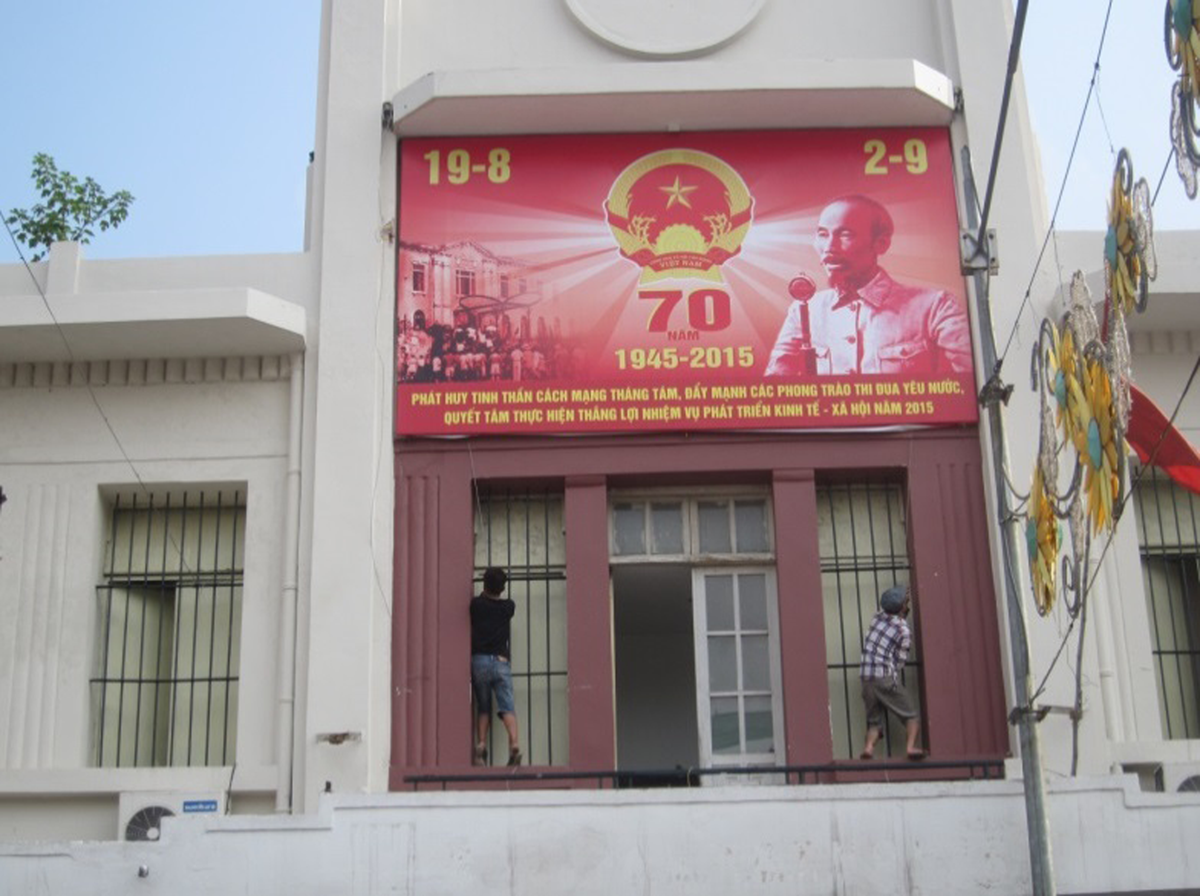
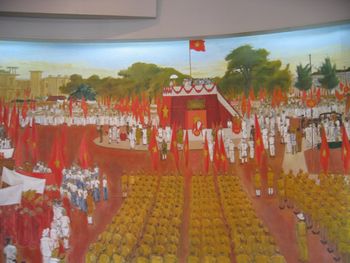
Chief among these is Independence Day, 2 September 1945. This exalting moment of self-wrought emancipation from French colonial rule is portrayed as a Hanoi event as well as a nation-making one. Its key moment is visualized as a sanctifying articulation: the first public utterance of the word đồng bào (compatriot, but with the earthy sense of ‘born of one womb’), spoken by the nation's cherished liberator President Hồ Chí Minh, often called Bác Hồ or just Bác, the honorific for father's elder brother (Pelley Reference Pelley2002: 160).
That foundational speech act is recognizable to everyone I know through images such as that in Figure 5.
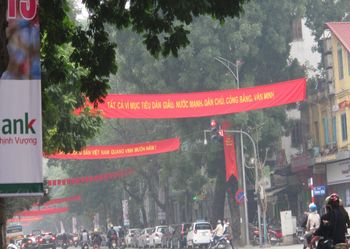
City street slogans: ‘Everything to reach the goal [of] prosperous people, strong country, democratic, just, civilized’; ‘Eternal life to the glorious Party!’. Source: Photo by the author.

An Independence Day anniversary poster. Source: Photo by the author.

West Lakers assure me that every schoolchild knows that đồng bào (compatriot) was the key word of the opening of the President's address to the great convocation assembled in Hanoi's Ba Dinh Square on that all-important day.Footnote 53 Critically, the event is narrativized as a call-and-response articulation between the President and the great gathering to which he spoke.
Every school-age child I know can recite his words, ‘Compatriots, can you hear me clearly?’ and the immediate joyful rejoinder, in unison and from the heart, by the attentive listeners in their ordered ranks. A stirring ‘Yes!’, but in words with the sense of ‘We hear!’ – ‘Có ạ!’ – was their jubilant cry. The well-known pictures show them in formation: schoolchildren and militia fighters, peasants and workers, even Buddhist monks. It is an exchange redolent of what is learned in childhood as the essence of moral agency: warmth of feeling conveyed aloud as a bond of care and conscience, following the nuances of relational ties and bonds.Footnote 54
There are two key things my interlocutors see in Independence Day images: first, the words being spoken by the President (Bác: ‘Uncle’), his face an iconic embodiment of the qualities for which he is revered. He is the nation's personification of revolutionary virtue at its most exalted, a fusion of achieving modernity with eternal Vietnameseness. Many posters show his countenance superimposed on a radiant white lotus blossom, thus identifying him as an exemplar of this supreme moral perfection (see Figure 1).Footnote 55
The compositional features of these images are important. In contrast to those discussed above, my interlocutors attach particular significance to the contrasting ways in which President Hồ Chí Minh's face is represented in state iconography. When they eventually began to comment on such items, my friends told me that in posters showing Bác's much-loved face positioned frontally, what they see is the warmth and intimacy of connectedness through loving speech.
I had thought there would be much the same warmth in their responses to an equally pervasive image of the President's face which is displayed above school entrance gates throughout the city and beyond. This shows Bác in a pose of what I had thought of as loving tenderness, looking down at a uniformed schoolgirl as he vests her with the red scarf of a Young Pioneer.Footnote 56 Definitely not, my friends said, at my suggestion that this is an image as charged with happy resonances as the ones in which Bác speaks at the microphone on Independence Day. For my male interlocutors especially, the vesting of the girl with her scarf is an unpleasant reminder of the predominantly female fellow students appointed to serve as class monitors in their schoolrooms, always ticking them off in the class misdemeanour book for having dirty fingernails and untucked shirt-tails. ‘He isn't looking at us. It's official,’ a West Lake graduate said, meaning formal and impersonal, like the many posters in which the President appears against the framing backdrop of the hammer and sickle.
So there is a striking contrast for my friends between the scarf-vesting image and those in which Bác is shown directly facing the viewer, as a radiant presence either framed by the gleaming petals of the lotus, or looking outwards from his podium, ‘mi-cro’ in hand but eyes directed to those to whom he addresses the critical embracing words of the đồng bào/compatriot speech. This is very like the images on ancestor altars, which must also show the face of the departed completely, in fully symmetrical frontal mode, both serene of countenance and wholly visible and unshadowed.Footnote 57 There are also images of Bác that, for my interlocutors, lack warmth and connectedness, specifically those where his face is directed away from the viewer. But when he gazes outwards in the mi-cro Independence Day posters, or those on which he appears against the framing backdrop of the lotus, as in Figure 1, there is no feeling of being subjected to a gaze of power, but a sense of connectedness with them as cherished recipients of his exemplarship and care.
For my interlocutors, the second key feature of the posters showing the President's Independence Day speech is the responsive citizenry in the making, actively co-producing that transfiguring moment. They are always shown as both decorous and agentive, their faculties of moral engagement alert and participatory, never turbulent or vengeful, as in Soviet iconography and that of today's China (the People's Republic of China: PRC) and the PRC under Mao. And what is crucial is that they articulate – the fact that they speak is as important as what the President says.
The multitude does not declaim/cry out (khẩu hiệu), the verb for the massed shouting of slogans, nor do they chant (tụng), which is the intoning of monks or lay devotees at an altar to the Buddha (hence the slang for an official's droning speech). What is said, instead, of the listeners addressed at the start of the President's speech is that they ‘make response’ (đáp lại). This is not imagined as a dialogue of equals. Yet my friends make it clear that it is still communion between moral actors, agentive on both sides, an engagement between speaking subjects interacting through feeling and disciplined perception, not mute acquiescence or the passions of a mob. All that is needed to call this to mind is the instantly recognizable image of the President's face and the ‘mi-cro’, the microphone into which he spoke. It is a national relic. Replicas are housed in museums, indexing the intimacy of a warm and productive exchange between speaking subjects—not a leader on high, making a speech to a silent multitude.
Images and moral agency
Yet the state's images of nationhood, and of the core precepts and principles prescribed for the achieving citizen, can both license and inhibit the power of speech. The question to which I turn below is why that sense of the moral citizen as a joyfully confident verbalizer can be suspended or derailed in the presence of state iconography – and how and why that sense of verbal power can be reclaimed.
The Independence Day speech is one of many occasions represented on banners and posters as moral landmarks in the nation's life in time. These range from the epic Hanoi event called the ‘Điện Biên Phủ of the Air’ to more recent milestones like those memorialized in the poster in Figure 7.Footnote 58
Mural showing President Hồ Chí Minh's Independence Day speech of 2 September 1945. Source: Photo by the author.

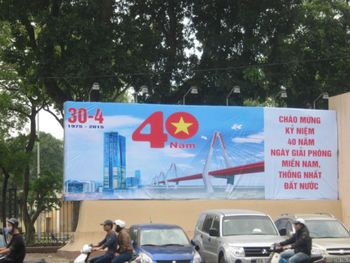
The fortieth anniversary of Liberation and Reunification. Source: Photo by the author.

What is marked in Figure 7 is the anniversary of the two great events of 1975 following the end of the Anti-US War: Liberation Day (Ngày Giải Phóng), when Saigon/Hồ Chí Minh City was reclaimed by Hanoi government forces, and Reunification (Thống Nhất), that is, the two Vietnams restored to unity. The poster's paired images show two of Hanoi's recent big infrastructure projects, represented as key ‘integration’ landmarks (hội nhập) embodying the nation's new life of globalized aid and trade. It is clear to my interlocutors why these can be conjoined with those earlier landmarks of revolutionary nationhood, though, as I explain below, the logic of doing so would not normally be articulated, especially to a foreigner.
Yet there are experiences of images that I have found West Lakers eager to verbalize. My friends have been energetically forthcoming on topics such as how particular images are produced, whether their look is pleasing or unpleasing, whether they are manifestations of greater or lesser care and skill on the part of the producer, and, crucially, the level of visual knowledge and sophistication they ascribe to the viewer. All these are ways of both showing and verbalizing one's capacity to be an active and discerning actor in the visual world. They are therefore manifestations of people's never-wholly-secure sense of moral agency, often expressed as commentary on the ethical deficiencies discerned in others. This includes officials thought to have fallen short in their role as producers of moralizing artefacts.
Thus the fact that there are other cases prompting the same cheerfully voluble West Lakers to say emphatically ‘I don't see anything – I never look at them’ felt initially like a dead-end in my fieldwork. But, as noted above, many of my interlocutors did become keen to talk about these matters, often starting with what they perceived as an image's connection with family life, then moving to discussion along the lines of what I set out in my list of the four elements to which viewers may react when engaging with state iconography: language, style, medium, and content.
This connection with family means that consideration of state images must also entail an understanding of image use within the home. The arenas of household and family are central to the ways West Lakers frame and experience ethical life. This does not imply a rigid separation between ‘home and the world’ – that resonant phrase in Indian scholarship which, in fact, points to permeability and interpenetration in the fraught experience of negotiating between the intimate and the external in colonial and post-colonial contexts.Footnote 59
In West Lake too, and more widely in Vietnam, the reference points of family and the wider world interpenetrate (Pettus Reference Pettus2004). They do so in and through images, in ways that embrace the dead and the living, as well as the iconographic presence of the personal and the Party-state. What has been called the interocular field (Appadurai and Breckenridge Reference Appadurai and Breckenridge1995: 11–37), in which viewers experience new images in terms set by older and more familiar ones, embraces far more than the realm of public culture in which the citizen's eye is schooled to associate what they see with an official repertoire of the seen and shown.
Household altars are points of interface between the realms of family and nationhood. No-one finds it discordant or odd that the items on household altars so often include the face of the nation's founding father President Hồ Chí Minh and a military death certificate stamped with state emblems and logos.Footnote 60 These are the kinds of images that are productive in West Lake contexts, generating presence as active portals of communication with departed kin.
Death certificates can be a substitute when families lack photos. Mai's neighbour, Mr Anh, tried the services of a psychic (nhà ngoại cảm) in the hope that the seer could produce a picture of his deceased father for his household altar. The psychic was a trained artist; he drew in charcoal the countenance he reported seeing when in communion with the deceased. Although Mr Anh and his wife thanked him and paid his modest fee, they subsequently agreed that the image was not ‘good’ and carried on using his army death certificate as their altar image.
Reflecting aloud about such things can mean reliving difficult moments, yet in ways the Hanoians I know find normal, even welcome: evoking visions of oneself as active and agentive, an articulating narrator putting thoughtful shape around one's actions and experiences.Footnote 61 People find pleasure in telling me such things: setting me straight, teasing out the complexities, exercising their acuteness of insight and ability to verbalize, and, as in this case, spelling out the logic of those situations in which the use of reasoning by those involved is not an appropriate thing to do.Footnote 62
That is why I had to think deeply about what had made our conversations dry up so abruptly when I tried to speak with West Lake friends about posters like the one in Figure 3. I had to try hard to grasp what was initially baffling about my assumption that they would find it unproblematic to be exegetical and forthcoming about such items, producing a reading or mapping out of what I had expected to be a poster's easily decoded message. This led to my recognition of the moral significance of both silence and exegesis in West Lake contexts, especially the recognition that there is an important difference for people between being silenced and the exercise of will and agency involved in opting to be silent.Footnote 63
So talking about state iconography is very different from having a conversation about something like my friend's altar drawing. It is not impossible, but for my interlocutors there was a kind of mental sound barrier to break through when I first tried to discuss such things. Friends who had hitherto been relaxed and forthcoming about so many other matters had to find ways to deal with something they had not previously realized, this being that a foreigner would fail to grasp what it is that is so odd and unfamiliar about seeking an exegetical reading of a message poster.
I had imagined easy leaps from the topics people had found unproblematic: stories like those about the altar picture and the many other things West Lakers have shared with me, like the tips and tricks involved in writing a top-marks answer to a question on ‘thankfulness as a national virtue’ in a morality education/citizenship exam. So I had thought it would be equally straightforward for the same people to reflect aloud on what they saw as a poster's message or theme. But I was wrong. None was as easy to speak of as their morals-subject exams, even the posters eventually spoken of as less repellent than the Party birthday poster in Figure 3, that is, those displayed in the run-up to the all-important occasion of national remembrance: TBLS.
To my mind the TBLS posters, especially those like Figure 12 with the key phrases đời đời (eternally) and đền ơn đáp nghĩa (thankfulness), extolled exactly the same thing as the exam questions they had discussed so willingly with me. This is perpetual thankfulness as the paramount ideal of TBLS in July as a moment of mobilized national will and feeling.
But not so. Something quite different happened initially when my friends found themselves addressed as an answerable ‘me’ in relation to a poster image. In such cases, the responding ‘me’ turns out to be situated in an uneasy space between two distinct versions of the actively articulating self. One is the ‘me’ of natural conversation of the kind my informants normally find welcome and unproblematic in my company. The other is the very different ‘me’ who is addressed as ‘you’ in the classroom. This is the accountable ‘me’ who is never to be confused with the ordinary, off-duty, at-home ‘me’. That accountable ‘me’ is the ‘I’ that the schoolchild learns to write about in essays and exams on education/citizenship topics.Footnote 64 Bringing the two together was not easy for my interlocutors. I have been very grateful to those who have been willing to do so, and in so doing they have helped me to understand what it is about sight and vision that can be both a muting and a reassertion of people's sense of themselves as mature and creditable moral agents.
Living with images
Items such as Figure 3 are the most common of the varied types of message poster (tranh cổ động: mobilization pictures) displayed in Vietnam.Footnote 65 Everyone is familiar with its visual style, this being one of the four elements of state images’ communicativeness that the Hanoians I know find problematic, though rarely worth commenting on. Even when they show the face of President Hồ Chí Minh, my interlocutors regard this kind of iconography as crude and cartoon-like. It is a style that West Lakers do not find striking or ‘classical’ and ‘sincere’, as people say of ‘red songs’, by which they mean that the rousing old songs about marching forward to the socialist future are rich in evocative power, redolent of the warmth and purpose of the high-socialist past. It is an era that my friends do not idealize uncritically, but they do speak of it as the time of their grandparents: simple and valiant, like the soaring melodies of the old anthems and work songs.
West Lakers like Mai and Khánh express a very different view of the posters’ stock images of citizens as social types representing the nation's collectivities in triumphant, though always decorous, achiever mode. What my friends find unwelcome is their temporality. Their representation is of an out-of-date modernity that is painful to observe. This is critical to that ‘I don't see them’ response: the sense that to register and willingly connect with what the images show would be to accept and endorse that problematic rendering of the nation's modern life. This is not just felt to be shaming about one's own goals and values, but – even worse – to defame the goals and achievements of one's parents and other elders.
Yet, as I explain below, people did eventually spell out to me what they see in these posters – which is that they show the future as they feel it looked to the serving soldiers and work-brigade members of the 1960s and 1970s. To young West Lakers particularly, this is the wrong visual language for today, and the accustomed way to deal with this is not to verbalize. ‘Everyone knows,’ they said, ‘no need to say it.’
The animation of images
It is specifically posters – a two-dimensional medium – that people initially found problematic to speak about. Public statuary is different. As a form in three dimensions it can be living and warm, at least in some cases.Footnote 66 Hanoi is a city of striking public monuments, as well as banners and posters. Monuments like the one shown in Figure 9 may appear to be uncompromising works of Party-approved socialist-realism – Vietnamese versions of what Caroline Humphrey (Reference Humphrey2002) has identified about potent images in the former Soviet Union. This is their capacity to act as instruments of myth-making. Building on Barthes’ (Reference Barthes1981) account of the mythic effects of images in Western capitalism, Humphrey shows that Soviet socialism too built on signifying practices, and that even in the post-Soviet era there are enduring semiotic cues of that ‘mythicized revolutionary romanticism’ (Humphrey Reference Humphrey2002: 39). What Hanoi's monuments achieve is very similar, though what I want to add to this is the sense of warmth and intimacy people find in some (though definitely not all) visualizations of the revolutionary myth, despite the stiffness and formality of their style.
Marking 27 July – TBLS, National Remembrance Day. Source: Photo by the author.

Inner city monument to the Hanoi insurgency that launched the 1946–54 anti-French Resistance War. Source: Photo by the author.

The whole of Vietnam's history is taught mythically: as an epic of heroic triumph to be learned both factually – names, dates, battlefields – and in a spirit of exaltation and moral purpose.Footnote 67 But, as in the case of President Hồ Chí Minh's Independence Day speech, it is also taught as moments of loving warmth when the sacred tasks of the citizen are realized in the idioms of moral agency, in words that are true because they are homely: the language of home and heart.
That expressiveness can be manifested through engagement with public monuments. These are often sites of interaction with non-mortals, hence as active and fully animated by perceiving and responsive presences as household ancestor altars. A notable example is the statue group in Figure 9, which is situated near the edge of my West Lake fieldsite next to one of the city's big covered markets.
The sculpted fighters are unmistakable to the people I know as the youthful volunteers who took part in the celebrated 1946 insurgency in this part of the inner city, the enclave of trading and residential streets known as the Old Quarter (Phố cổ). It is what every schoolchild learns as the next major event after Independence Day: the launch of the anticolonial resistance war, waged against the French by the forces of the Viet Minh liberation movement under the leadership of President Hồ Chí Minh.
Compositionally, the work has a much more dynamic aesthetic than the second of the two monuments discussed below. The fighters in Figure 9 are rendered in vigorously gestural poses. The female figure is strikingly feminized, her flying hair and upraised weapon expressive of energy and action, as are the active stances of the male fighters beneath her. Like other statuary of this kind, it is a larger-than-life rendering of a heroic moment that is intended to sum up the will and spirit of community and people as a whole, not to memorialize specific individuals (Kruk Reference Kruk2008). Yet, for local people, the monument instantiates immanence, not impersonal occurrence. Like a household altar or tomb, it too is a space for personal engagement with the deceased. Thắp hương (incense-burning) is regularly performed at the site. It is an act that is both moral and compelling, not what my friends would call ‘political’. What they mean is that it is neither officially orchestrated, nor disapproved of by the officials charged with maintaining local order and ‘civility’/civilizedness (văn minh).Footnote 68
Nor do the people I know make much of their engagement with the site. No-one calls it ‘religion’ or ‘spirituality’. It is just everyday loving-kindness and good feeling – tình cảm – no different from what is done to show loving care for kin at home, both living and deceased.Footnote 69
Local people make regular contact with those instantiated in the images. They come to the monument to light incense and make offerings, just as they do at home and in their visits to family tombs, most commonly on the climacteric days of the dark and full moon when these engagements are most readily achieved. This can be seen in Figure 10, showing the monument's altar space which is used for incense-lighting by officials on national commemoration days. The incense shown here, though, has been offered by householders from the adjoining streets where the epic events of 1946 took place. The offerings embrace those depicted in the sculpted images as kin and neighbours, to be cherished and provided for. ‘They'll see we care,’ a woman said, placing her incense in the bowl.
A lit cigarette shared with the deceased. Source: Photo by the author.

That sense of presence and communicative warmth is shown too by the lit cigarette – very common as an offering to deceased fighters. It is a soldier's pleasure and comfort, shared between the living and the dead. Those poignant lit cigarettes also abound on the tombs of the city's vast war cemeteries; moving and heartfelt, as I have seen when I have accompanied friends like Mai and Khánh who have generously included me in their visits of communion with lost kin and comrades.
Doing such things with warmth and no thought of return or gain means acting with sensibility. This is tình cảm, not a feeling experienced inwardly, but actively ‘feeling with’, responsive to the needs and sensibilities of others (Rydstrom Reference Rydstrom2003; Tran Reference Tran2015). This is the essence of moral agency: the basis of a life lived ethically and creditably, with warmth and humanity.
These are things my friends enjoy telling me about: the nature of feeling and conscience; the care taken to instil these sensibilities in their children; even painful family problems. It was the reason I had been surprised by their difficulties in talking about message posters. Everyone was always so forthcoming and unhesitant about other things, including why articulation itself is a critical measure of ethical refinement. No child can be allowed to think it is enough to feel love inwardly. Proper articulation is the essence of ‘feeling with’/tình cảm. It entails such things as always saying ‘I greet you, grandmother’; never being perfunctory or slapdash in taking leave (xin phép); and the use of proper relational terms (xưng hô). These are never to be seen or treated as rules or ‘etiquette’, but as the promptings of a feeling heart.
These expressions of ethical awareness are not confined to the home and family. They can also include comments on public statuary. No-one is hesitant about disparaging such items. The fighters’ monument where they place the cigarettes is okay, people say. This is partly a matter of its local connections, but also because its aesthetic is considered inoffensive.
The monument in Figure 11 is certainly very different, both aesthetically and compositionally, from the one in Figure 9. Its figures are rigidly inert, the faces far more depersonalized, and the outlines of the bodies bulked up and given added immobile weight by their stiff verticality and the exaggerated size of the fists and heavily inexpressive features. What it has in common with most of the posters produced today is that the figures are shown as archetypes in stasis, their task achieved and victory assured. Like the tillers and toilers in posters, the figures are shown at rest rather than straining will and muscle in the act of productive toil. This is a monument that speaks very differently to my interlocutors from the one where my friends share cigarettes with the departed. The memorial in Figure 11 is a work dating from 1984, in a prime site opposite ‘Restored Sword’ Lake, and it is very unloved. ‘So Soviet,’ says another West Lake friend, Mrs Oanh. She and her husband are hospital clerical workers and have done well out of their sideline in informal house-letting to students and incomers; they have a son and daughter who attend city-centre colleges.
The Death Vow monument, erected in 1984. Source: Photo by the author.

Mrs Oanh is well aware that the sculptor was Vietnamese. What she means is that it has the look of Soviet message art, with its brawny workers and defeminized Mother Russias. ‘No feeling,’ she says, the same phrase Mai used about the worker poster in Figure 3. It is bad for a Vietnamese artist to have done this, a sign that the work was not executed with care, ‘from the heart’. The memorial is to something that matters. It has the same subject mattter as the other monument to the youthful anti-French resisters, represented in this case in their official persona as members of Hanoi's famous ‘Death Vow regiment’ (Quyết Tử quân). But the beefy figures are thought graceless and un-Vietnamese. The Hanoians I know have a strong sense of the look of a Vietnamese face and body, both readily distinguishable from those of other Asians. There is no need to spell it out: the implication is that the artist has not conveyed proper pride in Vietnameseness. He should have taken more care, and if his talents were not sufficient to do justice to his important theme, it is shameful and bad that those who approved the statue thought Vietnamese viewers too lacking in perception to recognize bad art.Footnote 70
Speaking and silence
It was in realizing that it is felt proper for such things to be said that I began to grasp what made talking about message posters so different. The term for posters is ‘mobilization picture’ (tranh cổ động). Much against my initial assumptions, West Lakers have made clear to me that they do not think the purpose of mobilization posters is to spark the kind of puzzle-it-out exegetical reasoning that historians take to be the intended response to Soviet and PRC Chinese state graphics. The idea of gathering around a poster, learning from its message, and discussing its mix of pictorial and verbal injunctions and aphorisms was unexpected and puzzling to my West Lake friends. Posters are not like school textbook lessons; they are not thought of as prompts to exegetical comment or interpretation. Unlike historical photographs, they are not reproduced in textbooks. People were amazed that I had expected this.
What they eventually made clear to me is that posters are lowly; they are unlike photos and memorial sculpture, which are recognizable as art, though humbler than the treasures housed in museums. To speak of monuments is a sign of well-tuned perceptions and sensibilities, and concern for the beauty of one's city and nation. There is nothing dangerously subversive about disparaging those responsible for works like the Death Vow memorial, if it is made clear that there is no disrespect intended for authority in general, merely a good citizen's righteous ire at those who fall short of the high standards authority exists to enforce.
This is where the distinction between two- and three-dimensional visuality comes into play. With few exceptions, as in the case of the drawing-based poster in Figure 2, the cartoon-like message posters are held to be produced without thought or artistry, their stock images mindlessly put together by staff from the city's Grassroots Mass Culture Communications office. This is what Mai conveyed, her assumption being that the makers of posters are careless jobsworths churning out posters without anything like a rationale connecting their computer-generated images with each other, or with their assigned texts and themes.
‘They're just illustrations,’ she says, assembled at random when the order comes down to produce yet another poster to mark a national occasion like Liberation or the Party's birthday, or to trigger the mobilized citizens’ action of a phong trào. This is the term for a ‘movement’, that is, a mass mobilization campaign. Indeed, my interlocutors tend to think of posters as manifestations of the state in campaign mode, for every phong trào a plethora of red-banner exclamations and graphics.Footnote 71
The most exalted of these recurrent mobilizations is TBLS when the nation joins in reverential remembrance of those who have sacrificed (hy sinh) in the nation's service. They include both the deceased (the Liệt sĩ), the disabled war casualties (Thương binh), and the women awarded the official title of ‘Heroine Mother’. The TBLS campaign's emotional tenor is very strong. Its animating principle – thankfulness (biết ơn) – is one of the shining virtues taught as a core value of the national character in the parable-like lessons of the schools’ morals-education syllabus.
Like other state graphics, a TBLS poster is not thought of as declarative or propositional. ‘It doesn't remind us – it isn't to tell us anything,’ Quyên's son Minh said. The effect is thought of as direct and visceral, ‘corpothetic’ in Pinney's (Reference Pinney2004; Reference Pinney, Edwards and Bhaumik2008) terms. It too is to be recognized in an animating flash. It is not to be worked out analytically or decoded, but to be experienced as a stirring of the will to action in the particular mode and spirit of the particular phong trào campaign it materializes. For TBLS, thankfulness is given form as moral work undertaken by a collectivity. This can be a Youth Union branch cleaning the tombs of a war cemetery or a school class paying a ‘comfort visit’ to a Heroine Mother.Footnote 72
The state media give in-depth coverage to such activities. Their ethos is never disparaged, though some say frankly that the target-setting can be onerous, lacking the sincerity and warmth the occasion merits. So too the cartoonish posters, though it took time for anyone to spell this out to me. When my friends did start to talk about them, they spoke of them as inept and cack-handed, constructed without thought or care. I had thought it would come across as respectful and serious to refer to posters as ‘political art’, but this was bizarre and unwelcome. ‘Art is for museums,’ people say.Footnote 73
My suggestion that message posters might reflect a distinctive Vietnamese aesthetic, as in the case of the remarkable springtime iconography used on Party birthday posters (see Figure 13), was equally odd, a foreigner's conceit. To be thought of as not knowing the difference between art and the banal tools of consciousness-raising is not a good thing. The posters are behaviourist, said a well-read West Lake graduate, using cues and triggers intended for minds too limited for higher forms of communication.
A TBLS poster: ‘Promoting/furthering the mobilization campaign for “remembrance” is the way to make our capital city prosperous, beautiful, civilized and modern’. Source: Photo by the author.

‘Hail spring – Hail the Party – Happy New Year of the Cat’. Source: Photo by the author.

I had thought viewers like Mrs Oanh might regard the act of producing posters as something close to what people might do themselves. I had in mind the way one writes and draws diagrams in the exam room, or uses one's laptop and texting skills. Posters would thus be products of embodied skills the viewer might identify with. But no: the lowliness of the mechanical act of illustration reflects discreditably on the viewer and is why my notion of political ‘art’ is so incongruous.Footnote 74
It is not that such things as seeing posters as behaviourist is ‘political’, hence dangerous to utter aloud. It is more that everyone knows, so there is no need to spell it out. Exegesis, however innocent and on-message, can be an exercise with unwelcome possibilities. For someone who does not know me well, it might be that as a foreigner I would not know where to stop if someone gave me a reading of a poster like the one in Figure 7. I might imagine that its images of Hanoi's two big recent ‘cooperation’ ventures – its Korean-built super-skyscraper and Japanese-funded new airport highway bridge – are to be read as indicators that the revolutionary spirit of 1975 was bearing fruit in the accomplishments of today. Inoffensive and anodyne, one might think, and in keeping with the developmentalist state narratives celebrating Vietnam as a peaceful country now happily ‘cooperating’ (hợp tác) with non-socialist lands in the spirit of today's market-friendly socialism.
But what if they said this, and I then followed up with something like, ‘So why can't Vietnam build bridges and skyscrapers without foreign help?’ That would be very bad: not only because their comment had elicited a foreigner's sneer, but worse, because there would be no available script for a reply. Respondents would lack the basis to make the kind of quickfire, right-answer response that such a question demands. This is shaming, a predicament best evaded by keeping quiet.
What my younger interlocutors eventually spelled out for me is that such a prospect can produce a kind of instant flashback to the classroom. What this evoked was the wafer-thin divide between getting it right and being rewarded for diligence and virtue as an ‘excellent pupil’ – học sinh giỏi – and being the dunderhead who gets it wrong, the figure of innumerable media caricatures of the schoolroom underperformer, tearful and abashed before teacher and classmates. Again, silence is a choice: a best option and an agentive one.
Exegesis in context
The prospect of talking about statuary does not have this effect. It was the idea of being exegetical about posters that induced those flashbacks, so very much at odds with the cheery, articulate way people like to take me through their exam-room memories. Those are memories of being an achiever, or at least of potential: one's answer was not always awarded the full marks hoped for, but at least the rules of the game were known. Not so with posters, which my interlocutors make clear are thought of as aimed at the viewer's autonomic responses, not the mind and heart of a person equipped with the capacity to register and produce reasoned thought and speech. So here we meet another of those problem qualities of state posters, this being their language and modes of speech, more specifically their distancing mix of idioms denying the viewers’ powers of communicative moral agency.
This returns us to the difference between the two- and three-dimensional. Being aimed at the viewer's autonomic responses makes two-dimensional iconography feel unlike anything an active intelligence might probe or play with. Posters fall within the realm of things for which one, and only one, solution could conceivably hit the mark. My idea of roaming around the possibilities, testing out this or that plausible way to connect the pictorial elements and make sense of this or that choice of figures to illustrate the text was entirely wrong. Posters belong to the realm of things for which anything one might articulate must be the one and only right answer.
Being able to spot more than one possibility is not a sign of cleverness or the kind of creativity (sáng tạo) extolled in the morals subject textbooks. It is bad; the situation when one says ‘I'm confused.’ In classroom terms this means the confusion is my fault. Its meaning is: ‘I've failed to prepare properly and can't work out what I should have seen’, never ‘Isn't it interesting that there are several possibilities here?’. This cannot be. Authority produced the poster, and its meaning should flash straight to the mind and heart.
If that does not occur, the guilty party must be the viewer, instantly self-constituted as the silenced little no-nothing in the caricatures, just the kind of low-quality citizen at which the posters are thought to be aimed. This means someone too dim for the subtleties of reasoned thought and speech, unequipped to be a fully developed moral agent.
Hence, ‘I never look – we never see them’, the silencing silenced in a low-risk way. What one can always say, for safety, is that the important messages of state and Party are delivered by the print and broadcast media in forms appropriate to more sophisticated minds. That is what the high-achiever connects with, leaving it to the poster-makers to reduce their essence to the simplicities required for the citizen of lesser ‘quality’ (chất lượng).Footnote 75
That is not how the producers see their work. Those I know regard themselves as moral agents too, motivated and creative, like the ‘cultural professionals’ discussed in Luehrmann's (Reference Luehrmann2011) account of Soviet ideology work. They are distressed that there are Hanoians who think it demeaning to be the intended recipients of their works. They also think it unjust that what they do is not esteemed as the continuation of a revolutionary tradition of grassroots cultural work carried out in updated form: using computers, yet still a mission inherited directly from the guiding moral hand of President Hồ Chí Minh himself.
What has opened up space for actual discussion in my fieldwork are images of ‘Uncle’ Hồ with the ‘mi-cro’, the Independence Day microphone. Thus it is speaking about speaking that has opened the floodgates, allowing my friends to feel agentive and authoritative again in telling me that the mi-cro posters are images of communion with the kind of citizenry who are active verbally, hence ethically; participating in the world as full moral agents. That is what makes them feel back on track as confident verbalizers in their own right.
This is greatly in contrast to the Independence Day ‘mi-cro’ images in Figure 3, with its smiling worker and schoolchildren. This has not at all been the innocuous ice-breaker I had expected it to be. This Party birthday poster is the one of which people have said most emphatically ‘I don't see them – we never look at them.’ I had thought it would convey something bland and unproblematic, like ‘Hail the Party – see how much we can be proud of, meaning today's prosperous and productive life; every child at school; the happy fruit of everything set in train by the Party's birth in 1930’. This was a mistake, above all in relation to the final element of the poster mode's problem qualities: their content, that is, the ideological point they convey.
‘No!’ people eventually said, taking pleasure in reclaiming the role of authoritative narrativizer with something to set me straight about. Posters are literal, nothing like statuary or altar photos: two not three dimensions, never a leap to the kind of ‘abstract’ sense my foreigner's logic had produced. Equally wrong was my suggestion that a poster might be intended to alert citizens to the conditions of a novel, contemporary now, to be contrasted with the modern now of 40 years ago. In a poster, the now of today is a fulfilment of that prior now, not a rupture or departure from it. So while the idea that ‘We live so much better now’ is frequently articulated, it is not thought at all characteristic of state iconography to present the world of today as calling for novel forms of moral initiative or new ways to conceptualize the purposes of education or the path to be taken for the nation's young.
In a Party birthday poster, there can be no doubt that what the images show is a trajectory in the eternal high-socialist temporality of the schools’ Marxism/citizenship syllabus. The children in the poster are running. This is something my interlocutors instantly equate with ‘advancing’ in the sense of the core idiom of the Young Pioneer anthem every child sings at school. This is Tiến Bước – advance, go forth; quick-march.Footnote 76
So the word and image are to be taken literally. The happy children are advancing in the evolutionary temporal space of the Marxist ideal. They are not standing side by side with the worker. Instead they are like jubilant sprinters winning the race of life, running directionally and with purpose, an eager dash towards the future as they will live and make it. And that future is what everyone has no wish to verbalize, because it is painfully at odds with what their families consider the right and moral path for a talented youngster. The children in the poster are Young Pioneers (Đội viên), so are the best and finest of the citizenry-to-be. That means in Party birthday terms that they will grow up to become precisely what the image shows: helmeted heavy-industry workers, that is, tiên phong, the vanguard class of the revolutionary ideal.
That was a glorious vision of achievement in the early post-independence years, when the verbal and visual instruments of what Schwenkel (Reference Schwenkel2015) calls ‘utopic infrastructuralism’ enjoined citizens to look forward with joy to the new Vietnam of paved roads, factories, and giant electrification schemes. It also meant the revolution's social triumphs, especially the universal schooling initiatives which eradicated ‘word blindness’ (mù chữ) in less than a generation (Malarney Reference Malarney2012). Today's literature syllabus retains that vision of fluency in spoken and written Vietnamese as being central to the achievement of full moral personhood for the modern citizen (Pelley Reference Pelley2002: 90–95). The literature textbooks still exalt the mix of social and moral truths to be learned from the works of the national poets and novelists, evolving seamlessly from the pre-modern classics to the masters of the revolutionary age, especially the Party poet Tố Hữu (1920–2002) who wrote elegiacally about the beauty of factory chimney smoke rising heavenwards in the dawn.Footnote 77
Tố Hữu’s verses are still loved, but what the poster says is not the same. Its message is now hideously out-of-date, a vision of calamity for any loving parent. That is what makes the posters so galling for West Lakers like Mai to see, their defectiveness personal rather than ‘abstract’, a slighting of kin and home. So it is not just that the producers have failed to treat the viewer as a thinking moral agent, responsive to reasoned argument and shared sensibility. The visceral jolt this one creates is to one's sense of love and feeling for cherishing elders. There is no need to say it, because everyone knows.
Not verbalizing it is not to be silenced, but a choice of silence: a non-speaking way to say no to a visualization that so problematically sets the morality of home and officialdom incompatibly at odds with one another. That makes it such an affront to what my younger West Lake interlocutors speak about so feelingly: ‘My grandmother; my mother and father too,’ my friend Chính said. He had been telling me about his elders’ dream of happiness for him and his younger sister: secure white-collar jobs, perhaps one day a Master's degree from a famous foreign university. ‘They never stopped. They worked all the time; they never stopped thinking about us.’ What he meant was the hard work their elders have done to ensure that the younger generation would not grow up to toil in a hellhole garment industry sweatshop or shrimp-packing plant. No-one today thinks a factory is glorious, even those like Chính, one of West Lake's incomers, who is proud that his grandmother learned the skills of industrial modernity in the 1960s as the first girl from her village to sign up for service in an all-female wartime labour brigade assigned to do ‘shock work’ (xung kích lao động) in a Haiphong munitions workshop.
But today's real-life labour heroes wear business suits and do not look like the helmeted man with the cable. Such figures are now included among the stock characters of the state's ‘all citizens together’ iconography, but not on Party birthday posters. Those are always ‘classical’, West Lakers say, just like the language: pure and uncompromising, without allusions to the marketized world of today.
So friends like Chính and Mai did eventually convey what was wrong and silencing about such posters; why there was so much to fend off through a willed non-registering of the assumptions they felt the producers were making about them. This iconography is not perceived as representing a glowing utopian future held tantalizingly out of reach by the slow march to revolutionary modernity (Fitzpatrick Reference Fitzpatrick1999; Bonnell Reference Bonnell1997; Kruk Reference Kruk2008). When they and my other interlocutors felt ready to articulate these normally unexpressed views, they made clear to me what they find so problematic in what all four elements of the posters convey. This is the sense of officials affronting them with clumsily composed renderings of a shamingly out-of-date modernity. It is iconography that projects viewers not forwards, but ineptly back in time, through their language, medium, style and content, to the way no citizen who regards herself as informed and responsible wants to visualize achieving modernity today for herself and her children.
So for my interlocutors, the helmeted worker poster is an image of deficient moral agency: theirs, and that of the officials who produced it. Central to its moral deficiency is that the Pioneer children are of the past, not today. They are the bright-eyed jubilant achievers of many years ago with old-fashioned clothes and hairstyles, and satchels rather than backpacks. This is not a pleasing throwback to the visual language of the past. My suggestion that people might find it pleasantly nostalgic to see this – indeed, that the posters were intended to be reassuringly archaic – was laughingly dismissed. Posters are not like that, everyone agreed; they never work in that ‘abstract’ way.Footnote 78
Conclusion
The truths revealed in images matter greatly in West Lake. Among those that generate great concern for the urban citizens I have come to know are the truths that may be inferred about them from the world of iconography in which they live and act. As I have sought to show, there is much concern among my interlocutors with what foreigners are held to think about a propagandized citizenry, this being that what Petrov (Reference Petrov2011) calls the ‘trueing’ effects of propaganda produce a populace rendered voiceless and infantilized by its ‘generative’ force. This implies an extinguishing or absence of moral agency, hence the antithesis of Pinney's notion of the generative quality of images. What I have found in fieldwork is closer to Pinney than Petrov, but with the further important point that my Hanoi interlocutors themselves have a notion of the propaganda image as potentially roboticizing. What they want is to be thought of as discerning and sophisticated citizens, hence not the intended recipient of a poster's visceral prods and effects.
What I have therefore tried to do by drawing attention to the four-fold set of problems that emerged when I tried to discuss images with West Lakers is how actively the realm of the visual takes shape as a critical site of moral agency. Hanoi's densely saturated streetscapes are suffused with the communicative signs and symbols that make late-socialist marketization both painful and fulfilling to experience. The personal and the official are closely entwined in its dynamic visual economy. And as they interact with the array of idioms and languages through which exemplary goals and ideals are materialized, my friends negotiate this iconographic world as a domain of ethical action and creative initiative.
This is not to suggest that such negotiations are easy or straightforward, or to deny that visuality can entail coercion and disempowerment as well as warmth and shared sensibility. But what I learned from my interlocutors is that voicelessness in matters of visual life need not entail a loss or absence of moral agency. The unsaid and non-articulated can be as important and powerful as things voiced and verbalized in both key arenas of a Hanoian's visual life: those of citizenship and the family.
So we should recognize that there are no hard-and-fast divisions between the sayable and unsayable or the voiced and unvoiced in matters of moral agency. This is what I conclude from those breakthrough moments when my West Lake friends made their critical moves from ‘We never see them’ to a mode of keen exegetical point-making. What images can do is to animate and confirm people's sense of themselves as moral agents. And they can do this even though engagement with that four-fold mix of language, style, content, and medium makes so much of my interlocutors’ visual world problematic and painful to deal with, thereby bringing them face-to-face with the knowledge that being energetic and agentive in the ways they wish and strive to be is never something they can ever feel wholly confident or secure about in today's Vietnam.