When public health emergencies or disasters occur, adequate staffing throughout the health-care continuum is essential for patient care and safety, staff health and safety, and sustainability of surge capacity. Health-care organizations making disaster plans assume that staff will be available to fulfill plan details. This assumption has been challenged, with multiple research studies indicating that health-care workers experience a variety of barriers and concerns related to reporting to work following a disaster.Reference Brice, Gregg and Sawyer1–Reference Qureshi, Gershon and Sherman5 Consistently identified barriers include childcare, eldercare, pet care obligations, fear and concern for family and self, personal health problems, and transportation problems.Reference Brice, Gregg and Sawyer1–Reference Qureshi, Gershon and Sherman5 Fewer staff may be available than anticipated,Reference Brice, Gregg and Sawyer1–Reference Adams and Berry4 potentially to the detriment of quality and safety.
As surge capacity research has uncovered barriers related to staff availability during disasters, it is important for researchers to explore factors that could promote staff ability and willingness to report (WTR) to work.Reference Connor2,Reference Adams and Berry4,Reference Qureshi, Gershon and Sherman5 Personal or household preparedness has been studied in a variety of ways with different populations,Reference Gowing, Walker and Elmer6–Reference Kohn, Lipkowitz Eaton and Feroz8 and development of a personal plan has been identified as a potential solution to barriers to staff response following disaster. Despite increasing frequency of this recommendation, exploration of the impact of such plans on staff reporting to work has been limited,Reference Brice, Gregg and Sawyer1 with few studies specifically considering possible associations between personal preparedness on absenteeism or WTR described in health-care literature,Reference Brice, Gregg and Sawyer1,Reference Mercer, Ancock and Levis3,Reference Labrague, Hammad and Gloe7 particularly with a wide range of disaster scenarios. Exploration into preparedness is complicated by its lack of a universally accepted definitionReference Brice, Gregg and Sawyer1,Reference Kohn, Lipkowitz Eaton and Feroz8 or measurement instrument,Reference Labrague, Hammad and Gloe7,Reference Kohn, Lipkowitz Eaton and Feroz8 although common elements of preparedness include obtaining knowledge of preparedness activities, development of communication and evacuation plans, stockpiling of supplies, and assembly of supply kits.
To enhance understanding of personal preparedness as a potential mitigating factor against staffing limitations, it is essential to include it as a focal point of surge capacity research. Specific aims of this study were to identify:
1. Ability and willingness of nurses to report to work in time of disaster
2. Barriers to nurses’ ability and WTR to work in time of disaster
3. Personal disaster preparedness of nurses
METHODS
This pilot study used online survey methodology to examine health-care personnel’s ability and WTR to work based on a variety of disaster scenarios, barriers to their reporting to work, personal disaster preparedness, and demographic data. The survey consisted of demographic items, 8 disaster scenarios, and 12 preparedness activities. Participants were asked to rate their ability and WTR to work following the disaster scenarios. The demographic items and the disaster scenarios were based on the “Disaster Survey” created by Qureshi et al.,Reference Qureshi, Gershon and Sherman5 modified with permission of Dr. Qureshi, and piloted and used in a North Texas health network with consistent results. Because each scenario was different and could reasonably be expected to elicit different responses to ability or willingness, we did not combine them into a single “score” for either ability or willingness. Each scenario was, therefore, analyzed individually.
Participants were asked to indicate whether they had pursued each preparedness activity, all of which had been frequently cited in literature. The items related to personal disaster preparedness were obtained from an investigator-designed survey used in a previous study of preparedness in north central Texas community members. To avoid combining disparate items into a single measure of “preparedness,” each preparedness activity was viewed separately.
Sample and Setting
All nurses (over 500) employed by a metropolitan North Central Texas hospital were invited to participate in the study; 91 participants completed the survey.
Study Procedures
The study was approved by the Institutional Review Board of the primary investigator’s University before implementation. Nurses were invited to participate in the study by means of email that included an introductory letter and a link to an anonymous Qualtrics9 survey, with data only accessible to researchers (neither of whom were supervisors of participants). The letter explained the study’s purpose, benefits, risks, and privacy and rights protections, and provided contact information for questions related to the study. This information was repeated on the first screen of the survey, which served as consenting document.
Data Analysis Procedures
Data were exported from Qualtrics9 and analyzed with descriptive and inferential statistics using Minitab 17.10 All items in the survey were used in the analysis. Several items were grouped into ranges or categories for easier analysis. The Pearson r was used as a descriptive statistic to test for relationships between variables. Relationships between the disaster scenarios and personal disaster preparedness items tool were analyzed using a correlational matrix. For this study, significance was considered to be any P value less than 0.05.
RESULTS
Participants were nurses reflecting a cross-section of the major acute care units and nursing specialties. The majority (73%) worked full time 8- or 12-h day shifts. The majority (83.5%) ranged in age from 30 to 59 y, which is consistent with the overall nursing population. The majority reported being responsible for childcare (54.9%) and for care of pets or livestock (76.9%). The majority lived in the county where the facility was located or in the adjacent county, with 98% commuting to work by private vehicle.
We examined data for differences in response among various demographic groups, including age range, years of experience, and type of unit or specialty. No appreciable trends were identified; statistical significance could not be achieved due to the small sample size in which participants were not fully distributed across all potential categories.
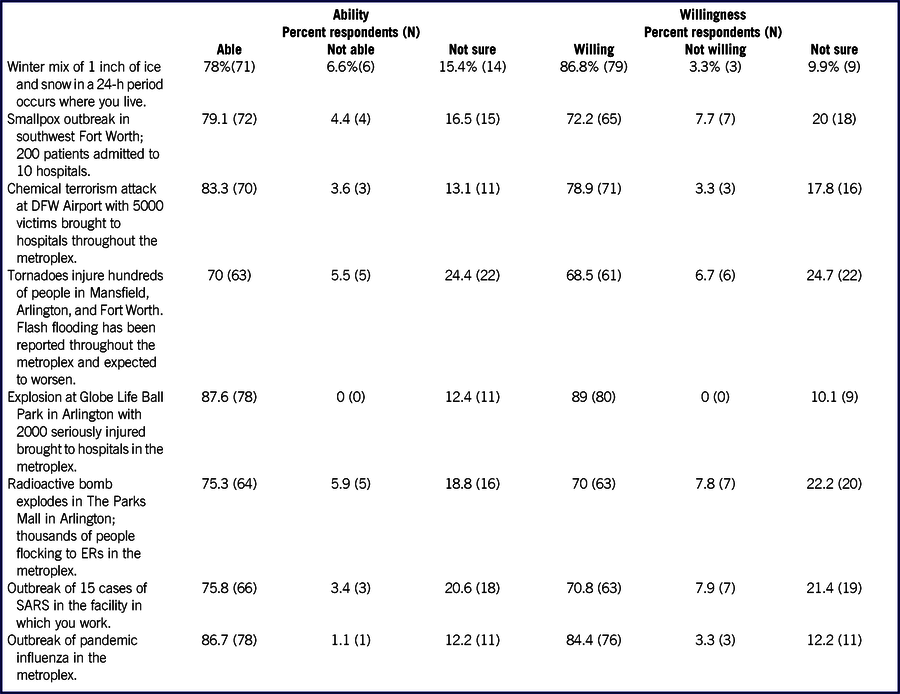
Many participants indicated being able or willing to report to work following the disaster scenarios (Table 1). Despite these findings, participants acknowledged barriers to reporting to work, with “child care obligations” and “pet care obligations” being cited most frequently for inability to report to work, and “fear/concern for my family” and “fear/concern for my personal safety” being cited most frequently for unwillingness to report to work.
Results of Ability and Willingness to Report to Work

Abbreviations: DFW, Dallas-Fort Worth; ER, emergency room; SARS, severe acute respiratory syndrome.
To determine if family and personal obligations produced differences in ability and WTR to work, we tested for relationships between each disaster scenario and responsibility for children, elders, pets/livestock; and having a spouse/partner expected to work during the disaster. No statistical significance was found for any of these relationships.
We tested for relationships between family and personal obligations and concern for bioterrorism. Responsibility for children was found to have a significant relationship (r 2 = −.207; P = 0.049); those with children expressed more concern than those without children.
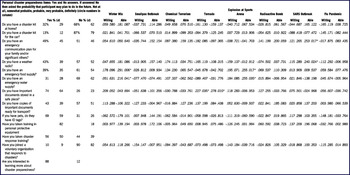
Personal disaster preparedness ranged from 12% (having a disaster kit for car) to 64% (safe storage for important documents). Participants having taken disaster response training (43%) reported undertaking some type of preparedness activity, including having some combination of water supplies, food supplies, weather radio, and communication plan. Most participants (88%) indicated at least some willingness to learn more about disaster preparedness.
To determine if undertaking various preparedness activities produced relationships in ability and WTR to work, we tested for relationships between each disaster scenario and each preparedness activity (Table 2). Most disaster scenarios showed no statistically significant relationship with preparedness activities.
Personal Disaster Preparedness (N = 91)

* Pearson correlation, P value significant α < 0.05.
Abbreviations: ID, identification; SARS, severe acute respiratory syndrome.
DISCUSSION
The range of ability and WTR to work following the disaster scenarios included percentages higher than those in studies using a similar instrument.Reference Adams and Berry4,Reference Qureshi, Gershon and Sherman5 Unlike other studies that have reported decreased WTR for chemical, biological, radiological, or nuclear (CBRN) or infectious disease events,Reference Mercer, Ancock and Levis3–Reference Qureshi, Gershon and Sherman5 70% or more of this study’s participants indicated they would be willing to report for such events. These findings are somewhat surprising because disaster scenarios that include CBRN events or infectious diseases rank high on scales examining fear and risk perception,Reference Smith, Burkle and Archer11 and studies of health-care workers have suggested that WTR decreases as perceived risk increases.Reference Connor2 It is possible that nurses who chose to complete the survey were more able and willing to report to work than those who did not complete the survey.
Despite most participants indicating they would be able and willing to report to work during a disaster, they acknowledged barriers affecting them, as has been the case in other studies.Reference Connor2,Reference Adams and Berry4,Reference Qureshi, Gershon and Sherman5 “Fear/concern for my family” and “child care obligations” were the chief reasons cited as barriers to willingness and ability to report to work, which is consistent with other studies that found statistically significant associations between presence of dependents in the home and predicted absenteeism.Reference Mercer, Ancock and Levis3,Reference Adams and Berry4 The presence of such barriers does not necessarily mean that health-care workers will not report to work. Nevertheless, because common barriers exist, it is important not only to identify and acknowledge them, but also to explore potential options to mitigate their impact.
Although no mass transportation is available to this hospital, few participants reported transportation concerns. We would anticipate that transportation limitations could be of concern in severe winter weather due to its low frequency/high impact on the region, yet few participants indicated that this scenario would affect their reporting to work. In contrast, the tornado/flooding scenario is a high frequency event for the region, and it produced the lowest levels of ability and WTR to work, and the highest percentage of “not sure” responses. It is possible that responses to severe weather scenarios were affected by experience with or frequency of such occurrences.
The majority of our study participants indicated being able and willing to report despite not having completed various preparedness activities. These findings differ from literature citing a potential connection between preparedness and WTR,Reference Gowing, Walker and Elmer6 but are consistent with the findings of other studies of hospital workersReference Brice, Gregg and Sawyer1 and emergency department staffReference Mercer, Ancock and Levis3 that found no statistically significant associations between personal preparedness and willingness to respond. With personal preparedness frequently recommended as a method to increase WTR during disasters, its limited relationship with WTR is somewhat surprising. Reasons for a lack of consistent connection are yet unknown; potential confounding factors may include the absence of a standard definitions and measurement instruments. It is possible that the multifactorial nature of WTR is so complex that preparedness by itself does not affect WTR significantly. It may be useful to explore combinations of other variables including disaster-specific education, sense of professional duty, organizational climate, and practical experience with disasters.Reference Connor2 It is also possible that prospective studies into WTR do not effectively address actual behavior; perhaps retrospective studies of actual behavior following a disaster or public health emergency linked to personal preparedness at the time of the event would produce more accurate findings. Further research exploring this relationship would be valuable because much is still unknown.
The only preparedness activities completed by a majority of participants were “taken training in personal protective equipment” (82%), “safe storage for important documents” (64%), “pets have ID tags” (59%). Consistent with disaster literature,Reference Brice, Gregg and Sawyer1,Reference Mercer, Ancock and Levis3,Reference Kohn, Lipkowitz Eaton and Feroz8 all other activities were completed by 45% or fewer of the participants. Even when defining personal disaster preparedness generally as “meeting major goals of prepar[ing] supplies and creat[ing] a family or household plan,”Reference Kohn, Lipkowitz Eaton and Feroz8 (p.218) disaster literature reveals overall underpreparedness for disasters and a wide range of personal preparedness.Reference Kohn, Lipkowitz Eaton and Feroz8 Studies involving household or personal preparedness are hampered by the lack of a universal definition and valid, reliable instrument. Further study into development of standard metrics and definition will be beneficial for future research.
LIMITATIONS
Because this was a pilot study, the research was conducted in a single hospital in a specific geographic region and targeted only nurses; findings thus cannot be generalized to other regions or other essential personnel. The small percentage of responses to the survey also limit generalization, as does potential selection bias, because those who completed the survey could have been more interested in or prepared for disaster than those who did not complete the survey.
Although the consent screen explained that all data were anonymous, confidential, and accessible only to the researchers, it is still possible that respondents thought their employer could become aware of their responses because the survey link was sent to their work email. Such a concern could have inhibited candor or participation of potential respondents. Additionally, social desirability bias could have occurred, with participants providing responses that would portray themselves in a favorable or heroic manner, or “expected answers” they thought the researchers wanted to hear.
CONCLUSIONS
Health-care providers’ commitment to a personal disaster plan is a logical element to promote surge capacity, yet more study must be undertaken to provide support for this recommendation. This study explored both barriers to ability and WTR to work following a disaster and personal preparedness as a potential mitigating factor for these barriers. Future studies should include a full range of essential personnel within the health-care continuum in multiple settings and locales, with emphasis on development of reliable, valid instruments to measure personal preparedness and exploration of other factors that may contribute to WTR.
Funding
Sigma Theta Tau International Beta Alpha Research Grant (2015).