Introduction
The Antarctic continent contains the coldest, most arid environments on Earth (Onofri et al. Reference Onofri, Selbmann, Zucconi and Pagano2004). These environments are restricted to the ice-free regions of the continent, of which the 4800 km2 McMurdo Dry Valleys of South Victoria Land comprise the most extensive ice-free deserts in Antarctica (Vishniac Reference Vishniac1993, Onofri et al. Reference Onofri, Selbmann, Zucconi and Pagano2004, Cowan & Ah Tow Reference Cowan and Ah Tow2004). These deglaciated zones provide a range of biotic habitats including lakes, glacial streams, flushes, ponds, open mineral soils and stable rock surfaces (Cowan & Ah Tow Reference Cowan and Ah Tow2004). McMurdo Dry Valley desert soils have, in the past, been widely believed to support very low microbial populations (Boyd et al. Reference Boyd, Rothenberg and Boyd1970, Cameron et al. Reference Cameron, Morelli and Johnson1972). However, recent quantitative and phylogenetic studies have demonstrated that McMurdo Dry Valley mineral soils harbour both substantial populations of microorganisms with 106–108 cells.g-1 (Cowan et al. Reference Cowan, Russell, Mamais and Sheppard2002) and high microbial phylogenetic diversity (e.g. Smith et al. Reference Smith, Ah Tow, Stafford, Cary and Cowan2006, Aislabie et al. Reference Aislabie, Chhour, Saul, Miyauchi, Ayton, Paetzold and Balks2006).
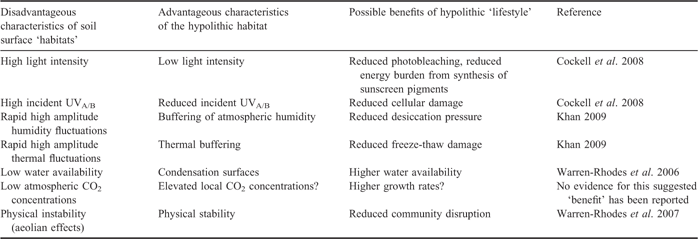
The geology of the McMurdo Dry Valleys is complex, with mixed granite, schist and gneiss basements cross-cut with quartz and marble outcrops (Bockheim Reference Bockheim1997). Freeze-thaw fragmentation of these outcrops and transport of the fragmented strata by historical glacial events has seeded much of the southern Dry Valleys with small translucent quartz stones (Broady Reference Broady2005). Where these are present in the desert pavement (i.e. exposed to the surface), they support the growth of localized ‘hypolithic’ communities (Nienow & Friedmann Reference Nienow and Friedmann1993). These communities are most commonly observed as green and/or red/orange pigmented cyanobacterial layers colonizing the rock-soil interface at the base and along the sides of the translucent rocks or stones (Wood et al. Reference Wood, Rueckert, Cowan and Cary2008, Pointing et al. Reference Pointing, Chan, Lacap, Lau, Jirgens and Farrell2009). The advantageous microenvironmental characteristics of the hypolithic habitat, in comparison to the soil surface photic zone, are shown in Table I.
A comparison of soil surface and hypolithic microenvironmental properties.

Hypolithic communities have been found in both hot (Schlesinger et al. Reference Schlesinger, Pippen, Wallenstein, Hofmockel, Klepeis and Mahall2003, Warren-Rhodes et al. Reference Warren-Rhodes, Rhodes, Pointing, Ewing, Lacap, Gomez-Silva, Amundson, Friedmann and McKay2006, Pointing et al. Reference Pointing, Warren-Rhodes, Lacap, Rhodes and McKay2007) and cold (Broady Reference Broady1981, Smith et al. Reference Smith, Bowman, Scott and Line2000, Cockell & Stokes Reference Cockell and Stokes2004, Wood et al. Reference Wood, Rueckert, Cowan and Cary2008, Pointing et al. Reference Pointing, Chan, Lacap, Lau, Jirgens and Farrell2009) deserts, where similar conditions of extreme temperature fluctuations and aridity exist. They are typically associated with any suitable translucent mineral substrate, including quartz (Schlesinger et al. Reference Schlesinger, Pippen, Wallenstein, Hofmockel, Klepeis and Mahall2003), flint (Berner & Evenari Reference Berner and Evenari1978), limestone (Cockell & Stokes Reference Cockell and Stokes2004), gypsum (Hughes & Lawley Reference Hughes and Lawley2003) and sandstone (Friedmann & Ocampo Reference Friedmann and Ocampo1976).
Antarctic hypolithic communities are typically described as being dominated by cyanobacteria (Broady Reference Broady1981, Wood et al. Reference Wood, Rueckert, Cowan and Cary2008, Pointing et al. Reference Pointing, Chan, Lacap, Lau, Jirgens and Farrell2009), with commonly encountered taxa including Phormidium spp., Lyngbya spp., Chroococcidiopsis- and Synechococcus-like cells (Smith et al. Reference Smith, Bowman, Scott and Line2000) and Plectonema (Broady Reference Broady1981). Here we present field observations which demonstrate that Antarctic hypolithons exist in different physical and compositional types. The possibility that these communities constitute stages in community development has implications for microbial adaptation and succession in polar (and other cold) habitats.
Methods
Field survey
All data were collected during field expeditions to the McMurdo Dry Valleys in the 2005–08 (inclusive) summer seasons. Hypolithic community surveys were principally focussed on the desert pavements of the upper Miers Valley (78°45′S, 163°15′E), on both the north- and south-facing valley walls over an altitude range of 170 m (valley floor at the western end of Lake Miers) to 634 m (northern ridgeline). More limited surveys were also undertaken in the neighbouring Marshall Valley and Shangri La region, at Marble Point, the Labyrinth (Upper Wright Valley) and the Beacon Valley. Quartz and marble pebbles were readily identified visually, owing to the pale colouration of both mineral types. Selected hypolithons were photographed and collected by sterile transfer to WhirlPak® bags.
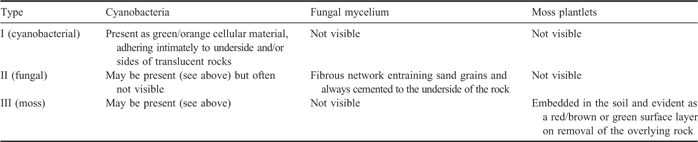
Different hypolithic community ‘classes’ were identified in the field on the basis of gross morphological properties (see below), and the identification was supported by on-site light microscopy (Olympus). For field identification, a ‘key’ was routinely employed (Table II).
Key for identification of hypolithic community types.

Molecular phylogenetics
Phylogenetic marker genes (16S rRNA and 18S rRNA genes) were amplified from hypolithon metagenomic DNA extracts (primer sets E9F+U1510R and EUKA+EUKB, respectively) (Reysenbach & Pace Reference Reysenbach and Pace1995, Hansen et al. Reference Hansen, Tolker-Nielsen, Givskov and Molin1998, Diez et al. Reference Diez, Pedros-Alio, Marsh and Massana2001) and cloned directly into the pTZ57R/T vector (Fermentas). Insert DNA was sequenced using the MegaBACE 500 Automated Capillary DNA Sequencing System (Amersham Biosciences). Sequences were edited using Chromas (Technelysium) and assembled in DNAMAN Version 4.15 (Lynann Biosoft) before submission to the NCBI database. The BlastN function was used to detect related sequences.
Results and discussion
Hypolithon distribution
The upper Miers Valley and neighbouring Shangri La regions are rich in quartz and marble outcrops, providing numerous small quartz stones (and less abundant marble) suitable for hypolithic community development. The laminar structure of the outcrops commonly generates fragments with near-flat upper and lower surfaces, and a crystalline depth of 2–4 cm. All hypolithic communities observed in this study were found beneath quartz and marble rocks with an upper surface area of > 4 cm2 (c. 2 x 2 cm) (Appendix A) and partially embedded in the soil as components of the desert pavement (Fig. 1a). It is thought that smaller translucent rocks (< c. 4 cm2) do not present a physically stable microenvironment and are therefore not commonly colonized. It is notable that the overlying rock typically shows no surface evidence of the subsurface community type (e.g. Fig. 1b), which is only revealed by removal of the rock from the soil.
a. Typical Miers Valley desert pavement with b. embedded hypolithic quartz rock. c. Type I hypolithic communities are dominated by cyanobacteria, d. often Oscillatoriales sp. e. Type II (fungal-dominated) hypolithic communities. f. Light micrographs of structural filaments of Type II communities at 100x magnification. g. Type III (moss-dominated) hypolithic communities, and h. light micrograph (100x magnification) of the moss Hennediella heimii found in Type III hypolithic communities. (Pictures by D.A. Cowan and N. Khan, microscopy by S.A. Wood and S.B. Pointing).

The distribution of hypolithons was not homogenous across the valley systems, but was essentially dependent on the location of suitable quartz and marble outcrops. The highest abundance of hypolithons was found in the vicinity and downslope of such outcrops, where frequencies were as high as 5 per m2 (equivalent to c. 140 cm2 of rock surface, or 1.4% total ground surface area). Across the region, average hypolithon distribution was more commonly 0.1–0.5 per m2 (0.03–0.14% of total surface area). Broady (Reference Broady1981) showed hypolithic community coverage in the typical dry mineral soils in the Vestfold Hills, Antarctica to average 66 cm2 m-2. In McKelvey Valley, a high altitude location within the McMurdo Dry Valleys, colonization was recorded as 4.9%, although this rose to 22% where soils were impacted by snowmelt (Pointing et al. Reference Pointing, Chan, Lacap, Lau, Jirgens and Farrell2009). In an extensive biological survey undertaken across Garwood, Marshall and Miers valleys in the lower McMurdo Dry Valleys region during the 2008 summer, hypolithons were identified in 38% of the 439 recorded transects (Antarctica New Zealand Event K020, unpublished results). For the entire survey area (c. 250 km2) and using the average recorded hypolithon coverage of 25 cm2 40 m-2 transect, we calculate the total regional hypolithon coverage to be c. 1562 m2. As the terrestrial ecosystem in the region is devoid of vascular plants, photosynthesizing hypolithic communities can be considered major contributors to productivity (in terms of carbon assimilation) in the region.
Hypolithon structures
Based on extensive field observations, supported by microscopic and phylogenetic analyses, we suggest that hypolithic communities in the Miers Valley can be divided into three morphological types or classes: Type I: Cyanobacterial-dominated communities, Type II: Fungal-dominated communities, Type III: Moss-dominated communities.
Cyanobacterial-dominated communities (Type I) were evident as pigmented biofilms adhering intimately to the underside and submerged sides of translucent rocks (Fig. 1c & d). Both green and red/orange pigmented zones were sometimes evident (Fig. 1c). While Type I communities were commonly associated with quartz substrates, they were also the only hypolithic community type associated with other translucent rock types (e.g. marble) recorded at various McMurdo Dry Valley sites (Miers Valley, Marble Point, Labyrinth–Upper Wright Valley). These Type I hypolithic communities may have the lowest light requirement, as the translucency of marble is very much lower than quartz of similar dimension (typically below the detection limits of a quantum light meter).
Analysis of community rDNA from Type I hypolithons revealed cyanobacterial phylotypes were largely from two orders: Nostocales (Genbank accession numbers HM490249, HM490250, HM490254–HM490256) and Oscillatoriales (Leptolyngbya sp., Genbank accession numbers HM490251 to HM490253, HM490257, HM490258), which together comprised c. 45% of the cyanobacterial sequences detected (Khan Reference Khan2009).
Type II communities were structurally very distinct from other hypolithic communities. These communities were firmly ‘cemented’ (adherent) to the underside of the quartz rock (Fig. 1e). The preliminary identification of this hypolithon type may be predicted in situ with some accuracy by physically testing the mobility of the embedded quartz rock. Rocks harbouring Type I and III hypolithic communities often rotated with relatively little manual pressure, whereas Type II communities impart a perceptible resistance to physical rotation. Once removed from the embedded position in the soil, Type II communities were extremely fragile and crumbled readily with either shock or pressure. The community appeared as a loose structure of mineral particles held in place by a network of fine filaments (Fig. 1e). Microscopy showed branched fungal mycelia-like structures (Fig. 1f) loosely associated with green-pigmented algal cell clusters (Fig. 1f, inset). Ongoing phylogenetic studies indicate that cyanobacterial and chlorophyte phylotypes are also recoverable from Type II hypolithons. Type II communities showed no visual evidence of photosynthetic macro-organisms (e.g. mosses).
Type III communities were physically dominated by mosses (Fig. 1g). These communities did not adhere to the rock surface, but occurred directly underneath the rock with the perimeter of the community generally mirroring that of the overlying rock. Removal of the overlying rock exposed the upper surface of the moss community, where the tips of the moss leaves were visible as a greenish layer (Fig. 1g). The Type III communities were relatively resistant to fragmentation and were readily recovered in an unbroken state. The bright green colour of the chlorophyll-rich leaf tips (Fig. 1h) suggested that these mosses were viable and actively photosynthesizing at the point of sampling. The moss-dominated structures provided a lattice network which holds mineral particles, constituting a high proportion of the total mass of the physical community. Phylogenetic analyses have shown that moss species from Moss Superclass V, such as Bryum argenteum Hedw. (Genbank accession numbers HM490214–HM490227) dominate these communities (Khan Reference Khan2009). Morphological characterization has also shown that other Moss Superclass V species such as Hennediella heimii (Hedw.) Zand. are also present (R. Herbert, personal communication 2009). It is of note that we have also recently described hypoliths supporting lichen mycobiont and phycobiont and mosses from the high altitude tundra of Tibet (Wong et al. Reference Wong, Lau, Lacap, Aitchison, Cowan and Pointing2010). The possibility that hypoliths supporting mosses are a feature of cold deserts on a wider scale therefore also arises.
Relationships and evolution of hypolithic communities
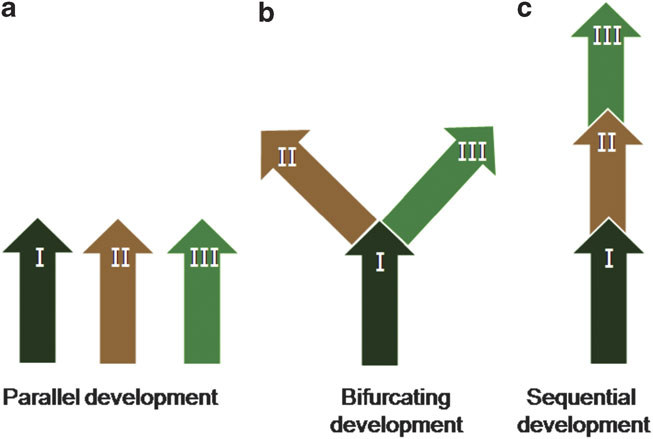
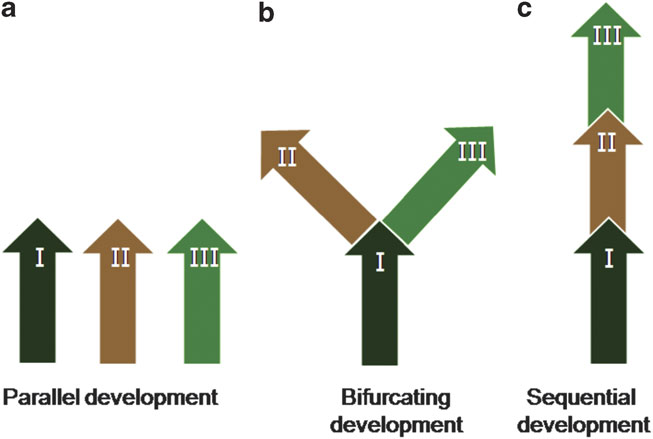
The presence of a hypolithic community (irrespective of type) under virtually every translucent rock of suitable type and size in the Miers, Marshall and Garwood valleys suggests that the development of these communities is not dependent on a complex and occasional set of environmental and biological factors. This observation suggests that the capacity for hypolithic community development is ubiquitous in these lower McMurdo Dry Valley regions; i.e. cells, spores and/or propagules which are recruited to establish the structural hypolithic community are either already present or rapidly acquired (e.g. via aeolian transport). However, it is not clear what factors control the development of one, rather than another, hypolithic community type. Several possible developmental routes are clearly possible (Fig. 2). The community types may evolve completely independently (Fig. 2a), where the process is dictated by specific environmental requirements (positive control) or limitations (negative control). For example, the observation that only Type I hypolithons occur under rock types with low light transmission is suggestive that community development for Types II and III hypolithons is under positive control and that a minimum level of light transmission is a critical factor. Alternatively, community development may be linked and the three types may represent stages in succession (Fig. 2b & c). The progression of such a developmental pathway could be dictated by relative growth rates or by more complex factors such as modifications of growth environments by one developmental state as a prerequisite for development of the next. It seems likely that Type I hypolithons represent the basal developmental state.
Hypothetical pathways for the development of hypolithic communities.
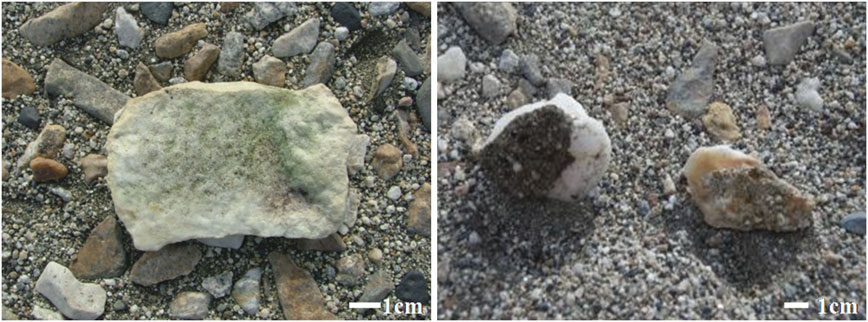
This view is supported, albeit without an extensive dataset, by the results of an in situ hypolithic community growth rate experiment established at a site in the Miers Valley in January 2005. Quartz rocks harbouring hypolithic communities (the types were not recorded) were collected, cleaned and sterilized by ethanol swabbing, and repositioned on open soil at a site where hypolithons were relatively common (estimated 0.1–0.2 per m2). Evidence of growth was assessed visually after 12 months (January 2006) and again after 48 months (January 2009). After 12 months, a single quartz rock showed signs of early Type I (cyanobacterial) community development (Fig. 3a). The visual appearance of two nascent hypolithons after 48 months, most notably the cemented characteristic, was typical of a Type II (fungal) community.
Evidence for growth of hypolithic communities. a. 12 month development, b. 48 month development (photographs by DA Cowan and N Khan).

The apparent lack of a dominant photoautotrophic component in Type II (fungal) hypolithic communities raises intriguing questions on the trophic structure of this community. The most common hypothesis is that autotrophs are the primary organisms in succession due to the lack of organic carbon present for the development of heterotrophic communities (Walker & del Moral Reference Walker and del Moral2003). Carbon fixation by autotrophs results in an increase in carbon available and the development of heterotrophic communities that drive decomposition and nutrient cycling in the ecosystem (Bardgett & Walker Reference Bardgett and Walker2004, Bardgett et al. Reference Bardgett, Bowman, Kaufmann and Schmidt2005). However, recent studies have shown that diverse heterotrophic microbial communities occur in low carbon environments before the establishment of autotrophic communities (Tscherko et al. Reference Tscherko, Rustemeier, Richter, Wanek and Kandeler2003). Furthermore, ancient carbon has been shown to sustain heterotrophic microbial communities in low carbon environments in Antarctica (Hopkins et al. Reference Hopkins, Sparrow, Elberling, Gregorich, Novis, Greenfield and Tilston2006). The open soils surrounding hypolithic communities have been shown to harbour diverse heterotrophic organisms (Smith et al. Reference Smith, Ah Tow, Stafford, Cary and Cowan2006), some of which are common to hypolithic populations (Khan Reference Khan2009). Under the favourable environmental conditions of the hypolithic niche, open soil communities are likely to contribute to the successional development of hypolithic communities, but do not necessarily drive the process.
One possible model which could incorporate both developmental and trophic elements would position Type II hypolithons as an intermediate developmental state between Type I and III. A possible developmental pathway would involve the establishment of a localized fixed carbon pool, driven by the dominant cyanobacterial composition of the Type I community. The elevated heterotrophic carbon availability would then drive the development of an essentially (but not solely) heterotrophic Type II community. This is consistent with recent studies in low carbon glaciated sites in the Austrian Alps which showed that the abundance of fungi relative to bacteria within the soil microbial community increased as succession proceeded and resources availability (i.e. carbon) increased (Bardgett et al. Reference Bardgett, Bowman, Kaufmann and Schmidt2005, Reference Bardgett, Richter, Bol, Garnett, Baumler, Xu, Lopez-Capel, Manning, Hobbs, Hartley and Wanek2007). The structural stabilization of the hypolithic zone by the fungal mycelia might facilitate the subsequent development of a Type III community, placing the moss-dominated consortium as the successional ‘climax’ community. We therefore propose as a working hypothesis that a possible developmental pathway for hypolithic communities is that represented in Fig. 2c. While the driving forces for this developmental pathway are uncertain, we speculate that founder trophic effects (Halkka et al. Reference Halkka, Raatikainen and Halkka1974, Cordonnier et al. Reference Cordonnier, Courband and Franc2006) are possible causative agents. The increased eutrophication of the hypolithic microenvironment resulting from cyanobacterial (founder) colonization may be a trigger for heterotrophic fungal colonization and/or for moss germination.
We also note that the ‘growth’ experiment suggests that the developmental timescales for ‘mature’ communities are probably in the order of <1 year (Type I) and 1–4 years (Type II). As yet we have no data to provide a putative timescale for the development of Type III communities. However, given the slow growth rates for Antarctic mosses (Skotnicki et al. Reference Skotnicki, Ninham and Selkirk2000), we predict that Type III hypolithons may develop over periods of 10–50 years. This projection has the merit of being testable by carbon dating of communities (e.g. Bardgett et al. Reference Bardgett, Richter, Bol, Garnett, Baumler, Xu, Lopez-Capel, Manning, Hobbs, Hartley and Wanek2007) or by longer time-scale monitoring of population compositions in model hypolithic environments.
Acknowledgements
This research was undertaken under the auspices of the South African National Antarctic Programme; the New Zealand Antarctic Research Programme under Antarctica New Zealand and the Waikato University Antarctic Terrestrial Biology Research Program. The authors gratefully acknowledge funding from the National Research Foundation (SA), the Hong Kong Research Grants Council (7733/08 M) and the NZ Foundation for Research Science & Technology (Terrestrial Antarctic Biocomplexity Survey, nzTABS). We gratefully acknowledge Susie Woods (Cawthron Institute, Nelson, NZ) for provision of the electron micrographs.
Appendix A. Dimensions of hypolithic quartz rocks collected in the Miers Valley (January 2008).

Average area (cm2) = 27.3 ± 12.7 (n = 21).