Introduction
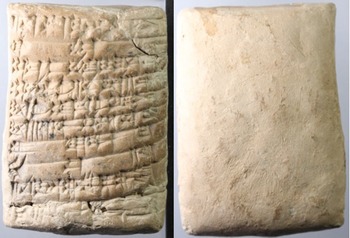
Slemani Museum is an archaeological museum which is located within the heart of the city of Slemani, Slemani Governorate, Kurdistan Region, Iraq. It is also known as Sulaimaniya Museum. In terms of numbers of contents, it is the second largest Museum in Iraq, following the Iraq Museum in Baghdad. It houses artifacts which date from the pre-historic period to the late Islamic and Ottoman periods. This short letter of Samsu-iluna (1749–1712 B.C.), king of Babylon, is kept in the Slemani Museum, along with other Old Babylonian documents. The letter has been registered under our names for publication since 2012, but we have not had time to work on the publication due to our studies. At the end of 2020 we started work on it and have prepared this edition. The transliteration and translation of the letter were made by Dr. Ardalan Khwshnaw and the commentary on the letter was written by Khana Mohammed.
Following the collapse of the Iraqi state following the invasion in 2003, the Slemani Museum received a large number of cuneiform tablets dating to various periods of Mesopotamian history from the southern part of Iraq. Among these previously unpublished cuneiform tablets a good number belonged to the Old Babylonian period, and include administrative tablets, economic tablets, contracts, and letters. As mentioned, we chose this unpublished Old Babylonian letter already in 2012 as the main topic of the present paper. At that time Dr Al-Rawi was the head of the cuneiform department in the Museum and together with other employees of the same department (Mr Adel, Ms Hero and Ms Hazha) helped us to find this royal letter among the other Old Babylonian tablets. Khwshnaw surveyed the Old Babylonian tablets from the museum for his Doctoral dissertation,Footnote 1 and even if a number of them turned out not to be Old Babylonian and had to be returned to the museum, the final number of tablets from this period currently held by the museum amounts to some eighty-five.
Some important and unique letters are to be found among those treated in Khwshnaw's 2018 Doctoral dissertation, one of which is this royal letter of Samsu-iluna, king of Babylon, son of the great king of Babylon Hammurapi, which Samsu-iluna during his reign addressed to a certain Ipqu-Gula in Isin. Samsu-iluna demands of Ipqu-Gula to give 180 iku (ca. 65 hectares) of a field in the Isin region to a certain Mār-Amurrim, who was probably an Amorite army general.
Samsu-iluna Letters
Only the active correspondence of Samsu-iluna has come down to us, those letters that he sent, not those that he received. The reason for this situation is well known: the excavations of Babylon did not reach the Old Babylonian level, the palace built by Samsu-iluna has not been discovered to this day and the letters written by Samsu-iluna were therefore found with their recipients, in other cities.Footnote 2 Therefore, here we should mention the letters sent by Samsu-iluna that have been published so far, according to the catalogue of the ARCHIBAB-website: to date nineteen letters of Samsu-iluna have been published and with this letter the total of Samsu-iluna letters becomes twenty.Footnote 3
We can find six letters from Samsu-iluna which are already published in Altbabylonische Briefe (AbB) 2: letter 47 is from Larsa. Samsu-iluna addressed the letter to Sin-ilum, Bitum-Rabi and Kasap-Sin and he talks about giving barley to the Šamaš temple in Larsa. The other letters of Samsu-iluna in AbB 2 are from Sippar which were sent to different people.Footnote 4 A letter from Samsu-iluna that comes from Lagaba is addressed to Ibbi-Šahan and speaks of a prohibition on the purchase of people from Ida-Maraṣ or Arrapha.Footnote 5 According to the ARCHIBAB-website a letter published in AbB 6 is likely to have been found and written in the kingdom of Babylon.Footnote 6 Samsu-iluna mentions in it that he sent omens and asks his addressees to show the signs to the soldiers. We can also find two letters from Samsu-iluna in AbB 7. The first is addressed to Abban the king of Aleppo and is thought to be from Sippar.Footnote 7 It talks about shopping in Aleppo. The second letter (a legal rescript) is also from Sippar and is known from 4 duplicates. The letter speaks of regulations concerning the feeding of nadītum-priestesses and it says that the people of Sippar brought their daughters into the cloister, but did not provide them with means of subsistence: they were hungry and they were fed from the royal granary.Footnote 8
In AbB 8, we can only find one letter from Samsu-iluna which is addressed to Marduk-naṣir and the letter is from Yahrurum.Footnote 9 Two other letters from Samsu-iluna are published in AbB 11 which are from Nippur.Footnote 10 We can find another letter of Samsu-iluna which is also from Sippar.Footnote 11 Three more letters from Samsu-iluna are available in AbB 14, one letter is from the kingdom of Babylon and two more are from Yahrurum.Footnote 12 Another letter of Samsu-iluna exists in TIM 1 which belongs to the kingdom of Babylon,Footnote 13 and the last letter from Samsu-iluna which is published by de Boer without giving any sure information about its provenience, but based on personal names is probably from southern Babylonia.Footnote 14
As a result, it appears that Samsu-iluna, king of Babylon, sent 8 letters to Sippar, 3 letters to the region of Babylon, 3 letters to Yahrurum, 2 letters to Nippur, 1 letter to Larsa, 1 letter to Lagaba, 1 letter to Isin and 1 letter whose provenience is unknown, as in Table 1:
Table showing the destinations/likely proveniences of Samsu-iluna's letters.

The Letter
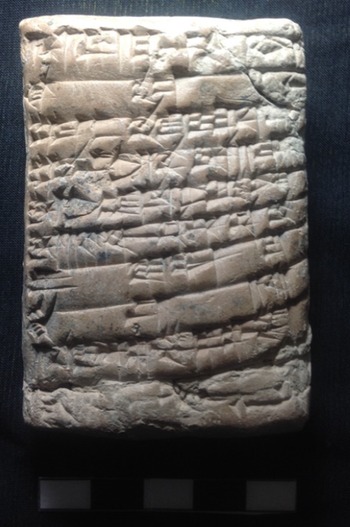
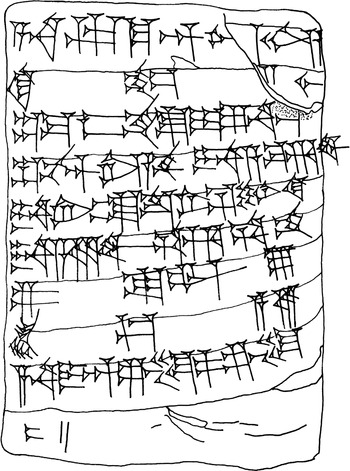
A number of important Old Babylonian letters were found during the course of the Doctoral research on the unpublished Old Babylonian letters in Slemani Museum, and among them there was this one, addressed by Samsu-iluna to a certain Ipqu-Gula (see Fig. 2–6). Despite this not being a popular personal name during the Old Babylonian period, it should be mentioned that a certain Ipqu-Gula, appears in two contracts from Sippar from the beginning of the reign of Abi-ešuh, the king of Babylonia, son of Samsu-iluna, as the son of a certain Ubār-Lulu (spelled u-bar-lu-lu) and the brother of Abum-waqar, Nidnuša, Ibni-Marduk and Nūr-ilišu.Footnote 15 It seems that Ipqu-Gula who appears in the two Sippar contracts is a member of the family of Nūr-ilišu (I), a well-known family in Sippar during the Old Babylonian period, and that perhaps the family is also originally from the Isin region, as hypothesized on the basis of the theophoric names found in “Familie 13” according to Kalla's Sippar prosopography.Footnote 16 See fig. 1.
The sons of Ubar-Lulu, chart made by Ardalan Khwshnaw, 2020.

If our restoration is correct for the name of the recipient of this letter, as a certain Ipqu-Gula!, we have noted above that this personal name was not common in Babylonia during the reign of Samsu-iluna. In addition to that, and according to the letter's context, it is not clear to us what is the relationship between the recipient of the present letter Ipqu-Gula and Ipqu-Gula, the son of Ubār-Lulu,Footnote 17 who appears in the two contracts of Sippar. But could it be that the two names belong to the same person? According to the context of this letter it is clear that the recipient of the letter Ipqu-Gula was a professional and he was perhaps a šassukkum (the head of the cadastre-office) of the royal domain in the region of Isin, as Šamaš-hazir was in Larsa region during the reign of Hammurapi.Footnote 18 In this capacity Samsu-iluna asks him to give a field in Isin to Mār-Amurrim, the general/head of the Amorites. This ensures that the address of the letter is Isin, and that Ipqu-Gula is located there, rather than in Sippar.
In this case, is it possible to say that perhaps both people named Ipqu-Gula are the same Ipqu-Gula? As mentioned, according to Kalla's prosopography of Sippar families, this family originates in the Isin regionFootnote 19 rather than Sippar. For this reason, it would probably also be possible to say that perhaps Ipqu-Gula, the recipient of this letter, is probably the same as Ipqu-Gula who belongs to the family of Nūr-ilišu, because the two persons are originally from the same region. Consequently, it could be possible to say that Ipqu-Gula, the recipient of the present letter and Ipqu-Gula who appears in the Sippar contracts are probably the same person, who was originally from Isin. Despite all this, we must also mention that the letter probably dates from the early years of Samsu-iluna's reign, before the widespread rebellion between Si. 8 and 14. Therefore, the chance that it is the same Ipqu-Gula of Sippar from some 25 years later during the reign of Abi-ešuḫ is not impossible, but nevertheless very small.
Regarding Mār-Amurrim who appears in the present letter as a ugula mar-tu, this was a common personal name during that time, therefore the identification of this person is very difficult.
Photo of SM 1377 by Ardalan Khwshnaw, 2015

Hand-copy of SM 1377 by Khana Mohammed on tracing paper, 2021

Letter of Samsu-ilūna
Museum Number: SM 1377
Dimensions: (7.5 x 5 x 2.2 cm)
Date: Samsu-iluna
Provenience: Isin
Transliteration
Obv.
1. a-na ip-qú- dg[u?-la?]
2. qí-bí-[ma]
3. um-ma sa-am-su-i-lu-na-ma
4. tup-pí an-ni-a-am i-na a-ma-ri-im
5. i-na er-ṣe-et ì-si-in ki
6. i-na a.šà-im ša re-ša-am
7. ú-ka-al-lu
8. 10.0.0 gán a-šà
9. a-na dumu-dmar-tu ugula mar-tu
10. [i-di-in]
Translation
2. Speak 1. to Ipqu-G[ula], 3. Thus (says) Samsu-Iluna: 4. as soon as (you) see this my letter, 5–10.[give] a field of 180 iku (ca. 65 hectares) in the Isin territory to Mār-Amurrim, the general.
Comments
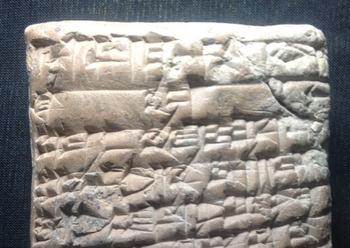
1. Ipqu-G[ula]: The second part of the name of the recipient of the letter is broken only the sign DINGIR and the beginning of the sign following DINGIR remain, which looks like a GU-sign. Due to the context of the letter, which shows the address of the letter as the Isin region, and it being clear that the goddess Gula was a local deity of Isin, we prefer to restore the second part of this name as dgu-la. As above, Ipqu-Gula was probably a šassukkum (land registrar, recorder) of the royal domain in the region of Isin, just as Šamaš-hazir was during the reign of Hammurapi in the region of Larsa.Footnote 20 Therefore Samsu-iluna asks him to give a field to Mār-Amurrim in Isin. Also worth mentioning is the modern attempt at repair at the broken place at the end of the first and second lines with a piece from another tablet with some incongruous signs.
9. dumu-dmar-tu ugula mar-tu = Mar-Amurrim šāpir Amurrim.
ugula is a Sumerian logogram, which in Akkadian reads as šāpir (“general”). D. Charpin comments: “But this Sumerian logogram that we translate as “general”, literally means the “head of the Amorites.”Footnote 21 But as Charpin mentions military titles change during the Old Babylonian period from place to place. For example in Babylon šāpir Amurrim (ugula mar-tu) “general” is used for the general of army, but at the same time in Ešnunna and Mari they were using rabi Amurrim (gal mar-tu) for the same title. It is still hard to describe exactly the status of the general of an army at that time, but it seems that he was at the top of the Babylonian army hierarchy.Footnote 22 This is the reason why the same title of rabi Amurrim is given in the tradition of Ešnunna (taken from Mari) by the ideogram gal mar-tu. One problem, therefore, arises concerning the relationship between the title of “general” (rabi Amurrim) and the title of rabiān Amurrim: the latter could well designate the “chief of the armies.”Footnote 23
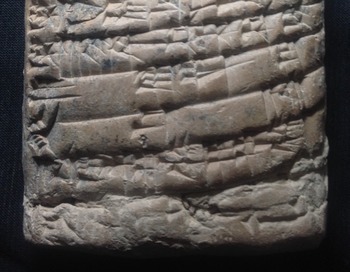
10. The last line of the letter is invisible or is probably broken and restored with fake signs that do not belong to the letter, in which case given the context of the letter it might not be difficult to restore with the verb of nadānu (give) in the imperative as we have done. One should also not forget to mention the modern restoration in the broken part of the last line with some fake signs from another tablet. Another possibility for a reading of the last line is a verb based on the D-stem of kânu (confirm) tu-ka-a-an or ki-i-in.
Conclusion
Isin appears as the destination of the letter according to its content and the personal name of the addressee can be plausibly restored as Ipqu-Gula. On the one hand it might seem tempting to associate the Ipqu-Gula attested here from Isin and a namesake known from Sippar, due to the fact that the Sippar family to which that Ipqu-Gula belongs is likely to have originated in Isin. On the other hand, it should also be mentioned that this letter probably dates from the early years of the reign of Samsu-iluna, while Ipqu-Gula of Sippar is attested from documents of the time of Abi-ešuḫ from at least 25 years later. Therefore, it is difficult to say that the two Ipqu-Gula are the same with any confidence, and one must remain cautious in this regard.
Based on data from the ARCHIBAB-website we have so far nineteen letters sent by Samsu-iluna and with this letter, the total of Samsu-iluna letters has become twenty which are published so far.
Based on the content of the letter and the name of the letter recipient, it is clear that the letter's provenance is Isin (Išān Baḥrīyāt). It is likely to have been excavated there some time after 2003, which is when the majority of tablets started to reach Slemani Museum.
Detail of top of obverse of SM 1377, photo by Ardalan Khwshnaw, 2015.

Detail of bottom of obverse of SM 1377, photo by Ardalan Khwshnaw, 2015.

Obverse and reverse of SM 1377, photos by Ardalan Khwshnaw, 2015.

Acknowledgements
We would like to thank the Museum staff at Slemani Museum as well as the director, Mr Hashim Hama Abdullah, for their assistance. We are also grateful to Mark Weeden for editorial assistance.
Abbreviations
- AbB 2:
Frankena, R. 1966. Briefe aus dem British Museum (LIH und CT 2 - 33). Altbabylonische Briefe in Umschrift und Übersetzung 2. Leiden: Brill.
- AbB 3:
Frankena, R. 1968. Briefe aus der Leidener Sammlung (TLB IV). Altbabylonische Briefe in Umschrift und Übersetzung 3. Leiden: Brill.
- AbB 6:
Frankena, R. 1974. Briefe aus dem Berliner Museum. Altbabylonische Briefe in Umschrift und Übersetzung 6. Leiden: Brill.
- AbB 7:
Kraus, F. R. 1977. Briefe aus dem British Museum (CT 52). Altbabylonische Briefe in Umschrift und Übersetzung 7. Leiden: Brill.
- AbB 8:
Cagni, L. 1980. Briefe aus dem Iraq Museum (TIM II). Altbabylonische Briefe in Umschrift und Übersetzung 8. Leiden: Brill.
- AbB 11:
Stol, M. 1986. Letters from Collections in Philadelphia, Chicago, and Berkeley, Altbabylonische Briefe in Umschrift und Übersetzung 11. Leiden: Brill.
- AbB 12:
Van Soldt, W. H., Letters in the British Museum. Altbabylonische Briefe in Umschrift und Übersetzung 12. Leiden: Brill.
- AbB 13:
Van Soldt, W. H. 1994. Letters in the British Museum. Altbabylonische Briefe in Umschrift und Übersetzung 13. Leiden: Brill.
- AbB 14:
Veenhof, K. R. 2005. Letters in the Louvre. Altbabylonische Briefe in Umschrift und Übersetzung 14. Leiden: Brill.
- MHET 2/6:
Dekiere, L. and Gasche, H. 1997. Old Babylonian real estate Documents from Sippar in the British Museum. Mesopotamian History and Environment Texts 2/6, 1997, University of Ghent.