1. Introduction
Southeastern Asia consists of several micro-continental blocks separated by multiple Palaeo-Tethys and back-arc basin suture zones (Fig. 1a) (Metcalfe, Reference Metcalfe1996, Reference Metcalfe2013; Sone & Metcalfe, Reference Sone and Metcalfe2008). It was commonly accepted that the collision between the South China and Indochina blocks happened along the Ailaoshan–Song Ma suture zone, where the South China Block (SCB) subducted southward beneath the Indochina block (Liu, J. L. et al. Reference Liu, Ji, Kuang, Jiang, Xu and Peng2012; Faure et al. Reference Faure, Lepvrier, Nguyen, Vu, Lin and Chen2014, Reference Faure, Lin, Chu and Lepvrier2016 a,b; Lai et al. Reference Lai, Meffre, Crawford, Zaw, Xue and Halpin2014; Halpin et al. Reference Halpin, Tran, Lai, Meffre, Crawford and Zaw2016). The widespread metamorphism and deformation in North Vietnam (known as the Indosinian orogeny) is generally considered to have occurred during Middle to Late Triassic times in response to the collision (Lepvrier et al. Reference Lepvrier, Maluski, Vu, Leyreoup, Phan and Nguyen2004, Reference Lepvrier, Van, Maluski, Thi and Van2008; Nakano et al. Reference Nakano, Osanai, Owada, Hayasaka and Nam2009, Reference Nakano, Osanai, Sajeev, Miyamoto, Minh, Owada and Windley2010; Zhang, R. Y. et al. Reference Zhang, Lo, Chung, Grove, Omori, Iizuka, Liou and Tri2013; Faure et al. Reference Faure, Lepvrier, Nguyen, Vu, Lin and Chen2014, Reference Faure, Lin, Chu and Lepvrier2016 a,b). But some studies report that the orogenic event may have happened in early Palaeozoic (Findlay, Reference Findlay1997; Carter et al. Reference Carter, Roques, Bristow and Kinny2001) or middle Carboniferous (Hutchison, Reference Hutchison and Şengör1989; Metcalfe, Reference Metcalfe1996, Reference Metcalfe2013) times. Carter & Clift (Reference Carter and Clift2008) argued that interaction between the SCB and Indochina block during the Triassic period was a thermo-tectonic reactivation event instead of the Indosinian orogeny.
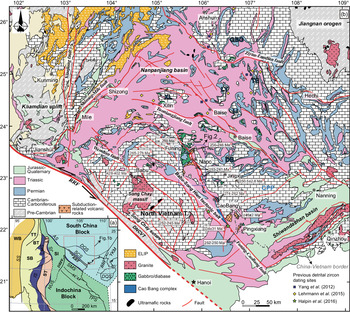
(a) Sketch of tectonic map of Southeast Asia showing the main continents and suture zones (modified from Cai & Zhang, Reference Cai and Zhang2009; Metcalfe, Reference Metcalfe2013; Faure et al. Reference Faure, Lepvrier, Nguyen, Vu, Lin and Chen2014). Abbreviations: BT – Baoshan terrane; SB – Sibumasu block; SI – Simao terrane; TT – Tengchong terrane; WB – West Burma block; LT – Lincang arc terrane; ST – Sukhothai arc terrane; JS – Jinghong suture; NUS – Nan–Uttaradit suture; CMS – Changning–Menglian suture; IS – Inthanon suture; AS – Ailaoshan suture; SMS – Song Ma suture; DQS – Dian–Qiong suture; SCS – Song Chay suture; TPS – Tamky–Phuoc Son suture; SS – Shan suture; RRF – Red River fault; DBPF – Dien Bien Phu fault; SCAF – Song Ca fault; HHF – Hepu–Hetai fault; YKM – Yunkai massif. (b) Simplified geological map of the Nanpanjiang basin, South China and adjacent tectonic units (modified from Tran & Khuc, Reference Tran and Khuc2011; DRCCGS, 2012). Igneous rock ages: a – Song Chay massif, 428–402 Ma, Roger et al. Reference Roger, Leloup, Jolivet, Lacassin, Trinh, Brunel and Seward2000; Yan, D. P. et al. Reference Yan, Zhou, Wang and Xia2006; b – Babu ophiolite, 278–265 Ma, Zhang, B. H. et al. Reference Zhang, Ding, Zhang, Zhang and Chen2013; Liu, H. C. et al. Reference Liu, Peng and Guo2018; Xiang et al. Reference Xiang, Yan, Xia, Xia and Li2020; c – Cao Bang complex, ultramafic and mafic rocks, 274–262 Ma, Hoa et al. Reference Hoa, Izokh, Polyakov, Borisenko, Anh, Balykin, Phuong, Rudnev, Van and Nien2008; Thanh et al. Reference Thanh, Hai, Hoang, Lan, Kwon, Itaya and Santosh2014; Halpin et al. Reference Halpin, Tran, Lai, Meffre, Crawford and Zaw2016; basalts, 334 ± 31 Ma, Tran et al. Reference Tran, Dang, Do, Nguyen, Fuken and Tran2007; rhyolites, 252–250 Ma, Halpin et al. Reference Halpin, Tran, Lai, Meffre, Crawford and Zaw2016; d – Funing basite, c. 260 Ma, Zhou et al. Reference Zhou, Zhao, Qi, Su and Hu2006; e – Funing–Jingxi–Pingxiang volcanic arc, 256–246 Ma, Liu, B. et al. Reference Liu, Li, Guan, Chen, Chen, Li, Hu, Zhang and Yu2018; Xiang et al. Reference Xiang, Yan, Xia, Xia and Li2020; 253–241 Ma, Hu et al. Reference Hu, Du, Yang, Huang, Huang and Huang2012; Xiang, Reference Xiang2018; 250.5 ± 2.8 Ma, Qin et al. Reference Qin, Wang, Zhang, Pan, Hu and Zhou2012; 246 ± 2 Ma, Qin et al. Reference Qin, Wang, Zhang, Pan, Hu and Zhou2011; f – granites related to the collision in the North Vietnam Terrane, 252–245 Ma, Roger et al. Reference Roger, Maluski, Lepvrier, Van and Paquette2012; Chen et al. Reference Chen, Lin, Faure, Lepvrier, Van Vuong and Van Tich2014. Isolated carbonate platforms after Lehrmann et al. Reference Lehrmann, Chaikin, Enos, Minzoni, Payne, Yu, Goers, Wood, Richter, Kelley, Li, Qin, Liu and Lu2015: GBG – Great Bank of Guizhou; TE – Tian’e; LI – Lingyun; LY – Leye; XL – Xilin; CPP – Chongzuo–Pingguo; DB – Debao. Fold vergence was compiled from Faure et al. (Reference Faure, Lin, Chu and Lepvrier2016 a). DNCVT – Dai Nui Con Voi terrane.

Based on the ophiolites and magmatic arc reported in Yunnan and Guangxi provinces, China (Wu et al. Reference Wu, Zhong, Zhang and Ji1999, Reference Wu, Wu, Zhong, Kuang and Ji2000, Reference Wu, Ma, Zhong, Wu, Ji, Kuang and Xu2001, Reference Wu, Ji, He and Zhong2002; Zhong et al. Reference Zhong, Wu, Ji, Zhang and Ding1999; Dong & Zhu, Reference Dong and Zhu2000), Cai & Zhang (Reference Cai and Zhang2009) proposed the Dian–Qiong Suture Zone (DQSZ) to represent the position where the branch of the Palaeo-Tethys ocean closed and the SCB and Indochina block amalgamated. It extends approximately along the south margin of the present Nanpanjiang basin (Cai & Zhang, Reference Cai and Zhang2009). However, different opinions have been put forward that suggest the Babu (SE Yunnan Province) – Song Hien (NE Vietnam) ultramafic–mafic rocks were originated from a mantle plume, as a part of the Emeishan Large Igneous Province (ELIP) (Zhou et al. Reference Zhou, Zhao, Qi, Su and Hu2006; Hoa et al. Reference Hoa, Izokh, Polyakov, Borisenko, Anh, Balykin, Phuong, Rudnev, Van and Nien2008, Reference Hoa, Polyakov, Anh, Borisenko, Izokh, Balykin, Phuong and Dung2016; Huang et al. Reference Huang, Du, Yang, Zhou, Hu, Huang and Huang2014). Lepvrier et al. (Reference Lepvrier, Faure, Van, Vu, Lin, Trong and Hoa2011) and Faure et al. (Reference Faure, Lepvrier, Nguyen, Vu, Lin and Chen2014, Reference Faure, Lin, Chu and Lepvrier2016 a) hence questioned the DQSZ and suggested the Song Chay Suture as another suture between the SCB and Indochina block. Recently, more evidence shows that these igneous rocks may be interpreted as ophiolites and island arc rocks that formed in the Palaeo-Tethys (Halpin et al. Reference Halpin, Tran, Lai, Meffre, Crawford and Zaw2016; Liu, H. C. et al. Reference Liu, Peng and Guo2018; Xiang et al. Reference Xiang, Yan, Xia, Xia and Li2020, Reference Xiang, Yan, Xia and Xia2021) or in back-arc ocean settings (Tran et al. Reference Tran, Thanh, Halpin and Zaw2011; Thanh et al. Reference Thanh, Hai, Hoang, Lan, Kwon, Itaya and Santosh2014). Such uncertainty adds controversy to understanding the tectonic evolution of the southeastern Asian continent and Palaeo-Tethys ocean in South China.
Siliciclastic deposits in ancient orogenic belts can provide valuable information about the provenance and tectonic setting of sedimentary basins (Dickinson & Suczek, Reference Dickinson and Suczek1979; Dickinson, Reference Dickinson and Zuffa1985; Garzanti et al. Reference Garzanti, Vezzoli, Andò, Paparella and Clift2005, Reference Garzanti, Wang, Vezzoli and Limonta2016). The Nanpanjiang basin (also termed the Youjiang basin) located adjacent to the DQSZ is filled with thick Triassic siliciclastic deposits, and plays an important role in the reconstruction of the tectonic evolution of the southern margin of the SCB. Previous works mostly focused on the stratigraphy and sedimentation of the central–northern Nanpanjiang basin (Enos et al. Reference Enos, Wei and Yan1997, Reference Enos, Wei and Lehrmann1998, Reference Enos, Lehrmann, Wei, Yu, Xiao, Chaikin, Minzoni, Berry and Montgomery2006; Yang et al. Reference Yang, Cawood, Du, Huang and Hu2012, Reference Yang, Cawood, Du, Huang and Hu2014; Lehrmann et al. Reference Lehrmann, Chaikin, Enos, Minzoni, Payne, Yu, Goers, Wood, Richter, Kelley, Li, Qin, Liu and Lu2015; Qiu et al. Reference Qiu, Yan, Yang, Wang, Tang and Shahnawaz2017), as well as the ophiolites and island arc volcanic rocks within the southern part of the Nanpanjiang basin (Zhong et al. Reference Zhong, Wu, Ji, Zhang and Ding1999; Wu et al. Reference Wu, Ma, Zhong, Wu, Ji, Kuang and Xu2001; Qin et al. Reference Qin, Wang, Zhang, Pan, Hu and Zhou2011, Reference Qin, Wang, Zhang, Pan, Hu and Zhou2012; Hu et al. Reference Hu, Du, Yang, Huang, Huang and Huang2012; Xiang et al. Reference Xiang, Yan, Xia, Xia and Li2020, Reference Xiang, Yan, Xia and Xia2021). In the Song Hien area, the dismembered ophiolitic rocks scattered within the Triassic clastic matrix have also been well studied, showing features of a tectonic mélange zone (Halpin et al. Reference Halpin, Tran, Lai, Meffre, Crawford and Zaw2016). We selected the Napo basin because of its spatial location between the Babu–Song Hien Tectonic Belt (BSHTB) and the Funing–Napo volcanic extrusive complex, as well as for its thick and continuous Triassic siliciclastic filling (Duan et al. Reference Duan, Meng, Wu, Yang, Wang and Zhan2020).
In this paper, we present detailed detrital modes, whole-rock geochemistry and detrital zircon U–Pb geochronology for the Triassic clastic rocks in the Napo basin, in order to estimate their provenance and tectonic setting. Then, we attempt to shed new light on the tectonic evolution of the southern margin of the SCB through comparative research of the provenance of Triassic deposits in the Napo basin and central–northern Nanpanjiang basin.
2. Geological setting
The SCB is composed of the Yangtze and Cathaysia blocks, which amalgamated along the Jiangnan orogen during Neoproterozoic time (Wang et al. Reference Wang, Fan, Zhang and Zhang2013; Yao et al. Reference Yao, Cawood, Shu and Zhao2019), after which it went through intensive deformation in response to the early Palaeozoic orogeny (Faure et al. Reference Faure, Shu, Wang, Charvet and Choulet2009; Charvet et al. Reference Charvet, Shu, Faure, Choulet, Wang, Lu and Breton2010; Li et al. Reference Li, Li, Wartho, Clark, Li, Zhang and Bao2010; Wang et al. Reference Wang, Zhang, Fan, Zhang, Chen, Cawood and Zhang2010, Reference Wang, Zhang, Fan, Zhao, Zhang, Zhang, Zhang and Li2011) and Mesozoic Indosinian orogeny (Yan et al. Reference Yan, Zhou, Song, Wang and Malpas2003; Chu et al. Reference Chu, Faure, Lin and Wang2012; Qiu et al. Reference Qiu, Yan, Tang, Wang, Yang, Tang and Wang2016). The basement of the SCB consists mainly of Meso- to Neoproterozoic metamorphosed volcanic and sedimentary units associated with abundant granites (Yao et al. Reference Yao, Cawood, Shu and Zhao2019 and references therein). The thick sediment cover includes Palaeozoic–Middle Triassic carbonates and turbidity fan siliciclastic rocks, and Jurassic–Cretaceous shallow-water clastic sediments (Yan et al. Reference Yan, Zhou, Song, Wang and Malpas2003; Qiu et al. Reference Qiu, Yan, Yang, Wang, Tang and Shahnawaz2017).
The Nanpanjiang basin developed in the southwest of the SCB, bounded by the Shizong–Mile fault to the northwest, Ziyun–Luodian fault to the northeast and the BSHTB to the south (Fig. 1b). The basic palaeogeography of the Nanpanjiang basin involved isolated Palaeozoic carbonate platforms and Lower–Middle Triassic deep-water siliciclastic sediments. The Lower Triassic succession is characterized by deposition of pelagic limestone, black shale and minor siliciclastic turbidites as starved basin facies deposits (Lehrmann et al. Reference Lehrmann, Pei, Enos, Minzoni, Ellwood, Orchard, Zhang, Wei, Dillett, Koenig, Steffen, Druke, Druke, Kessel and Newkirk2007, Reference Lehrmann, Chaikin, Enos, Minzoni, Payne, Yu, Goers, Wood, Richter, Kelley, Li, Qin, Liu and Lu2015). In contrast, during Middle Triassic time, thick siliciclastic turbidites of interbedded sandstone and shale, associated with minor calcareous mudstone and carbonate, were formed, with abundant bivalve and ammonoid fossils indicating Anisian and Ladinian depositional ages (BGMRGR, 1985; Du et al. Reference Du, Huang, Huang, Xu, Yang and Huang2009; Yang et al. Reference Yang, Cawood, Du, Huang and Hu2012). Finally, in late Middle to Late Triassic times, most portions of the basin were folded in response to the Indosinian orogeny (Faure et al. Reference Faure, Lepvrier, Nguyen, Vu, Lin and Chen2014, Reference Faure, Lin, Chu and Lepvrier2016 a,b; Qiu et al. Reference Qiu, Yan, Tang, Wang, Yang, Tang and Wang2016), indicating the end of its marine history. The Upper Triassic terrestrial siliciclastic successions (e.g. fluvial detrital deposits) only developed in the northernmost area, unconformably covering the older sequences. The provenance of the Triassic turbidites within the Nanpanjiang basin is still controversial. Based on the numerous sandstone petrological, geochemical and detrital zircon geochronological analyses, it has generally been interpreted as a foreland basin related to the subduction and closure of the Palaeo-Tethys ocean and subsequent Indosinian collision (Yang et al. Reference Yang, Cawood, Du, Huang and Hu2012; Lehrmann et al. Reference Lehrmann, Chaikin, Enos, Minzoni, Payne, Yu, Goers, Wood, Richter, Kelley, Li, Qin, Liu and Lu2015). However, given the palaeocurrent restoration and zircon U–Pb age pattern and Hf isotope data, Duan et al. (Reference Duan, Meng, Nicholas and Li2017, Reference Duan, Meng, Wu, Yang, Wang and Zhan2020) argued that the Triassic sediments in this basin may have been deposited in a back-arc setting and are more likely derived from a hypothetical magmatic arc along the southeastern active margin of the SCB, corresponding to the subduction of the Palaeo-Pacific plate beneath the SCB.
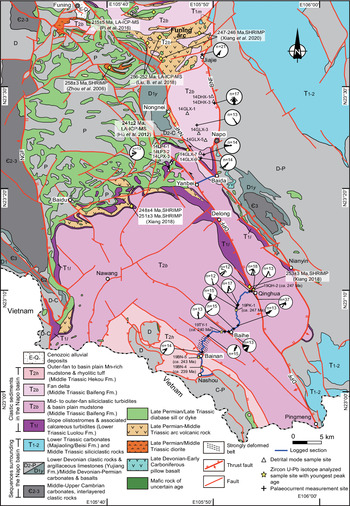
The BSHTB lies along the China–Vietnam border and generally acts as the southern part of the Nanpanjiang basin. Considering the existence of the ophiolitic and arc-related volcanic rocks, this belt may represent the boundary between the North Vietnam Terrane (NVT) and SCB (Cai & Zhang, Reference Cai and Zhang2009). Here, the Napo basin acts as the northern part of the BSHTB, with a late Permian – Middle Triassic volcanic arc to the north (Wu et al. Reference Wu, Ma, Zhong, Wu, Ji, Kuang and Xu2001; Hu et al. Reference Hu, Du, Yang, Huang, Huang and Huang2012; Liu, B. et al. Reference Liu, Li, Guan, Chen, Chen, Li, Hu, Zhang and Yu2018; Xiang et al. Reference Xiang, Yan, Xia and Xia2021) and Cao Bang ophiolitic suite to the south (Tran et al. Reference Tran, Thanh, Halpin and Zaw2011; Halpin et al. Reference Halpin, Tran, Lai, Meffre, Crawford and Zaw2016). These suites play an important role in recording the tectonic–sedimentary evolution of the southern part of the Nanpanjiang basin. This basin has a dominant filling of Triassic deep-marine deposits that are in fault contact with surrounding Palaeozoic sedimentary rocks (Fig. 2). The lower Palaeozoic sequence is composed of middle–upper Cambrian massive carbonates and subordinate clastic rocks, and is unconformably overlain by Devonian clastic rocks, massive carbonates and interlayered cherts (BGMRGX, 1985). The upper Palaeozoic sequence consists mainly of Carboniferous–middle Permian clastic rocks and carbonates interbedded with minor cherts. The upper Permian Linghao Formation consists of interbedded pillow basalts and volcanogenic clastic rocks, and these basalts show geochemical signatures matching those of the Emeishan high-Ti and low-Ti basaltic rocks in SW China (e.g. Zhou et al. Reference Zhou, Zhao, Qi, Su and Hu2006; Fan et al. Reference Fan, Zhang, Wang, Guo and Peng2008). Thus, they are interpreted as products of the ELIP at c. 260 Ma (Zhou et al. Reference Zhou, Zhao, Qi, Su and Hu2006; Huang et al. Reference Huang, Du, Yang, Zhou, Hu, Huang and Huang2014; Yang et al. Reference Yang, Cawood, Du, Huang and Hu2014). The Lower–Middle Triassic sequence can be divided into platform-facies carbonates and marine-facies siliciclastic sediments (BGMRGX, 1976; BGMRYN, 1978). The former conformably overlies the surrounding Palaeozoic sequence and is characterized by limestones rich in ooids, bioclasts and intraclasts, indicating a shallow-water sedimentary environment. The latter marine siliciclastic deposits comprise Lower Triassic slope-facies olistostromes and Middle Triassic fan delta and submarine fan assemblages (see Section 3).
Geological map of the Napo basin and adjacent areas with palaeocurrent rose diagrams (modified after BGMRGX, 1976; BGMRYN, 1978). The logged section from Qinghua to Nashou corresponds to Figure 3a–c, and the logged section from Baida to Yanbei corresponds to Figure 3d. Abbreviations: BNF – Baida–Napo fault; DPF – Delong–Pingmeng fault; NGF – Nabu–Gezao fault; NNF – Nongnei–Nianyin fault; Fm. – Formation.

The magmatic rocks in adjacent areas are composed mainly of large-scale mafic dykes/sills and pillow basalts/basaltic andesites (BGMRYN, 1978). However, the nature and origin of these mafic rocks is still under debate. Based on geochronological and geochemical analyses, two competing opinions can be summarized as (1) products of the ELIP (Zhou et al. Reference Zhou, Zhao, Qi, Su and Hu2006; Huang et al. Reference Huang, Du, Yang, Zhou, Hu, Huang and Huang2014) or (2) a magmatic arc related to the subduction of the Babu Palaeo-Tethys branch ocean (Wu et al. Reference Wu, Ma, Zhong, Wu, Ji, Kuang and Xu2001; Hu et al. Reference Hu, Du, Yang, Huang, Huang and Huang2012; Liu, B. et al. Reference Liu, Li, Guan, Chen, Chen, Li, Hu, Zhang and Yu2018; Xiang et al. Reference Xiang, Yan, Xia and Xia2021). Recently, detailed studies on the geochronology of these rocks have shown that they were generated during late Permian to Late Triassic times (c. 260–215 Ma; Zhou et al. Reference Zhou, Zhao, Qi, Su and Hu2006; Hu et al. Reference Hu, Du, Yang, Huang, Huang and Huang2012; Pi et al. Reference Pi, Hu, Peng, Wu, Wei and Huang2016; Liu, B. et al. Reference Liu, Li, Guan, Chen, Chen, Li, Hu, Zhang and Yu2018; Xiang et al. Reference Xiang, Yan, Xia and Xia2021), which indicates that the Napo basin and adjacent areas have undergone multiple magmatic events originating from different tectonic settings. In addition, there also exists a suite of ocean island basalt (OIB)-type pillow basalts between the Upper Devonian and lower Carboniferous (BGMRGX, 1985), which record the opening and spreading of the Palaeo-Tethys ocean (Guo et al. Reference Guo, Fan, Wang and Li2004).
3. Sedimentology and associated facies
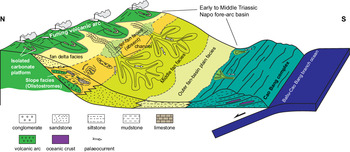
Despite structural folds, thrusts and strike-slip faults, the sedimentary framework of the Napo basin reveals a deep-water slope–turbidite fan system that developed in the south and shallow marine fan deltaic assemblages in the north, divided by the Nongnei–Nianyin fault (NNF) (Fig. 3).
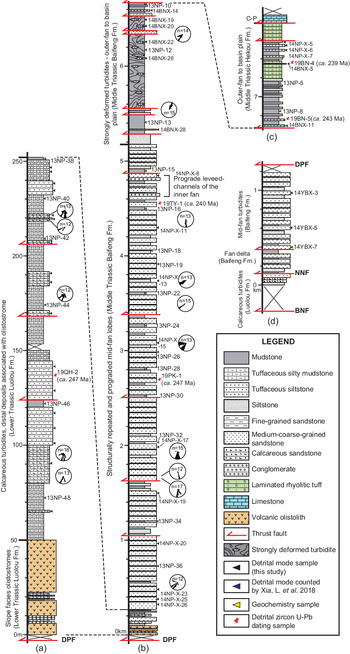
(a–d) Stratigraphic columns of the Lower to Middle Triassic sequence in the Napo basin. Abbreviations: BNF – Baida–Napo fault; C–P – Carboniferous–Permian; DPF – Delong–Pingmeng fault; NNF – Nongnei–Nianyin fault; Fm. – Formation.

3.a. Lower Triassic (Luolou Formation)
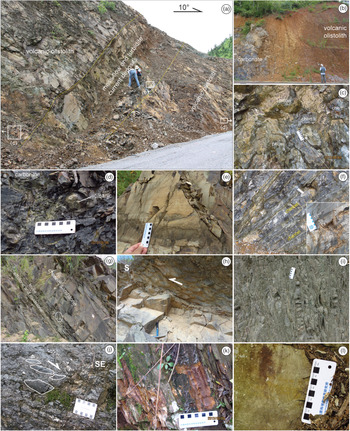
The slope facies of the Lower Triassic Luolou Formation, with a thickness of c. 250 m, has limited distribution to the west of the Delong–Pingmeng fault (DPF), and it is characterized by olistostromes comprising olistoliths and associated mass-flow deposits and turbidites. The olistoliths comprise large volcanic and carbonate blocks (Fig. 4a, b). The volcanic olistoliths with pillow structures (Fig. 4c) are commonly 8–30 m in size and the carbonate olistoliths are 2–5 m in size. Mass-flow deposits consist of grain- and mud-supported conglomerates, in which the unsorted gravels are mainly pebble- to boulder-sized marl, calcarenite, oolitic limestone and fossiliferous limestone, with minor volcanic rocks (Fig. 4d). There are minor pebbly sandstone interlayers in the conglomerates formed by turbidity currents (Fig. 4e). Fossils, such as Claraia wangi, are found in the carbonate olistoliths and gravels, consistent with the Early Triassic age, during which small, isolated carbonate platforms formed on the flank of the volcanic arc. The upper part of the Luolou Formation, close to the olistostromes, contains a suit of calcareous sandstones (Figs 3a, 4f), c. 200 m in thickness. The photomicrographs show that these calcareous sandstones show relatively high contents of volcanic lithic fragments and plagioclase grains, suggesting that they were deposited in association with the olistostromes by turbidite currents (Xia, L. et al. Reference Xia, Yan, Xiang, Xia, Shi, Jiang, Li and Wei2018). Sedimentary features indicate that the detritus of the Luolou Formation was sourced proximally from submarine volcanoes and locally overlying isolated carbonate platforms.
Representative field photographs of the Lower to Middle Triassic sequence in the Napo basin. (a, b) Volcanic and carbonate olistoliths interbedded with mass-flow conglomerates and turbidites in the Lower Triassic Luolou Formation. (c) Pillow structure of the basaltic olistolith. (d) Mass-flow conglomerates with sub-rounded–lenticular carbonate and volcanic gravels. (e) Turbidite sandstone interlayer with normal graded bed sequence. (f) Medium- and thin-bedded calcareous turbidite sandstone, showing the Bouma Tab and Tde divisions. (g) Thick-bedded channel sandstones interbedded with thin-bedded levee siltstones and mudstones in the mid-fan facies, Middle Triassic Baifeng Formation. (h) Flute marks on undersurface of thick-bedded channel sandstone in the mid-fan facies of the Baifeng Formation, showing the S-directed flows. (i) Lenticular or boudin-like sandstone blocks with scaly fabric mudstone matrix in the outer-fan facies, upper part of the Baifeng Formation. (j) Submerged distributary channel conglomerates in the delta front facies, Baifeng Formation, associated with the typical imbricate gravel structure, indicating the SE-directed palaeocurrents. (k) Mn-rich laminated mudstone of the basin plain facies from the Middle Triassic Hekou Formation. (l) Dark green-grey coloured rhyolitic tuffs with laminated bedding and soft-sediment deformation structures from the upper part of the Hekou Formation. Length of hammer for scale is 35 cm.

3.b. Middle Triassic (Baifeng Formation)
3.b.1. Turbidite fan system
Submarine turbidites are the dominant deposits of the southern Napo basin. The interbedded associations of medium- to coarse-grained greywacke in the channels and laminated siltstone and mudstone in the levees represent the progradation of mid-fan lobes (Figs 3b, 4g), with a thickness of c. 4800 m. The typical erosional structures such as flutes and grooves are preserved as sole marks on the undersurfaces of channel sandstones (Fig. 4h). For the levee deposits, various associations of Bouma divisions (Bouma et al. Reference Bouma, Kuenen and Shepard1962), including Tabc, Tbc, Tcde and Tde, are prevalent. The Bouma Ta divisions commonly show fining-upward grading, muddy rip-up clasts and a sharp or erosional surface, indicating that a high-density turbidity current incised the substrate. Bouma Tc divisions are characterized by climbing ripples or ripple foresets. Moreover, there are minor pebbly sandstones in these siliciclastic turbidites, which may be the fillings in the leveed channels of the inner-fan facies that prograded over the mid-fan lobes.
The upper part of the Baifeng Formation, c. 1100 m in thickness, consists mainly of siltstones and mudstones, as well as minor sandstone olistoliths and mass-flow deposits (e.g. mud-supported conglomerates). Some siltstone beds exhibit Bouma divisions dominated by Tcde, Tce and Tde, indicating they were originally deposited in outer-fan to basin plain environments. However, most of these rocks have been strongly deformed by subsequent Late Triassic tectonics, giving rise to stratal disruption with a block-in-matrix character (Figs 3b, 4i). N/NE-vergent folds and slaty cleavages are also widely developed, consistent with the N/NE-directed thrusting in NE Vietnam (Lepvrier et al. Reference Lepvrier, Faure, Van, Vu, Lin, Trong and Hoa2011; Chen et al. Reference Chen, Lin, Faure, Lepvrier, Chu and Wang2013).
3.b.2. Fan deltaic assemblages
The fan deltaic assemblages are mainly developed to the north of the NNF. Owing to the poor outcrop conditions, a complete lithology column is difficult to achieve, but delta front and pro-delta facies deposits can be identified. The delta front facies deposits consist of coarse- to medium-grained sandstones, interbedded with siltstones and mudstones. The sedimentary structures, such as imbricated gravels in submerged distributary channel conglomerates (Fig. 4j), tabular cross-bedding and current cross-laminations in sheeted sandstones, are commonly developed. The pro-delta facies is composed primarily of thin-bedded and fine-grained sandstones, siltstones and mudstones, with parallel bedding and lamination. The delta plain facies was not observed.
The slices of the Napo basin between the DPF and NNF appear c. 1000 m thick, and consist of mid-fan turbidites and prograded fan delta fillings, including thick- to medium-bedded sandstone and intercalated thin-bedded mudstone (Figs 2, 3d). Because of the Late Triassic deformation, the mid-fan turbidites are thrust above the fan delta deposits.
3.c. Middle Triassic (Hekou Formation)
The Hekou Formation, located in the south end of the basin, is c. 1100 m thick and dominated by laminated sandstones, Mn-rich mudstones and rhyolitic tuffs, intercalated with thick minor coarse-grained sandstones (Figs 3c, 4k). Thin-bedded and fine-grained sandstone interlayers show slightly eroded bases, suggesting deposition in distal channels of the outer-fan facies. The rhyolitic tuff at the top is characterized by lamination with distinctive soft-sediment deformation structures (Fig. 4l), indicating the possible existence of synchronous volcanic activities in adjacent domains.
4. Analytical methods
4.a. Detrital modes and palaeocurrent direction
In this study, we collected 34 samples of medium- to coarse-grained sandstone for detrital mode analysis throughout the basin, with locations plotted in Figures 2 and 3. The composition and proportion of detrital framework grains in thin-sections were point counted according to the Gazzi–Dickinson method (Ingersoll et al. Reference Ingersoll, Bullard, Ford, Grimm, Pickle and Sares1984). The counting categories and the raw point-counted data (>500 points per slice) are summarized in online Supplementary Material Tables S1 and S2, respectively. The criteria used for discriminating the types of lithoclast, matrix and other components are based on Dickinson (Reference Dickinson1970), Graham et al. (Reference Graham, Ingersoll and Dickinson1976) and Ingersoll (Reference Ingersoll1990).
Additionally, in order to restore the palaeocurrents, detailed measurement of the flutes, grooves and cross-lamination in the turbidites and cross-bedding and imbricated flat pebbles in the fan delta were undertaken from 21 locations.
4.b. Whole-rock major-, trace- and rare earth element geochemistry
Twenty-three sandstone samples were selected for geochemical analyses, with six samples from the Luolou Formation, 15 samples from the Baifeng Formation and two samples from the Hekou Formation. Whole-rock major-, trace- and rare earth element (REE) data were analysed at the National Research Centre for Geoanalysis, Chinese Academy of Geological Sciences (CAGS), Beijing. Major elements were obtained by standard X-ray fluorescence (XRF) spectrometry methods with analytical error less than 1 %. For trace elements and REEs, the rock powders were first digested by HF + HNO3 in Teflon bombs and then analysed by inductively coupled plasma mass spectrometry (ICP-MS) with analytical precision better than 5 %. The geochemical data are listed in online Supplementary Material Table S3.
4.c. LA-ICP-MS zircon U–Pb dating
Zircons from five sandstone samples were subjected to U–Pb dating. Milled sandstone material was first sieved at 250 µm (60-mesh) and zircons separated using standard heavy liquid and magnetic techniques. Then, the hand-picked zircons were mounted on adhesive tape, enclosed in epoxy resin and finally polished to about half of their original thickness. Cathodoluminescence (CL) imaging of zircons was carried out using a FEI PHILIPS XL30 scanning electron microprobe at the Beijing SHRIMP Centre, Institute of Geology, CAGS. Zircon U, Th and Pb isotopic data and trace-element compositions were obtained using a laser ablation inductively coupled plasma mass spectrometer (LA-ICP-MS) at Beijing Createch Testing Technology Co., Ltd. Detailed operating conditions for the laser ablation system and the ICP-MS instrument and data reduction are the same as those described by Hou et al. (Reference Hou, Li and Tian2009). The standard 91500 (1065 ± 3 Ma, Wiedenbeck et al. Reference Wiedenbeck, Allé, Corfu, Griffin, Meier, Oberli, von Quadt, Roddick and Spiegel1995) was used to calibrate the U–Th–Pb ratios and absolute U abundances. Trace-element compositions of zircon were calibrated using 29Si as an internal standard and NIST610 as an external standard. The off-line data selection, integration of background, analytic signals, time-drift correction and quantitative calibration for U–Pb dating were performed by ICPMSDataCal (Liu et al. Reference Liu, Gao, Hu, Gao, Zong and Wang2010). Zircon ages younger than c. 1000 Ma are based on 206Pb/238U ratios, and the older ages are based on 207Pb/206Pb ratios. The concordance is defined as 100 % × (206Pb–238U age)/(207Pb–235U age) for the former analyses and 100 % × (206Pb–238U age)/(207Pb–206Pb age) for the latter. For the detrital zircons, individual analyses with a concordant percentage higher than 90 % were chosen for calculation. The concordia plot and combined probability plot and histogram were calculated using ISOPLOT 4.15 (Ludwig, Reference Ludwig2012). The analytical results of the zircon U–Pb dating are summarized in online Supplementary Material Table S4.
5. Results
5.a. Detrital modes and palaeocurrent direction
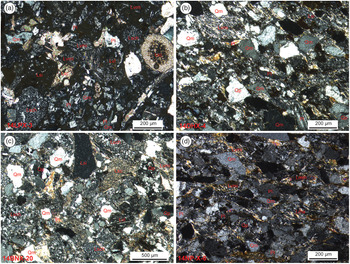
Photomicrographs show the detrital grains in the sandstones are mainly subangular to sub-rounded with moderate to poor sorting and variable contents of clay matrix and calcite cementation (Fig. 5). For most samples, point-counted detrital grains are quartz (monocrystalline and polycrystalline), feldspar (plagioclase) and lithic fragments (sedimentary, volcanic and metamorphic fragments). Volcanic lithic fragments (Lv) are characterized by microlithic or lathwork textures that consist of plagioclase phenocrysts in a microlithic matrix. Sedimentary lithic fragments (Ls) consist of siltstone, argillite shale, chert and carbonate lithic fragments. The polycrystalline micas, quartz–mica aggregate grains and metamorphosed volcanic fragments form a majority of the metamorphic lithic grains. Additionally, the calcareous and siliciclastic turbidite samples of the Napo basin counted by Xia, L. et al. (Reference Xia, Yan, Xiang, Xia, Shi, Jiang, Li and Wei2018) and Yang et al. (Reference Yang, Cawood, Du, Huang and Hu2012), respectively, were used as comparative results.
Photomicrographs (cross-polarized) showing the detrital compositions and textures of sandstones in the (a) Lower Triassic Luolou Formation, (b, c) Middle Triassic Baifeng Formation and (d) Hekou Formation. Abbreviations: Lma – quartz–feldspar–mica aggregate lithic; Lmm – polycrystalline mica lithic; Lsc – carbonate lithic; Lsi – siltstone lithic; Lsch – chert lithic; Lvmi – volcanic lithic with microlithic texture; Lvl – volcanic lithic with lathwork texture; Pl – plagioclase; Qm – monocrystalline quartz; and Qp – polycrystalline quartz. See online Supplementary Material Table S1 for details.

The Lower Triassic Luolou Formation sandstones from the slope facies contain relatively lower quartz contents (5.5–10.6 %, avg. 8.0 %), more abundant feldspar (38.5–44.4 %, avg. 42.0 %) and lithic fragments (47.9–51.4 %, avg. 50.0 %), and are enriched in volcanic lithic grains (Fig. 5a). The Middle Triassic Baifeng Formation sandstones from the fan delta and turbidite fan contain higher quartz (35.1–51.6 %, avg. 42.3 %) and lower lithic fragment (23.4–41.1 %, avg. 30.6 %) and feldspar contents (18.1–34.2 %, avg. 27.1 %) than the Lower Triassic samples (Fig. 5b, c). In the Middle Triassic Hekou Formation, turbidite sandstones show similar detrital fragments to those from the Baifeng Formation, with relatively fewer quartz grains (30.8–38.5 %, avg. 34.4 %) and more feldspar grains (28.9–38.6 %, avg. 33.7 %) and lithic fragments (29.8–33.9 %, avg. 31.9 %) (Fig. 5d). The quartz grains in all counted sandstone samples are dominated by monocrystalline quartz with no inclusions and a uniform extinction, reflecting a volcanic origin. Some polycrystalline quartz grains show undulatory extinction and directional deformation, which suggests a metamorphic origin. Plagioclase is more prevalent than K-feldspar. Among the lithic fragments, the Luolou Formation sandstones show relatively high contents of volcanic and sedimentary grains, with average contents of 57.7 % and 41.8 %, respectively. However, the sandstones from the Baifeng and Hekou formations are characterized by the more sedimentary fragments (avg. 46.9 % and 39.7 %, respectively) and volcanic fragments (avg. 35.9 % and 38.5 %, respectively), and fewer metamorphic fragments (avg. 15.9 % and 17.1 %, respectively).
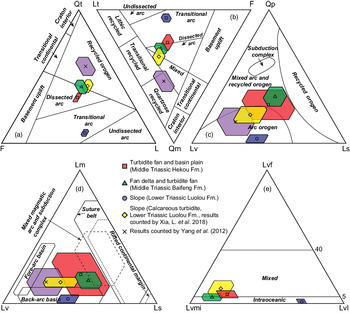
On the Qt–F–L and Qm–F–Lt diagrams, all the counted samples plot within or close to the dissected/transitional arc and recycled orogen fields (Fig. 6a, b), whereas on the Qp–Lv–Ls diagram most of them fall within the arc-orogen or mixed arc and recycled orogen fields (Fig. 6c). The Lm–Lv–Ls diagram (Fig. 6d) clearly shows that most samples overlap close to the mixed magmatic arc and subduction complex field, as well as the fore/back-arc basin field, which suggests that these sandstones seem to be more likely deposited close to the magmatic arc. In the Lvf–Lvmi–Lvl diagram (Fig. 6e), the Lower Triassic sandstone samples plot within the intraoceanic field, but most of the Middle Triassic samples fall within the mixed field. This indicates that the volcanic detritus was more likely derived from a continental arc rather than an oceanic arc, which is consistent with the arc-related volcanic rocks to the north of the basin.
Discrimination diagrams of (a) Qt–F–L, (b) Qm–F–Lt, (c) Qp–Lv–Ls, (d) Lm–Lv–Ls and (e) Lvf–Lvmi–Lvl for the Triassic sandstones in the Napo basin ((a–c) after Dickinson, Reference Dickinson and Zuffa1985; (d) after Ingersoll & Suczek, Reference Ingersoll and Suczek1979; (e) after Marsaglia & Ingersoll, Reference Marsaglia and Ingersoll1992). Abbreviations: F – total feldspars; Lm – metamorphic lithic fragments; Ls – sedimentary lithic fragments; Lt – total lithic fragments; Lv – volcanic lithic fragments; Lvf – volcanic lithic with felsic texture; Lvmi – volcanic lithic with microlithic texture; Lvl – volcanic lithic with lathwork texture; Qm – monocrystalline quartz; Qp – polycrystalline quartz; Qt – total quartz; L = Lv + Ls + Lm.

In addition, the restoration of Early–Middle Triassic palaeocurrents in the Napo basin show the primary S-directed transport of sediments, implying a source from the north (Figs 2, 3).
5.b. Whole-rock geochemistry
The siltstone and mudstone samples from both the Lower and Middle Triassic strata have similar major-element characteristics. The slight enrichment of SiO2 content (54.01–69.33 %, avg. 61.69 %) in the siltstone and mudstone samples indicates the variation of quartz in these rocks. Alkali elements Na2O, K2O and CaO are 0.01–1.09 % (avg. 0.64 %), 2.49–5.20 % (avg. 3.83 %) and 0.10–4.65 % (avg. 1.02 %), respectively. All samples contain moderate Al2O3 (15.26–23.50 %, avg. 18.07 %) and Fe2O3 contents (1.21–6.86 %, avg. 3.73 %). Low concentrations of TiO2 contents (0.58–0.88 %, avg. 0.75 %) can be attributed to a small amount of Ti-rich heavy minerals (e.g. ilmenite, titanite and titaniferous magnetite).
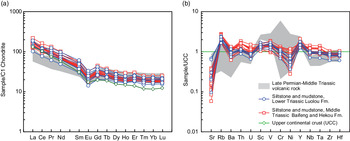
As illustrated in Figure 7a, all the analysed Early–Middle Triassic samples are enriched in light rare earth elements (LREEs) with high LaN/YbN values (6.05–10.13, avg. 8.08) and have relatively flat heavy rare earth elements (HREEs) and negative Eu anomalies in the chondrite-normalized REE patterns, with DyN/YbN values ranging from 2.59 to 4.21. In the upper continental crust (UCC)-normalized trace-element spider diagram (Fig. 7b), they have relatively flat patterns and are close to the UCC, with negative Sr and Ni anomalies, but positive Rb and Y anomalies.
(a) Chondrite-normalized rare earth element patterns and (b) UCC-normalized trace-element spider diagrams for the Napo basin siltstone and mudstone samples. Chondrite and UCC values used for normalization are from Sun & McDonough (Reference Sun, McDonough, Saunders and Norry1989) and Rudnick & Gao (Reference Rudnick and Gao2003), respectively. The volcanic arc (Hu et al. Reference Hu, Du, Yang, Huang, Huang and Huang2012; Xiang, Reference Xiang2018; Xiang et al. Reference Xiang, Yan, Xia and Xia2021) in an adjacent area is plotted for comparison.

5.c. Detrital zircon U–Pb geochronology
5.c.1. Lower Triassic Luolou Formation (sample 19QH-2)
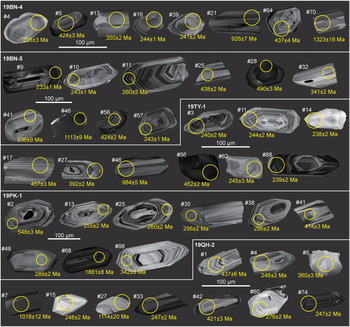
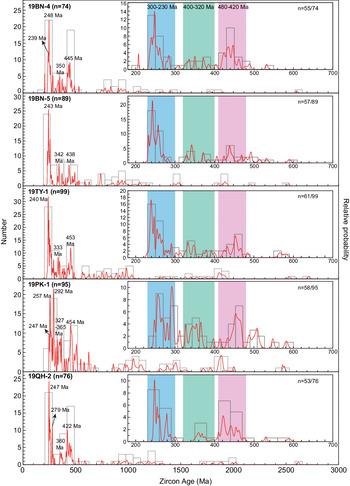
The zircon crystals analysed are mainly euhedral and prismatic crystals, ranging from 70 μm to 140 μm in diameter, with length to width ratios between 1:1 and 2.5:1. Most grains show visible internal oscillatory zoning in CL images (Fig. 8) and high Th/U ratios (0.09–1.66), indicating their magmatic origin. A few exhibit core–rim structures and are slightly rounded in shape. Of 85 analyses on 85 zircons from sample 19QH-2, 76 grains yield concordant ages ranging from Neoarchaean to late Early Triassic (Fig. 9). The relative probability plots and age histograms of the detrital zircons are characterized by two major groups (300–241 Ma and 475–421 Ma, respectively), one subordinate group (397–352 Ma) and a minor scattered age group (Precambrian). For the two major groups, Permian–Early Triassic detrital zircons show two age peaks at 279 Ma and 247 Ma, respectively, and Ordovician–Silurian zircons yield one age peak at 422 Ma. The subordinate group has one age peak at 360 Ma.
Cathodoluminescence images of representative zircons from turbidite sandstone, including samples 19QH-2, 19PK-1, 19TY-1, 19BN-4 and 19BN-5. Yellow circles indicate the in situ analytical spots for U–Pb age.

Relative probability plots and age histograms of detrital zircons from turbidite sandstone samples in the Triassic Napo basin.

5.c.2. Middle Triassic Baifeng Formation (samples 19PK-1, 19TY-1)
Most of the zircon crystals from turbidite sandstone samples 19PK-1 and 19TY-1 are 80 μm to 180 μm in size. The majority are euhedral and prismatic (Fig. 8) with aspect ratios ranging from 1.25 to 3. Combined with internal oscillatory zoning and high Th/U ratios (0.04–3.92), most of the detrital zircons have a magmatic origin. For sample 19PK-1, 95 of 100 analysed grains yield concordant ages and show two major groups (296–247 Ma and 492–414 Ma), a subordinate group (397–307 Ma) and a minor scattered age group (Precambrian) (Fig. 9), similar to those of 19QH-2. The first group of zircons displays three age peaks at 292 Ma, 257 Ma and 247 Ma, respectively, and the second one shows an age peak at 454 Ma. However, the subordinate group of detrital zircons has a scattered age distribution pattern between 365 Ma and 327 Ma without a remarkable age peak.
For sample 19TY-1, 99 of 110 analysed zircons have concordant ages and show a similar age distribution pattern to 19PK-1. Two major groups (291–230 Ma and 484–400 Ma) yield age peaks at 240 Ma and 453 Ma, respectively, and the subordinate group (392–303 Ma) shows an age peak at 333 Ma. Minor Precambrian zircons display a scattered age distribution pattern, ranging from 566 Ma to 2636 Ma (Fig. 9).
5.c.3. Middle Triassic Hekou Formation (samples 19BN-4, 19BN-5)
Samples 19BN-4 and 19BN-5 are medium-grained sandstones from the Middle Triassic Hekou Formation. The majority of the analysed zircons are 70–150 μm diameter, euhedral to subeuhedral and prismatic crystals (Fig. 8), associated with aspect ratios ranging from 1.2 to 2.5 and relatively high Th/U ratios (0.05–1.90). Eighty-eight analyses on 88 zircons from sample 19BN-4 yield 74 concordant analyses. Most of the zircons show ages between 3278 Ma and 236 Ma, with two major groups at 285–236 Ma and 480–403 Ma, a subordinate group at 385–308 Ma and a scattered age group older than 530 Ma (Fig. 9). For the two major groups, Permian–Late Triassic zircons exhibit two age peaks at 239 Ma and 248 Ma, respectively, and Ordovician–Silurian zircons display an age peak at 445 Ma. The subordinate group has an age peak at 350 Ma.
One hundred analysed zircons from sample 19BN-5 yield 89 concordant ages ranging from 2523 Ma to 232 Ma, with one major (281–232 Ma, age peak at 243 Ma) and two subordinate groups (384–329 Ma and 493–406 Ma, age peaks at 342 Ma and 438 Ma, respectively). Minor zircons have scattered ages older than 514 Ma (Fig. 9).
6. Discussion
6.a. Weathering and sediment recycling
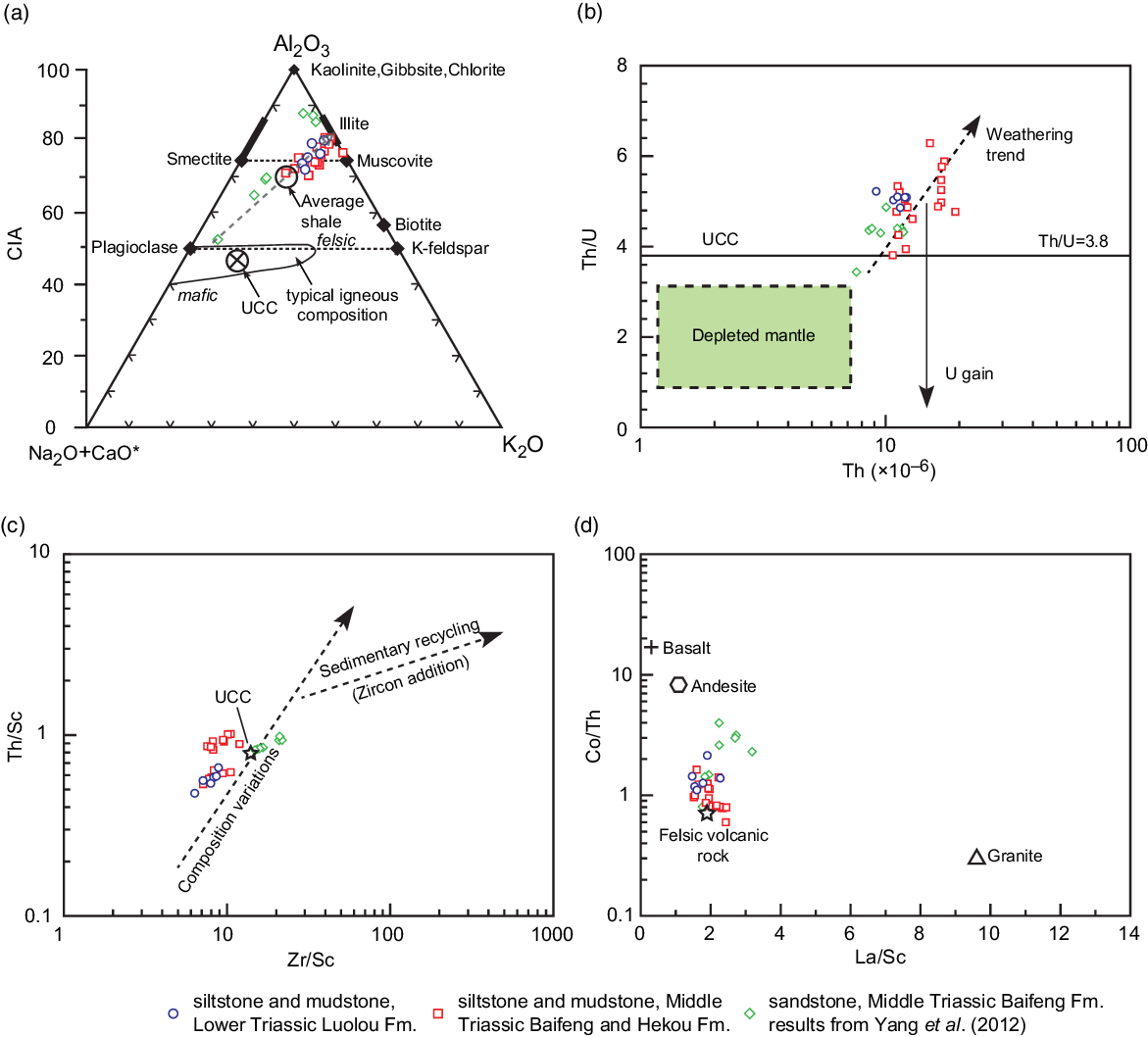
The Chemical Index of Alteration (CIA) plays an important role in establishing the degree of weathering for a source rock (CIA = (Al2O3/(Al2O3 + CaO* + Na2O + K2O)) × 100) (Nesbitt & Young, Reference Nesbitt and Young1982, Reference Nesbitt and Young1984). The molecular proportions of CaO* in the silicate minerals were calculated following Bock et al. (Reference Bock, McLennan and Hanson1998). The results indicate that both the Lower and Middle Triassic samples have higher CIA values (avg. 76 and 75, respectively) than average shale and most of the sandstones (52–75) (Yang et al. Reference Yang, Cawood, Du, Huang and Hu2012), indicating a moderate to high degree of chemical weathering of the source rocks. In the A–CN–K diagram (Fig. 10a), all the samples are plotted along or close to a line between idealized plagioclase and illite, and the Middle Triassic samples show a scattered distribution, indicating non-steady-state weathering conditions. This is generally attributed to active tectonism that permits strong erosion of all portions within the weathering profiles for the source rocks (Nesbitt et al. Reference Nesbitt, Fedo and Young1997). In addition, the Napo basin sediments also show higher CIA values than those of the central–northern Nanpanjiang basin (Tian’e and Ziyun area, CIA = 57–89 and 55–61, respectively; Yang et al. Reference Yang, Cawood, Du, Huang and Hu2012), showing their stronger degree of weathering. Given the thin-section photomicrograph and detrital mode results, we consider that the detrital fragments of Napo basin sediments may be derived from a mafic source that had undergone moderate to high weathering and/or from mixed provenance components of different compositions (McLennan et al. Reference McLennan, Hemming, McDaniel, Hanson, Johnsson and Basu1993).
(a) A–CN–K diagram showing the degree of weathering. (b) Th/U v. Th and (c) Th/Sc v. Zr/Sc diagrams illustrating weathering and sediment recycling (McLennan et al. Reference McLennan, Hemming, McDaniel, Hanson, Johnsson and Basu1993). (d) Co/Th v. La/Sc discrimination diagram indicating sedimentary provenance (after Gu et al. Reference Gu, Liu, Zheng, Tang and Qi2002). Upper continental crust (UCC; Taylor & McLennan, Reference Taylor and McLennan1985) and coarse-grained sandstone studied by Yang et al. (Reference Yang, Cawood, Du, Huang and Hu2012) are plotted as a reference.

Trace-element ratios (e.g. Th/U, La/Sc, Co/Th, Th/Sc and Zr/Sc) of sandstone are particularly useful for indicating the nature of source rocks and measuring the degree of chemical weathering and sedimentary recycling (McLennan et al. Reference McLennan, Hemming, McDaniel, Hanson, Johnsson and Basu1993; Gu et al. Reference Gu, Liu, Zheng, Tang and Qi2002; Yan, Z. et al. Reference Yan, Wang, Wang, Yan, Xiao and Li2006, Reference Yan, Wang, Yan, Wang and Guo2012). All the siltstone and mudstone samples have relatively higher Th/U ratios (3.81–6.28, avg. 5.02) than UCC (= 3.8; Taylor & McLennan, Reference Taylor and McLennan1985). In the Th/U versus Th diagram (Fig. 10b), the Lower Triassic sandstone samples plot together, suggesting that the source rocks underwent weak to moderate weathering and a low degree of recycling. The Th/U ratios of these samples range from 4.85 to 5.22, similar to sediments deposited in active tectonic settings (<5.0; Bhatia & Crook, Reference Bhatia and Crook1986). The Middle Triassic samples display a positive linear trend along the weathering trend, implying that these sediments were derived from weathered source rocks and materials with recycled sediment (Meinhold et al. Reference Meinhold, Kostopoulos and Reischmann2007).
Based on the Th/Sc versus Zr/Sc diagram, we can determine the compositional variation and the degree of sediment sorting and recycling of the basin fillings (McLennan et al. Reference McLennan, Hemming, McDaniel, Hanson, Johnsson and Basu1993). In the Th/Sc versus Zr/Sc diagram (Fig. 10c), all the samples display a positive linear correlation along the trend of compositional variation. This result suggests that both the Lower and Middle Triassic sediments have a relatively mafic source and underwent no significant sediment recycling (McLennan et al. Reference McLennan, Hemming, McDaniel, Hanson, Johnsson and Basu1993). In addition, the lower Th/Sc and Zr/Sc ratios imply that the Lower Triassic sediments seem to contain more mafic components than the Middle Triassic sediments, consistent with the detrital mode results. The Zr/Sc ratios of the siltstone and mudstone are smaller than those of the sandstone, implying concentration of zircon in the coarser fraction (Meinhold et al. Reference Meinhold, Kostopoulos and Reischmann2007). These features are all indicative of low to moderate weathering of the source rocks and no significant sediment recycling for the Lower Triassic sandstones. However, compared with the Lower Triassic, the Middle Triassic sandstones are derived from source rocks with a relatively higher degree of weathering, as well as no significant recycling.
6.b. Provenance
6.b.1. Lower Triassic (Luolou Formation)
Given the field investigations, we have confirmed that the Lower Triassic Luolou Formation exposed to the west of the DPF is mainly composed of volcanic and carbonate olistoliths, associated with conglomerates and sandstones of gravity-flow origin. The zircon ages and geochemical characteristics of the volcanic olistoliths (c. 253–248 Ma; Xiang, Reference Xiang2018) are consistent with those of the Funing arc to the north (c. 256–241 Ma; Hu et al. Reference Hu, Du, Yang, Huang, Huang and Huang2012; Liu, B. et al. Reference Liu, Li, Guan, Chen, Chen, Li, Hu, Zhang and Yu2018; Xiang et al. Reference Xiang, Yan, Xia and Xia2021), which indicates that the Napo basin may have developed since the Changhsingian of the late Permian or the Early Triassic at least, and been genetically related to this volcanic arc in space and time.
The abundant volcanic and carbonate lithic fragments of the sandstones imply that the provenance is composed of primarily mafic rocks with a few recycled sediments (Fig. 5a). The detrital mode results indicate that the sediments are derived from a transitional arc source (Fig. 6a–c) and may have been deposited within a subduction-related basin setting (Fig. 6d). However, the calcareous and siliciclastic turbidite sandstones in the upper part have a relatively higher quartzose content and less lithic fragments and feldspar grains, which plot close to the dissected arc and recycled orogen fields (Xia, L. et al. Reference Xia, Yan, Xiang, Xia, Shi, Jiang, Li and Wei2018). This indicates that there was a transition of dominant provenance during the late depositional stage of the Luolou Formation.
The trace elements, such as REEs, high-field-strength elements and some transition metal elements (e.g. Co, Sc) are considered less likely to be modified by weathering, transport and diagenesis (Taylor & McLennan, Reference Taylor and McLennan1985; McLennan et al. Reference McLennan, Hemming, McDaniel, Hanson, Johnsson and Basu1993), which can be used to discriminate the character of the source rock for clastic deposits. Mafic rocks generally have low LREE/HREE ratios and no obvious negative Eu anomalies, but felsic rocks do not (Yan et al. Reference Yan, Wang, Yan, Wang and Guo2012). The siltstone and mudstone samples from the upper Luolou Formation show apparently fractionated REE patterns with high LaN/YbN (6.30–8.91, avg. 7.58), LREE/HREE (5.79–7.49, avg. 6.76) and a distinct negative Eu anomaly (Eu/Eu* = 0.57–0.66, avg. 0.61) (Fig. 7a). In the Th/Sc versus Zr/Sc diagram, both Th/Sc and Zr/Sc ratios are lower than the average value of UCC, reflecting the effect of composition variations (McLennan et al. Reference McLennan, Hemming, McDaniel, Hanson, Johnsson and Basu1993). Gu et al. (Reference Gu, Liu, Zheng, Tang and Qi2002) established a discrimination diagram using Co/Th versus La/Sc to determine different magmatic arc compositions and sources. High Co/Th ratios and low La/Sc contents suggest provenance primarily from a mafic source. When plotted on the Co/Th versus La/Sc diagram (Fig. 10d), the upper Luolou Formation samples fall in the field between andesite and felsic volcanic rock. Thus, considering a certain amount of volcanic lithic fragments within the sandstone, we suggest that the provenance of the upper Luolou Formation is likely to be derived from mixed mafic and felsic rocks.
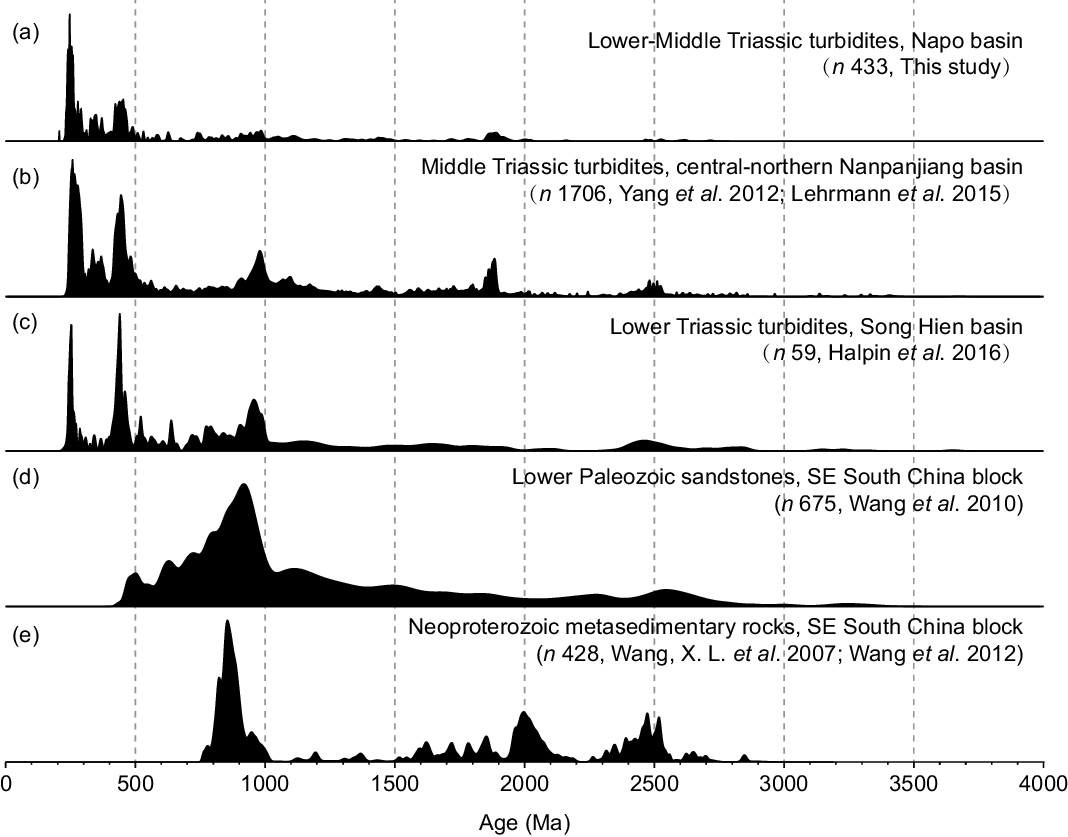
The U–Pb age spectra of detrital zircons can provide constraints on the provenance of sediments (Dickinson & Gehrels, Reference Dickinson and Gehrels2003; Dickinson et al. Reference Dickinson, Lawton and Gehrels2009). For the sandstone sample 19QH-2, the detrital zircons yield two major age groups at 300–241 Ma and 475–421 Ma, one subordinate group at 397–352 Ma and a minor scattered Precambrian age group (Fig. 9). The youngest age peak is at c. 247 Ma, suggesting that the sedimentation of the Luolou Formation has continued until latest Olenekian time. The detrital zircons with ages of 255–241 Ma in the predominant group are mainly derived from arc-related basaltic to andesitic rocks to the north of the basin, which is consistent with the S-directed palaeocurrent direction. The zircons derived from the ELIP should be limited because of its short magmatic duration of c. 6 Ma, ranging from 262 Ma to 256 Ma (Shellnutt et al. Reference Shellnutt, Pham, Denyszyn, Yeh and Tran2020 and references therein). The apparent age peak at 279 Ma for sample 19QH-2 implies the existence of magmatic activity during early Permian (Kungurian) time in the Napo area. In addition, the subordinate group zircons (397–352 Ma) are consistent with the widespread Late Devonian – early Carboniferous magmatic activities in the southern SCB (Guo et al. Reference Guo, Fan, Wang and Li2004; Liu, Y. Q. et al. Reference Liu, Ji, Kuang, Jiang, Xu and Peng2012). The majority of early Palaeozoic detrital zircons (475–421 Ma) fit well with the timing of the widespread tectonothermal activity in the southeastern SCB (e.g. Yunkai and Wuyi massifs; Wang, Y. J. et al. Reference Wang, Fan, Zhao, Ji and Peng2007, Reference Wang, Zhang, Fan, Zhao, Zhang, Zhang, Zhang and Li2011; Faure et al. Reference Faure, Shu, Wang, Charvet and Choulet2009; Charvet et al. Reference Charvet, Shu, Faure, Choulet, Wang, Lu and Breton2010; Li et al. Reference Li, Li, Wartho, Clark, Li, Zhang and Bao2010; Yu et al. Reference Yu, Huang, Sun and He2018; Wang et al. Reference Wang, Li, Wang, Santosh and Chen2020). However, it is believed that the Yunkai and Wuyi massifs could not contribute detritus to the Napo basin owing to the Debao and Chongzuo–Pingguo carbonate platforms which acted as topographic barriers (Lehrmann et al. Reference Lehrmann, Chaikin, Enos, Minzoni, Payne, Yu, Goers, Wood, Richter, Kelley, Li, Qin, Liu and Lu2015). The Song Chay Silurian massif (436–402 Ma; Yan, Z. et al. Reference Yan, Wang, Wang, Yan, Xiao and Li2006) in the NVT may have provided the dominant source for the Lower Triassic succession in the southern–southeastern Song Hien basin (Fig. 11c; Halpin et al. Reference Halpin, Tran, Lai, Meffre, Crawford and Zaw2016), but the existence of the Babu–Cao Bang branch ocean as well as the dominant S-directed palaeocurrents are not in favour of this provenance for the Napo basin. Thus, we suggest that the detrital zircons of the subordinate early Palaeozoic age group are not directly derived from the early Palaeozoic orogen, southeastern SCB, but are more likely to be recycled from the older sedimentary sequence (e.g. Lower Devonian Yujiang Formation) and/or from the late Permian–Triassic mafic magmatic rocks which capture zircons from the wall rocks.
Probability density plots for detrital zircon U–Pb ages from the (a) Lower–Middle Triassic Napo basin turbidites, compared with the (b) Middle Triassic turbidites in the Nanpanjiang basin (Yang et al. Reference Yang, Cawood, Du, Huang and Hu2012; Lehrmann et al. Reference Lehrmann, Chaikin, Enos, Minzoni, Payne, Yu, Goers, Wood, Richter, Kelley, Li, Qin, Liu and Lu2015), the (c) Lower Triassic turbidites in the Song Hien basin (Halpin et al. Reference Halpin, Tran, Lai, Meffre, Crawford and Zaw2016), the (d) lower Palaeozoic sandstones (Wang et al. Reference Wang, Zhang, Fan, Zhang, Chen, Cawood and Zhang2010) and the (e) Neoproterozoic metasedimentary rocks (Wang, X. L. et al. Reference Wang, Zhou, Griffin, Wang, Qiu, O’Reilly, Xu, Liu and Zhang2007; Wang et al. Reference Wang, Yu, Griffin and O’Reilly2012) in the SE South China Block.

The scattered Precambrian detrital zircons are subhedral to rounded in shape with oscillatory zoning and core–rim structures, suggesting derivation from multiple sources. These zircons reveal Archaean (>2500 Ma) and Palaeoproterozoic (1300–800 Ma and 2000–1700 Ma) ages and are in accordance with those of the early Palaeoproterozoic basement rocks and syn-orogenic Neoproterozoic rock suites in the Jiangnan orogen (Yao et al. Reference Yao, Cawood, Shu and Zhao2019 and references therein), which have been commonly interpreted as the sediment sources for the central–northern Nanpanjiang basin (Yang et al. Reference Yang, Cawood, Du, Huang and Hu2012; Lehrmann et al. Reference Lehrmann, Chaikin, Enos, Minzoni, Payne, Yu, Goers, Wood, Richter, Kelley, Li, Qin, Liu and Lu2015), as well as the lower Palaeozoic sandstones and Neoproterozoic metasedimentary rocks in the southeastern SCB (Fig. 11d, e; Wang, X. L. et al. Reference Wang, Zhou, Griffin, Wang, Qiu, O’Reilly, Xu, Liu and Zhang2007; Wang et al. Reference Wang, Zhang, Fan, Zhang, Chen, Cawood and Zhang2010, Reference Wang, Yu, Griffin and O’Reilly2012). However, considering the topographic barriers of the late Palaeozoic carbonate platform and volcanic arc in the Napo area, these older zircons also could be captured in the younger magmatic rocks or recycled from the Palaeozoic sequences.
6.b.2. Middle Triassic (Baifeng and Hekou formations)
The sedimentary framework of the Triassic Napo basin, as illustrated in Figures 2 and 3, is composed of different sedimentary facies that southwardly change from the slope, mid-fan and outer-fan to basin plain. Both the progradation of the turbidite fan system to the south of the DPF and the fan delta over the slope to mid-fan system to the north of the DPF indicate that the depocentre gradually migrated towards the south. The Middle Triassic Baifeng and Hekou formations are dominated by the mid- to outer-fan and basin plain associations, with minor pebbly sandstones and conglomerates in the leveed channels of the inner-fan facies observed to prograde over the mid-fan turbidites. Most of the inner-fan deposits may have been uplifted and eroded in response to the South China–Indochina collision.
The detrital framework composition of the Middle Triassic turbidite sandstones shows moderate quartzose contents and subequal lithic fragments and feldspar grains (Figs 5b–d, 6a, b). Most of the samples fall within the fields between dissected arc and recycled orogen (Dickinson & Suczek, Reference Dickinson and Suczek1979; Dickinson, Reference Dickinson and Zuffa1985), implying that a mixed arc and recycled orogen were likely to be the dominant sources (Fig. 6a, b). The Qp–Lv–Ls and Lm–Lv–Ls diagrams (Fig. 6c, d) also display similar results. The volcanic lithic proportions with dominant microlitic and lathwork texture from the Triassic sandstones show that they were likely derived from mafic magmatic rocks (Fig. 6e). The trace-element characteristics of the Middle Triassic siltstones and mudstones display higher LREE/HREE (5.33–9.11, avg. 7.31) and LaN/YbN (6.05–10.13, avg. 8.26) ratios and relatively lower Eu/Eu* (0.53–0.66, avg. 0.58) than those of the Early Triassic samples, close to the sandstones from a continental island arc or active continental margin setting (Bhatia & Crook, Reference Bhatia and Crook1986). The Th/Sc (0.53–1.01, avg. 0.77) and Zr/Sc (7.13–11.93, avg. 8.9) ratios also display an increasing trend (Fig. 10c). In the Co/Th versus La/Sc diagram (Fig. 10d), they plot close to the felsic volcanic source rock. This suggests that the Middle Triassic successions of the Napo basin had received more intermediate to acidic rocks and/or recycled sediments than the Lower Triassic.
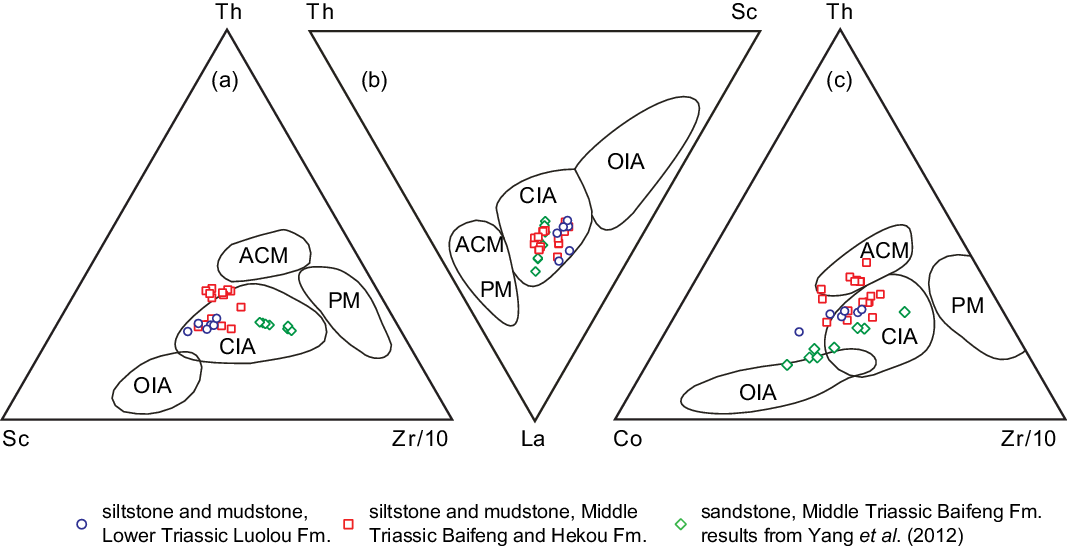
Four detrital zircon samples from the Baifeng and Hekou formations display similar age spectra with one major group at 300–230 Ma, two subordinate groups at 400–320 Ma and 480–420 Ma, respectively, and scattered groups at 1200–800 Ma and 2000–1700 Ma (Fig. 10). Sample 19BN-4 collected from the middle part of the Hekou Formation yields the youngest age peak at c. 239 Ma, suggesting the sedimentation still continued during Ladinian time. As discussed above, we further conclude that the dominant late Permian to Middle Triassic zircons were derived mainly from the north subduction-related volcanic arc (c. 256–241 Ma) and a few from the ELIP-related mafic intrusive rocks (c. 260 Ma). Given the primary S-directed palaeocurrent data, the thick-bedded volcanic sequences developed between the Upper Devonian and lower Carboniferous carbonates to the northeast of the basin could possibly act as the subordinate provenance. Both the subordinate early Palaeozoic and scattered Precambrian zircons are more likely recycled from the Palaeozoic sequences and/or derived from the magmatic arc as captured zircons, similar to those from the Lower Triassic Luolou Formation. Considering the detrital mode, geochemistry and zircon age spectra, it is inferred that the sediments within the Early to Middle Triassic Napo basin were derived mainly from subduction-related volcanic arc and recycled orogen materials. Immobile trace elements (La, Sc, Co, Th and Zr) are suited for provenance and tectonic setting discrimination owing to their relatively low mobility during weathering and transportation (Taylor & McLennan, Reference Taylor and McLennan1985; Bhatia & Crook, Reference Bhatia and Crook1986). In the ternary diagrams of Th–Sc–Zr/10, La–Sc–Th and Th–Co–Zr/10 (Fig. 12; Bhatia & Crook, Reference Bhatia and Crook1986), all samples plot within or near the continental island arc field. Thus, we suggest that the Lower to Middle Triassic sediments of the Napo basin were deposited within a continental island arc setting, with predominant provenance from a magmatic arc including basalts and basaltic andesites, as well as from adjacent Palaeozoic sedimentary/volcanic sequences (carbonates, siltstones, cherts and basalt interlayers). Moreover, the supply from the late Permian Emeishan basalt is limited, and the Cao Bang complex to the south cannot have contributed detritus to the basin fillings because of the north-to-south palaeocurrent direction. Our study further indicates that the Napo basin has no first-cycle detrital inputs from the magmatic and metamorphic rocks presently exposed in the early Palaeozoic orogen (e.g. Yunkai massif), as well as the Neoproterozoic Jiangnan orogen.
Discrimination diagrams of (a) Th–Sc–Zr/10, (b) La–Sc–Th and (c) Th–Co–Zr/10 (after Bhatia & Crook, Reference Bhatia and Crook1986) illustrating tectonic setting for the clastic rocks in the Napo basin, compared with coarse-grained sandstone data published by Yang et al. (Reference Yang, Cawood, Du, Huang and Hu2012). Abbreviations: ACM – active continental margin; CIA – continental island arc; OIA – oceanic island arc; PM – passive margin.

6.c. Tectonic implications
Palaeogeographic and palaeomagnetic evidence suggest that the SCB and Indochina block may have drifted away from Gondwana during Silurian–Devonian times (Metcalfe, Reference Metcalfe1996, Reference Metcalfe and Metcalfe1999, Reference Metcalfe2013; Li et al. Reference Li, Rui, Junwen and Ye2004; Sone & Metcalfe, Reference Sone and Metcalfe2008), causing the opening and spreading of the Palaeo-Tethys ocean (e.g. Changning–Menglian–Inthanon and Jinshajiang–Ailaoshan–Song Ma–Song Chay ocean; Metcalfe, Reference Metcalfe2013, Faure et al. Reference Faure, Lepvrier, Nguyen, Vu, Lin and Chen2014, Reference Faure, Lin, Chu and Lepvrier2016 a,b). During late Palaeozoic time, the deep-water carbonates, cherts and pillow basalts were widely developed in Guangxi province, South China (Guo et al. Reference Guo, Fan, Wang and Li2004; Chen et al. Reference Chen, Qing, Yan and Li2006; Huang et al. Reference Huang, Huang, Du, Yang, Huang, Hu and Xie2013). For instance, the geochemical characteristics of chert from the Upper Devonian and lower–middle Permian sequences in the Napo and Yangshuo area, Guangxi province, show negative Ce anomalies and higher Y/Ho ratios, implying that these cherts were deposited in an open-rift or open marine basin with few terrigenous inputs (Chen et al. Reference Chen, Qing, Yan and Li2006; Huang et al. Reference Huang, Huang, Du, Yang, Huang, Hu and Xie2013). With the continuous rifting along the southern margin of the SCB, the Babu–Cao Bang branch ocean started to open and spread during early Carboniferous to middle Permian times (c. 334–265 Ma; Wu et al. Reference Wu, Ma, Zhong, Wu, Ji, Kuang and Xu2001; Tran et al. Reference Tran, Dang, Do, Nguyen, Fuken and Tran2007; Zhang, B. H. et al. Reference Zhang, Ding, Zhang, Zhang and Chen2013; Thanh et al. Reference Thanh, Hai, Hoang, Lan, Kwon, Itaya and Santosh2014; Halpin et al. Reference Halpin, Tran, Lai, Meffre, Crawford and Zaw2016; Liu, H. C. et al. Reference Liu, Peng and Guo2018; Xiang et al. Reference Xiang, Yan, Xia, Xia and Li2020), separating the NVT to the south and SCB to the north. This is also supported by the early Permian radiolarians found within the Babu ophiolite by Feng & Liu (Reference Feng and Liu2002).
In late Carboniferous to Early Triassic times (c. 300–250 Ma), the Jinshajiang–Ailaoshan–Song Ma–Song Chay Palaeo-Tethys ocean, to the south of the NVT, subducted southward beneath the eastern Indochina block and led to the development of the Truong Son and Day Nui Con Voi magmatic arc (Liu, J. L. et al. Reference Liu, Tran, Tang, Nguyen, Tran, Wu, Chen, Zhang and Zhao2012; Faure et al. Reference Faure, Lepvrier, Nguyen, Vu, Lin and Chen2014, Reference Faure, Lin, Chu and Lepvrier2016 a; Lai et al. Reference Lai, Meffre, Crawford, Zaw, Xue and Halpin2014). The continued collision between the NVT and eastern Indochina block probably occurred at c. 250–245 Ma, resulting in syncollisional felsic magmatism being widely developed in the NVT (Roger et al. Reference Roger, Maluski, Lepvrier, Van and Paquette2012; Chen et al. Reference Chen, Lin, Faure, Lepvrier, Van Vuong and Van Tich2014). After a lithospheric extension potentially induced by the Emeishan plume (c. 260 Ma; Zhou et al. Reference Zhou, Zhao, Qi, Su and Hu2006), the Babu–Cao Bang branch ocean subducted northward beneath the SCB during late Permian to Middle Triassic times (c. 256–241 Ma), which led to the development of arc-related volcanic rocks in the Funing, Jingxi and Pingxiang areas, SW Guangxi province (Wu et al. Reference Wu, Ma, Zhong, Wu, Ji, Kuang and Xu2001; Qin et al. Reference Qin, Wang, Zhang, Pan, Hu and Zhou2011, Reference Qin, Wang, Zhang, Pan, Hu and Zhou2012; Hu et al. Reference Hu, Du, Yang, Huang, Huang and Huang2012; Xiang et al. Reference Xiang, Yan, Xia and Xia2021).
Based on careful field investigations and provenance analyses of the Triassic Napo basin, we conclude that the development of the basin has a close relationship with the subduction of the Babu–Cao Bang branch ocean. During Early Triassic time, both the Napo basin and central–northern Nanpanjiang basin were in a starved sedimentary environment dominated by pelagic carbonates and shales (Lehrmann et al. Reference Lehrmann, Pei, Enos, Minzoni, Ellwood, Orchard, Zhang, Wei, Dillett, Koenig, Steffen, Druke, Druke, Kessel and Newkirk2007), as well as mass-transport deposits along a syn-depositional fault (e.g. Funing–Cao Bang and Tuoniangjiang fault; Xia, L. et al. Reference Xia, Yan, Xiang, Xia, Shi, Jiang, Li and Wei2018; Xia, W. J. et al. Reference Xia, Yan, Xiang, Xia, Jiang, Wei, Li and Zhou2018). In the Napo basin, the volcanic and carbonate olistoliths and sandstones with enrichment of volcanic and recycled carbonate lithic fragments in the Lower Triassic sediments indicate a provenance from the adjacent magmatic arc and Palaeozoic sequences. However, the obviously increased quartzose content and chemical discrimination values (LREE/HREE, LaN/YbN, Th/Sc and Zr/Sc) of the Middle Triassic successions suggest that more felsic materials have been added during this time, and are probably derived from the uplifted Palaeozoic siliciclastic sequences in response to the continued subduction of the Babu–Cao Bang branch ocean. Besides, the Middle Triassic turbidites in the Napo basin show the characteristics of relatively lower quartz and higher volcanic lithic fragment contents than those in the central–northern Nanpanjiang basin (Yang et al. Reference Yang, Cawood, Du, Huang and Hu2012; Lehrmann et al. Reference Lehrmann, Chaikin, Enos, Minzoni, Payne, Yu, Goers, Wood, Richter, Kelley, Li, Qin, Liu and Lu2015). The percentage of early Palaeozoic and Precambrian zircons also decreased distinctively. It indicates a dominant contribution from the magmatic arc sequence along the southern margin (Fig. 11a, b).
Considering that the Napo basin is located between the volcanic arc (Funing arc) and Cao Bang complex (Halpin et al. Reference Halpin, Tran, Lai, Meffre, Crawford and Zaw2016), we suggest that it should be interpreted as a fore-arc basin related to the northward subduction and closure of the Babu–Cao Bang branch ocean in the interval of c. 256–239 Ma (Fig. 13). The sedimentary framework of the Napo basin is composed of a southward-prograding fan delta and slope–turbidite fan system, similar to that of the modern Sunda fore-arc basin on the southwest flank of the Sumatra arc massif (Beaudry & Moore, Reference Beaudry and Moore1985), and is also consistent with the idealized framework of fore-arc basin deposits (Dickinson, Reference Dickinson, Busby and Ingersoll1995). Synchronously, the central–northern Nanpanjiang basin is more likely to be in a back-arc setting (Zeng et al. Reference Zeng, Liu, Chen, Zheng, Zhang, Li and Jiang1995; Qiu et al. Reference Qiu, Yang, Yan, Wells, Qiu, Gao, Dong, Zhang and Wang2019; Duan et al. Reference Duan, Meng, Wu, Yang, Wang and Zhan2020) instead of a peripheral foreland basin (Lehrmann et al. Reference Lehrmann, Pei, Enos, Minzoni, Ellwood, Orchard, Zhang, Wei, Dillett, Koenig, Steffen, Druke, Druke, Kessel and Newkirk2007, Reference Lehrmann, Chaikin, Enos, Minzoni, Payne, Yu, Goers, Wood, Richter, Kelley, Li, Qin, Liu and Lu2015; Du et al. Reference Du, Huang, Yang, Huang, Tao, Huang, Hu and Xie2013). In addition, the amphibole schists of the Babu ophiolite yield 40Ar–39Ar ages of 231–230 Ma (Wu et al. Reference Wu, Zhong, Zhang and Ji1999), in accordance with the zircon age (230.5 ± 8.2 Ma) of eclogite in the Song Ma suture zone (Zhang, R. Y. et al. Reference Zhang, Lo, Chung, Grove, Omori, Iizuka, Liou and Tri2013). It implies that the Babu–Cao Bang branch ocean seems to close later than the Ailaoshan–Song Ma–Song Chay ocean. In Late Triassic time, the continued collision between the SCB and Indochina block resulted in the Babu–Cao Bang ophiolites being tectonically emplaced into the Lower–Middle Triassic sandstone matrix (Zhong et al. Reference Zhong, Wu, Ji, Zhang and Ding1999; Zhang, B. H. et al. Reference Zhang, Ding, Zhang, Zhang and Chen2013; Halpin et al. Reference Halpin, Tran, Lai, Meffre, Crawford and Zaw2016) and the entire Nanpanjiang basin being folded and uplifted, finally terminating the basin history.
Reconstruction of the sedimentary framework and facies for the Early to Middle Triassic Napo basin.

7. Conclusions
(1) The Napo basin located in the China–Vietnam border region developed during Early to Middle Triassic times and hosted a southward-prograding suite of deposits including fan delta, unstable slope (olistostromes) and turbidite fan (mid-fan to basin plain) deposits. The siliciclastic deposits are dominated by immature greywackes derived from mafic to felsic source rocks. Detrital mode and geochemical evidence suggest that these sediments were probably deposited in a subduction-related basin, with unstable source areas that underwent a moderate- to high-degree of weathering but no significant sediment recycling, due to tectonic uplift.
(2) The provenance characteristics and detrital zircon U–Pb age spectra indicate that the Triassic siliciclastic rocks in the Napo basin developed in a continental island arc setting and were derived mainly from mixed late Permian – Middle Triassic magmatic arc and uplifted Palaeozoic sedimentary/volcanic successions. The detritus derived from the ELIP is subordinate and limited. Furthermore, there is no first-cycle detrital input from the igneous and metamorphic rocks formed in the early Palaeozoic orogen (e.g. Yunkai massif) and Neoproterozoic Jiangnan orogen.
(3) Structurally, the Napo basin located between the Funing arc and Cao Bang complex should be interpreted as a fore-arc basin, which was formed in response to the northward subduction of the Babu–Cao Bang branch ocean beneath the SCB in late Permian to Middle Triassic times (c. 256–239 Ma). The Napo basin, as well as the entire Nanpanjiang basin, were finally strongly deformed and overprinted by the continued South China–Indochina collision during late Middle to Late Triassic times.
Acknowledgements
This study was financially supported by the National Natural Science Foundation of China (H.Z., grant number 41602180), the Second Tibetan Plateau Scientific Expedition and Research (STEP) (H.Z., grant number 2019QZKK0704), the China Geological Survey (Z. X., grant numbers 12120113067500, 1212011085415) and the Foundation of Key Laboratory of Deep-Earth Dynamics of Ministry of Natural Resources, Institute of Geology, CAGS (Z. X., grant number J1901–24). The manuscript benefited from constructive suggestions by Chun-Ming Wu, Kai-Jun Zhang, Zong-Qi Wang, Zhen Yan and James D. L. White. We are especially grateful to Guido Meinhold and Michel Faure for their constructive reviews of our paper, and to Stephen Hubbard for his editorial handling.
Supplementary material
To view supplementary material for this article, please visit https://doi.org/10.1017/S0016756821000558