Introduction
Ulcerative colitis is one of the most common forms of inflammatory bowel disease, which progresses with chronic inflammation of the intestinal mucosa. Its prevalence is approximately 156–291 per 100 000 in the general population, although this has increased over time.Reference Ordás, Eckmann, Talamini, Baumgart and Sandborn1 While ulcerative colitis generally progresses with gastrointestinal signs, extraintestinal findings are evident in more than 50 per cent of cases.Reference Orchard, Jewell, Sartor and Sandborn2, Reference Rogler and Schölmerich3 Extraintestinal signs can be observed in almost any organ. The head and neck region are generally affected by oral cavity and ocular involvement.Reference Danese, Semeraro, Papa, Roberto, Scaldaferri and Fedeli4–Reference Podolsky6
Systemic autoimmune diseases, including ulcerative colitis, may involve the auditory system. The auditory system can become the target of an autoimmune attack in two ways. The inner ear is primarily involved in autoimmune inner-ear disease, whereas it is secondarily involved in systemic autoimmune diseases such as systemic lupus erythematosus, rheumatoid arthritis, Wegener's granulomatosis and Cogan's syndrome.Reference Billings7, Reference Mathews and Kumar8 In patients with systemic autoimmune diseases, hearing loss is generally bilateral with acute onset, and shows progression during active periods of the disease. A few studies have reported sensorineural hearing loss (SNHL) in patients with ulcerative colitis thought to result from autoimmune or immune-mediated mechanisms.Reference Kumar, Walsh, Wilson and Carlin9–Reference Kanra, Kara, Seçmeer, Özen, Gürakan and Akçören11 The cochlea may be one of the extraintestinal sites implicated in patients with ulcerative colitis.
The present study aimed to investigate whether cochlear involvement is an extraintestinal manifestation in patients with ulcerative colitis by using pure tone audiometry, speech audiometry and distortion product otoacoustic emission testing. In addition, the relationship between hearing loss and disease activity were investigated.
Materials and methods
Patient selection
Forty-four patients diagnosed with ulcerative colitis at the gastroenterology clinic of the Kayseri Training and Research Hospital and 44 healthy control subjects were included in the present study. The control subjects consisted of volunteers selected from the hospital staff. Age, gender, disease duration and endoscopic findings were recorded for all ulcerative colitis patients. The extent and severity of ulcerative colitis were determined by periodic colonoscopies; disease was classified as mild, moderate or severe, according to the Montreal classification system.
Patients were excluded from the study if they had: a family history of hearing loss; a history of noise exposure, previous ear surgery or cranial trauma; hearing loss, vertigo or tinnitus symptoms; or a history of chronic metabolic or autoimmune disease and ototoxic drug use. All patients underwent otoscopic evaluation; patients with otitis externa, a perforated tympanic membrane and otitis media, or the presence of a flat tympanogram or absence of acoustic reflexes, were excluded from the study. The medical history of control subjects was normal and there were no consistent otological complaints.
The study protocol was designed in accordance with the Helsinki Declaration and approved by the ethics committee of Erciyes University Medicine School. All participants gave written informed consent prior to participation.
Auditory assessment
After otoscopic examination, all participants underwent pure tone audiometry (at 250, 500, 1000, 2000, 4000 and 8000 Hz) and speech audiometry (using the AC40 Diagnostic Audiometer; Interacoustics, Middelfart, Denmark). Normal middle-ear functions were measured by tympanometry (using the AZ26 Impedance Audiometer; Interacoustics), and immittance and acoustic reflexes were assessed. Pure tone air and bone conduction audiometry at frequencies including 250, 500, 1000, 2000, 4000 and 8000 Hz were performed on all subjects. Pure tone hearing averages were used to assess the degree of hearing loss. Pure tone averages (PTA) were calculated by averaging threshold values at frequencies of 500, 1000, 2000 and 4000 Hz for the left and right ear separately. Subjects with hearing thresholds of less than 20 dB were considered to have normal hearing.
Distortion product otoacoustic emission (DPOAE) measurements were performed using Echoport ILO288 screening equipment (Otodynamics, Hatfield, UK). Measurements were carried out in a silent room using a probe inserted in the external auditory canal. Continuous sound stimuli were applied simultaneously with pure tones at two different frequencies in order to measure DPOAE amplitudes. The following stimulus parameters were used: L1 = 65 dB SPL, L2 = 55 dB SPL and f1/f2 = 1.22. The DPOAE measurements were performed at seven different frequencies between 1000 and 8000 Hz (i.e. 1001, 1501, 2002, 3003, 4004, 6006 and 7996 Hz).
Statistical analysis
All statistical analyses were performed using SPSS for Windows software, version 16.0 (SPSS, Chicago, Illinois, USA). Results are expressed as mean ± standard deviation. The chi-square test was used to compare categorical variables between groups. The student's t-test was used for group comparisons of: audiometric pure tone hearing threshold averages at frequencies of 250, 500, 1000, 2000, 4000 and 8000 Hz; PTA; speech discrimination scores; and DPOAE amplitude values. The Pearson correlation test was used to evaluate relationships between the audiometric test results, disease severity and disease duration. A p value of less than 0.05 was considered statistically significant.
Results
Demographic results
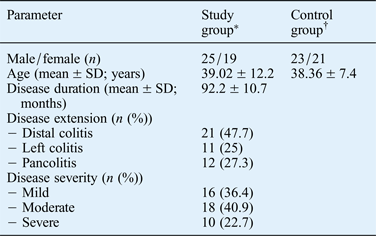
The study included 44 patients (25 men and 19 women) with ulcerative colitis, with a mean age of 39.02 ± 12.20 years (Table I). The control group consisted of 44 healthy individuals (23 men and 21 women), with a mean age of 38.36 ± 7.40 years (Table I). No significant differences were observed between groups regarding age (p = 0.761) and gender (p = 0.669).
Demographic and clinical features of study and control groups

*n = 44; †n = 44. SD = standard deviation
Audiometric results
In both groups, audiometric pure tone hearing threshold averages (at frequencies of 250, 500, 1000, 2000, 4000 and 8000 Hz), PTA, speech discrimination scores and distortion product otoacoustic emission (DPOAE) measurements were determined for each ear separately. Right and left ear measurements were compared between groups. Significant differences were observed for all measurements except DPOAE values at 6000 Hz in the right ear (p < 0.05).
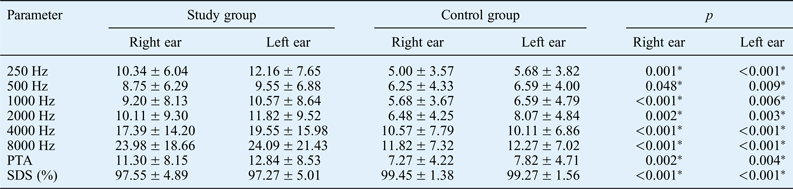
None of the subjects from either group had an air–bone gap at any of the measured frequencies. All of the subjects from the control group and 40 of the 44 patients from the study group had normal hearing levels according to the pure tone hearing threshold averages (less than 20 dB). The PTA values for the right and left ears were 11.30 ± 8.15 dB and 12.84 ± 8.53 dB in the study group, and were 7.27 ± 4.22 dB and 7.82 ± 4.71 dB in the control group, respectively. The PTA values were significantly higher in the study group compared to the control group (Table II). Pure tone hearing thresholds of the patients and controls were significantly different at all frequencies (p < 0.05; Table II). Audiometric pure tone thresholds at 250, 500, 1000, 2000, 4000 and 8000 Hz were found to be higher in patients with ulcerative colitis. The pure tone hearing threshold results of the patients are shown in Figures 1 and 2.
Distribution of pure tone hearing thresholds at 250, 500, 1000, 2000, 4000 and 8000 Hz for right ears of study group. SD = standard deviation
Distribution of pure tone hearing thresholds at 250, 500, 1000, 2000, 4000 and 8000 Hz for left ears of study group. SD = standard deviation
Hearing threshold levels, pure tone averages and speech discrimination scores for study and control groups
Data represent mean (± standard deviation) hearing levels (dB) unless indicated otherwise. *Student's t-test (p < 0.05). PTA = pure tone average; SDS = speech discrimination score
Speech discrimination scores for the right and left ears were 97.55 ± 4.89 and 97.27 ± 5.01 in the study group, versus 99.45 ± 1.38 and 99.27 ± 1.56 in the control group, respectively. Speech discrimination scores were significantly lower in the study group compared to the control group (p < 0.05; Table II).
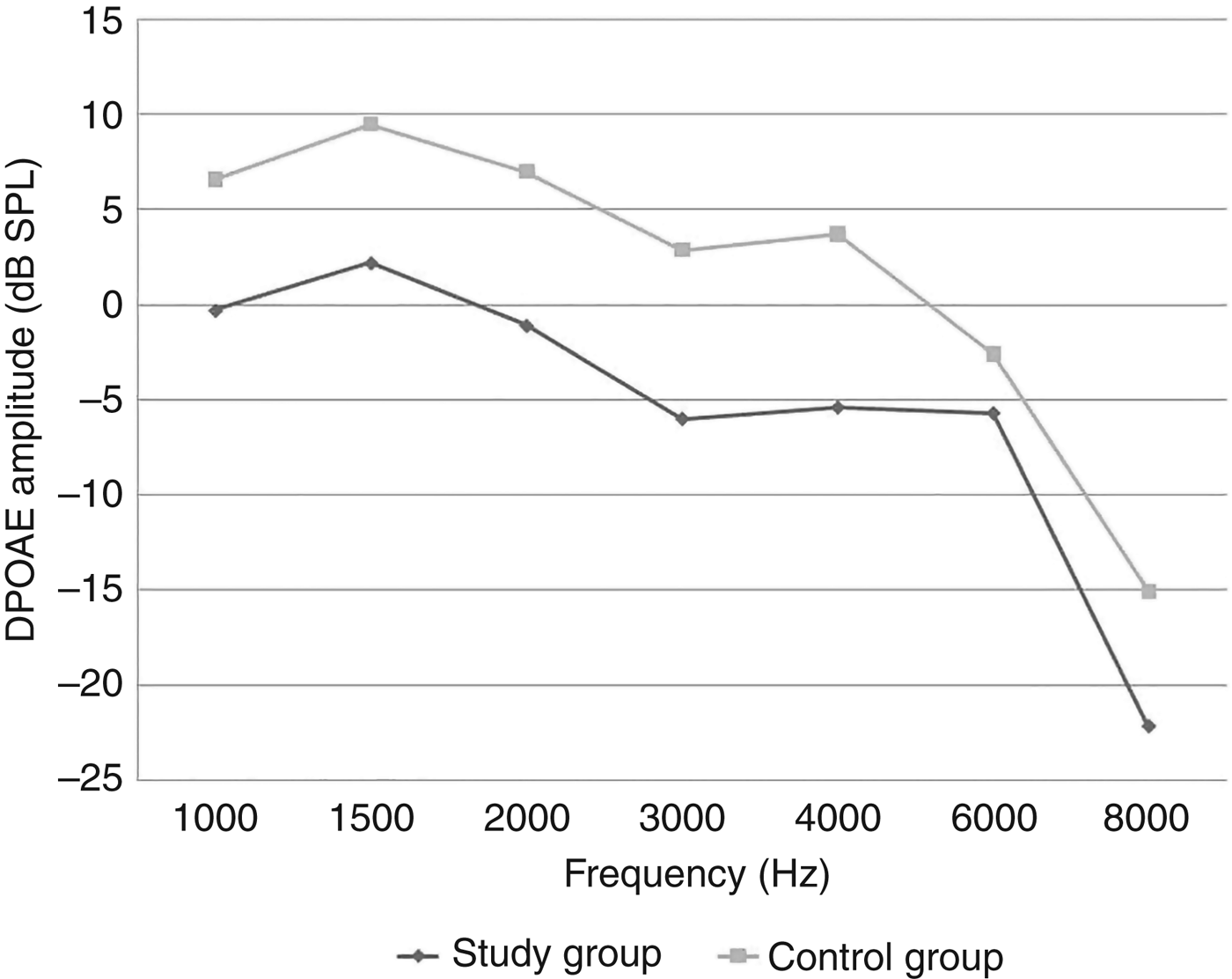
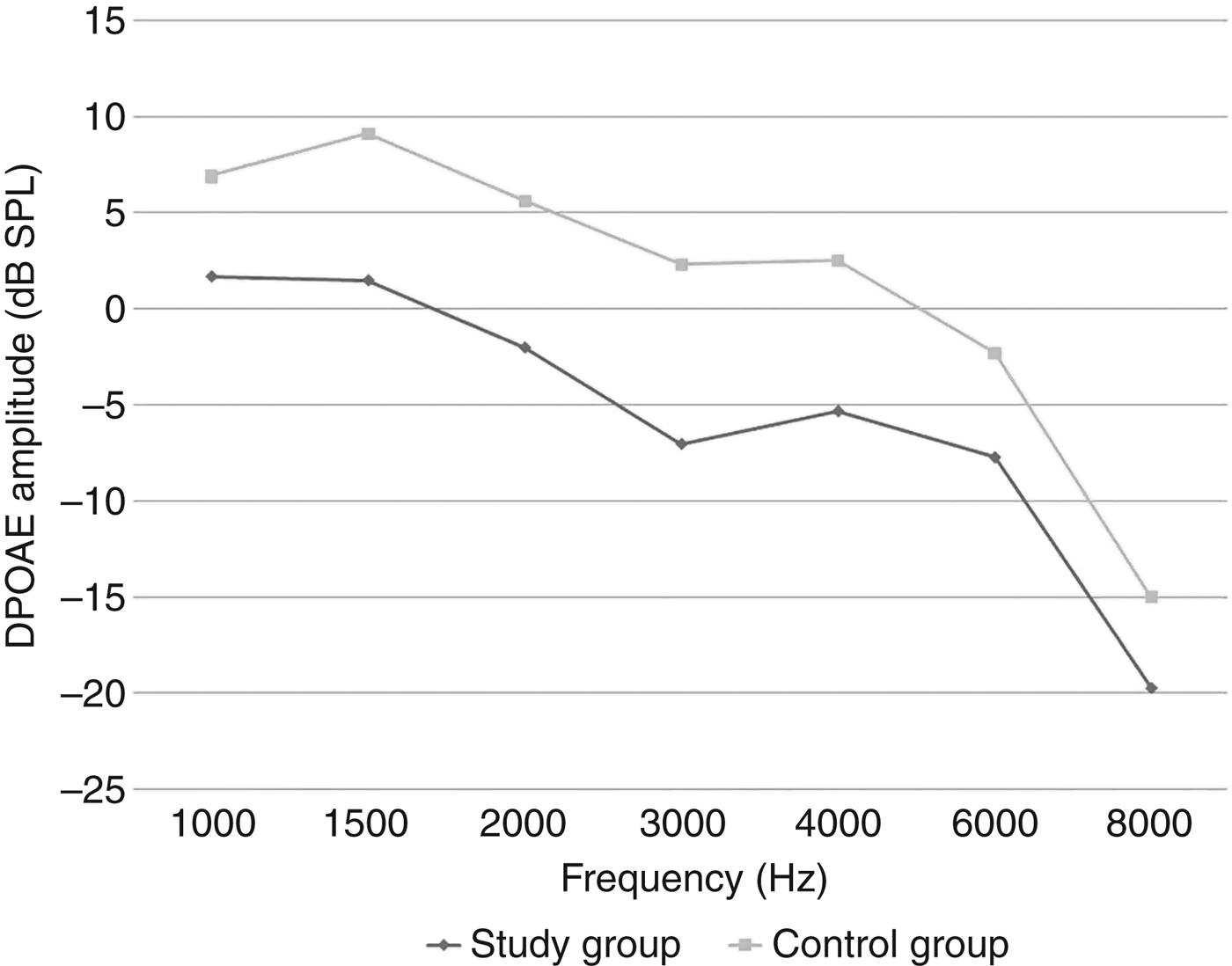
The DPOAE amplitude values were significantly lower at all frequencies (i.e. 1000, 1500, 2000, 4000, 6000 and 8000 Hz) in the study group compared to the control group, except for 6000 Hz in the right ear (p < 0.05; Figures 3 and 4).
Distortion product otoacoustic emission (DPOAE) amplitude values for right ears of study and control groups. There were statistically significant differences between the study and control groups (p < 0.05) for DPOAE values at 1000, 1500, 2000, 3000, 4000 and 8000 Hz.
Distortion product otoacoustic emission (DPOAE) amplitude values for left ears of study and control groups. There were statistically significant differences between the study and control groups (p < 0.05) at all measured frequencies.
Clinical results
In the study group, mean disease duration was 92.2 ± 10.7 months. The extent and severity of disease were evaluated in ulcerative colitis patients by periodic colonoscopic examinations. Twelve patients (27.3 per cent) had pancolitis and 21 patients (47.7 per cent) had distal colitis. Ulcerative colitis involved the left colon in 11 patients (25 per cent). With regard to disease severity, there was mild disease in 16 patients (36.4 per cent), moderate disease in 18 patients (40.9 per cent) and severe disease in 10 patients (22.7 per cent) (Table I). No significant correlations were detected between the extent and severity of disease and PTA, speech discrimination scores and DPOAE measurements (p > 0.05). There was also no significant correlation between disease duration and audiometric test results (p > 0.05).
Discussion
Ulcerative colitis, which is one of the most frequently observed forms of inflammatory bowel disease, is a chronic, autoimmune, inflammatory bowel disease that progresses with relapses. The clinical course includes superficial ulceration of intestinal mucosa, rectal bleeding, diarrhoea and abdominal pain.Reference Conrad, Roggenbuck and Laass12
Currently, loss of tolerance to intestinal flora is the most commonly suggested pathophysiological factor in ulcerative colitis.Reference Wen and Fiocchi13 In a review of ulcerative colitis by Ordás et al., it was suggested that there are increased amounts of luminal antigen in the lamina propria.Reference Ordás, Eckmann, Talamini, Baumgart and Sandborn1 This is proposed as being due to increased intestinal permeability, resulting from dysfunction of tight junctions and the mucus layer in intestinal epithelium. Reduced tolerance of macrophages and dendritic cells against increased amounts of luminal antigen increases the release of pro-inflammatory cytokines (i.e. tumour necrosis factor (TNF)-α, and interleukins (IL) 1, 2, 6, 23 and 1β) via activation of the nuclear factor kappa B pathway. This activation cascade leads to injury in the epithelial barrier by causing transformation of cluster of differentiation T cells to type 2 helper cells through IL-4 release and the recruitment of natural killer cells.Reference Ordás, Eckmann, Talamini, Baumgart and Sandborn1
In the literature, studies have indicated the existence of two different immune mechanisms in the pathophysiology of ulcerative colitis. The first is an autoimmune mechanism resulting from serum and mucosal auto-antibodies against intestinal epithelium. Perinuclear antineutrophil cytoplasmic antibodies (ANCA) are indicated as evidence for this mechanism.Reference Kumar, Walsh, Wilson and Carlin9, Reference Wen and Fiocchi13 The second mechanism concerns activity against intestinal bacterial antigens that occur as a result of impaired humoral and cell-mediated immunity.Reference Wen and Fiocchi13
The pathogenesis of extraintestinal signs has not yet been fully elucidated. It is thought that systemic immunity can be induced by increased amounts of antigen in the lumen due to the increased permeability of intestinal mucosa.Reference Akbayir, Çalış, Alkim, Sökmen, Erdem and Özbal14 The amounts of pro-inflammatory cytokines such as IL-1, IL-2 and TNF-α are increased as a result of an activated immune system, which causes inflammatory responses in many sites in the body.Reference Orchard, Jewell, Sartor and Sandborn2 It has been shown that the perinuclear ANCA positivity often observed in ulcerative colitis patients is associated with the presence of extraintestinal signs such as primary sclerosing cholangitis, erythema nodosum and uveitis.Reference Ott and Schölmerich15 This supports the idea that extraintestinal signs are associated with autoimmune mechanisms.Reference Ott and Schölmerich15 The cochlea may also be targeted in this autoimmune attack, in a similar manner to other extraintestinal sites.Reference Akbayir, Çalış, Alkim, Sökmen, Erdem and Özbal14
There is limited information regarding the pathology of hearing loss associated with ulcerative colitis. It is thought that hearing loss can occur in ulcerative colitis patients as a result of autoimmune mechanisms.Reference Kumar, Walsh, Wilson and Carlin9 Several theories have been proposed, including hearing loss resulting from lymphocyte-mediated cytotoxicity, vasculitis or immune complex deposition.Reference Kumar, Walsh, Wilson and Carlin9
In a histopathological study of the cochlea in patients with SNHL thought to be caused by ulcerative colitis, Hoistad et al. observed loss of the organ of Corti, a decreased number of spiral ganglion cells and endolymphatic hydrops.Reference Hoistad, Schachern and Paparella16 They suggested that these findings were caused by autoimmune mechanisms due to ulcerative colitis. Sensorineural hearing loss caused by an immune mechanism was first described by McCabe, in 1979, in a study where all 18 patients benefitted from steroid and immunosuppressive therapy.Reference McCabe17
Ulcerative colitis patients are usually treated with mesalazine, corticosteroids or immunosuppressive agents. The role of mesalazine as the causative agent of SNHL in patients with ulcerative colitis is not clear. There were no reports of this drug causing SNHL found in the literature, and no drug manufacturers list SNHL as an adverse side effect.
A few studies have investigated hearing loss in patients with ulcerative colitis. Hollanders first reported SNHL in a patient with ulcerative colitis in 1986.Reference Hollanders18 Kumar et al. reported that subclinical SNHL is associated with ulcerative colitis.Reference Kumar, Walsh, Wilson and Carlin9 Karmody et al. considered SNHL as an extraintestinal finding in inflammatory bowel disease, and the authors stated that this was caused by systemic immune dysfunction.Reference Karmody, Valdez, Desai and Blevins19 Kalyoncu et al. investigated hearing loss in children with inflammatory bowel disease, but found no significant results.Reference Kalyoncu, Urgancı, Calıs and Ozbal20 Kariya et al. described two cases of ulcerative colitis with SNHL, in which three-dimensional magnetic resonance imaging demonstrated obliteration of the inner ear.Reference Kariya, Fukushima, Kataoka, Tominaga and Nishizaki21 In our patient group, there were only four subjects (9 per cent) with PTA values higher than 20 dB. Although pure tone hearing threshold averages were at normal levels in ulcerative colitis patients, they were significantly higher compared to the control group.
• This study investigated whether cochlear involvement is an extraintestinal manifestation in ulcerative colitis
• Ulcerative colitis patients and controls underwent pure tone and speech audiometry, and distortion product otoacoustic emission (DPOAE) tests
• The DPOAE amplitude values, representing outer hair cell physiological motility, were decreased in patients compared to controls
• Decreased DPOAE amplitude values are a primary sign of cochlear involvement in ulcerative colitis, even in patients with normal hearing levels
To date, previous studies have investigated hearing loss in patients with ulcerative colitis or inflammatory bowel disease by pure tone audiometry exclusively. Although cochlear injury due to an immune mechanism has been considered as the most important reason for hearing loss, cochlear functions have not been investigated. In our study, hearing loss was evaluated by pure tone and speech audiometry, while cochlear function was evaluated by distortion product otoacoustic emission (DPOAE) measurements. Measurements of DPOAE correspond closely with the function and physiological motility of outer hair cells of the cochlea. Normal DPOAE results present very strong confirmation of normal cochlear function.Reference Kimberley22 In the present study, the DPOAE amplitude values of the patients were found to be significantly lower than those of the control group at all measured frequencies except for 6000 Hz in the right ear. These results suggest that the physiological motility of outer hair cells of ulcerative colitis patients was decreased, when compared to the healthy subjects. The decreased DPOAE amplitude values together with normal hearing thresholds may be accepted as early signs of cochlear involvement in patients with ulcerative colitis.
Conclusion
Ulcerative colitis may lead to cochlear involvement as an extraintestinal manifestation of disease. The decreased distortion product otoacoustic emission amplitude values, representing physiological motility of outer hair cells, can be accepted as a primary sign of cochlear involvement in ulcerative colitis cases, even in patients with normal hearing levels.