





1. Introduction
Grammatical gender is one of the better-studied topics in Germanic languages, including heritage varieties (e.g. Lohndal & Westergaard Reference Lohndal and Westergaard2016, Audring Reference Audring, Kürschner and Dammel2023). Shifts and reductions in Germanic gender paradigms are the norm rather than the exception (see e.g. Duke Reference Duke, Dammel, Kürschner and Nübling2010). Many have claimed that grammatical gender is particularly susceptible to loss and change in situations of language contact while others have found well-preserved gender systems in heritage languages (Kühl & Petersen Reference Kühl and Heegård Petersen2021:68). With this study of grammatical gender in one variety of Pennsylvania Dutch, a language descended from Palatine German and spoken by many distinct groups spread across North America, we contribute to the scientific discussion on the vulnerability of grammatical gender and number to change and whether that vulnerability results from language contact or from language internal conditions.
This study investigates evidence of change in gender and number agreement in Pennsylvania Dutch among speakers in the Old Order Amish community of Lancaster County, Pennsylvania. Researchers have long noted that Pennsylvania Dutch as spoken by sectarians like the Old Order Amish and Old Order Mennonites tends to be more innovative and subject to grammatical change than varieties spoken by nonsectarians (see e.g. Huffines Reference Huffines and Dorian1989 on loss of case marking in Sectarian Pennsylvania Dutch). Little research has investigated grammatical gender in Pennsylvania Dutch and most of the research that does exist is focused on gender assignment (e.g. Reed Reference Reed1942, Page Reference Page and Putnam2011). Work on gender agreement has generally been descriptive (e.g. Reed Reference Reed1948) and none has suggested as we do here that the gender paradigm could be undergoing widespread change.
In section 2, we give a brief introduction to the history of Pennsylvania Dutch and its speakers. We also provide a more in-depth overview of grammatical gender in Germanic more broadly and in Pennsylvania Dutch in particular. Section 3 describes this study’s methodology and section 4 its results. We discuss the implications of our findings in section 5 and conclude in section 6.
2. Background
2.1 Pennsylvania Dutch development and speakers
Pennsylvania Dutch (henceforth PD) emerged in the eighteenth century among German speakers who had come to Pennsylvania over the course of the century from German-speaking lands, primarily along the Upper Rhine. The language developed via dialect mixing and is most similar to eastern Palatine dialects (Louden Reference Louden2016:13). Its speakers are often divided into nonsectarian and sectarian groups. The nonsectarian group is descended primarily from German speakers of Lutheran and Reformed backgrounds and is fully assimilated into the mainstream of American society. Among nonsectarians, PD is moribund, and the overwhelming majority of speakers are elderly. The most well-known of the sectarian speakers are the Old Order Amish (OOA) and Old Order Mennonites (OOM), who are characterized by their plain dress, use of horse-and-buggy transportation, and restrictions on the use of technology (Louden Reference Louden, Berend and Knipf-Komlósi2006).
Due to the language shift of the nonsectarians, the great majority of present-day speakers of PD are sectarian, either OOA or OOM. Most sectarian PD speakers are also fluent speakers of English and have been described as “natively ambilingual” (Louden Reference Louden2016:343). Among almost all buggy-driving OOA and OOM groups, PD is the primary in-group vernacular.Footnote 1 Given the rapid increase of population among these separatist groups, the number of PD speakers is also increasing. As of 2024, there were 401,005 OOA living in the United States spread across 32 different states and three Canadian provinces, as well as one small community in Bolivia (“Amish Population, 2024”). The population, which totaled 318,475 in 2017, is growing rapidly (“Amish Population, 2017”). The largest OOA settlement is in Lancaster County, Pennsylvania. Its population grew from 36,920 in 2017 to 43,640 in 2024 (“Twelve Largest Amish Settlements, 2017”, “Twelve Largest Amish Settlements, 2024”). Thus, the Amish of the Lancaster, Pennsylvania community represent about 11 percent of the total number of Amish in the world. In addition to the OOA, Lancaster County is also home to a large community of OOM.
2.2 Grammatical gender in Germanic
Though much work has examined Pennsylvania Dutch in the past century, relatively little has focused on the varieties spoken by Amish and Mennonite groups. This is certainly the case for grammatical gender. Hockett (Reference Hockett1958:231) provides a classic and concise definition of gender: “Genders are classes of nouns reflected in the behavior of associated words.” Corbett (Reference Corbett1991) and many others distinguish between gender agreement and gender assignment. Following Hockett’s definition, agreement refers to the behavior of words associated with a class of nouns. On this basis, one can say that German has three genders as expressed on the definite articles in the following examples: der. M Löffel (M) ‘the spoon’, die. F Gabel (F) ‘the fork’, das. N Messer (N) ‘the knife’. Gender assignment refers to “the way in which native speakers allocate nouns to genders” (Corbett Reference Corbett1991:3). As can be seen in the examples above, gender assignment in German can be opaque. Nevertheless, there are semantic, morphological, and phonological regularities in the assignment of gender, though most are probabilistic (Köpcke Reference Köpcke1982, Zubin & Köpcke Reference Zubin, Köpcke and Craig1986).
The three-gender system Germanic inherited from Indo-European is preserved not only in German but also in Icelandic, Faroese, and Nynorsk, for example. In some Germanic languages, it has been reduced to a two-gender system by the merger of masculine and feminine genders into a common gender that stands in contrast to neuter (e.g. the standard varieties of Dutch, Swedish, and Danish). In a third category are English, Afrikaans, and Contemporary Hasidic Yiddish, which have lost grammatical gender (see Kürschner Reference Kürschner, Putnam and Richard Page2020, Belk et al. Reference Belk, Kahn and Eszter Szendrői2020, Reference Belk, Kahn and Eszter Szendrői2022).
A survey of the changes in the gender systems in different Germanic languages reveals patterns in the changes and the factors that underlie them. For the North and West Germanic languages that merged the masculine and feminine genders into a common gender, there is strong evidence that phonological mergers and morphological restructuring were factors (Kürschner Reference Kürschner, Putnam and Richard Page2020:265–266). In the case of Middle Dutch, unstressed vowels were reduced, resulting in the unemphatic nominative masculine definite article and unemphatic nominative feminine definite article being homophonous with a distinction between masculine and feminine definite articles still found in the accusative (M dien/den, F die/de) and other oblique cases. Subsequently, the case system was lost and the unemphatic nominative definite article form de was generalized for both masculine and feminine nouns. However, the strong adjective endings for masculine and feminine nouns remained unmerged in Middle Dutch (Kürschner Reference Kürschner, Putnam and Richard Page2020:265). Duke (Reference Duke, Dammel, Kürschner and Nübling2010:660) argues that the strong adjective endings were subsequently restructured in analogy to the definite articles for the different genders.
English and Afrikaans have completely lost grammatical gender, although they do retain referential gender for pronouns. In Old English, the three-gender system was still intact adnominally, but referential gender for animates was usual in pronouns. It is unlikely that the loss of gender had primarily phonological reasons since some gender markings were phonologically quite distinct, as in the Old English demonstrative nominative singular (M se, N þæt, F sēo; Kürschner Reference Kürschner, Putnam and Richard Page2020:267–268). The loss of gender in English occured alongside a generalized loss of inflection throughout the language, which may be indicative of typological drift (Kürschner Reference Kürschner, Putnam and Richard Page2020:268).
In Afrikaans, phonology did not play a role in the loss of gender. At the time of Dutch settlement at the Cape in the seventeenth century, there was already evidence of the emergence of common gender in the northern Dutch dialects in Holland, the dialect area from which the Dutch settlers had come. Early written evidence from the Cape shows the development of a common gender and great variability in the gender assignment of historically neuter nouns, with high- and low-frequency neuters often reassigned to common gender. This uncertainty and variability in gender assignment of neuters persisted into the twentieth century. The high-contact language situation on the Cape presumably led to imperfect learning of grammatical gender, and speakers accommodating one another depending upon context (Roberge Reference Roberge2002). The process of standardization in the late nineteenth and early twentieth centuries established Modern Afrikaans as a language with no grammatical gender. Prior to that, basilectal varieties tended to be more like Modern Afrikaans, whereas acrolectal varieties were more likely to preserve the distinction between common gender and neuter typical of Hollandic dialects (Duke Reference Duke, Dammel, Kürschner and Nübling2010, Kürschner Reference Kürschner, Putnam and Richard Page2020).
Contemporary Hasidic Yiddish is a minority language that has lost grammatical gender since World War II. Belk et al. (Reference Belk, Kahn and Eszter Szendrői2020, Reference Belk, Kahn and Eszter Szendrői2022) have documented the loss of gender and case inflections on determiners and adjectives in spoken Contemporary Hasidic Yiddish and in Yiddish written texts in Haredi communities. Like Pennsylvania Dutch in the Amish community, Contemporary (primarily Hasidic) Yiddish is spoken by ethnoreligious communities for in-group communication, while members of the community use the dominant language of their location with people outside the Hasidic community. In the aftermath of the Holocaust and World War II, surviving Hasidic Yiddish speakers from Eastern Europe relocated to the Hasidic communities of London, Antwerp, New York, Montreal, and Israel. Belk et al. (Reference Belk, Kahn and Eszter Szendrői2022) argue that the resulting dialect mixing in these Hasidic communities coupled with a large number of L2 speakers led to the development of a koiné variety that lacks grammatical gender.
In a study investigating gender agreement and pronominal reference in German and Yiddish, Krogh & Petersen (Reference Krogh, Thisted Petersen, Christensen, Jørgensen and Wood2019) found that the variety of Yiddish spoken by the ultraorthodox Jewish community in New York has shifted to more closely resemble pronoun use in English. An effect of animacy is clear in that masculine and feminine pronouns (er and zi respectively) are now used almost exclusively to refer to humans according to their biological gender, while the neuter pronoun es or dos tends to be used to refer to all other nouns. Krogh & Petersen also found evidence of animacy-based pronominal reference in German, particularly in spoken varieties, despite grammatical gender agreement being present in definite articles and attributive adjectives.
Krogh & Petersen’s (Reference Krogh, Thisted Petersen, Christensen, Jørgensen and Wood2019) findings are consistent with the Agreement Hierarchy, which orders agreement positions by the likelihood of grammatical (syntactic) versus semantic agreement. According to the Agreement Hierarchy, grammatical gender agreement is most likely in attributive position and least likely in personal pronouns. Conversely, semantic agreement is most likely in personal pronouns and least likely in attributive position. The complete hierarchy is given below, with grammatical agreement increasingly likely to occur moving toward the left and semantic agreement increasingly likely to occur moving toward the right (Corbett Reference Corbett1979:204):
 $${\text{attributive } {\unicode{x2013}} {\text { predicate }} {\unicode{x2013}} {\text { relative pronoun }} {\unicode{x2013}} {\text{ personal pronoun}}}$$
2.3 Grammatical gender in Pennsylvania Dutch
Like Standard German (henceforth SG), Pennsylvania Dutch inherited three categories of grammatical gender: masculine, feminine, and neuter (Reed Reference Reed1948). PD gender assignment closely aligns with gender assignment in German varieties spoken in Germany as seen in PD der. M Leffel (M) ‘the spoon’, die. F Gawwel (F) ‘the fork’, es. N Messer (N) ‘the knife’. Gender agreement in PD, as in SG, may be expressed in the singular noun phrase via determiners and adjectives and is dependent upon the gender of the noun, for example, es. N Maedel (N) ‘the.n girl’. Gender agreement is found in pronominal reference as well: es. N Maedel (N) – es. N iss am esse ‘the girl – she.n is eating’ (Van Ness Reference Van Ness1993:198). Note that the grammatical gender of Maedel is neuter although the noun refers to a female. Similarly, the pronoun es is also neuter because its antecedent, Maedel, is neuter. Thus, grammatical gender in PD does not always correspond with what is sometimes referred to as natural gender or sex. The grammatical gender of an inanimate object may be masculine or feminine; the grammatical gender of animates may be neuter.
Like SG, gender agreement also interacts with number in PD. Gender agreement only occurs in the singular. Possible gender targets, such as articles, attributive adjectives, and pronouns, also occur in the plural. However, in plural forms there is no agreement for gender, only for number. Thus, gender is expressed in the singular but not in the plural. In addition, there is a high degree of syncretism between the exponence of number agreement in plural forms of articles, attributive adjectives, and pronouns and gender agreement in the corresponding feminine forms.
The gender and number agreement paradigms presented here for definite/indefinite articles and inflections on intervening adjectives (see table 1) and pronouns (see table 2) are based on instructive grammars (e.g. Buffington & Barba Reference Buffington and Albert Barba1954, Frey Reference Frey1985, Stoltzfus Reference Stoltzfus2013) and research studies (e.g. Reed Reference Reed1948, Van Ness Reference Van Ness1993, Meister Ferrè Reference Meister Ferré1994). Most work of this kind is based on Nonsectarian PD in the mid to late twentieth century at a time when it was more widely spoken (e.g. Reed Reference Reed1948, Buffington & Barba Reference Buffington and Albert Barba1954). Stoltzfus’ (Reference Stoltzfus2013) instructive grammar, though written for students of Sectarian Amish PD, is heavily based on nonsectarian grammars as those were the sources available to her. Nonetheless, sources such as these can be used for establishing a baseline about what gender and number agreement in PD should look like.
Gender and number inflection on determiners and adjectives in Pennsylvania Dutch adapted from Stoltzfus (Reference Stoltzfus2013:44–45 and 48)Footnote 4

Table 1 Long description
A table with five rows and five columns comparing gender and number inflection on determiners and adjectives in Pennsylvania Dutch. The columns are labeled Masculine, Feminine, Neuter, and Plural. The rows are labeled Definite Articles, Weak Adjective Endings, Indefinite Articles, and Strong Adjective Endings. Row 1: Definite Articles, der [da], die [di], es [s], die [di]. Row 2: Weak Adjective Endings, -∅, der grooss Bu, the big boy, -∅, die grooss Fraa, the big woman, -∅, es grooss Kind, the big child, -i [i], die groossi Buwe, the big boys. Row 3: Indefinite Articles, en [n], en [n], en [n], N/A. Row 4: Strong Adjective Endings, -er [-ɐ], en groosser Bu, a big boy, -i [i], en groossi Fraa, a big woman, -∅, en grooss Kind, a big child, -i [-i], groossi Buwe, big boys.
Gender and number marking on pronouns in Pennsylvania Dutch (Reed Reference Reed1948)

Table 2 Long description
A table showing gender and number marking on pronouns in Pennsylvania Dutch. The table has four columns labeled Masculine, Feminine, Neuter, and Plural. The row labels are er, sie, es, and sie respectively. Row 1: Masculine, er; Feminine, sie; Neuter, es; Plural, sie.
Reed (Reference Reed1948) and Meister Ferré (Reference Meister Ferré1994) recognized that the vowels in definite articles tend to be reduced by using non-standard spelling for der .M (Reed: dr and Meister Ferré: də) and die .F/P (Reed: d/di and Meister Ferré: di). Such reductions are also common in the Southwestern German dialects from which PD stems. Palatine German has de .M, di .F/P, and s .N (Green Reference Green and Russ1990:252)Footnote 2 and Swiss German has de .M, cliticized d’ .F/P, and s .N (Russ Reference Russ and Russ1990:373).Footnote 3 Based on this, we would not necessarily expect PD to have the phonetic realizations der .M [dɛɐ] (diphthong) and die .F [di:] (long vowel) that are prescribed in SG and on which the spelling is based. All sources that describe gender and number in PD are generally in agreement that the paradigm is as presented in tables 1 and 2 with a fully intact tripartite gender system.
Table 1 shows that definite articles are inflected for gender and number while indefinite articles are not. Weak adjective endings (null marking) are used in all singular definite noun phrases (plural uses {-i}). This applies to demonstratives as well. On the other hand, strong, overtly inflected adjective endings are used in indefinite, possessive, and bare noun phrases (henceforth NPs).Footnote 5 The morphemes {die} and {-i} mark both feminine and plural and thus represent single forms used for multiple functions. All the forms in table 1 are common case since dative has been lost in most modern Sectarian PD varieties (Louden Reference Louden2016:324). However, it is notable that historically, case, number, and gender presented a multiplicity of form and function in the noun phrase. This paradigm displays only remnants of that morphological richness.Footnote 6
The third-person pronouns consist of one form for each gender and one form for plural with syncretism again between the singular feminine and plural pronouns (sie ‘she/they’; see table 2).
Against this background of gender and number agreement that one might expect based on what is known about PD and its closest relatives, we next consider deviations from this norm. In her study on case marking, Huffines (Reference Huffines and Dorian1989:222) found that, “in contrast to the nonsectarian native speakers, the sectarians have several errors in grammatical agreement involving gender.”Footnote 7 Unfortunately, Huffines did not elaborate on these “errors.” In Stoltzfus’ instructive grammar on Amish PD, she encouraged learners not to “worry too much about remembering the der and die and es perfectly. Native speakers do not always say them correctly either” (Stoltzfus Reference Stoltzfus2013:16).Footnote 8 Though nontransparent gender systems typical of Germanic languages take longer to acquire than more transparent gender systems such as those found in Romance languages (Lohndal & Westergaard Reference Lohndal and Westergaard2016:3), adult speakers of such languages usually have no trouble marking gender agreement according to their native language’s paradigm. Schmid (Reference Schmid2002:124), for example, found that 54 L1 German speakers living in Anglophone countries (England and the US) made gender errors at a rate of only 3 percent. Such rates can be attributed to slips of the tongue and possibly to some extent to attrition since these speakers had been living in English-dominant locations for a minimum of 45 years (Schmid Reference Schmid2002:70).Footnote 9 This demonstrates that for German speakers, there is very little deviation from expected gender agreement. Stoltzfus’ comment for PD raises the possibility that her intuitions allow for more flexibility in gender agreement than found in Schmid’s study of L1 German speakers living in England and the US.
While modern sectarian PD varieties have lost case marking on determiners and adjectives, the nonsectarian varieties – to the extent that they were still spoken in the late twentieth century – mostly retained dative case marking (Huffines Reference Huffines and Dorian1989, Meister Ferré Reference Meister Ferré1994).Footnote 10 Keiser (Reference Keiser2015) argued convincingly that the more conservative case marking found in nonsectarian speakers has more to do with the speaker’s age than with the group because both nonsectarian and sectarian speakers in the first half of the twentieth century were more likely to retain case marking than younger sectarian speakers.Footnote 11 Louden (Reference Louden2016:323) described how dative case was quite rapidly completely lost among most sectarians in the early twentieth century.Footnote 12 In other Germanic varieties, in which the gender system has undergone reduction, these changes involve loss of case marking as well (see e.g. Goltz & Walker Reference Goltz, Walker and Russ1990 on the North Saxon dialect of Low German and Kürschner Reference Kürschner, Putnam and Richard Page2020 for Dutch). Thus, loss of case marking in Germanic languages is often linked with a similar trajectory in gender marking, or can at least destabilize previously stable gender marking because gender is tightly bound with case in nominal morphology.
Meister Ferré’s (Reference Meister Ferré1994:27) examination of case marking among the Lancaster Amish found that di .F – which was expected and consistently used for common case – was to some extent encroaching on dative də .F (indistinguishable from the common case masculine definite article) although də was still more frequent in dative case. This is at least one way that the loss of consistent dative case marking could have led to the destabilization of gender in this PD variety. As di became used to mark feminine in dative case, də when used for dative case could have been reanalyzed as a licit form for all feminine NPs regardless of case. This in conjunction with the fact that the vowels used to distinguish these two articles are highly similar and reduced could have introduced confusion between the masculine and feminine definite articles as the dative case entered the final stages of loss. This situation closely parallels what happened in Dutch described in section 2.2 above.
Despite extensive evidence of case loss and some preliminary evidence that gender is undergoing some changes as well, to our knowledge no previous work on PD has claimed as we do here that the gender paradigm, like case, is undergoing extensive syncretism and restructuring in a variety of PD. By contrast, Van Ness (Reference Van Ness1993, Reference Van Ness1995) – who collected data on pronominal reference from New Order Amish PD speakers in Holmes County, Ohio – found that the pronoun es .N and the definite article es .N were being used at increasing rates to refer to women.Footnote 13 This expanding use of es .N to refer to animate females indicates dialectal variation in gender agreement patterns in PD.
3. Methods
3.1 Research questions
The attested restructuring of the gender systems of other Germanic languages motivates the research questions in this study. To the extent that we find divergence from the gender paradigm as presented in tables 1 and 2 above, we expect those developments to be somewhat different in the domains of determiners, adjective inflections, and pronominal reference due to the predictions of the Agreement Hierarchy (Corbett Reference Corbett1979). Pronouns are more likely to be conditioned by semantic features like animacy than determiners and adjectives in attributive position. Reorganization of masculine and feminine into common gender is frequent across the Germanic family (e.g. Dutch, Swedish, and Danish). Due to the phonological similarity of der .M and die .F/P versus es. N in PD (as in many Germanic languages, where masculine and feminine inflections are more similar and neuter is less so; Lohndal & Westergaard Reference Lohndal and Westergaard2016), we predict any syncretism in the gender agreement of definite articles and adjectives to involve masculine and feminine genders and not neuter, which is phonologically dissimilar to the masculine and feminine definite articles. Correspondingly, the masculine and feminine strong adjective endings are both reduced vowels and thus phonologically similar, whereas attributive adjectives for neuter nouns always have a zero inflection. Because plural inflection in PD is often syncretized with feminine inflections, we expect any syncretism between masculine and feminine to impact the plural paradigm as well.
On this basis, we investigate the following research questions for Pennsylvania Dutch as spoken by the Amish of Lancaster County:
-
1. Is there evidence of gender reorganization and reduction?
-
2. Is evidence of change in grammatical gender agreement consistent with the Agreement Hierarchy?
-
3. Is there evidence of syncretism between masculine and feminine due to the phonological similarity of the masculine and feminine definite articles and adjective endings?
3.2 Participants
Eight native speakers of Pennsylvania Dutch from the Lancaster County Old Order Amish community are included in this study. There are six females and two males with a mean age of 40 years and a range of 32–62 years (see table 3). Seven of the participants are current members of the OOA and can be considered typical speakers from this community. They hold occupations typical for the Amish in that all the women are homemakers, who may do some part-time work on the side, and the men work in construction and other similar industries. P1 is a former member who left the Amish approximately fifteen years prior to the study, but still has a lot of Amish friends and family. Though she probably does use PD less than a typical Amish member, her performance in this study does not noticeably differ from that of the other participants. P6 is a bishop whose responses show some effects from his knowledge of Amish High German used by the Amish for religious purposes.Footnote 14 These effects are discussed in the results section. Though this sample size is quite small, the participants are not concentrated in any single area or social circle. They span the layers of Amish society ranging from more traditional, conservative, and inward-facing to less so. Because of this, we believe the participants are as representative of the Lancaster Amish as such a small sample size can be.
Age and sex of each participant

Table 3 Long description
A table with three columns and nine rows, including a header row. The columns are labeled Participant, Age, and Sex. The rows list the participants P1 to P8 with their respective ages and sexes. Row 1: Participant, Age, Sex. Row 2: P1, 35, F. Row 3: P2, 35, F. Row 4: P3, 45, F. Row 5: P4, 32, F. Row 6: P5, 37, F. Row 7: P6, 62, M. Row 8: P7, 39, F. Row 9: P8, 38, M.
Two Standard German speakers from Germany (one male from Essen and one female from Gießen; both 23 years old) and one PD speaker from Holmes County, Ohio (a male of unknown age) are used as comparisons for certain portions of this study. Two former Amish native speakers of PD from Lancaster County, Pennsylvania (one male aged 59 and one female aged 36) are used as raters in a judgment task of definite articles. More information on these additional speakers’ contributions is provided in the results section.
3.3 Procedure
Each study session consisted of a language background questionnaire, a picture naming task used to elicit definite articles, a translation task used to elicit definite articles and adjective endings, and a pronoun judgment task, which examined the acceptability of gender agreement on pronouns. All study sessions were audio-recorded in full.Footnote 15
The picture naming task was adapted from Hendricks (Reference Hendricks2014) and designed to elicit definite articles. It involved 32 nouns total; eight each from M(asculine), F(eminine), N(euter), and P(lural) (see table 4). Nouns were strategically chosen so that each one would be easily depicted, frequent, and its gender assignment undisputed.Footnote 16 Expected gender was taken from Beam’s (Reference Beam2004–Reference Beam2011) PD dictionary.Footnote 17 Only nouns beginning with consonants were chosen to create a clear boundary between the vowel of the preceding definite article and the beginning of the noun.Footnote 18 All categories had two disyllabic nouns (except for N, which had four), while the rest were monosyllabic. Lastly, a few English loanwords were included (two for M and F and one for N and P; marked in table 4 with an asterisk *).
Picture naming task stimuli (n = 32)

Table 4 Long description
The table is divided into four columns labeled Masculine, Feminine, Neuter, and Plural. Each column lists nouns with their English translations. The Masculine column includes words like ‘man’, ‘dog’, ‘foot’, ‘tree’, ‘plate’, ‘mirror’, ‘frog’, and ‘key’. The Feminine column includes words like ‘woman’, ‘fly’, ‘hand’, ‘flower’, ‘fork’, ‘potato’, ‘fence’, and ‘match’. The Neuter column includes words like ‘child’, ‘mouse’, ‘leg’, ‘house’, ‘bed’, ‘book’, ‘knife’, and ‘baby’. The Plural column includes words like ‘people’, ‘horses’, ‘teeth’, ‘shoes’, ‘chairs’, ‘peaches’, ‘spoons’, and ‘boots’. Some words are marked with an asterisk indicating they are English loanwords.
To depict the 32 nouns, we searched for clipart using the Microsoft Word creative commons search engine. Each image was randomly placed with another image on flashcards. On each flashcard, one of the two images was circled (see figure 1 for an example). Each image therefore appeared twice (once circled and once not circled) on the 32 flashcards. Flashcards were shuffled between each participant session, and were thus randomized in order of appearance.
Picture naming task example (n = 32).

The following script was used to elicit a definite article for each noun:
Researcher: Was sehnscht du do? ‘What do you see here?’
Participant: En Key un en Hand. ‘A key and a hand.’
Researcher: Un was iss circled? ‘And what is circled?’
Participant: Der Key. ‘The key.’
Upon beginning our analysis of the definite article elicitations, we noticed that while the neuter definite article (es) was easily distinguishable, it was difficult to make unbiased judgments about whether participants had produced der .M [də] or die .F/P [dɪ]. The vowels tended to be very short (55 ms on average). In many instances where die was expected, we did not hear a clear [ɪ] but a reduced central vowel [ə], which would be expected for masculine NPs.
To check our perceptions with those of native speakers, we created a perception test in PsychoPy (Peirce et al. Reference Peirce, Gray, Simpson, MacAskill, Höchenberger, Sogo, Kastman and Kristoffer Lindeløv2019) using the elicited definite articles. For the test, we extracted all definite articles (excluding neuter-marked das and es) and isolated them.Footnote 20 Definite articles were also extracted from the pre-recorded story (Frog, where are you?; Mayer Reference Mayer1969) told by an Amish PD speaker from Holmes County, Ohio, and were mixed randomly with the Lancaster recordings. Articles that were too short or contaminated by background noise were excluded (n = 27). These definite article clips (Lancaster: n = 173; Ohio: n = 22) were randomly presented to two native-speaker raters from the Lancaster Amish, who were asked to judge each definite article as der [də] or die [dɪ]. The orthography der and die were displayed in view of the raters and the respective pronunciations [də] and [dɪ] were used in the verbal instructions.
In addition to the judgment task described above, we performed an acoustic analysis of the NPs in which der or die were produced. Using Praat (Boersma & Weenink Reference Boersma and Weenink1992–Reference Boersma and Weenink2021), the full NPs, the full definite articles, and the definite article vowels (excluding the plosive [d] at the onset) were each manually marked on a separate tier (see figure 2 for an example). Following Pätzold & Simpson (Reference Pätzold and Simpson1997), who measured formant frequencies of vowels in SG at the midpoint,Footnote 21 and using a Praat script based on Stanley & Lipani (Reference Stanley and Lipani2019), we took automatized measurements of F1, F2, and F3 at the vowel’s midpoint on the vowel tier (marked V in figure 2). We used Praat’s default settings, so it generated formant frequencies for five formants. The Praat script also measured vowel duration on the vowel tier. Females had a formant ceiling of 5,500 Hz while males had a formant ceiling of 5,000 Hz in accordance with Praat’s recommendation (Stanley & Lipani Reference Stanley and Lipani2019).
The marking of articles and vowels in Praat

Due to poor audio quality (e.g. background noise; n = 15), a lack of clear formant structure following the burst of the /d/ in the spectrogram (n = 41),Footnote 22 and other reasons (n = 5),Footnote 25 some definite articles had to be excluded from the analysis. The final count of definite articles included in this analysis was 209 (M: n = 56; N: n = 46; F: n = 63; P: n = 44). The range of tokens contributed per participant was 6–35 (Mean = ∼26).
To account for interspeaker variation, we normalized the formant frequencies we had extracted adapting the methodology used by Guion (Reference Guion2003), Lipski (Reference Lipski2015), and Joo et al. (Reference Joo, Schwarz and Richard Page2018). We extracted F3 values at the midpoint of /a/-sounds produced by participants (in M a nn, G a wwel, H a nd, H au s,Footnote 26 and P a sching). The mean F3 value across these items was calculated for each participant. P6 was chosen as a baseline, and his mean F3 values for /a/ were divided by each participant’s mean F3 value to get the normalization value. This normalization quotient was then multiplied by each respective participant’s F1 and F2 values. Because F3 values reflect vocal tract length, they are useful for minimizing the vocal tract differences between males and females. The F3 of /a/ is used because the production of this vowel minimally involves the tongue and labial articulators (see Lipski Reference Lipski2015:95).
The translation task elicited definite and indefinite articles and adjective inflections. A subset of twelve of the 32 nouns in table 4 were chosen; three each from masculine, feminine, neuter, and plural and three from each animacy category: human, animal, and inanimate object (see table 5). NPs consisting of an article, an adjective, and a noun were created and included one definite (weak endings expected) and one indefinite (strong endings expected) NP for each adjective–noun pair. Images for each item were obtained from the Microsoft Word Creative Commons search engine and placed, along with the NPs in English, on flashcards (see figure 3 for an example). These flashcards were shown to participants in succession, and the NP was read aloud in English. Participants were asked to translate each one into PD (“Wie daetscht du ‘the old man’ saage in Deitsch?” How would you say ‘the old man’ in PD?). Flashcards were randomized between each session by shuffling.
Translation task stimuli (definite: n = 12, indefinite: n = 12, total: n = 24)Footnote 23

Table 5 Long description
A table categorizing nouns by gender and animacy with example phrases. The table has 3 rows and 4 columns. Column headers are Masculine, Feminine, Neuter, and Plural. Row labels are Humans, Animals, and Inanimate objects. Row 1: Humans. Masculine: the/an old man. Feminine: the/a nice woman. Neuter: the/a young child. Plural: the/ø friendly people. Row 2: Animals. Masculine: the/a brown dog. Feminine: the/a little fly. Neuter: the/a gray mouse. Plural: the/ø playful horses. Row 3: Inanimate objects. Masculine: the/a big tree. Feminine: the/a yellow flower. Neuter: the/a red book. Plural: the/ø ripe peaches.
Examples of translation task flashcards.Footnote 27

The pronoun judgment task used a subset of nine of the 32 nouns in table 4 (see table 6). These nine nouns included three nouns of each gender and no plural nouns. The plural pronoun is consistently used to refer to all plural nouns and thus is uninteresting. Each noun appeared three times referred to once by each gendered third-person pronoun; er .M, sie .F, and es .N. Each of these three iterations was accompanied by the same image and scenario in which the pronoun referred to the previously mentioned noun. Clipart taken from the Microsoft Word Creative Commons search engine depicted each of the nine nouns. The stimuli were presented in audio form in combination with the image in a Microsoft Powerpoint presentation and randomized using a macro between each participant.
Nouns used for the pronoun judgment task (n = 9)

Table 6 Long description
The table categorizes nouns by gender and provides corresponding pronouns in Pennsylvania Dutch. It has three rows and three columns. The rows are labeled Humans, Animals, and Inanimate objects. The columns are labeled Masculine, Feminine, and Neuter. Row 1: Humans. Masculine: Mann, man. Feminine: Fraa, woman. Neuter: Kind, child. Row 2: Animals. Masculine: Hund, dog. Feminine: Mick, fly. Neuter: Meisli, mouse. Row 3: Inanimate objects. Masculine: Baam, tree. Feminine: Blumm, flower. Neuter: Bett, bed.
The noun Kind (N) ‘child’ was depicted by the image in figure 4 and appeared in the following scenario:
Pronoun judgment task example (image used for Kind (N) ‘child’).

Audio that accompanied all three iterations: Was iss es .N Kind (N) am duh? ‘What is the child doing?’
-
• Audio for the M stimulus: Er .M iss in die Schul am geh. ‘He is going to school.’
-
• Audio for the F stimulus: Sie .F iss in die Schul am geh. ‘She is going to school.’
-
• Audio for the N stimulus: Es .N iss in die Schul am geh. ‘It is going to school.’
Participants were then asked to rate on a Likert scale from 1 (really bad) to 5 (really good) how good or bad the pronoun sounded to them within its context (see figure 5). Because Kind (N) is neuter, er .M and sie .F are grammatically incongruent. However, because a male child is depicted, the pronoun er .M is in accordance with natural gender.
Likert scale for pronoun task (1 = really bad, 2 = pretty bad, 3 = alright, 4 = pretty good, 5 = really good)Footnote 28

4. Results
4.1 Definite articles
The definite article vowels in this study are very short (mean: 55 ms), and it was difficult to judge whether der .M or die .F/P had been pronounced. While no other researchers have reported general difficulties in perceiving the distinction between der and die, Meister Ferré (Reference Meister Ferré1994:27) in her study on case among the Lancaster Amish mentioned that “the use of contractions of article and preposition somewhat obscured a clear distinction of article forms. The initial sound of the article /di/ or /də/ was attached to the preceding preposition, such as /si ge:d in d ʃu:l/ ‘she goes to school” (emphasis ours).
One of the authors, who is a native speaker of this PD variety, categorized each elicitation using her own judgment. However, we acknowledge that this introduces researcher bias, and we employed two additional strategies to ameliorate this issue. Firstly, we created a perception task and had two native speakers of this variety listen to the elicited definite articles from the picture naming task and judge whether they heard der or die. Secondly, we measured formant frequencies (F1, F2, F3) and duration values of definite article vowels. To confirm that our linguistic tasks and measurement methods were valid, two SG speakers performed the same production tasks. If our acoustic analysis can capture a clear and measurable distinction between der .M and die .F/P for SG, this provides evidence that the methods are valid.
The most striking result from definite article elicitation in this study (including both the picture naming task and the translation task) is the lack of the neuter definite article es in participants’ production of definite articles. Of the eight participants included here only four produced any es .N definite articles at all. This sibilant article (pronounced [s]) is clearly distinguishable from der .M and die .F/P making researcher judgments reliable in these cases. The number of NPs included in tables 7, 8, 9, and 10 differ slightly between participants because NPs in which a definite article was not elicited were excluded.
Picture naming task: Instances of es vs. də before neuter nouns

Table 7 Long description
A table comparing instances of definite articles es and da before neuter nouns. The table has 2 rows and 10 columns. Column headers are P1, P2, P3, P4, P5, P6, P7, P8, Total, and Percentage. Row labels are es and da. Row 1: es, 0, 0, 0, 0, 1, 1 asterisk, 0, 2, 4, 8.33 percent. Row 2: da, 6, 6, 7, 8, 6, 0, 7, 4, 44, 91.67 percent.
*Participant 6 also produced 5 instances of SG das, which is atypical for PD.
Translation task: Instances of es vs. də before neuter nouns

Table 8 Long description
The table presents data on the use of definite articles es and da before neuter nouns by eight participants. It has two rows labeled es and da, and nine columns labeled P1 through P8, Total, and Percentage. Each cell contains numerical values representing the count of definite articles used. The es row shows values of 0, 0, 0, 0, 3, 0, 1, 0, with a total of 4 and a percentage of 17.39 percent. The da row shows values of 3, 4, 3, 4, 1, 0, 2, 2, with a total of 19 and a percentage of 82.61 percent. The table highlights the frequency and distribution of the definite articles es and da among the participants.
Picture naming task: Instances of də vs. dɪ before expected M, F, and P nouns

Table 9 Long description
A table titled ‘Picture naming task: Instances of d vs. d&iscaps; before expected M, F, and P nouns’ with three rows and eleven columns. The table is divided into three sections: Masculine, Feminine, and Plural. Each section has two sub-rows labeled ‘M d&’ and ‘F/P d&iscaps;’. The columns are labeled P1 through P8, Total, and Percentage. The Masculine section shows values for ‘M d&’ ranging from 2 to 8 and a total of 47 with 100 percent. The Feminine section shows values for ‘M d&’ ranging from 3 to 8 and a total of 46 with 92 percent, and values for ‘F/P d&iscaps;’ ranging from 0 to 4 and a total of 4 with 8 percent. The Plural section shows values for ‘M d&’ ranging from 0 to 7 and a total of 21 with 55.26 percent, and values for ‘F/P d&iscaps;’ ranging from 0 to 7 and a total of 17 with 44.74 percent.
Translation task: Instances of də vs. dɪ before expected M, F, and P nouns

Table 10 Long description
The table presents the distribution of definite articles produced by participants in a language study, focusing on masculine, feminine, and plural nouns. It has 3 rows and 11 columns. The columns are labeled P1, P2, P3, P4, P5, P6, P7, P8, Total, and Percentage. The rows are labeled Masculine, Feminine, and Plural. Each row is further divided into subcategories: M d&iscaps; and F/P d&iscaps;. Row 1: Masculine. M d&iscaps;: P1, 4; P2, 5; P3, 5; P4, 4; P5, 4; P6, 1; P7, 4; P8, 3; Total, 30; Percentage, 100 percent. F/P d&iscaps;: P1, 0; P2, 0; P3, 0; P4, 0; P5, 0; P6, 0; P7, 0; P8, 0; Total, 0; Percentage, 0 percent. Row 2: Feminine. M d&iscaps;: P1, 2; P2, 3; P3, 4; P4, 5; P5, 1; P6, 0; P7, 1; P8, 0; Total, 16; Percentage, 55.17 percent. F/P d&iscaps;: P1, 2; P2, 2; P3, 0; P4, 0; P5, 1; P6, 2; P7, 2; P8, 4; Total, 13; Percentage, 44.83 percent. Row 3: Plural. M d&iscaps;: P1, 0; P2, 0; P3, 0; P4, 3; P5, 3; P6, 3; P7, 3; P8, 0; Total, 12; Percentage, 75 percent. F/P d&iscaps;: P1, 1; P2, 0; P3, 0; P4, 0; P5, 2; P6, 0; P7, 0; P8, 1; Total, 4; Percentage, 25 percent.
Turning first to the picture naming task (see table 7), most definite article elicitations from neuter NPs sounded indistinguishable from der .M [də] (n = 44, 91.67% of all instances).Footnote 29 In contrast to all other participants, who often produced what we perceived to be [də] in NPs of all genders, participant 6 produced the three-way gender distinction clearly. This participant is an Amish bishop, who regularly studies and reads aloud from the German Bible and other religious texts at worship services. This understanding of Amish High German, which is not used productively by the Amish, clearly impacted his responses. He was the only participant to produce das (the SG neuter definite article; e.g. das .N Haus (N) ‘the house’ instead of es .N Haus (N)) and did so in all neuter NPs for which he produced a definite article (n = 5) with only one exception, where he produced the PD version of the article (es .N Maedli (N) ‘the girl’). Most of his elicitations matched the expected gender of the noun. Exceptions include * das .N Hand ( F) ‘the hand’, *der. M Match ( F) ‘the match’, *der. M Mick ( F) ‘the fly’, and *der. M Grumbeere ( P) ‘the potatoes’. Otherwise, the gender/number agreement in his elicited definite articles was in accordance with the PD paradigm as described in section 2.3. Though we presume that these elicitations do not perfectly convey how participant 6 produces definite articles in naturalistic speech, he clearly still has knowledge of all three genders and can assign and mark gender according to the PD paradigm.
We also compared instances of es and də in neuter NPs elicited in the translation task. Again, participants produced very few neuter definite articles (n = 4, 17.39%; see table 8),Footnote 30 and in their place they produced der [də] definite articles in combination with nouns that have historically and indisputably belonged to neuter (n = 19, 82.61%). This leads us to conclude that marking of neuter on definite articles has significantly receded in the speech of at least some speakers of this PD variety. As a point of comparison, we also examined a pre-recorded telling of the Frog, where are you? story (Mayer Reference Mayer1969) by an Amish native speaker from Holmes County, Ohio. This speaker produced ten neuter definite articles (es) in his approximately 3-minute-long recording. He did not produce der when es was expected.
Compared to der .M and es .N, the distinction between der .M and die .F/P is much more difficult to judge impressionistically. Nonetheless, the counts in tables 9 and 10 – as judged by the author, who is a native speaker of the Lancaster Amish PD variety – do show a few things. First, there were no obvious cases of die in masculine NPs as we would expect. Second, there were relatively few cases of clearly perceptible die for feminine NPs (Picture Naming Task: n = 4; Translation Task: n = 13). Third, die was more perceptible in plural NPs in overall counts (39% of all plural NPs as opposed to 22% of all feminine NPs) suggesting that number is more clearly distinguished on definite articles than gender.
The findings in tables 9 and 10 are based on one native-speaker author’s impressionistic judgments of the definite articles der and die, which are difficult to differentiate in these data. To account for the possibility that a distinction is being made that was simply difficult for this person to perceive, we asked two raters to judge whether they perceived the Lancaster-produced definite articles as der or die. Rater 1 preferred der and probably used it as a default (n = 103; 59.54%), whereas rater 2 showed the same pattern in reverse preferring die (n = 108; 62.43%; see figure 6). It is striking how common it was for both raters to perceive die for masculine NPs, where der was expected (rater 1: n = 19, 40.43%; rater 2: n = 30, 63.83%). The researcher did not judge any masculine NPs to have die. Both feminine and plural definite articles were perceived as the unexpected der in some cases, though this happened less often for plural (rater 1: n = 14, 35.9%; rater 2: n = 12, 30.77%) than for feminine (rater 1: n = 32, 64%; rater 2: n = 22, 44%). This general pattern matches researcher judgments and suggests that number distinctions are more salient and resilient than gender ones. A glance at these numbers and the distribution in figure 6 reveals that, overall, the gender/number of nouns did not predict which definite article the two raters would perceive.
Rater judgments of definite articles produced by Lancaster Amish speakers (n = 173)Footnote 32

Figure 6 Long description
The bar graph compares the count of definite articles perceived by two raters in Pennsylvania Dutch. It features two grouped bar charts, each divided into four stacked bars representing different genders: Masculine, Neuter, Feminine, and Plural. The horizontal axis is labeled ‘Definite Article Perceived by Rater’ with categories ‘der’ and ‘die’. The vertical axis is labeled ‘Count’. For Rater 1, the counts are: der - Masculine 28, Neuter 29, Feminine 32, Plural 14; die - Masculine 19, Neuter 8, Feminine 18, Plural 25. For Rater 2, the counts are: der - Masculine 17, Neuter 14, Feminine 22, Plural 12; die - Masculine 30, Neuter 23, Feminine 28, Plural 27. The color scheme uses blue for Masculine, yellow for Neuter, red for Feminine, and green for Plural.
If we compare these Lancaster-elicited results to the judgments of the Ohio speaker’s elicitations, the raters agreed more consistently on which definite article they perceived for the Ohio speaker. For the Lancaster data, they agreed on 103 of 172 total tokens (59.88%). The mean agreement rate for participants from Lancaster is 61.78%. The inter-rater reliability for the elicitations from Lancaster speakers is 29.77%.Footnote 31 Conversely, the raters agreed on 20 of 22 for the Ohio speaker’s elicitations (90.91%). The inter-rater reliability for the Ohio speaker is 45.45%. Though the number of articles from the Ohio speaker is too low to make strong conclusions, the fact that his recorded articles were randomly included with the Lancaster data suggests that the raters were better able to hear the difference between der and die for the speaker from Ohio as opposed to the definite articles produced by participants from Lancaster. Thus, our Lancaster raters can still perceive the distinction between masculine and feminine definite articles drawn from free speech when the speaker is clearly distinguishing between der and die.Footnote 33
The two raters’ judgments also align more closely with the expected PD gender paradigm in the case of the speaker from Ohio (though, unfortunately, there were not many feminine and plural nouns in the Frog story recording from the Ohio speaker given the prevalence of masculine nouns like Bu ‘boy’ and Hund ‘dog’). Rater 1 only judged two cases – one feminine and one plural (∼9%) – as the unexpected definite article, while rater 2 judged one masculine, two feminine, and one plural (∼18%) as the unexpected definite article (see figure 7). For Lancaster (excluding neuter NPs), 47.43% of definite articles were judged as the unexpected article (unexpected judgments for rater 1: n = 65, 47.79%; unexpected judgments for rater 2: n = 64, 47.06%).
Rater judgments of definite articles produced by the Amish speaker from Ohio (n = 22)

We would expect die .F/P, pronounced with the high front vowel [ɪ], to have a lower F1 and a higher F2 than der .M, pronounced with the mid central vowel [ə]Footnote 34 (see e.g. Pätzold & Simpson’s Reference Pätzold and Simpson1997 F1 and F2 means for SG [ɪ] and [ə]). The graph depicted in figure 8, however, does not show a clear F1/F2 distinction between der (represented by Masculine) and die (represented by Feminine and Plural). Neuter should not be represented on this graph and only is because of the elicitations of der preceding neuter nouns in this study (see tables 7 and 8). The singular masculine and neuter ellipses overlap almost completely with feminine, and to a lesser extent plural, which shows a slight tendency to have lower F1 and higher F2 values as expected. The same pattern can be observed in the F1 and F2 medians for each gender/number group (see table 11).
F1 and F2 values for the vowels of elicited definite articles (n = 209). The ellipses represent 95 percent confidence intervals

Figure 8 Long description
A scatter plot representing the relationship between two variables, F1 and F2. The horizontal axis represents F2 values ranging from 0 to 3000, and the vertical axis represents F1 values ranging from 0 to 800. The data points are categorized into four groups: Masculine (blue), Neuter (yellow), Feminine (red), and Plural (green). Each group is represented by differently colored dots, and ellipses indicate 95 percent confidence intervals for each category. The data points are concentrated around the center with some spread, showing overlapping clusters for different groups. The plot includes a legend on the right side to identify the categories.
F1, F2, F3, and vowel duration medians

Table 11 Long description
A table comparing median F1, F2, F3 frequencies, and vowel duration for different grammatical genders and numbers. The table has four rows and four columns. The columns are labeled Median F1 (Hz), Median F2 (Hz), Median F3 (Hz), and Median vowel duration (ms). The rows are labeled Masculine, Neuter, Feminine, and Plural. Row 1: Masculine, 422.01, 1632.03, 2729.38, 50. Row 2: Neuter, 407.46, 1696.98, 2704.14, 52. Row 3: Feminine, 392.39, 1722.94, 2702.85, 56. Row 4: Plural, 382.85, 1799.01, 2766.17, 49.
The vowels in this study also have nearly identical duration across grammatical gender and number (M: 50 ms, N: 52 ms, F: 56 ms, P: 49 ms). Vowel duration is thus not being used as a distinguishing marker for gender or number.
If we separate P6’s acoustic medians from everyone else’s (see table 12 and individual graphs in the Appendix), P6’s perceptible distinction between der and die noted in researcher judgments is shown to be acoustically measurable. Not only are P6’s feminine and plural definite article vowels more likely to have a lower F1 and a higher F2 than masculine ones (especially true for plural), but his definite article vowels are also slightly longer before plural nouns. The medians in table 12 are based on 28 elicited der and die articles from P6 and 181 from the other participants combined.
F1, F2, F3, and vowel duration medians: P6 compared to all other participants

Table 12 Long description
The table compares the acoustic medians of definite articles spoken by participant P6 and other participants. It has 6 rows and 6 columns. The columns are labeled Gender, Median F1, Median F2, Median F3, Median vowel duration, and Sample size. The rows are labeled P6 and Seven other participants. For P6, the data is divided into Masculine, Feminine, and Plural. For Seven other participants, the data is divided into Masculine, Neuter, Feminine, and Plural. Each row provides specific values for Median F1, Median F2, Median F3, Median vowel duration, and Sample size. The table shows the distinct acoustic measurements for each gender category and participant group.
The validity of our tasks is corroborated by the measurements taken from the der .M and die .F/P elicitations of two Standard German speakers. We do not assume that SG measurements function as some sort of benchmark that PD values should aspire to as SG and PD represent two distinct German varieties with divergent histories. Instead, we include data from two SG speakers to demonstrate that our tasks and measurements can and do elicit a clear distinction between der and die in the case of SG. In addition to being perceptibly distinct in their pronunciation, die clearly has a lower F1 and higher F2 than der, which is exactly as we would expect (see table 13).Footnote 35 Figure 9 also shows a clear grouping of the vowels in feminine and plural (die), on the one hand, and the vowels in masculine (der), on the other. The median vowel durations are comparable to P6’s median durations (M: 79 ms; F: 73 ms; P: 62 ms).
F1, F2, F3, and vowel duration medians for the two Standard German speakers

Table 13 Long description
A table comparing vowel medians for Standard German speakers. The table has four rows and five columns. The columns are labeled Median F1 (Hz), Median F2 (Hz), Median F3 (Hz), Median vowel duration (ms), and Sample size. The rows are labeled Masculine, Feminine, and Plural. Row 1: Masculine, 471.24, 1682.83, 2446.39, 79, n equals 26. Row 2: Feminine, 276.31, 1967.58, 2976.79, 73, n equals 23. Row 3: Plural, 286.69, 1931.13, 2849.83, 62, n equals 20.
F1 and F2 values for the definite articles elicited from two Standard German speakers (n = 63). The ellipses represent 95 percent confidence intervals

In order to measure the spectral overlap of F1 and F2 in expected [ɪ] in feminine and plural definite articles and expected [ə] in masculine definite articles, we conducted a multivariate analysis of variance (Manova) to generate a Pillai score. The dependent variables in the Manova were F1 and F2; the independent variable was the expected vowel. The Pillai score, which can range from 0 to 1, measures the similarity between the two clusters. A Pillai score of 0 indicates no difference (total overlap) between the two clusters; a score of 1 indicates no similarity (no overlap) between the two clusters (Nycz & Hall-Lew Reference Nycz and Hall-Lew2013). Pillai scores are typically used to indicate whether a vowel merger has taken place (e.g. Nycz & Hall-Lew Reference Nycz and Hall-Lew2013). In this case, the assumption is that the Pillai score would provide additional evidence for whether or not speakers were consistently producing [dɪ] for the feminine and plural definite articles versus [də] for the masculine article. If the speaker consistently made the distinction, the Pillai score should be relatively high. If the speaker did not distinguish the feminine/plural definite article from the masculine definite article, the Pillai score should be low.
For the F1 and F2 values of the vowels in masculine versus feminine definite articles, both P6 and the SG speakers had a Pillai score indicating some separation between the formant frequency clusters of der and die (P6: 0.512; SG: 0.752; see table 14). The Pillai score for the rest of the Lancaster participants, on the other hand, indicates almost total overlap between the two (0.018). The Pillai score for masculine as opposed to plural shows the same relationship (P6: 0.844; SG: 0.658 as opposed to the other Lancaster participants: 0.059). Furthermore, the p-values for P6 and the SG speakers indicate a significant difference between the vowels produced in masculine versus those produced in feminine/plural definite articles. The p-values for the other Lancaster participants do not reach significance.Footnote 37 These findings reinforce those of researcher categorizations and rater judgments. While P6 and the SG speakers are making a distinction between der and die, the other seven Lancaster speakers, in most cases, are not.Footnote 38
Pillai scores and significance for expected vowel pairs in masculine versus feminine/plural definite articles

Table 14 Long description
The table presents Pillai scores and significance for expected vowel pairs in masculine versus feminine/plural definite articles. It has 3 columns and 2 rows. The columns are labeled Expected contrast, Lancaster participants without P6, P6, and SG speakers. The rows are labeled with different vowel pairs and their respective scores. Row 1: [ə]36 – [i] (Masculine-Feminine), Lancaster participants without P6: 0.018, P6: 0.512, SG speakers: 0.752. Row 2: [ə] – [i] (Masculine-Plural), Lancaster participants without P6: 0.059, P6: 0.844, SG speakers: 0.658.
*** = p < 0.001, ** = p < 0.01, * = p < 0.05, . = p < 0.1
4.2 Adjectives
We turn next to inflection on adjectives. Table 1 shows that according to the PD nominal paradigm, weak inflection {-ø} is expected in singular definite NPs and {-i} is expected in plural definite NPs. For indefinite articles, strong adjective inflections are expected ({-er} for masculine, {-i} for feminine, {-ø} for neuter, and {-i} for plural).
Participants’ responses to the translation task that was used to elicit adjectives did not always align with the prompt. Participants sometimes (1) used an indefinite article when a definite was prompted (n = 17), (2) used a demonstrative that hadn’t been prompted (e.g. ser. M grooss-er. M Baam (M) ‘that big tree’; n = 5), (3) dropped the article altogether (e.g. scheen-i. F Fraa (F) ‘nice woman’; n = 7), or (4) used an unexpected form of the definite article (e.g. [də] when the noun was neuter; n = 19). Nevertheless, no NPs were excluded from this analysis. Demonstratives, like definite articles, require weak adjective endings, while bare NPs, like indefinite articles, require strong adjective endings (Reed Reference Reed1948:326). These criteria were used to evaluate only the gender/number inflection on the adjective. Definite articles were disregarded in this portion of the analysis (but see section 4.1). The masculine and feminine/plural adjective inflections ({-er}, pronounced as the low central vowel [ɐ], and {-i}, pronounced as the high front vowel [ɪ], respectively) were unproblematic to distinguish impressionistically, so no acoustic analysis was conducted for these.
Compared to the definite articles (and putting plural aside for now), it is striking how target-like the adjective inflections were (n = 104 of the 144 total; 72.22%).Footnote 39 Feminine NPs were more likely to show unexpected morphology with only 40% being target like compared to 83.33% of masculine and 90.2% of neuter NPs. Deviation from the paradigm due to gender incongruence (n = 24; 16.67%), overmarking (strong adjective inflection in definite/demonstrative NPs: n = 9; 6.25%), and undermarking (weak inflection in indefinite NPs: n = 7; 4.86%) were also attested (see table 15). Gender incongruence was not attested for masculine (0%), but a few cases occurred for neuter NPs (e.g. en rot-er. M Buch (N) ‘a red book’: n = 5; 9.8%) and a higher proportion of adjectives modifying feminine nouns were incongruent (e.g. en gehl-er. M Blumm (F) ‘a yellow flower’: n = 19; 42.22%). All of these gender incongruent cases involved the overextension of the masculine {-er} morpheme into feminine and neuter NPs. The ending {-i} was not used outside of feminine and plural NPs, where it is expected. Overmarking was more common in masculine NPs (e.g. der grooss-er. M Baam (M) ‘the big tree’: n = 7; 14.58%) than feminine NPs (e.g. der scheen-i. F Fraa (F) ‘the nice woman’: n = 2; 4.45%). Undermarking, on the other hand, was more common in feminine NPs (e.g. en glee Mick (F) ‘a small fly’: n = 6; 13.33%) than in masculine NPs (e.g. en alt- ø Mann (M) ‘an old man’: n = 1; 2.09%). Neuter NPs could not be over- or undermarked as the ending is the same (null) for both definite and indefinite NPs. Thus, the picture that emerges is that adjectives in masculine NPs, though usually target like, may be overmarked. The masculine morpheme is commonly overextended into feminine NPs, where it is incongruent. Adjectives in neuter NPs were mostly targetlike (very likely to receive null inflection).
Gender inflection on adjectives: Targetlikeness vs. deviation

Table 15 Long description
A table with four rows and five columns comparing adjective inflections across masculine, feminine, and neuter genders. The columns are labeled Masculine, Feminine, Neuter, and Total. The rows are labeled Targetlike, Gender incongruent, Overmarking, and Undermarking. Row 1: Targetlike, Masculine n 40; 83.33 percent, Feminine n 18; 40 percent, Neuter n 46; 90.2 percent, Total n 104; 72.22 percent. Row 2: Gender incongruent, Masculine n 0; 0 percent, Feminine n 19; 42.22 percent, Neuter n 5; 9.8 percent, Total n 24; 16.67 percent. Row 3: Overmarking, Masculine n 7; 14.58 percent, Feminine n 2; 4.45 percent, Neuter NA, Total n 9; 6.25 percent. Row 4: Undermarking, Masculine n 1; 2.09 percent, Feminine n 6; 13.33 percent, Neuter NA, Total n 7; 4.86 percent.
Only one of the eight participants (P3) produced exclusively target like adjective inflections.Footnote 40 With a range between 38.89% and 100% adherence to the paradigm, half of the participants adhered to the paradigm less than 70% of the time (P1, P2, P4, and P5) while the other half (P3, P6, P7, and P8) adhered to it to a greater extent (see table 16). Variation thus appears to be common throughout this speech community, and the boundaries between gender groups are somewhat fluid. In contrast, the two SG speakers, who completed the same study produced 35 NPs in perfect accordance with the SG paradigm (100%). This shows that (near) perfect alignment is a reasonable expectation for a stable paradigm. The fact that the PD data does not align with the paradigm cited in PD sources to the extent that we would expect for a stable system and that the variation is not systematic in a way that indicates gender reassignment provides strong evidence that this paradigm is being restructured.
Individual differences in adherence to the gender paradigm for adjective inflections

Table 16 Long description
The table presents data on participants’ adherence to a gender paradigm for adjective inflections. It includes eight participants labeled P1 through P8, with columns for Targetlikeness and Percentage. The Targetlikeness column shows the number of correct inflections out of 18, while the Percentage column shows the adherence percentage. Row-wise data: Row 1: P1, 8/14, 44.44 percent. Row 2: P2, 11/18, 61.11 percent. Row 3: P3, 18/18, 100 percent. Row 4: P4, 7/18, 38.89 percent. Row 5: P5, 12/18, 66.67 percent. Row 6: P6, 14/18, 77.78 percent. Row 7: P7, 17/18, 94.44 percent. Row 8: P8, 17/18, 94.44 percent. The total adherence is 104 out of 144, which is 72.22 percent. The table highlights variation in adherence to the paradigm among participants.
One might hypothesize that contact with English could encourage total loss of adjective inflections since English does not have adjective inflections. In this case, one would expect an increasing number of unmarked adjectives. This is not borne out in these results as overmarking is just as common as undermarking. While adjective inflections remain, their ability to cue gender is undermined in this system. They may be in the process of being recategorized according to other criteria.
Interestingly, the participants who translated plural NPs (five of the eight participants)Footnote 41 used the plural adjective inflection {-i} consistently according to the paradigm (on all attributive adjectives modifying a plural noun regardless of article type) for all straightforward cases of a PD adjective (n = 14). In some cases, though, participants either produced an English adjective in the PD phrase or rephrased to avoid using an adjective (n = 16). That some borrowed English adjectives were also marked with {-i} even when the English adjective already ended in a highly similar vowel (e.g. happy-i Leit ‘happy people’; n = 5) provides further evidence that plural adjective inflection is quite robust, and that adjective inflection more broadly is not being lost in this variety.
4.3 Pronominal reference
In the pronoun judgment task, we consider the role of animacy and biological sex (natural gender) as opposed to grammatical gender in pronominal reference. We do not consider number inflection here. The eight participants’ Likert scale ratings are depicted in a boxplot (figure 10), which shows the interquartile range and median ratings for each pronoun as used in reference to each noun. Table 17 shows the overall mean rating for each noun–pronoun combination. Because grammatical gender marking in SG is robust yet still subject to influence from semantic features such as sex (see e.g. Krogh & Peterson Reference Krogh, Thisted Petersen, Christensen, Jørgensen and Wood2019:406), the inclusion of results for the same task from two SG-speaking participants (see figure 11 and table 18) ensures that we are measuring a tendency toward semantic-based pronominal reference at the expense of grammatical gender rather than just observing a semantic effect typical for gendered languages.Footnote 42
PD speakers’ Likert scale ratings (1 = very bad, 5 = very good) for each noun by each pronoun (n = 216). The thick lines are medians.

Figure 10 Long description
Panel A: A box-and-whisker plot showing Likert scale ratings for the noun ‘Mann’ (man) by different pronouns. The horizontal axis represents pronouns (er, sie, es) and the vertical axis represents Likert scale ratings ranging from 1 to 5. The median ratings for ‘er’ are around 5, for ‘sie’ around 2, and for ‘es’ around 1. Panel B: A box-and-whisker plot showing Likert scale ratings for the noun ‘Fraa’ (woman) by different pronouns. The horizontal axis represents pronouns (er, sie, es) and the vertical axis represents Likert scale ratings ranging from 1 to 5. The median ratings for ‘er’ are around 2, for ‘sie’ around 3, and for ‘es’ around 4. Panel C: A box-and-whisker plot showing Likert scale ratings for the noun ‘Kind’ (child) by different pronouns. The horizontal axis represents pronouns (er, sie, es) and the vertical axis represents Likert scale ratings ranging from 1 to 5. The median ratings for ‘er’ are around 4, for ‘sie’ around 3, and for ‘es’ around 2. Panel D: A box-and-whisker plot showing Likert scale ratings for the noun ‘Hund’ (dog) by different pronouns. The horizontal axis represents pronouns (er, sie, es) and the vertical axis represents Likert scale ratings ranging from 1 to 5. The median ratings for ‘er’ are around 4, for ‘sie’ around 3, and for ‘es’ around 2. Panel E: A box-and-whisker plot showing Likert scale ratings for the noun ‘Mick’ (fly) by different pronouns. The horizontal axis represents pronouns (er, sie, es) and the vertical axis represents Likert scale ratings ranging from 1 to 5. The median ratings for ‘er’ are around 3, for ‘sie’ around 3, and for ‘es’ around 2. Panel F: A box-and-whisker plot showing Likert scale ratings for the noun ‘Meisli’ (mouse) by different pronouns. The horizontal axis represents pronouns (er, sie, es) and the vertical axis represents Likert scale ratings ranging from 1 to 5. The median ratings for ‘er’ are around 3, for ‘sie’ around 3, and for ‘es’ around 2. Panel G: A box-and-whisker plot showing Likert scale ratings for the noun ‘Baam’ (tree) by different pronouns. The horizontal axis represents pronouns (er, sie, es) and the vertical axis represents Likert scale ratings ranging from 1 to 5. The median ratings for ‘er’ are around 3, for ‘sie’ around 2, and for ‘es’ around 3. Panel H: A box-and-whisker plot showing Likert scale ratings for the noun ‘Blumm’ (flower) by different pronouns. The horizontal axis represents pronouns (er, sie, es) and the vertical axis represents Likert scale ratings ranging from 1 to 5. The median ratings for ‘er’ are around 2, for ‘sie’ around 3, and for ‘es’ around 3. Panel I: A box-and-whisker plot showing Likert scale ratings for the noun ‘Bett’ (bed) by different pronouns. The horizontal axis represents pronouns (er, sie, es) and the vertical axis represents Likert scale ratings ranging from 1 to 5. The median ratings for ‘er’ are around 3, for ‘sie’ around 2, and for ‘es’ around 4.
PD speakers’ mean Likert scale ratings (1 = very bad, 5 = very good) for each noun by each pronoun

Table 17 Long description
A table with 4 rows and 9 columns. The columns are labeled with pronouns: M, F, N, M, F, N, M, F, N. The row labels are Mann, Fraa, Kind, Hund, Mick, Meisli, Baam, Blumm, Bett. The values in the table are mean Likert scale ratings ranging from 1 to 5. Row 1: Mann, 5.00, 1.50, 4.75, 4.75, 4.00, 4.13, 3.50, 2.75, 3.50. Row 2: Fraa, 1.50, 5.00, 1.50, 4.00, 4.00, 4.00, 2.38, 3.50, 2.38. Row 3: Kind, 1.38, 2.63, 3.75, 3.75, 4.75, 4.86, 3.88, 5.00, 4.50. Row 4: Hund, 4.75, 4.00, 4.75, 4.00, 4.00, 4.00, 3.50, 2.75, 3.50. Row 5: Mick, 4.00, 4.00, 4.13, 3.50, 2.75, 3.50. Row 6: Meisli, 4.13, 4.00, 4.00, 2.38, 3.50, 2.38. Row 7: Baam, 3.50, 2.75, 3.50, 5.00, 4.50. Row 8: Blumm, 2.75, 3.50, 2.38, 5.00, 4.50. Row 9: Bett, 3.50, 2.38, 4.50.
SG speakers’ Likert scale ratings (1 = very bad, 5 = very good) for each noun by each pronoun (n = 54). The thick lines are medians

SG speakers’ mean Likert scale ratings (1 = very bad, 5 = very good) for each noun by each pronoun

Table 18 Long description
The table presents the mean Likert scale ratings for each noun-pronoun combination. It has 8 rows and 10 columns. The columns are labeled with pronouns: M: er, F: sie, and N: es. The rows are labeled with nouns: Mann, Frau, Kind, Hund, Fliege, Mäuschen, Baum, Blume, and Bett. The values in the table are as follows: Row 1: Mann, M: er 5.00, F: sie 1.50, N: es 1.50. Row 2: Frau, M: er 1.00, F: sie 5.00, N: es 1.00. Row 3: Kind, M: er 4.00, F: sie 1.50, N: es 5.00. Row 4: Hund, M: er 5.00, F: sie 1.50, N: es 2.00. Row 5: Fliege, M: er 2.00, F: sie 4.50, N: es 3.00. Row 6: Mäuschen, M: er 3.00, F: sie 4.00, N: es 5.00. Row 7: Baum, M: er 3.50, F: sie 1.50, N: es 1.50. Row 8: Blume, M: er 1.50, F: sie 5.00, N: es 1.50. Row 9: Bett, M: er 1.50, F: sie 1.00, N: es 5.00.
For nouns referring to humans (Mann (M) ‘man’, Fraa (F) ‘woman’, and Kind (N) ‘child’), er .M was unanimously preferred by PD speakers for Mann (M) (mean: 5.00) and the same applies to sie .F for Fraa (F) (mean: 5.00). Er .M was preferred for Kind (N) (mean: 4.75), even though es .N is the gender congruent pronoun, because a male child was depicted. Nonetheless, es .N was also fairly acceptable with a mean rating of 3.75 for Kind (N). In contrast, the SG speakers – while also finding er .M acceptable for Kind (N) (mean: 4.00) – clearly preferred grammatically congruent es .N (mean: 5.00).
Grammatical gender does not seem to exercise much influence on pronoun choice for the animals (Hund (M) ‘dog’, Mick (F) ‘fly’, and Meisli (N) ‘mouse’) for PD speakers. For all three nouns, all three pronouns were relatively acceptable. Er .M had the highest rating for Hund (M) (mean: 4.75) followed by sie .F (mean: 4.00) and the lowest rating was given to es .N (mean: 3.75). On the other hand, es .N had the highest ratings for Mick .F (mean: 4.75) and Meisli .N (mean: 4.86). SG participants’ ratings contrasted sharply with PD participants’ in that the gender congruent pronoun was clearly preferred over the other two options (er .M for Hund (M): 5.00; sie .F for Fliege (F): 4.50, and es .N for Mäuschen (N): 5.00). Es .N was clearly dispreferred for both Fliege (F) (mean: 3.00) and Hund (M) (mean: 2.00).
Lastly, for nouns referring to inanimate objects, es .N was preferred by PD speakers for all three nouns regardless of grammatical gender (Baam (M) ‘tree’: 3.88; Blumm (F) ‘flower’: 5.00; Bett (N) ‘bed’: 4.50). Interestingly however, er .M was more acceptable for Baam (M) (3.50) than sie .F (2.38) while sie .F was more acceptable for Blumm (F) (3.50) than er .M (2.75) indicating that grammatical gender still exerts some influence here. It is not clear why er .M had such a high rating for Bett (N) (3.50) as there is no semantic or grammatical reason for it. Nevertheless, the general pattern suggests that PD is trending toward greater influence from semantic variables (sex and animacy), while grammatical gender continues to condition responses to a decreasing extent. SG speakers again contrast with PD speakers in their clear preference for the grammatically congruent pronoun (er .M for Baum (M): 3.50;Footnote 43 sie .F for Blume (F): 5.00, and es .N for Bett (N): 5.00). Es .N is completely unacceptable for Baum (M) (1.50) and Blume (F) (1.50). Though some effect of animacy and biological sex is observed for both speaker groups, the SG speakers clearly prefer grammatical gender agreement in pronominal reference for each item, while the PD speakers find neuter pronominal reference most acceptable for inanimate objects and for Mick and Meisli, which are less likely to be anthropomorphized than dogs.Footnote 44
5. Discussion
Despite the woes of second language learners tasked with acquiring the German grammatical gender system famously bemoaned by Mark Twain in his (Reference Twain1880) satirical essay The Awful German Language and the longer period required for L1 children to acquire opaque, tripartite Germanic gender systems (Lohndal & Westergaard Reference Lohndal and Westergaard2016), adult native speakers of languages with grammatical gender do not find it to be unnatural or strange (Curzan Reference Curzan2003:12). In German, which has one of the more complex grammatical gender systems, even native speakers who are no longer dominant in German make very few mistakes (Schmid Reference Schmid2002). What should we conclude then from results such as those found in this study and the parallel findings among Hasidic Contemporary Yiddish speakers, who either use gender marking on determiners and adjectives inconsistently or have generalized one form to all contexts (Belk et al. Reference Belk, Kahn and Eszter Szendrői2020, Reference Belk, Kahn and Eszter Szendrői2022)?
It is noteworthy that grammatical gender remains predictive to some extent among these PD speakers. In these data, the definite article die. F/P never precedes masculine or neuter nouns and the article es .N never modifies masculine, feminine, or plural nouns. The feminine/plural adjective inflection {-i} never modifies masculine or neuter nouns. When these markers appear then, they are predictive of their respective gender/number. As predicted by the paradigm, neuter nouns are much more likely to appear with the null adjective inflection {-ø} in indefinite NPs as compared to masculine, feminine, and plural nouns. While biological gender clearly conditions pronoun choice for humans (er .M was preferred for the male child Kind (N)) and the pronoun es .N was clearly preferred for all inanimate objects, grammatical gender is also a factor. Examples of this include the following: neuter Kind (es .N was rated fairly high), masculine Baam (er .M was rated more highly than sie .F), and feminine Blumm (sie .F was rated more highly than er .M).
Nevertheless, though we recognize that our participant pool is small, we believe we have presented convincing evidence that our findings cannot be explained by a typical amount of error/deviation in a stable system or by the inclusion of participants whose PD is unusual in some way. We argue that the grammatical gender paradigm is unstable and very likely undergoing change among the Amish of Lancaster.Footnote 45 This can be observed in all three domains examined here. Neuter marking is drastically reduced in definite articles and masculine and feminine/plural definite articles are nearly indistinguishable. Adjective inflections are much more targetlike than definite articles, but still show a high degree of variation with the overuse of masculine {-er} featuring as one of the most common deviations from the historical paradigm. Plural marking on both definite articles and adjectives is better preserved than gender and is consistent and stable on adjective inflections in these data.
In pronominal reference, there appears to be a shift toward semantic gender agreement conditioned by biological gender and animacy at the expense of grammatical gender agreement. Gender agreement based on biological sex is most robust for humans. With regard to animals, neuter is most preferred for Mick and Meisli but least preferred for Hund. In the picture naming task, it was not possible to identify the biological sex of the dog. One possible explanation for the preference for a masculine pronoun for Hund is that grammatical gender is more likely to be preserved if an animal tends to be anthropomorphized. However, in English, which does not have grammatical gender, he and she are typically used for higher and domestic animals depending on sex, and he is used when the sex is unknown, though it is always an option for domestic and nondomestic animals regardless of sex (Siemund Reference Siemund2008:1). The PD speakers in this study may be similarly assigning gender to domestic and higher animals based on biological sex and preferring masculine pronouns when the sex is unknown. More data are needed to evaluate assignment of gender for animals. With regard to inanimate objects, neuter pronominal reference is always most acceptable, but there is still evidence of grammatical gender due to the relatively high acceptability of pronominal reference that is congruent to grammatical gender. Further research is needed to confirm that these findings can be generalized to the whole Lancaster Amish community.Footnote 46
Pronominal reference has been shown to be trending toward an animacy-based English-like system in modern Yiddish (Krogh & Petersen Reference Krogh, Thisted Petersen, Christensen, Jørgensen and Wood2019) in that er .M ‘he’ and zi .F ‘she’ are now more likely to refer mainly to males and females, while es .N ‘it’ refers to inanimate objects. This is the same semantic drift that occurred in the history of English and is attested in other Germanic languages as well (e.g. in Norwegian; see Audring Reference Audring, Kürschner and Dammel2023: 16). Semantic interference of grammatical gender can be found even in languages with a stable gender system (e.g. in SG, Mädchen ‘girl’ may be referred to as es .N or sie .F), though interestingly this trend is also recent in SG (see Mills Reference Mills1986:52, where she notes that pronominal reference on the basis of natural gender at the expense of grammatical gender is more common now than it was in the nineteenth century). This general tendency to prefer semantic as opposed to grammatical gender agreement for pronouns is a cross-linguistically attested pattern that is consistent with Corbett’s (Reference Corbett1979) Agreement Hierarchy.
As predicted by the Agreement Hierarchy, we did find evidence that grammatical gender agreement is better preserved on adjectives (an attributive element) than on pronouns. However, the extensive syncretism between all three definite articles (der. M, die. F/P, and es .N), which are also attributive elements, indicates that the shift away from grammatical gender marking is not limited to pronominal reference.
It is an open question how long grammatical gender can continue to be acquired by young learners when it is available only in such dwindling contexts. Lundquist et al. (Reference Lundquist, Rodina, Sekerina and Westergaard2016) found that in Norwegian, which in many dialects has or is in the process of condensing feminine and masculine into a single common gender, even speakers who still produced three-way gender distinctions could not use feminine and masculine markers predictively. This suggests that even when a distinction is still being produced, it is not necessarily being comprehended, especially when use is variable. It is not yet clear whether grammatical gender marking is being perceived and parsed by PD speakers of this variety and, furthermore, whether grammatical gender will be completely lost in this PD variety or will remain in a state of variation.
Though we have discussed variation up to this point as evidence of instability and loss, it is important to note that variation in grammatical gender marking can be stable. For example, grammatical gender marking in Fering, a dialect of North Frisian, another Germanic language, has been produced inconsistently for at least 100 years (Hendricks Reference Hendricks2014:247). Given that inconsistency in gender marking was undocumented for PD in prior studies (despite case loss being well-researched), we presume that the findings of this study are indicative of quite recent developments. It is therefore not the case that gender in Lancaster Amish PD is currently simply in a state of stable variation though it is possible that it could develop such a system.
As a result of the findings from other Germanic languages, we predicted that the phonological similarity between masculine and feminine would lead to syncretism between the two. This is the case for definite articles. In describing a phonological near-merger, Pierrehumbert (Reference Pierrehumbert2003:139) stated, “Speakers have learned not to pay attention to phonetic cues that are extremely variable in the speech community, and which therefore do not distinguish these words on average.” In his (Reference Lipski2015) study on Quechua-Spanish bilinguals, Lipski also found a near-merger from which he concluded, “the wide scattering of Spanish vowel tokens by Quechua-dominant speakers potentially results in the ignoring of this variability by listeners even when speakers themselves show a slight tendency to differentiate Spanish mid and high vowels” (Lipski Reference Lipski2015:105). These descriptions fit well with what has been outlined here for PD vowels in the definite articles der and die. While some speakers still produce clear cases of die (as opposed to der), most instances of the definite article are simply too similar to hear or measure a distinction.
In contrast to our prediction that the data would show a tendency toward a two-gender system (masculine/feminine and neuter) because of neuter’s phonological salience in Germanic languages (e.g. Dutch, Swedish, and Danish), use of the neuter definite article appears to be receding rapidly. The definite article es .N has been almost completely replaced by [də] in these data. Though this development is not as well-documented as masculine/feminine syncretism in Germanic, it is not unheard of. Hietpas & Salmons (Reference Hietpas, Salmons, Clemens, Gribanova and Scontras2025), for example, reported for Heritage Dutch spoken in Wisconsin that almost no cases of neuter het were found. Instead, common gender de had been used in the vast majority of NPs. Neuter het was also lost over time in the development of Afrikaans (Duke Reference Duke, Dammel, Kürschner and Nübling2010). Kühl & Petersen (Reference Kühl and Heegård Petersen2021), who examined Heritage Danish in Argentina, found that while the speakers’ use of gender was quite standard-like, deviations were much more likely to impact the less frequent neuter gender. Neuter is commonly the least frequent gender in West Germanic languages (Page Reference Page and Putnam2011:155–156) and is even less frequent in PD than in SG (Page Reference Page and Putnam2011:158), so low frequency could be part of the explanation for its vulnerability.
Returning to the adjectives, it is interesting that the masculine and feminine morphemes remain easily distinguishable in contrast to the definite articles. However, syncretism between masculine and feminine was found here too (the masculine inflection was overapplied to feminine NPs in 42.22% of cases). We also note the high percentage of targetlike productions of zero inflection on adjectives preceding neuter nouns. It will be interesting to see whether adjective inflections before neuter nouns remain relatively stable and targetlike while {-er} takes over feminine and {-i} marks only the plural.
What is the role of the intense contact with English in these developments? There have been multiple attempts by researchers to explain linguistic developments due to contact with English in modern PD varieties as maintenance strategies rather than worrisome losses. Enninger & Wandt (Reference Enninger and Wandt1982:124), for example, argued “that the structural changes which Pennsylvania German [PD] among the OOA (Old Order Amish) has undergone … are not indicators of a lamentable structural decomposition … but rather that the changes are indicators of a successful attempt of a speech community to adjust flexibly a societally indispensable variety to changing community needs.” This adaptive influence of English on PD may well be part of the explanation for the Lancaster Amish who live in the largest Amish settlement in the world (“Twelve Largest Settlements, 2024”), which attracts millions of tourists each year. As Qvarnström shows in her 2015 dissertation, the Amish of Lancaster have largely shifted off the farm and into industries that bring many Amish men, women, and children into daily contact with tourists and other outsiders. This development in Amish life is known as the “lunch pail threat” (Kraybill Reference Kraybill2001).
This does not explain why such a shift in gender would occur among the Amish of Lancaster but not among the Amish of Holmes County, Ohio, who represent the second largest Amish community and also boast a booming tourism industry. However, there is also evidence that PD has been maintained even in the workplace in Holmes County to an extent that may not be the case for the Lancaster Amish despite parallel shifts off the farm and into tourism and other industries in both communities (see Keiser Reference Keiser, Joseph, DeStefano, Jacobs and Lehiste2003). The increased use of English in the workplace and within the Amish community could have promoted grammatical gender-marked input that is simply too low in quantity or quality to foster maintenance among the Lancaster Amish (see Hendricks Reference Hendricks2014:246 for her discussion on the maintenance of “complex, opaque or inconsistent features” when input is decreased). The use of English and the status of grammatical gender and number in modern PD-speaking communities are deserving of much more intensive study than has been presented here. Such a study would reveal much about the limits of contact effects and how much input is required to prevent loss of complex, morphological systems.
Because of low participant numbers, it was not possible to evaluate sociolinguistic variables such as sex, age, and proficiency. It is foreseeable, for example, that older speakers would have a better-preserved gender system than younger speakers. Because men work away from home and speak more English amongst themselves in the Lancaster OOA community than do women (see Qvarnström Reference Qvarnström2015:208), it is also possible that their grammatical gender systems would be more heavily impacted. Lastly, the OOA community in Lancaster is quite large and very diverse in terms of religious and linguistic conservatism. Families and social circles that are more devout and more committed to separatism may speak PD more and use PD features that are more conservative. All of these factors require more participants and a finer-grained study design to tease apart.
6. Conclusions
Previous research on PD varieties (e.g. Reed Reference Reed1948 for nonsectarians in Pennsylvania; Meister Ferré Reference Meister Ferré1994 for the Lancaster Amish; Keiser Reference Keiser2012 and Van Ness Reference Van Ness1993, Reference Van Ness1995 for Amish in the Midwest) has not revealed any indication of the widespread changes in grammatical gender and number agreement that we have found and discussed here. The underlying assumption in all published work on PD is that the three-gender system and its exponence are stable. We submit that these developments found among the Amish of Lancaster, Pennsylvania (drastic reduction of the neuter definite article, near-merger of the masculine and feminine/plural definite articles, variation in adjective inflection, and a tendency for semantic factors such as animacy and biological sex to condition pronominal gender) are not surprising if one considers the many parallel developments in other Germanic varieties. Contemporary Yiddish is also undergoing a similar semanticization in pronominal reference (Krogh & Petersen Reference Krogh, Thisted Petersen, Christensen, Jørgensen and Wood2019) and the loss of gender marking on determiners and adjectives (Belk et al. Reference Belk, Kahn and Eszter Szendrői2020, Reference Belk, Kahn and Eszter Szendrői2022). Swedish, Danish, some continental varieties of Norwegian, and Dutch have lost the distinctions between masculine and feminine due to phonological similarity (Duke Reference Duke, Dammel, Kürschner and Nübling2010; Lohndal & Westergaard Reference Lohndal and Westergaard2016). English and Afrikaans have completely lost grammatical gender (Kürschner Reference Kürschner, Putnam and Richard Page2020). Furthermore, case – which is tightly interconnected with gender and number in Germanic – has been lost in modern PD varieties (Huffines Reference Huffines and Dorian1989). This could have destabilized gender and number marking. The robust preservation of adjective inflection in these data suggests that this is not a simple story of convergence with English. In addition to influence from English, language-internal factors are driving these developments. To conclude, grammatical gender has not been lost in this PD variety. It clearly still has a role to play, albeit a diminishing one. What will become of grammatical gender in the future in this as well as in other PD varieties remains to be seen.
Appendix: Individual participant graphs
F1 and F2 values for the vowels of elicited definite articles. The ellipses represent 95 percent confidence intervals.


Note: Participant 8 had too few definite articles to graph with ellipses.
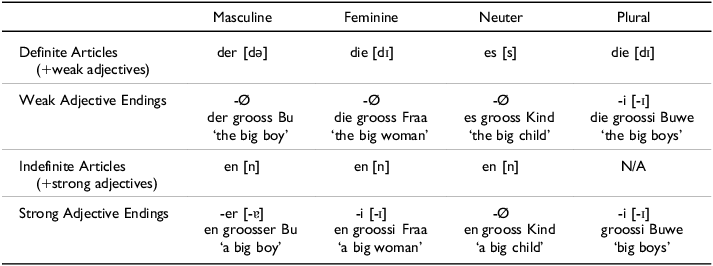


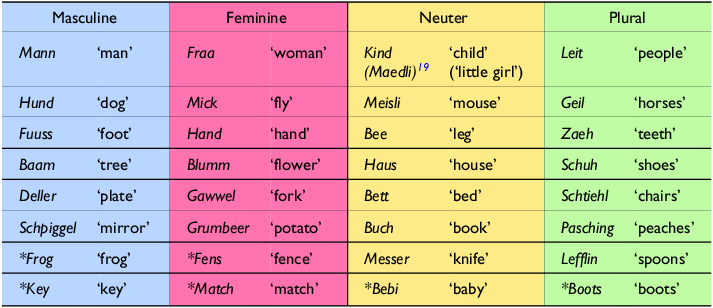




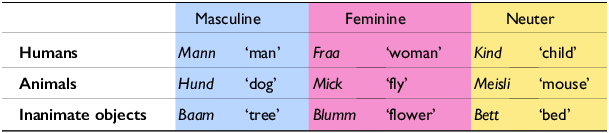

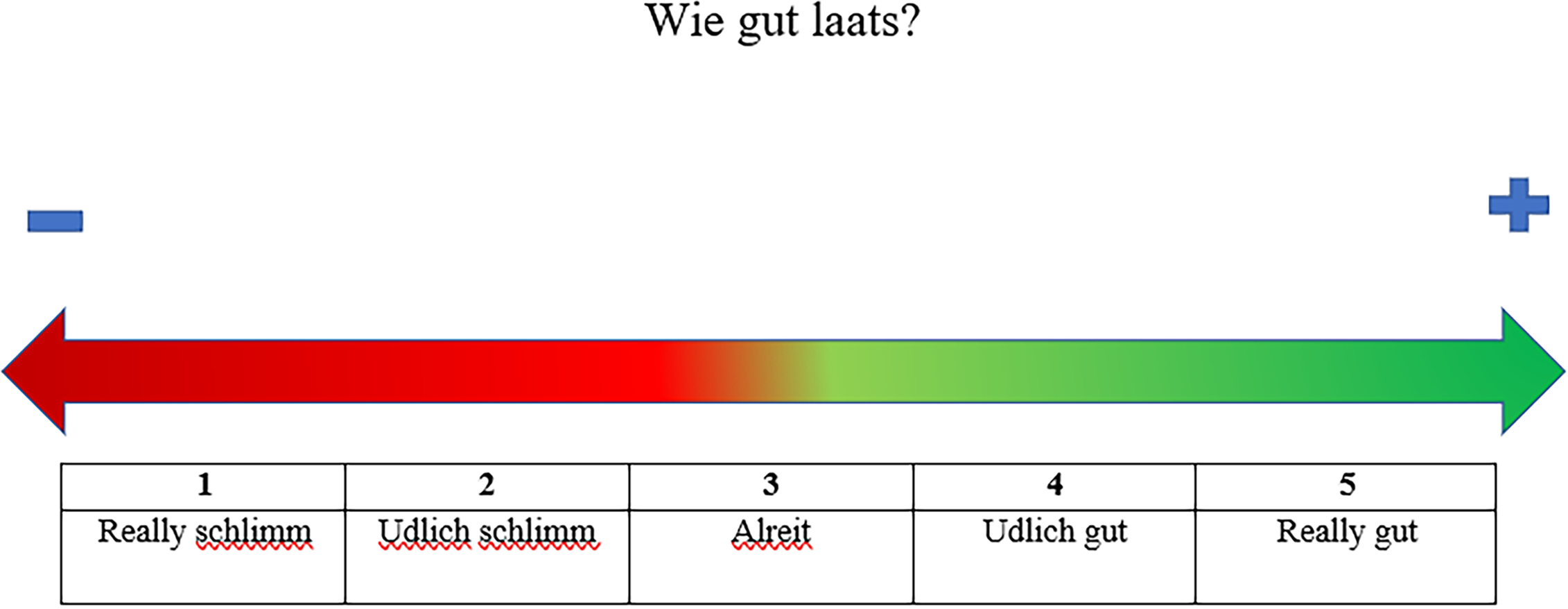


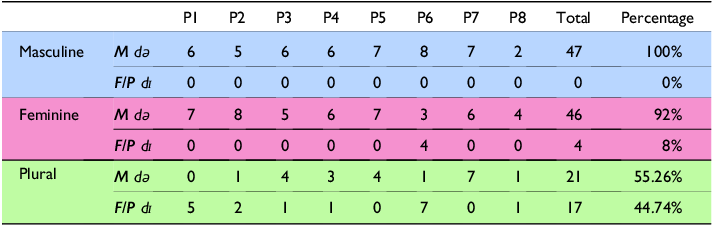
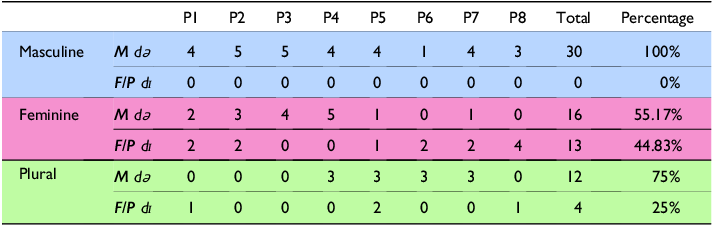


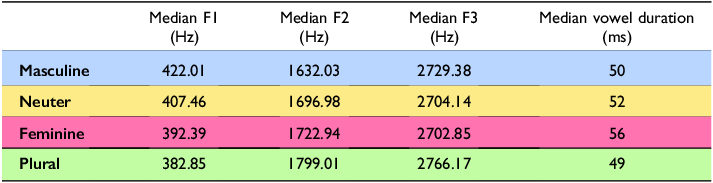
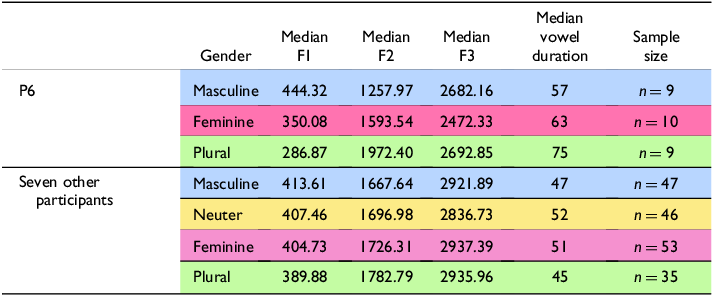
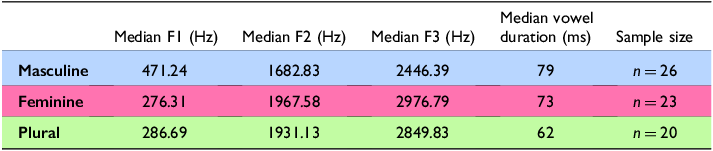


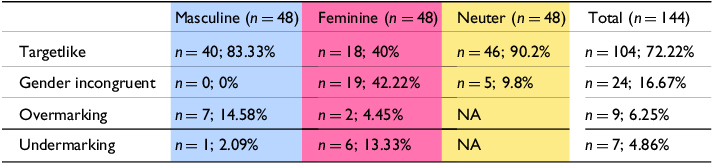


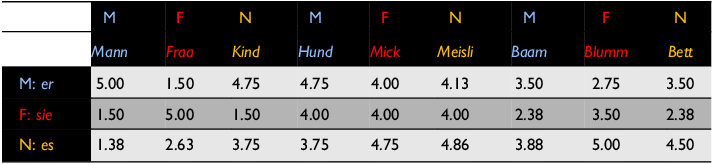

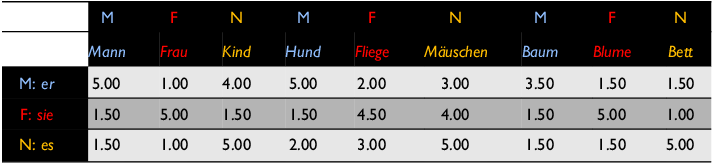

 Open access

