Introduction
Advances in perennial ryegrass (Lolium perenne L.) plant breeding have brought about improvements in its agronomic characteristics (Wilkins and Humphreys, Reference Wilkins and Humphreys2003; Sampoux et al., Reference Sampoux, Baudouin, Bayle, Béguier, Bourdon, Chosson, Deneufbourg, Galbrun, Ghesquière, Noël, Pietraszek, Tharel and Viguié2011; Wilkins and Lovatt, Reference Wilkins and Lovatt2011) in terms of meeting the requirements of ruminant livestock for high-forage quality and herbage yield. Perennial ryegrass is the main component of grassland swards, particularly on dairy and other livestock farms in North-Western Europe and other temperate regions, and it is often sown in mixtures with legumes such as white clover (Trifolium repens L.) (Egan et al., Reference Egan, Galvin and Hennessy2018). Commercially available cultivars of perennial ryegrass provide livestock farmers with different functional traits, such as yield potential, ploidy, phenology or growth form, to meet different requirements and conditions (BSA, 2016; Pérez-Harguindeguy et al., Reference Pérez-Harguindeguy, Díaz, Garnier, Lavorel, Poorter, Jaurequiberry, Bret-Harte, Cornwell, Craine, Gurvich, Urcelay, Veneklaas, Reich, Poorter, Wright, Ray, Enrico, Pausas, de Vos, Buchmann, Funes, Quétier, Hodgson, Thompson, Morgan, ter Steege, van der Heijden, Sack, Blonder, Poschlod, Varietti, Conti, Stavem, Aquino and Cornelissen2016). Before release, these cultivars are tested in field trials against standard reference cultivars, predominantly for their yield and persistence in pure stands fertilized with nitrogen. Data from these evaluations provide the basis for nationally recommended lists of varieties (Sampoux et al., Reference Sampoux, Baudouin, Bayle, Béguier, Bourdon, Chosson, Deneufbourg, Galbrun, Ghesquière, Noël, Pietraszek, Tharel and Viguié2011; Roche et al., Reference Roche, Berry, Bryant, Burke, Butler, Dillon, Donaghy, Horan, Macdonald and Macmillan2017). Results on the performance of single cultivars, however, do not provide information on their performance in mixtures. It was reported recently that maximizing the functional-trait diversity of perennial ryegrass cultivar mixtures, rather than cultivar richness itself, promoted biomass production (Lowry et al., Reference Lowry, Bosworth, Goslee, Kersbergen, Pollnac, Skinner, Warren and Smith2020). Designers of herbage seed mixtures are now starting to combine cultivars in ways that increase functional trait diversity. The consequences of functional traits of perennial ryegrass grown in mixtures with white clover, in terms of botanical composition and herbage yield, have been reported in several studies. For instance, Fothergill and Davies (Reference Fothergill and Davies1993) found that very early perennial ryegrass was a beneficial companion grass for white clover. A lower tiller density in perennial ryegrass is known to reduce its competitive ability thereby enabling the development of a greater proportion of clover in the sward (Frame and Boyd, Reference Frame and Boyd1986). Upright cultivars of perennial ryegrass also allow for increased proportions of clover (Elgersma and Schlepers, Reference Elgersma and Schlepers1997). Consequently, differences in phenology or growth form of cultivars can affect the total herbage yield of swards by modifications of the botanical composition in mixtures. Similarly, grass-cultivar functional traits may also affect the feed value, including the protein content, of the harvested biomass indirectly, by modifying the sward clover content. Beneficial outcomes for livestock farmers from perennial ryegrass cultivars with specific functional traits when grown in mixtures will only be realized when there are detectable improvements, either directly or indirectly via changes in the botanical composition. Until now, however, little consideration has been given to the question of whether cultivars of perennial ryegrass that represent particular functional traits affect the forage quality itself. Moreover, it is also unclear whether these effects change when these cultivars are grown in mixtures with clover and/or with other non-legume forbs. A potentially greater role for forbs in grassland swards, especially swards managed with lower nutrient inputs, has been proposed as an adaptation to some of the impacts associated with climate change (Carlsson et al., Reference Carlsson, Merten, Kayser, Isselstein and Wrage-Mönnig2017).
Under conditions with low external inputs, grassland swards are mainly based on mixtures of species from several functional groups (Wachendorf and Taube, Reference Wachendorf and Taube2001; Peyraud et al., Reference Peyraud, Le Gall and Lüscher2009). Therefore, a higher number of dicotyledonous species (legume and non-legume forbs) are often found (Trott et al., Reference Trott, Wachendorf, Ingwersen and Taube2004; Smidt and Brimer, Reference Smidt and Brimer2005; Van Dobben et al., Reference Van Dobben, Quik, Wiger Warnelink and Lantinga2019). However, as in high-input grassland, low-input grassland for dairy cattle should provide forage that is of high and constant quality throughout the growing season (Wilkinson et al., Reference Wilkinson, Lee, Rivero and Chamberlain2019). Productivity and stability are improved in swards containing grasses, legumes and non-leguminous forbs (reviewed by Sanderson et al., Reference Sanderson, Skinner, Barker, Edwards, Tracy and Wedin2004). Several authors have reported that swards with forb shares of between 40 and 62% have provided high levels of herbage yield, livestock performance or weed suppression (Soder et al., Reference Soder, Sanderson, Stack and Muller2006; Assaf and Isselstein, Reference Assaf and Isselstein2009; Pembleton et al., Reference Pembleton, Hills, Freeman, McLaren, French and Rawnsley2016; Cong et al., Reference Cong, Suter, Lüscher and Eriksen2018; Ineichen et al., Reference Ineichen, Marquardt, Wettstein, Kreuzer and Reidy2019). Many species of forbs contain high pectin contents within their cell walls and have long been known to increase mineral contents and affect the properties that influence voluntary intake (Foster, Reference Foster1988; Derrick et al., Reference Derrick, Moseley and Wilman1993; Bruinenberg et al., Reference Bruinenberg, Valk, Korevaar and Struik2002). However, increasing the amount of forbs in mixtures leads to a similar reduction in the grass content. Thus, within mixture swards, the influence of a single grass species or cultivar has less effect on the overall quality of the harvested biomass than in pure grass swards (Sanderson, Reference Sanderson2010a).
Therefore, the objective of the current paper was to determine any effects of the cultivars' functional traits on forage quality in different crop stands. We hypothesized that (i) phenology and growth form of perennial ryegrass affect forage quality in pure stands, (ii) phenology affects forage quality in mixtures indirectly as a consequence of the botanical composition, (iii) growth form has no direct effect on forage quality and (iv) mixtures have positive effects on forage quality irrespective of grass functional trait.
Materials and methods
Experimental site and weather conditions
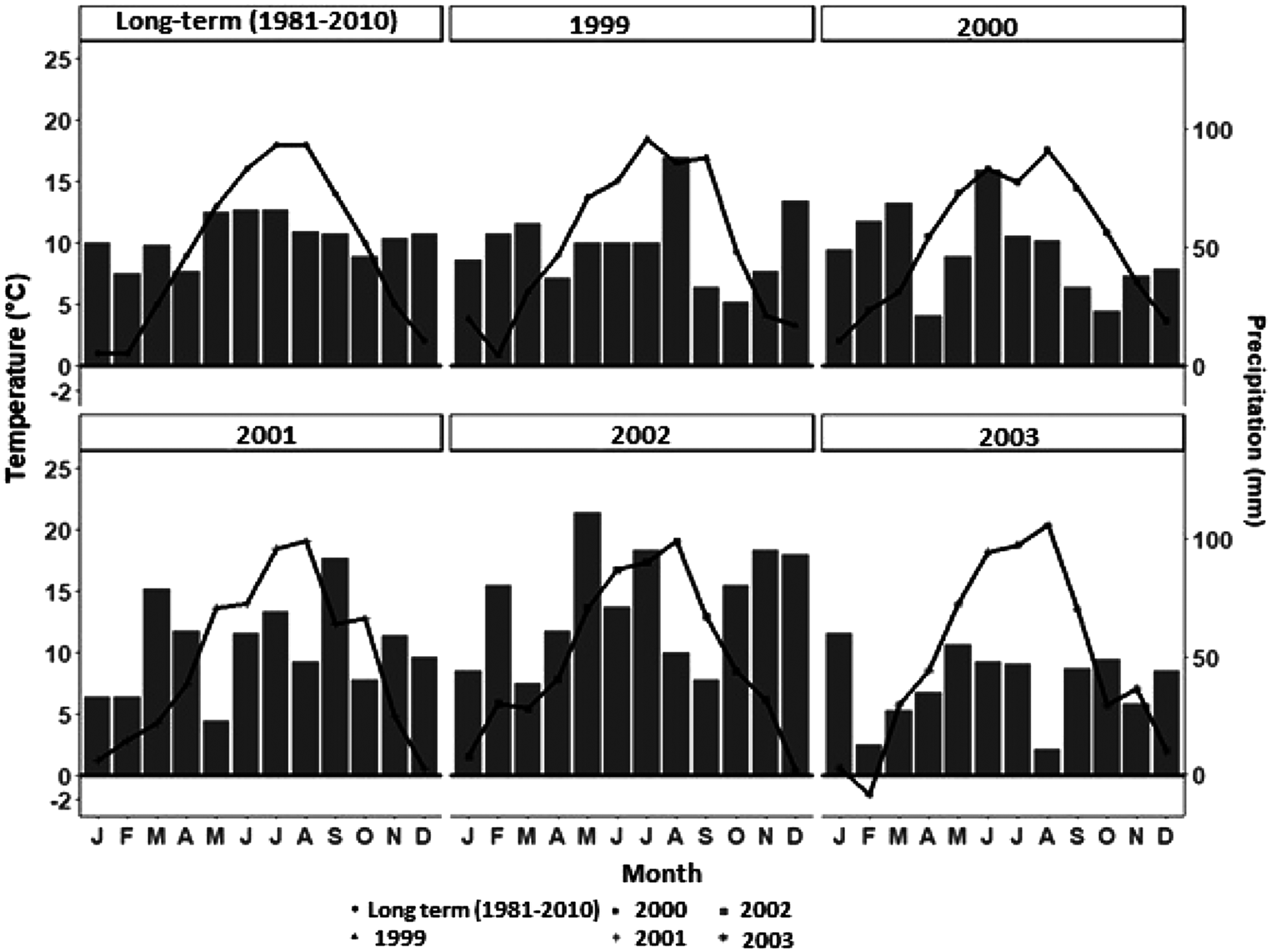
A field experiment was conducted at the research farm ‘Reinshof’ (51.50°N, 9.93°E; elevation: 150 m above sea level) near Göttingen, Germany over five consecutive full harvest years from 1999 to 2003. The experimental site is characterized by an average air temperature of 9.3°C and an annual precipitation sum of 648 mm. The soil is a Haplic Luvisol with a silty-clay texture containing 73% silt, 15% clay, 23% sand, 0.1% total nitrogen and 1.0% organic carbon, in the upper 30 cm soil depth. The C/N ratio and pH (CaCl2) are 10 and 5.9, respectively. The weather conditions during the experimental years are presented in Fig. 1. Compared with the long-term average, annual temperatures were mostly higher than average (except in 2001) with the highest temperature during 2000. With the exception of 2002, the annual precipitation sum was lower compared with the long-term average, with up to 28% less precipitation during 2003.
Monthly average air temperatures (°C) and monthly precipitation sum (mm) compared with long-term (LT, 1981–2010) weather data collected by the German weather service near the field-site (51.50°N and 9.95°E).

Experimental design and treatments
For the purpose of the study, four diploid cultivars of perennial ryegrass were selected to provide a factorial combination of functional traits, i.e. phenology (early and late) and growth form (upright and prostrate) (Pérez-Harguindeguy et al., Reference Pérez-Harguindeguy, Díaz, Garnier, Lavorel, Poorter, Jaurequiberry, Bret-Harte, Cornwell, Craine, Gurvich, Urcelay, Veneklaas, Reich, Poorter, Wright, Ray, Enrico, Pausas, de Vos, Buchmann, Funes, Quétier, Hodgson, Thompson, Morgan, ter Steege, van der Heijden, Sack, Blonder, Poschlod, Varietti, Conti, Stavem, Aquino and Cornelissen2016). The chosen cultivars were cv. Sambin (early upright), cv. Bardonna (early prostrate), cv. Hercules (late upright) and cv. Kerdion (late prostrate). These represented the full range of variability of the varieties available in Germany at that time. Additional agronomic traits (e.g. persistence, sward density, disease resistance and yield potential) were similar among each other and close to the average of the range of available varieties. Each cultivar was sown either as (i) a binary mixture with white clover (T. repens L.) in proportions of 75 : 25% grass : legume, respectively, or (ii) as four-species mixtures containing perennial ryegrass, white clover, ribwort plantain (Plantago lanceolata L.) and dandelion (Taraxacum officinale L.) in proportions of 40 : 20 : 20 : 20%, respectively. The proportions were based on the sowing density of 2000 germinable seeds/m2. In addition, the perennial ryegrass cultivars were grown in pure-sown stands and fertilized with 200 kg N/ha, as calcium–ammonium–nitrate, top dressed in equal proportions prior to each growth cycle. In the following, the abbreviations G, GC and GCF refer to pure grass, grass-clover and grass–clover–forbs mixtures, respectively. Levels of soil phosphorus and potassium were considered to be good based on soil sampling and therefore no applications of these nutrients were made during the experimental period. The extractable (calcium acetate lactate) soil nutrient concentrations at the end of the experiment were 90 mg/kg phosphorus and 130 mg/kg potassium. Sowing of the crop stands was conducted during August of the preceding year before the onset of the experiment. Treatment plots were arranged in a randomized block design with four replications. This resulted in a total of 48 plots (22.5 m2 size) representing the experimental units (three sward types × four perennial ryegrass cultivars × four replicates).
Sampling of forage biomass, quality and botanical composition
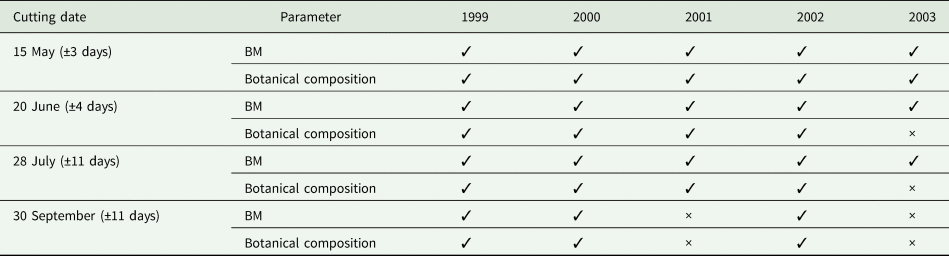
Each plot was harvested three or four times annually for 5 years at 5 cm stubble height (Table 1) using a Wintersteiger forage harvester (model HD 1500; Wintersteiger Ried im Innkreis, Austria) equipped with an automatic weighing device for biomass fresh matter (FM) determination. To avoid plot-edge effects only the centre 1.15 m plot width was cut and the unharvested forage from the borders was mown and removed afterwards to ensure even regrowth. Consequently, each plot was harvested repeatedly during the experimental period. Mean harvest dates for cut 1 to cut 4 were: 15 May (±3 days), 20 June (±4 days), 28 July (±11 days) and 30 September (±11 days). At each harvest date, a bulked random subsample of approximately 500 g FM was collected to quantify the botanical composition by means of manual separation into the sown species, i.e. perennial ryegrass for G; perennial ryegrass and clover for GC; and additionally dandelion and plantain for GCF. Any non-sown species present in the samples were denoted as unsown species and forbs were bulked. Thereafter the dry matter (DM) content of each functional group was determined after drying to constant weight in a forced air-oven (ULM, 800, Memmert GmbH und Co KG, Schwabach, Germany) at 105°C. Prior to manual separation, a bulked subsample of the total FM at harvest was dried separately (60°C, 48 h) and milled to pass a 1-mm screen (Retsch) to determine the forage quality using near-infrared reflection spectroscopy with a NIR systems 6500 scanning monochromator (Foss, Silver Spring, Maryland, USA) by double scanning each sample. The spectra files were processed and predicted with the grass and forage calibration on the SaBiNA server covering a large calibration data set (Tillmann, Reference Tillmann2010). In the current study, results for contents of crude protein (CP, g/kg DM), ash-free acid detergent fibre in the organic mass (ADF, g/kg DM) and metabolizable energy (MJ ME/kg DM) are reported. The energy content was calculated according to Losand et al. (Reference Losand, Pries, Menke, Tholen, Gruber, Hertwig, Jilg, Kluth, Spiekers, Steingaß and Südekum2007) which takes the gas formation, crude ash, CP, crude lipids and ADF into account. For crude ash, default values from the feed-value tables of the German Agricultural Society were applied with 78 and 84 g/kg DM for G and the mixtures, respectively (DLG, 1997). Correction for crude ash within the energy calculation system is provided to account for soil contamination at harvest. Samples were harvested clean and, therefore, little variation of energy as consequence of crude ash was expected (e.g. Cherney et al., Reference Cherney, Ketterings and Cherney2016). The within-year variation of the CP, ADF and ME contents was evaluated by the coefficient of variation calculated within years, i.e. the quotient of the standard deviation and the mean. The variables are each denoted CVCP, CVADF and CVME. The nitrogen nutrition index (NNI) was calculated to check whether the experimental conditions were consistent with that of low-input grassland. For samples exceeding a DM yield of 1 t DM/ha, the NNI was calculated as the quotient between the actual N content (Nact = CP/6.25) and the critical N content (Ncrit) reported by Duru et al. (Reference Duru, Lemaire, Cruz and Lemaire1997). Based on the assumptions for Ncrit, we applied one function for all crop stands in accordance with Duru (Reference Duru1994).
Dates of data sampling in each cut of the experimental years

The BM refers to biomass and quality sampling. Botanical composition refers to the determination of the botanical composition by manual separation. ✓: sampling conducted; ×: no sampling.
Statistical analysis
Several statistical models were generated to analyse each target variable using R version 3.5.1 (R Core Team, 2018) with linear-mixed effects models in the package nlme (Pinheiro et al., Reference Pinheiro, Bates, DebRoy and Sarkar2015). To account for varying cutting dates between years, a pseudofactor of cut × year was created to prevent single-year analysis. The botanical composition of the mixture crop stands was analysed for clover shares and forb shares separately for each mixture. The shares of clover and forbs were logit-bounded between 0 and 1. The models included the fixed factors cut × year, phenology, crop stand and growth form. The block was modelled as a random effect and the experimental plot (combination of phenology × growth form × crop stand × block) was nested within block to account for repeated measurements on the same plot throughout the study. To analyse forage quality (CP, ADF and ME), linear mixed-effects models were generated where the cut × year, growth form, phenology and crop stand as well as their interactions were modelled as fixed factors. The block was modelled as a random effect and the experimental plot was nested within block to account for repeated measurements on the same plot throughout the study. Several global models were generated before analysis for each target variable and every single model performance with varying variance corrections was evaluated by the second order Akaike information criterion (AICc accounting for small sample sizes) before a step-wise model reduction was performed from the best global model using the MuMIn package (Barton, Reference Barton2018). For this purpose, all models were ranked and chosen for analysis of variance nested in the global model according to the AICc. For each target variable, the model with the lowest AICc was chosen as the final model. Normality of the residuals was checked by visual inspection of quantile–quantile plots. Variance homogeneity was evaluated by Bartlett's test and plots of residuals v. fitted values and residuals v. predictor values (Zuur et al., Reference Zuur, Leno, Walker, Saveliev and Smith2009). The variances of the CP and ME contents were adjusted for by crop stand and phenology, whereas the variance of ADF was adjusted for by phenology. The CP and ME contents were log- and ADF contents square-root transformed before analysis. The CVCP, CVADF and CVME were analysed using linear-mixed-effects models where the year, phenology, growth form and mixture as well as their interactions were modelled as fixed effects and the block and plot nested in block was modelled as a random effect without any data transformation or variance correction. For the CVCP, CVADF and CVME only significant interactions with the crop stand will be considered to determine differences between mixtures and pure stands. Analysis of variance was followed by Tukey's test using the emmeans package (Bretz et al., Reference Bretz, Hothorn and Westfall2011; Lenth et al., Reference Lenth, Singmann, Love, Buerkner and Herve2019) to compare the different levels of the influencing factors. In instances where a factor of interest had no significant interaction with the remaining factors, the levels of these remaining factors were pooled. Additionally, Pearson's correlation coefficients were calculated between the share of each functional group (clover, forbs and grass) within the mixtures and each CP, ADF and ME separated for cuts. In addition, Pearson's correlations between each functional group (grass, clover, forbs and unsown) within the mixture crop stands were determined to estimate competition. All transformed values were back-transformed for reporting.
Results
Botanical composition
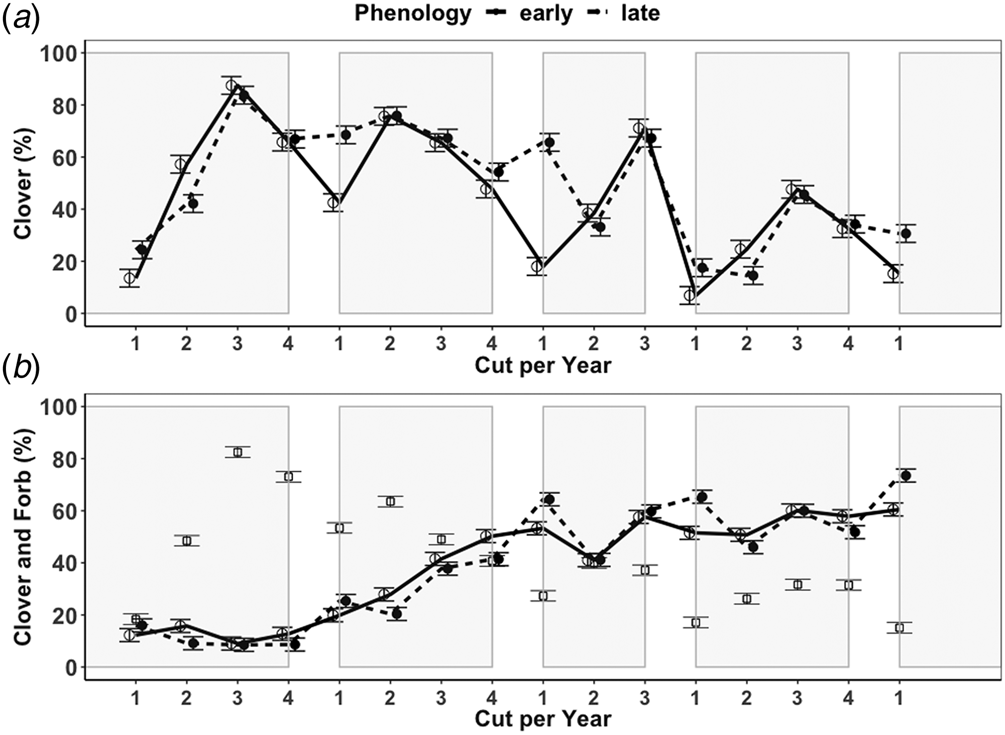
Except for the first cut in 1999, where unsown weeds contributed 12, 21 and 18% in G, GC and GCF, respectively, there was little competition from unsown species throughout the study period. The G crop stand consisted, on average, of 95% grass (not shown). Generally, dicots within the mixtures had greater importance during summer. The interaction between phenology × cut × year (P ⩽ 0.001) was significant also and was explained by greater clover shares in cut 1 when late instead of early grass cultivars were grown (except in 2002). However, in cut 2 of 1999 the opposite was found (early > late) (Fig. 2(a)). The clover share within GC was significantly affected by growth form (P ⩽ 0.05) and growing prostrate grass cultivars resulted in significantly greater clover shares compared with using upright cultivars (51 v. 43%). Within GCF, the clover share was affected by cut × year (P ⩽ 0.001) with mostly greater amounts of clover later in the season and during the initial 2 years of the study (Fig. 2(b)). A strong increase of non-leguminous forbs was observed in GCF from 2000 onwards with grass contributing not more than 30% to the total biomass. The forbs consisted mainly of plantain (on average 84% of the forbs). The interaction of phenology × cut × year was also significant (P ⩽ 0.001). From 2001 onwards, growing late grass cultivars allowed greater forb shares than with early cultivars at cut 1. Growing early cultivars allowed more forbs in the last cut of 2000 (Fig. 2(b)). Growth form affected the forb share with prostrate cultivars resulting in greater shares than upright cultivars (42 v. 37%).
Proportion of dicot species within the mixtures: (a) refers to clover in GC and (b) to forbs (circles) and clover (rectangle) in GCF. The clover share in GCF was not affected by the grass phenology. Open circles show early cultivar treatments, closed circles late cultivar treatments. The difference to 100% consisted of grass. Presented are estimated means and bars show standard error of the mean. No separation was done on cut 4 in 2001 or cut 2 to cut 4 in 2003. 1: first cut, 15 May (±3 days); 2: second cut, 20 June (±4 days); 3: 28 July (±11 days); 4: fourth cut, 30 September (±11 days); GC: mixture of grass and white clover; GCF: mixture of grass, white clover, dandelion and plantain. Shaded areas indicate years 1999 to 2003.

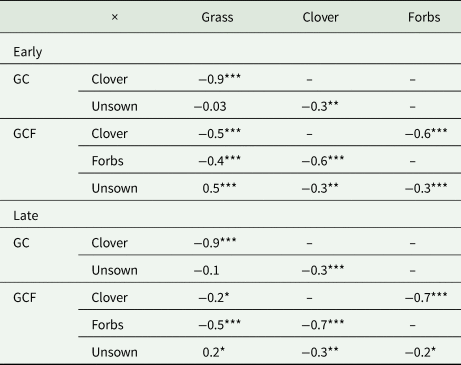
All functional groups within the mixtures were significantly negatively correlated and were therefore antagonistically related (Table 2). Exceptions were observed only in GCF where the relationship between grass and unsown species was positive and in GC where unsown species and grass did not correlate. The negative correlation between forbs and clover was greater than between forbs and grass in GCF.
Pearson's correlation coefficients between the share of grass, clover and forbs within the mixture crop stands GC and GCF separated for early and late phenology of the grass cultivars
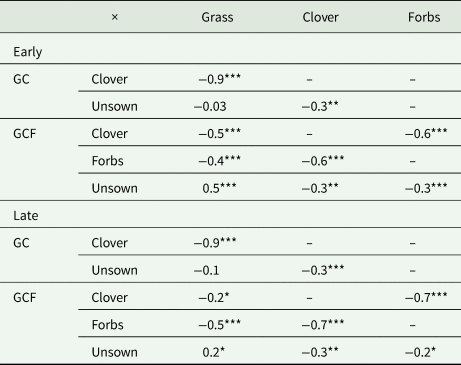
* Indicates P < 0.05, **P < 0.01, ***P < 0.001. – indicates no correlation. GC refers to the mixture of grass and white clover; GCF refers to the mixture of grass, white clover, dandelion and plantain.
Effect of phenology of Lolium perenne on forage quality
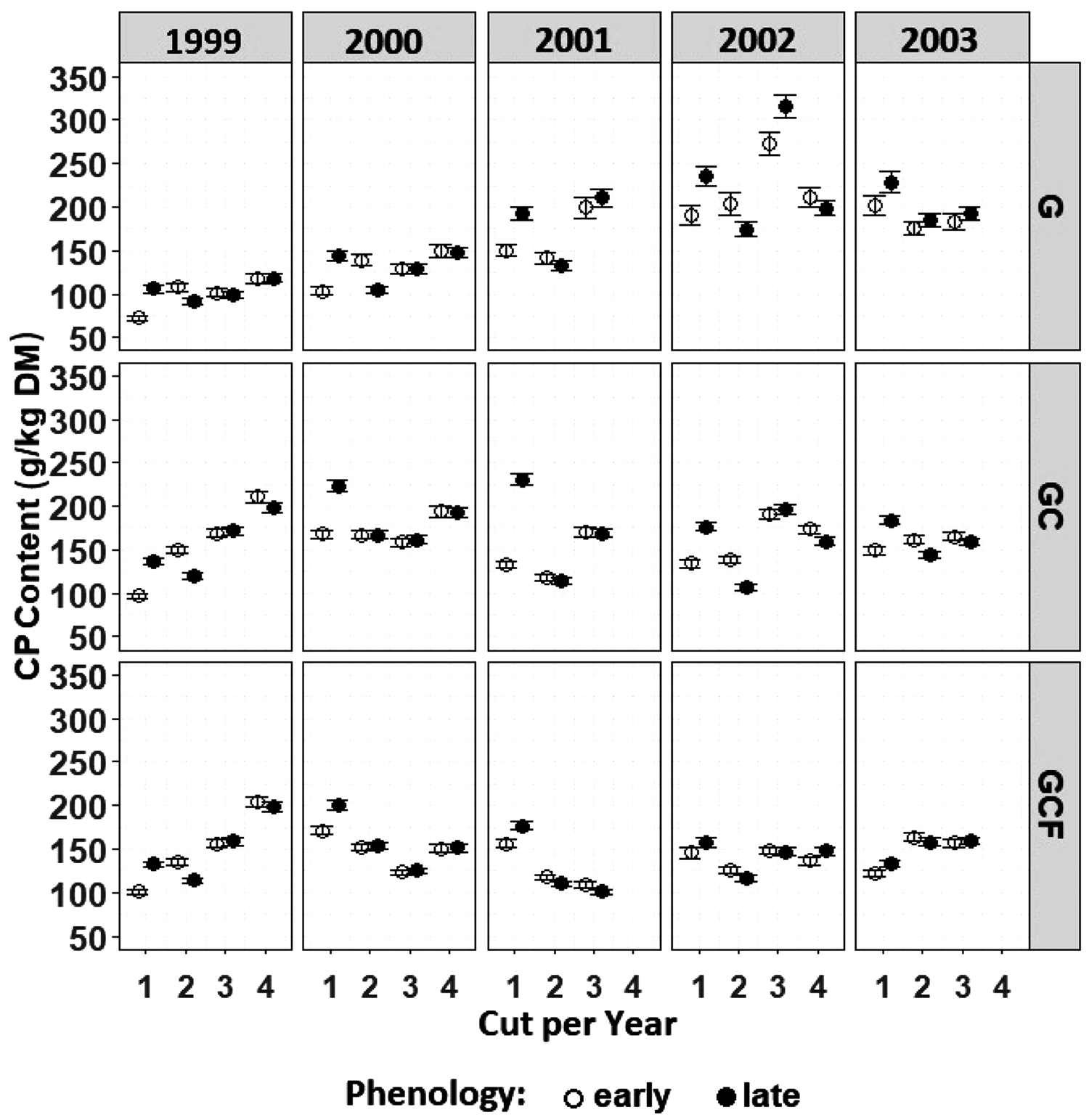
The CP content was significantly affected by the interaction of cut × year × crop stand × phenology (P ⩽ 0.001) (Table S1). This interaction is explained by CP contents of the late cultivars, which were nearly always higher than early cultivars in cut 1 (Fig. 3). In contrast, there were lower CP contents for late than the respective early cultivars during cut 2. The differences between phenology in the second cut were less pronounced in the mixtures (Fig. 3). Whereas during the first 2 years of the study, the mixtures mainly contained more CP, the pattern changed thereafter with G having greater CP contents as GCF and GC ranged in between them. No clear differences between the mixtures were found. If any, GC had greater CP contents than GCF.
CP contents as affected by cutting date within year, phenology of grass cultivar and crop stand. Presented are estimated means ± standard error of the mean. Open circles show early phenology and solid circles late phenology. CP: crude protein, G: grass pure stands, GC: mixture of grass and white clover; GCF: mixture of grass, white clover, dandelion and plantain; 1: first cut, 15 May (±3 days); 2: second cut, 20 June (±4 days); 3: third cut, 28 July (±11 days); 4, fourth cut, 30 September (±11 days).

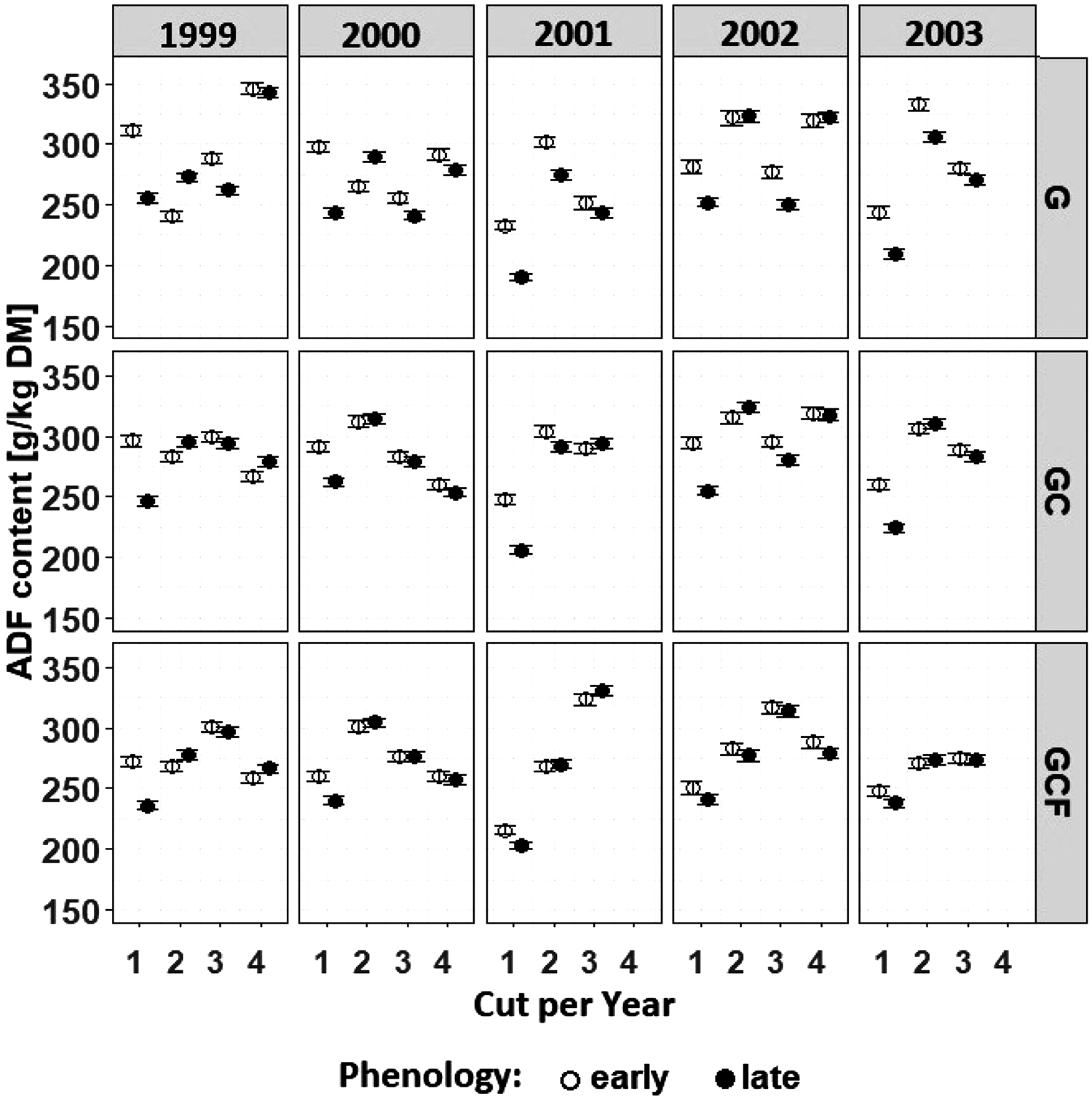
A significant interaction of cut × year × crop stand × phenology (P ⩽ 0.001) was found for the ADF contents (Table S1). Phenology was important for G, with early cultivars mostly having more ADF than late cultivars. The early cultivars grown in G also had more ADF than late cultivars in cut 3, and also in cut 2 of 2001 and 2003, respectively. In contrast, late cultivars in G and GC had consistently more ADF than early cultivars in cut 2 of 1999, in cut 2 of 2000 (G) and cut 4 of 1999 (GC) (Fig. 4). Within the mixtures, phenology was less important for cuts taken later in the year, and particularly in GCF. At the first harvest, early cultivars had greater ADF contents than late cultivars grown in G and GC, whereas in GCF this difference was not significant from 2002 onwards. The differences between mixtures and G depended on the phenology and the season. Mixtures had clearly more ADF than G in cut 3, whereas G had clearly more ADF in cut 4 during the first 2 years (Fig. 4).
ADF contents as affected by cutting date within year, phenology of grass cultivar and crop stand. Presented are estimated means ± standard error of the mean. Open circles show early phenology and solid circles late phenology. ADF: acid detergent fibre, G: grass pure stands, GC: mixture of grass and white clover; GCF: mixture of grass, white clover, dandelion and plantain; 1: first cut, 15 May (±3 days); 2: second cut, 20 June (±4 days); 3: third cut, 28 July (±11 days); 4, fourth cut, 30 September (±11 days).

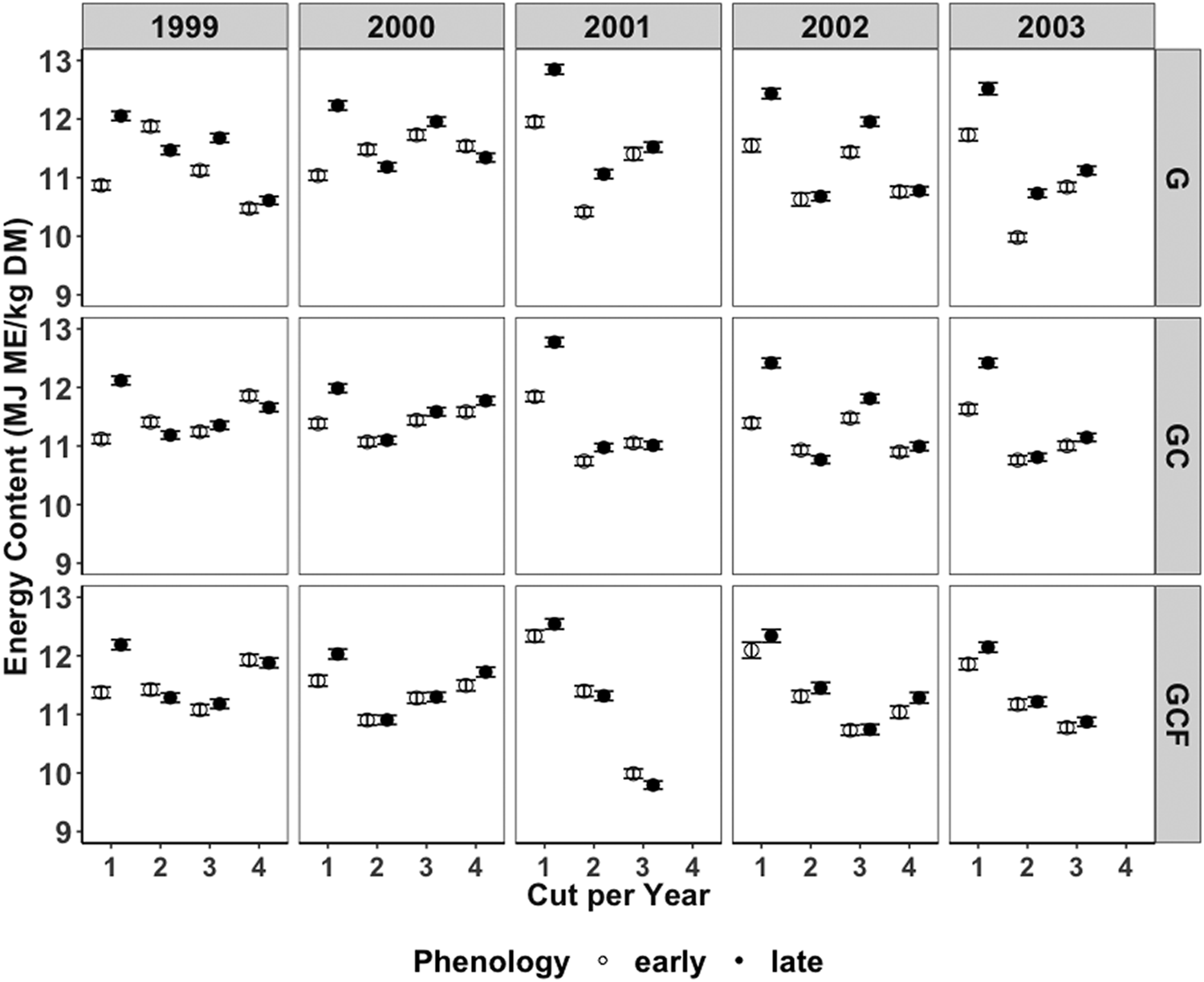
The ME values were inversely related to ADF contents and they were significantly affected by the interaction of cut × year × crop stand × phenology (P ⩽ 0.001). Energy contents were greater in late cultivars in cut 1 throughout the crop stands. However, in GCF the difference was not significant during 2001 and 2002. In addition, G with late cultivars had greater energy contents in the third cut of 1999, 2002 and 2003, whereas this was found for GC only in 2002. The phenology effect in cut 2 differed between years. In 1999 (G and GC) and 2000 (only G) the early cultivar had greater energy contents than late cultivar crop stands, whereas in 2001 (G and GC) and 2003 (only G) the opposite was found (Fig. 5). A clear difference between crop stands was found: in cut 3 the energy contents were mostly greater for G, whereas in cut 4 the mixtures mostly had more energy than G.
Metabolizable energy contents as affected by cutting date within year, phenology of grass cultivar and crop stand. Presented are estimated means ± standard error of the mean. Open circles show early phenology and solid circles late phenology. ME: metabolizable energy, G: grass pure stands, GC: mixture of grass and white clover; GCF: mixture of grass, white clover, dandelion and plantain; 1: first cut, 15 May (±3 days); 2: second cut, 20 June (±4 days); 3: third cut, 28 July (±11 days); 4, fourth cut, 30 September (±11 days).

Effect of growth form of Lolium perenne on forage quality
For CP a significant interaction of growth form × crop stand (P ⩽ 0.05) was found. However, prostrate growth forms always had significantly more CP than upright treatments irrespective of crop stand (average: 157 v. 146 g/kg DM). The interaction between growth form × cut × year was also significant (P ⩽ 0.001) and prostrate forms mostly had greater CP contents than upright treatments and never the other way round. There was a significant interaction between growth form × crop stand × phenology for ADF contents (P ⩽ 0.05). Within the crop stands with early cultivars, treatments with upright growth forms always had significantly more ADF than the respective prostrate treatments irrespective of crop stand (on average: 275 v. 289 g/kg DM), whereas within late cultivars the growth form had no effect (on average: 271 g/kg DM). The effect of growth form for ME was significant in an interaction with phenology and cut × year (P ⩽ 0.001). Within the early treatments, on most cutting dates the prostrate growth forms had greater energy contents than the respective upright treatments (on average: 11.4 v. 11.1 MJ ME/kg DM) whereas within the late phenology group the growth forms did not differ except on cut 2 in 1999 where the upright treatments had greater energy contents than the prostrate treatments (11.2 v. 11.4 MJ ME/kg DM).
Variation of forage quality within years
For CVCP, CVADF and CVME, significant interactions with crop stand were found. For CVCP the interaction between crop stand × year was significant (P ⩽ 0.001). In 1999 and 2001, G (0.19) had clearly lower CVCP than the mixtures (average 0.27), whereas in 2002 GCF (0.12) had the lowest CVCP (0.23 on average in G and GC). For CVADF the interactions of crop stand × phenology (P ⩽ 0.001) and crop stand × year (P ⩽ 0.001) were significant. Within the early cultivars the order increased from GC < GCF < G (0.07 < 0.1 < 0.12), whereas for late cultivars G had a greater CVADF than both mixtures (0.14 v. 0.13). The development over the years resulted in higher CVADF of G (0.15) compared with the mixtures in 1999 (average: 0.08), 2002 (0.11 v. 0.09) and 2003 (0.15 v. 0.09), whereas in 2001 GCF (0.22) had the greatest CVADF compared with G (0.17) and GC (0.08). The interaction between year × crop stand × phenology (P ⩽ 0.01) was significant for CVME. In 1999 and 2003 for early cultivars, G had a higher CVME than the mixtures (on average: 0.07 v. 0.04), whereas in 2001 GCF had the greatest CVME (0.1 v. 0.07). In the late cultivars, G had greater CVME than the mixtures in cut 1 (0.06 v. 0.04). The mixture GCF had a higher CVME than G and GC in 2001 (0.12 v. 0.9), whereas in 2002 and 2003 the CVME of G and GC were greater than of GCF (0.07 v. 0.06).
Botanical composition and forage quality
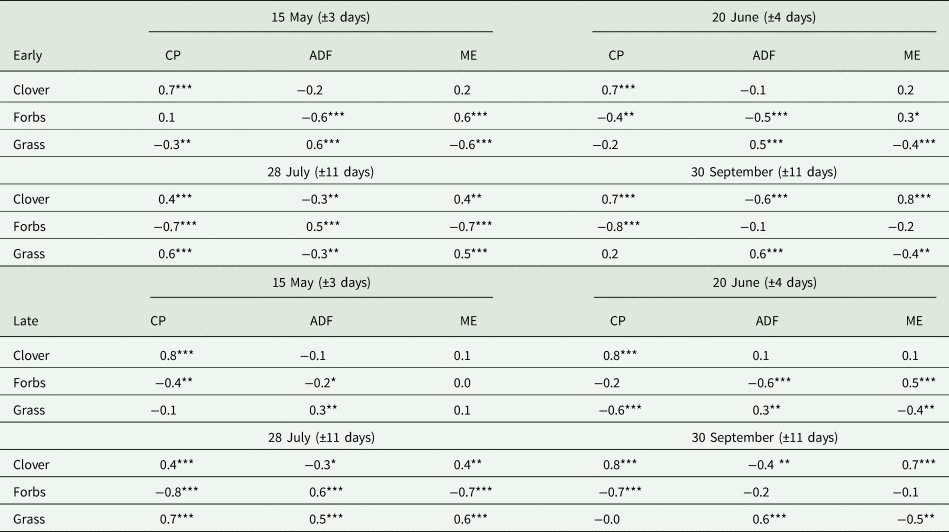
The share of functional groups within the mixture crop stands correlated with forage quality parameters (Table 3). Correlations between clover and CP were always positive and significant whereas there was never a positive correlation between forbs and CP. Forbs had a significantly negative correlation with ADF except in cut 3, where the opposite was found. Grass mostly had a positive correlation with ADF except in cut 3 where the opposite was found. In that cut, grass and CP were positively correlated. The energy contents were negatively correlated with grass but positively with clover in the last cut.
Pearson's correlation coefficients between forage quality parameters and functional groups within the mixture swards GC and GCF separated for each cut and phenology of the grass cultivars

*P < 0.05, **P < 0.01, ***P < 0.001. CP: crude protein, ADF: acid detergent fibre, ME: metabolizable energy contents; GC: mixture of grass and white clover; GCF: mixture of grass, white clover, dandelion and plantain.
The clover share refers to GC and GCF whereas forbs refer to GCF only.
Discussion
Forage productivity and nitrogen status
Mixture swards in the current study received no fertilizer N as their management was intended partly to mimic low-input conditions. Values of NNI <1 were obtained consistently for every crop stand (values not shown). Consequently, the mixtures here may be considered as similar to low-input conditions common for organic agriculture. Hence, the current study represents a comparison of two different farming systems. On the one hand, pure stands fertilized with nitrogen represent conventional farming and the situation for cultivar testing. On the other hand, low-input farming is provided by growing cultivars within mixtures containing legumes and also forbs. Here, cultivars tested under intensive conditions are applied to a completely different environmental force. Hence, the comparison allows assessment of the impact that functional traits of grass cultivars have under low-input conditions.
As indicated by Hofer et al. (Reference Hofer, Suter, Buchmann and Lüscher2017), perennial ryegrass suffers from drought-induced water stress and N limitations. In view of the very dry growing conditions compared with the long-term average, especially during 2000, 2001 and 2003, perennial ryegrass might have suffered more than the sown forbs which can develop a greater rooting-depth and thereby show some drought tolerance (Hofer et al., Reference Hofer, Suter, Haughey, Finn, Buchmann and Lüscher2016). Plantain most likely had a greater rooting depth than perennial ryegrass (Stewart, Reference Stewart1996). The strong competition of forbs (mainly plantain) against grass in GCF may, therefore, have resulted from the combination of water and N limitation. Reduced growth of perennial ryegrass especially during summer was observed by Elgersma and Schlepers (Reference Elgersma and Schlepers1997) and a limited growth is supported by the low NNI and increasing CP contents from 2001 onwards in pure stands. Following Egan et al. (Reference Egan, Lynch and Hennessy2017) swards based on grass–white clover are similar in their production as highly fertilized pure grass swards. Heshmati et al. (Reference Heshmati, Tonn, Isselstein, Höglind, Bakken, Hovstad, Kallioniemi, Riley, Steinshamn and Østrem2016) report that the inclusion of forbs in the mixtures of the current study had no adverse effects when comparisons are made with the binary mixture; moreover, yields were maximized in GCF. This supports a study reported by Assaf and Isselstein (Reference Assaf and Isselstein2009) who demonstrated high yields of mixtures containing up to 40% dandelion under similar climatic conditions and Cong et al. (Reference Cong, Suter, Lüscher and Eriksen2018) for mixtures containing up to 62% plantain in Denmark.
Effect of functional traits of Lolium perenne cultivars
Cultivar and/or species mixtures optimized with respect to functional trait diversity have been discussed recently as being highly important for securing grassland productivity (Mahaut et al., Reference Mahaut, Fort, Violle and Freschet2019; Lowry et al., Reference Lowry, Bosworth, Goslee, Kersbergen, Pollnac, Skinner, Warren and Smith2020). One principal question of the current study was whether cultivars of perennial ryegrass representing important functional traits affect forage quality in (i) pure stands and (ii) in mixtures with white clover or white clover and forbs. Thus, it is necessary to distinguish between the direct effects of the cultivar-specific functional traits and indirect effects that occur via modifications of the botanical composition within mixtures.
The first hypothesis was that the phenology and the growth form of perennial ryegrass cultivars affect forage quality directly in pure stands. There was a strong impact of phenology in the primary growth of G in the form of increased ADF contents and lower energy and protein of early cultivars. The phenology of grass also played a role in summer where ADF was increased in the early compared with late cultivars in the G pure stands and this also had consequences for the ME content. In addition, in view of greater ADF and lower ME contents in treatments with upright growth forms compared with prostrate treatments, the first hypothesis is confirmed. The increase of ADF during the primary growth was mostly steeper for early cultivars because of their greater stem-to-leaf ratios (Buxton, Reference Buxton1996). The decisions made at the farm level to grow specific cultivars are often based on results from official testing trials (Sampoux et al., Reference Sampoux, Baudouin, Bayle, Béguier, Bourdon, Chosson, Deneufbourg, Galbrun, Ghesquière, Noël, Pietraszek, Tharel and Viguié2011; BSA, 2016; Roche et al., Reference Roche, Berry, Bryant, Burke, Butler, Dillon, Donaghy, Horan, Macdonald and Macmillan2017). These trials are frequently conducted with nitrogen fertilizer inputs in amounts similar to those applied to G in the current study. Effects of these cultivar-specific functional traits on forage quality in G consequently represent common cultivar testing situations. In normal farming practice the effects of phenology can be compensated for by adjusting the harvest dates, although mixtures of cultivars that differ in their phenology are often grown within a particular sward (e.g. Suter et al., Reference Suter, Rosenberg, Mosimann and Frick2017; Agricultural Chambers Germany, 2018).
The second hypothesis of the current study was that phenology affects forage quality in mixtures indirectly as a consequence of modified sward botanical composition, because the mixture components buffer the direct grass effects. The dominant phenology effect in the primary growth observed in G was confirmed in the mixtures although the effects in GCF were clearly less pronounced from 2001 onwards (early cultivars in GC always had more ADF in cut 1; in GCF only until 2001). Early cultivars resulted in lower CP and ME contents but higher ADF contents at harvest in the primary growth. Interestingly, the clover share in GC was greater in the primary growth with late cultivars (except for 2002 where no difference was found) and in GCF the forb share was greater in the primary growth with late cultivars from 2001 onwards (Fig. 2). Dandelion and plantain have previously been found to have lower cell wall contents than perennial ryegrass (Derrick et al., Reference Derrick, Moseley and Wilman1993). Grasses typically have higher fibre contents than dicotyledonous species (Elgersma and Søegaard, Reference Elgersma and Søegaard2016). The effect of grass phenology on forage quality in terms of ADF and energy of mixtures in the primary growth was, therefore, a result of the grass share (early > late) and the grass phenology itself. Consequently, our second hypothesis must be rejected. However, a direct grass phenology effect was buffered by the mixture components from 2001 onwards, especially in GCF where the grass shares declined sharply as a consequence of increased content of forbs and clover (Fig. 2(b)). Consequently, forbs buffered ADF and enabled higher energy contents during the primary growth period when grown with early perennial ryegrass cultivars after 3 years of production. To maintain the grass effects in such swards under practical farming conditions is likely to require reseeding after 3 years. In the aftermaths in most cases there were no differences in the shares of clover and forbs as consequence of phenology. Accordingly, in the aftermath there were little or no measurable effects observed on forage quality as a consequence of phenology.
The third hypothesis of the current study was that growth form has no direct effect on forage quality. When no significant interaction between growth form and crop stand was found, the growth form influence was stable irrespective of crop stand. The growth form × crop stand interaction, however, was significant for forage quality indicating that there were differences of the growth form between crop stand levels. Nevertheless, this was not the case as the herbage of prostrate-crop stands always had more CP than that of upright treatments irrespective of crop stand. Growing prostrate cultivars allowed for more forbs and clover within the mixtures. Thus, there was an indirect effect on forage quality provided by a shift towards more dicots within the mixtures; this led to increased CP and reduced the ADF contents (Table 3). Ergon et al. (Reference Ergon, Kirwan, Fystro, Bleken, Collins and Rognli2016b) reported that grass grown in mixtures has more fibre than the same grass grown in pure stands and harvested the same day. Consequently, the presence of forbs might have buffered the grass fibre accumulation. Thus, our third hypothesis is partially confirmed. Evidence for lower cell wall contents of dicotyledonous species, compared with grass, has also been shown in previous studies (Brink et al., Reference Brink, Sanderson and Casler2015; Elgersma and Søegaard, Reference Elgersma and Søegaard2016). However, the growth form had a direct effect on forage quality as indicated by the G crop stands. Interestingly, early upright cultivars had more fibre and less energy than early prostrate cultivars, irrespective of crop stand. This growth-form effect was not significant when late cultivars were grown. Within the mixtures, this effect could be attributed to the botanical composition. Following a literature review by Roche et al. (Reference Roche, Berry, Bryant, Burke, Butler, Dillon, Donaghy, Horan, Macdonald and Macmillan2017), the growth form of grass is considered important, whether grazing (prostrate) or cutting (upright) is conducted. In view of the higher shares of clover and/or forbs when grown with prostrate cultivars, these cultivars could be used preferentially under conditions where such species are favoured. Consequently, the importance of the growth form is important directly for the botanical composition and indirectly for forage quality.
Mixtures achieve high-quality forage
Benefits of mixtures containing high-yielding forage species maximized with respect to evenness of these species within mixtures have been highlighted across several agro-ecological regions (e.g. Kirwan et al., Reference Kirwan, Lüscher, Sebsatià, Finn, Collins, Porqueddu, Helgadóttir, Baadshaug, Brophy, Coran, Dalmannsdóttir, Delgado, Elgersma, Fothergill, Frankow-Lindberg, Golinski, Grieu, Gustavsson, Höglind, Huguenin-Elie, Iliadis, Jørgensen, Kadziuliene, Karyotis, Lunnan, Melengier, Maltoni, Meyer, Nyfeler, Nykanen-Kurki, Parente, Smit, Thumm and Connolly2007; Helgadóttir et al., Reference Helgadóttir, Suter, Gylfadóttir, Kristjánsdóttir and Lüscher2018). In the current study, evenness had a positive influence on CP and ME contents within mixtures (Fig. S1).
Our fourth hypothesis was that mixtures have positive effects on forage quality irrespective of the functional traits of the grass cultivars. Based on the findings of the current study, unfertilized swards containing on average 47% white clover and 50% perennial ryegrass (GC), or on average 42% white clover, 38% forbs and 18% perennial ryegrass (GCF) had good overall forage quality when compared with a perennial ryegrass sward (average share of 95%) fertilized with nitrogen. This contradicts some of the findings on semi-natural grassland (Bruinenberg et al., Reference Bruinenberg, Valk, Korevaar and Struik2002) but supports studies on temporary grassland (e.g. Ergon et al., Reference Ergon, Kirwan, Fystro, Bleken, Collins and Rognli2016b; Grace et al., Reference Grace, Boland, Sheridan, Lott, Brennan, Fritch and Lynch2018) and may be related to the intensity and frequency of the cutting system, which is often limited in semi-natural grassland. In the current study, mixture swards were associated with a positive effect on the forage quality, as hypothesized. However, this pattern depends on the season of the year. The mixtures were mostly better than the pure stand in the last cut whereas during summer they performed worse than the pure stands. Higher stem-to-leaf ratios of plantain herbage harvested during summer and a reduced digestibility was probably responsible for this pattern (Derrick et al., Reference Derrick, Moseley and Wilman1993). The negative influence of forbs on the energy contents in summer is underlined by a negative correlation (Table 3). The CP contents recorded in the current study were at similar levels to values reported by Sanderson (Reference Sanderson2010b) and for both mixtures CP contents were mostly above the critical value of 140 g/kg DM required for high-merit dairy cows (Kalscheur et al., Reference Kalscheur, Vandersall, Erdman, Kohn and Russek-Cohen1999). In the current study, herbage of the fertilized grass often failed to achieve this range during the initial years (Fig. 3). As in the case of high-input grassland, low-input grassland needs to provide forage that is of high and constant quality throughout the season, particularly when required for dairy cattle (Wilkinson et al., Reference Wilkinson, Lee, Rivero and Chamberlain2019). Thus, a low variability of forage quality is envisaged. The mixtures used in treatments investigated in the current study mostly had lower variability of forage quality than the pure grass crop stands. A lower intra-annual variability of forage quality within binary grass–legume mixtures was also reported previously for studies carried out in northern Europe (Elgersma and Søegaard, Reference Elgersma and Søegaard2016; Ergon et al., Reference Ergon, Kirwan, Fystro, Bleken, Collins and Rognli2016b). According to Soder et al. (Reference Soder, Sanderson, Stack and Muller2006) and Pembleton et al. (Reference Pembleton, Hills, Freeman, McLaren, French and Rawnsley2016), grass–forbs mixtures may also have additional benefits for dairy cows. Biologically active plant metabolites present in plantain affect urinary N excretion of ruminants and thereby potentially reduce the nitrification and N losses on pastures (Judson et al., Reference Judson, Fraser, Peterson and Edwards2018; Pjilman et al., Reference Pjilman, Berger, Lexmond, Bloem, Van Groenigen, Visser, Erisman and Van Eekeren2019; Simon et al., Reference Simon, de Klein, Worth, Rutherford and Dieckow2019).
In production systems based on grass–white clover swards, the clover share of the herbage is generally low in spring and this can result in undesirable seasonal variability in forage quality (Davidson and Robson, Reference Davidson and Robson1986). Studies have found that clover production is lower when grown together with very early ryegrass cultivars (Fothergill and Davies, Reference Fothergill and Davies1993) and with cultivars that develop high sward density (Frame and Boyd, Reference Frame and Boyd1986), or under high N fertilization (Egan et al., Reference Egan, Galvin and Hennessy2018) with negative consequences for dairy cows (Egan et al., Reference Egan, Lynch and Hennessy2017). In contrast to Sanderson and Elwinger (Reference Sanderson and Elwinger1999), in the current study the clover share was promoted with late cultivars as the companion grass. This, however, only applied to the primary growth in spring, where the development of late cultivars was slower. In contrast to the findings of Elgersma and Schlepers (Reference Elgersma and Schlepers1997) prostrate cultivars did not provide greater competition against mixture partners. One reason may be that in the study by Elgersma and Schlepers (Reference Elgersma and Schlepers1997) the upright cultivar was tetraploid, having a lower sward density (Frame and Boyd, Reference Frame and Boyd1986).
Based on a meta-analysis, Dineen et al. (Reference Dineen, Delaby, Gililand and McCarthy2018) concluded that white clover contents of up to 60% are beneficial for dairy milk production. In view of the forage quality found in the current study this can be confirmed. In agronomic terms, mixtures are better adapted than single-species swards, particularly under extreme growing conditions when niche separation compensates for lower resource availability (Hofer et al., Reference Hofer, Suter, Haughey, Finn, Buchmann and Lüscher2016). However, such results are biased by the a-priori selection of high-yielding species grown for the first production years. The current study highlights the forage quality of mixtures consisting of species typical in grassland under management based on low-input but under high utilization intensity. When increasing species diversity from a binary to a four-species mixture, little changes in forage quality resulted despite the reduced grass contents.
In conclusion, phenology affected forage quality in the primary growth, where early cultivars had more fibre and less protein and energy contents. This effect remained throughout the study in the monocultures and binary mixtures, but it was not significant from 2002 onwards in the four-species mixture. Growing prostrate cultivars allowed for greater shares of white clover and forb species in the mixtures. This promoted the protein and energy content and reduced the fibre contents with positive consequences for forage quality. Indirect effects of the sward growth form on forage quality as a consequence of modifications of the sward botanical composition were more important than direct effects on forage quality. Therefore, growth form has a clear indirect impact on forage quality. Consequently, when decisions are made concerning choice of grass cultivars in mixtures, with the aim of attaining high-forage quality and/or yield provided by these cultivars, consideration should also be made about the competitive ability linked to differences in growth form, especially its longer term effects after 3 years of production. However, information about competitive ability in this context is lacking in practice.
Supplementary material
The supplementary material for this article can be found at https://doi.org/10.1017/S0021859620000428.
Acknowledgements
Realization of the presented research was made possible by intensive field work and laboratory analyses conducted by S. Bonorden and B. Hohlmann. We kindly thank C. Wunderow for linguistic revision of the manuscript and Alan Hopkins for linguistic proof-reading. We would also like to thank the anonymous reviewers for their helpful advice.
Financial support
This study was funded by the Federal Office for Agriculture and Food (grant number: 02OE621) which is greatly acknowledged.
Conflict of interest
The authors declare no conflict of interest.
Ethical standards
Not applicable.