Introduction
Mental health issues are the major contributor to life years lost to disability in developed countries such as Australia (Begg et al., Reference Begg, Vos, Barker, Stevenson, Stanley and Lopez2007). Anxiety and mood disorders are by far the most prevalent health problems affecting adults, and measures of general psychological distress are an efficient means of identifying affected individuals in a community context where psychotic illnesses are relatively uncommon (Andrews and Slade, Reference Andrews and Slade2001).
Previous studies have suggested that certain aspects of diet might influence the risk of depression (Payne, Reference Payne2010). Much of this research has focused on the role of B-vitamins (Skarupski et al., Reference Skarupski, Tangney, Li, Ouyang, Evans and Morris2010) and omega-3 fatty acids (Appleton et al., Reference Appleton, Rogers and Ness2010). Vitamins B12 and B6 and folate are thought to reduce the toxic effects of homocysteine on the vasculature of the brain and to interact with S-adenosylmethionine, which, in turn, is involved in the synthesis of monaminergic neurotransmitters (Ford et al., Reference Ford2010). Omega-3 fatty acids are thought to play a role in brain cell membrane function and to influence production of neurotransmitters such as serotonin and dopamine (Riediger et al., Reference Riediger, Othman, Suh and Moghadasian2009). Olive oil consumption is also inversely associated with depressive symptoms (Kyrozis et al., Reference Kyrozis, Psaltopoulou, Stathopoulos, Trichopoulos, Vassilopoulos and Trichopoulou2009).
Increasingly, nutrition research has focused on measures of overall diet rather than specific nutrients (Wirt and Collins, Reference Wirt and Collins2009). This aims to account for correlation or synergy between foods/nutrients and for the fact that people eat a combination of foods. The Mediterranean Diet Score (MDS), which was first proposed by Trichopoulou et al. (Reference Trichopoulou, Costacou, Bamia and Trichopoulos2003), is one such measure. The MDS has been associated with a reduction in total and cardiovascular mortality (Sofi et al., Reference Sofi, Abbate, Gensini and Casini2010), as well as cognitive decline (Feart et al., Reference Feart2009; Scarmeas et al., Reference Scarmeas, Stern, Mayeux, Manly, Schupf and Luchsinger2009) and incidence of cancer and Parkinson's and Alzheimer's diseases (Sofi et al., Reference Sofi, Abbate, Gensini and Casini2010). An alternative approach to defining dietary patterns is to use a data-driven method such as factor analysis, which identifies patterns of correlation between foods.
Food choices have been shown to be associated with depression and stress (Mikolajczyk et al., Reference Mikolajczyk, El Ansari and Maxwell2009), hence the importance of prospective studies in this area. Two recent prospective studies have examined dietary patterns in relation to subsequent mental health. In a Spanish cohort (mean age, 37 years), followed for a median period of 4.4 years, a Mediterranean dietary pattern (MDP), similar to the Trichopoulou score, was associated with reduced risk of depression (Sanchez-Villegas et al., Reference Sanchez-Villegas2009). The study employed a case definition of depression, using self-report of either a clinical diagnosis of depression or the use of antidepressants. In an English cohort, with a mean age of 56 years at baseline, two distinct patterns of food consumption, “whole food” and “processed food,” were found using principal components analysis (Akbaraly et al., Reference Akbaraly, Singh-Manoux, Marmot and Brunner2009). Risk of depression 5 years later was higher in the lowest tertile of whole-food consumption but did not change substantially over the other two tertiles, whereas for processed food, the risk of depression increased consistently with increased consumption (Akbaraly et al., Reference Akbaraly, Singh-Manoux, Marmot and Brunner2009).
In the Melbourne Collaborative Cohort Study (MCCS), migrants from Greece or Italy were oversampled, resulting in 25% of participants born in Greece or Italy while the majority were born in Australia. In the whole of the state of Victoria, Greek born constituted 1.2% and Italian born 1.7% of the total population in the 2006 census (The State of Victoria, 2007). This diverse background is associated with a range of diets (Giles and English, Reference Giles, English, Riboli and Lambert2002), which is important if factor/principal components analysis or the MDS based on the original description of Trichopoulou et al. is used to look at dietary patterns. Without the inclusion of truly Mediterranean-style diets, the scores will not represent this. We have previously shown in the MCCS that a Mediterranean-style pattern identified by principal components analysis was inversely associated with cardiovascular and ischemic heart disease mortality (Harriss et al., Reference Harriss2007) and that the MDS was inversely associated with all-cause and cardiovascular mortality (Hodge et al., Reference Hodge, English, Itsiopoulos, O'Dea and Giles2011).
The aim of this study was to determine whether dietary patterns at baseline, in particular a Mediterranean-style diet, defined using the MDS or factor analysis of food frequency questionnaire (FFQ) data, were associated with reduced psychological distress at follow-up in the MCCS for Australian-born participants who were healthy at baseline.
Methods
Participants
The MCCS is a prospective cohort study comprising 17,045 men and 24,469 women, aged between 27 and 76 years at baseline (99.3% were aged 40–69 years). Study participants were recruited from the Melbourne metropolitan area between 1990 and 1994 via the electoral rolls, advertisements, and community announcements in local media. Southern European migrants were recruited deliberately to extend the range of lifestyle exposures, including dietary factors, and we included all participants with valid baseline dietary information in the calculation of dietary patterns and the MDS (n = 37,260). For the subsequent analysis of psychological distress, we included only the Australian born, as the response rates to follow-up in the Greek- and Italian-born participants aged 50–69 years at baseline were low, <50% in the Greek born and <60% in the Italian born, compared with nearly 80% for the Australian born.
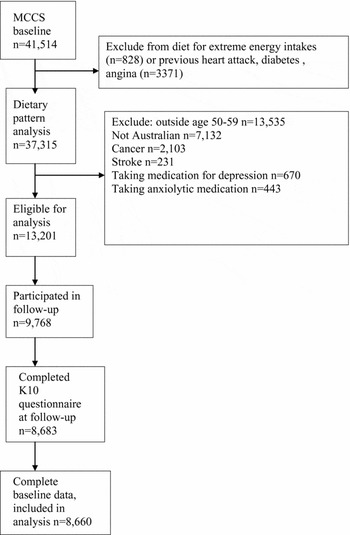
Australian-born people, aged 50–69 years at baseline, who were not taking medication for anxiety or depression, did not have extreme dietary energy intakes (i.e. in the upper or lower 1% of the sex-specific distribution), and who did not have health conditions, such as angina, diabetes, cancer, coronary artery disease, or stroke at baseline (based on self-report), were eligible (n = 13,201) (Figure 1). Of the eligible participants, 74% (n = 9,768) attended the follow-up between 2003 and 2007 and 65.8% (n = 8,683) completed the rating of the Kessler Psychological Distress Scale (K10) (Kessler et al., Reference Kessler2002). After further exclusion for other missing data, 8,660 people were included in these analyses.
The number of participants included and excluded. K10 = Kessler Psychological Distress Scale; MCCS = Melbourne Collaborative Cohort Study.

The Cancer Council Victoria's Human Research Ethics Committee approved the study protocol. Further details of the study have been published elsewhere (Giles and English, Reference Giles, English, Riboli and Lambert2002).
Dietary data
Dietary data were collected using a self-administered 121-item FFQ developed for the MCCS (Ireland et al., Reference Ireland1994). Alcohol intake data were collected using beverage-specific frequency and quantity questions. An MDS was computed on the basis of the description of Trichopoulou et al. (Reference Trichopoulou, Costacou, Bamia and Trichopoulos2003). For frequencies of intake above the sex-specific medians for vegetables, fruit, cereals, legumes, and fish and below the medians for dairy and red meat (not chicken), participants were allocated 1 point or zero for intakes on the other side of the median. For alcohol, 1 point was allocated for daily intakes between 10 and 50 g per day for men and between 5 and 25 g per day for women; lower or higher intakes scored zero (Trichopoulou et al., Reference Trichopoulou, Costacou, Bamia and Trichopoulos2003). Trichopoulou et al. used the ratio of dietary monounsaturated (MUFA) to saturated (SFA) fats as the ninth component of the MDS (Trichopoulou et al., Reference Trichopoulou, Costacou, Bamia and Trichopoulos2003); however, we used the intake of olive oil. In Australia, red meat is an important source of MUFA (Baghurst et al., Reference Baghurst, Record and Leppard2000), and in a Spanish population, olive oil is more closely associated with the MDS than is MUFA (Martinez-Gonzalez et al., Reference Martinez-Gonzalez2008).
Dietary patterns were also identified using the principal component option in factor analysis. We previously found 4 factors within the MCCS dietary data that were characterized by meat and fatty foods, cooked vegetables and salad, fruit, and a combination that included some Mediterranean foods (Hodge et al., Reference Hodge, English, O'Dea and Giles2007) but nothing that could be considered overall as “Mediterranean.” Because the focus in the current analysis was on a Mediterranean diet, we limited the final solution to two factors, based on the hypothesis that dietary patterns reflecting the habits of southern European and Australian participants would be identified.
Possible confounders
Possible confounders measured at baseline and identified a priori were physical activity (four levels grouped as low/high); education (primary school, high school, degree); smoking status (never, past, current); history of arthritis, asthma, kidney stones or gallstones, dietary energy intake, and Socio-Economic Indexes for Areas (SEIFA) – Index of Relative Socio-economic Disadvantage (Pink, Reference Pink2008) based on census collection district (divided into quintiles, with the lowest representing the greatest disadvantage). Alcohol was not considered separately, as it was included in the dietary indices.
Information on social support was collected using questions on the number of people in the household (1, 2, 3–4, 5+), the number of relatives visited each month, the number of friends who could be visited without an invitation (0, 1–2, 3–4, 5–9, 10+), and the number of hours of social activity per week (0, 1–2, 3–4, 5–9, 10+).
Psychological distress
At baseline, symptoms of psychological distress were not assessed. Participants provided all their current medication containers at baseline, and the names of these medications were recorded. Thus, the use of anti-depressant and anxiolytic drugs could be determined at baseline and people using them were excluded from the analysis. At follow-up, participants completed the K10 (Kessler et al., Reference Kessler2002). The K10 has 10 questions regarding symptoms experienced during the last 30 days; each item has 5 possible responses from “all the time” to “never,” scored from 5 to 1, so the total score has a minimum of 10 and maximum of 50, with 50 implying severe psychological distress (Andrews and Slade, Reference Andrews and Slade2001). We used the cut-off point of 19/20 for significant psychological distress, which had acceptable detection rates (sensitivity 0.66, specificity 0.92) for DSM-IV (Diagnostic and Statistical Manual of Mental Disorders, Fourth Edition) diagnoses of any current anxiety or depressive disorders in a community sample in Australia (Andrews and Slade, Reference Andrews and Slade2001).
Statistical analysis
Dietary patterns were determined by factor analysis, using the principal components option and orthogonal rotation. Two factors with eigenvalues of 7.3 and 4.8, respectively, were identified and labeled “modified Mediterranean dietary pattern” and “Australian dietary pattern,” respectively. Scores for each of these factors were calculated by multiplying the factor loading for each food by individual frequencies of intake and summing these for each participant. Quintiles were calculated for scores on these two patterns, using valid dietary data for all participants. The MDS was divided into 3 categories: 0–3, 4–6, 7–9.
Comparisons of baseline variables in responders versus non-responders and people with higher or lower K10 scores at follow-up were performed using one-way analysis of variance for continuous variables and χ2 test for categorical variables. Logistic regression with K10 score <20 or ≥20 as the outcome was used to analyze associations for diet variables, with the outcome variable coded so that a higher odds ratio indicated a positive association with psychological distress. Separate models, adjusting for covariates listed earlier, were used for MDS categories and quintiles of factor scores, with both factors included in the same model. For each dietary index, the lowest scoring participants were used as the reference group. Analyses were also performed using a K10 score of ≥30 to indicate the likelihood of severe mental distress. All analyses were performed with Stata 11 (StataCorp, College Station, Texas, USA).
Results
The variables loading on the two dietary patterns are shown in Appendix 1. (See Appendixes 1–3, available as supplementary material attached to the electronic version of this paper at http://journals.cambridge.org/ipg). For convenience, the factors were named “modified Mediterranean” (negative loadings for margarine, tea, and sausages/frankfurts, and positive loadings for olive oil, rice, pasta, fruit, salad vegetables, olives, figs, legumes, feta, ricotta and parmesan cheeses, steamed fish, beef or veal, boiled chicken, game meats, and herbal tea) and “Australian” (negative loadings for olive oil and feta cheese, and positive loadings for breakfast cereal, wholemeal bread, cheddar cheese, vegetables – carrot, pumpkin, beetroot, green beans and peas, and cauliflower; some fruit, tea, margarine, pudding, cake, cream, jam, vegemite, and roast lamb).
Comparison of the people included in the analysis and those eligible at baseline but not included here because they died, did not return to follow-up, or did not complete the K10 questionnaire at follow-up indicated that the responders were younger, more educated, in a higher SEIFA quintile, more physically active, less likely to smoke, had fewer prevalent health problems, were more social, and scored higher for each diet pattern measure than those who were not included (data not shown).
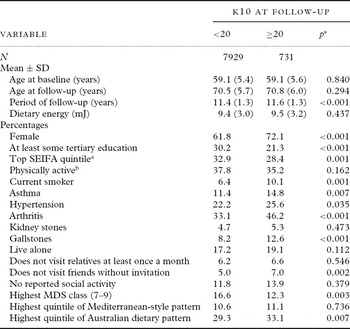
Table 1 shows participants’ baseline characteristics, age at follow-up, and length of follow-up by K10 classification at follow-up. A small but significant difference was seen for length of follow-up (slightly longer in people with K10 score of ≥20 at follow-up). Higher K10 score at follow-up was also associated with being female, less education, lower SEIFA quintile, smoking, health conditions other than kidney stones, and not visiting friends without an invitation. People in the highest quintile of the Australian dietary pattern were more likely to have a high K10 score, while those in the highest MDS group were less likely to have a high K10 score.
Baseline characteristics of participants according to K10 score at follow-up

*p value from one-way analysis of variance for continuous variables and from χ2 test for categorical variables.
aThis is the least disadvantaged group.
bClassified in the “high” activity group combining the two of four most active classes.
K10 = Kessler Psychological Distress Scale; MDS = Mediterranean Diet Score; SEIFA = Socio-Economic Indexes for Areas.
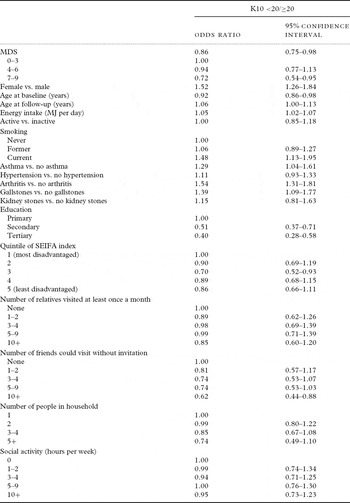
Table 2 shows the associations of psychological distress with the MDS. There is an inverse association between MDS and psychological distress. In addition, being female, self-reported arthritis, gallstones and asthma, current smoking, higher dietary energy intake, and older age at follow-up were positively associated with psychological distress at follow-up. Having a greater number of friends who could be visited without an invitation, more education, and older age at baseline were inversely associated with psychological distress at follow-up.
Associations between the MDS at baseline and psychological distress according to K10 score at follow-up,a adjusting for baseline variables as listed in the table and age at follow-up (N = 8660)

aThe K10 categories have been coded so that odds ratio >1 reflect increased risk of psychological distress.
K10 = Kessler Psychological Distress Scale; MDS = Mediterranean Diet Score; SEIFA = Socio-Economic Indexes for Areas.
Although there were no differences between the mean ages of people with normal or higher K10 score at baseline or follow-up, those with a high K10 score had a longer follow-up time. In the multivariate model, baseline age was inversely associated and follow-up age positively associated with higher K10 score, reflecting the increased length of follow-up seen in Table 1. It was our impression that people who were less physically or mentally well at follow-up took longer to attend if they came back at all.
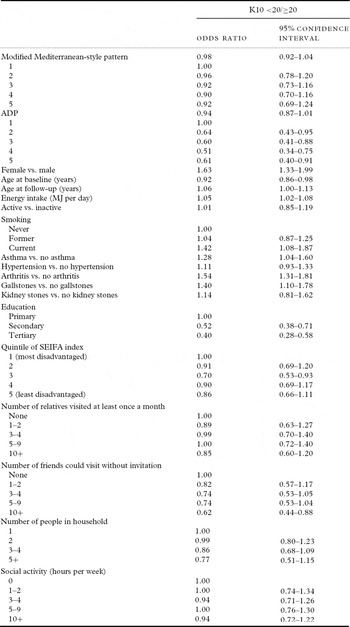
There was no association between the modified MDP and higher K10 score at follow-up (Table 3). For the Australian dietary pattern, there was an inverse association. But there was a little difference in the odds ratio between quintiles 2 and 5, the lowest being in quintile 4, and the variable overall was of borderline significance. Associations between the other covariates and psychological distress at follow-up were similar to those in the model with MDS.
Associations between quintiles of the modified Mediterranean-style pattern and ADP at baseline and psychological distress according to K10 score at follow-up,a adjusting for baseline variables as listed in the table (both dietary patterns were included in a single model) and age at follow-up (N = 8660)

aThe K10 categories have been coded so that odds ratio >1 reflect increased risk of psychological distress.
ADP = Australian dietary pattern; SEIFA = Socio-Economic Indexes for Areas.
If a more strict definition of psychological distress using a K10 cut-off point of ≥30 was used, the association with MDS was similar to that described earlier (Appendix 2), but the smaller number of cases using this definition resulted in wider confidence intervals. There was no association for the modified MDP (Appendix 3). The results for the Australian dietary pattern showed that odds ratio for quintiles 2–5 were all <1, but none of the confidence intervals excluded 1 (Appendix 3). The only variables retaining a significant relationship with the outcome were baseline arthritis and education.
Discussion
We observed an inverse association between the MDS at baseline and psychological distress at follow-up. There was also an inverse association between adherence to a traditional Australian dietary pattern and psychological distress at follow-up for these Australian-born MCCS participants. We found no evidence for an association between the modified Mediterranean dietary factor and psychological distress at follow-up. Our observations support our hypothesis that the MDS would be inversely associated with depression and anxiety at follow-up, consistent with a study examining a younger Spanish cohort (Sanchez-Villegas et al., Reference Sanchez-Villegas2009). An English study (Akbaraly et al., Reference Akbaraly, Singh-Manoux, Marmot and Brunner2009) also found that being in the upper two thirds of the healthier (whole-food) diet pattern score at baseline was associated with a reduced risk of depressive symptoms some 5 years later. Our observations regarding the Australian dietary pattern may suggest a different interpretation. While it is likely that having a healthy diet, providing adequate levels of nutrients, would be associated with better mental and physical health, it may be that depressive symptoms or psychological distress is also associated with factors other than the nutrients ingested with these dietary patterns.
Patterns of food consumption may also reflect the individual's adoption of practices of his/her community, and such behavior could reflect a propensity for the subsequent development or not of anxiety and depression. In Swedish adults, a high sense of coherence (SOC), a measure of people's ability to understand what happens around them, to manage the situation alone or with the help of significant others, and to find meaning in the situation, was associated with a healthier eating pattern (Lindmark et al., Reference Lindmark, Stegmayr, Nilsson, Lindahl and Johansson2005). The SOC is also strongly related to perceived health, especially mental health (Eriksson and Lindstrom, Reference Eriksson and Lindstrom2006). It may be that people with a higher score on the traditional Australian eating pattern in our study also had a higher SOC and were thus less susceptible to mental health problems.
Our findings are also consistent with the results of a recently published cross-sectional Australian study that showed that a traditional Australian diet was inversely associated with prevalent depressive and anxiety disorders in women aged 20–93 years in the Geelong Osteoporosis Study (Jacka et al., Reference Jacka2010). It should be noted that these traditional Australian dietary patterns identified are not based on processed foods, rather they reflect what is referred to as “meat and three vegetables,” along with the “healthy” choices of wholemeal bread and margarine, and as such are likely to provide a good level and variety of nutrients despite the inclusion of puddings, cakes, cream, and jam in the pattern we identified.
Our study had a number of strengths. It had a large number of participants, with more than 700 Australian-born individuals having evidence of psychological distress at follow-up. The dietary questionnaire was comprehensive and designed specifically for the diverse diets in the MCCS (Ireland et al., Reference Ireland1994) and has been used to elucidate many previous functional associations (eg Harriss et al., Reference Harriss2007; Hodge et al., Reference Hodge, English, O'Dea and Giles2007; Reference Hodge, English, Itsiopoulos, O'Dea and Giles2011). Our dietary patterns were calculated using the whole cohort at baseline. This means that people scoring high on the MDS were not just eating more or less than other Australian-born participants, they were being scored relative to the southern European migrants. For example, in a previous analysis of the MDS in our cohort, we found that those having a score of 6–9 consumed seven servings of vegetables and five servings of fruit per day compared with 3 and 2 servings, respectively, for those scoring 0–2 (Hodge et al., Reference Hodge, English, Itsiopoulos, O'Dea and Giles2011). Similarly, with the factor analysis, by including everyone we were able to identify two quite distinct dietary patterns that matched our expectations of Australian and Mediterranean patterns, although the Mediterranean pattern identified here included high loadings for meat in contrast to the traditional Mediterranean diet.
The participants completed comprehensive questionnaires, allowing us to control for many potentially confounding factors. Finally, the time period between the dietary questionnaires and follow-up was long, more than 10 years, reducing the potential likelihood of reverse causality.
Our study also had limitations. We did not assess psychological distress at baseline, and it is possible that the presence of such symptoms could result in dietary change (Mikolajczyk et al., Reference Mikolajczyk, El Ansari and Maxwell2009). While we excluded people taking anti-depressant or anxiolytic drugs at baseline, this would likely identify only a small proportion of people with depressive symptoms (Zhang et al., Reference Zhang2010). Participants who completed the K10 at follow-up were generally healthier than those who did not, but this should not affect the internal validity of our study. As with all the studies of diet relying on self-report, the dietary data will be measured with error. There is also the possibility of dietary change over time, which may modify relationships between baseline diet and depressive symptoms at follow-up. Finally, although the K10 is a validated measure of psychological distress that has been used extensively in Australian (Andrews and Slade, Reference Andrews and Slade2001) surveys, it does not necessarily yield specific psychiatric diagnoses.
We modified the original MDS so that rather than using the MUFA to SFA ratio to assess dietary fat intake (Trichopoulou et al., Reference Trichopoulou, Costacou, Bamia and Trichopoulos2003), we used the actual intake of olive oil. We believe that this better reflects the Mediterranean diet, which is characterized by high levels of fat that mostly comes from olive oil (Sofi et al., Reference Sofi, Abbate, Gensini and Casini2010), than would the MUFA to SFA ratio in Australia, where the relatively high intake of meat is the main source of MUFA (Baghurst et al., Reference Baghurst, Record and Leppard2000). Olive oil also contains other phytonutrients that may be beneficial (Kyrozis et al., Reference Kyrozis, Psaltopoulou, Stathopoulos, Trichopoulos, Vassilopoulos and Trichopoulou2009).
The MDS we calculated reflects an idealized Mediterranean diet based on the dietary profile commonly available in the Mediterranean region in the 1960s (Sofi et al., Reference Sofi, Abbate, Gensini and Casini2010), while our modified Mediterranean factor reflects what was actually being consumed by the people of Mediterranean origin in Melbourne, Australia, in the early 1990s, including relatively high frequency of consumption of not only fruit, vegetables, and legumes, similar to the MDS, but also meat. This difference may contribute to the inconsistency observed between the two Mediterranean-style dietary patterns.
The mean K10 scores for our sample of older men and women were 13.9 and 15.1, respectively, while for men and women (aged 18 years and older) in a national survey the mean K10 scores were 13.9 and 14.5, respectively (Andrews and Slade, Reference Andrews and Slade2001), indicating that the MCCS cohort was similar to the general population in terms of psychological distress.
For people born in Australia, the MDS was associated with reduced distress and anxiety at follow-up, suggesting that the consumption of a healthy diet, as observed in other studies, may reduce the risk of mental illness. We also observed that adherence to a traditional Australian diet, which would not be considered particularly healthy, was associated with a reduced subsequent prevalence of psychological distress. We propose that this is not due only to physiological associations between nutrients and mental symptoms, raising the possibility that people who eat a diet typical of their community maintain better mental health.
Conflict of interest
None.
Descriptions of authors’ roles
A. Hodge designed and conducted the analysis and wrote the paper. L. Flicker assisted with the design and analysis and critically reviewed the manuscript. D. English was largely responsible for the collection of outcome data and critically reviewed the manuscript. O. Almeida critically reviewed the manuscript. G. Giles was responsible for the establishment of the cohort and collection of baseline data, and critically reviewed the manuscript.
Acknowledgments
This study was made possible by the contribution of many people, including the original investigators and the diligent team members who recruited the participants and completed the follow-up. We express our gratitude to the many thousands of Melbourne residents who continue to participate in the study.
A. Hodge was funded by the National Health and Medical Research Council (NHMRC) (grant 520316). This work was funded by VicHealth, the Cancer Council Victoria, and the National Health and Medical Research Council (grant 209057).