


Diabetes, particularly type 2 diabetes mellitus, is a major public health concern worldwide(Reference Wild, Roglic and Green1). In parallel with economic development and lifestyle changes in China, the Chinese diabetic population has increased rapidly in recent years, alongside the steady growth in diabetes prevalence globally. According to a recently published survey, 9·7 % of the adult Chinese population has diabetes(Reference Yang, Lu and Weng2). Because diabetes complications can be prevented or delayed by the rigorous control of blood glucose level(Reference Turner, Cull and Holman3), it is well established that nutritional intervention is essential to improve blood glucose control in people with diabetes(Reference Pastors, Warshaw and Daly4). Diabetics should pay sufficient attention to diabetes nutrition therapy; however, undesirable clinical effects occur due to deficiencies that still exist in nutrition knowledge(Reference Li5). Education is an effective way to make up for the deficiency(Reference Chapman-Novakofski and Karduck6), while in outlying areas of China, formal diabetes nutritional and eating education is lacking. In the present study, a questionnaire-based pilot survey was conducted in Yakeshi, a remote city in northern China, to assess the nutrition knowledge, attitudes and practices of type 2 diabetics in relation to dietary intake and blood glucose control and to evaluate the effect of implementation of nutritional and eating education on healthy diet and self-management of diabetes.
Methods
Participants and study design
A questionnaire-based pilot survey of patients with type 2 diabetes in Yakeshi was conducted from April 2010 to April 2011. In the present study, 109 males and fifty-three females were selected from the endocrine out-patient and in-patient departments of three hospitals (Inner Mongolia Forestry General Hospital, Yakeshi Hospital and Yakeshi Mongolia Hospital). The inclusion criteria were patients identified with type 2 diabetes mellitus according to the new diabetes classification and diagnostic criteria (specified by the American Diabetes Association in 1997). Investigators were recruited from hospital nurses and trained by the researchers to give a verbal explanation of the questionnaire for patients.
To describe the knowledge, attitudes and practices of patients with type 2 diabetes, 162 diabetics participated in the knowledge–attitude–practice (KAP) questionnaire survey. Participants were conscious and consented to the survey project. Scores for knowledge, attitudes and practices were assessed by questionnaire and face-to-face interviews. For assessing the effect of nutritional and eating education, fifty-four patients were randomly selected from the 162 interviewees and signed a written informed consent before accepting a 6-month nutritional and eating education. Education assessment questionnaires and 24 h recalls were completed before and after education, and fasting blood glucose and 2 h postprandial blood glucose were also checked. Multiple methods were applied in the education programme. (i) Nutrition lectures were given, during which food exchange lists and nutrition knowledge materials were distributed to every participant and food and nutrition hygiene knowledge was explained using real food and food models. Lectures were controlled to within 1 h and 10–15 min were left for answering questions and for discussion. (ii) According to the knowledge misunderstandings that occurred in the questionnaire, wrong answers were explained and the relevant nutrition knowledge was given to the patients face-to-face. (iii) Patients and their families were taught to develop individualized nutrition therapies based on their height, weight, labour intensity, blood glucose, blood lipids, renal function, liver function and personal eating habits according to the concept of food exchange portion. (iv) Follow-up telephone calls were made once per month to understand patients’ exercise, drugs and treatment situation and to solve their actual nutrition issues.
Dietary intake data
Both a gravimetric method and a standardized 24 h dietary recall were used to investigate patients’ dietary and nutrient intakes during 3 d at baseline and follow-up. All foods and drinks consumed in the previous 24 h were recorded and the amounts of different food items that were mixed in one dish were recorded respectively. Local food photographs, portion-size images and volumetric vessels were used to increase the accuracy of the recall from the previous 24 h. Interviewers coded dietary data according to the Chinese Coding Manual (China Addendum to the INTERMAP Nutrition Manual of Operations). The nutritional composition of ingredients was computed using the Chinese food composition tables(Reference Wang and Yang7).
Questionnaire design
The KAP questionnaire was designed on the basis of reviewing extensive literature(Reference Zhao and Xu8) and was examined by experts from university departments of Nutrition and Food Hygiene, Epidemiology and Statistics. The questionnaire was used in a pre-study to test its reliability and validity and corresponding revision of two items was made according to the pre-study results.
The KAP questionnaire was divided into four sections and comprised a series of questions pertaining to sociodemographic characteristics, basic nutrition knowledge, attitudes towards nutrition behaviours and practice characteristics. The sociodemographic part of the instrument included questions on demographic characteristics, disease-related characteristics, and actual and expected sources of nutrition knowledge (in the nutrition knowledge sources section, participants could choose more than one option). For assessing basic nutrition knowledge, participants were asked fifteen questions (maximum accumulated score was 23) relating to ideal weight, treatment, hypoglycaemia, food exchange portion, complications, diet, etc. Some issues required detailed answers (e.g. common symptoms of diabetes, common complications of diabetes, concept of food exchange portion, daily food intake and the energy distribution ratio of three meals, calculation method of ideal weight, symptoms and treatment measures of hypoglycaemia, taboo foods of diabetes and glycaemic control method) and these items were assessed with 2 points as a desirable score, the other questions scoring 1 point. Validity and reliability were calculated. The content validation index was 0·923 and Cronbach's α index was 0·909. For attitudes towards nutrition behaviours, respondents were asked to use a two-point ordinal scale (rating scale from 0 to 2, 2 = ‘yes’ and 0 = ‘no’) in seven questions, including changing unhealthy diet, losing weight, accepting diabetes education, etc. Validity and reliability were calculated. The content validation index was 0·879 and Cronbach's α index was 0·813. In the fourth set of questions, we assessed nutrition practices: this section had eighteen questions relating to general diet, weight check, blood-glucose check, exercise, frequency of food intakes, etc. The maximum score was 23 including five questions scoring 2 points (‘How often do you monitor your blood glucose?’, ‘How often do you monitor your body weight?’, ‘How often do you drink milk?’, ‘How often do you eat vegetables?’ and ‘How often do you eat fruits?’), other items were assessed with 1 point as a desirable score. Validity and reliability were calculated. The content validation index was 0·880 and Cronbach's α index was 0·773. The summation of knowledge, attitude and practice grades was equal to the total KAP score of the participants. The proportion of nutrition knowledge, active attitude and optimal practice for each question was calculated as the rate of the number of people who gave a correct (positive) answer in the total answers.
The education assessment questionnaire was simplified from the above questionnaire. The sociodemographic part and attitude section were removed and fourteen typical questions, including seven from the knowledge section and seven from the practice section, were selected.
Statistical analysis
Statistical analysis was done using the statistical software package SPSS for Windows version 16·0. The level of significance was established as a two-sided P value of < 0·05. Data were reported as mean and standard deviation (for continuous variables) or as number and percentage (for categorical variables), and were compared using the Student t test or the χ 2 test.
Results
Basic characteristics of the study participants
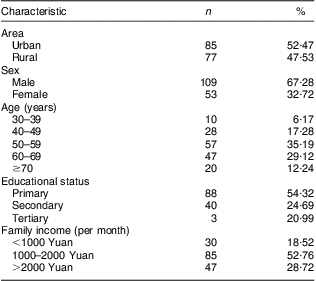
A total of 162 patients were interviewed and all returned the questionnaires after proper answering. Of these patients, eighty-five (52·47 %) were from the city and seventy-seven (47·53 %) were from the country. The number of male patients was much higher than that of female patients: 109 (67·28 %) and fifty-three (32·72 %), respectively. Patients over the age of 50 years accounted for 76·55 % and 54·32 % of all participants had only primary education. The distribution of diabetic patients according to their sociodemographic characteristics is shown in Table 1.
General characteristics of 162 diabetes patients in Yakeshi, a remote city in northern China, April 2010–April 2011
The disease-related characteristics of the participants were assessed and showed that 133 had a family history of diabetes, 79·12 % of the interviewees had varying degrees of diabetic complications, 123 patients had a practice duration of over 1 year and 75·31 % of the patients considered diet control as an important method of controlling blood glucose (Table 2).
Disease-related characteristics of 162 diabetes patients in Yakeshi, a remote city in northern China, April 2010–April 2011
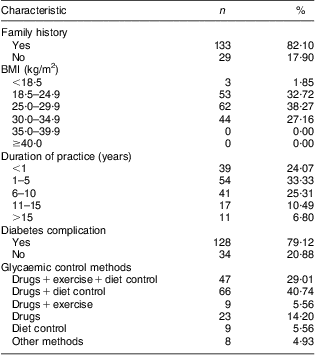
‘Family history’ means whether patients’ relatives had had diabetes; ‘Duration of practice’ refers to the length of time that patients had had diabetes.
Diabetes patients’ actual and expected sources of nutrition information
Most of the patients had no diabetes nutritional education experience; their sources of nutritional information were extensive but irregular. Medical workers was the main actual source, accounting for 64·20 %; other sources were ward-mates (28·40 %), friends and relatives (17·90 %), radio and television (20·37 %), newspapers and magazines (13·58 %), books (30·25 %), nutrition lectures (8·64 %) and others (2·47 %). Their expected sources were medical workers (88·89 %), nutritionists (6·17 %), books (3·09 %) and others (1·85 %).
Diabetic-related knowledge, attitudes and practices of participants
The mean overall KAP score for the patients who had diabetes education experience was 39·00 (sd 5·38), significantly higher (P < 0·001) than for those without, who had a mean score of 31·00 (sd 7·94); this difference also occurred in knowledge score (P < 0·05) and practice score (P < 0·001), but the attitude score was not significantly different between these two groups (P > 0·05). Patients with >1 year of practice duration were more likely to have a higher practice score (mean 15·76 (sd 3·72); P < 0·05) and KAP score (mean 32·41 (sd 7·63); P < 0·05) compared with those with a practice duration of < 1 year (mean 13·85 (sd 4·00) and mean 29·44 (sd 9·02), respectively); however, knowledge and attitude scores showed no significant differences between these two groups (P > 0·05). There was a significant difference in KAP score according to educational status, with patients who had higher education level scoring significantly higher than those with lower education level (P < 0·001); the same was true for knowledge score (P < 0·001), but no significant differences by education were found in attitude and practice scores (P > 0·05). The results showed no evidence of an association between knowledge (P > 0·05), attitude (P > 0·05), practice (P > 0·05) or KAP (P > 0·05) scores and urban/rural area (Table 3).
Knowledge, attitude and practice scores according to area, diabetes education experience, duration of practice and educational status among 162 diabetes patients in Yakeshi, a remote city in northern China, April 2010–April 2011

KAP, overall knowledge–attitude–practice.
Comparison of baseline and follow-up
By the end of the education, after the exclusion of twelve patients who were lost to follow-up (nine did not leave their telephone number voluntarily and three changed their telephone number later), forty-two patients (female thirteen, male twenty-nine; aged 35–74 years; five newly diagnosed (<1 year of practice duration) and the others with diabetes duration of 1–18 years) were left.
On analysing the responses, the number of patients who answered correctly was higher at the final follow-up compared with baseline. Awareness of most questions was significantly (P < 0·05) higher at the end of the study as shown in Table 4; however, intake of vegetables showed no improvement (P > 0·05).
Comparison of baseline and follow-up diabetes-related nutrition knowledge, awareness and practice accuracy of diabetes patients (n 42) in Yakeshi, a remote city in northern China, April 2010–April 2011

n represents the correct (positive) answer.
Table 5 shows that, before education, most patients’ daily nutrient intakes were seriously inadequate compared with the Recommended Nutrient Intakes (RNI), with vitamin A, vitamin C and Ca intakes even lower than one-third of the RNI. After the intervention, the increment in protein, Fe, Zn and Se intakes was not significant, while lipids, carbohydrate, energy, fibre, vitamin A, thiamin, riboflavin, vitamin C, vitamin E, Ca and Mg intakes increased significantly (P < 0·05).
Comparison of baseline and follow-up daily nutrient intakes of diabetes patients (n 42) in Yakeshi, a remote city in northern China, April 2010–April 2011

RNI, Recommended Nutrient Intake.
To convert kcal to kJ, multiply kcal value by 4·184.
*No specific standard; cannot calculate the percentage contribution to RNI.
It can be seen from Table 6 that the rate of patients having a proper food intake was low before the intervention. After the nutritional and eating education, the situation improved and significant improvements were found in the rate of patients with recommended daily intakes of vegetables, grains, dairy and fruit.
Comparison of baseline and follow-up rates of daily food intakes within the recommended range among diabetes patients (n 42) in Yakeshi, a remote city in northern China, April 2010–April 2011

Compared with baseline, after the nutrition intervention both fasting blood glucose and 2 h postprandial blood glucose were decreased significantly (P < 0·05; Table 7).
Impact of education on glycaemic indices of diabetes patients (n 42) in Yakeshi, a remote city in northern China, April 2010–April 2011

Discussion
Status of nutrition knowledge, attitudes and practices of patients with diabetes
It can be seen from the survey results that diabetes patients were mostly concentrated in the elderly, with relatively low educational level, that most patients were overweight and had varying degrees of complications. Inappropriate nutrition is a significant causative factor for type 2 diabetes(Reference Kafatos and Codrington9). In the baseline survey, where 75·31 % of the participants said to control blood glucose by controlling diet, they have realized the importance of nutrition therapy for diabetes control; however, lacking professional guidance leads to misunderstandings on foods and then makes treatment ineffective. According to a survey in the UK, patients understood and were able to achieve the dietary changes suggested(Reference Moore and Adamson10). Proper nutrition suggestions to diabetics are necessary. In this pilot survey, we found that the 162 patients’ actual nutrition information sources are extensive but irregular. They got information mainly from medical workers, accounting for 64·20 %, and medical staff was also their main expected information source. It can be seen that diabetics trusted medical workers and wanted to get proper diabetes treatment principles from them, especially nutrition therapy guidance. Medical practitioners have an obligation to disseminate diabetes-related nutrition knowledge among patients to enable them to master the nutrition therapy methods during hospitalization and lay a good foundation for the implementation of nutrition therapy after discharge. It is indispensable to spread nutrition knowledge among medical and nursing staff. Moreover, nutritional and eating education should be developed in communities(Reference Zhang and Qiao11). Enhancing the message via diverse methods, such as nutrition lectures, books, newspapers, television, radio and community activities, can make patients form healthy eating habits, thus achieving optimal clinical effect. In the USA, diabetes self-management education is recommended with national standards and provided by professional diabetes educators other than physicians(Reference Funnell, Brown and Childs12).
Data from the KAP survey showed that the patients who had diabetes education experience had significantly higher scores in knowledge, practice and total KAP than those without diabetes education experience. These findings are in keeping with other literature, which displayed that educated patients’ knowledge on diet is significantly improved compared with patients not receiving intensive education(Reference Chapman-Novakofski and Karduck6). It is well understood that formal diabetes nutritional and eating education can improve patients’ KAP mastery and further affect their nutrition behaviours. Patients with longer diabetes duration had significantly higher practice scores than those with shorter practice experience. This may because the recurrence of diabetes, increase of diabetes complications or opportunities for exchanges between ward-mates make them know more about correct nutrition practices for diabetes, while without formal diabetes nutritional and eating education, there are no significant differences in attitude, knowledge and KAP scores. The survey score results also indicated that patients with higher educational level had significantly higher KAP score than less educated ones, with also a significantly higher score in one parameter: knowledge. Education status influences patients’ KAP and is crucial to diabetes; a study carried by Nilsson et al. found that diabetics who were less educated had 40 % excess mortality compared with those were highly educated(Reference Nilsson, Johansson and Sundquist13). In the present study there was no disparity between urban and rural regions of the city in scores on knowledge, attitudes, practices and total KAP. It has been proven that diabetes-related nutrition education can significantly improve the KAP level(Reference Zhao and Xu8). Various nutrition education activities should be carried out in this region to help patients form reasonable eating habits and healthy nutrition behaviours, improve their glycaemic control abilities and thus reduce the occurrence of diabetes complications.
Improvements of nutritional and eating education on diabetes-related knowledge, awareness, dietary intake and blood glucose control
Findings from the baseline KAP questionnaire indicated that although patients’ attitudes were positive, deficiencies existed in knowledge and practice. To improve their knowledge and practice, diabetes nutritional and eating education referring to healthy diet and self-management for diabetics was conducted.
In the present study we found that the rate of correct (positive) answers in the follow-up was significantly higher than in baseline, especially the rate of ‘Do you know the concept of food exchange portion?’ (increased from 2·38 % to 90·48 %) and ‘Do you deduct staple foods when you eat fruits?’ (increased from 11·90 % to 100·00 %). Education greatly improved patients’ mastery of nutrition knowledge, the telephone follow-up strengthened their awareness of self-management and made patients participate in nutrition therapy actively. The rate of ‘How often do you eat vegetables?’ had no improvement (P > 0·05) since this rate was very high at baseline.
As evidenced at baseline, patients’ daily dietary intake was undesirable, the rate of diabetes patients with recommended daily intakes of food was low, especially for vegetables (2·38 %). After nutritional and eating education, the patients’ dietary pattern improved; the percentage in terms of meeting recommendations for grains, vegetables, dairy and fruits increased remarkably (P < 0·05). Although protein, Fe, Zn and Se intakes showed no significant difference (P > 0·05), most daily nutrient intakes showed a significant increase (P < 0·05), closer to the RNI standards. All of these results indicate that the described nutritional and eating education allowed patients to truly recognize the importance of rational nutrition therapy and improve their dietary pattern. Nutritional balance is essential to maintain health and central to preventing type 2 diabetes(Reference Tuomilehto, Lindstrom and Eriksson14, Reference Knowler, Barrett-Connor and Fowler15). Diets high in fruits and vegetables demonstrate a strong and consistent pattern for providing benefits against diabetes(Reference Jimenez-Cruz, Bacardi-Gascon and Jones16). Vegetables contain a large amount of dietary fibre, which can lower fasting blood glucose, postprandial blood glucose and improve glucose tolerance, so eating them in moderation is good for patients’ glycaemic control. Fruits are high in sugars that are absorbed quickly; thus diabetics with poor fasting blood glucose control should eat them with caution and those with better fasting blood glucose control should also limit the quantity of fruit intake. When eating fruits, an appropriate amount of a staple food should be deducted. Low energy intake improves 2 h blood glucose profiles, insulin sensitivity and Hb(Reference Boden, Sargrad and Homko17). The total energy intake should be calculated with a food exchange system according to patients’ height, weight and labour intensity. Increasing the intake of carbohydrate can improve insulin sensitivity and glucose tolerance(Reference Lu18), and energy provided by carbohydrate should account for 50–60 % of total energy. Protein should provide 15–20 % of total energy and the proportion of high-quality protein should more than one-third of total protein intake. Meat, eggs and beans are all good sources of high-quality protein, but because most respondents in the present survey were elderly people and because animal foods contain high amounts of fat and cholesterol, they were suggested to eat more dairy, beans and related products. Dietary fat, especially too much saturated fat intake, is associated with impaired fasting glucose and insulin resistance(Reference Feskens and Kromhout19). Fat intake should be controlled to less than 30 % of total energy. An adequate supply vitamins and minerals plays an important role in correcting metabolic disorders of diabetes and preventing complications. In the present study, patients’ low intakes of vitamin A and Ca may relate to their eating habits and they should make a diet transition towards foods with high vitamin A and Ca and low fat and cholesterol content, such as milk, eggs, cod-liver oil, carrots, beans and their products.
Previous research has shown that patient education adds value to diabetes management and that specific interventions aimed at improving patients’ knowledge can improve diabetes control(Reference Asha and Mohan20). In the follow-up, patients’ blood glucose control was improved significantly compared with baseline. Both fasting blood glucose and 2 h postprandial blood glucose declined to the desirable standards which were constructed by the Chinese Diabetes Society(21). The diabetes nutritional and eating education had made patients informed of correct nutrition knowledge on proper diet and following the healthy diet consistently made contributions to patients’ blood glucose control.
A possible bias from patients’ answers to the questions may exist in the current study. We adopted face-to-face interviews; however, diabetics could have misunderstood some of the questions because of a low level of education and kept something back when reporting nutrition knowledge, attitudes and practices. Thus answer bias was unavoidable in our interview-based investigation. Also, because of food diversity (different shapes, different cooking methods), participants had difficulties in assessing accurately the amount of food intake; thus dietary data collection bias may exist inevitably.
Despite these limitations, the present study is the first to report the nutrition knowledge, attitudes and practices and effect of nutritional and eating education among patients with type 2 diabetes in Yakeshi; no formal nutrition education has been made on the diabetics here before. This pilot study may provide a useful reference for further study on nutrition education and nutrition therapy of diabetes in outlying areas and more intensive nutrition intervention might be required to improve patients’ dietary intakes and nutrition management of type 2 diabetes.
Acknowledgements
Sources of funding: This work was supported by the National Science Foundation of China (No. 81172650). The funder had no role in the design, analysis or writing of this article. Conflict of interest: None of the authors had any conflicts of interest in this work. Ethics: The study was approved by the Ethical Committee of Harbin Medical University. Authors’ contributions: Y.W. was the Principal Investigator of the project and contributed to the study design, writing, revising and final approval of the manuscript. H.W., Z.F.S. and Y.H.B. contributed equally to the study. The manuscript and revised paper were written mainly by H.W. and Z.F.S. L.Z. took part mainly in the investigation and data analysis. Acknowledgements: The authors sincerely acknowledge all of the investigators and their staff for participation in this survey and thank Xiangkun Cao and Antonia Frank for language editing of the revised manuscript.



