Introduction
The almond bark beetle, Scolytus amygdali, is a polyphagous beetle that can infest many species of fruit and forest trees (Russo, Reference Russo1931; Janjua & Samuel, Reference Janjua and Samuel1941; Benazoun, Reference Benazoun1983; Benazoun & Schvester, Reference Benazoun and Schvester1990; Zeiri et al., Reference Zeiri, Braham and Braham2011, 2014). Scolytus amygdali has been recorded widely from the Mediterranean region (Russo, Reference Russo1931; Benazoun, Reference Benazoun1983; Cherif & Trigui, Reference Cherif and Trigui1990; Beghami, Reference Beghami2010; Zeiri et al., Reference Zeiri, Braham and Braham2011), the Middle East (Ben-Yehuda, Reference Ben-Yehuda2005; Youssef et al., Reference Youssef, Mostafa, Okil and Khalil2006; Bolu & Legalov, Reference Bolu and Legalov2008), Asia (Janjua & Samuel, Reference Janjua and Samuel1941) as a serious economically pest attacking wild and cultivated trees of Rosaceae. It is a secondary pest that injures and weakens its host by inducing physiological stress. These weakened trees produce chemical stimuli that can influence the beetles’ host preference; secondary metabolites produced by trees have been shown to directly influence the behavior of beetles at multiple stages of their life cycle (Wood, Reference Wood1982). In Scolytinae, the role of olfaction in host plant selection has been thoroughly studied (Borden, Reference Borden1989; Vité & Baadar, Reference Vité and Baadar1990; Mendel et al., Reference Mendel, Boneh and Riov1992; Drumont et al., Reference Drumont, Gonzaléz, De Windt, Gregoire, De Proft and Seutin2009), and changes in host plants have reportedly induced changes in feeding patterns and oviposition behavior (Harrison, Reference Harrison1987; Thompson et al., Reference Thompson, Wehling and Podolsky1990; Singer & Parmesan, Reference Singer and Parmesan1993). Bark beetle distribution is correlated to abundance of its host species (Lekander et al., Reference Lekander, Bejer-Petersen, Kangas and Bakke1977), and host range is often limited to species within a single genus (Sauvard, Reference Sauvard, Lieutier, Day, Battisti, Grégoire and Evans2004). However, in the absence of choice, many bark beetles are able to feed and develop on a wide variety of hosts across multiple genera (Chararas, Reference Chararas1973). Only a few bark beetle species females, including S. amygdali, may choose hosts that are most suitable for larval development (Jaenike, Reference Jaenike1990; Agosta, Reference Agosta2006; Bertheau et al., Reference Bertheau, Sallé, Roux-Morabito, Garcia, Certain and Lieutier2009). This behavior has been tested in Bertheau et al. (Reference Bertheau, Sallé, Roux-Morabito, Garcia, Certain and Lieutier2009) and it seems to be not universal (Agosta, Reference Agosta2006). In most cases, individuals of one sex begin feeding on a host tree and release an aggregation pheromone, attracting more beetles to the host. If the selected tree is later deemed unfavorable, the process will be repeated. The composition of the bark, which can contain active attractive and repulsive chemicals, usually determines whether or not the beetles will colonize. Once a host tree has been colonized by S. amygdali, females will dig longitudinal galleries, where they will eventually oviposit. Once the attack initiates on weak and older trees, S. amygdali makes galleries and holes in the bark and destroys the phloem tissues in the inside the infested bark that leads to its complete death (Mendel et al., Reference Mendel, Ben-Yehuda, Marcus and Nestel1997). Damages can be also caused by nutricial bites of flying adults during their maturation, feeding on buds and twings (Ben-Yehuda, Reference Ben-Yehuda2005). Bud destruction can also be caused by overwintering forms on their spring flight (Ben-Yehuda, Reference Ben-Yehuda2005).
The objective of our research was to study feeding and reproductive behavior of S. amygdali, both in the laboratory and in the field, in order to assess its host preference and reproductive potential across four species of potential host trees. Understanding the behavior of S. amygdali will enable us to implement more effective IPM strategies for controlling it.
Materials and methods
Vegetal material
Four different host species of fruit trees were used in this experiment, all in the genus Prunus: almond (Prunus dulcis), apricot (Prunus armeniaca), peach (Prunus persica), and plum (Prunus domestica). Branches for all four hosts were taken from trees planted in the orchard of the Professional Training Center of Agriculture, Jammel, Monastir, Tunisia (35°37′60″N: 10°46′0″E). Cut branches were used in this experiment because the branches of these hosts, once cut, become physiologically stressed and release chemical substances that can attract or repulse females prior to host selection. After the host is selected, female bark beetles begin to release pheromones; this initiates the stage of infestation called ‘secondary attraction’.
Laboratory experiment
The laboratory experiment was carried out during October 2009, and involved examining characteristics of maternal galleries on four host species in order to analyze the reproductive performance of females of S. amygdali. Ten healthy branches from each host species (almond, peach, apricot, and plum) were placed in rearing cages under the laboratory conditions at standard temperature (25°C) and photoperiod (16L: 8D). A total of five rearing cages were used. Each of the first four cages contained five naturally infested almond branches along with five non-infested branches from one of the four hosts. These additional five branches were almond in Cage 1, peach in Cage 2, apricot in Cage 3, and plum in Cage 4. Cage 5 contained five naturally infested branches of almond and five non-infested branches from each of the four hosts, for a total of 25 branches. The presence of infested branches in the middle of rearing boxes together with the stressed, non-infested branches induced infestation and ensured that newly emerged adults would have a free choice of branches. Each branch represents a replicate; although it would have been better to put each branch in its own individual cage, there were insufficient resources to prepare and maintain 40 cages under laboratory conditions. After 1 month, the five old, infested almond branches used to induce the attack were removed from the cages, leaving only the newly infested branches. In order to determine the under-bark development period of S. amygdali, we recorded the dates that the first entrance hole and the last exit hole were made. Infestation of healthy branches was tracked by counting the number of new entrance holes on a daily basis. After development had completed, branches were decorticated and the number of maternal galleries was counted. For each host species, the lengths of 50 maternal galleries were measured; galleries of different shapes and lengths were selected in order to accurately observe the entirety of gallery variation. Reproductive potential of S. amygdali was quantified by measuring the length of the maternal galleries and by calculating the female fecundity (number of eggs present per maternal gallery).
Field host-selection experiment
A free-choice assay of S. amygdali in the field was conducted during November 2010 using traps of branches from the same four host species used in the laboratory experiment. Twenty-five healthy branches with equal dimensions were taken from each host plant. Five branches from each host were placed together on five different trees in different randomly selected spots in the field. These spots covered the entire field. The branches were installed in the middle of each tree at equal distances from each other and from the tree trunk (fig. S1). After the branches were installed, they were monitored for 30 days, after which time the number of S. amygdali entrance holes were counted on each branch. The branches were taken back to the laboratory and placed in rearing cages to let the beetles complete their life cycle in a controlled environment (Zeiri et al., Reference Zeiri, Braham and Braham2011). Host preference of S. amygdali in the field was quantified by measuring and calculating the number of maternal galleries per branch, the number of maternal galleries per cm2, the number of emerged adults per branch, and the number of emerged adults per maternal gallery.
Statistical analysis
For both experiments, the rate of infestation was calculated using cross tab analysis. Statistical analyses were carried out using IBM SPSS 20.0.
Results
Reproductive potential of females of S. amygdali
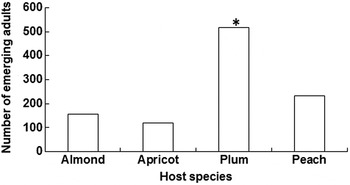
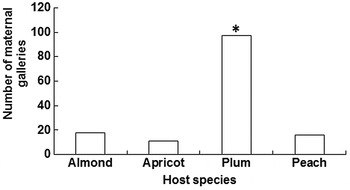
Under laboratory conditions, the infestation on plum was significantly more prevalent than on the other trees, based on the sums of emerging adults (fig. 1) and maternal galleries (fig. 2).
Number of emerging adults of S. amygdali from four hosts (almond, peach, plum, and apricot). Symbol ‘*’ shows highest sum of emerging adults.

Number of maternal galleries made by S. amygdali on four hosts (almond, peach, plum, and apricot).

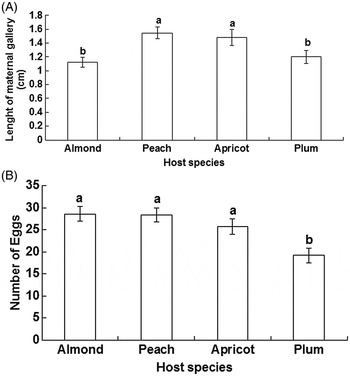
The average length of examined maternal galleries of S. amygdali was 1.338 cm (± 0.7). It was 1.548 (±0.08) on peach, 1.484 (±0.11) on apricot, 1.2 (±0.09) on plum, and 1.12 (±0.07) on almond (fig. 3A). Although mean gallery length was greater for peach branches (fig. 3A), it did not vary significantly between the four tested hosts (F = 4.888, df = 3, P = 0.003*). There was also a significant variation for the number of eggs per gallery on different hosts (F = 6.67; df (3); P = 0.000) (fig. 3B). There was a positive correlation between the length of maternal galleries and the number of eggs per gallery (R = 0.492, P = 0.000).
Reproductive performance of S. amygdali, assessed by measuring the length of maternal galleries of females (A) and the number of eggs laid (B) on four host tree species (almond, peach, plum, and apricot). Lowercase letters (a, b, and c) show the comparison between the host species for the same parameter studied (values with the same letter do not exhibit statistically significant variation). The bars show standard error.

Chronology
In laboratory conditions, the under-bark development period of S. amygdali, which is herein defined as the time frame between the making of the first entrance hole and the first exit hole, lasted 45 days on plum with a total emergence period of 47 days (table S1). In apricot, the under-bark development period was longer (65 days) and the emergence period was shorter (47 days) (table S1). The development period on peach (64 days) was not significantly different than that of apricot (table S1). The under-bark development period in almond was 56 days with a relatively short emergence period of 47 days (table S1). The beetles on almond, peach, and apricot had identical emergence periods, but different development periods (table S1). The beetles on plum exhibited different behavioral patterns than those on the other three hosts: A short development period and long emergence period (table S1). Larval development occurred most rapidly in plum, followed by almond, peach, and apricot. The wood of the plum trees appears to be more suitable for under-bark development of S. amygdali. Even though the infestation period differed by as much as 13 days between hosts, it was still remarkable to see the observed degree of variation in emergence period across hosts (fig. S2).
Infestation rates of S. amygdali females on different hosts
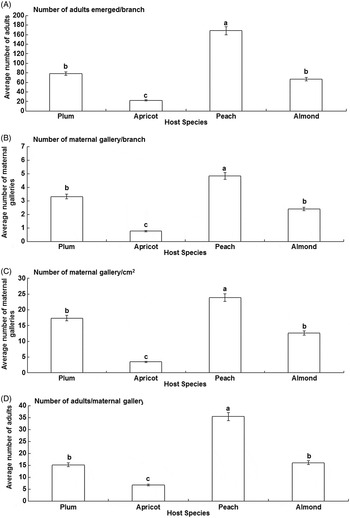
The infestation rates observed in the field experiment show that 54% (54/100) of the installed branches of the four hosts were infested by female S. amygdali. Females infested 84% (21/25) of the peach branches, 56% (14/25) of the almond branches, 52% (13/25) of the plum branches, and 24% (6/25) of the apricot branches. The chi-squared test, based off of the cross tab statistical test on hosts in the field, shows that the females of S. amygdali behave differently toward each of the four hosts, with relatively high preference for peach (χ2 = 18.196, df (3), P = 0.000). A similar pattern was observed when studying emergent adults from the four host species (F = 11.511, df = 3, P = 0.000). The amount of emergent adults per branch is greater on peach (168.24 ± 121.56) than on the other three species (fig. 4A). The number of maternal galleries per branch is also greatest on peach (4.84 ± 3.45) and significantly lower on apricot (0.76 ± 0.36). The number of maternal galleries per branch varies significantly between hosts (F = 5.769, df = 3, P = 0.0001) (fig. 4B). The number of maternal galleries per cm2 (F = 7.267, df = 3, P = 0.000) is significantly greater on peach 0.024 (±0.003) and significantly lower on apricot (0.003 ± 0.007) when compared to the values for plum and almond (fig. 1C). There is also a statistically significant difference between the numbers of emerged adults per maternal gallery (F = 6.114, df = 3, P = 0.001): this value is greater on peach (35.39 ± 39.47) than on the other three hosts tested (fig. 4D).
Description for the attack of S. amygdali on four host tree species (almond, peach, plum, and apricot). Lowercase letters (a, b, and c) show the comparison between the host species for the same parameter studied (values with the same letter do not exhibit statistically significant variation). The bars show standard error.

Discussion
Scolytus amygdali usually develops on species of Rosaceae such as Amygdalus communis, Persica vulgaris, Prunus armeniaca, and Prunus persica (Russo, Reference Russo1931; Janjua & Samuel, Reference Janjua and Samuel1941; Benazoun, Reference Benazoun1983, Reference Benazoun2004; Benazoun & Schvester, Reference Benazoun and Schvester1990; Cherif & Trigui, Reference Cherif and Trigui1990; Bright & Skidmore, Reference Bright and Skidmore1997; Ben-Yehuda et al., Reference Ben-Yehuda, Tolasch, Francke, Gries, Gries, Dunkelblum and Mendel2002; Youssef et al., Reference Youssef, Mostafa, Okil and Khalil2006; Alford, Reference Alford2007; Bolu & Legalov, Reference Bolu and Legalov2008, Zeiri et al., Reference Zeiri, Braham and Braham2011, 2014). However, this polyphagous pest has been recorded on many other hosts such as Malus domestica and Cedrus atlantica (Russo, Reference Russo1931; Janjua & Samuel, Reference Janjua and Samuel1941; Benazoun, Reference Benazoun1983; Benazoun & Schvester, Reference Benazoun and Schvester1990; Cherif & Trigui, Reference Cherif and Trigui1990; Talbi, Reference Talbi2010). Scolytus amygdali can switch hosts, moving from Rosaceae to forest trees. This polyphagous behavior in Scolytinae was previously reported by Balachowsky (Reference Balachowsky1963). Multiple researchers studying the behavior of beetles toward their hosts used similar studies to observe the host preferences of females offered a free choice, and to observe the emergence patterns of their offspring (Moeck et al., Reference Moeck, Wood and Lindahl1981; Benazoun, Reference Benazoun1983, Reference Benazoun2010; Belhabib et al., Reference Belhabib, Lieutier, Ben Jamaa and Nouira2009; Tiberi et al., Reference Tiberi, Faggi, Panzavolta, Sabbatini Peverieri, Marziali and Niccoli2009; Lee & Seybold, Reference Lee and Seybold2010; Buhroo, Reference Buhroo2012). Maternal galleries were longer in peach and apricot and shorter in plum and almond, with an overall average length of 1.338 cm (± 0.7). These galleries were shorter than the maternal galleries observed in C. atlantica, which were about 4.0 cm long (Beghami, Reference Beghami2010). Maternal galleries in almond yielded the greatest number of eggs, whereas the least number of eggs were collected from maternal galleries in plum. Fecundity of S. amygdali females was important on almond. On C. atlantica, a female of S. amygdali can lay 43 eggs (Beghami, Reference Beghami2010). In Morocco, the fertility of female S. amygdali was between 14.8 eggs per female (apricot) and 40.5 eggs per female (almond) (Benazoun, Reference Benazoun1983). A positive correlation between the length of the galleries and the number of eggs was observed. Similar results have been reported in other beetles (Sauvard, Reference Sauvard, Lieutier, Day, Battisti, Grégoire and Evans2004; Belhabib et al., Reference Belhabib, Lieutier, Ben Jamaa and Nouira2009).
In laboratory conditions, the greatest amount of maternal galleries and emerged adults were observed on plum, followed by peach, almond, and apricot. The under-bark life cycle of S. amygdali was relatively short for beetles on almond and plum and relatively long on apricot and peach. The total development cycle of S. amygdali lasted 103 days on almond, 111 days on peach, and 112 days on both apricot and plum. Our results are consistent with those of Benazoun (Reference Benazoun1983). These development times are significantly shorter than those of S. amygdali on forest trees, which is over 150 days (Beghami, Reference Beghami2010).Although females infested the plum branches more than the other host branches, they laid the least amount of eggs on plum. In contrast, the greatest number of eggs was laid on almond, implying that almond is the most preferred host of S. amygdali.
In this study, 54% of installed branches were infested in natural conditions. Infestation rates suggested that peach was greatly preferred by S. amygdali, whereas preference for apricot was significantly weaker. Similar selective behavior of S. amygdali has been observed previously (Benazoun, Reference Benazoun1983; Ben-Yehuda, Reference Ben-Yehuda2005). In our experiment, a significant difference was observed between hosts for the number of emergent adults: The number of emerged adults from peach was higher than on plum, almond, and apricot. Benazoun (Reference Benazoun1983) found that the greatest number of adults emerged from almond, followed by peach and plum, with the fewest adults emerging from apricot. Similarly, peach trees had the greatest amount of entrance holes and apricot trees had the least. The multiplication rate was also significantly different between beetles on the four hosts: It was greater on peach and less on apricot. Benazoun (Reference Benazoun1983) found similar results for the same species: a multiplication rate ranging 28.7–61. The infestation density varies between host species; density is greatest on peach and lowest on apricot. Based on these results, S. amygdali appears to have weak host preference for apricot, though it has been reported on apricot in Baluchistan (Janjua & Samuel, Reference Janjua and Samuel1941). Our results also show that the S. amygdali had the greatest host preference for peach. These observations are inconsistent with Benazoun (Reference Benazoun1983) and Ben-Yehuda (Reference Ben-Yehuda2005), who observed that the almond is the most preferred host species of S. amygdali. The contradiction between our results and that of previous studies might be due to difference in experimental designs, our study has more repeats. In addition, it might be due difference in population of S. amygdali or host tree varieties used in this study (Ahmed et al., Reference Ahmed, Naveed, Noor ul Ane, Ren, Barro and Qiu2014). On C. atlantica, S. amygdali have been reported as producing 15 galleries per branch and 154 galleries per m2, with an infestation frequency of 42% (Beghami, Reference Beghami2010).
A lot of the recent bark beetle research focuses on bark beetles’ ability to communicate and interact with host trees by utilizing a wide array of semiochemicals (Byers, Reference Byers2012). Secondary metabolites such as terpenes or phenols may be responsible for variation in insect performance among trees (Belhabib et al., Reference Belhabib, Lieutier, Ben Jamaa and Nouira2009). Most bark beetles species are oligophagous but show preferences for certain tree species (Wood, Reference Wood1982; Kirkendall, Reference Kirkendall1983). Ethylene has been reported as an attractant for Phloeotribus scarabaeoides (Rodríguez et al., Reference Rodríguez, Campos, Raya and Peña2003). Some field bioassays indicate that the differences in concentrations of monoterpenes have different effects on colonization rates of Ips typographus (Reddemann & Schopf, Reference Reddemann and Schopf1996). Ascher et al. (Reference Ascher, Guervitz, Renneh and Nemny1975) found that female Scolytus rugulosus [=mediterraneus (Eggers)] were deterred from feeding on peach twigs after the twigs had been soaked in hexamethylditin. Levy et al. (Reference Levy, Ishaaya, Gurevitz, Cooper and Lavie1974) cited three flavonoids made from apricot bark that stimulate bites by S. rugulosus: taxifolin, pinocembrin and dihydrokaempferol. The response of beetles to these flavonoids significantly differed from their response to other compounds. They were much more active in the presence of these stimulating chemicals when compared to beetles exposed to naringenin, quercetin, kaempféro 5,7- dihydroxy-2-methyl-chromone, and scopoletin. Taxifolin showed a stimulating effect on S. rugulosus, Scolytus mediterraneus, and Scolytus multistriatus (Levy et al., Reference Levy, Ishaaya, Gurevitz, Cooper and Lavie1974; White, Reference White1992). These results indicate that these three flavonoids are involved in attracting the bark beetles and inducing infestation. Gourevitz and Ishaaya (Reference Gourevitz and Ishaaya1972) indicated that the response of S. rugulosus to the infested bark is stronger than to the non-infested bark (Vite & Renwick, Reference Vite and Renwick1968). Additional studies on the behavioral response of bark beetles that attack forest trees were carried out by multiple authors (Coster, Reference Coster1970; McNew, Reference McNew1970; Renwick, Reference Renwick1970; Silverstein, Reference Silverstein and Beroza1970; Bernays & Chapman, Reference Bernays and Chapman1994).
Studies have demonstrated that the macerated leaves and branches of species in the genus Prunus (Rosaceae: Amygdaloideae) act as natural pesticides because they contain numerous volatile organic compounds, including 2-propanol, hexanal, trans-2-hexenal, 1-hexanol, cis-3-hexenol, mandelonitrile, benzoic acid, benzaldehyde, benzyl alcohol, and hydrogen cyanide. These compounds can be isolated and reformulated to create a concentrated standard solution. When properly applied, these extracts can be used as control agents against insects (U.S. Patent No.: 7.195.788).
Conclusion
Scolytus amygdali is a polyphagous pest that mainly develops on fruit trees in Rosaceae, but can alter its behavior and adapt to alternate hosts (e.g., forest trees). Out of the four Prunus species tested in this study, peach appears to be the most preferred host of S. amygdali. The beetles also demonstrate some preference for plum and almond, but very weak preference for apricot. The development cycle of S. amygdali appears to be influenced by the female's selection of a host for oviposition, with adults developing significantly faster on plum trees and significantly slower on apricot trees.
Supplementary material
The supplementary material for this article can be found at http://www.journals.cambridge.org/BER
Acknowledgements
The author thanks David Plotkin (Florida Museum of Natural History, University of Florida, USA) for his comments and help in revising the language of our manuscript. The authors also thank Regional Center of Horticulture and Biological Agriculture and Olive Institute, Sousse, for their help in collection of data.