INTRODUCTION
Wild ruminants can harbour a high density of ticks that can transmit several organisms, many of which cause diseases of veterinary and/or public health importance. Tick-borne diseases affecting wild ruminants have been reported around the world. One of these diseases is piroplasmosis, caused by Theileria and Babesia species. Although some of them are benign or low pathogenic species, others can cause diverse symptomatology and even death. Infection with Theileria has been reported in several deer species. Theileria cervi has been found in white-tailed deer and elk (Chae et al. 1999; Yabsley et al. 2005). Theileria capreoli was described in roe deer by Rukhlyadev in 1939 and more recently a sequence of the 18S rRNA gene amplified from roe deer blood has been deposited in GenBank, although no thorough characterization is yet available. Another unclassified Theileria sp. has been reported in sika deer (Inokuma et al. 2004). In Europe, Babesia divergens and Babesia capreoli are implicated in cervid babesiosis. B. divergens, a species widely studied in cattle and the most common agent of human babesiosis in Europe (Kjemtrup and Conrad, 2000; Zintl et al. 2003), has been described in several deer species such as reindeer, roe deer and red deer (Langton et al. 2003; Duh et al. 2005b). B. capreoli, phylogenetically very similar to B. divergens, has also been observed in red deer and sika deer (Gray et al. 1991). On the other hand, Babesia odocolei has been reported as the agent responsible for babesiosis in deer species from America such as white-tailed deer, reindeer and elk (Holman et al. 2000, 2003). Also in America, an unclassified babesia has been reported in reindeer (Holman et al. 2002) and mule deer (Yabsley et al. 2005). A new Babesia, identified as Babesia sp. EU1 and more closely related to B. odocoilei than to B. divergens (Herwaldt et al. 2003; Duh et al. 2005a), was recently described in cervids from Slovenia (Duh et al. 2005a,b) and it has been implicated in cases of human babesiosis in Europe (Herwaldt et al. 2003). Although in the USA human babesiosis is mainly caused by Babesia microti, a babesia closely related to those isolated from wild ungulates (the WA1-type, recently described as a distinct species, Babesia duncani) has also occasionally been reported in humans (Persing et al. 1995; Kjemtrup and Conrad, 2000; Conrad et al. 2006). Similarly, isolates infecting cottontail rabbits in the USA have been shown to be identical to B. divergens (Goethert and Telford, 2003). In this context, the study of wildlife species as reservoirs of different pathogens is of major importance for the development of control strategies. However, little is known about tick-borne diseases in wild ruminants in Spain. Studies on piroplasmosis in wildlife ungulates from Spain are restricted to a few seroprevalence studies or case reports (Ferrer et al. 1998a,b; Marco et al. 2000; Hofle et al. 2004; Hurtado et al. 2004). In this study, red deer, roe deer and chamois were examined for molecular evidence of infection with babesias and theilerias with the aim to (i) increase knowledge of the epidemiology and diversity of piroplasms parasitizing these wildlife species; (ii) compare the piroplasm species infecting wild and domestic ruminants, and (iii) investigate the potential role of wildlife as reservoir of zoonotic pathogens.
MATERIALS AND METHODS
Sample collection
This study was conducted in the Basque Country and in Catalonia, 2 regions in Northern Spain, where animals live in open areas. Twenty-eight (9 male and 19 female) red deer (Cervus elaphus) and 69 (47 male and 22 female) roe deer (Capreolus capreolus) originating from the Basque Country were collected between 2001 and 2005. All red deer samples were collected during the hunting season (November–February) whereas roe deer were obtained throughout the year after being hunted (February–June, 22 animals), found with traumatisms (44), or dead by other causes (cachexia, stress and pneumonia). In roe deer ages ranged from 2 months to more than 10 years and in red deer all the animals except 2 were adults. Animals were classified into 3 age categories: fawns (<1 year), yearlings (red deer 1–3 years and roe deer 1–2 years), and adults (red deer >3 years and roe deer >2 years). A sample of 38 (20 male and 18 female) Pyrenean chamois (Rupicapra pyrenaica pyrenaica) from Catalonia was also analysed. Chamois samples were obtained after being hunted (16) or captured alive in healthy conditions (5) or diseased: pestivirus infection (14), contagious ecthyma (1), pneumonia (1) and toxoplasmosis (1). Information regarding pestivirus infection in some of these animals has been reported elsewhere (Hurtado et al. 2004). Ages ranged from 2 months to 11 years, and they were classified into 3 age groups according to the horn rings: kids (<1 year), yearlings (1–3 years), and adults (>3 years).
Blood samples were collected in EDTA containing tubes and both blood and tissue samples were stored at −20 °C until subsequent DNA purification and hybridization analysis. Whenever possible ticks were collected, counted and classified (Gil-Collado et al, 1979; Manilla, 1998).
DNA extraction
DNA was extracted from 22 blood samples (9 red deer and 13 chamois), 112 spleen samples (19 red deer, 69 roe deer and 24 chamois) and 1 kidney (1 chamois). DNA was extracted using the QIAamp DNA Mini kit (Qiagen, Hilden, Germany) for DNA purification from whole blood and the standard phenol/chloroform extraction protocol was used for tissues. DNA yields were subsequently determined with a NanoDrop® ND-1000 Spectrophotometer (NanoDrop Technologies, DE, USA).
PCR amplification and RLB hybridization
PCR amplification of the hypervariable V4 region of the 18S rRNA gene of the genera Theileria and Babesia, and the subsequent reverse line blot (RLB) hybridization with generic and specific probes were carried out as previously described for ovine, bovine and equine piroplasm species (Nagore et al. 2004a,b; Garcia-Sanmartin et al. 2006). Additionally, a new probe was designed to identify a new Theileria genotype (Theileria sp. 3185/02, GenBank Accession number AY421708) recently found in a red deer imported from Germany that died in Central Spain (Hofle et al. 2004). The probe was designed using Vector NTI 8.0 software (Informax Inc., North Bethesda, MD) and synthesized by MWG Biotech AG (Germany) with a C6 amino linker and the following nucleotide sequence: 5′-CGGTTATAAAATTTATTTTATTTCCG-3′. The specificity of the probe was tested against the following Theileria and Babesia species from cattle, horse, sheep, dog and wildlife: T. annulata, T. buffeli, B. bigemina, B. bovis, B. divergens, B. major, T. equi, T. equi-like, B. caballi, B. caballi-like, T. ovis, Theileria sp. OT1, Theileria sp. OT3, B. ovis, B. motasi, T. annae, B. canis canis, B canis vogeli, B. microti, Babesia sp. EU1 and Theileria sp. 3185/02. To exclude false positive results, negative controls included during DNA extraction and PCR amplification were subjected to RLB hybridization. The V4 hypervariable region of at least 1 strain of each genotype found in each animal species was submitted to a commercial subcontractor for automatic dye-terminator cycle sequencing.
Sequence comparison analysis
The sequences obtained were compared with the GenBank database by nucleotide sequence homology searches made at the network server of the National Center for Biotechnology Information (NCBI) using BLAST. Multiple sequence alignments were performed using the program AlignX (Vector NTI 8.0 suite, InforMax, North Bethesda, MD, USA) with an engine based on the ClustalW algorithm (Thompson et al. 1994).
Statistical analysis
Prevalence of each parasite species or combination was analysed according to independent variables such as host species, age category, sex, sample type (blood or tissue), capture conditions (hunted, with traumatisms or with others diseases) and tick infection by Chi square or Fisher exact test. P<0·05 was considered as significant.
Nucleotide sequence Accession numbers
The sequences of the 18S rRNA genes corresponding to Theileria sp. OT3 from chamois, red deer and roe deer, B. divergens from roe deer, Theileria sp. 3185/02 from roe deer, B. divergens from roe deer and T. ovis from chamois described in this work were deposited in GenBank under Accession numbers DQ866839-45, respectively.
RESULTS
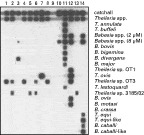
The new probe designed for Theileria sp. 3185/02 gave a positive result with the amplified 18S rRNA gene from the Theileria strain from red deer with GenBank acc. nr. AY421708 (Hofle et al. 2004), and no cross-reaction was observed when tested against the Theileria and Babesia species from cattle, horse, sheep, dog and wildlife used as controls (see Materials and Methods section). The inclusion of this new probe in the RLB panel allowed the detection of this theileria in red deer from the Basque Country, and for the first time, also in roe deer from the same area. Besides Theileria sp. 3185/02, two other theilerias, Theileria ovis and Theileria sp. OT3 (previously described in sheep from the Basque region) (Nagore et al. 2004b), and 1 babesia, Babesia divergens, were also identified among the wildlife samples included in this study (Fig. 1). However, whereas Theileria sp. OT3 was found in all 3 animal species analysed, Theileria sp. 3185/02 was found in both red and roe deer but not chamois, and T. ovis and B. divergens were only found in 1 species, chamois and roe deer, respectively.

Fig. 1. Reverse line blot macroarray of the PCR products generated by amplification of genomic DNA from wildlife samples and from pure plasmid DNA used as control. Oligonucleotide probes are indicated in rows, and samples are applied in columns as follows: lanes 1–8, field samples; lane 9, genomic DNA from uninfected roe deer; lane 10, Babesia sp. EU1 from an infected deer used as control; lane 11, mixture of bovine piroplasms 18S rRNA gene clones (note that cross-reaction occurs between the T. lestoquardi probe and the amplicon generated from T. annulata (Nagore et al. 2004b)); lane 12, mixture of ovine piroplasms 18S rRNA gene clones; lane 13, Theileria sp. 3185/02 18S rRNA gene clone; lane 14, mixture of equine piroplasms 18S rRNA gene clones.
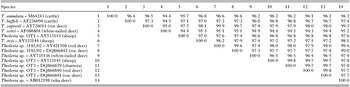
Although the RLB technique was proven to be specific (Gubbels et al. 1999; Nagore et al. 2004a,b), hybridization results from previously undescribed hosts were confirmed by sequencing. Thus, the complete 18S rRNA gene or the V4 region were sequenced from the piroplasms identified as Theileria sp. 3185/02 from 2 roe deer; Theileria sp. OT3 from 2 roe deer, 1 red deer and 3 chamois; B. divergens from 4 roe deer; and T. ovis from 1 chamois. In all the cases sequencing analysis confirmed the RLB results. The sequences obtained in this study were compared with the GenBank database, and the similarity values for the complete 18S rRNA gene for the theilerias described in this study and related sequences from GenBank are shown in Table 1. Hence, the complete 18S rRNA gene sequences of Theileria sp. 3185/02 from roe deer (this study, acc. nr. DQ866842) and red deer (AY421708) were 99·6% identical and they were more than 99·7% identical to a sequence from a roe deer identified as T. capreoli in GenBank (Acc. nr. AY726011). The complete 18S rRNA gene of Theileria sp. OT3 from roe deer, red deer and chamois shared 99·7–99·8% similarity among themselves and with a sequence previously described in sheep from the Basque Country (Acc. nr. AY533145). Likewise, the V4 region of the 18S rRNA gene of T. ovis from the Catalonian chamois was 99·7% similar to the T. ovis identified in sheep from Spain (Acc. nr. AY533144), and at least 99·5% identical to other T. ovis sequences from sheep and goats available in GenBank. The V4 region of the 18S rRNA gene of four roe deer samples that hybridized with B. divergens was sequenced. Comparison of these sequences with the GenBank database identified B. divergens found in wild ruminants (GenBank Acc. nr. AY098643 from reindeer, and AY572456 from roe deer) and B. capreoli from roe deer (AY726009) as the closest matches. Hence, 3 of the 4 sequences determined in this study were identical to B. divergens (AY098643 and AY572456), and B. capreoli (AY726009) in the 416 nt. of the V4 region compared, whereas the fourth one varied in 3 nt. T at position 663 (AY572456 numbering) was a common feature of all the sequences from wild ruminants, but different from the B. divergens found in other hosts. Conversely, the sequences from wild ruminants shared a G at position 631 with B. divergens from humans and from cotton-tail rabbit (AY144688), and with other babesias isolated from humans like Babesia sp. MO1 (AY048113) and Babesia sp. BAB693W (AY274114), and differed from B. divergens found in cattle and Ixodes ricinus ticks, which carry an A at this position. Hence, sequence comparison grouped all the babesias from wildlife species together along with B. divergens and other B. divergens-like isolates of human origin.

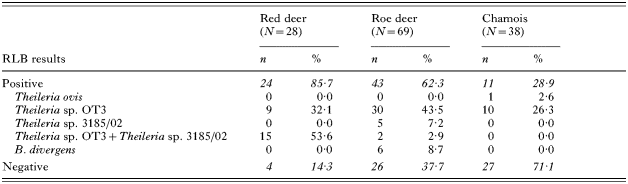
The total prevalence of piroplasms detected by RLB was significantly different between species: 85·7% in red deer, 62·3% in roe deer and 28·9% in chamois. The distribution of each haemoparasite among the different species is summarized in Table 2. Theileria sp. OT3 was found in the 3 animal species and always as the most prevalent piroplasm (85·7% in red deer, 46·4% in roe deer and 26·3% in chamois). Theileria sp. 3185/02 was significantly more abundant in red deer (53·6%) than in roe deer (10·1%) (P<0·05) and it was absent from chamois. B. divergens was restricted to 6 roe deer and T. ovis to 1 chamois. Mixed infections were only found in red and roe deer but not in chamois, and they were all made up of the combination of Theileria sp. OT3 and Theileria sp. 3185/02. In red deer Theileria sp. 3185/02 occurred always as a mixed infection with Theileria sp. OT3 and this combination was the most prevalent (P<0·05), accounting for 62·5% of the positive animals (15/24). This mixed infection was significantly more prevalent in red deer than in roe deer (P<0·05), since mixed infection was only found in 2 roe deer (4·7% positive animals, 2/43). Conversely, single infection with Theileria sp. OT3 was the most prevalent form of infection in roe deer (69·8% positive animals, 30/43) (P<0·05). Theileria sp. 3185/02 and Theileria sp. OT3 were found in every age category of roe deer, and the latter was more prevalent in adults than yearlings (P<0·05) whereas B. divergens was always found in yearlings. Among the 4 roe deer fawns analysed 1 was positive to Theileria sp. 3185/02 and 2 to Theileria sp. OT3. Interestingly, the prevalence of Theileria sp. OT3 was significantly higher (P<0·05) in the pestivirus-positive chamois (55·6%) than in those negative (17·2%). No infections with other species of piroplasms found in other wild ruminants such as Theileria cervi, Babesia odocoilei, Babesia sp. EU1 or Babesia sp. isolates RD61 or RD63 were found in this study. No differences between piroplasm infection (presence/absence and different species combinations) and sex of the animals, sample type and capture conditions were found.

Twelve red deer, 44 roe deer and 22 chamois could be examined for ticks. A total of 147 ticks were collected from 11 of the 12 red deer examined for tick infestation (mean 13·4; range (2–31) ticks/animal). No significant association was found between presence of ticks and infection status (P>0·05). I. ricinus was the most frequently found tick species accounting for 76·2% of all the ticks collected, followed by Haemaphysalis inermis (16·3%), Dermacentor reticulatus (4·7%), Dermacentor marginatus (1·4%), Haemaphysalis punctata (0·7%) and Rhipicephalus bursa (0·7%). 522 ticks were found in 34 of the 44 roe deer examined for ticks (mean 15·4; range (1–42) ticks/animal), 373 of them from 25 of the 28 Theileria-positive animals examined (25/28, 89·3%). An association was found between presence of ticks and infection with Theileria sp. (P<0·05). I. ricinus was the main tick species found in roe deer (97·9%), whereas the presence of other species was sporadic (0·9% of H. punctata, 0·8% of H. inermis and 0·4% of R. bursa). The genus Dermacentor was not found in roe deer. No significant differences were found between the number or the species of ticks collected and piroplasm infection (presence/absence and different species combinations) (P>0·05). Twenty-two chamois, corresponding to those not hunted, were examined for ticks, and only in 5 of them ticks were collected. In this case, ticks were identified but not counted. The tick species found were D. marginatus (3 animals, 2 of them positive to Theileria sp. OT3), H. punctata (1 animal positive to Theileria sp. OT3) and both Haemaphysalis sulcata and R. bursa (1 negative animal).
DISCUSSION
The technique used in this study allowed the simultaneous detection and identification of different Theileria and Babesia species using oligonucleotide probes whose specificity has been previously determined (Nagore et al. 2004a,b; Gubbels et al. 1999) and a new probe developed as part of this study. Besides, the catchall and genus-specific probes guarantee that no new species passed unnoticed. Thus, this survey led to the identification of 4 different piroplasms in the red deer, roe deer and chamois analysed.
The most prevalent piroplasm in red deer, roe deer and chamois was Theileria sp. OT3, which was also found with high prevalence (42·2%) in the ovine population of the Basque Country (Nagore et al. 2004b). The high prevalence found in cervids, and particularly in red deer (85·7%, i.e. all the positive red deer), suggests that deer might be the reservoir of Theileria sp. OT3 in wildlife and the source for ovine infection. Second in prevalence was Theileria sp. 3185/02, previously described in a red deer imported from Germany that died in Central Spain (Hofle et al. 2004). In this study, Theileria sp. 3185/02 was found with high prevalence in red deer from the Basque Country (53·6%) and, though at lower prevalence (10·1%), also in roe deer. Sequencing analysis of the complete 18S rRNA gene confirmed that the theileria identified as Theileria sp. 3185/02 in red and roe deer in this study were the same as that recently found in a roe deer from Galicia (Spain) and identified as Theileria capreoli in GenBank (Acc. nr. AY726011), and very similar to Theileria sp. strains obtained from Cervus nippon yesoensis (e.g. AB012195, AB012198). This high similarity suggests that we are dealing with the same piroplasm species. Finally, T. ovis was the theileria less frequently found and restricted to a Catalonian chamois kid that died from pneumonia.
Prevalence of babesia infection was much lower than that of theileria, and it was restricted to B. divergens-infection of roe deer (8·7%). The first report of naturally acquired babesiosis caused by B. divergens in cervids dates from 2003, when Langton et al. (2003) detected the parasite in a reindeer herd. More recently, Duh et al. (2005b) detected B. divergens in 54·9% of roe deer and in 16·7% red deer after analysing a similar number of animals as we did. B. capreoli has been isolated from red deer and sika deer and compared with B. divergens in morphological, serological and transmission studies (Gray et al. 1990). Gray et al. (1990) concluded that B. capreoli and B. divergens were closely related morphological and serologically, but described differences in host specificity. The 18S rRNA gene sequence of a babesia from a roe deer from France has been recently deposited in GenBank identified as B. capreoli (AY726009). This sequence was identical in the V4 region to 3 babesias from roe deer identified in our study, and above 99·8% identical in the complete gene to other B. divergens from wildlife. Since neither morphological, serological nor molecular techniques can differentiate between B. capreoli and B. divergens, they should be considered the same species parasitizing different hosts. The differences in host specificity could also be interpreted as differences in infectivity associated with different strains, and therefore, further studies are needed to study strain-associated host-specificity to investigate this difference in infectivity.
In the Basque Country sheep and beef cattle spend several months in communal mountain pastures where they can get in contact with wildlife species. In addition, an increment has been recorded in the cervid population in the area over the last decades, and also in tick abundance (Barandika et al. 2006). Ixodes ticks feed on 3 hosts, one during each life stage, and this situation where mountain pastures are shared by different animal species favours the possibility of ticks biting different host and transmitting piroplasm species. Similarly, Pyrenean chamois share their habitat with cattle, goats, sheep and roe deer, and in some places also with red deer. Interestingly, a high seroprevalence of T. ovis has been reported in sheep and goats of the area (Ferrer and Castella, 1999). This contact with domestic animals would explain the presence of piroplasm species in hosts other than those where they were initially described. Detection of B. divergens in wildlife species has been described before (Duh et al. 2005b; Langton et al. 2003), but this is the first time that the presence of traditionally-considered ovine piroplasm species like T. ovis or the more recently described genotype Theileria sp. OT3 is reported in host other than sheep or goats. This variable host range is consistent with the close phylogenetic relationships of several Theileria species (Nagore et al. 2004b), and highlights the apparent lack of host specificity of piroplasm species discussed above. Conversely, Theileria sp. 3185/02 was only found in red and roe deer but not in chamois, and likewise, no hint of its presence was found in a previous study carried out in the ovine population of the Basque Country (Nagore et al. 2004b). However, the specific probe for Theileria sp. 3185/02 was not used in that previous study, and therefore, further studies are needed before confirming its specificity for deer.
Several species of ticks were collected from red and roe deer, but I. ricinus was the most prevalent and in the case of roe deer almost the only tick species found (97·9%). I. ricinus is also the most abundant tick in the vegetation of the Basque Country (Barandika et al., 2006), and it is known to be the vector of B. divergens (Zintl et al., 2003). Only 2 of the 6 roe deer positive to B. divergens could be examined for tick infestation; no ticks were seen in one of them and 13 I. ricinus ticks were collected from the other. In Catalonia, however, I. ricinus is not so common and other tick species like D. marginatus, R. bursa or H. punctata are more prevalent. Although no ticks were collected from the chamois positive to T. ovis, R. bursa is known to be the vector of this piroplasm species. In addition, we have also detected T. ovis DNA in I. ricinus ticks from the vegetation (unpublished results). Although the tick vectors of Theileria sp. 3185/02 and Theileria sp. OT3 have yet to be identified, given the high prevalence of Theileria sp. 3185/02 in deer and of Theileria sp. OT3 in wild ungulates and sheep, ticks of the highly abundant genus Ixodes are most probably involved in the Basque Country. However, in other areas like Catalonia the vectors might be other tick species. Further studies on questing ticks from the vegetation are in progress to evaluate this hypothesis.
Although severe parasitaemia in combination with high population density and poor nutrition can lead to clinical piroplasmosis (Yabsley et al. 2005), clinical signs are not normally associated with wildlife. In this study, most of the cervids were apparently healthy and, whenever analysed, haematological parameters were within the normal ranges (data not shown) suggesting that they were chronic asymptomatic carriers. Absence of clinical signs in bovine babesial infections in endemic areas is associated to the so-called inverse age resistance (Zintl et al. 2005). Resistance to disease (but not to infection) has been observed in calves infected with B. divergens in endemic areas. A similar phenomenon could explain the situation found in wildlife ruminants, which occupy areas with high infection pressure. Hence most animals would become infected as fawns (the 6 roe deer positive to B. divergens were yearlings) and acquire immunity without showing clinical symptoms. Immunity in older animals would be reinforced by repeated tick challenge. This mechanism would allow the parasite to establish persistent reservoir infections early in the life of the host favouring survival and transmission. Regarding theilerias, where this phenomenon has not been described, we can hypothesize that the species found are not pathogenic for cervids and do not normally elicit clinical disease. In the case of chamois, however, several animals were found to have lower than normal red blood cell counts, haematocrit, and haemoglobin values, and forms compatible with Theileria spp. were seen by microscopical examination in 2 chamois (data not shown). In fact, piroplasmosis was the initial evidence for the unspecific signs later associated to pestivirus infection (Hurtado et al. 2004). The immunosuppressive effect of pestiviruses might have favoured the infection with Theileria. In any case, in this study infection with Theileria sp. was observed to occur early in life (as young as 2 months old) since the only kid chamois and 3 of the 4 roe deer yawns analysed were positive. Similarly, infection with T. cervi has been reported in white-tailed deer fawns (Waldrup et al. 1992; Yabsley et al. 2005).
The high sensitivity of the technique used allowed the detection of subclinical infections and the survey revealed an infection rate much higher than expected, particularly in red deer. This fact, added to the lack of host-specificity, are of serious concern in terms of piroplasmosis control, since these results suggest that a considerable number of wildlife animals are chronic asymptomatic carriers that may serve as reservoirs of the infection. These results highlight the importance of wildlife surveillance surveys to study the potential role of wildlife as reservoir of piroplasmosis and other zoonosis and the risk of wildlife translocation.
The authors thank Dr Ramón A. Juste (NEIKER) for critical reading and helpful comments on the manuscript. We would also like to thank all those who kindly provided us with control samples for this study: Dr Tatjana Avsic-Zupanc (University of Ljubljana) for Babesia sp. EU1, Dr Tomás Camacho (Laboratorio Lema and Bandín, Vigo) for T. annae, Dr García Fernández (CIFA, Granada) for T. annulata, Dr. Sonia Almería (Universidad Autónoma de Barcelona) for T. ovis and Dr Monika Zahler-Rinder (Ludwig Maximilians Universität of Munich) for B. microti. This work was conducted under financial support from the Instituto Nacional de Investigación y Tecnología Agraria y Alimentaria (INIA) (Projects RTA02-001 and RTA03-074-C2-1), and the Departamento de Agricultura y Pesca del Gobierno Vasco. We wish to thank GADEN (Grupo Alavés para la Defensa y Estudio de la Naturaleza), ACCA (Asociación de Cotos de Caza de Alava), and ‘Departamentos de Agricultura y Medio Ambiente de las Diputaciones de Araba, Bizkaia y Gipuzkoa' for providing the animal samples. J.G. is the recipient of a pre-doctoral fellowship from INIA.