Introduction
Disaster planners, administrators, and society think that health care personnel, firefighters, and other similar professional experts who are assigned to work in times of disaster are willing to work in any disaster.Reference Stergachis, Garberson, Lien, D’Ambrosio, Sangare and Dold 1 , Reference Iserson, Heine, Larkin, Moskop, Baruch and Aswegan 2 However, when looking at the current situation, it is seen to be the reverse. For instance, 25 nurses were laid off or discharged from their duty because of their unwillingness to work after Hurricane Frances, which occurred in the USA in 2004.Reference Qureshi, Gershon and Sherman 3 In Toronto (Canada), 25.0% of nurses did not want to work since they feared contamination of acute respiratory distress syndrome (SARS).Reference Imai, Takahashi, Hasegawa, Lim and Koh 4
In some conducted research studies, several factors have been found related to willingness of persons to work in a disaster. The type of disaster, individual demographic factors, family factors, and workplace factors are some of them.Reference Arbon, Ranse and Cusack 5 - Reference Burke, Goodhue, Chokshi and Upperman 8 Directly stated factors affecting the willingness to work of personnel are: not having personal or family security, not having sufficient protective equipment, having some dependent family members, and not being educated about disasters.Reference Qureshi, Gershon and Sherman 3 , Reference Gullion 6 , Reference Delaney 7 , Reference Schechter 9 , Reference Charney, Rebmann and Flood 10 According to the results of a study made by Lanzilotti et al, while 90.0% of the nurses wanted to work out of the hospital in a possible disaster, willingness rates to work were 59.0% for chemical disasters, 53.0% for biological disasters, 49.0% for contagious diseases, and 45.0% for radiological disasters.Reference Lanzilotti, Galanis, Leoni and Craig 11 In another research study conducted with firefighters in the USA, while 68.8% of the participants stated their willingness to work in a flu epidemic, only 30.4% of the participants stated their willingness even if one of his family members got sick.Reference Delaney 7
Firefighting is an important profession. In any disaster, the fire department is the first institution to call.Reference Kramer 12 Firefighters are on duty for many vital functions, including fire extinguishing, search and rescue works, and evacuation of disaster victims to a safe zone.Reference Fushimi 13 For that reason, fire departments should be prepared for disasters. Any kind of simple planning and any effort which is spent to understand the structure of disasters may provide a safe and successful response of firefighters to disasters.Reference Adiguzel 14 Another important issue in disaster planning of fire departments is personnel planning. In case of a disaster situation, it is vital to have willing personnel to work in disasters. In the international literature, type of disaster, individual demographic factors, family factors, and workplace factors have been identified as factors that influence health care personnel’s willingness to work during a disaster.Reference Arbon, Ranse and Cusack 5 However, little is known about firefighters and firefighter candidates’ willingness to work in a disaster. Civil defense and firefighting programs in Turkey educate and train students who can participate in search and rescue work in every kind of disaster, particularly in fires. Identification of some characteristics of students who choose this program, and willingness of them to work in disasters after graduation, is important.
Therefore, it was aimed to identify the willingness of students (of civil defense and firefighting programs) to work in disasters after graduation and the factors associated with willingness.
Method
The universe of this descriptive, epidemiological study was 1,116 students of civil defense and firefighting programs in Turkey. They were from 11 different universities. In the research study, a sample was not chosen as it was aimed at reaching the whole universe. Students who refused to participate in the survey and students who were not present in the class for any reason at the time of the survey were excluded in the study.
Overall participation rate in this study was 65.5% (n=733). Participation rate was not uniform among universities, grades, and education type (daytime or evening). Totals of 67.7% (n=564) and 58.3% (n=165) of students participated in the study were in daytime and evening education, respectively. Similarly, 72.9% (n=439) of freshman students and 56.8% (n=292) of sophomore students participated in the study. The participation rates for 11 universities are as follows: 40.6% (n=133) for Kocaeli; 60.5% (n=49) for Yalova; 61.8% (n=55) for Istanbul; 67.5% (n=129) for Akdeniz; 76.3% (n=58) for Namik Kemal; 79.3% (n=73) for Karabuk; 79.5% (n=31) for Ataturk; 85.0% (n=68) for Ege; 92.0% (n=69) for Giresun; 100.0% (n=40) for Gaziantep; and 100.0% (n=26) for Bitlis.
A standardized survey form of 58 questions was initially prepared by researchers and was reviewed by two separate disaster specialists. In order to identify poorly stated and unclear questions, a pilot study was conducted with the revised version and participation of 10 students registered to the Emergency and Disaster Management program in Canakkale University (Canakkale, Turkey).
One of the authors visited each school and conducted the survey. Data were collected in every school under observation between April 1st and April 25th, 2013. The survey form (available online as supplementary material) consisted of questions related to students’ socio-demographic characteristics, health conditions, experiences about disasters and fires, willingness to work in disasters after graduation, and the education received at school.
In the study, SPSS 20.0 statistical package program (IBM Corporation; Armonk, New York USA) was used for the analysis of data. The descriptive statistics, namely arithmetic average, median, and standard deviation, were used. Chi-square test (Pearson and Fischer) was used to analyze the relationship between dependent (willingness of student to work in disaster) and independent variables (age, sufficiency of received income, university of student, living place, grade of student, type of education, if exercising regularly, nutrition situation, smoking, drinking alcohol, if having a hobby related to disaster, if having a phobia, experience of disaster, being educated about disaster, and if satisfied with the received education). Multi-variate logistic regression modeling was used to determine the factors affecting the willingness of students to work in disasters. The factors determined as factor/mixing and/or the variables with P value of .20 or less, pertaining to relations with dependent variable in binary analysis, were put into modeling simultaneously. Statistically significance level was assumed as P<.05 in all analyses.
For the study, written permissions were received from relevant schools, Hacettepe University (Ankara, Turkey) Non-Interventional Clinical Research Ethics Board (GO 13/220-11.04.2013), and the participants. This study was financed by Hacettepe University.
Results
Overall, 733 of 1,116 students (65.5%) participated in the study and fully filled out the questionnaires.
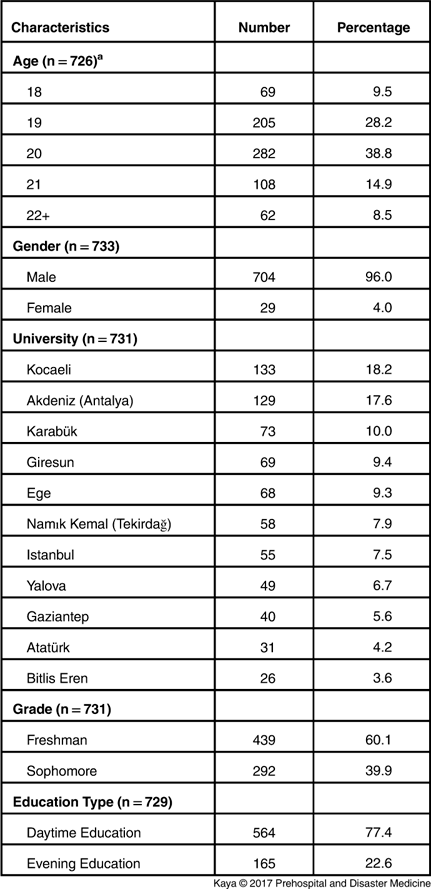
The mean age of students was 20.0 (1.8) years (median: 20; minimum: 17; maximum: 42). The group of 20-year-olds consisted the largest age group (282 people; 38.8%). A total of 96.0% of students (704 people) were male. The participant students were mostly from Kocaeli University (133 people; 18.2%) and Akdeniz University (129 people; 17.6%). Of all, 60.1% (439 people) of participants were freshman students; 77.4% of students (564 people) were from daytime education (Table 1); and 99.3% of students (727 people) stated they were single.
Distribution of Students According to Their Socio-Demographic Characteristics

a Mean (SD): 20.0 (1.8) years; Median: 20; Minimum: 17; Maximum: 42.
Only 4.7% of students (34 people) stated that there was someone hindering them from being away from home in times of disasters. Most of the hindering people (20 people) were from the group of grownups. Students stated that the one hindering them from work in disasters was mostly their mother (11 people) and father (four people). Students explained the special situation of the hindering people as being seriously sick (four people).
A total of 43.5% of the students (315 people) stated that they experienced any kind of disaster. While 90.8% of the students (267 people) mentioning the type of disaster that they experienced said that they experienced an earthquake, 81.5% of the students (251 people) experienced it very lightly and did not experience any loss of life or property.
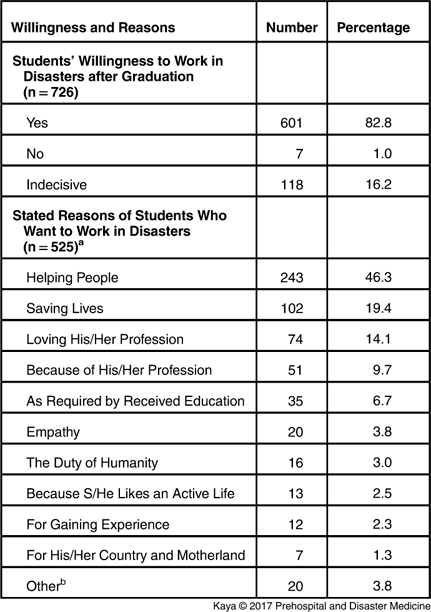
Most of the students (601 people; 82.8%) stated that they wanted to work in disasters after graduation. Of all, 46.3% of the students (243 people) who stated willingness to work in disasters after graduation mentioned that they wanted to work in disasters because they wanted to help people (Table 2).
The Students’ Willingness to Work in Disasters After Graduation and Their Reasons

a Row percent is taken.
b Because there are conscientious and moral aspects of it (4); Because s/he likes to work in disasters (4); Because of having a heroic feeling (3); Because taking a role in any kind of disaster is his/her biggest dream (2); Because s/he has eagerness to learn and work (2); Because working in disasters is voluntary (2); and Because s/he is interested (2).
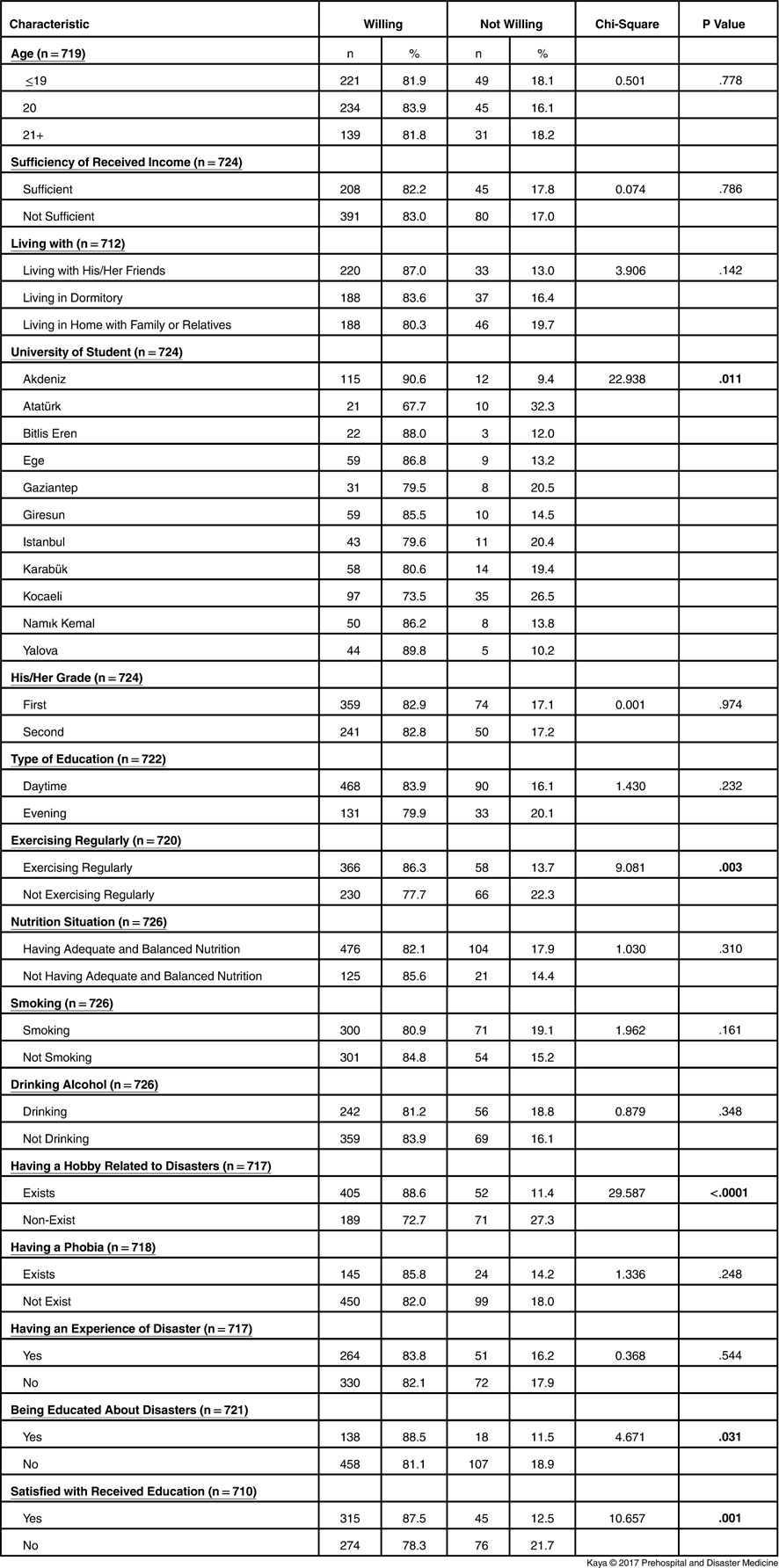
Binary analyses were made pursuant to several features after uniting “indecisive” and “not willing” groups, showing the willingness situation to work in disasters after graduation. In conducted analyses, “university of student,” “exercising regularly,” “having a hobby related to disaster,” “having education about disaster,” and “a sense of satisfaction for received education” have been found statistically significant (P<.05; Table 3).
The Distribution of Students’ Willingness to Work in Disasters after Graduation, According to Some Characteristics

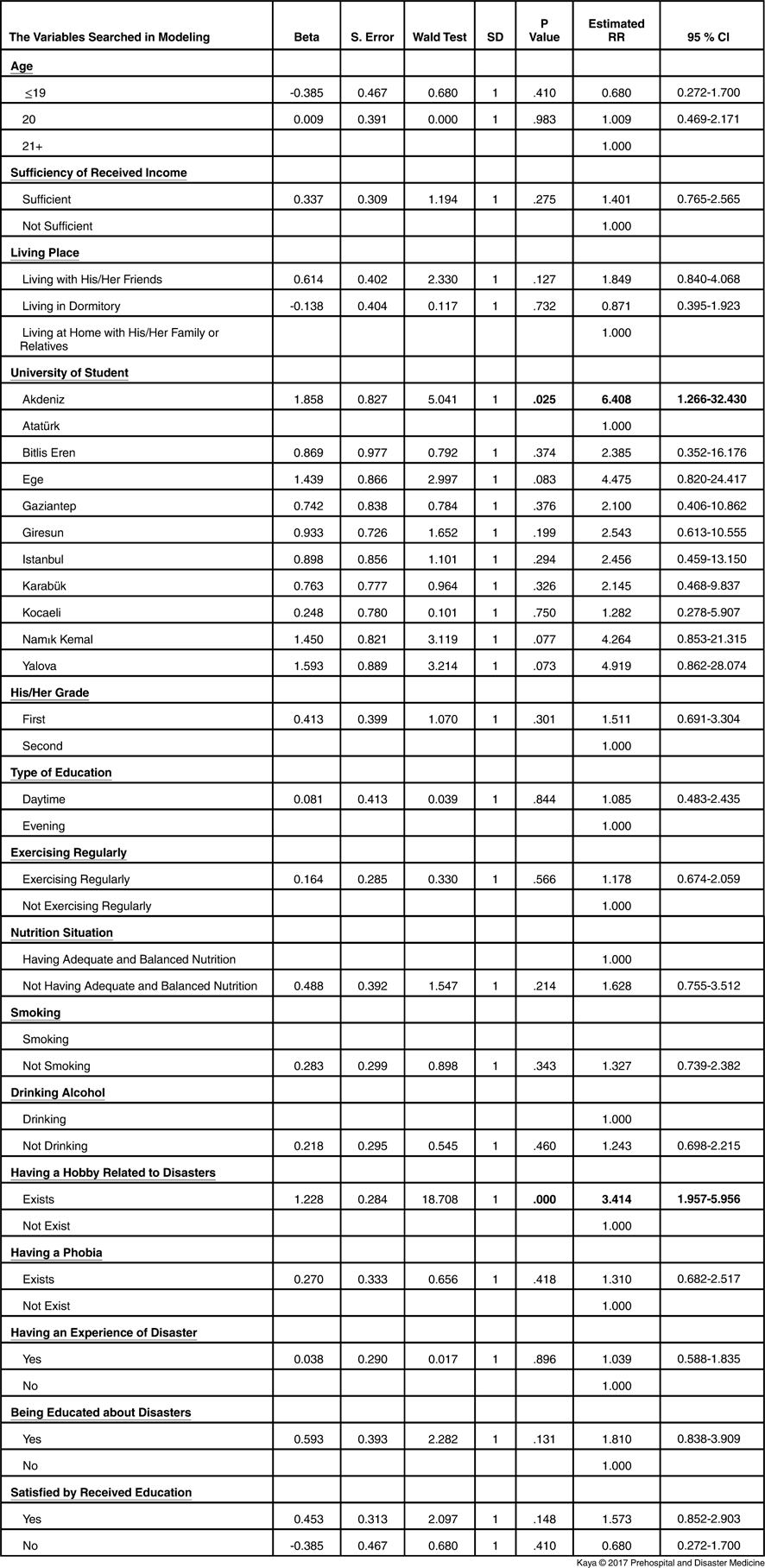
When the willingness situation of students to work in disasters after graduation (ref=not willing) was analyzed with multi-variate analysis by providing simultaneous control for logistic regression modeling and several other factors, “university of students” and “if having a hobby related to disasters” were found relevant in a statistically significant level.
When the difference between universities for students’ willingness to work in disasters after graduation was analyzed, Atatürk University was taken as a reference, which was found relevant with the least willingness level in binary analysis. The students of Akdeniz University were found to be 6.408 (95% CI, 1.266-32.430) times more willing to work in disasters after graduation. The students’ willingness to work in disasters after graduation and its relation with their universities was found to be statistically significant. Having a hobby (ie, mountain climbing, diving, and cave exploring) which could be useful in responding to disasters increased the students’ willingness to work in disasters 3.414 (95% CI, 1.957-5.956) times compared to those who did not have a hobby (Table 4).
The Factors Affecting the Willingness of Students Who Want to Work in Disasters After Graduation - Multi-Variate Logistic Regression Modeling

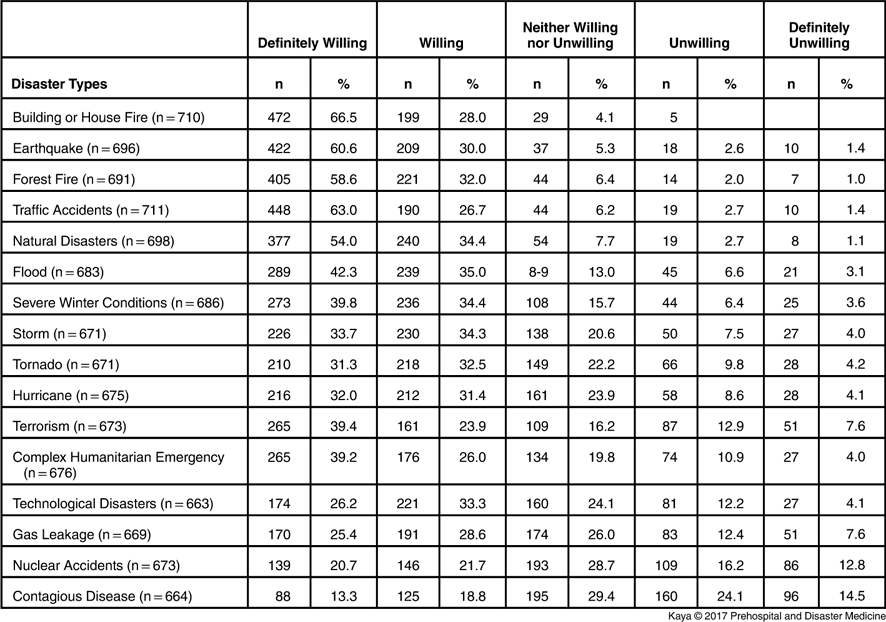
Building and house fires (671 people; 94.5%), earthquake disasters (631 people; 90.6%), and forest fire disasters (626 people; 90.6%) were the kinds of disasters in which students were most willing to work in after graduation. Contagious disease disasters (213 people; 32.1%) and nuclear accident disasters (285 people; 42.4%) were the kinds of disasters in which students were least willing to work in after graduation (Table 5).
The Students’ Willingness to Work in Different Types of Disasters after Graduation

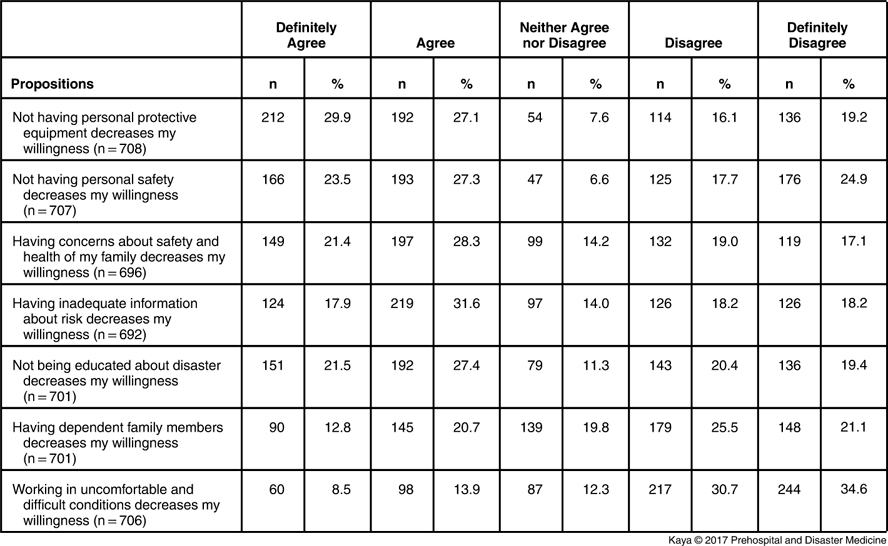
While most (404 people; 57.0 %) of the students stated that they agreed with the proposition of “not having personal protective equipment” among the situations affecting willingness to work in disasters after graduation, fewest (158 people; 22.4 %) of the students mentioned that they agreed with the proposition of “working in difficult and uncomfortable conditions decreases my willingness to work” (Table 6).
The Opinions of Students Regarding Several Propositions that may Affect Their Willingness to Work in Disasters after Graduation

Discussion
Overall, 96.0% of the participant students (704) were male. In a similar study, which was conducted in the Ankara Fire Department previously, it was identified that 98.6% of the workforce was male.Reference Adiguzel 14 The fact that it is not being preferred by women, since firefighting is a difficult job requiring physical strength, may explain this situation. This gender inequality may be seen in other fire departments throughout the world. For example, while there were not any female firefighters in many metropolis fire departments in the USA, only 3.7% of the firefighters were female throughout the country.Reference Hulett, Bendick and Thomas 15
While 82.2% (601 people) of the students stated that they wanted to work in disasters after graduation, 16.2% (118 people) of them stated their indecision, and 1.0% of them stated their unwillingness to work in disasters after graduation.
The reason for 16.2% of the students (118 people) being unsure about working in disasters after graduation may be due to the fact that the students have seen the difficulties of the profession after starting school, and therefore have the idea of changing profession. Also, the students may have chosen the program only because they could not earn a high enough score from the university entrance exam to have other professions of which they wanted. On the other hand, students may have different career ideas, such as starting a degree program.
When looking at the willingness of students to work in different kind of disasters, building and house fires (671 people; 94.5%), earthquake disasters (631 people; 90.6%), and forest fire disasters (626 people; 90.6%) were the kinds of disasters in which students were mostly willing to work in after graduation. Contagious disease disasters (213 people; 32.1%) and nuclear accident disasters (285 people; 42.4%) were the kinds of disasters in which students were least willing to work in after graduation.
Even though studies made with firefighters were very few, there have been many studies made with health care personnel. Conducted studies showed that willingness percentages of personnel may differ with respect to disaster types. In these studies, while personnel stated that they were more willing to work in airborne disease disasters and mass casualties, they also stated that they were least willing to work in radiological, nuclear, biological, and chemical disasters.Reference Lanzilotti, Galanis, Leoni and Craig 11 , Reference Smith 16 - Reference Martens, Hantsch and Stake 20 In a study conducted with firefighters in the USA, while 95.3% of the firefighters stated that they wanted to work in a disaster similar to the September 11, 2001 attacks in New York, 95.0% of them stated that they wanted to work in a possible hurricane and 69.7% of them stated that they wanted to work in a contagious disease epidemic.Reference Delaney 7 According to the results of a study made by Lanzilotti et al, while 90.0% of nurses wanted to work out of the hospital in a possible disaster, willingness rates to work in disasters were 59.0% for chemical disasters, 53.0% for biological disasters, 49.0% for contagious diseases, and 45.0% for radiological disasters.Reference Lanzilotti, Galanis, Leoni and Craig 11 In a study made by Martens et al, while 85.0% of the participants wanted to work in mass casualties and airborne disease disasters, only 22.0% of them stated that they wanted to work in biological and chemical disasters.Reference Masterson, Steffen, Brin, Kordick and Christos 19 In another study, while 84.1% of the participants stated that they wanted to work in a snowstorm, 64.8% of them wanted to work in smallpox epidemic.Reference Martens, Hantsch and Stake 20 In a study made by Kaya et al, with heath care personnel, it was found that while participants had more willingness to work in earthquakes (52.8%) and natural disasters (49.4%), they were less willing to work in disasters originating from nuclear accidents (22.5%) and contagious diseases (31.5%).Reference Kaya, Calıskan, Durak and Altıntas 21 In almost all previously conducted studies, while personnel stated that they were more willing to work in airborne disease disasters and mass casualties, they were least willing to work in radiological, nuclear, biological, and chemical disasters, and this is compatible with this study. In this study, students’ mentioning of more willingness to work in fire-related disasters may be resulted from the fact that they assimilated firefighting with fire extinguishing. It is a normal and expected situation that people’s willingness to work in nuclear accidents and with contagious diseases, potentially including high personal risks, is low. Fire departments should absolutely consider in personnel planning that personnel may not want to work in disasters with high risk, like nuclear accidents and contagious diseases.
In chi-square analysis, which was done to examine the relationship of willingness of students to work in disasters after graduation with several factors, variables of “university of student”, “if exercising regularly,” “if having a hobby related to disaster,” “if having been educated about disaster,” and “if being satisfied from the received education” were found statistically significant (P=.011, P=.003, P<.0001, P=.031, and P=.001, respectively). When students’ willingness to work in disasters after graduation (ref=unwilling) was analyzed with multi-variate analysis by providing simultaneous control for logistic regression modeling and several other factors, only “university of students” and “if having a hobby related to disasters” were found relevant in a statistically significant level. Having different willingness rates of students to work in disasters after graduation for each university may be related to the quality of the education of which the universities provide. Receiving poor/inadequate education may have caused them to be less willing to work in disasters after graduation. Besides, some universities might have built more awareness related to the willingness of students to work in disasters compared to others. Awareness levels may affect the willingness of students to work in disasters after graduation. To identify this thoroughly, there is a need for other studies supported by more detailed and qualitative studies. Each university should identify the reasons for willingness or unwillingness to work in disasters by conducting special and comprehensive studies.
Students having a hobby related to disasters may be more willing since they know the working conditions of this profession better than others. In addition, students having a hobby about disasters may have a hobby related to their profession because they already want to work in disasters. Supporting of hobbies (such as mountain climbing, swimming, walking, and similar activities increasing body strength), organizing classes and courses about them, and motivating students for these kinds of hobbies will undoubtedly contribute to their future professional life positively.
Students stated that not having personal protective equipment (57.0%), not having personal security (50.8%), having concerns about safety and health of their families (49.7%), having inadequate information about risk (49.5%), not being educated about disaster (48.9%), and having some dependent family members (33.5%) would decrease their willingness to work in disasters. Many conducted studies, in compliance with this study, showed that not having personal protective equipment, not having personal security, having concerns about safety and health of their families, having inadequate information about risk, not being educated about disaster, and having some dependent family members significantly decreased the willingness of personnel.Reference Qureshi, Gershon and Sherman 3 , Reference Delaney 7 , Reference Lanzilotti, Galanis, Leoni and Craig 11 , Reference Dimaggio, Markenson, G and Redlener 22 - Reference Considine and Mitchell 24 A study made by Rokach et al found that the willingness of health care personnel who come to work in an anthrax epidemic was 50.0% greater among the group with the highest knowledge about anthrax.Reference Rokach, Cohen, Shapira, Einav, Mandibura and Bar-Dayan 25 In another study, willingness of emergency nurses decreased with unknown chemical and biological agents.Reference Considine and Mitchell 24
Lowness of the number of students who stated “having dependent family members decreases the willingness” might have been resulted from the students being young, single, and not being aware of the situation since they did not have any dependent family members yet. Fire departments should provide safety for its personnel and their families, inform them about risks, and provide them with personal protective equipment in times of disaster.
Limitations
This study has some limitations. In addition to the overall low participation rate, the participation ratio is heterogynous with respect to universities, student grades, and their education type. The authors didn’t have information regarding sociodemographic characteristics of non-participants, and this is another limitation of this study. In four universities (Ataturk, Bitlis, Gaziantep, and Giresun), the program was newly established, and therefore data were collected from first grade students only. This study was a descriptive study and did not aim to have results generalizable to the target population. The authors aimed to reach all 1,116 students attending school, yet only 733 of them completed the questionnaire, 20 students did not accept to participate in the study, and the rest could not be reached as they were absent on the survey date. It is assumed that non-participation was not associated with study variables, and it was not expected to lead to a differential bias in selection. However, the study group is not necessarily representative of the target population, and given that the demographic information of all schools’ students was not known, there was no chance to compare participants’ demographic data with that of the target population. On the other hand, it was crucial to have a study conducted on this subject for the first time. Within this context, the findings of this study will make an important contribution to the studies on willingness to work in disasters, which are very limited in Turkey.
Conclusion
Overall,16.2% of the students stated that they were indecisive to work in disasters in the future, and 1.0% of them stated that they did not want to work in disasters. The willingness of the students to work in nuclear accident and contagious disease disasters was found to be lower compared to other disaster types.
Another important finding of this study shows that willingness of students to work during disasters decreases: (1) when their personal protective equipment and personal safety were not provided; (2) when they had concerns about family health and safety; (3) when they lacked information about risk; and (4) when they were not trained for particular disasters.
Supplementary Material
To view supplementary material for this article, please visit https://doi.org/10.1017/S1049023X17007087