Introduction
The importance of colour on ancient statues has long been overlooked, sometimes deliberately, as it is considered to contradict the value often accorded to the ‘purity’ of bare marble. That was the attitude notably supported by Winckelmann, who, despite being aware of polychromy, sought to champion the beauty of clean marble (Primavesi Reference Primavesi, Brinkmann, Hollein and Primavesi2010). The colouring of ancient sculptures is better understood today thanks to important studies conducted in Europe (Liverani Reference Liverani2004; Rosing & Østergaard Reference Rosing and Østergaard2009; Brinkmann et al. Reference Brinkmann, Hollein and Primavesi2010; Jockey Reference Jockey2013; Liverani & Santamaria Reference Liverani and Santamaria2014). Research, however, has so far mostly focused on Greek examples, and the meaning of this practice has not yet been fully clarified (Jockey Reference Jockey2013). Similar studies on Roman sculptures of mid and late Imperial times, by contrast, remain sparse (Abbe Reference Abbe and Brinkmann2010; Verri et al. Reference Verri, Opper and Deviese2010; Liverani Reference Liverani, Liverani and Santamaria2014), and the role of colour in the visual language of sculpture is poorly appreciated. This is despite Vitruvius (De Architectura 9, 2–4; Gros Reference Gros2015), Pliny (Natural History XXXIII, 122; Schmitt Reference Schmitt2013) and Plutarch (Moralia 287 B–C, De Gloria atheniensium 6, 348E; Frazier & Froidefond Reference Frazier and Froidefond1990), among other authors, describing the practice of colouring in the Roman and Roman-Hellenistic world. Combining material evidence with these literary sources offers the potential for new insight into the significance and use of sculptural polychromy: visibility, finish, realism and trompe l'oeil (Bradley Reference Bradley2009).
The sculptures of Roman Africa have never been studied extensively as a whole (Gauckler Reference Gauckler1897; Merlin et al. Reference Merlin, Lantier and Al Alawi1922; Chaisemartin Reference Chaisemartin1987; Baratte & Chaisemartin Reference Baratte, Chaisemartin, Friedland, Sobocinski and Gazda2015). Consequently, their polychromy has been afforded little consideration. An extensive project by a Franco-Tunisian team, led by Fr. Baratte and F. Bejaoui, aims to catalogue the Roman Imperial-period statues in the collections of the Bardo Museum in Tunis, broadly dating from the second to third centuries AD: this project provides a significant opportunity to study the use of colour in Roman statuary in Africa Proconsularis. In fact, 180 of the 500 documented sculptures show traces of polychromy that has already been analysed by visual observation using a Dino-lite video microscope. Many of these statues were found during excavations and hence have a documented provenance and context.
The theory of vision elaborated by Galen (second century AD) insists on the value of colour in visual perception, and documents the continuity of this Greek notion in the Roman world: statues are animated only through colour (Lucian, Imagines VI, 27; Ozanam & Bompaire Reference Ozanam and Bompaire2008). Colour is an integral part of the historical and political message that they convey. This role has yet to be decoded, but the systematic study of a geographically and chronologically consistent corpus allows several problems to be addressed:
-
1) The decision of what to colour: what type of statues (gods, emperors or political figures, colossal statues) and what parts (clothes, face, body) were painted?
-
2) The distribution of pigment: which colours were used to define which features? Which pigments were used? Were different pigments used according to the quality of the sculpture and the rank of the figure portrayed?
-
3) The technique used by the painter of the marble statues: how did they execute their work? How many coats were used (Rouveret et al. Reference Rouveret, Dubel and Naas2006)?
-
4) The display of the statue: what is the relation between the setting in which the statue is displayed and the use of colour?
-
5) The meaning of the colours used (realistic, symbolic, political).
This article aims to provide the first examination of the use of colour in African statues of the Roman period through the analysis of five sculptures stored in the reserves of the Bardo Museum. This is a preliminary work to demonstrate the potential of the corpus of 180 statues that we inventoried.
The characterisation of the nature of the pigments with X-ray fluorescence spectroscopy, and of their application technique, combined with observations under the microscope and in UV light, aims at understanding the polychromy in the study sample. This allows comparison with other case studies and the evaluation of hypotheses about the meaning of the colour in the statues. By incorporating this new method of material analysis into the study of Roman sculpture, we hope to recover the visually defining aspect of polychrome Roman statuary.
The analysed statues
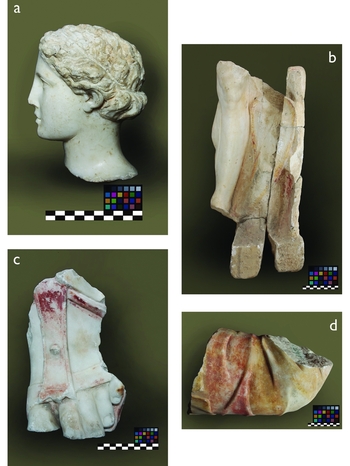
The first sculpture is a female head from the second century AD, smaller than life-size, possibly depicting Athena Lemnia (Figure 1a). It presents classical features, with a straight nose, thin eyelids and a small and fleshy mouth. The wavy hair is parted in the middle and rolled up on headband ribbons. The white, fine-grained marble of the face is polished, and the chiselled hair shows evidence of a gold finish. It might have been intended to evoke a Greek chryselephantine sculpture, which lends a certain preciousness to the piece, similar to the case of domestic statues in Rome, as well as those found from Delos (Jockey & Bourgeois Reference Jockey and Bourgeois2005).
Statue fragments included for study: a) head of Athena Lemnia, marble, 166 × 100mm, Bardo Museum; b) warrior's left leg, marble, 575mm, Bardo Museum; c) fragmentary colossal right foot, marble, 235 × 185mm, Bardo Museum; d) fragmentary right elbow, marble, 360 × 145 × 175mm, Bardo Museum.

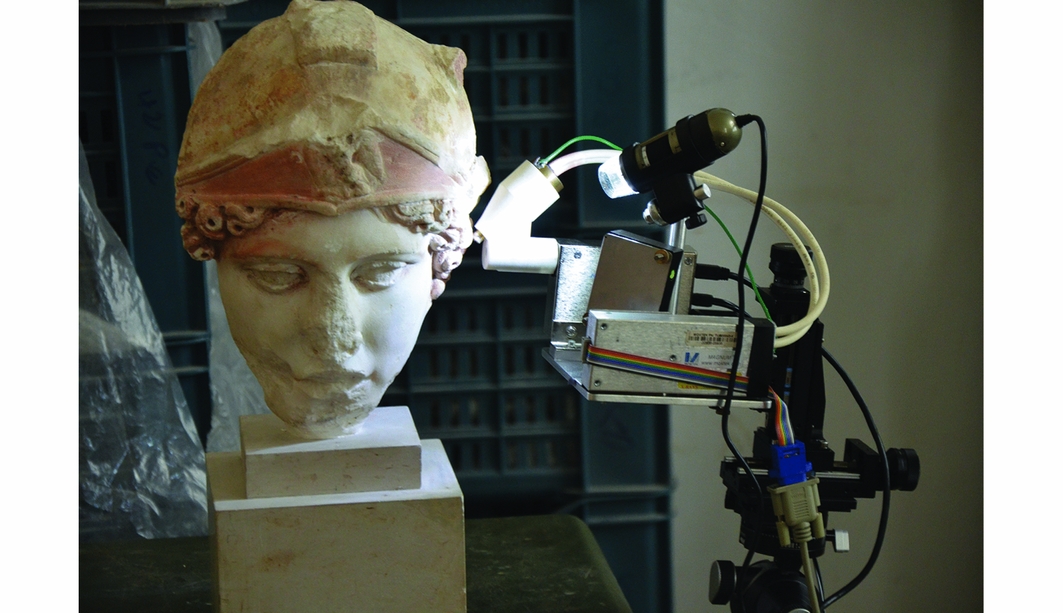
The second statue depicts a female life-sized head wearing a helmet, resembling Athena Parthenos (Figure 2), dating from the end of the Nerva-Antonine period (second century AD). It was discovered in Oudhna (ancient Uthina) (Quoniam Reference Quoniam1948). Athena Parthenos is represented frontally, her brow ridge is strongly marked and her eyelids are fleshy. A ridge surmounts the smooth helmet, and its visor is adorned with an eagle with outstretched wings. This piece appears to have been cut vertically from a relief. The face, leaning slightly forward, with its pronounced features, would have been visible from afar.
Measurements performed at the Bardo Museum by a portable Pd-anode XRF system developed in-house on a female head wearing a helmet (Athena Parthenos), marble, 290 × 230mm, Bardo Museum.

The third piece is the life-sized left leg of a male warrior (Figure 1b), discovered in 1914 during the excavations of the raised substructure of the Capitol at Thuburbo Majus and dating from the second century AD. A pile of weapons supports the naked leg, which is carefully polished. A coat, draped over a shield decorated with a Gorgon's head and a pair of cnemides (greaves), whose surfaces are covered with plaster, can be identified, and the leg is clad in greaves.
The fourth sculpture is a colossal male foot (Figure 1c), wearing a sandal that supports it, upon which there is a main strap decorated in its centre with a button. This foot, meticulously polished and accurately detailed, might have been part of a masculine deity or an Imperial representation.
The fifth sculptural element is a fragment of a right elbow from a colossal male statue dating to the second century AD (Figure 1d). The elbow, half-flexed, is covered with a piece of drapery, perhaps a long sleeve.
Methods
All sculptures and traces of colour were first observed with a Dino-lite video microscope under visible and UV light. Measurements were performed at the Bardo Museum by means of a portable Pd-anode XRF system (Figure 2). It is equipped with a Moxtek tube and a Silicon Drift Detector (Amptek) with an active area of 25mm2. Experiments were conducted at 30kV and 50μA, with an acquisition time of 5 minutes and a beam diameter of about 1mm. The XRF spectra were processed using the PyMCA dedicated software (Solé et al. Reference Solé, Cotte, Papillon, Susini and Walter2007). This software helps to confirm the presence of elements in case of the overlap of XRF peaks (e.g. Pb-M and S-K), and takes into account escape or pile-up peaks. Evaluation (or semi-quantification) of material quantities is possible with the method of fundamental parameters.
Results and discussion
The display of the colour: optical observations
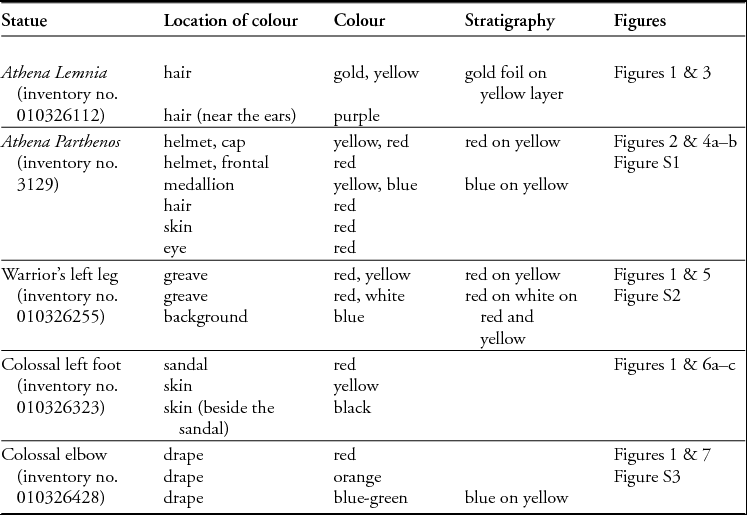
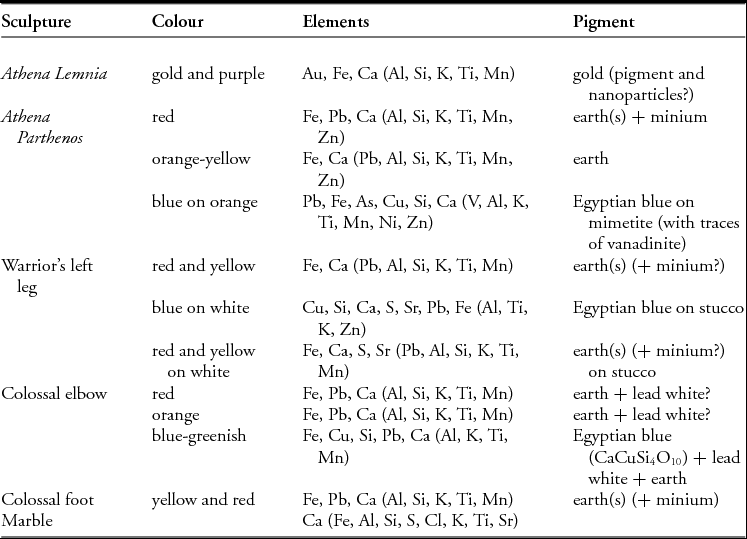
Optical observation showed the distribution of surviving traces of polychromy (Table 1).
Details of the statues analysed.

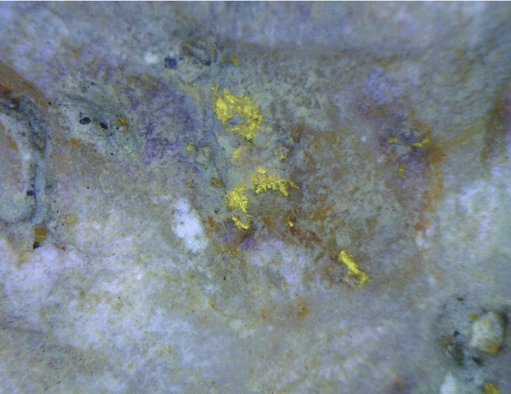
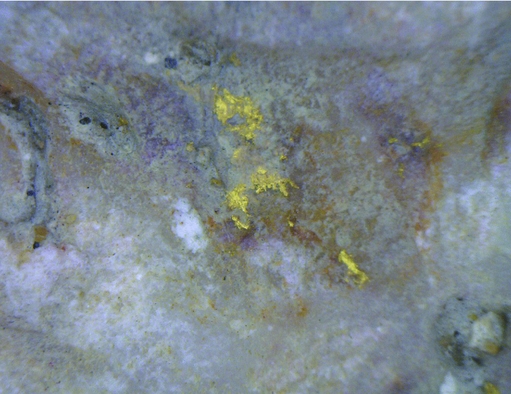
The head of Athena Lemnia shows traces of polychromy in the hair: on a layer of ochre yellow, gold leaf is observed. Near the ears, the surface layer is coloured in purple hues (Figure 3).
Athena Lemnia, micrograph of the hair (width: 1200µm).
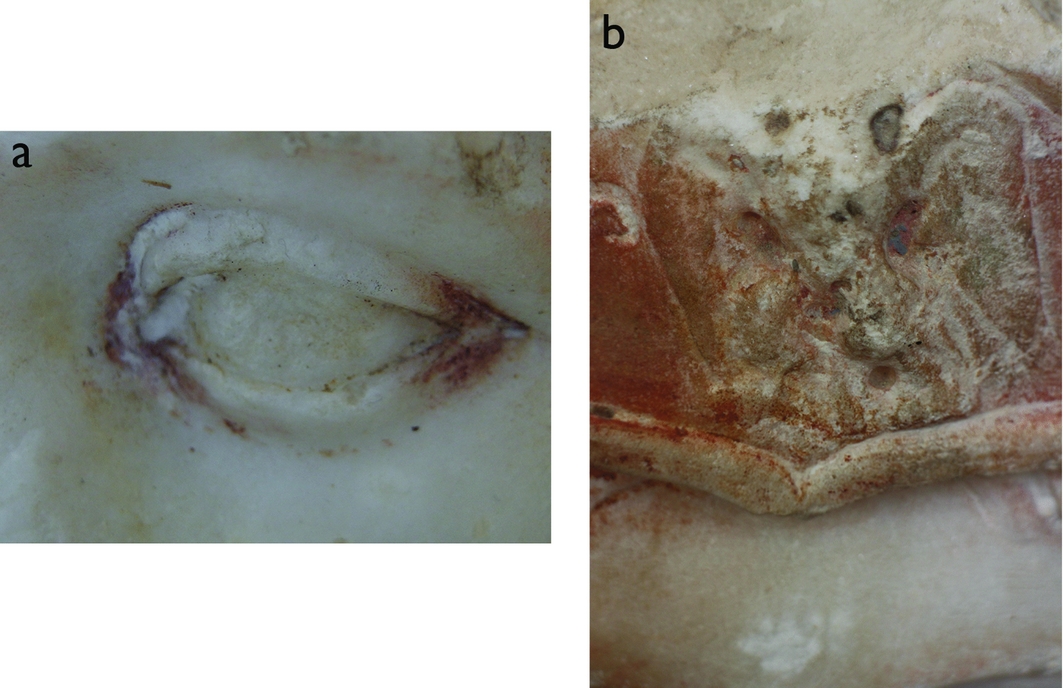
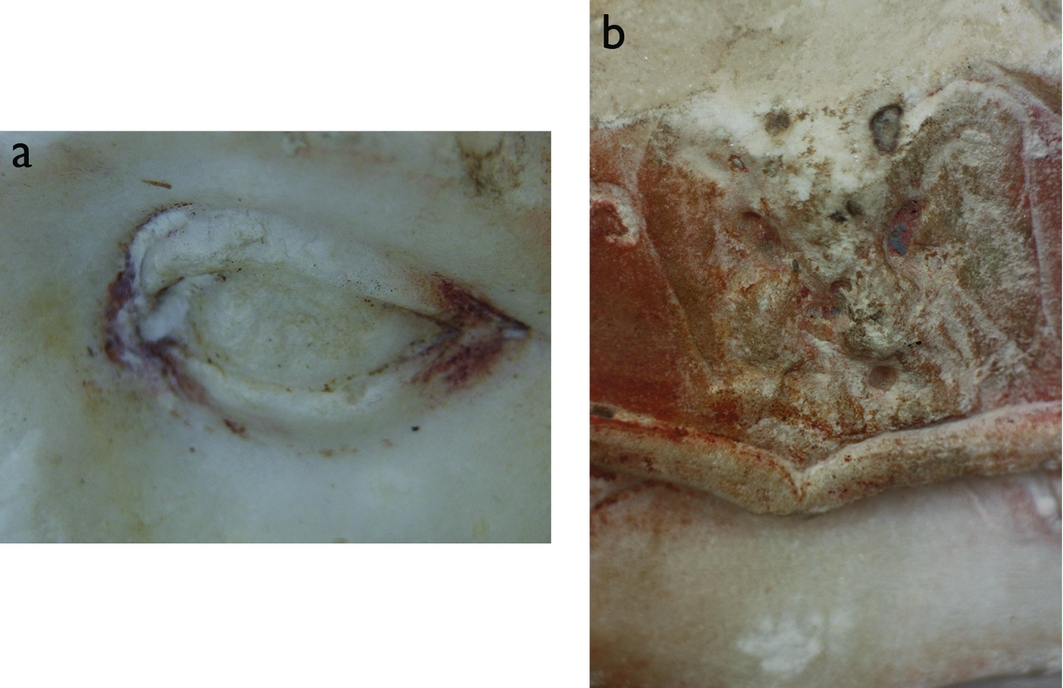
The Athena Parthenos displays a yellow-red rendering of the skin near the helmet; the eyes are highlighted with a darker red hue (Figure 4a), and so is the hair. The front of the helmet is painted with dark red, with an accurate finish of the medallion by means of several yellow layers and traces of superficial blue and pink layers in the background of the eagle (Figure 4b). The helmet's cap is coloured in red and painted on a yellow preparatory layer (Figure S1).
Athena Parthenos: a) detail of the eye; b) detail of the visor of the helmet and the medallion.
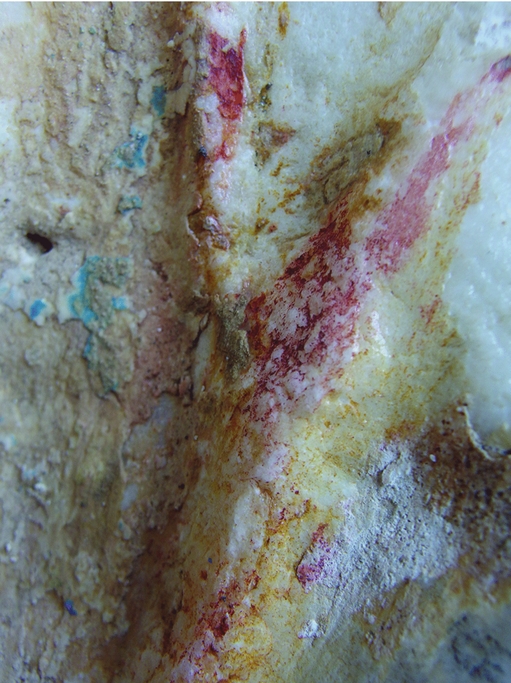
The warrior's leg also shows a white finish on the surface. Several layers of polychromy are visible on the greave, mostprobably from different phases. The first was a preparatory layer of yellow paint (Figure 5), followed by red paint, and then red-painted plaster along with a blue layer on the background plaster (Figure S2).
Warrior's left leg showing details of the greaves and the background.
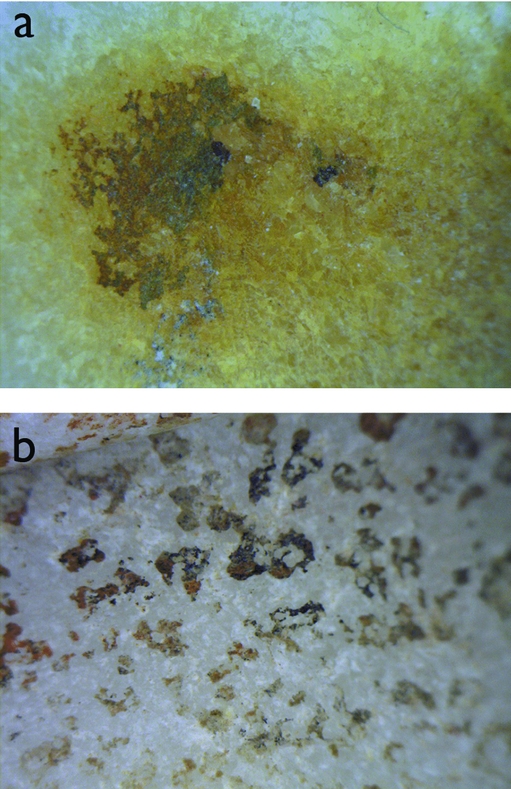
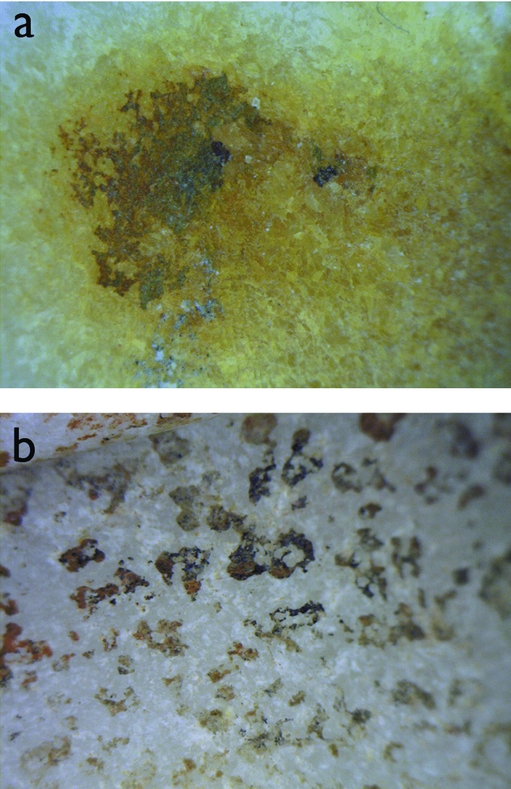
The sandal of the colossal left foot is coloured in red, with shadows rendered in black around the toes (Figure 6) and along the left part of the main strap covering the instep. The flesh is tinted in a reddish yellow, especially visible on the little toe (Figure 6a).
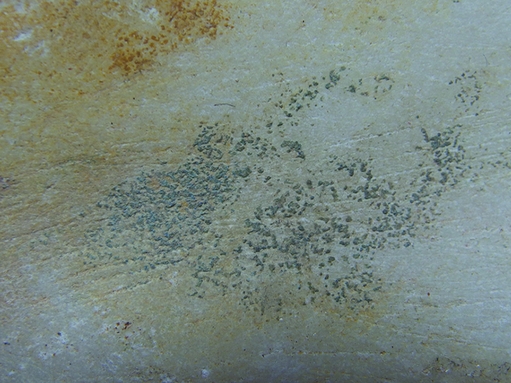
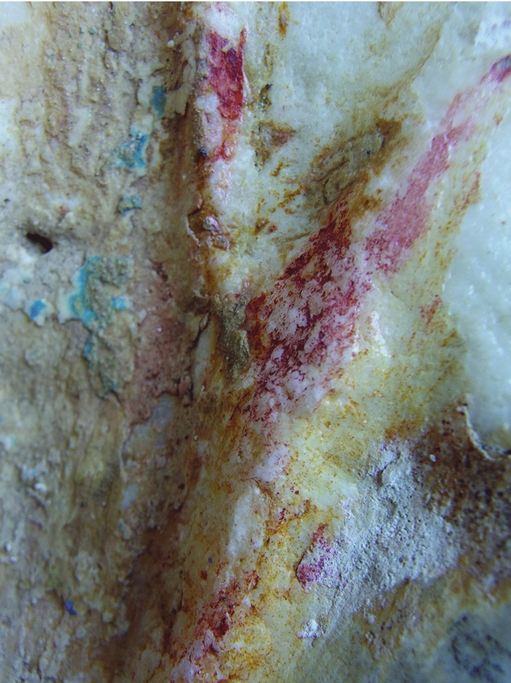
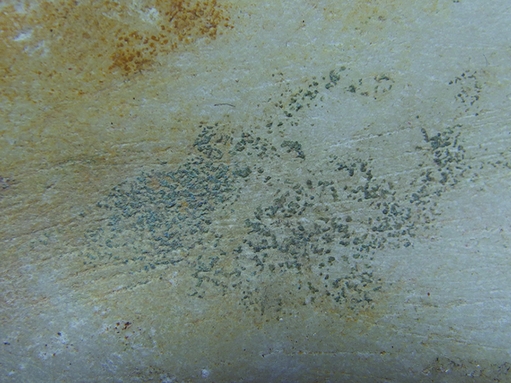
The colossal elbow is clad in a garment coloured in red, yellow and orange (Figure 7); the colours do not follow the garment's folds. At the outside of the elbow, traces of a superficial blue layer are found on top of a yellow layer (Figure S3).
The colossal left foot, showing a) the naked skin of the little toe (width of the micrograph 1220µm) and b) black shading near the sandal (width of the micrograph 1280µm).
The colossal elbow showing blue spots on yellow.
The presence of pigments
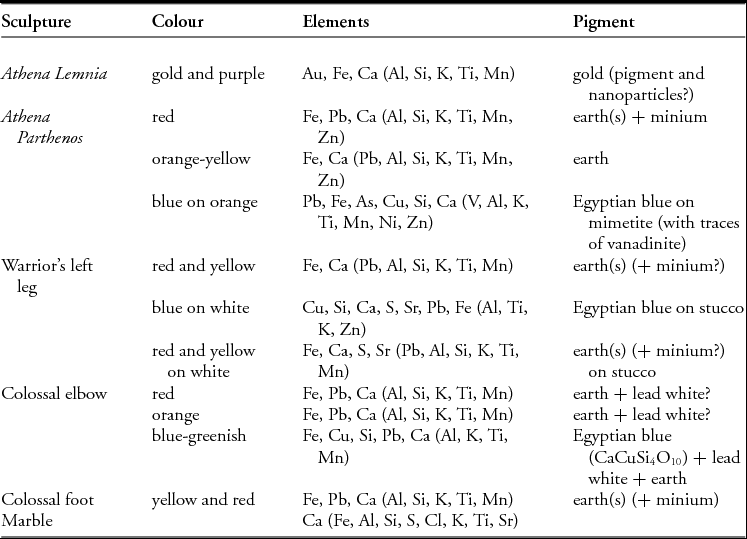
The results of the in situ XRF analyses are presented in Table 2. The XRF spectra interpretation had to take additional peaks characteristic of buried and altered sculptures, and diffraction peaks from the marble support, into account. The presence of pigments has been assessed on each sculpture investigated (Table 2). The common presence of lead mixed with ochre shows an intentional use of colours beyond that expected from external pollution (accretions or earths). The pigments were used on the clothes as well as the flesh, and most were in common use during the period (Kakoulli Reference Kakoulli2002).
X-ray fluorescence results on each sculpture: the pigment(s) used is identified from the detected elements (trace elements in parentheses). When lead is detected, an assumption is made between lead white or minium according to the observed tone. Calcium is detected in each colour, mainly coming from the marble support.
Red
The main colour visible on the sculptures is red, present in various tones. XRF analyses indicated the use of red earth shown by the presence of iron and other elements (silicon, aluminium, titanium, manganese) for this colour. For some colours, lead was also found, indicating either the use of lead white to lighten the colour, or else the use of minium to darken it. Minium is obtained by heating either litharge or lead white, and is commonly used in Roman painting. It is also heated and sometimes mixed with red ochre to obtain a pigment named sandyx or sirycum, mentioned by Pliny (Natural History, XXXVI, XXIII; Schmitt Reference Schmitt2013) (Rosing & Østergaard Reference Rosing and Østergaard2009; Fermo et al. Reference Fermo, Andreaoli, Piazzalunga and De Vos2013).
Semi-quantitative analyses have also been performed on red colours in order to test whether different pigments with various traces have been used. Manganese, zinc and titanium, linked to earths, are often used for such purposes. Large frequencies of diffraction peaks prevent reliable determination of the presence of these trace elements, however.
Four shades of red are visible on Athena Parthenos, obtained through the varied use of pigments, including minium (lead based) and at least two different earth pigments. The iron-based pigments include various trace elements: manganese, titanium and zinc, probably from clays. The manganese:iron ratio is found to bearound 4 per cent. The helmet has two different colours: red and brown with less minium (although the distribution of minium in the red part is not homogeneous). The eye, hair and flesh of the face show traces of red colour that are also rich in earth and minium. The darker part of the helmet has also been analysed and indicates a higher content of manganese, which could be due to the use of an umber earth. This result must be regarded with caution, however, because only two areas of the helmet were analysed and the content of iron was low.
The colossal foot shows traces of red on the flesh, and dark red on the sandal. The XRF analyses indicate the use of an iron-based pigment on the sandal different to those used for Athena Parthenos (a low content of trace elements such as manganese, zinc or titanium), and associated with a lead-based compound, probably minium considering the dark red colour. The flesh paint is less intense, but again the association of iron and lead, even at low concentrations, demonstrates the use of a mixture of similar pigments; the same observation has been made of darker traces analysed on the toes.
On the colossal elbow, yellow-orange alternates with red. Both colours contain iron- and lead-based pigments, although the lead content is higher in the yellow-orange part, being equivalent in amount to iron. This suggests that lead white was mixed with an earth pigment to lighten the colour.
With regard to the leg of the warrior, analysis of red patches indicate the presence of iron and lead, with some parts showing higher amounts of sulphur and strontium. The higher content of strontium is attributable to a gypsum under-layer on some parts of the sculpture. With the exception of this difference, the red pigment composition is very similar in all parts, with only a very small amount of trace elements. The reason for the presence of lead is uncertain, as it is also seen in the analysed patches of blue.
Yellow
The yellow-orange colours present in the different sculptures are linked to the use of earth pigments (indicated for red earths (ochres) by iron with or without traces of titanium, zinc or manganese). It is not possible to assess whether the composition of red and yellow earths from the same sculpture differ, as they appear to be very similar. It is possible that the change in colour (e.g. Athena Parthenos or the elbow) was obtained simply by changing the heating treatment of the same earth: firing yellow ochre above 275°C induces the transformation of goethite (α‐FeOOH) into haematite (α‐Fe2O3) to produce red ochre. Both pigments were used extensively, and their transformation process was well known to the painters of antiquity (Mastrotheodoros et al. Reference Mastrotheodoros, Beltsios and Zacharias2010).
More surprisingly, another yellow-orange colour has been detected in the decoration of the helmet of Athena Parthenos. A layer of yellow-orange is present under a blue patch (Figure S1) from which lead, arsenic, chlorine and vanadium (in smaller quantity) have been detected. This indicates the possible use of mimetite with traces of vanadinite, confirmed by fluorescence during exposure to UV light. Mimetite is a lead arsenate (Pb5(AsO4)3Cl) of yellow colour, while vanadinite is a lead vanadate (Pb5(VO4)3Cl) of brownish/orange colour. Both minerals are commonly found in lead-ore deposits or iron-rich soils (i.e. red and yellow ochres). Although mimetite is not a commonly used pigment, it has been detected in some paintings from the Hellenistic period (Rouveret & Walter Reference Rouveret2004, Reference Rouveret and Descamps-Lequime2007; Brecoulaki Reference Brecoulaki2006), as well as from a Roman context in the wall paintings of the Tomb of the Three Brothers in Palmyra. Buisson et al. (Reference Buisson, Burlot, Eristov, Eveno and Sarkis2014) suggest that this pigment may have held special significance, representing gold, by noting the high refinement of the decoration.
Similarly, the price of such a rare pigment may belie special significance. Occurrences of vanadinite are rare but attested in the Hellenistic period by the statues from Delos (Jockey & Bourgeois Reference Jockey and Bourgeois2005), the wall paintings from Alexandria (Rouveret & Walter Reference Rouveret and Walter1998, Reference Rouveret2004: 47–48, 67–68) and the brick figurine from Amathonte (Courtois & Velde Reference Courtois and Velde1981). In Roman times, the use of vanadinite is presumed in the sinopia of the Lod Mosaic in Israel; Piovesan et al. (Reference Piovesan, Maritan and Neguer2014) assume, however, that it was present in the natural earth. Its presence was also associated in small quantities with the lead white applied on the Sciarra Amazon of the Ny Carslberg Glyptotek art museum (Sargent & Hoberg Therkildsen Reference Sargent and Hoberg Therkildsen2010: 33). In the case of the helmet of Athena Parthenos, vanadium is present in low concentrations, while vanadinite is more probably an impurity associated with mimetite.
Gold and purple
Gold colouration has been observed on the hair of the Athena Lemnia (Table 1) and has been identified as gold foil by XRF. Small areas of purple have also been observed around it, as in the analogous case in Delos (Jockey & Bourgeois Reference Jockey and Bourgeois2005). Purple colouration can be obtained when gold is present as nanoparticles, or when silver-gold sulphides are formed, as observed in ancient Egyptian foils (Tissot et al. Reference Tissot, Troalen, Manso, Ponting, Radtke, Reinholze, Barreiro, Shaw, Carvalho and Guerra2015). Such purple stains have also been observed in Egyptian archaeological gilded ivories from eighth-century BC Syria, identified as pure gold (Spadavecchia et al. Reference Spadavecchia, Alberic, Apchain, Fontan and Reiche2014), where the formation of nanoparticles would have been allowed by the structure of the collagen present in the ivory. In every case, the purple colour is not intentional.
Blue
The Athena Parthenos, warrior's leg and colossal elbow display blue colouring, all of which show a high content of copper and silicon, indicating the use of Egyptian blue, mainly composed of CaCuSi4O10 (Tables 1 & 2). This pigment was commonly used during the Roman Imperial period and described in the first century AD by Vitruvius. The pigment (ceruleum) forms through furnace-firing of small particles of ground and moistened copper, fine sand and nitrum (natron). No traces of tin or arsenic have been detected, which would give information on the production of this pigment (Kakoulli Reference Kakoulli, Freestone, Rehren and Shortland2009); iron, lead and traces of zinc are present in all three sculptures, but their significance is difficult to interpret due to the presence of under-layers on the Athena Parthenos and the warrior's leg. The colossal elbow presents a less-intense greenish-blue colour, possibly obtained through mixing lead white and Egyptian blue with yellow earth.
A complex polychromy: technical observations and meaning
The analyses carried out on this first corpus of statues allowed the identification of a detailed and refined polychromy, using not only different ochres but also various pigments: Egyptian blue, vanadinite, mimetite, minium and sandyx. Some pigments, such as mimetite and vanadinite, were not commonly used in Roman times, and were relatively precious (Egyptian blue, as well as gold-leaf gilding). It is of particular note that we have documented here the first Roman use of vanadinite, which was also a rare pigment in Hellenistic times. Furthermore, colour effects (light, shadow and ad hoc colouring) were sought by juxtaposing, superimposing, lightening or darkening colours.
The head of the helmeted Athena Parthenos displays four different tones of minium, used in neighbouring zones of the statue, and probably darkened using selected ochres rich in manganese (in the visor), or lightened by means of a lower ochre-yellow layer (on the helmet). The rendering of the medallion on the front is especially refined; vanadinite and mimetite were used, and some details of the eagle were drawn in Egyptian blue, probably over a lead undercoating. The colours may have represented the bronze of the weapons, while the medallion was probably characterised by yellow—evocative of gold—with precious blue finishes, as well as other pigments that were difficult to procure. The skin was darkened with minium, at least in the shadows cast by the hair and the helmet; and the use of strong and bold colours enhanced the visibility of the figure, which might have been displayed in a public context, probably far removed from the viewer.
This vision of the warrior goddess Athena Parthenos is in contrast to the Athena Lemnia, which represented peace after victory, and whose divinity is conveyed by the golden hues of her hair and the lightness of her skin, designed to enhance the seraphic image of supernatural splendour. As it was probably displayed in a private house, it had a decorative rather than a religious function. Polychromy was therefore used to emphasise the religious message carried by this type of sculpture. Their partially polychromed appearance was already accepted by art historians from the Neoclassic movement as a valuable representation of the ideal sculpture (Østergaard Reference Østergaard, Panzanelli, Schmidt and Lapatin2008: 47).
The two colossal statue fragments have a detailed polychromatic scheme. The drape on the elbow is coloured to render the features of the garment differently from the folds in the sculpture: several hues of red lightened with lead conveyed the effect of movement in the cloth. The presence of blue and green on the elbow may refer to a bronze band holding back the garment. The latter is painted in Egyptian blue and mixed with lead white, sometimes over a layer of yellow ochre. Alternatively, the green-blue hues may have been used to render the shadows. On the colossal foot, minium red on ochre highlights the sandal. The skin is coloured with yellow ochre, and shadowing highlights the movement of the foot and the pressure applied on the toe.
The warrior's leg displays two phases of polychromy. These document the original painting of the piece and subsequent restorations. After a first phase where weapons were coloured with yellow ochre and minium to give a realistic bronze effect, these and the figure's coat were then coloured in red and given a strong chromatic effect through the use of plaster, probably with lead white to enhance the colour. In general, the use of the blue background was introduced during the Classical period, and developed further under the Roman Imperial period (Liverani Reference Liverani, Liverani and Santamaria2014). In our case, the blue background was laid over plaster and lead white, emphasising the white of the skin and the red of the weapons, and accentuating the 3D aspect of the statue by making the flat background more visible, following the Greek model (Liverani Reference Liverani and Santamaria2014).
The chromatic treatment of marble applied to colossal statues, for which colour facilitated perception from below and from afar. Garments, shoes and particularly weapons would undergo thorough colouring, but the skin was also finished by lightening with lead white, or by darkening it with minium in order to render shadows.
As far as the techniques used are concerned, many procedures can be observed. Pure colours were laid on the marble to emphasise the borders (e.g. the eyes of Athena Parthenos). Otherwise, multiple layers of colour were applied directly to the stone or the marble; the hues were composed not by prior mixing of the colours, but rather by overlaying several transparent layers to obtain the desired colour and shade. This painting technique was used until the Middle Ages and gives a surprising 3D aspect to the sculpture (Treu Reference Treu1889; Mendel Reference Mendel1909: 316; Verri et al. Reference Verri, Opper and Deviese2010). The technique is apparent in the helmet of the Athena Parthenos and the colossal elbow. A transparent black layer, also observed in statues from Aphrodisias in western Asia Minor (Abbe Reference Abbe and Brinkmann2010: 280), allowed the creation of shadows as seen on the colossal foot. Different tones may, however, have been prepared in advance, such as the four shades of red identified on the Athena Parthenos, also visible from the different spectrum response (Figure 8).
XRF spectra of three points on the Athena Parthenos: the spectrum of the marble without colour traces is shown in green, while different shades of red on the helmet are shown in red and black.

In some cases, a preparatory layer is observed, e.g. the lead white on the colossal elbow, or the yellow preparatory layer used to highlight the warm tone of gold leaf. This recognised technique was applied in a later phase of the statue’s life, although this has unfortunately not been chronologically defined. This use of a preparatory layer of plaster, on which lead white and colour were laid, was partly intended to hide earlier colouring. Pigments were used hierarchically: brighter pigments (vanadinite and mimetite), which are rare materials, were used for the most precious elements, on which the onlookers’ attention should be drawn.
Conclusions
By combining typology, context of display, optical observation and the material analysis of painted layers, several intentions could be defined through the study of the use of polychromy in these North African statues, although the presented corpus is too small to propose definitive answers:
-
• To convey movement or ‘animate’ the statue (Lucian Imagines VI, 27; Ozanam & Bompaire Reference Ozanam and Bompaire2008) by creating shadows (as in the colossal elbow, colossal foot or in the head of the helmeted Athena Parthenos), and to give a sense of relief to the statue (as in the warrior's leg).
-
• To integrate the details (e.g. the eagle on the helmet).
-
• To distinguish particular material qualities (such as gold for the medallion in the visor of Athena Parthenos's helmet, and bronze for the weapons).
The relationship between colour, setting and function also played an important role in the polychromy scheme. Viewed from afar, as in the Greek tradition, the statues could present strong, bold pigments, yet also be adorned with many more subtle pigments when viewed more closely.
The enhancement of the religious message conveyed by the statues is also apparent, as observed for the heads of Athena: the seraphic quietude of Athena Lemnia in contrast to the liveliness of the warrior Athena Parthenos, with sharp eyes and strong shadows. This use of colour follows the technical and ideological tradition of Hellenism. A political or ideological use is not observed, as it might have been for a Roman Imperial portrait (Liverani Reference Liverani2004; Rosing & Østergaard Reference Rosing and Østergaard2009).
Regional technical peculiarities were not observed, and a technical koiné (common language), inheriting the Greek ‘know-how’, was adopted. Analysed statues show the importance of getting the required colour by superposing different translucent layers, thus diminishing the stationary aspect of the sculpture and giving it a realistic appearance.
Although the sample size is too small to propose a generalised meaning of polychromy in Tunisian sculpture, it is clear that the illusionistic effects observed in Hellenistic statues (Jockey Reference Jockey2011) persisted into the second and third centuries AD. Remarkable traces of colour were used to render shadows and depth, enhancing tridimensionality and depicting material qualities, such as metal. This confirms a desire to animate the statues, with the colours contributing to the ambiguous perception of statues' identities (as live or inanimate beings), as related by ancient and Late Antique sources (Caseau Reference Caseau2014).
Acknowledgements
This study is part of the project ‘Les Couleurs Du Blanc. L'apport De L'archeometrie Aux Perceptions Du Monde Antique: une approche du sens de la polychromie de la sculpture dans l'Afrique romaine proconsulaire (Ier–IVes.)’, funded by Sorbonne-Universités (project manager Francois Baratte). The authors are very grateful to the Institut National du Patrimoine and the Ministère de la Culture, Tunis, for their kind and fruitful collaboration. We also thank Sarah Berraho (Université Paris-Sorbonne (Paris IV)), a member of this project, for discussion and comments.
Supplementary material
To view supplementary material for this article, please visit https://doi.org/10.15184/aqy.2016.250