Introduction
Pastures in tropical and subtropical regions often consist of C4 grass forage species, including bermudagrass (Cynodon dactylon L.), bahiagrass (Paspalum notatum Flugge), and limpograss [Hemarthria altissima (Poir.) Stapf & C.E. Hubb.] (Vendramini Reference Valencia, Williams and Sollenberger2010). Due to their anatomical and morphological characteristics, these forages have decreased digestibility and crude protein compared to C3 species (Vendramini Reference Vendramini2010). Although C4 forages usually meet the maintenance requirement of mature beef cattle, replacement heifers, calves, and dairy cattle often require nutrient supplementation to maintain adequate health and favorable weight gain (Graham and Vance, Reference Graham and Vance2003).
Diet supplements are often added to improve digestibility and crude protein of some poor-quality forages, including many of the forage grass species currently used in subtropical regions. To meet the dietary needs of livestock, supplementation with feedstuffs or molasses is common in Florida, whereas legumes are preferred in other regions of the United States. Unfortunately, common cool-season legumes such as alfalfa (Medicago sativa L.) and clovers (Trifolium sp. L.) do not perform or persist well in the Florida climate (Ball et al. Reference Ball, Hoveland and Lacefield2007; Ferrell et al. Reference Ferrell, Sellers, Mudge and Smith2006). Attempts have been made to incorporate warm-season forage legumes such as carpon desmodium [Desmodium heterocarpon (L.) DC] and aeschynome (Aeschynomene americana L.) into forage systems with limited success due to establishment failures under seasonally wet conditions (Vendramini and Kretschmer Reference Vendramini and Kretschmer2013; Vendramini and Silveira Reference Vendramini and Silveira2016). Currently, ‘Amarillo’ pintoi peanut is under investigation as a supplement in central and south Florida where seasonal flooding is likely to occur.
Pintoi peanut is a seeded, prostrate growing, warm-season perennial legume that grows from a central taproot and forms a dense mat of stolons (Carvalho and Quesenberry Reference Carvalho and Quesenberry2012). Yellow flowers bloom throughout the year unless the plant is dormant, and its tetrafoliolate leaves consist of ovate leaflets that measure 4.5 cm long and 3.5 cm wide (Cook et al. Reference Cook, Pengelly, Brown, Donnelly, Eagles, Franco, Hanson, Mullen, Partridge, Peters and Schultze-Kraft2005). Pintoi peanut is native to Brazil and has been introduced into other tropical and subtropical Central and South American countries, where it is used in many production systems as a forage for beef and dairy cattle due to its high tolerance to defoliation and trampling (Villarreal et al. Reference Villarreal, Cochran, Villalobos, Roja-Bourrillon, Rodriguez and Wickersham2005).
Pintoi peanut is slow to establish, making adequate weed control a primary factor for the success of this crop. Similarly, rhizoma peanut (Arachis glabrata Benth.; RP) has also been reported to establish slowly and competition from weeds has affected its early growth when planted in monoculture or grown in RP-bahiagrass mixtures (Valencia et al. Reference Valencia, Williams and Sollenberger1999). Other than its potential for use in grazing systems in Florida, little research has been performed on the plant to determine its tolerance to herbicides. Knowledge of pintoi peanut’s herbicide susceptibility may improve its establishment, maintenance, and persistence in pure or grass-mixed swards. Therefore, the objective of this research was to evaluate pintoi peanut’s ability to tolerate applications of various PRE and POST herbicides during and after establishment.
Materials and Methods
Three separate experiments were conducted in 2015 and 2016 to evaluate the tolerance of pintoi peanut to PRE and POST herbicides applied during the year of planting, and POST herbicides applied 2 yr after planting.
Tolerance of Pintoi Peanut to PRE Herbicides within the Year of Planting
The experiment was conducted at the University of Florida Range Cattle Research and Education Center near Ona, FL, in 2015 and 2016 (27°26′N, 82°55′W), on an Ona fine sand (sandy, siliceous, hyperthermic Typic Alaquods) with 10 g kg−1 organic matter, pH 6.0. Prior to planting, the experimental area was treated with glyphosate at 2.2 kg ae ha−1, disked, and compacted with a large roller to conserve moisture. ‘Amarillo’ pintoi peanut (Tropical Seeds, LLC, Coral Springs, FL) seed was planted into 38-cm rows on May 19, 2015, and May 20, 2016. A seeding rate of 10 kg ha−1 was used to achieve an in-row spacing of five to six seeds per meter. The plots received 34 kg N ha−1, 15 kg P ha–1, 28 kg K ha–1, and 28 kg ha−1 of a micronutrient mix (Frit 503G, Frit Industries, Ozark, AL) 15 d after planting (DAP) in both years. Annual grasses were controlled as necessary using clethodim at 0.14 kg ai ha−1 (Select Max, Valent USA Corp., Walnut Creek, CA).
The PRE herbicide treatments consisted of pendimethalin (Prowl H2O, 455 g ai L−1, BASF Corporation, Research Triangle Park, NC) at 532, 1,065, and 2,130 g ai ha−1; imazethapyr (Pursuit, 240 g ai L−1, BASF Corporation) at 35, 71, and 141 g ai ha−1; imazapic (Impose, 240 g ai L−1, Makhteshimm Agan of North America, Inc., Raleigh, NC) at 35, 70, and 105 g ai ha−1; and 2,4-D amine (445 g ae L−1, Winfield Solutions LLC, St. Paul, MN) at 280, 561, and 1,121 g ae ha−1. Preemergence herbicide treatments were applied immediately after planting. Herbicides were applied using a CO2 pressurized backpack sprayer with a hand-held boom (1.5 m wide, nozzle spacing 38 cm) equipped with 11002 flat-fan nozzle tips delivering 187 L ha−1 at 193 kPa. Treatments were arranged in a randomized complete block design with four replications and the plot size was 1.5 m by 4.6 m. An nontreated check was included and weeds were allowed to naturally infest the plots. The experimental area was irrigated with 19 mm of water 1 d after planting in 2015 to aid herbicide incorporation. However, no irrigation was necessary in 2016 because rainfall occurred 2 d after planting.
Crop injury was evaluated on a scale of 0% to 100%, with 0 representing no injury, and 100 representing plant death at 30 and 60 d after treatment (DAT). Stand counts were also recorded by counting the number of pintoi peanut plants present in the center 3 m of each plot at 30 and 60 DAT. Stand count data were normalized to the percent of nontreated plants by dividing the number of pintoi peanut plants found in each herbicide treatment by the number of pintoi peanut plants found in the nontreated treatment.
Tolerance of Pintoi Peanut to POST Herbicides within the Year of Planting
This experiment was conducted adjacent to the previously described PRE herbicide experiment. Therefore, information regarding the site and planting management practices followed the same procedures described previously. The POST herbicide treatments were applied at 15 and 30 DAP, corresponding to 80% emergence and 2 wk after 80% emergence. Herbicide treatments consisted of imazethapyr at 35 and 70 g ai ha−1; 2,4-D at 280 and 561 g ae ha−1; imazapic at 35 and 70 g ai ha−1; sulfosulfuron (Outrider, Monsanto Company, St. Louis, MO) at 26 and 53 g ai ha−1; carfentrazone at 17 and 35 g ai ha−1; and 2,4-D amine at 561 g ae ha−1 plus carfentrazone (Aim, 240 g ai L−1, FMC Corporation, Philadelphia, PA) at 17 and 35 g ai ha−1. The experimental design was a randomized complete block design arranged as a 2 × 12 factorial of two application timings (15 and 30 DAP) and 12 POST herbicide treatments. The experiment had four replications and the plot size was 1.5 by 4.6 m. Herbicide treatments were applied as stated previously. An nontreated check was included, and weeds were allowed to naturally infest the plots.
Crop injury was evaluated visually at 15, 30, and 60 DAT. Stand counts were also recorded at 30 and 60 DAT. Stand count data were normalized to the percent of nontreated as described previously.
Tolerance of Pintoi Peanut to POST Herbicides the Year After Planting
The experiment was conducted in Marianna, FL (30°52′ N, 85°11′W, 35 m above sea level) in 2015 and Ona, FL, in 2016 to test tolerance of pintoi peanut swards to POST herbicides the year after planting. The soil type at the Marianna location was a Red Bay fine sandy loam (fine-loamy, kaolinitic, thermic Rhodic Kandiudults), pH 6.5; and at the Ona location it was an Ona fine sand, pH 6.0. ‘Amarillo’ pintoi peanut plots at the Marianna location were established from transplants on August 28, 2014, at a spacing of 46 by 46 cm for a total of nine plants per plot. At the Ona location, plots were seeded on May 19, 2015. Both locations were fertilized as described previously, but not during the year of herbicide application.
The POST herbicide treatments and rates used in this experiment were the same as those used in the previous POST herbicide experiment. Herbicide treatments were applied on May 12, 2015, at the Marianna location and on June 7, 2016, at the Ona location as described previously. Treatments were arranged in a randomized complete block design with four replications with a plot size of 1.8 by 1.8 m. A nontreated check was included, and weeds were allowed to naturally infest the plots. The effect of the POST herbicide treatments on pintoi peanut was assessed by visually estimating crop injury on a scale of 0% to 100%, as stated previously, at 15, 30, and 60 DAT.
Statistical Analysis
All data were subjected to ANOVA using PROC MIXED in SAS (version 9.4, SAS Institute, Cary, NC). Year and treatment were considered fixed, with replication and appropriate interactions considered as random effects in the PRE and POST herbicide experiments conducted within the year of planting. Data were combined over year when the treatment-by-year interaction was not significant (P ≥ 0.05). In the POST herbicides during establishment experiment, year, treatment, and application timing were considered fixed effects, with replication and the appropriate interactions as random effects. Prior to analysis, stand counts were converted to a proportion of the nontreated check. Mean separation was performed using Fisher’s protected LSD at P ≤ 0.05 when appropriate for all experiments.
Results and Discussion
Tolerance of Pintoi Peanut to PRE Herbicides within the Year of Planting
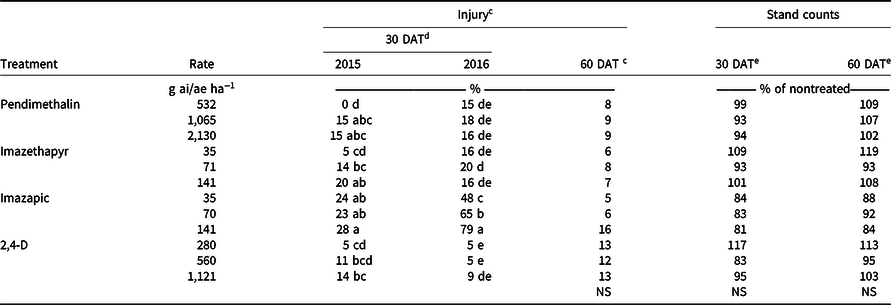
There was a year-by-treatment interaction (P < 0.0001) for injury data at 30 DAT; therefore, data were analyzed by year. The greatest level of injury in 2015 was observed in plots treated with all rates of imazapic, the high rate of imazethapyr, and the two highest rates of pendimethalin (Table 1). Regardless of herbicide or application rate, peanut injury was less than 30% in 2015. In 2016, imazapic resulted in 48% to 79% injury, and was at least 2-fold greater than all other treatments. The year-by-treatment interaction was not significant at 60 DAT (P = 0.678), and data were combined over years. All treatments resulted in less than 20% injury, indicating that the injury observed at 30 DAT was transient. Furthermore, stand counts (Table 1), expressed as a proportion of the nontreated, were not affected by PRE treatments at 30 DAT (P = 0.085) or 60 DAT (P = 0.113), indicating that the treatments applied in this study did not result in plant death.
Effect of PRE herbicides on pintoi peanut injury and stand counts during the year of establishment in 2015 and 2016 at Ona, FL. a,b

a Means followed by similar lowercase letters within columns are not significantly different (P ≤ 0.05).
b Abbreviations: DAT, days after treatment; NS, not significant.
c Injury includes visual symptoms of necrosis, and/or chlorosis and/or stunting and/or twisting.
d Treatments were applied immediately after planting. Approximately 80% of plants had emerged by June 3, 2015, and June 6, 2016.
e Data are means averaged over 2015 and 2016. Stand counts in the nontreated averaged 1.8 and 0.7 plants m−1 row in at 30 and 60 DAT, respectively.
The reason for differences in injury from imazapic in 2015 and 2016 is not known, but it could be due to the differences in rainfall before and after application. Plots were irrigated to incorporate PRE herbicides in 2015, but 13 mm of rainfall were received the day before planting followed by a total of 26 mm within 3 d after planting in 2016. Injury on pintoi peanut from imazapic appears to possibly be more severe than to common peanut (Arachis hypogaea L.) because previous research found that 70 g ha−1 resulted in 1% injury or less at 14 and 77 DAT in common peanut (Teuton et al. Reference Mislevy, Williams, Blount and Quesenberry2004). Imazapic is also often utilized as a PRE treatment when establishing rhizoma perennial peanut with no indication of injury (Mislevy et al. 2007). Imazethapyr injury on common peanut applied PRE has also been found to cause little or no injury (Teuton et al. Reference Mislevy, Williams, Blount and Quesenberry2004). Similarly, pendimethalin has been shown to cause some initial stunting in previous research (Dotray et al. Reference Dotray, Baughman, Keeling and Grichar2001), but injury appeared to be transient because no stunting was observed by 62 d after planting.
Tolerance of Pintoi Peanut to POST Herbicides within the Year of Planting
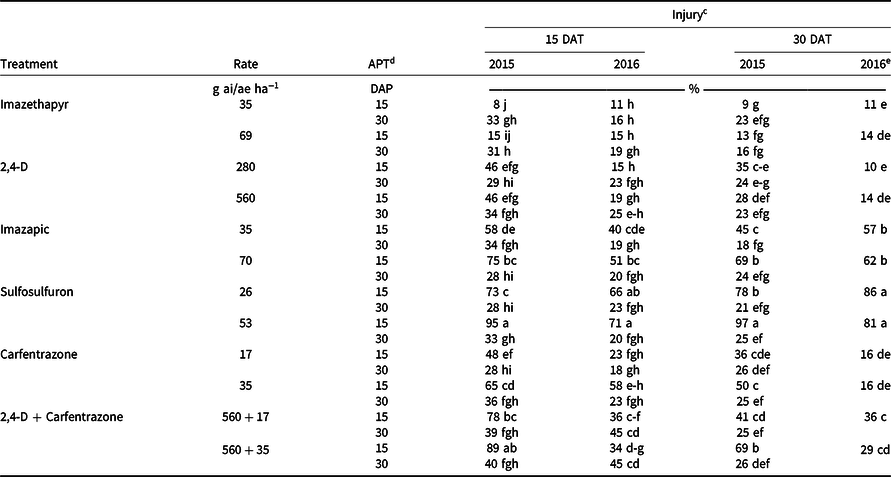
Data were analyzed by year for pintoi peanut injury at 15 and 30 DAT due to significant year-by-treatment interactions. There was a timing-by-treatment interaction for pintoi peanut injury at 15 DAT in 2015 (P < 0.0001) and 2016 (P < 0.0001). Sulfosulfuron at 53 g ha−1 resulted in the greatest injury (95%) when applied during emergence in 2015, but this was not different from the high rate of 2,4-D + carfentrazone, which resulted in 89% injury (Table 2). Delaying the application until 2 wk after emergence resulted in at least a 2-fold reduction in pintoi injury from all rates of imazapic, sulfosulfuron, carfentrazone, the low rate of 2,4-D, and 2,4-D + carfentrazone. Injury to other species in the Fabaceae family by 2,4-D appears to be species and rate dependent (Davy et al. Reference Davy, Karle, Kyser, DiTomaso and Rinella2015; Leon et al. Reference Leon, Ferrell and Brecke2014; McCurdy et al. Reference McCurdy, McElroy and Flessner2013, Reference McCurdy, McElroy, Flessner, Hoyle and Parker2016). For example, research by Evers et al. (Reference Evers, Grichar, Pohler and Schubert1993) indicated that injury (97%) from 2,4-D on berseem clover (Trifolium alexandrinum L.) was higher than that observed (16%) on rose clover (Trifolium hirtum All.) by 57 DAT, but increasing the rate from 800 to 1,700 kg ha−1 resulted in at least 77% injury to both species. Established white clover (Trifolium repens L.) appears to be tolerant to 2,4-D at 400 kg ha−1 when applied during the winter months (Enloe et al. Reference Enloe, Johnson, Renz, Dorough and Tucker2014).
Effect of POST herbicides on pintoi peanut injury during the year of establishment in 2015 and 2016 at Ona, FL.a,b

a Means followed by similar lowercase letters within columns are not different (P ≤ 0.05).
b Abbreviations: APT, application timing; DAP, days after planting; DAT, days after treatment.
c Injury includes visual symptoms of necrosis, and/or chlorosis and/or stunting and/or twisting.
d Approximately 80% of plants had emerged by June 3, 2015, and June 6, 2016.
e Data means were averaged across application timings (15 and 30 DAP).
Delaying application of imazethapyr resulted in at least a 2-fold increase in pintoi injury, but only in 2015. Imazethapyr applied POST has been shown to result in stunting of common peanut if rainfall moves the herbicide into the crop root zone (Grichar et al. Reference Grichar, Nester and Sestak1997). Similar to 2015, injury was also highest (71%) in 2016 after sulfosulfuron was applied at a high rate at emergence. There were no differences in injury by delaying applications of imazethapyr, 2,4-D, the low rate of carfentrazone, or 2,4-D + carfentrazone. However, delaying application of imazapic, sulfosulfuron, and the high rate of 2,4-D + carfentrazone resulted in at least a 2-fold decrease in pintoi injury at 15 DAT. The timing-by-treatment interaction was significant at 30 DAT (P < 0.0001) in 2015, but it was not significant in 2016 (P = 0.572); therefore, data were combined over application timing in 2016 (Table 2). Similar to 15 DAT in 2015, the high rate of sulfosulfuron resulted in the greatest injury with nearly complete kill when applied at emergence. Additionally, delaying the application of imazapic, sulfosulfuron, 2,4-D + carfentrazone, and the high rate of carfentrazone by 2 wk resulted in at least a 2-fold decrease in pintoi peanut injury. There were no differences in application timing when imazethapyr, 2,4-D, or the low rate of carfentrazone was applied. In 2016, sulfosulfuron resulted in >80% pintoi peanut injury, regardless of application timing (Table 2), which was the greatest injury observed compared to all other treatments. Imazapic resulted in approximately 60% injury at both application rates, regardless of application timing. All other treatments resulted in <40% injury.
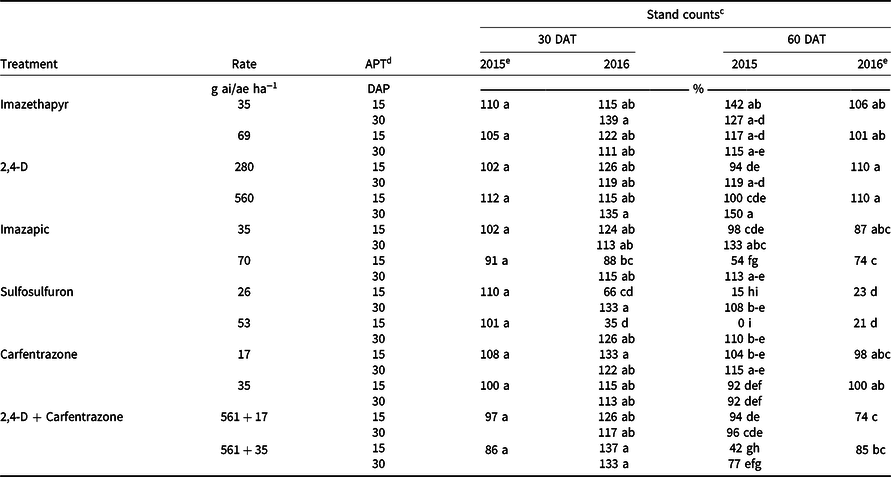
At 30 DAT in 2015 there was no application timing-by-treatment interaction (P = 0.063) for stand counts (Table 3). Additionally, the main effects of treatment (P = 0.168) and application timing (P = 0.126) were also not significant. Therefore, stand was not affected by any herbicide or either application timing as counts ranged from 74% to 124% of the nontreated. However, in 2016, there was an application timing-by-treatment interaction (P = 0.008). Delaying sulfosulfuron application by 2 wk resulted in an increase in peanut stand from 66% to133% and from 35% to126% of nontreated at 26 and 53 g ha−1, respectively (Table 3). There were no differences between application timing for any of the other treatments; therefore, injury observed in plots treated with herbicides other than sulfosulfuron did not affect peanut stand.
Effect of POST herbicides on pinto peanut stand counts during the year of establishment in 2015 and 2016 at Ona, FL.a,b

a Means followed by similar lowercase letters within columns are not different (P ≤ 0.05). Average stand counts for nontreated plots at 30 DAT were 1.7 and 1.3 plants m−1 row in 2015 and 2016, respectively. Stand counts at 60 DAT were 1.3 and 1.6 plants m−1 row in 2015 and 2016, respectively.
b Abbreviations: APT, application timing; DAP, days after planting; DAT, days after treatment.
c Data indicate the number of pintoi peanut plants following the herbicide treatment divided by the number of pintoi peanut plants of the nontreated treatment.
d Approximately 80% of plants had emerged by June 3, 2015, and June 6, 2016.
e Data means were averaged across application timings (15 and 30 DAP).
Although weed control was not the primary data collected from this research, primarily broadleaf and annual sedge (Cyperus spp.) species were present in experimental plots in 2015, and annual sedges were predominant in 2016. By 30 DAT in 2015, imazapic provided the highest level of weed control of at least 49%; all other treatments resulted in no greater than 33% weed control (data not shown). In 2016, the high rate of imazapic resulted in the highest level of weed control (84%), but was not different from the low rate of this herbicide. Sulfosulfuron resulted in 66% weed control (data not shown).
When comparing the effects of treatments at 60 DAT in terms of stand counts, there was an application timing-by-treatment interaction (P = 0.0001) in 2015 (Table 3). There was virtually no impact of delaying applications by 2 wk (for imazethapyr, carfentrazone, 2,4-D + carfentrazone, or the low rate of 2,4-D); stand counts in all but the high rate of 2,4-D + carfentrazone was at least 92% of the nontreated (Table 3). However, delaying application of imazapic at 70 g ha−1 and both rates of sulfosulfuron resulted in at least a 1.5-fold and 7-fold increase in stand counts, respectively. There was also a statistical difference between application timings with the high rate of 2,4-D; however, stand counts in these plots were at least 100% of the nontreated. In 2016, the application timing-by-treatment interaction was not significant (P = 0.277) for stand counts (Table 3), and data were pooled across application timings. Sulfosulfuron resulted in the greatest reduction in pintoi peanut stand, which is not surprising considering that this herbicide is effective in controlling white clover in turfgrasses (Derr Reference Derr2012). All other treatments resulted in pintoi peanut stand counts ranging from 74% to 110% of the nontreated. Research has indicated that imazethapyr can cause stunting when applied POST under various environmental conditions (Grichar et al. Reference Grichar, Nester and Sestak1997), which is consistent with our results. Conversely, research on common peanut has indicated satisfactory tolerance from POST applications of imazapic, regardless of application timing (Grichar Reference Grichar1997a, Reference Grichar1997b; Teuton et al. Reference Mislevy, Williams, Blount and Quesenberry2004); however different types (Spanish market- and Virginia market-types) differ in their response to imazapic (Dotray et al. Reference Dotray, Baughman, Keeling and Grichar2001). These data indicate that pintoi peanut is more tolerant as plants continue to mature.
Tolerance of Pintoi Peanut to POST Herbicides the Year After Planting
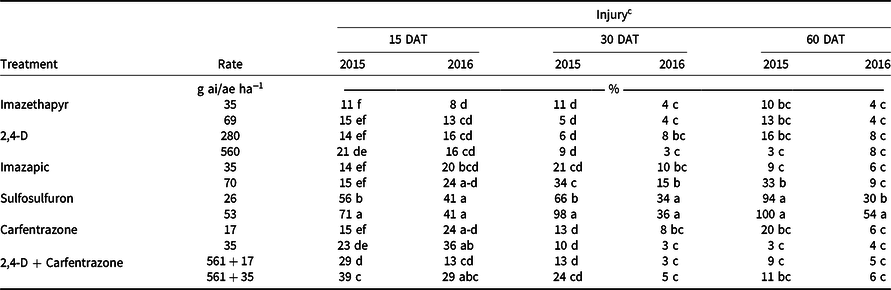
There was a year-by-treatment interaction for pintoi peanut injury at 15, 30, and 60 DAT; therefore, data from each year were analyzed separately. Pintoi peanut injury ranged from 11% to 71% at 15 DAT in 2015 (Table 4). Sulfosulfuron resulted in 56% and 71% injury at 26 and 53 g ha−1, respectively, which was 1.4-fold greater than all other treatments. While injury from all other herbicides tended to decline over time in 2015, sulfosulfuron injury tended to increase relative to the other treatments and was nearly 3-fold greater than all other treatments by 60 DAT (Table 4). In 2016, injury ranged from 8% to 41% at 15 DAT, with similar levels of injury from sulfosulfuron, the high rate of imazapic, carfentrazone, and the high rate of 2,4-D + carfentrazone. Similar to 2015 results, injury in 2016 from all treatments other than sulfosulfuron declined over time, but injury from sulfosulfuron was at least 2-fold greater than all other treatments at 30 and 60 DAT (Table 4).
Effect of POST herbicides on established pintoi peanut in 2015 and 2016 combined over locations (Marianna and Ona, FL).a, b

a Means followed by similar lowercase letters within columns are not different (P ≤ 0.05).
b Abbreviation: DAT, d after treatment.
c Injury includes visual symptoms of necrosis, and/or chlorosis and/or stunting and/or twisting.
In 2015 at 30 and 60 DAT, weed control did not exceed 50%, which is problematic for producers wanting to control weeds in pintoi peanut (data not shown). In 2016 at 30 and 60 DAT, weed control ranged from 11% to 80% and from 9% to 53%, respectively (data not shown). Although sulfosulfuron resulted in excellent control of annual sedges at this location in 2016, the resultant injury on the peanut will likely preclude its use for weed control in pintoi peanut swards. The herbicide combination of 2,4-D + carfentrazone provided control at 30 DAT at a level that was similar to that when the high rate of imazapic and 2,4-D was used, and the result was a nearly 1.5-fold increase in weed control compared to all other treatments except for the high rates of 2,4-D and sulfosulfuron (data not shown). Therefore, this herbicide combination (2,4-D + carfentrazone) may need to be applied at least two times during the growing season to obtain satisfactory long-term weed control.
Data from these studies indicate that pintoi peanut is tolerant to PRE applications of pendimethalin, imazethapyr, and imazapic, results that are similar to those from previous research conducted on common peanut (Dotray et al. Reference Dotray, Baughman, Keeling and Grichar2001; Teuton et al. Reference Teuton, Mail, MacDonald, Ducar and Brecke2004). However, for long-term weed control during the establishment phase of this perennial species, use of POST herbicides will likely be necessary. Data from the POST study within the year of planting indicate that higher levels of crop safety are achieved when pintoi peanut plants have been emerged for at least 2 wk prior to herbicide application. Given that the weed spectrum in our plots were controlled by at least 75% with imazethapyr and imazapic as a PRE treatment (data not shown), timely POST applications of imazapic, 2,4-D, carfentrazone, or a combination of these herbicides may be useful in prolonging weed control during establishment. This PRE followed by POST concept is widely practiced in several row crops, but has not yet been documented in pintoi peanut. Stands of pintoi peanut planted the previous year appear to be tolerant to all herbicides examined in this work, except sulfosulfuron. Future research should evaluate the effects of multiple herbicide applications and tank-mixtures to obtain satisfactory weed control in pintoi peanut.
Acknowledgments
This project is a contribution of the Florida Agriculture Experiment Station and is based upon work that is supported by the U.S. Department of Agriculture–National Institute of Food and Agriculture (Hatch project, accession number 0231798, project number FL-ONA-005203). No conflicts of interest have been declared.