


Introduction
The world is facing an increasing number of humanitarian emergencies, including increasing natural crises such as those connected to climate change as well as man-made crises (e.g., industrial accidents, armed conflicts). Many of these are complex emergencies, a humanitarian crisis in a country, region or society where there is total or considerable breakdown of authority resulting from internal or external conflict and which requires an international response (United Nations High Commissioner for Refugees 1[UNHCR]). They are typically characterized by extensive casualties and displacement, breakdown of societies, hindrance of humanitarian assistance, and security risks to humanitarian workers. In many cases, smaller-scale emergencies are co-occurring within the regions with complex emergencies, such as conflict-ridden countries being simultaneously hit by natural hazards. Meanwhile, funding cut has led organizations to prioritize resources to the most vulnerable, meaning that difficult choices must be made. Issues can arise as the rapidly changing situations mean that the needs may rapidly shift, leading to mishandling of the prioritization process. Humanitarian emergencies vary as sudden-onset, slow-onset, or chronic/protracted crises (World Health Organization [WHO]2). Each phase—acute, post-acute, early recovery, reconstruction—differs, with early phases marked by high mortality, limited health care access, and overwhelmed authorities. Mental Health and Psychosocial Support (MHPSS), “any local or outside support that aims to protect and promote psychosocial well-being and/or prevent or treat mental health condition” (Inter-Agency Standing Committee [IASC], 2007), is vital in conflict settings, where affected populations face psychological distress such as post-traumatic stress disorder (PTSD), depression, and anxiety, caused by violence, ongoing stressors, and displacement. A 2019 study demonstrated that the age-specific years lived with disability (YLDs) per 1000 individuals for PTSD and depression were more than five times higher than the average global mean burden of disease estimates,Reference Charlson, van Ommeren and Flaxman3 although it did not differentiate between different types of conflict-affected populations, i.e., whether conflicts are ongoing, simmering, or have ceased. International guidelinesReference Yim, Lorenz and Salkovskis4-6 promote integrated, holistic MHPSS responses, covering clinical and community needs. However, they lack specific guidance for different emergency phases, especially in prolonged or ongoing conflicts. As crises grow more complex, operational challenges—logistical hurdles, infrastructure damage, security concerns, and staff mental health—hamper MHPSS delivery.Reference Yim, Lorenz and Salkovskis4 Developing adaptive policies suited to the realities of acute and prolonged emergencies is essential.
Previous research identifies barriers and facilitators to MHPSS delivery. Research found resource limitations, access issues, and stigma as barriers, with social support and task-sharing as facilitators; cultural relevance posed both as a challenge and an aidReference Rowe and Nadkarni7. Another noted limited scaling of interventions, mostly hindered by weak health systems in less stable Low and Middle-Income Countries (LMICs).Reference Troup, Fuhr and Woodward8 Expert consensus studies can prioritize MHPSS implementation and integration. Yirdaw et al.Reference Yirdaw, Moussallem and Alkasaby9 identified systemic barriers across program, health system, and government levels, highlighting the importance of multisectoral collaboration, political commitment, planning, and funding. Tol et al.Reference Tol, Le and Harrison10 shifted focus from efficacy to system and implementation research, prioritizing workforce strengthening, supervision, outcome monitoring, evaluation, and sector integration. Overall, addressing system-level challenges is essential for effective MHPSS deployment.
However, significant gaps remain in understanding barriers during acute emergencies, as most studies are region-specific, crisis-specific, or limited in scope, reducing their generalizability. To address this gap, the current study sought to systematically explore the barriers faced by MHPSS practitioners across different continents. The findings are intended to inform policy development, enhance intersectoral collaboration, and support capacity-building initiatives, ultimately strengthening the resilience, sustainability, and efficiency of MHPSS responses.
Method
Design
The study employed a web-based survey (Qualtrics) to accommodate delegates across multiple time zones. It comprised multiple-choice, ranking, and open-ended questions to identify barriers to MHPSS in acute emergencies from program, health system, and government perspectives, informed by the Yirdaw et al.Reference Yirdaw, Moussallem and Alkasaby9 model. The survey questions are included in Appendices A and B.
Participants and Procedures
Participants were eligible to take part if they worked in a large nongovernmental organization (NGO). The research advert was circulated in 2025 summer through the internal staff mailing list, and participation is voluntary and anonymous. The informed consent form was separate from the main survey.
Analysis
Analysis follows the COREQ GuidelinesReference Tong, Sainsbury and Craig11 and recommendations for survey research.Reference Kelley, Clark and Brown12 Quantitative responses were analyzed using descriptive statistics, and qualitative responses were analyzed using reflexive thematic analysis.Reference Braun and Clarke13 This approach did not advocate for data saturation. We adopted a critical realist approach. In this approach, existing theory could be used and expanded upon. Although the survey was anonymous and the researcher independent from the NGO, it was anticipated that the findings would be fed back to the team, which could potentially influence the responses for fear of being identified. Free-text responses were coded using an abductive hybrid approach—combining data-driven coding with theory-led analysis based on the systemic, ecological framework across stakeholder levels (program, health system, government, international). Codes were organized into categories to identify patterns and relationships, progressing from semantic analysis to abstract interpretation. These were synthesized into themes, reflecting patterns grounded in the data, through an iterative process.
Use of Generative AI Tools
GPT-4.1 nano was used to improve the grammar, conciseness, and language of the manuscript in selected sentences in November 2025. All identifiable details were removed when using the AI. The authors reviewed and edited the content as needed.
Reflexivity
The researchers were all clinical psychologists. The first author had no direct field experience, and the analysis was informed by her professional background, research, and traveling experience in humanitarian settings. The second and third authors both have extensive experience in the MHPSS field, including senior leadership roles in international NGOs, and interpreted the data with attention to broader program, policy, coordination, and implementation implications.
Results
Professions and Years of Experiences
A total of 53 people filled in the informed consent, and 45 of them completed the survey. We were unable to trace the reasons for survey non-completion. The median response time was 26.4 minutes. Respondents mainly identified as psychologists (37.7%), MHPSS delegates (28.3%), coordinators (15.1%), and field officers (13.2%). Respondents were allowed to select multiple answers. MHPSS delegates were either psychiatrists or psychologists, and the difference between the options of “MHPSS delegates” and “psychologists/psychiatrists” was based on whether they were in deployment in the field at the time of survey completion. One person identified as a psychiatrist and one as an MHPSS program manager. Figure 1 shows the breakdown of their professional backgrounds. The median years of experience in emergency settings was 8.5 (range from 1-30 years, Mean = 10.14, Standard Deviation = 6.07), indicating that the respondents had extensive experience. Participants noted that they have worked in a range of emergency settings including infectious disease (e.g., Ebola), armed conflicts, and natural hazards (e.g., earthquakes).
Professional backgrounds.

Geographic Regions
Respondents were primarily working in Africa (41.3%), followed by Asia (26.1%), Europe (17.4%), and South America (13.0%); one respondent was based in North America. No one was based in Oceania or the Pacific Islands.
Ranking Questions
Participants identified barriers by selecting and then ranking their selected operational, health system, and government-level issues. The “other” category allowed free-text responses, which were not used in ranking but analyzed qualitatively. Percentages indicate the proportion of respondents assigning each barrier to a specific rank. Tables 1-3 indicate the number of people who selected the options as barriers and subsequently their ranking of those barriers. For operational barriers, when asked to rank the most significant barriers, referring to Table 1, low awareness of the benefits of MHPSS was ranked top, with 37.0% putting that as the most significant barrier. Shortage of MHPSS experts was ranked by most people as the 2nd most significant barrier; mental health stigma was ranked by most people as the 3rd most significant barrier. “Other” responses included coordination issues, MHPSS staff deployed to emergencies being non-MH practitioners, funding, and cultural beliefs.
Ranked barriers from an operational perspective

Table 1. Long description
The table consists of seven columns: Barrier, Rank 1, Rank 2, Rank 3, Rank 4, Rank 5, and Total (n). Data is presented as percentages with the raw number of respondents in parentheses.
* Low awareness of benefits of M H P S S: Rank 1 at 37.0% (10), Rank 2 at 29.6% (8), Rank 3 at 18.5% (5), Rank 4 at 7.4% (2), Rank 5 at 7.4% (2), Total 27.
* Mental health stigma: Rank 1 at 19.1% (4), Rank 2 at 19.1% (4), Rank 3 at 52.4% (11), Rank 4 at 9.5% (2), Rank 5 at 0.0% (0), Total 21.
* Shortage of M H P S S experts: Rank 1 at 13.6% (3), Rank 2 at 54.6% (12), Rank 3 at 4.6% (1), Rank 4 at 27.3% (6), Rank 5 at 0.0% (0), Total 22.
* Lack of adapted guidelines on what programs/interventions to be implemented: Rank 1 at 11.1% (2), Rank 2 at 16.7% (3), Rank 3 at 38.9% (7), Rank 4 at 22.22% (4), Rank 5 at 11.1% (2), Total 18.
* Other: Rank 1 at 66.7% (10), Rank 2 at 13.3% (2), Rank 3 at 13.3% (2), Rank 4 at 6.7% (1), Rank 5 at 0.0% (0), Total 15.
Note: Lower ranks (1-2) indicate higher perceived urgency.
Note: Values are shown as “X% (n),” where n = number of respondents who assigned that rank. Percentages are based on the number of respondents who ranked each barrier. Lower ranks (1-2) indicate higher perceived urgency. Numbers do not add up to the total number of respondents because respondents were only asked to rank those that they deemed important.
From a health system perspective (Table 2), the top-ranked barriers were MHPSS not prioritized within both the health system and the overall health strategy/MHPSS-related policies for professionals to follow. “Other” responses included over-capacity of health workers, lack of supervision, and low prioritization of management, etc.
Ranked barriers from a health system perspective

Table 2. Long description
The table consists of 10 columns: Barrier, Rank 1 through Rank 8, and Total n.
* M H P S S not prioritized within health systems: Rank 1 at 48.4 percent (15), Rank 2 at 29.0 percent (9), Rank 3 at 9.7 percent (3), Rank 4 at 6.5 percent (2), Rank 5 at 3.2 percent (1), Rank 6 at 3.2 percent (1), Ranks 7 and 8 at 0.0 percent. Total n equals 31.
* Low prioritization of M H P S S in overall health strategy: Rank 1 at 34.5 percent (10), Rank 2 at 34.5 percent (10), Rank 3 at 10.3 percent (3), Rank 4 at 6.9 percent (2), Rank 5 at 3.5 percent (1), Rank 6 at 6.9 percent (2), Rank 7 at 3.0 percent (1), Rank 8 at 0.0 percent. Total n equals 29.
* Lack of M H P S S-related policies for local authorities to follow: Rank 1 at 34.6 percent (9), Rank 2 at 26.9 percent (7), Rank 3 at 19.2 percent (5), Rank 4 at 19.2 percent (5), Ranks 5 through 7 at 0.0 percent. Total n equals 26.
* Lack of M H P S S training among other health professionals: Rank 1 at 0.0 percent, Rank 2 at 11.1 percent (3), Rank 3 at 48.2 percent (13), Rank 4 at 25.9 percent (7), Rank 5 at 14.8 percent (4), Ranks 6 through 8 at 0.0 percent. Total n equals 27.
* Lack of or no functional referral system: Rank 1 at 11.5 percent (3), Rank 2 at 7.7 percent (2), Rank 3 at 7.7 percent (2), Rank 4 at 26.9 percent (7), Rank 5 at 19.2 percent (5), Rank 6 at 23.1 percent (6), Rank 7 at 3.8 percent (1), Rank 8 at 0.0 percent. Total n equals 26.
* Minimal training opportunities for M H P S S personnel: Rank 1 at 4.8 percent (1), Rank 2 at 28.6 percent (6), Rank 3 at 33.3 percent (7), Rank 4 at 9.5 percent (2), Rank 5 at 19.0 percent (4), Rank 6 at 0.0 percent, Rank 7 at 4.8 percent (1), Rank 8 at 0.0 percent. Total n equals 21.
* Poor M H P S S monitoring and evaluation: Rank 1 at 4.5 percent (1), Rank 2 at 0.0 percent, Rank 3 at 9.1 percent (2), Rank 4 at 27.3 percent (6), Rank 5 at 27.3 percent (6), Rank 6 at 18.2 percent (4), Rank 7 at 9.1 percent (2), Rank 8 at 4.5 percent (1). Total n equals 22.
* No M H P S S hotline or communication platform: Ranks 1 through 3 at 0.0 percent, Rank 4 at 18.2 percent (2), Rank 5 at 27.3 percent (3), Rank 6 at 27.3 percent (3), Rank 7 at 27.3 percent (3), Rank 8 at 0.0 percent. Total n equals 11.
* Other: Ranks 1 through 4 at 25.0 percent (1 each), Ranks 5 through 8 at 0.0 percent. Total n equals 4.
Note: Values are shown as “X% (n),” where n = number of respondents who assigned that rank. Percentages are based on the number of respondents who ranked each barrier. Lower ranks (1-2) indicate higher perceived urgency. Numbers do not add up to the total number of respondents because respondents were only asked to rank those that they deemed important.
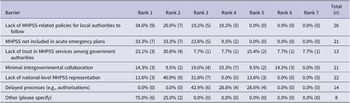
Table 3 shows the ranking of key barriers from the government level. The top-ranked key government-level barrier was lack of MHPSS-related policies for local authorities to follow, and not being included in the acute emergency plans. “Other” responses include “unrealistic” MHPSS-related action plans, absence of local financial responses to take over when organizations exit.
Ranked barriers from government level

Table 3. Long description
The table consists of 9 columns: Barrier, Rank 1, Rank 2, Rank 3, Rank 4, Rank 5, Rank 6, Rank 7, and Total n.
* Lack of M H P S S-related policies for local authorities to follow: Rank 1 at 34.6 percent (9), Rank 2 at 26.9 percent (7), Rank 3 at 19.2 percent (5), Rank 4 at 19.2 percent (5), Ranks 5 to 7 at 0.0 percent (0). Total n is 26.
* M H P S S not included in acute emergency plans: Rank 1 at 33.3 percent (7), Rank 2 at 33.3 percent (7), Rank 3 at 23.8 percent (5), Rank 4 at 9.5 percent (2), Ranks 5 to 7 at 0.0 percent (0). Total n is 21.
* Lack of trust in M H P S S services among government authorities: Rank 1 at 23.1 percent (3), Rank 2 at 30.8 percent (4), Rank 3 at 7.7 percent (1), Rank 4 at 7.7 percent (1), Rank 5 at 15.4 percent (2), Rank 6 at 7.7 percent (1), Rank 7 at 7.7 percent (1). Total n is 13.
* Minimal intergovernmental collaboration: Rank 1 at 14.3 percent (3), Rank 2 at 9.5 percent (2), Rank 3 at 19.0 percent (4), Rank 4 at 33.3 percent (7), Rank 5 at 9.5 percent (2), Rank 6 at 14.3 percent (3), Rank 7 at 0.0 percent (0). Total n is 21.
* Lack of national-level M H P S S representation: Rank 1 at 13.6 percent (3), Rank 2 at 40.9 percent (9), Rank 3 at 31.8 percent (7), Rank 4 at 0.0 percent (0), Rank 5 at 13.6 percent (3), Ranks 6 to 7 at 0.0 percent (0). Total n is 22.
* Delayed processes: Rank 1 at 0.0 percent (0), Rank 2 at 0.0 percent (0), Rank 3 at 42.9 percent (6), Rank 4 at 28.6 percent (4), Rank 5 at 28.6 percent (4), Ranks 6 to 7 at 0.0 percent (0). Total n is 14.
* Other: Rank 1 at 75.0 percent (6), Rank 2 at 25.0 percent (2), Ranks 3 to 7 at 0.0 percent (0). Total n is 8.
Note: Values are shown as “X% (n),” where n = number of respondents who assigned that rank. Percentages are based on the number of respondents who ranked each barrier. Lower ranks (1-2) indicate higher perceived urgency. Numbers do not add up to the total number of respondents because respondents were only asked to rank those that they deemed important.
Taken together, from the quantitative analysis, top-ranked barriers were related to understanding of the importance of MHPSS, including low representation of MHPSS staff at national level, low prioritization of MHPSS in acute emergencies, and low awareness of the benefits of MHPSS.
Qualitative Analysis
All open questions and free-text responses from the “other” category were entered into reflexive thematic analysis. Overall, four themes were generated.
1. Systemic Under-Prioritization and Under-Preparedness
MHPSS is seen as a “Nice-to-have” rather than lifesaving
Many respondents indicated a systemic under-prioritization of MHPSS, where it was seen as separate to the initial response and a “nice-to-have.” As an example, one respondent said, “MHPSS is seen like a second emergency.” MHPSS was not seen as essential, as another respondent put it, “… That there are life-saving acute needs, and there are no resources (human, time, space …) to organize and in general pay attention to a separate MHPSS component.” Another person noted how this was a view held not only by other agencies, decision-makers, or the government, but also by other internal stakeholders. It was mentioned that “some humanitarian workers and some health care professionals with a ‘human veterinarian’ approach, still question and even obstruct MHPSS response.” As a result of the lack of recognition, MHPSS resources were underfunded, and the funding was piecemeal, resulting in a delayed response. In particular, respondents noted that more specialized services were lacking.
Coordination and Integration
Beyond under-recognition by other agencies, inter-agency integration was fragmented. Examples included embedding MHPSS into mobile clinics, disaster units, shelters, protection, and primary care. Respondents stressed the need for both external and internal advocacy with affected communities, local authorities, and within organizations to enhance visibility and emphasize the cross-sectoral importance of MHPSS.
Coordination and integration needed to take place across sectors and agencies, within and between government institutions and humanitarian sectors. Respondents asserted that a systemic, public health approach had to be taken. That said, the “public health” approach had to be done correctly, where “considering only mortality and disregarding dignity and indirect impact of better mental health on overall health” was seen as “brutal and wrong.”
Institutional buy-in is crucial as it is often needed to access the sites, reduce stigma and build local ownership. One of said the respondents stated, “International agencies are in emergency contexts for a limited time; it is the government agencies that remain in the territories, which is why this aspect has been fundamental to my work.” Respondents argued for a stronger national coordination platform and mechanism. They also gave examples of challenges from the system and shed light on the importance of coordination:
“Most of the time, their green light is based on the trust they have for someone in particular or something they appreciate from your institution or some pressure received from international level. In my experience, they are never against any MHPSS intervention but the system doesn’t allow them to have as much engagement as for vaccination or controlling maternal mortality or stabilizing mass casualties. Inter-agency coordination for example allowed us to deliver the psychotropic medication where it was more needed.”
Therefore, it is crucial that there is an awareness of MHPSS within operational coordinators, although in reality, respondents noted that the communication and coordination was “intermittent,” “territorial,” and “unreliable” at times. One participant pointed out that as different agencies worked in different MHPSS programs, there was no coordination or intention to meet and discuss together.
Some respondents noticed the positive changes in the regions they worked in, where one said, “Government to a certain level is beginning to see the importance of MHPSS interventions during emergencies.” Another person said, “I have had very positive experiences with local authorities during acute emergencies, where they actively supported the delivery of MHPSS in affected villages, for instance, by making calls, indicating the most affected areas, facilitating access, and providing rooms for service delivery.” Good coordination and support from government was also seen to be helpful in navigating bureaucratic processes.
Preparedness
Many respondents noted the lack of preparedness in response to emergencies in MHPSS. The lack of preparedness would affect “both the quality of assistance provided to the affected people and negatively impact the responders themselves.” Respondents indicated MHPSS training occurred only during the crisis, not in preparedness efforts. They recommended integrating MHPSS into emergency plans, sharing contingency measures across regions, establishing surge rosters, and securing sustainable funding. One suggested creating a sub-delegation of MHPSS to update risk scenarios in contingency planning.
In early emergency phases, respondents emphasized the importance of gathering targeted information during needs assessments, ideally by qualified MHPSS practitioners, to identify and refer those most severely affected. Similarly, mapping should include both cultural and institutional MHPSS coping mechanisms.
To aid the implementation, coordination, and integration, respondents stressed the importance of integrating MHPSS into the emergency preparedness and response policies, as well as legal and protection policies. Guidelines included internal, national, and international guidelines. One person mentioned that “Internal guidelines are lacking which comes as a total nonsense given the mandate of the organization over the years.” Specifically, respondents expressed a desire for having a unified framework and tools to be used for MHPSS intervention during emergencies, guidelines for coordination, mapping, and evaluation of services. They emphasized that the documents needed to be accessible—“Have short versions of guidelines when a sudden emergency hit (no time in the chaos to read 250 pages guidelines),” and that policies and guidelines needed to be realistic.
2. The MHPSS Workforce Quality-Capacity Conundrum
Respondents identified significant workforce challenges, notably a shortage of qualified MHPSS practitioners such as psychiatrists and psychologists. External delegates faced limited time to understand the context and were burdened with administrative tasks, reducing their capacity for MHPSS activities. Prioritizing quantity over quality (regarding MHPSS activities and outputs) can lead to burnout and compromise the quality of MHPSS delivery. Increasing community-based approaches and involving local staff, lay counsellors, midwives, nurses, and community health workers are vital. Yet, local MHPSS staff at community level remain scarce, and there are insufficient training programs, drills, or simulations. Respondents warned of the possible harm if staff were inadequately trained and supported: “Still limited recognition that poorly trained individuals can cause harm—the perception that ‘anyone can do MHPSS’ is widespread.” Another respondent shared a similar view: “EMDR (few days on the protocol with no practice) or other approaches that are potentially harmful when not in the right hands.”
Respondents mentioned the following training needs:
-
• Training in mental health awareness for all health professionals.
-
• Training on conflict contexts and responding to affected people due to flooding.
-
• Training materials had to be culturally and contextually adapted, following “do not harm” principles.
-
• Lay providers should not be trained in specialized therapies if not appropriate (and without appropriate supervision).
-
• Practitioners should not be diagnosing people with PTSD in acute phases.
Sustainable task-sharing requires ongoing supervision. However, it was noted that ongoing supervision was lacking. For example, it was noted that General Practitioners were trained in the Mental Health Gap Action Programme (mhGAP)14 (World Health Organization, 2023), but they were not supervised adequately. A respondent lamented that many people simply wanted a certificate after attending the training and had no genuine interest in supervising others.
Respondents recommended a ready pool of personnel across sectors for deployment, emphasizing the hiring of permanent MHPSS staff and the importance of human resources. They noted that in emergencies, a highly experienced MHPSS specialist is crucial, as deploying less experienced staff could lead to poor outcomes. Some highlighted that, in certain regions, professional titles like “clinical psychologist” are unprotected, resulting in inconsistent staff quality.
Humanitarian workers’ mental health
Many respondents urged greater focus on humanitarian workers’ mental health, emphasizing risks of burnout, compassion fatigue, and secondary trauma in high-pressure, protracted conflicts. They called for more open discussions on mental health for both affected populations and aid workers. One respondent highlighted the need for genuine staff wellbeing measures beyond peer support, while another stressed ensuring access to staff health support in emergencies. Some managers believed the MHPSS team should also support colleagues. Suggestions included incorporating psychological impact training for responders, ensuring staff health services are available during crises, and management checking on team wellbeing rather than setting unrealistic expectations.
3. The Operational Landscape: Service Gap, Access Constraints and Contextual Mismatch
Gaps in multi-layered service provision
There were notable gaps in the MHPSS service provision in acute emergencies. Respondents noticed that the term MHPSS might bear confusing semantic connotations, diluting the full range of activities that MHPSS provides. There seems to be a confusion or misunderstanding of MHPSS by others that MHPSS was something singular or modular. As a respondent put it, “Sometimes there is this idea that MHPSS is meant to ‘calm people down.’ As if it were a tool to facilitate the work of others, rather than a way to give people agency and empower them in their rights.”
While some respondents argued for more provision of psychological first aid (PFA),15 other respondents pointed out that there was often a misunderstanding that PFA was an intervention rather than PFA being more an activity or skill—“it (PFA) is used wrongly as an ‘intervention’ by the main agencies to prepare people to respond in emergencies, but the content is limited to a skill set relevant to apply when you find someone in acute distress due to a crisis.” Some noted the danger that the focus on PFA might risk the neglect of other approaches and best practices. A respondent said, “The extreme number of NGOs claiming to do MHPSS when all they offer is PFA.”
As MHPSS encompasses a variety of interventions that require different levels of specialism, there was a risk of non-MHPSS specialists being misguided and not appreciating the broad scope of MHPSS. For example, one respondent argued, “Calling it MHPSS means that many people can claim to do it, when they are only doing child friendly spaces, so the very basis, meaning anything more meaningful is not provided. The stigma towards psychiatric disorders means that beneficiaries don’t know what MHPSS can do. Anything meaningful, between very basic PSS and psychiatry gets completely missed.” Several respondents called for more provision that bridges basic psychosocial support and specialized care. Commissioning the higher two levels was seen as a challenge as respondents felt it was harder to justify those interventions when management saw that many other agencies claimed to implement MHPSS when they were only doing basic psychosocial support. Some respondents also noted that some populations had more complications in accessing services, such as males and communities where mental ill health was being stigmatized.
Another service gap was the lack of referral systems and balancing the providers’ ideological approach (community approaches versus biomedical approaches). The need for a more eclectic approach based on needs, rather than providers’ preferences was noted. Multiple respondents emphasized the need for multidisciplinary, cross-referral pathways and having functional referral systems.
Access constraints
Access issues include restricted movement, lack of security, and damaged facilities impeding reach to vulnerable areas. Safety concerns arise during ongoing traumatic events. Practical challenges include slow deployment of MHPSS staff due to visa constraints, and limit emergency response capacity. Inside sites, the lack of safe, private rooms hampers interventions. One respondent emphasized the need for investment in quick, effective information and surveillance systems for MHPSS access.
Culture and Beliefs
Culture and beliefs were key challenges identified from 2 aspects. From the community aspect, respondents described how stigma and discrimination related to mental health were challenges. For example, a respondent mentioned “In some contexts, stigma and discrimination against people with mental health conditions has been a major challenge.” On the other hand, some respondents described challenges from the provider level—where there was an underutilization of community-based approaches, and delivering interventions “consistent with traditions, culture and customs.” One person noted that “Once the services are presented to the affected communities in a culturally sensitive manner, without stigma arising wording, people seek services and benefit from it.”
As a respondent put it, “Arriving with pre-established ways of acting only contributes to the potential for further harm,” “not just copy and paste ‘International Guidelines’ that have no cultural adaptation.” A respondent gave specific examples where there might be a contextual mismatch with the communities they worked with—“Trainings are sometimes imported from global materials without tailoring to local cultural, linguistic, or community realities. Issue with people diagnosing PTSD in acute phases of the emergency.” Respondents noted that changing paternalistic approaches were needed and more participatory approaches and strengthening community focal points (including leaders, health workers, teachers, community helpers) were recommended. They noted the importance of inclusion and equity principles.
Some respondents mentioned practical needs and challenges such as the importance of culturally adapted MHPSS interventions, faith-based interventions, having ready-made leaflets in different languages (on topics including “managing panic attacks,” “talking to children”), as well as setting up contextual and cultural competence trainings.
4. The Implementation-Evaluation Cycle
The cyclical nature of MHPSS implementation barriers was evident, with under-recognition and under-prioritization affecting funding and workforce, thereby delaying task-sharing and capacity building. Poor coordination further slowed responses and hindered advocacy efforts. Sustainability seemed to be key, and monitoring and evaluation were needed for preparedness and planning, as well as building policy and guidelines. Respondents highlighted the lack of reliable MHPSS data for planning, emphasizing the need for psychometric tools in assessing and monitoring service users. They also called for qualitative, narrative, and relational indicators to capture change. At an international level, harmonized assessment, treatment, and follow-up tools were recommended to build evidence.
Despite the challenges, respondents noted positive experiences in doing MHPSS. One person said that their experience in acute emergencies was “chaotic, interested and practical.” There was a strong sense that respondents regarded MHPSS as essential and beneficial in acute contexts.
Discussion
This mixed-method survey aimed to understand the barriers to implementing MHPSS during acute emergencies faced by MHPSS practitioners in a large NGO across the globe. The quantitative and qualitative findings yielded consistent responses. Overall, respondents noted the lack of awareness of the importance and benefits of MHPSS and shortages in MHPSS resources workforce, training, and supervision). From the responses, it appeared that respondents were not aware of MHPSS-related policies and guidelines specific to acute emergencies. Qualitative analysis revealed 4 key themes:
-
1. Systemic under-prioritization and under-representation, viewing MHPSS as non-essential, with poor coordination and preparedness.
-
2. MHPSS workforce challenges, highlighting training, supervision, recruitment, staff wellbeing, and capacity issues.
-
3. Operational gaps, access barriers, and cultural mismatches affecting service delivery.
-
4. The importance of robust monitoring and evaluation within the implementation cycle.
Although guidelines around MHPSS in emergencies exist, 5,6,14 the findings highlight a theory-implementation gap and are consistent with previous research in other emergency settings and phases, including natural hazardsReference Rowe and Nadkarni7 and infectious diseasesReference Yirdaw, Moussallem and Alkasaby9;integration of MHPSS across the Movement,16 where challenges relating to resources, capacity, cultural adaptations, and systemic constraints were highlighted. Respondents asserted that MHPSS was not prioritized in acute phases of emergencies, where multiple respondents experienced feedback that MHPSS was not regarded as “life-saving” or “essential,” leading to delays in responses despite the evidence to the contrary.
The findings also echo the priority setting studyReference Tol, Le and Harrison10—moving toward system thinking and addressing system-related challenges rather than simply conducting efficacy research. The need for robust and multifaceted approaches—spanning legal frameworks, policy guidance, human resources in recruitment, retraining and upskilling the workforce—is critical to address the nexus between mental health and emergencies. There was an emphasis that both mental health (“MH”) and psychosocial support (“PSS”) are important and not to be neglected. More specialized interventions need to be implemented in acute settings in addition to other interventions such as child-friendly spaces and PFA. The mental health of MHPSS staff was seen as important, especially in acute phases, and not to be confused with staff health MHPSS (i.e., MHPSS provided to humanitarian staff rather than beneficiaries).
Limitations and Recommendations
Several limitations can be noted in this study. Although the survey respondents covered four continents, the sample size was modest as a mixed-method study. As a result, we could not analyze the results by region/ continent. Member checking was not conducted due to the anonymous nature. Future studies could consider increasing recruitment channels and incentivizing participants to respond. There was no staff delegate from the Pacific Islands or Oceania, which are increasingly impacted by climate change; this study did not capture their needs or challenges. There was also a lack of health delegate and case worker in this study. Another limitation is that the study solely involved MHPSS personnel without incorporating insights from non-MHPSS staff. To enhance communication and coordination across sectors, it is strongly recommended that future research include the perspectives of non-MHPSS staff—such as those involved in protection, education, and WASH. This inclusion could assist in identifying knowledge gaps and offer a more comprehensive understanding of resource allocation and triage decision-making processes. This could also support the formulation of policies and guidelines aimed at effectively addressing these gaps as initiatives evolve from program-specific efforts to system-wide integration and coordination. Respondents provided practical suggestions for building referral and coordination systems, including culturally responsive training, conflict-specific training, ready-made resources, short and accessible guidelines, and system-level advocacy. Their experiences reflect a global trend across agencies, highlighting ongoing challenges in prioritizing MHPSS, capacity-building, and delivering culturally appropriate, high-quality services. However, there is a crucial need for additional research to evaluate the impact and efficacy of existing mental health interventions in acute emergencies settings, to better inform policy and future responses.
In conclusion, addressing the implementation gaps in MHPSS during acute emergencies involves increasing the prioritization of MHPSS within emergency response efforts, strengthening the workforce through continuous training, supervision, and attention to staff wellbeing. Additionally, fostering culturally sensitive approaches, implementing robust and ongoing monitoring and evaluation systems, providing a broad and integrated range of MHPSS support beyond focusing on one or 2 interventions, and emphasizing preparedness are key. Genuine interagency collaboration efforts will make MHPSS more effective and sustainable, ultimately supporting recovery for affected communities.
Supplementary material
The supplementary material for this article can be found at http://doi.org/10.1017/dmp.2026.10429.
Acknowledgment
We thank the NGO staff for completing the survey despite their busy schedules.
Author contribution
SHY and OSR conceptualized and designed the study. SHY analyzed and wrote the manuscript under the supervision of SD and OSR. SD and OSR reviewed and edited the manuscript.
Funding statement
This paper is unfunded.
Competing interests
None.
IRB approval
The study was approved by the ethics review board of the International Committee of the Red Cross (reference number 2510_JUN).
Declarations of AI use
ChatGPT has been used to improve the grammar and language of the manuscript in selected sentences. All identifiable details were removed when using the AI. After using this tool, the authors reviewed and edited the content as needed and take full responsibility for the content of the publication.




 Open access

