Introduction
Whilst there is a body of interdisciplinary research on life transitions (Barroso et al. Reference Barroso, Gollop, Sandelowski, Meynell, Pearce and Collins2003) and a developing interest in those ageing with disability, Jeppsson Grassman et al. (Reference Jeppsson Grassman, Holme, Taghizadeh Larsson and Whitaker2012) observe that little is known about the experiences of people ageing with a range of impairments; social gerontology and gerontological social work research has tended to focus on those ageing into disability rather than those ageing with disability (Jeppsson Grassman et al. Reference Jeppsson Grassman, Holme, Taghizadeh Larsson and Whitaker2012; Putnam Reference Putnam2002). Writing as an adult ageing with impairment, Newell (Reference Newell and MacKinlay2008: 74) argues that ‘[t]he ageing of adults with all types of disabilities is an important issue which has not necessarily received the intellectual energy that it should’.
However, this population has become more visible (Putnam Reference Putnam2002), as a result of increased life expectancy, and advances in rehabilitation and medical technologies, and a body of literature on the topic is emerging. This literature notes important differences between the ‘ageing with disability’ and ‘ageing into disability’ populations, but has largely focused on those with physical impairments (e.g. Gilson and Netting Reference Gilson and Netting1997; Zarb and Oliver Reference Zarb and Oliver1993) or intellectual impairment (e.g. Bigby and Haveman Reference Bigby and Haveman2010; Gangadharan, Devapriam and Bhaumik Reference Gangadharan, Devapriam and Bhaumik2009; Kåhlinet et al. Reference Kåhlin, Kjellberg, Nord and Hagberg2013) and not sensory impairments, though one of the studies of Jeppsson Grassman et al. (Reference Jeppsson Grassman, Holme, Taghizadeh Larsson and Whitaker2012) related to adults ageing with visual impairment. The aim of this review is to synthesise existing knowledge about those ageing with dual sensory impairment, also known as deafblindness, in order to answer the following: what is known about the experiences, views and key features of old age and ageing for deafblind people?
Those who have aged with deafblindness are largely an unrecognised population, in both policy and the literature. Furthermore, in practice, social care services have often overlooked those ageing with impairments (Verbrugge and Yang Reference Verbrugge and Yang2002; Zarb Reference Zarb, Arber and Evandrou1993); in the United Kingdom (UK), services for disabled adults have often been targeted at those aged 18–65, whilst those over 65 are regularly transferred to mainstream older people's services. To inform policy and practice, there is a clear need to explore the experiences of those ageing with specific impairments such as deafblindness; such a need has been noted in relation to changing clinical needs (Dalby et al. Reference Dalby, Hirdes, Stolee, Strong, Poss, Tjam, Bowman and Ashworth2009) and also in relation to specific groups (e.g. those born with congenital rubella syndrome during the 1960s rubella pandemic (Armstrong and O'Donnell Reference Armstrong and O'Donnell2004) and those with Usher Syndrome (Damen et al. Reference Damen, Krabbe, Kilsby and Mylanus2005)).
Definitions
Deafblindness is a severe and complex impairment (Bodsworth et al. Reference Bodsworth, Clare and Simblett2011; Langer Reference Langer2008). This complexity becomes apparent when attempts are made to define and describe the condition (Alley and Keeler Reference Alley and Keeler2009; Dammeyer Reference Dammeyer2010b). Various terms for the impairment have emerged (Enerstvedt Reference Enerstvedt1996; Mar Reference Mar, Reiman and Johnson1993; Wittich et al. Reference Wittich, Southall, Sikora, Watanabe and Gagne2013), reflecting the broad spectrum of people who can be considered ‘deafblind’ (Alley and Keeler Reference Alley and Keeler2009; Smith Reference Smith, Reiman and Johnson1993). What deafblind people have in common is deprivation in use of the distance senses (sight and sound) (McInnes Reference McInnes1999), resulting in difficulties with communication, accessing information and mobility (Department of Health 1997). Geenens (Reference Geenens and McInnes1999) observes that deprivation in the distance senses also significantly diminishes information to the brain, impacting on the way in which deafblind people, particularly congenitally deafblind people, make sense of their surrounding environment. Deafblind people may therefore rely on the proximal senses, particularly touch, to explore and engage with their environment. Nicholas (Reference Nicholas2010: 7) notes that deafblind people ‘use active touch in ways that no one else does … [and] are generally more experienced in recognising stimuli by active touch’. Variations in, inter alia, aetiology, age, age of onset, interval between impairment in each sense, cognitive function, language/communication method and cultural background (Bodsworth et al. Reference Bodsworth, Clare and Simblett2011; Dalby et al. Reference Dalby, Hirdes, Stolee, Strong, Poss, Tjam, Bowman and Ashworth2009; Langer Reference Langer2008) all impact on a person's experience of deafblindness.
In addition to the broad categories of congenital and acquired deafblindness, four distinct groups of deafblind people have been identified (Deafblind Services Liaison Group 1988; Department of Health 2014). In England, the Department of Health's (1997) good practice guidelines, Think Dual Sensory, extend these classifications and apply them specifically to older deafblind people:
-
1. Those whose deafblindness has been acquired and developed in old age.
-
2. Older people who have lived with sight impairment and subsequently acquire hearing loss.
-
3. Older deafened or hearing-impaired people who have used speech to communicate, who subsequently acquire visual impairment.
-
4. Older culturally Deaf people who use British Sign Language, who subsequently acquire visual impairment.
-
5. Older people who have been deafblind for all or the majority of their life.
The majority of deafblind people fall into the first of these groups, a population predicted to expand considerably (Robertson and Emerson Reference Robertson and Emerson2010). Whilst this group has received less attention in research than congenitally deafblind children and young people with acquired deafblindness (Brennan, Horowitz and Su Reference Brennan, Horowitz and Su2005; Roberts Scharf and Bernard Reference Roberts, Scharf and Bernard2007), a range of literature is now evident. However, much less is known about those older people who have aged or are ageing with deafblindness. Whilst these are a much smaller group of deafblind people than those acquiring deafblindness in later life, it is important to note that they remain a heterogeneous population, with factors such as age of onset, previous education, communication method, cultural identity and social support as key variables.
Method
This paper reports on the findings of the second element of a systematically conducted literature review, the first element of which explored what is known about the vulnerability of deafblind people. The findings of the latter are published elsewhere (Simcock Reference Simcock2016). Whilst the inclusion criteria for the first element differed to those of the second (it did not focus solely on those ageing with deafblindness), the review method adopted was the same. A preliminary scoping search of bibliographic databases identified a highly diverse body of material, reflecting the classification of the types and quality of knowledge in social care of Pawson et al. (Reference Pawson, Boaz, Grayson, Long and Barnes2003): organisational knowledge; practitioner knowledge; user knowledge; research knowledge; and policy community knowledge. Such a diverse collection of material problematised two aspects of the systematic review process for both components of the review: quality appraisal and synthesis. The review was therefore systematically conducted and informed by the principles of rigour, comprehensive search strategies and transparency. An approach based on a ‘hierarchy of evidence’ was rejected, as this would have reduced the amount of literature reviewed to the point where any attempt at synthesis would not be possible. Such an approach would also have resulted in the loss of much material considered to be practitioner knowledge and ‘user’ testimony. There is increasing recognition of the importance of such knowledge in systematic reviews (Gough, Oliver and Thomas Reference Gough, Oliver and Thomas2012; Rutter et al. Reference Rutter, Francis, Coren and Fisher2010).
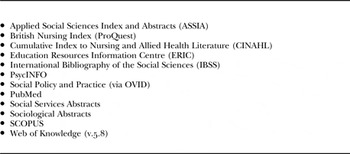
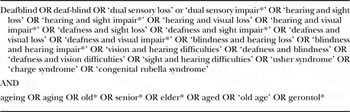
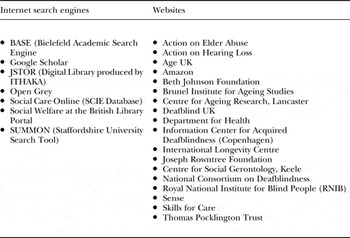
A comprehensive literature search was undertaken between April 2013 and May 2014. Twelve electronic bibliographic databases (see Table 1) were searched. Search terms were based on key concepts drawn from the review question (see Table 2). Searching was an iterative process, with terms being refined and developed as a result of the findings of the initial scoping searches. To identify grey literature and relevant but unpublished material, websites were searched and internet search engines used (see Table 3). Whilst it is a commercial website, Amazon was also explored, as its usefulness for literature searches has been acknowledged (Bryman Reference Bryman2008). One of the publications in this review (Stoffel Reference Stoffel2012) was found solely via Amazon.
Databases searched

Search terms

Search engines and websites

The ‘Deafblind Bibliography’ (constructed by James Gallagher, a deafblind man from the UK, as part of his Deafblindness Web Resource: www.deafblind.co.uk/biblio_unsorted.html) and ‘Selected Readings on Sensory Loss in Older Age’ produced by the Centre for Policy on Ageing (www.cpa.org.uk/information/readings/sensory_loss.pdf) were searched. The author also hand-searched DbI Review (publication of Deafblind International) and Talking Sense (publication of the charitable organisation Sense). Visits were made to the Sense library and discussions held with Sense practitioners. Finally, the search was enhanced through citation tracking, reference harvesting, author searching and personal contact with named authors (as recommended by Barroso et al. Reference Barroso, Gollop, Sandelowski, Meynell, Pearce and Collins2003; Fisher et al. Reference Fisher, Qureshi, Hardyman and Homewood2006; Rutter et al. Reference Rutter, Francis, Coren and Fisher2010).
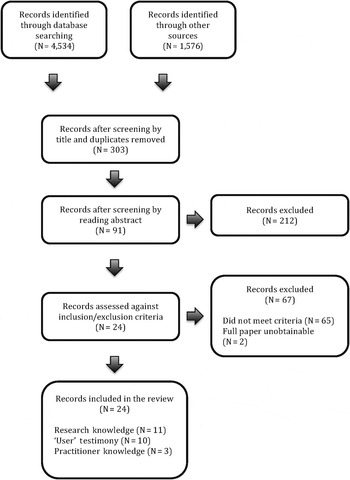
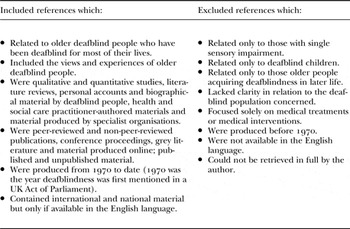
Certain references were excluded on the basis of the title alone. Those references appearing relevant were stored in bibliographic software (EndNote) and the criteria (see Table 4) were applied following reading of the title and abstract, where available, by the author. Those appearing relevant were retrieved and the criteria applied a further time. Details on identification, screening, eligibility and inclusion can be found in the PRISMA diagram (Figure 1; PRISMA from Moher et al. Reference Moher, Liberati, Tetzlaff and Altman2009).
PRISMA diagram.

Inclusion and exclusion criteria

The author used the TAPUPAS standards devised by Pawson et al. (Reference Pawson, Boaz, Grayson, Long and Barnes2003) as provisional guidelines for appraising the literature included. This framework involves assessing the Transparency, Accuracy, Purposivity, Utility, Propriety and Accessibility of the material. It also requires the reviewer to consider source-specific standards, relevant to each of the types of knowledge; these are outlined in the Social Care Institute for Excellence ‘Types and Quality of Knowledge in Social Care’ knowledge review (Pawson et al. Reference Pawson, Boaz, Grayson, Long and Barnes2003). However, priority was given to relevance over type or quality, owing to the limited amount of material identified; Killick and Taylor (Reference Killick and Taylor2009) and Ploeg et al. (Reference Ploeg, Fear, Hutchison, MacMillan and Bolan2009) report that it is often necessary to ‘relax’ quality criteria, in order to incorporate the material that has been found. Owing to the nature of the review question and the diversity of material, an interpretative rather than aggregative approach to synthesis was adopted (Bryman Reference Bryman2008). The diversity of material, variety of reporting conventions and multiple definitions of deafblindness used rendered data extraction problematic. The interpretative approach adopted by the author therefore involved reading and re-reading the material selected in order to identify dominant themes, related concepts, similarities and incongruities (Fisher et al. Reference Fisher, Qureshi, Hardyman and Homewood2006). Drawing on principles of critical interpretive synthesis (Dixon-Woods et al. Reference Dixon-Woods, Cavers, Agarwal, Annandale, Arthur, Harvey, Hsu, Katbamna, Olsen, Smith, Riley and Sutton2006), rather than being a determiner of whether material should be included or excluded, critique of the literature is offered within the synthesis.
Findings
Description of literature
A total of 24 references met the criteria and were therefore included. Eleven are research knowledge, adopting various methods. None of these studies focus specifically or solely on the experience of ageing with deafblindness; however, the topics and research questions were considered relevant to the review question. Whilst LeJeune's (Reference LeJeune2010) study is part of a larger research project entitled ‘Persons Aging with Hearing and Vision Loss’ (PAHVL Project), this title could be considered somewhat misleading. The participants in this study had acquired a second sensory impairment after the age of 55 years, having previously been single sensory impaired (either hearing impaired or sight impaired). Whilst they are now ‘ageing with deafblindness’, they have not necessarily been deafblind for the majority of their lives. The study was included, however, as the experiences of this population are distinct from those older people who have acquired dual sensory impairment in later life (LeJeune Reference LeJeune2010).
Ten references are ‘user’ testimony. These include collections of personal accounts of living with deafblindness published as texts, in specialist organisations' publications or in peer-reviewed journals. Most are written by deafblind people, whilst others have been constructed in response to questions posed by friends and social care practitioners. Two have a particular focus on the experiences of old age and ageing with deafblindness (Pollington Reference Pollington2008; Wolf Reference Wolf2006).
Three references are ‘practitioner knowledge’. Two of these are by the same author and all three are written by social workers. These accounts draw on practice experience, but also make use of other literature and interviews with deafblind people. They are not considered as ‘research knowledge’, as information from the interviews is used for illustrative purposes, rather than subject to any clear data analysis. None of these reports focus solely on the experiences of old age and ageing with deafblindness.
Table 5 summarises the 24 references.
References included in the review

Notes: 1. Since completing this literature review, the final report has been published. BSL: British Sign Language. UK: United Kingdom. USA: United States of America.
Synthesis
Dammeyer (Reference Dammeyer2015) observes that research in deafblindness is still in its infancy, and calls for greater interest in the field amongst the research community. Lack of a ‘research infrastructure’ for studies with deafblind people (Brennan and Bally Reference Brennan and Bally2007: 282) was apparent in this review. Neither a common deafblind population nor a common definition of deafblindness is evident across the 24 references, as similarly identified by Wittich et al. (Reference Wittich, Southall, Sikora, Watanabe and Gagne2013) in their systematic review of terms and definitions of deafblindness across clinical and research literature. Various definitions are used and differing populations included, making comparison across the material problematic. The majority of the material adopts a functional definition, focusing on the implications of dual sensory impairment. However, there are subtle differences. Yoken (Reference Yoken1979: 4) observes that all but one of the participants in her study ‘fall into the standard, accepted description of deafblindness’, yet there is no clear identification in her work of this ‘standard, accepted description’, albeit that there is some earlier reference to functional implications of the condition. Stoffel (Reference Stoffel2012: ix) makes no reference to functional limitations in his definition, referring instead to ‘a significant hearing loss and visual impairment’ and in his personal account, Cohn (Reference Cohn1998: 19) suggests a clear distinction between people with hearing and visual impairment and those who are ‘truly deaf-blind people’.
Studies do highlight particular differences between the needs and experiences of those acquiring deafblindness in later life, and those who have aged with the impairment. However, there is often a lack of clarity in reporting age of onset of deafblindness and current age, making it impossible to determine to which of these populations research participants belong. Furthermore, in studies that have included deafblind participants across the age groups, authors using direct quotations from participants or commenting on participants' views do not always make clear the relevant age/age of onset details of the particular participant, albeit that such participant characteristics are detailed in the methods sections.
Deafblind people use a range of languages and methods of communication (Barnett Reference Barnett2001) and may use a variety of methods depending on the situation (e.g. environment, location and time of day). Deafblind people may also use different methods for expressive and receptive communication (Sauerburger Reference Sauerburger1993). As such, research with deafblind people, including most, though not all, of that included in this review, often involves interpretation and translation. Use of interpreters and translation poses practical and epistemological challenges in qualitative research (Berman and Tyyskä Reference Berman and Tyyskä2011; Regmi, Naidoo and Pilkington Reference Regmi, Naidoo and Pilkington2010; Temple and Young Reference Temple and Young2004). Temple and Young (Reference Temple and Young2004), writing specifically about research with British Sign Language users, stress the epistemological challenges of interpreter and translation use. They note that users of different languages may construct different views of the social world, which presents a challenge to the researcher in accurately representing participants' experiences in a different language. Many of the deafblind participants in the research studies in this review use sign languages (tactually or utilising residual vision); however, their direct quotations are always represented in written English. Furthermore, some studies involve multiple translations, not only from Sign Languages to English, but also from a range of other European languages (e.g. Norwegian, Swedish, and Danish) to English (Göransson Reference Göransson2008; Gullacksen et al. Reference Gullacksen, Göransson, Rönnblom, Koppen and Jørgensen2011; Oleson and Jansbøl Reference Oleson and Jansbøl2005; Spring, Adler and Wohlgensinger Reference Spring, Adler and Wohlgensinger2012). Temple (Reference Temple2002) highlights that interpreters are not neutral but are themselves constructors of knowledge in the interpreting act. Whilst some of the studies note the use of interpreters in the research (Gullacksen et al. Reference Gullacksen, Göransson, Rönnblom, Koppen and Jørgensen2011; LeJeune Reference LeJeune2010; Spring, Adler and Wohlgensinger Reference Spring, Adler and Wohlgensinger2012; Yoken Reference Yoken1979), Oleson and Jansbøl (Reference Oleson and Jansbøl2005) are the only authors to recognise their role as constructors of knowledge, noting that their presence in qualitative interviews may affect the participants' responses to questions posed.
Kyle and Barnett (Reference Kyle and Barnett2012) suggest that knowledge of deafblind people's experiences can be gained through their autobiographical work. Gullacksen et al. argue that:
these personal stories relay important knowledge … [and that the] most important source of knowledge when it comes to understanding … how people cope with a life with deafblindness, are the people who actually experience it. (2011: 18–20)
However, many of the personal accounts identified in this review are limited in detail and depth, offering only a ‘snapshot’ of their life experiences. Furthermore, such accounts cannot be considered representative of the experiences of all deafblind people. The deafblind people writing or contributing to these accounts have their own particular backgrounds, which impact on their experiences. The majority of those contributing to the personal accounts also have contact with organisations for and of deafblind people, either as service users, employees or volunteers. Contact with such organisations is also the main method of participant recruitment in the majority of the research studies. The potential for bias that this engenders should be acknowledged (Padgett Reference Padgett2008).
Older people ageing with deafblindness: a hidden population
Wolf (Reference Wolf2006: 25) argues that older deafblind people are ‘often invisible and ignored’. Whilst she is referring here to all older deafblind people, this review suggests that it is those who have aged with deafblindness that are most ‘invisible’. As noted, no research literature focusing specifically and solely on the experiences of those ageing with deafblindness was identified. Whilst various researchers and practitioners have highlighted the important distinction between those ageing with deafblindness and those acquiring deafblindness in later life (Göransson Reference Göransson2008; Jansbøl Reference Jansbøl1999; Sense 2009; Spring, Adler and Wohlgensinger Reference Spring, Adler and Wohlgensinger2012; Wolf Reference Wolf2006), the majority of the research literature addresses the experiences and needs of the latter group. Indeed, over 80 references were found during the literature search relating to this population. There is evidence of an inherent assumption in the literature that ‘older deafblind people’ are those who have acquired the impairment in later life. Journal articles with titles such as ‘Vision and hearing loss in older adults’ (Berry Mascia and Steinman), ‘Dual sensory impairment in an aging population’ (Saunders and Echt Reference Saunders and Echt2011), ‘Dual sensory impairment in older age’ (Schneider et al. Reference Schneider, Gopinath, McMahon, Leeder, Mitchell and Wang2011) and ‘An overview of dual sensory impairment in older adults’ (Saunders and Echt Reference Saunders and Echt2007), inter alia, focus exclusively on those who have acquired deafblindness in later life; whilst in some this is made evident in the abstract or introduction, in others it is merely implied.
In those studies including a range of deafblind people, the ‘ageing with deafblindness’ population appears to be marginalised. Furthermore, the studies' oldest participants are often at an age that would be considered the ‘young old’ (Moody and Sasser Reference Moody and Sasser2012). One research study refers rather unspecifically to the oldest participants as being ‘over 46 years of age’, despite its stated focus on the difficulties in remaining independent for those with Usher Syndrome who are ‘getting older’ (Damen et al. Reference Damen, Krabbe, Kilsby and Mylanus2005). This lack of inclusion of older people ageing with deafblindness may be linked to participant recruitment difficulties, rather than choice; indeed, Kyle and Barnett (Reference Kyle and Barnett2012: 15) observe that it ‘proved more difficult to find older Deafblind people’ than younger Deafblind people for their study.
Marginalisation of older people who have aged with deafblindness is also evident in those references concerned with the ‘lifecourse’ or ‘life cycle’. For example, Miner (Reference Miner1995) includes significantly less material on later life than on issues related to infancy and childhood, adolescence, school experiences and early adulthood. Miner (Reference Miner1995: 294) herself suggests that ‘much more work needs to be done on elderly people's experiences with Usher syndrome’. The section titled ‘Ageing with deafblindness’ in Göransson's (Reference Göransson2008) study of the experience of deafblindness across the age groups is also significantly shorter than those concerned with childhood and adolescence; whilst this section starts with the profile of an 81-year-old woman who has aged with deafblindness, the majority of the chapter explores the experiences of those acquiring the impairment in later life. The publication of the follow-up study by Gullacksen et al. (Reference Gullacksen, Göransson, Rönnblom, Koppen and Jørgensen2011) contains chapters on both childhood and adolescence, but no separate chapter on old age. The studies by Ellis and Hodges (Reference Ellis and Hodges2013) and Oleson and Jansbøl (Reference Oleson and Jansbøl2005) seek to explore the experiences and lives of people with Usher Syndrome and deafblind people, respectively. Whilst neither study adopts a lifecourse perspective or approach, it is interesting to note that in both studies, the researchers clearly state a choice to focus on young deafblind people and those in early adulthood.
Crow (Reference Crow2000: 845) observes that the well-known American deafblind woman Helen Keller ‘was a woman who lived to old age, yet is fixed in the public imagination as an eternal child’. A number of personal accounts of living with deafblindness offer limited coverage of the experience of ageing. Both Coker (Reference Coker1995) and Murphy (Reference Murphy, Taylor and Bishop1991) acquired deafblindness in childhood and are now in later life, yet in neither account do they report on nor describe their experience of getting older, choosing to focus on childhood, schooling and early adulthood; these accounts were therefore excluded from the review. Those included in review, with the exception of Pollington (Reference Pollington2008) and Wolf (Reference Wolf2006), offer limited discussion in relation to getting older; they focus predominantly on experiences earlier in their lives, particularly diagnosis, education, adolescence and transition to adulthood.
Ageing with deafblindness: ongoing change and adjustment
Whilst sensory impairments have been described as ‘stable’ conditions (Kelley-Moore Reference Kelley-Moore, Dannefer and Phillipson2010; Shakespeare and Watson Reference Shakespeare and Watson2001), such description appears contrary to the experiences of those ageing with deafblindness. The concept of change, in both the impairment and its impact as people age, is common across all the literature reviewed. Göransson (Reference Göransson2008: 16) concludes that ‘deafblindness can never be regarded as something static’ and the experience of change forms the central theme of Pollington's (2008) personal account.
Changes in vision and hearing are one particular experience noted. Wolf (Reference Wolf2006: 24) observes that even those ‘who may have been [deafblind] for many years, see a worsening of their condition’. Older deafblind people report deterioration in both their hearing and vision (Duncan et al. Reference Duncan, Prickett, Finkelstein, Vernon and Hollingsworth1988; Göransson Reference Göransson2008; Gullacksen et al. Reference Gullacksen, Göransson, Rönnblom, Koppen and Jørgensen2011; LeJeune Reference LeJeune2010; Oleson and Jansbøl Reference Oleson and Jansbøl2005; Pollington Reference Pollington2008; Spring, Adler and Wohlgensinger Reference Spring, Adler and Wohlgensinger2012; Stiefel Reference Stiefel1991; Stoffel Reference Stoffel2012; Yoken Reference Yoken1979), with changes in vision in particular for those with Usher Syndrome, owing to the nature of retinitis pigmentosa (Butler Reference Butler2004; Damen et al. Reference Damen, Krabbe, Kilsby and Mylanus2005; Duncan et al. Reference Duncan, Prickett, Finkelstein, Vernon and Hollingsworth1988; Ellis and Hodges Reference Ellis and Hodges2013; Miner Reference Miner1995, 1997; Stiefel Reference Stiefel1991; Stoffel Reference Stoffel2012). Laustrup (Reference Laustrup2004) identifies that some of these changes result from the original aetiology of deafblindness and potential late manifestations of these aetiologies; others are attributed to other conditions, including age-related conditions. Barr (Reference Barr1990) describes the experience of both. Laustrup (Reference Laustrup2004) also highlights that progressive impairment of vision and hearing is not limited to those ageing with conditions related to acquired deafblindness, but also those with congenital deafblindness. This challenges the perception of congenital sensory impairment as ‘stable’ or ‘static’, and also Göransson's (2008) suggestion that for those ageing with congenital deafblindness the core challenge is external changes throughout the lifecourse, rather than changes in hearing and vision. The nature and timing of hearing and vision deterioration are variable and periods of stability and fluctuation are reported; two older deafblind participants in the Oleson and Jansbøl (2005: 14) study discuss changes in vision having no ‘fixed pattern’. It is important to note that changes in hearing and vision are not restricted to deterioration; some people ageing with deafblindness experience improvements as a result of changes in their condition or medical intervention (Stoffel Reference Stoffel2012; Yoken Reference Yoken1979).
As a result of these changes, those ageing with deafblindness often describe a need to make adjustments, and ‘individual adjustment’ is a concept common across the literature, particularly adjustment to loss. Miner (Reference Miner1995: 287) states that ‘Usher syndrome … requires multiple adaptations throughout the life cycle’ and her later paper on Usher Syndrome Type II focuses specifically on ‘adaptations’ (Miner Reference Miner1997). Adjustment is not a ‘one-off’ event. Yoken (Reference Yoken1979), Stiefel (Reference Stiefel1991), Göransson (Reference Göransson2008), Gullacksen et al. (Reference Gullacksen, Göransson, Rönnblom, Koppen and Jørgensen2011) and Wickham (Reference Wickham2011) all report repeated and ongoing adjustment. Ann Black, a contributor to the collection of personal accounts of Duncan et al. (1988: 8), refers to ‘a constant adjustment’ as she ages with Usher Syndrome. The literature observes those ageing with deafblindness making a range of adjustments: psycho-social adaptation and emotional ‘acceptance’ of deteriorating senses; changes in relationships, including personal relationships and relationships with social care services; and having to learn new ways to complete activities of daily living, use modern assistive technologies and access information (Duncan et al. Reference Duncan, Prickett, Finkelstein, Vernon and Hollingsworth1988; Ellis and Hodges Reference Ellis and Hodges2013; Göransson Reference Göransson2008; Gribs, Dougherty and Du Pre Reference Gribs, Dougherty and Du Pre1995; Gullacksen et al. Reference Gullacksen, Göransson, Rönnblom, Koppen and Jørgensen2011; Miner Reference Miner1995, 1996; Oleson and Jansbøl Reference Oleson and Jansbøl2005; Stoffel Reference Stoffel2012).
A particularly common adjustment experience concerns communication method. Participants in a number of studies, practitioners and those offering personal accounts describe how changes in hearing and vision render existing communication methods unsatisfactory, making communication difficult (Damen et al. Reference Damen, Krabbe, Kilsby and Mylanus2005; Göransson Reference Göransson2008; Gullacksen et al. Reference Gullacksen, Göransson, Rönnblom, Koppen and Jørgensen2011; Miner Reference Miner1997; Oleson and Jansbøl Reference Oleson and Jansbøl2005; Spring, Adler and Wohlgensinger Reference Spring, Adler and Wohlgensinger2012; Stoffel Reference Stoffel2012). Many older deafblind people describe how they have needed to learn new methods of communication over their lifecourse (Göransson Reference Göransson2008; Gullacksen et al. Reference Gullacksen, Göransson, Rönnblom, Koppen and Jørgensen2011; Spring, Adler and Wohlgensinger Reference Spring, Adler and Wohlgensinger2012).
Ageing with deafblindness: inter-related experience
Pollington (Reference Pollington2008: 32) states that she ‘cannot divorce ageing from deafblindness because that is what I am’. The relationship between ageing and deafblindness and the impact they have on each other are recurring themes across the literature. Gullacksen et al. (Reference Gullacksen, Göransson, Rönnblom, Koppen and Jørgensen2011) note that adjustment to deafblindness is a process that occurs alongside the ageing process: changes related to ageing occur concurrently with changes in the dual sensory impairment. Brennan and Bally (Reference Brennan and Bally2007) highlight that for many older people acquiring deafblindness in later life, the effects of age-related conditions exacerbate the dual sensory impairment and vice versa. It appears that this reciprocal exacerbation is also an experience of some of those who have aged with deafblindness. Stiefel (Reference Stiefel1991) and personal accounts in Wolf (Reference Wolf2006) and Stoffel (Reference Stoffel2012) include descriptions of a combination of age-related conditions and deafblindness adversely impacting on mobility, communication and activities of daily living. The impact of this exacerbation is captured in the words of a 71-year-old woman, deafblind from adolescence:
I have spent most of my adult life living alone with increasing disabilities … Now that I'm of retirement age, the difficulties are closing in. (Contributor in Stoffel Reference Stoffel2012: 201–2)
Age-related conditions, or late manifestations of the original aetiology of deafblindness as people age, result not only in increased physical, neurophysiological and cognitive impairment (Dammeyer Reference Dammeyer2010a; Laustrup Reference Laustrup2004), but may also affect strategies previously utilised by deafblind people when younger. For example, one 77-year-old participant in Yoken's (1979) study describes how loss of sensitivity in his fingers as he has aged has resulted in braille (a method previously used to access information) no longer being accessible. Stiefel (Reference Stiefel1991) experiences such increased impairment and wider effects as ‘accelerated’ ageing. Laustrup (Reference Laustrup2004) also observes incidences of what he identifies as ‘early’ or ‘premature’ ageing in data collected on the ageing process of deafblind adults with congenital rubella syndrome.
It is not just physical changes related to ageing that exacerbate the challenges of deafblindness. Göransson (Reference Göransson2008) and Wickham (Reference Wickham2011) note that living with deafblindness over a long period of time, combined with environmental changes, impacts on older deafblind people's experiences. Events over the lifecourse can be experienced with a sense of uncertainty or difficulty when one has had a life of reduced access to information, communication difficulty and high levels of isolation (Gullacksen et al. Reference Gullacksen, Göransson, Rönnblom, Koppen and Jørgensen2011; Wickham Reference Wickham2011). Grandparenthood, a role associated with old age (Green Reference Green2010), is reported as challenging by a woman ageing with Usher Syndrome Type I:
I can never be just a regular grandmother. Grandmothers can help their daughters and keep babies in their houses overnight alone. I can never do that. (Deafblind woman, aged 55, in Miner Reference Miner1995: 293)
Changes in social networks and loss of friends, particularly those able to use deafblind communication methods, are described as challenging by deafblind people as they age (Göransson Reference Göransson2008; Gribs, Dougherty and Du Pre Reference Gribs, Dougherty and Du Pre1995; Stoffel Reference Stoffel2012; Yoken Reference Yoken1979). Such changes and loss can be the result of age-related difficulties facing the friends themselves, bereavement or geographical distance. People with Usher Syndrome Type I report particular difficulties in maintaining links with the Deaf community, as they age and their vision deteriorates (Kyle and Barnett Reference Kyle and Barnett2012; Miner Reference Miner1995).
The relationship between ageing and deafblindness is not always perceived as negative. Pollington (Reference Pollington2008) describes the potential for her to be ‘forever young’ as she cannot see physical effects of ageing, such as changes in hair colour and wrinkling skin. She also describes becoming increasingly similar to her generational peers, as they acquire age-related sensory impairments: rather than standing out as a person with impairment, she describes ‘merg[ing] into the background’ (Pollington Reference Pollington2008: 33).
Independence: maintained or threatened
For some older deafblind people, living with the condition for a long time has facilitated easier adjustments, enabled them to maintain their independence and become increasingly self-reliant (Göransson Reference Göransson2008; LeJeune Reference LeJeune2010; Stoffel Reference Stoffel2012; Yoken Reference Yoken1979). Yoken (Reference Yoken1979) observes that for two of her participants, the condition is considered no more than a human characteristic comparable to gender, age or race. This perception is mirrored in the words of a 54-year-old man, deafblind from the age of eight:
The hearing and vision losses have been with me so long that I have practically taken them as they have come … My vision and hearing losses are not a big deal. (Deafblind contributor, in Stoffel Reference Stoffel2012: 88–9)
Similarly, Bejsnap (Reference Bejsnap2004), deafblind since adolescence, describes almost forgetting that he is deafblind, now that he is in later life.
In contrast, for some older people, living with deafblindness for a long time does not make maintaining independence or coping easier. Damen et al. (Reference Damen, Krabbe, Kilsby and Mylanus2005) observe that people with Usher Syndrome, particularly Type I, had increased difficulties maintaining their independence as they aged. Stiefel (Reference Stiefel1991) uses the metaphor of ‘madness’ in her personal account of the challenges of living and ageing with Usher Syndrome Type II, and there is evidence in her narrative that living with deafblindness for a long time does not make things easier. Comparably, a 50-year-old woman with Usher Syndrome Type II in Butler's (2004) paper suggests that life gets harder each year, not easier. As described by participants in Göransson's (2008) study, just as one adjusts and ‘gets used to’ deafblindness, then vision and/or hearing deteriorate further and one is faced with the need to adjust again.
As a result of these challenges and age-related changes, a deafblind person's independence can be threatened as they get older. However, not all deafblind people state a desire to be independent. Barr (Reference Barr1990: 336) explicitly expresses a dislike of the concept, stating that she is ‘always grateful for a helping hand’; she adds that it is her ‘freedom’ rather than independence that she values. This ‘helping hand’ may come from family, friends, other informal carers or formal social care services.
Relationship with social care services
Older people acquiring dual sensory impairment in later life rarely consider themselves deafblind (Göransson Reference Göransson2008; Pavey, Douglas and Hodges Reference Pavey, Douglas and Hodges2009; Sense 2006); as such, they do not always make contact with, nor are referred to, specialist social care services (Horowitz Reference Horowitz2003; Roberts, Scharf and Bernard Reference Roberts, Scharf and Bernard2007; Sense 2009). In contrast, in many of the personal accounts, older people who have aged with deafblindness express a desire to continue to engage in further training and rehabilitation services, even in later life (Barr Reference Barr1990; Duncan et al. Reference Duncan, Prickett, Finkelstein, Vernon and Hollingsworth1988; Pollington Reference Pollington2008; Stoffel Reference Stoffel2012). This includes learning how to use new assistive technologies (Stoffel Reference Stoffel2012), using new mainstream technologies (Stoffel Reference Stoffel2012) and engaging in rehabilitation services (Gribs, Dougherty and Du Pre Reference Gribs, Dougherty and Du Pre1995; Pollington Reference Pollington2008; Stoffel Reference Stoffel2012).
Some older deafblind people express concern about the ability of deafblind services to meet their needs as older people (Cohn Reference Cohn1998; Göransson Reference Göransson2008; Gribs, Dougherty and Du Pre Reference Gribs, Dougherty and Du Pre1995) and mainstream older people's services to meet their needs as deafblind people (Göransson Reference Göransson2008; Spring, Adler and Wohlgensinger Reference Spring, Adler and Wohlgensinger2012; Stoffel Reference Stoffel2012). Miner (Reference Miner1995) highlights that those ageing with Usher Syndrome Type I are not always even aware of the ageing process nor health and social care services for older people, owing to a life of reduced access to information.
Those who have aged with deafblindness now living in mainstream older people's residential settings (e.g. retirement villages and care homes) describe particular experiences of isolation and unmet need (Göransson Reference Göransson2008; Spring, Adler and Wohlgensinger Reference Spring, Adler and Wohlgensinger2012; Stoffel Reference Stoffel2012). The isolation is not only a consequence of staff lacking relevant communication skills, but also a result of being the only deafblind person in the setting. Advances in assistive technology for deafblind people are also not always considered positive for those ageing with the condition. For example, older participants in Göransson's (2008) research report having difficulties with assistive technology owing to changes in their fine motor skills, and Cohn (Reference Cohn1998) explains having difficulties with changing technologies, including modern, and invariably smaller, hearing aids. Helen Gribs is also described as disliking her newer telecommunications equipment, compared to the equipment used earlier in her life that ‘she loved for so many years’ (Gribs, Dougherty and Du Pre 1995: 197).
Discussion
Whilst research on disability and research on older people are plentiful, Priestley and Rabiee (Reference Priestley and Rabiee2001) note that there is a dearth of research on disability in later life. In particular, there is a paucity of research exploring the experiences of older people ageing with a variety of impairments. This is mirrored in the activities of charitable organisations for older people which have campaigned ‘for greater rights for older people without making reference to disability rights explicitly’ (Phillips, Ajrouch and Hillcoat-Nalletamby Reference Phillips, Ajrouch and Hillcoat-Nalletamby2010: 77). Reflecting this research gap, no studies focusing solely and specifically on the experiences of older people ageing with deafblindness were identified in this review: those ageing with the impairment are largely an invisible sub-group of the deafblind population.
Some studies of those ageing with a range of impairments are emerging, and these have identified shared experiences amongst this population: ongoing life changes, related to both impairment and ageing, and a consequent need for adaptation; the effects of ageing being experienced as a ‘second disability’; and anxiety related to maintaining independence (Gilson and Netting Reference Gilson and Netting1997; Jeppsson Grassman et al. Reference Jeppsson Grassman, Holme, Taghizadeh Larsson and Whitaker2012; Zarb and Oliver Reference Zarb and Oliver1993). These experiences are evident in the literature relating to those ageing with deafblindness, as illustrated above, and may be considered features of what Putnam (Reference Putnam2012: 92) describes as the ‘uniqueness to ageing with disability’. Early social theories of ageing did not always recognise the unique differences in people's ageing experiences (Phillips, Ajrouch and Hillcoat-Nalletamby Reference Phillips, Ajrouch and Hillcoat-Nalletamby2010), and Putnam (Reference Putnam2002) maintains that many theories of ageing do not examine the impact of life-long disability in particular. Oldman (Reference Oldman2002) similarly argues that there is limited evidence of links being made between disability issues and ageing theory. Of particular note is the tendency in social gerontology to view disability solely from a medical perspective (Phillips, Ajrouch and Hillcoat-Nalletamby Reference Phillips, Ajrouch and Hillcoat-Nalletamby2010). Some gerontologists have questioned the usefulness of exploring links between social models of disability and ageing theory, suggesting that it may reinforce the perception of old age as a time of inevitable decline (Oldman Reference Oldman2002). However, with its focus on disabling physical, social and attitudinal barriers, rather than individuals, Oldman (Reference Oldman2002) argues that the social model avoids any construction of old age. Furthermore, debates concerning the social model and its relationship with social care services have brought the concepts of rights and independence ‘under the gerontological gaze’ (Phillips, Ajrouch and Hillcoat-Nalletamby Reference Phillips, Ajrouch and Hillcoat-Nalletamby2010: 207); whilst such concepts are valued by older people generally (Secker et al. Reference Secker, Hill, Hill and Parkman2003), they appear to be of significant concern to those ageing with impairments.
Some older deafblind people report that living with the impairment for a long time had made future adjustments easier; however, others felt that coping with deafblindness did not get easier, and for some, things became harder with old age. Similar experiences are reported by people ageing with physical impairments (Jeppsson Grassman et al. Reference Jeppsson Grassman, Holme, Taghizadeh Larsson and Whitaker2012; Zarb and Oliver Reference Zarb and Oliver1993). These challenges are perceived as a threat to independence (Butler Reference Butler2004; Damen et al. Reference Damen, Krabbe, Kilsby and Mylanus2005; Göransson Reference Göransson2008; Jeppsson Grassman et al. Reference Jeppsson Grassman, Holme, Taghizadeh Larsson and Whitaker2012; Zarb and Oliver Reference Zarb and Oliver1993). However, not all those ageing with impairments report a desire to be independent (Zarb and Oliver Reference Zarb and Oliver1993) and, as identified in this review, this includes those ageing with deafblindness (Barr Reference Barr1990). This may reflect differing interpretations of ‘independence’, as noted by Kyle and Barnett (Reference Kyle and Barnett2012). Rejecting ‘independence’, Barr (Reference Barr1990) states a clear desire for assistance or a ‘helping hand’. Nonetheless, in redefining ‘independence’ the disability movement argues that it does not relate to the refusal of or lack of need for assistance, but rather concerns being in control of how and when that assistance is provided (Morris Reference Morris2004). Comparably, research exploring the meanings older people give to independence highlights that many view remaining autonomous and in control, inter alia, to be as important as being able to care for one self (Secker et al. Reference Secker, Hill, Hill and Parkman2003). Such interpretations of independence have influenced the development of contemporary adult social care in the UK, largely through the provision of direct payments and personal budgets (Prideaux et al. Reference Prideaux, Roulstone, Harris and Barnes2009). There is evidence that such services can promote positive outcomes (Netten et al. Reference Netten, Jones, Knapp, Fernandez, Challis, Glendinning, Jacobs, Manthorpe, Moran and Stevens2012; Woolham and Benton Reference Woolham and Benton2013) and they should therefore be made available to those ageing with impairments, including deafblind older people.
The ‘successful ageing’ paradigm (Rowe and Kahn Reference Rowe and Kahn1998), with its emphasis on the avoidance of disease and disability, maintenance of physical function and advocacy of individual behaviour modification is also clearly problematic from a disability perspective (Minkler and Fadern Reference Minkler and Fadern2002). For many people, a life lived with impairment does not make it easier to avoid or face further impairment or ill health, nor is an existing life-long impairment experienced as static. For example, while congenitally deafblind people may not have fully developed their proprioceptive sense (Brown Reference Brown2005; Sauerburger Reference Sauerburger1993), those ageing with deafblindness may experience further decline in proprioceptive function as they age, as a consequence of changes in the peripheral and central nervous system (Goble et al. Reference Goble, Coxon, Wenderoth, Van Impe and Swinnen2009). This may pose a particular challenge for those who have relied on the range of sensory systems encompassing ‘touch’, impacting on their balance and other sensorimotor tasks (Brown Reference Brown2005).
The experience of ongoing change and necessary adaptation described by those ageing with deafblindness is an experience also described by adults ageing with physical impairments (Jeppsson Grassman et al. Reference Jeppsson Grassman, Holme, Taghizadeh Larsson and Whitaker2012; Zarb and Oliver Reference Zarb and Oliver1993). Zarb and Oliver (Reference Zarb and Oliver1993) adopt the concept of a ‘career’ to describe the way those ageing with impairments have to make repeated adaptations; this is a concept that could be used to describe the ongoing adaptations made by deafblind people as they age, particularly in relation to changes in communication, which may necessitate the learning of new methods. However, a model of individual adjustment to describe the experience of disability over the lifecourse has been subject to critique by those adopting a ‘strong’ social model of disability (Oliver, Sapey and Thomas. 2012; Shakespeare and Watson Reference Shakespeare and Watson2001). Oliver, Sapey and Thomas (Reference Oliver, Sapey and Thomas2012) argue that such an individual adjustment model neglects the wider social situation. Whilst their research data are interpreted using a model of adjustment, Göransson (Reference Göransson2008) and Gullacksen et al. (Reference Gullacksen, Göransson, Rönnblom, Koppen and Jørgensen2011) identify this as a ‘life adjustment model’. This model acknowledges that adjustment is not just an individual response to impairment, but that deafblind people also need the social environment and service providers to adjust as they age. In the context of communication, as a deafblind person learns a new communication method as their dual sensory impairment changes, so too must service providers, family members and social networks, in order for communication to be meaningful and, indeed, to be established. This need for others to adjust is not always acknowledged in the literature (Hersh Reference Hersh2013).
In understanding the meanings older people themselves attribute to successful ageing, Bowling and Dieppe (Reference Bowling and Dieppe2005) observe that, in addition to maintaining health and function, enjoying life and being socially active were considered important. As highlighted in this review, some people ageing with deafblindness describe experiences of learning new skills, undertaking work, active engagement with rehabilitative services and making new friends in later life (Barr Reference Barr1990; Bejsnap Reference Bejsnap2004; Duncan et al. Reference Duncan, Prickett, Finkelstein, Vernon and Hollingsworth1988; Gribs, Dougherty and Du Pre 1995; Pollington Reference Pollington2008; Stoffel Reference Stoffel2012). Furthermore, case study examples of older people ageing with deafblindness learning new skills much later in life have also been presented at inter-disciplinary conferences (Jenson and Christiansen Reference Jenson and Christiansen2011; Schoone and Snelting Reference Schoone and Snelting2011). These experiences represent a direct challenge to the social construction of old age as a period of inevitable decline and withdrawal (Andrew Reference Andrew2012) and support Kelley-Moore's (2010: 106) suggestion that ‘persons who are ageing with disabilities … tend to be more proactive in the planning and management of potential long-term care needs’.
Those ageing with deafblindness appear to value care and support services, and express concerns about ongoing service availability, accessibility and funding for support, as do people ageing with both physical and intellectual impairments (Jeppsson Grassman et al. Reference Jeppsson Grassman, Holme, Taghizadeh Larsson and Whitaker2012; Ward Reference Ward2012). For Bejsnap (Reference Bejsnap2004), an older person deafblind from adolescence, it is lack of support that is central to the experience of being deafblind, rather than the impairment itself:
As soon as I let go of my interpreter, I am deaf and blind and all alone in the world. But when I am in contact again with my interpreter, I can communicate and get information about what's going on around me. (Bejsnap Reference Bejsnap2004: 72)
In order to ensure appropriate care and support services, it is important to develop knowledge and understanding of the unique experience of those ageing with impairment, and to recognise the differences between this population and those ageing into disability. However, Verbrugge and Yang (2002) suggest that such distinction between the groups can be simplistic. They argue that disability and ageing interweave throughout the lifecourse, and that it is essential to view them as intertwined. More detailed understandings are therefore required, necessitating further research and theorising in the field of disability in later life.
Conclusion
Older people ageing with deafblindness are an under-studied population, receiving little attention in the literature; this reflects the dearth of research on those ageing with a range of impairments. No empirical studies specifically and solely exploring the experiences of older people ageing with deafblindness were identified in this review. The research gaps are thus immediately evident. However, studies exploring the experiences of deafblind people more generally were found to contain relevant data and when read alongside ‘user’ testimony, and practitioner knowledge, certain themes emerged. Similarities in experience were identified between those ageing with deafblindness and those ageing with other impairments: ongoing change and the resultant need for enduring adaptation; a particular relationship between ageing and impairment, with one exacerbating the other; a sense that whilst one can learn adaptive strategies having lived with impairment for a long time, it does not necessarily get easier; and a particular relationship with care and support services. These experiences are illustrative of the unique nature of ageing with impairment, and challenge gerontologists to engage in further research and theorising in the field of disability in later life.
Acknowledgements
The author is grateful to all who assisted with identifying and retrieving published material and documents, in particular Dr Anna McGee at Sense, Prof. Heidi Woll, Prof. Jim Kyle, Ilene Miner CSW, and staff at the Helen Keller Center in New York. The author is also grateful to Prof. Jill Manthorpe, Prof. Anthea Tinker, the editor and reviewers for very helpful comments and feedback on an earlier draft of this paper.