INTRODUCTION
The common octopus, Octopus vulgaris Cuvier, 1797 (Cephalopoda: Octopodidae), acts as host of parasites of different taxonomic groups. Among them, two, the eimeriorin coccidian Aggregata octopiana (Schneider, 1875) Frenzel, 1885 (Apicomplexa: Aggregatidae) and the octopicolid copepod Octopicola superba Humes, 1957 (Copepoda: Octopicolidae), are highly host specific and were reported to occur in high prevalence (Pascual et al. Reference Pascual, Gestal, Estévez, Rodríguez, Soto, Abollo and Arias1996) and abundance (Bocquet and Stock, Reference Bocquet and Stock1960) in samples of O. vulgaris from different geographical regions. Both of them were reported to infect the gills (e.g. Hochberg, Reference Hochberg1983; Gestal et al. Reference Gestal, Abollo and Pascual2002; Mladineo and Jozić, Reference Mladineo and Jozić2005; Pascual et al. Reference Pascual, González and Guerra2006; Mladineo and Bočina, Reference Mladineo and Bočina2007), but the occurrence of concomitantly infected hosts – that is, the simultaneous infection of A. octopiana and O. superba in O. vulgaris – and the possibility of interspecific interference competition at the level of the gills have not yet been addressed in any study. The gill infection with eimeriorin coccidians presumably impairs the octopicolid copepods’ ability to physically establish on gill tissue resulting, therefore, in interspecific interference competition. Indeed, a complete substitution of the epithelial and connective tissues by cysts and developmental stages of A. octopiana, resulting in necrosis and desquamation, has already been documented for O. vulgaris (Mladineo and Bočina, Reference Mladineo and Bočina2007).
Evidence of interspecific competition is best documented for helminth parasites (see e.g. Poulin, Reference Poulin2007a ; Randhawa, Reference Randhawa2012). It can be numerical or functional and both types are equally convincing (see Poulin Reference Poulin2001, Reference Poulin2007a ). When searching for numerical evidence of interspecific competition in concomitantly infected hosts, one must test for the existence of a negative relationship between the numbers of parasites of the two species. Furthermore, a potential confounding effect of variables at the host and environment levels on parasite populations and communities (see e.g. Thomas et al. Reference Thomas, Renaud and Guégan2005) must be accounted for, if such a relationship is to be properly detected. In turn, functional evidence of competition concerns a change in how a parasite uses a given host resource, in response to the presence of another parasite. This type of evidence is most frequently detected as a slight shift in the site of infection. Accordingly, it can be derived by characterizing the ecological niches (sensu Hutchinson, Reference Hutchinson1957) of parasites, or more specifically, by considering their spatial dimension. Both the fundamental spatial niche (FSN) and the realized spatial niche (RSN) must be considered for analysis (see Poulin, Reference Poulin2007a ). The former refers to the potential distribution of a parasite in the host's body, that is, the range of sites in which a parasite species can develop, while the latter concerns the actual niche occupied by a parasite, which is determined by the interactions it establishes with other parasites. The FSN can only be measured if data from specimens harbouring single species infections are available (e.g. Holmes, Reference Holmes1961; Patrick, Reference Patrick1991). In summary, the interspecific competition can result in changes in numbers of parasites and/or in changes in the spatial distribution of parasites in the host's body.
The gills of octopuses constitute an atypical site of infection of eimeriorin coccidians, as these are usually transmitted trophically, that is, through predation of crustaceans, the usual intermediate hosts (Hochberg, Reference Hochberg and Kinne1990). Nonetheless, they might be found infected with them in cases of massive infection, as documented for O. vulgaris and the genus Aggregata (e.g. Mladineo and Jozić, Reference Mladineo and Jozić2005; Pascual et al. Reference Pascual, González and Guerra2006). An association between the infection of the gills and the infection of the gastrointestinal tract, the usual site of infection, has, however, not yet been tested.
This study follows on from a survey on the parasite fauna of wild-caught O. vulgaris, during the course of which both eimeriorin coccidians (i.e. Aggregata sp., most likely A. octopiana; it was not possible to measure the sporozoite dimensions to unequivocally ascertain the identity of the species) and octopicolid copepods (i.e. O. superba, European subspecies (O. s. superba)) were observed at the gills. Its aims were as follows: first, to characterize, in numerical terms, the occurrence of Aggregata sp. and O. superba in the body and gills of the wild-caught specimens of O. vulgaris; second, to characterize the FSNs and RSNs of Aggregata sp. and O. superba; and third, to search for numerical and functional evidence of interference competition between Aggregata sp. and O. superba at the level of the gills.
MATERIALS AND METHODS
Octopus vulgaris sampling and parasitological examination
The samples of O. vulgaris examined for parasites consisted of 30 specimens each and were collected seasonally during 2010 (winter sample: 2 March; spring sample: 24 and 31 May; summer sample: 7 September; and autumn sample: 22 November) off Matosinhos (41°10′N, 8°42′W), northwest Portuguese coast, northeast Atlantic Ocean. Each octopus was characterized with respect to different variables, which included the total body length, sex and stage of sexual maturity (determined according to Dia and Goutschine, Reference Dia and Goutschine1990); the Kruskal–Wallis test evaluated whether octopuses in different samples were of comparable size (i.e. total length). The body skin and connective tissue of arms were washed with saline solution (35‰) to remove the ectoparasites present and, after dissection, all organs were examined for the presence of parasites. The occurrence of lesions in the body skin and connective tissue of arms, namely of areas of exfoliation with discernible coccidian oocysts in the epidermis, was evaluated. The observations were first carried out under a stereo-dissecting microscope and then under a compound microscope (mucus and skin scrapings and smears of all organs). The infection parameters (i.e. prevalence and abundance) were determined according to Bush et al. (Reference Bush, Lafferty, Lotz and Shostak1997). In order to properly address the issue of interspecific interference competition, different sites were considered for analysis in each gill (Fig. 1): the gill ligament (GLi); the branchial gland (BG); the gill lamellae (GLa); the band of connective tissue joining the dorsal and ventral lamellae (indicated with a white *); and the stalks joining the primary lamellae to the BG (indicated in black). Furthermore, three lamellar regions – the proximal, middle and distal lamellar regions of the left and right gills – were analysed separately. Each of these extends along 1/3 of the gill axis length.
The different sites considered for analysis in each gill. Abbreviations: BG – branchial gland, GLa – gill lamellae, GLi – gill ligament, PR – proximal region, MR – middle region and DR – distal region; in black are the stalks joining the primary lamellae to the branchial gland, while the white * marks the band of connective tissue joining the dorsal and ventral lamellae (modified from Budelmann et al. Reference Budelmann, Schipp, Boletzky, Harrison and Kohn1997).

Occurrence of Aggregata sp. and O. superba in the body and gills of O. vulgaris
In order to get a general picture of the occurrence of the two parasites in the surveyed octopuses (N = 120), the number and percentage of specimens infected with (i) each of them and (ii) Aggregata sp. and O. superba were determined. Concerning the occurrence of the two parasites at the gills, in particular, we evaluated the number and percentage of specimens infected with (i) Aggregata sp. but not with O. superba, (ii) O. superba but not with Aggregata sp., (iii) Aggregata sp. and O. superba, (iv) Aggregata sp., regardless of whether or not O. superba had been detected on the body of O. vulgaris; and (v) O. superba, regardless of whether or not Aggregata sp. had been detected in the body of O. vulgaris. Beyond that, the number of oocysts of Aggregata sp. and specimens of O. superba were assessed (mean and s.e.) for the gills of non-concomitantly and concomitantly infected octopuses. Although other parasites were found infecting the examined octopuses, only these two were found frequently (were component taxa – prevalence for the total sample of octopuses >10% (sensu Bush et al. Reference Bush, Aho and Kennedy1990)) and in high numbers. Hence, the occurrence of other parasites and the possibility of interspecific competition between other pairs of parasites were disregarded.
Characterization of the ecological niches of Aggregata sp. and O. superba
The characterization of the ecological niches of Aggregata sp. and O. superba focused on the spatial dimension of the niche exclusively and considered both the FSN and the RSN. The seasonal samples of octopuses were considered separately for analysis, so that seasonal patterns of parasite occurrence and abundance could not interfere with the results and it was possible to evaluate whether or not the observed niche configuration was consistent between samples. The FSN of Aggregata sp. could not be measured once O. superba was found infecting all the examined octopuses. The RSN of Aggregata sp. and the fundamental and RSNs of O. superba were characterized by quantifying the differences in parasite occurrence and abundance between the sites of infection. In the case of the RSNs, only the octopuses infected with Aggregata sp. and O. superba were considered for analysis. The infection parameters assessed for each site of infection included the number and percentage of octopuses in which the site was found infected with a particular parasite and parasite counts (mean±s.d. (range)). Concerning Aggregata sp., it is not possible to determine the true number of parasites (that is, the exact number of sporozoites) present in a given site. A reliable estimate of this infection parameter could however be obtained by counting the oocysts visible to the naked eye, as those octopuses which were more heavily infected usually presented both more oocysts (enclosing many sporocysts) and sporocysts (enclosing several sporozoites). The oocyst counting was performed in tissue sections of about 1·0 cm2 (caecal wall, intestinal wall and proximal, middle and distal lamellar regions of gills) – a measure henceforth referred to as ‘density of coverage of Aggregata sp.’; only the oocysts visible on the surface were counted. This procedure could be adopted since, as a rule, the oocysts were regularly distributed throughout the infected tissues. The total numbers for the gastrointestinal tract and gills were obtained by summing the counts for the different sites of infection, that is, the densities of coverage for the lamellar regions and the counts for the stalks and band of connective tissue in the case of the gills, and the densities of coverage for the caecal and intestinal walls in the case of the gastrointestinal tract. The Levins’ measure of niche breadth (B) was assessed (following Geets et al. Reference Geets, Coene and Ollevier1997; see also Šimková et al. 2000) for each infrapopulation (sensu Bush et al. Reference Bush, Lafferty, Lotz and Shostak1997) and standardized afterwards (B A ). The mean and s.d. levels of B and B A were determined for both types of niches (fundamental and RSNs). B and B A were assessed as follows:
 $$B = \displaystyle{1 \over {\left( {\sum {[\,p_j^2 ]}} \right)}}$$
where p j is the proportion of specimens of a parasite found on infection site j.
 $$B_A = \displaystyle{{B - 1} \over {N - 1}}$$
where B is the Levins’ measure of niche breadth and N the number of infection sites. The existence of a relationship between the infection of gills and gastrointestinal tract was evaluated using the total numbers of oocysts recorded for the two sites (Spearman's rank order correlation test). The overlap between RSNs was measured using the percentage overlap measure, also known as the Renkonen's index (P) (following Geets et al. Reference Geets, Coene and Ollevier1997; see also Šimková et al. 2000):
 $$P = {\rm 1} - \left( {\sum {\displaystyle{{[\,p_{ia} - p_{\,ja} ]} \over 2}}} \right)$$
where p ia is the proportion of parasites of taxon i found on infection site a and p ja the proportion of parasites of taxon j found on infection site a.
Evaluation of numerical and functional evidence of interference competition
An influence of season and host sex and stage of sexual maturity in the distribution of the two parasites across the different lamellar regions of the gills was evaluated considering the total sample of octopuses. Moreover, the counts recorded for the different seasons of sampling, sexes and stages of sexual maturity were plotted together and the existence of substantial differences was evaluated. Afterwards, numerical evidence of interspecific interference competition at the level of the gills was evaluated by running a non-parametric partial rank correlation analysis in SPSS. This analysis tested the existence of a significant negative relationship between the counts recorded for the two parasites, while controlling for a potential confounding effect of host body size (i.e. total length) in the results. Since there is no direct way to conduct it in SPSS, the analysis was specified in a syntax editor window, in accordance with the instructions provided at the IBM website (http://www01.ibm.com/support/docview.wss?uid=swg21474822). Only the octopuses infected with at least one of the two parasites at the gills were considered for analysis. Functional evidence of competition was evaluated by characterizing the occurrence of each parasite (number and percentage of octopuses in which the site was found infected with a particular parasite and density of coverage/parasite counts (mean±s.d. [range])) in each of the three lamellar regions. This characterization was performed separately for the seasonal subsamples of octopuses infected with (i) both parasites at the gills and (ii) only one of the two parasites at the gills and for the left and right gills. A change in the infection levels of one parasite recorded for different lamellar regions, which could have been determined by the presence of the other parasite, was evaluated.
Statistical analysis of data
Data were analysed using SPSS for Windows, version 19·0 (SPSS Inc., Chicago, Illinois). The significance level was set at P<0·05. Non-parametric tests were used because the abundance data (sensu Bush et al. Reference Bush, Lafferty, Lotz and Shostak1997) for O. superba did not fit the normal distribution (one-sample Kolmogorov–Smirnov's test: Z = 1·353, P = 0·051, N = 120 (Aggregata sp.); and Z = 2·032, P = 0·001, N = 120 (O. superba)) (Zar, Reference Zar1996).
RESULTS
Characterization of the seasonal samples of O. vulgaris
The data recorded for the seasonal samples of O. vulgaris were as follows: winter sample: 69·8±8·2 (56·6–86·0) cm, 13 ♀♀ and 17 ♂♂ and 16 immatures and 14 matures; spring sample: 68·3±10·9 (53·4–88·7) cm, 15 ♀♀ and 15 ♂♂ and 16 immatures and 14 matures; summer sample: 65·8±10·8 (50·2–90·1) cm, 17 ♀♀ and 13 ♂♂ and 19 immatures and 11 matures; and autumn sample: 66·9±7·9 (53·4–89·1) cm, 11 ♀♀ and 19 ♂♂ and 15 immatures and 15 matures. The octopuses in different samples were of comparable size (Kruskal–Wallis test (for total body length): χ 2 = 3·755, d.f. = 3, P = 0·289). No area of exfoliation with discernible coccidian oocysts was ever seen in body skin and connective tissue of arms.
Occurrence of Aggregata sp. and O. superba in the body and gills of O. vulgaris
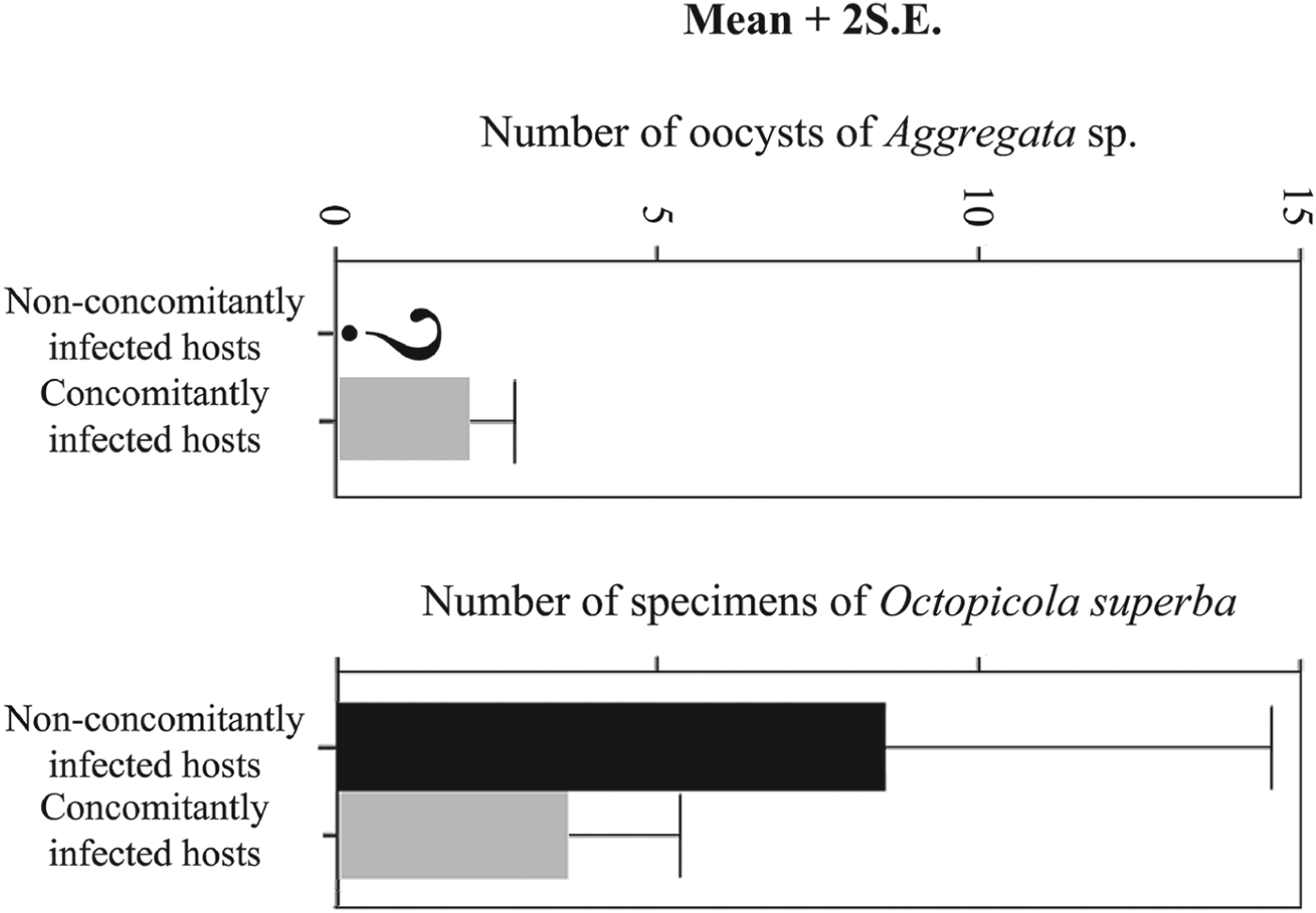
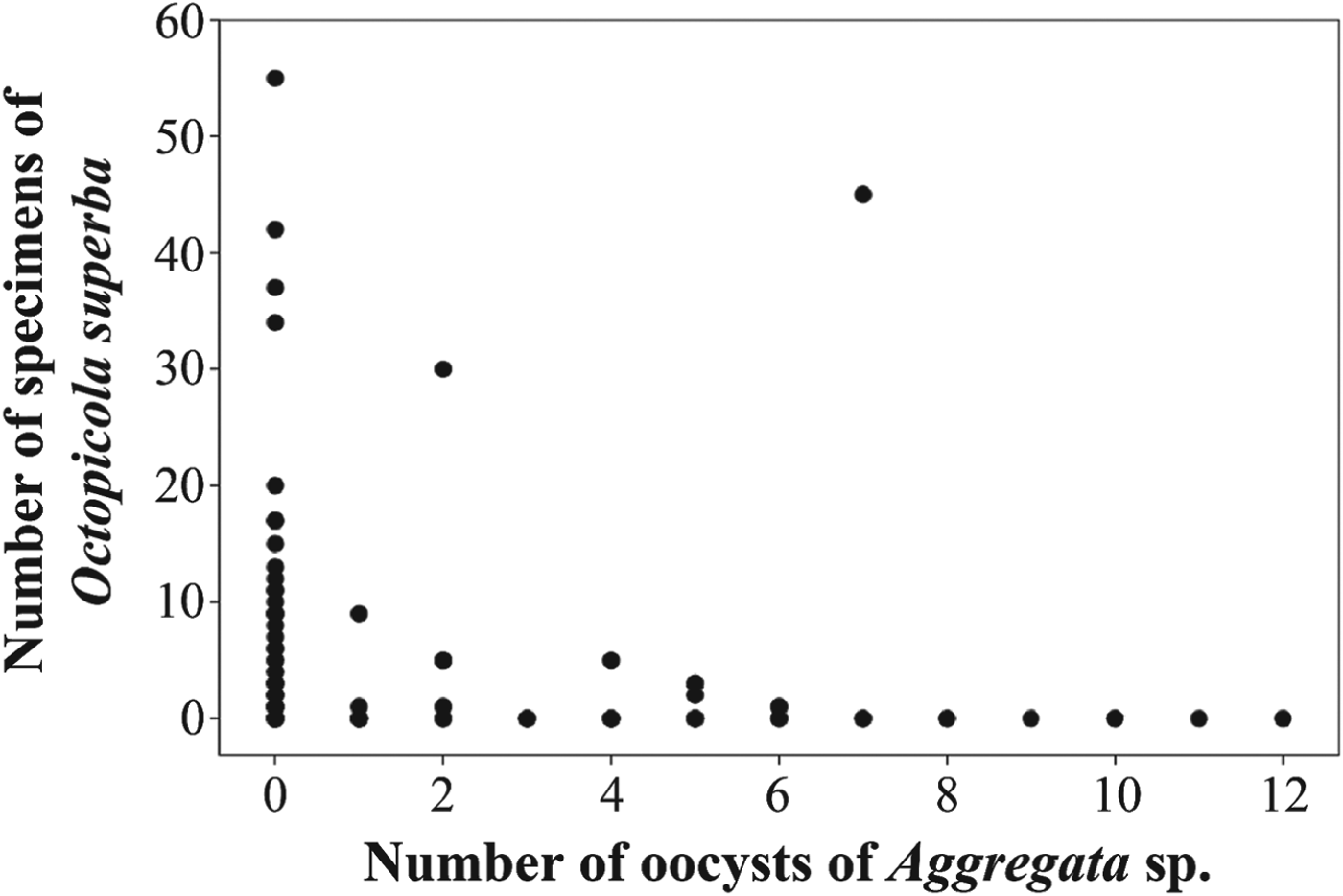
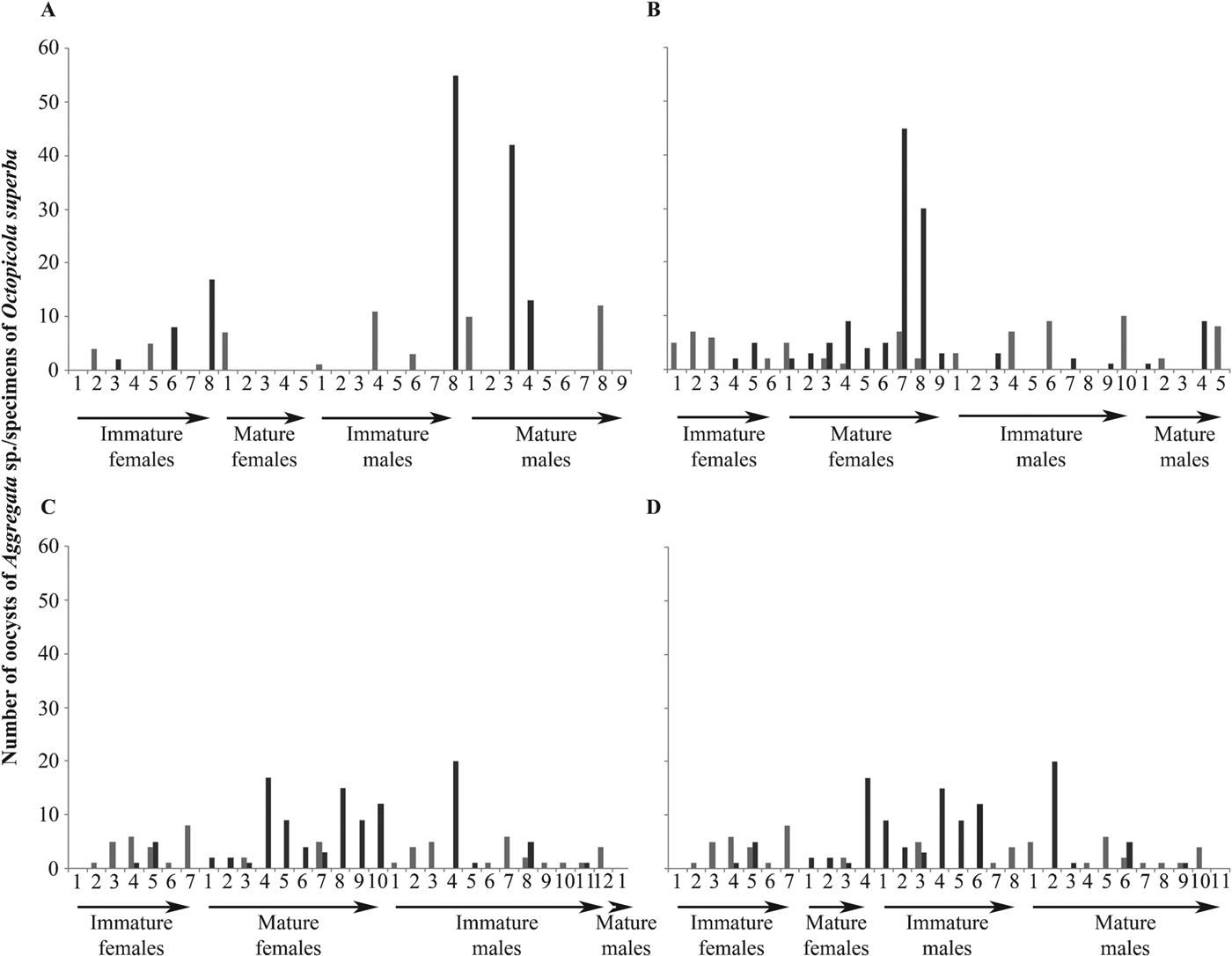
Fifteen (12·5%) out of the 120 examined octopuses were infected only with O. superba, while none was infected with Aggregata sp. exclusively; the two parasites co-occurred in 105 (87·5%) octopuses. In 39 octopuses (32·5%), the gills were infected with Aggregata sp. but not with O. superba; in 40 (33·3%), they were infected with O. superba but not with Aggregata sp.; and in 11 (9·2%), they were infected with both parasites. When disregarding whether the other parasite had also been detected in the octopus's body, it was found that Aggregata sp. and O. superba occurred at the gills of 50 (41·7%) and 51 (42·5%) octopuses, respectively. The number of specimens of O. superba recorded for the gills was smaller, on average, for the subsample of concomitantly infected octopuses (NO. vulgaris = 105), compared with that recorded for the subsample of non-concomitantly infected octopuses (NO. vulgaris = 15). However, this result was clearly not statistically significant. In this respect, no consideration is made for Aggregata sp., as none of the octopuses was infected with it exclusively (Fig. 2). Figures 3 and 4 show the oocyst and specimen counts for the gills of the examined octopuses. A non-linear relationship between the counts for the two parasites is evident (Fig. 3). Single and concomitant infections occurred in female and male octopuses, as well as in immature and mature octopuses (Fig. 4).
Mean (+2 s.e.) number of oocysts of Aggregata sp. and specimens of Octopicola superba recorded for the gills of non-concomitantly (NO. vulgaris = 15) and concomitantly (NO. vulgaris = 105) infected hosts.

Number of oocysts of Aggregata sp. and specimens of Octopicola superba recorded for the gills of the examined octopuses (NO. vulgaris = 120).

Counts of oocysts of Aggregata sp. (in grey) and specimens of Octopicola superba (in black) for the gills of each of the examined octopuses (ordered by ascending total length in each group – immature females, mature females, immature males and mature males): A, winter sample; B, spring sample; C, summer sample; and D, autumn sample.

Characterization of the ecological niches of Aggregata sp. and O. superba
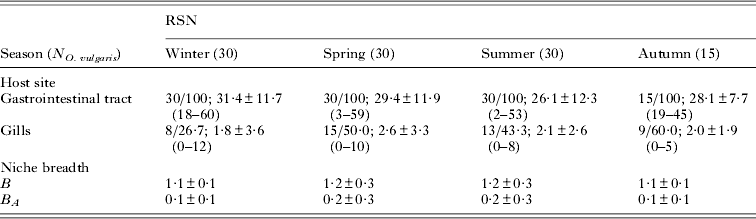
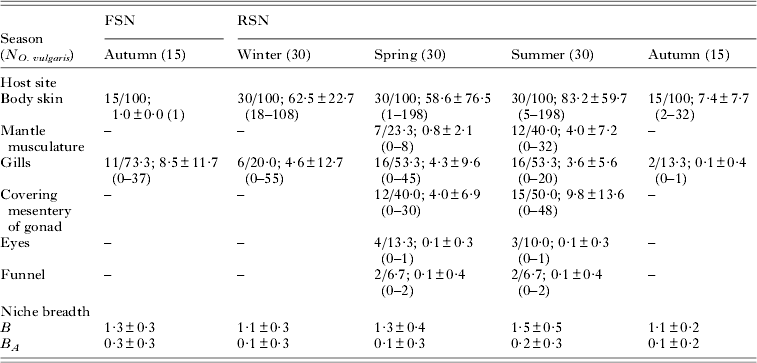
The RSN of Aggregata sp. consisted of two sites in all seasonal samples of octopuses: the gastrointestinal tract and the gills. The infection levels recorded for each of these sites and the values for the measures of niche breadth (i.e. B and B A ), are given in Table 1 for each seasonal sample. According to this table, in concomitantly infected hosts, the highest and lowest infection levels were recorded for the gastrointestinal tract and gills, respectively. Regarding O. superba, the FSN of the parasite consisted, also, of two sites, that is, the body skin and gills, but this could only be determined for the autumn sample of octopuses (Table 2). The mean parasite count was markedly higher in the gills than in the body skin. As for the RSN of the parasite, it consisted of two to six sites, which varied according to season of sampling and included the body skin, mantle musculature, gills, covering mesentery of gonad, eyes and funnel. The highest infection levels were recorded for the body skin in all seasonal samples. According to the standardized values of niche breadth (B A ), in autumn, the FSN of the parasite was, in average, broader than the RSN. A significant positive correlation was detected between the oocyst counts recorded for the gills and gastrointestinal tract (Spearman's rank order correlation test: r s = 0·370, P = 0·0001, N = 105). The overlap between the RSNs of the two parasites (P) was 0·3.
The realized spatial niche (RSN) of Aggregata sp. (as determined for the seasonal subsamples of Octopus vulgaris infected with Aggregata sp. and Octopicola superba): infection levels – number of octopuses/percentage of octopuses; and oocyst counts (mean±s.d. (range)) – recorded for the different sites and Levins’ (B) and standardized (B A ) measures (mean±s.d.) of niche breadth

The fundamental (FSN) (as determined for the seasonal subsample of Octopus vulgaris infected only with Octopicola superba) and realized (RSN) (as determined for the seasonal subsamples of O. vulgaris infected with Aggregata sp. and O. superba) spatial niches of O. superba: infection levels – number of octopuses/percentage of octopuses; and specimen counts (mean±s.d. (range)) – recorded for the different sites and Levins’ (B) and standardized (B A ) measures (mean±s.d.) of niche breadth

Numerical and functional evidence of interference competition
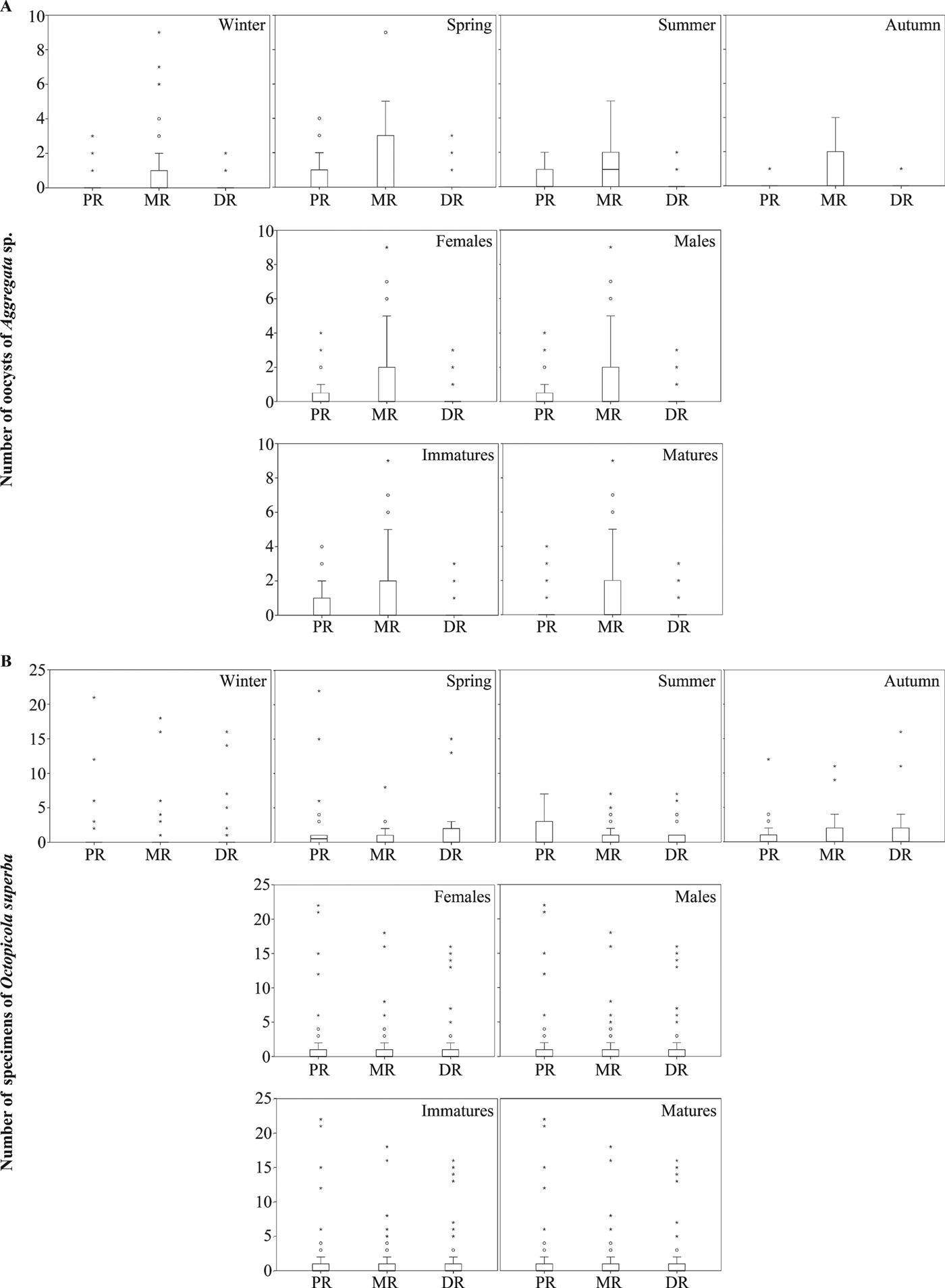
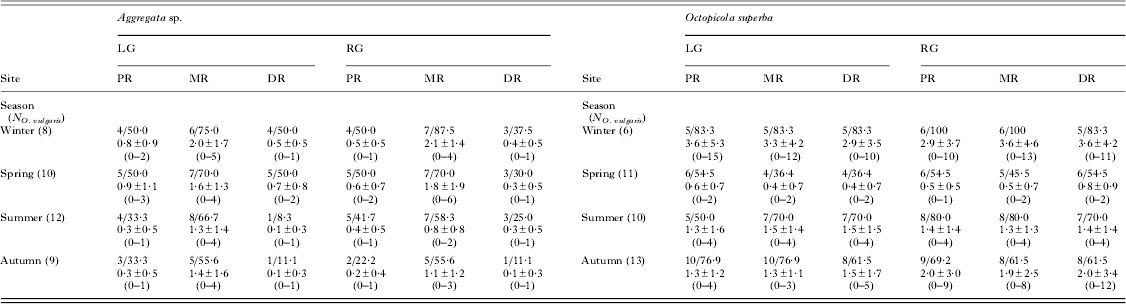
An influence of season and host sex and stage of sexual maturity in the distribution of the two parasites across the different lamellar regions of the gills could be excluded after analysing the corresponding plots (Fig. 5A and B). Statistical support for a significant negative relationship between the two parasites has been found (non-parametric partial rank correlation analysis: r s = −0·263, P = 0·013, N = 90). The sites of infection of Aggregata sp. in the gills included the stalks joining the primary lamellae to the BG (1/0·8%, 0·0±0·1 [0–1] oocysts), the band of connective tissue joining the dorsal and ventral lamellae (2/1·7%, 0·0±0·1 [0–1] oocysts) and the lamellae (50/41·7%, 1·8±2·8 [0–12] oocysts); the gill ligament and the BG were never found infected. Octopicola superba was found on the gill lamellae exclusively. According to the infection levels in Table 3, which respects the seasonal subsamples of octopuses whose gills were infected with the two parasites, Aggregata sp. was more frequent and found in higher numbers in the middle lamellar regions of the left and right gills, whereas O. superba was more frequent and found in higher numbers on the proximal and distal lamellar regions of both gills. These trends were consistent between spring and summer seasons. No major difference in the spatial distribution of Aggregata sp. was found when considering the subsamples of octopuses whose gills were infected with it exclusively. However, when considering the subsamples of octopuses whose gills were infected only with O. superba, no clear trend of spatial distribution could be identified (see Table 4).
Distribution of parasites (number of oocysts/specimens) across the different lamellar regions according to season of sampling and host sex and stage of sexual maturity: A, Aggregata sp.; and B, Octopicola superba. Abbreviations: PR – proximal region, MR – middle region and DR – distal region.

Infection levels of Aggregata sp. and Octopicola superba – number of octopuses/percentage of octopuses; oocyst/specimen counts (mean±s.d. (range)) – recorded for the proximal (PR), middle (MR) and distal (DR) lamellar regions of the left (LG) and right (RG) gills (the seasonal subsamples considered for analysis consisted of those octopuses whose gills were infected with both parasites)

Infection levels of Aggregata sp. and Octopicola superba – number of octopuses/percentage of octopuses; oocyst/specimen counts (mean±s.d. (range)) – recorded for the proximal (PR), middle (MR) and distal (DR) lamellar regions of the left (LG) and right (RG) gills (the seasonal subsamples considered for analysis consisted of those octopuses whose gills were infected with only one of the two parasites)

DISCUSSION
The eimeriorin coccidians of the genus Aggregata can develop in different sites of the body of O. vulgaris, including the body skin, connective tissue of arms, mantle musculature, gills, covering mesentery of digestive gland, covering mesentery of gonad and different sections of the gastrointestinal tract (oesophagus, crop, caecum and intestine) (Gestal, Reference Gestal2000; Gestal et al. Reference Gestal, Abollo and Pascual2002; Mladineo and Jozić, Reference Mladineo and Jozić2005; Pascual et al. Reference Pascual, González and Guerra2006; Mladineo and Bočina, Reference Mladineo and Bočina2007). These cited studies focused on the eimeriorin coccidians, and failed to mention the occurrence of other parasites which, being present, could have influenced the spatial occurrence pattern of Aggregata. In this way, the available literature cannot be used to characterize the actual FSN of the parasite. The only consideration that can be made is that the RSN of the parasite consisted of two of the infection sites mentioned in the literature. In the case of O. superba, the FSNs and RSNs consisted of the same two sites in autunm; nonetheless, according to the recorded B A values, the FSN was broader, on average, than the RSN. By definition, the RSNs are subsets of the FSNs, which means that they comprise only some of the sites in which a parasite species can develop. Moreover, in cases where interactions with other parasite species are unimportant – that is, have no significant effect on any of the parasites – they represent the optimal sites within the FSN, whereas in cases where interactions are actually important, they represent the sites of the FSN which are available to the parasite (Poulin, Reference Poulin2007a ). According to these ideas, it is possible to conclude that the FSN of O. superba is not characterized in full in this study. Furthermore, it excludes some of the sites in which the parasite can develop (i.e. mantle musculature, covering mesentery of gonad, eyes and funnel). A possible cause for this situation may be the number of octopuses infected with O. superba but not with Aggregata sp. Moreover, this was too low (i.e. NO. vulgaris = 15) to characterize it in full. The infection levels recorded for the FSN of O. superba are interesting, inasmuch the mean parasite count was higher for the gills than for the body skin. Furthermore, while comparing the infection levels recorded for the RSN with those recorded for the FSN, it was found that lower and higher levels were recorded, respectively, for the gills and body skin. These findings suggest that the gills constitute the preferred site of infection of O. superba. Also, they might be understood as preliminary functional evidence of interspecific interference competition. A preference for the gills is not surprising, once these provide parasitic copepods with suitable food, that is, epithelial cells, mucus and blood. The body skin also provides them with epithelial cells and mucus constituting, therefore, an adequate alternative site of infection. When the gills are infected with eimeriorin coccidians, the octopicolid copepods’ ability to physically establish on them is probably impaired. As a consequence, they may have to move to other sites of the host's body, most likely the body skin, as suggested by the infection levels recorded for the RSN of O. superba. The infection with Aggregata sp. can also affect the spatial distribution of O. superba on the host's body by leading to changes in the octopus's behaviour, as those found by Mladineo and Jozić (Reference Mladineo and Jozić2005) – specimens of O. vulgaris became excited, left their shelters and swam and became inactive inside their shelters a few days before dying. The reason for this is two-fold: on the one hand, in addition to crawling, the octopuses move by jet propulsion, and changes in their locomotory behaviour (and ultimately, in the respiratory water flow through the gills) can affect the distribution of O. superba on the gills, as this probably moves while under the dislodging action of the respiratory water current; on the other hand, a prolonged stay inside a shelter can affect the spatial distribution of O. superba, as this was reported to exhibit a circadian behavioural rhythm, inhabiting the mantle cavity of O. vulgaris during daytime and moving out along its arms, mantle and head after dark (Deboutteville et al. Reference Deboutteville, Humes and Paris1957). The significant positive correlation between the numbers of oocysts recorded for the gills and the gastrointestinal tract can be understood as evidence that the gills function mainly as an accessory site of infection in octopuses in which the main sites of absorption along the gastrointestinal tract (that is, the caecum and intestine) are massively infected. The Renkonen's index (P) ranges from 0 (no overlap between niches) to 1 (complete overlap), which means that the overlap between the RSNs of the two parasites was low. Such a low level can be understood as preliminary evidence for interactive site segregation (see Holmes, Reference Holmes1973; Poulin, Reference Poulin2007a ), that is, of adjustments in the infection site of O. superba in response to the presence of Aggregata sp. in the gills. Moreover, although the gills seem to function mainly as an accessory site of infection of Aggregata sp., they were found infected with the coccidian in 41·7% of the examined octopuses, while they seem to constitute the preferred site of infection of O. superba but were only infected with the copepod in 42·5% of the examined octopuses. The standardization of the Levins’ values of niche breadth (B) resulted in low values, once the Levins’ standardized measure of niche breadth (B A ) ranges from 0 to 1. Such low values indicate that the spatial niches are dominated by few sites or, more precisely, that the two parasites are specialists with respect to the sites they infect.
Numerical evidence of a negative interaction between the two parasites at the level of the gills was given by the non-parametric partial rank correlation analysis. Furthermore, this analysis could demonstrate the existence of a significant negative relationship between the counts recorded for the two parasites, while controlling for a potential confounding effect of host body size (i.e. total length) in the results. It is worth noting, that the mean number of oocysts of Aggregata sp. in the gills was higher in spring and summer and that these were also the seasons for which the RSN of O. superba consisted of more sites, that is, was broader. These data suggest, therefore, a negative effect of Aggregata sp. on O. superba. The characterization of the spatial distribution of the two parasites at the level of the gills further suggested the existence of such a negative effect. On the one hand, the spatial distribution patterns of the two parasites were complementary in octopuses whose gills were infected with both of them; on the other hand, the spatial distribution pattern of Aggregata sp. was consistent between octopuses whose gills were infected with the two parasites and with it exclusively (contrary to that found for O. superba). Despite the evidence underpinning the existence of a negative interaction between Aggregata sp. and O. superba, the non-linear relationship between the oocyst and specimen counts for the gills suggests that both parasites occurred aggregated among hosts. This aggregated distribution of parasites, where a few hosts harboured many parasites while most harboured none or just a few, was first noted by Crofton (Reference Crofton1971), being consistent with one of the few general laws in parasite ecology (Shaw and Dobson, Reference Shaw and Dobson1995; Poulin, Reference Poulin2007b ). A possible cause of the aggregation of Aggregata sp. could have been the differential exposure and susceptibility of the octopuses to the parasite. Furthermore, Aggregata sp. is a trophically transmitted parasite, and aggregation could have resulted from the uneven distribution of the infective stages in the population of first intermediate hosts. Besides, the octopuses were of different size and host body size has been recognized as a reliable proxy for different factors closely related with susceptibility to infection (see Poulin, Reference Poulin2013). In the case of O. superba, the aggregation might not only be related with the different size of the octopuses; indeed, it might also be the result of the combined effect of a series of factors usually associated with the octopodid cephalopods (i.e. sedentarism and solitary behaviour) and the octopicolid copepods (i.e. direct life cycle and high host specificity).
In conclusion, this study's findings suggest that the octopicolid copepods are able to detect changes in the gills resulting from infection with eimeriorin coccidians, and that their behaviour is mobile enough to allow them to adjust the site of infection.
ACKNOWLEDGEMENTS
The authors thank two anonymous referees, for their valuable comments on a previous version of the manuscript, Professor Vítor Silva, for his assistance during the field collection of octopuses, and Professor António Múrias dos Santos, for his advice concerning the statistical analysis of the data.
FINANCIAL SUPPORT
The authors are grateful to the Portuguese Foundation for Science and Technology and the European Social Fund for the grant to F. I. Cavaleiro (PhD grant reference: SFRH/BD/65258/2009). This research was partially supported by the European Regional Development Fund (ERDF) through the COMPETE – Operational Competitiveness Programme and national funds through FCT – Foundation for Science and Technology, under the projects PEst-C/MAR/LA0015/2013, DIRDAMyx FCOMP-01-0124-FEDER-020726 (FCT – PTDC/MAR/116838/2010) and AQUAIMPROV – Sustainable Aquaculture and Animal Welfare (NORTE-07-0124-FEDER-000038).