Introduction
Borderline personality disorder is a chronic psychiatric condition characterized by affective instability, impulsive behaviour, interpersonal problems and cognitive disturbances (Paris, Reference Paris2005). General population studies indicate a prevalence of close to 1% (Torgersen et al. Reference Torgersen, Kringlen and Cramer2001; Samuels et al. Reference Samuels, Eaton, Bienvenu, Brown, Costa and Nestadt2002). Although the disorder may improve over time, it impacts on the life and development of young adults over periods of decades (Paris, Reference Paris2005). About 10% of the patients die by suicide (Paris, Reference Paris2005; Pompili et al. Reference Pompili, Girardi, Ruberto and Tatarelli2005).
Stress is postulated to play an essential role in the expression of core borderline symptoms. Borderline personality disorder, by definition, features criteria such as mood reactivity and transient stress-related paranoid ideation. The explicit (and exceptional) incorporation of (stress) reactivity in these criteria, in the otherwise aetiologically neutral DSM-IV (APA, 2000), defines a prominent role for stress with regard to symptom expression.
However, the phenomenology of mood and stress reactivity in borderline personality disorder remains unclear. Some clinical studies focused on emotional dysregulation, reporting stronger and specific patterns of emotional instability in borderline personality disorder as compared with controls (Cowdry et al. Reference Cowdry, Gardner, O'Leary, Leibenluft and Rubinow1991; Stein, Reference Stein1996; Koenigsberg et al. Reference Koenigsberg, Harvey, Mitropoulou, Schmeidler, New, Goodman, Silverman, Serby, Schopick and Siever2002; Stiglmayr et al. Reference Stiglmayr, Grathwol, Linehan, Ihorst, Fahrenberg and Bohus2005; Ebner-Priemer et al. Reference Ebner-Priemer, Kuo, Kleindienst, Welch, Reisch, Reinhard, Lieb, Linehan and Bohus2007). Other studies, including community and student samples, specifically investigated stress (appraisal) and found subjects with borderline syndrome to report more interpersonal stressors and higher stress appraisal compared with controls (Trull, Reference Trull1995; Sinha & Watson, Reference Sinha and Watson1997; Daley et al. Reference Daley, Hammen, Davila and Burge1998; Pagano et al. Reference Pagano, Skodol, Stout, Shea, Yen, Grilo, Sanislow, Bender, McGlashan, Zanarini and Gunderson2004; Stiglmayr et al. Reference Stiglmayr, Grathwol, Linehan, Ihorst, Fahrenberg and Bohus2005; Jovev & Jackson, Reference Jovev and Jackson2006).
A third series of studies investigated the effect of stress on mood in borderline personality disorder (Perry et al. Reference Perry, Lavori, Pagano, Hoke and O'Conell1992; Tolpin et al. Reference Tolpin, Gunthert, Cohen and O'Neill2004). One clinical study reported higher recurrence rates of depression following life events in borderline personality disorder (Perry et al. Reference Perry, Lavori, Pagano, Hoke and O'Conell1992). However, the class of common small daily events, rather than low-prevalent life events, probably represent more important predictors of psychopathology in general (Kanner et al. Reference Kanner, Coyne, Schaefer and Lazarus1981; Monroe, Reference Monroe1983), and of subjective distress in particular (Norman & Malla, Reference Norman and Malla1991). One study in students investigated whether borderline features were related to emotional reactivity to interpersonal stress on a day-to-day basis, using end-of-day questionnaires (Tolpin et al. Reference Tolpin, Gunthert, Cohen and O'Neill2004). This study found subjects with subclinical borderline syndrome to report more daily interpersonal stressors, but no greater negative affective reactivity to these stressors (Tolpin et al. Reference Tolpin, Gunthert, Cohen and O'Neill2004). The current study aimed to extend these findings to a clinical sample of patients with borderline personality disorder, using the only approach specifically designed to investigate emotional reactivity to minor stressors that continually happen in the flow of daily life: the Experience Sampling Method (ESM) (Delespaul, Reference Delespaul1995).
Previous studies using ESM have shown that emotional reactivity to daily life stress is associated with a number of psychopathological disorders, such as major depression, bipolar disorder, and psychosis (Myin-Germeys et al. Reference Myin-Germeys, Peeters, Havermans, Nicolson, DeVries, Delespaul and Van Os2003). In order to investigate whether emotional reactivity to stress is a core feature of borderline personality disorder, rather than an expression of a general vulnerability to psychopathology, the current study not only compared a sample of patients with borderline personality disorder with healthy controls, but also with a sample of patients with psychotic disorder. The rationale for the inclusion of this latter comparison is that patients with psychotic disorder have been shown to display the largest reactivity to daily life stress, compared with major depressive and bipolar groups (Myin-Germeys et al. Reference Myin-Germeys, Peeters, Havermans, Nicolson, DeVries, Delespaul and Van Os2003).
The current study addressed the following questions: (1) does stress in the natural environment affect mood, and (2) does the emotional reaction to daily life stressors differ between patients diagnosed with psychotic disorder and with borderline personality disorder? A third group of healthy volunteers was included as the reference category.
Method
Subjects
Sample
The sample consisted of 50 subjects with psychotic illness (PSY), 48 subjects diagnosed with a borderline personality disorder (BPD) and 50 healthy control subjects (CON). Written informed consent, conforming to the local ethics committee guidelines, was obtained from all subjects. All patients were receiving ambulatory treatment. All participants had to be between 18 and 55 years old with sufficient command of the Dutch language. Exclusion criteria were severe endocrine, cardiovascular or brain disease and severe alcohol or drug dependence.
PSY were recruited through the mental health facilities in the area of Southern Limburg in The Netherlands. PSY had to have a lifetime occurrence of psychotic symptoms (according to Research Diagnostic Criteria) for at least 2 weeks in clear consciousness. Extensive screening with diagnostic interviews such as the Brief Psychiatric Rating Scale (Ventura et al. Reference Ventura, Green, Shaner and Liberman1993) and the Positive and Negative Syndrome Scale (Kay et al. Reference Kay, Fiszbein and Opler1987) was used to map Axis I psychiatric symptomatology. Interview data and clinical record data were used to complete the Operational Criteria Checklist for Psychotic Illness, yielding DSM-III-R diagnoses through the opcrit computer program (McGuffin et al. Reference McGuffin, Farmer and Harvey1991).
BPD had to fulfil the formal DSM-IV criteria for borderline personality disorder and were extensively screened with the complete versions of the structured clinical interview for DSM-IV Axis I and II disorders, the Structured Clinical Interview for DSM-IV (SCID) I and the SCID II (First et al. Reference First, Gibbon, Spitzer, Williams and Benjamin1997, Reference First, Spitzer, Gibbon and Williams2002).
CON were recruited from the general population through a random mailing procedure in the area of Southern Limburg in The Netherlands. They were selected on the basis of absence of a family or personal history of psychosis, or current use of psychotropic medication including benzodiazepines. After obtaining informed consent subjects were interviewed to complete the Brief Psychiatric Rating Scale and the Operational Criteria Checklist for Psychotic Illness, yielding DSM-III-R diagnoses through the opcrit computer program (McGuffin et al. Reference McGuffin, Farmer and Harvey1991).
ESM
ESM is a within-day momentary self-assessment technique. Previous applications of ESM have demonstrated the feasibility, validity and reliability of the method in general population samples and in samples of psychiatric patients (Stein, Reference Stein1996; van Eck et al. Reference van Eck, Nicolson, Berkhof and Sulon1996; Myin-Germeys et al. Reference Myin-Germeys, Krabbendam, Jolles, Delespaul and van Os2002; Jacobs et al. Reference Jacobs, Nicolson, Derom, Delespaul, van Os and Myin-Germeys2005). Subjects were studied in their normal daily living environment. They received a digital wristwatch and a set of ESM self-assessment forms collated in a booklet for each day. Ten times a day on six consecutive days, the watch emitted a signal (beep) at unpredictable moments between 07:30 and 22:30 hours. After each ‘beep’, subjects were asked to stop their activity and fill out the ESM self-assessment forms previously handed out to them, collecting reports of thoughts, current context (activity, persons present, location), appraisals of the current situation, and mood. All self-assessment items were rated on seven-point Likert scales. The ESM procedure was explained to the subjects during an initial briefing session and a practice form was completed to confirm that subjects were able to understand the seven-point Likert scale format. Subjects were asked to complete their reports immediately after the beep, thus minimizing memory distortions and to record the time at which they completed the form. During the sampling period subjects were repeatedly called by a research assistant to assess whether they were complying with the instructions. In order to know whether the subjects had completed the form within 15 min of the beep, the time at which subjects indicated they completed the report was compared with the actual time of the beep. All reports completed more than 15 min after the signal were excluded from the analysis. Previous work has shown that reports completed after this interval are less reliable and consequently less valid (Delespaul, Reference Delespaul1995). For the same reason, subjects with less than 20 valid reports were also excluded from the analysis (Delespaul, Reference Delespaul1995).
Emotional stress reactivity assessment
Previously, emotional stress reactivity was conceptualized as mood reactivity to daily events and minor disturbances in daily life (Myin-Germeys et al. Reference Myin-Germeys, van Os, Schwartz, Stone and Delespaul2001). Both the mood measures and the stress measures were derived from the experience sampling reports as described below.
Mood assessments
Mood states were assessed with nine mood adjectives rated on seven-point Likert scales (1–7, indicating ‘not at all’ to ‘very’). The mood adjectives ‘down’, ‘guilty’, ‘insecure’, ‘lonely’ and ‘anxious’ formed the negative affect (NA) scale (Cronbach's α=0.94 over the subject means). The mood adjectives ‘happy’, ‘cheerful’, ‘relaxed’ and ‘satisfied’ formed the positive affect (PA) scale (Cronbach's α=0.97 over the subject means).
Stress assessments
Stress was conceptualized as the subjectively appraised stressfulness of distinctive events and minor disturbances that continually happen in the natural flow of daily life. Two different stress measures were computed. For event-related stress, subjects were asked to report the most important event that happened between the current and the previous reports. This event was subsequently rated on a seven-point bipolar scale (−3=very unpleasant, 0=neutral, 3=very pleasant). Responses were recoded to allow high scores to reflect stress (−3=very pleasant, 0=neutral, 3=very unpleasant). For activity-related stress, subjects judged their current activity on three self-report items (scored on seven-point Likert scales). The mean of the scales ‘I am not skilled to do this activity’, ‘I would rather do something else’ and ‘This activity requires effort’ formed the activity-related stress scale (Crohnbach's α=0.69 over the subject means).
Statistical analysis
Initial pairwise group comparisons were performed on the number of valid beeps and the subjects' averages for the dependent variables NA and PA, and the independent variables event-related stress and activity-related stress, using one-way analysis of variance with the Tukey multiple comparison procedure. Correlations between the independent variables event-related stress and activity-related stress and the dependent variables NA and PA were calculated per subject and subsequently analysed as an individual-level variable. A one-sample, two-tailed t test with α=0.05 was conducted to test whether the mean of these individual-level correlation coefficients significantly deviated from zero. Distribution of the demographic variables age and sex across the three groups was analysed by pairwise group comparisons on the subjects' averages using one-way analysis of variance with the Tukey multiple-comparison procedure and by χ2 tests respectively.
In addition, multilevel linear random regression models were fitted. Multilevel or hierarchical linear modelling techniques are a variant of the more often used unilevel linear regression analyses and are ideally suited for the analysis of ESM data consisting of multiple observations in one person, i.e. at two levels (ESM-beep level and subject level) (Schwartz & Stone, Reference Schwartz and Stone1998). Since – in ESM – observations from the same subject are more similar than observations from different subjects, the residuals are not independent. Conventional regression techniques do not take into account the variance components at two different levels.
Data were analysed with the multilevel xtreg module in stata (release 8.0; StataCorp LP, College Station, TX, USA). The B is the fixed regression coefficient of the predictor in the multilevel model and can be interpreted identically to the estimate in the conventional unilevel regression analysis.
In order to test the hypothesis that group modified the emotional reaction to daily life stress, multilevel linear regression analyses were conducted with standardized NA and PA as the dependent variables (standardized NA=NA/s.d. of NA in the whole sample). According to Cohen, 0.8 s.d. can be considered a large effect size, and 0.2 s.d. a small effect size (Cohen, Reference Cohen1988). Group was a three-level categorical variable with value labels 0=CON, 1=PSY and 2=BPD. Group and the two stress measures were included in the model as covariates as well as their interactions: mood=B0+B1 group+B2 stress+B3 group×stress. Estimation of the effect sizes of stress on NA/PA for each group were calculated from the model with the interactions by calculating appropriate linear combinations using the stata lincom routine. Main effects and interactions were assessed by the Wald test. Analyses were conducted separately for event-related stress and activity-related stress.
In order to control for possible differences between the three groups in level of depression, the mean scores per person on the ESM mood item ‘I feel down’ (e.g. ESM depressed mood) were added to the analysis as a possible confounder along with the independent variables sex and age.
Results
Subjects
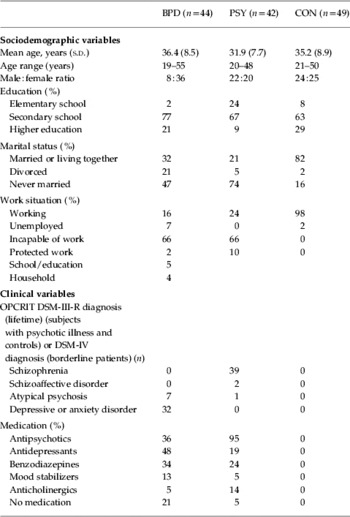
Of the 50 control subjects who entered the study, one was excluded because of technical problems with the signalling device (see ESM section). Of the 50 patients with psychotic disorder, two did not return the diary booklets and six patients were unable to comply with the research protocol (they had fewer than 20 valid reports and were therefore excluded from the analysis; see ESM section). Four of the 48 patients with borderline personality disorder were excluded because they had fewer than 20 valid reports. The final sample thus consisted of 49 in the CON group, 42 in the PSY group and 44 in the BPD group (Table 1). Demographic and clinical characteristics of the research sample are summarized in Table 1. The BPD group consisted of significantly more female subjects than the other two groups [χ2(2)=13.10, p=0.001]. The mean age of BPD was significantly higher than PSY [F(2, 132)=3.26, p<0.05, Tukey honestly significantly different test; BPD>PSY].
Sociodemographic and clinical characteristics of the research sample

BPD, Borderline personality disorder; PSY, psychotic illness; CON, controls; OPCRIT, Operational Criteria Checklist; DSM, Diagnostic and Statistical Manual of Mental Disorders.
Stress and mood measures
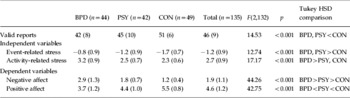
The number of valid reports and the mean scores of the independent and the dependent variables are shown in Table 2. The two mood variables, NA and PA, were significantly, but moderately, negatively correlated (r=−0.44, 95% CI −0.49 to −0.39).
Means (s.d.) and F test statistics of the number of valid reports and the independent and dependent variables for patients with borderline personality disorder, patients with psychosis and control subjects

s.d., Standard deviation; BPD, borderline personality disorder; PSY, psychotic illness; CON, controls; HSD, honestly significantly different.
Both BPD and PSY reported significantly more event-related stress compared with CON. BPD also reported significantly more activity-related stress than PSY and CON (Table 2). The two stress measures, event-related stress and activity related stress, were significantly correlated but the correlations were low (r=0.17, 95% CI 0.13–0.20). BPD reported more NA and less PA compared with PSY, and both reported significantly more NA and less PA compared with CON.
Predictors of mood states
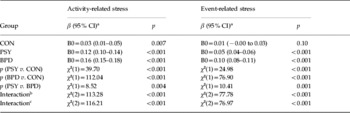
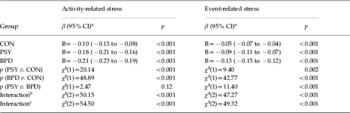
The multilevel random regression analysis showed that the two stress measures were significantly associated with NA [event-related stress: B0=0.06 (s.e.=0.00), p<0.001; activity-related stress: B0=0.11 (s.e.=0.01), p<0.001] and PA (event-related stress: B=−0.09 (s.e.=0.01), p<0.001; activity related stress: B=−0.17 (s.e.=0.01), p<0.001]. In addition, group was also significantly associated with NA and PA in the same fashion as reported in the unilevel analysis presented in Table 2.
Significant interaction effects between group and stress were found for both NA [activity-related stress: B=0.05 (s.e.=0.01), p<0.001; event-related stress: B=0.03 (s.e.=0.00), p<0.001], and PA (activity-related stress: B=−0.05 (s.e.=0.01), p<0.001; event-related stress: B=−0.03 (s.e.=0.00), p<0.001], indicating that group moderated the impact of small daily stress on mood. The interaction effects remained significant after controlling for the possible confounding effects of the variables age, sex and mean level per person of ESM depressed mood [NA: activity-related stress: B=0.07 (s.e.=0.01), p<0.001; event-related stress: B=0.04 (s.e.=0.01), p<0.001, PA: activity-related stress: B=−0.05 (s.e.=0.01), p<0.001; event-related stress: B=−0.04 (s.e.=0.01), p<0.001].
BPD reacted significantly stronger to daily life stress compared with PSY and CON, with larger decreases in PA and increases in NA. PSY reacted significantly stronger to daily life stress than CON (Tables 3 and 4). Interaction effects differed significantly between BPD and PSY in adjusted and unadjusted conditions (Tables 3 and 4).
The effect of stress on negative affect by group

CI, Confidence interval; CON, controls; PSY, psychotic illness; BPD, borderline personality disorder; ESM, Experience Sampling Method.
a Regression coefficient indicates change in negative affect associated with activity-related stress adjusted for age, sex and mean level of ESM depressed mood per subject.
b Stress×group interaction adjusted for age, sex and mean level of ESM depressed mood per subject.
c Stress×group interaction unadjusted for age, sex and mean level of ESM depressed mood per subject.
The effect of stress on positive affect by group

CI, Confidence interval; CON, controls; PSY, psychotic illness; BPD, borderline personality disorder; ESM, Experience Sampling Method.
a Regression coefficient indicates change in positive affect associated with activity-related stress adjusted for age, sex and mean level of ESM depressed mood per subject.
b Stress×group interaction adjusted for age, sex and mean level of ESM depressed mood per subject.
c Stress×group interaction unadjusted for age, sex and mean level of ESM depressed mood per subject.
Discussion
This study is one of the first to ecologically validate the DSM-IV borderline criterion mood reactivity by investigating emotional reactivity to daily life stress in a clinical sample of borderline patients using a momentary design. The outcome of the current study suggests that enhanced emotional reactivity to daily life stress might be most specific for borderline personality disorder. Patients with borderline personality disorder not only reported significantly more emotional reactivity to daily life stress than healthy controls, but they also were emotionally more reactive than patients with psychotic disorder, a diagnostic group – until now – known to express the largest emotional reactivity to daily life stress (Myin-Germeys et al. Reference Myin-Germeys, Peeters, Havermans, Nicolson, DeVries, Delespaul and Van Os2003). The current study, therefore, generates scientific support for the incorporation of mood reactivity in DSM-IV borderline personality disorder classification and suggests that mood reactivity might be triggered by a broad range of small stressors in daily life. The effect sizes were small but not negligible, especially since we assessed frequently occurring exposures in daily life, the cumulative effects of which may be considerable.
Several studies have addressed stress, mood instability or aversive tension in borderline syndrome (Cowdry et al. Reference Cowdry, Gardner, O'Leary, Leibenluft and Rubinow1991; Trull, Reference Trull1995; Stein, Reference Stein1996; Sinha & Watson, Reference Sinha and Watson1997; Daley et al. Reference Daley, Hammen, Davila and Burge1998; Koenigsberg et al. Reference Koenigsberg, Harvey, Mitropoulou, Schmeidler, New, Goodman, Silverman, Serby, Schopick and Siever2002; Stiglmayr et al. Reference Stiglmayr, Grathwol, Linehan, Ihorst, Fahrenberg and Bohus2005). However, only one previous study investigated the relationship between borderline features and emotional reactivity to daily life stress using a daily process design. This non-clinical study by Tolpin et al. (Reference Tolpin, Gunthert, Cohen and O'Neill2004) assessed emotional reactivity to interpersonal stress in daily life of college students with borderline features. They found that subjects with borderline features showed: (i) more interpersonal stress (in line with the results of the current study); (ii) more instability of mood; but (iii) – contrary to the authors' expectations and the results of the current study – no stronger emotional reactivity towards these stressors. The authors concluded that this last finding could be the consequence of methodological limitations such as using a non-clinical sample, collecting information once at the end of each day with the inherent risk of recall bias, or insufficient sensitivity of the measure of daily interpersonal stressors addressing only a specific range of daily events (questionnaire) without determining the frequency of a particular stressor during the day. Free from these limitations, the current clinical study – using a signal-contingent random sampling procedure with multiple assessments per day (Jacobs et al. Reference Jacobs, Nicolson, Derom, Delespaul, van Os and Myin-Germeys2005) – indeed did find borderline personality disorder to express strongest emotional reactivity to daily life stress.
Many studies have focused on the importance of interpersonal stress in borderline personality disorder (Gunderson & Phillips, Reference Gunderson and Phillips1991; Tolpin et al. Reference Tolpin, Gunthert, Cohen and O'Neill2004). It could be argued that the current findings do not reflect over-reactivity to general stress but rather result from an over-representation of interpersonal stresses in the BPD group. However, similar results were found for both event- and activity-related stress. Whereas the first might include more interpersonal stresses, this is unlikely for the latter.
The current study also shows that borderline patients score worst on absolute mood (e.g. NA and PA) and stress measures (e.g. activity-related stress) (Table 2). Out-patient borderline patients, thus, not only react emotionally stronger to minor disturbances and daily hassles that continually happen in the flow of everyday life, they also continually experience worse mood and more daily life stress than psychotic patients and healthy controls. Previous Experience Sampling studies (Peeters et al. Reference Peeters, Nicolson, Berkhof, Delespaul and deVries2003; Myin-Germeys et al. Reference Myin-Germeys, Krabbendam, Delespaul and van Os2004), investigating depressive and psychotic disorder respectively, have shown that women express more emotional reactivity towards daily life stress than men. It has also been shown that borderline personality disorder improves with age (Paris, Reference Paris2005). Although the BPD group in the current study consisted of significantly more female subjects than the other two groups (Table 1), and the mean age of BPD and CON was significantly higher than PSY (Table 1), controlling for sex and age did not change the significant interaction between group and daily life stress in the current study.
In line with the literature, the borderline group showed large co-morbidity of depressive and anxiety disorders (Zanarini et al. Reference Zanarini, Frankenburg, Dubo, Sickel, Trikha, Levin and Reynolds1998, Reference Zanarini, Frankenburg, Hennen, Reich and Silk2004). A total of 73% (32 of 44 subjects) of the BPD subjects expressed a current anxiety or mood disorder. Controlling for the mean level of ESM depressive mood per person, a measure that can also be assessed in controls, however, revealed no substantial alteration in the relationship between group and emotional reactivity to daily life stress (see Results section). Controlling for SCID I depressive disorder – instead of mean level of ESM depressed mood per person – yielded the same results. This is in line with previous research suggesting that affective instability in borderline personality disorder is not equivalent to depression given the high levels of environmental responsiveness (Gunderson & Phillips, Reference Gunderson and Phillips1991). On the other hand, it might be argued that mood reactivity in borderline personality disorder resembles the bipolarity in bipolar disorder. Studies investigating the interface between borderline personality disorder and depressive and bipolar disorder have concluded that they are independent disorders, with overlapping aetiologies (Gunderson & Phillips, Reference Gunderson and Phillips1991; Paris et al. Reference Paris, Gunderson and Weinberg2007). The results of the current study and previous research of our group (Myin-Germeys et al. Reference Myin-Germeys, Peeters, Havermans, Nicolson, DeVries, Delespaul and Van Os2003) are in line with this conclusion since it has been shown that enhanced stress reactivity is a mechanism underlying depressive disorder, bipolar disorder and borderline personality disorder, being most specific, however, for the latter group.
Methodological issues
The following methodological issues should be taken into account. First, the data are based on subjective reports. Although subjective reports are considered less reliable (e.g. do all subjects interpret or answer the questions identically?), they can be valid, whereas the validity of objective approaches cannot be taken for granted (Strauss, Reference Strauss1994). Second, the present study was a cross-sectional study, which makes it impossible to establish causal relationships. Therefore it is impossible to determine whether stress measures influenced mood, or mood influenced the subjective appraisal of stress. However either explanation has clinical relevance. Third, the current study used ESM, a daily life assessment technique in which subjects have to comply with a paper-and-pencil diary protocol without the researcher being present. Recently, some authors have put doubt on the reliability and subject compliance in paper-and-pencil ESM studies, favouring the use of electronic devices (Stone et al. Reference Stone, Shiffman, Schwartz, Broderick and Hufford2002, Reference Stone, Shiffman, Schwartz, Broderick and Hufford2003). However, in a comparative study, Green et al. concluded that both methods yielded similar results (Green et al. Reference Green, Rafaeli, Bolger, Shrout and Reis2006). In addition, a recent study of our group using a signal-contingent random time sampling procedure with multiple observations per day – such as the protocol used in the current study – also found evidence underscoring the validity of the paper-and-pencil random time self-report data in the current study (Jacobs et al. Reference Jacobs, Nicolson, Derom, Delespaul, van Os and Myin-Germeys2005).
It can be argued that stronger emotional reactivity to daily life stress in subjects with borderline personality disorder might result directly from the intrusiveness of the ESM. Indeed, borderline subjects reported significantly more distress from the ESM than subjects with psychotic disorder and healthy controls. Controlling for the ESM item ‘How much did this beep disturb you?’, however, did not substantially change the results of the current study.
Conclusion
Since the introduction of DSM-IV in 1994, marked reactivity of mood is a core feature of DSM-IV borderline personality disorder classification. The current study, however, is one of the first to validate this criterion by investigating emotional reactivity to daily life stress in (clinical) borderline personality disorder, using a momentary assessment design. Enhanced emotional reactivity to daily life stress may be most specific for borderline personality disorder since the current study showed that in this group it is even more pronounced than in psychotic disorder, a diagnostic category that thus far had been shown to be most emotionally reactive to the effects of daily life stress.
Acknowledgements
The authors thank Karola Huistra, Truda Driesen and Frieda Van Goethem for assistance with the data collection. I.M.-G. was supported by a 2006 Narsad Young Investigator Award and by the Dutch Medical Council (VIDI grant).
Declaration of Interest
None.