Introduction
The endotracheal intubation procedure remains the most effective method of opening airways during prehospital treatment. Proper insertion of the endotracheal tube prevents stomach contents from entering the respiratory tract and allows asynchronous cardiopulmonary resuscitation (CPR) to be conducted, which minimizes the breaks between chest compressions, thus improving the quality of the CPR procedure. Reference Soar, Maconochie and Wyckoff1
An important factor in proper use of endotracheal intubation is correct inflation of the endotracheal tube cuff. The pressure required for correct inflation of the cuff should be in the range of 20cm to 30cm H2O. Assessment of the correct pressure should be precise and should be carried out using a manometer to indicate the cuff seal inflation pressure. Research in other countries has shown that assessment of cuff inflation using the palpation technique is relatively ineffective and rarely results in correct cuff inflation. Experienced paramedic specialists using the palpation technique to assess the amount of air in the cuff during intensive care conduct the procedure correctly in less than 30% of cases. Reference Lim, Kim and Kim2–Reference Michlig5 It has been proven that during palpation assessment, the cuff seal is over-inflated, even to as high as 100cm H2O. Reference Hoffman, Parwani and Hahn4 Application of incorrect pressure in the endotracheal tube cuff seal can be extremely worrying, as it may cause numerous complications. Reference Bouattour, Prost-Lapeyre, Hauw-Berlemont, Diehl and Guerot6–Reference Lau, So, Tang, Yeung, Lam and Yan11 In prehospital paramedic treatment, intubation is often used as the chosen method for clearing the airways. Unfortunately, attention is rarely paid to the correct cuff seal, and instruments for ensuring the seal during the procedure are seldom used. During paramedic treatment, in most cases, a syringe is used and the amount of air is assessed using the palpation technique. Reference Peters and Hoogerwerf12 In this paper, the authors try to answer the question of what the differences are in the quality of endotracheal tube cuff inflation and the time required for the procedure, depending on whether a syringe or a device for inflating the cuff are used. The aim of the study was to determine the effect of using a manometer inflation device versus a 20ml syringe for inflation of an inserted endotracheal tube cuff on cuff pressure and time to accomplish inflation. The influence was also assessed of completed certified Advanced Life Support (ALS) and Advanced Cardiovascular Life Support (ACLS) training courses on the achieved inflation volume and the time needed to inflate the cuff.
Material and Methods
Research Group
The research was conducted on January 30, 2020 during a simulated rescue at the 15th International Winter Championship of Medical Rescuers in Bielsko-Biala, Poland. The research involved 108 paramedics working in ambulance response teams. The criterion for inclusion in the study was working in emergency medical teams and being nominated to participate in the 15th International Winter Paramedic Championship in Bielsko-Biala. The persons taking part in the research were from 32 ambulance stations from across Poland. Demographic data on the study participants are presented in Table 1. All study participants gave informed consent for the study to be carried out. The research was approved by the ethical committee of University of Bielsko-Biala (Bielsko-Biala, Poland) under the reference number RNN/305/2019 – approval 2019/12/7/2.
Study Group Demographic Data

Research Methods
The study used a simulation technique and was conducted during a simulated rescue in order to maximize the similarity of the procedure to that used in real-life situations. The research was preceded by participants completing a short questionnaire with demographic data and the methods used by the participants for sealing the endotracheal tube cuff in clinical treatment. All respondents indicated that they use a syringe, and the vast majority of respondents reported using a syringe with a volume of 20ml. Therefore, in order to standardize the conducted procedure, a 20ml syringe was used in the study. The procedure was carried out using a SimMan ALS (Laerdal; Stavanger, Norway) mannikin, serial number SN.23548170915 Software 7.2.0.2; an endotracheal inner diameter (ID) – 7.5 tube; a 20ml syringe; and endotracheal tube balloon manometer device (no. (01)14250105600510) clock manometer with a measuring scale from 0cm to 120cm H2O with a specific scale showing the correct pressure necessary for proper cuff inflation. Measurements were also taken using a validated stopwatch by accredited research staff (no. AB1701; Polish Accreditation Center) from the paramedic laboratory at the University of Bielsko-Biala.
Research Procedure
The mannikin was correctly intubated by a laboratory technician overseeing the study using an ID – 7.5 endotracheal tube and a Macintosh laryngoscope to a depth of 21cm, measured from the left corner of the mouth. Every procedure was conducted using a brand-new endotracheal tube, which was inserted into the mannikin’s trachea immediately before the cuff was inflated. The study comprised two procedure methods conducted one after the other.
Method A involved sealing the endotracheal tube cuff using a 20ml syringe. The time was measured from the moment the syringe was picked up to the moment the cuff inflation procedure was completed and the syringe placed beside the mannikin. Immediately after the procedure was completed, the pressure in the cuff seal was measured using a clock manometer.
Method B involved sealing the endotracheal tube cuff using a clock device for inflating the endotracheal tube cuff. The time was measured from the moment the device was picked up to the moment the cuff inflation procedure was completed and the device placed beside the mannikin. Immediately after the procedure was completed, the pressure in the cuff seal was measured.
Analysis was also conducted of the effect of completed certified ALS or ACLS training courses on the quality of endotracheal tube cuff seal inflation.
All data were entered into a specially prepared Excel 2019 (Microsoft Corp.; Redmond, Washington USA) spreadsheet and subjected to statistical analysis.
Statistical Analysis
The assumed level of significance adopted was P = .05. Variables expressed at the ordinal or nominal level were analyzed using tests based on chi-square distribution. For 2x2 tables, a continuity correction was applied, while if conditions were not met for the application of a chi-squared test, a precise Fisher test was used and extended for tables larger than 2x2. Parametric tests were used to analyze quantitative variables divided into groups (the student’s T test or ANOVA analysis of variance), or their non-parametric equivalents (the Mann-Whitney U test or the Kruskal-Wallis test). The selection of tests was carried out on the basis of the distribution of the variables, which was verified using the Shapiro-Wilk test. The calculations were conducted using an R (R Foundation for Statistical Computing; Vienna, Austria) statistics environment version 3.6.0, PSPP software (GNU Project), and MS Office 2019 (Microsoft Corp.; Redmond, Washington USA).
Results
Analysis of the results obtained during the study should be complemented by key information contained in the questionnaires completed before the procedure was carried out. All the study participants indicated that the method they always used in conducting advanced paramedic treatment was that of inflating the endotracheal tube cuff by syringe. The main determinant they indicated for this choice of method was the time required for carrying out the procedure. None of the study participants gave inflated cuff volume as a condition that determined correct completion of the procedure (Table 2 and Table 3).
Statistical Description of Analyzed Parameters

Note: N – amount; M – mean; SD – standard deviation; Min – minimum; Max – maximum; Q25 – first quartile; Me – median; Q75 – third quartile.
Comparison of Method A and Method B in Terms of Endotracheal Cuff Inflation Pressure

Note: U – test statistic; p –statistical significance; Me – median; Min – minimum result; Max – maximum result; Q25 – first quartile; Q75 – third quartile.
The pressure in cuffs inflated using Method A was significantly higher statistically than in cuffs inflated using Method B (P <.05; Table 4).
Comparison of Cuff Inflation Pressures According to Pressure Range for Both Methods

Inflation of endotracheal tube cuffs using Method A significantly less often statistically resulted in achievement of the required pressure (20cm H2O - 30cm H2O) than during use of Method B (Table 5).
Comparison of Method A and Method B in Terms of Endotracheal Tube Cuff Inflation Time

Note: U – test statistic; p – statistical significance; Me – median; Min – minimum result; Max – maximum result; Q25 – first quartile; Q75 – third quartile.
The time required to inflate the endotracheal tube cuff using Method B was significantly longer statistically than the time required using Method A (P <.05; Table 6).
Comparison of Method A and Method B Cuff Inflation Pressure Depending on Completed ALS and ACLS Training Courses

Note: U – test statistic; p – statistical significance; Me – median; Min – minimum result; Max – maximum result; Q25 – first quartile; Q75 – third quartile.
Abbreviations: ALS, Advanced Life Support; ACLS, Advanced Cardiovascular Life Support.
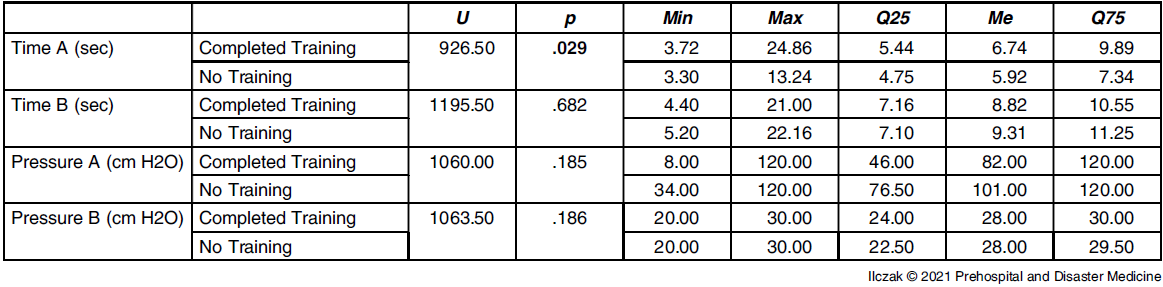
Completion of certified ALS and ACLS training courses did not have a statistically significant influence on correct inflation of the endotracheal tube cuff relative to the method applied (P >.05; Table 7).
Comparison of Time Required for Inflation of Endotracheal Tube Cuff Relative to the Method Applied and Completed Certified Training Courses

Note: U – test statistic; p – statistical significance; Me – median; Min – minimum result; Max – maximum result; Q25 – first quartile; Q75 – third quartile
Participants who had completed certified ALS and ACLS training courses took significantly longer to inflate the endotracheal tube cuff using Method A than participants who had not completed a training course (Table 8).
Comparison of Cuff Inflation Volume by Syringe in Relation to Completed Certified ALS and ACLS Training Courses

Abbreviations: ALS, Advanced Life Support; ACLS, Advanced Cardiovascular Life Support.
Among the participants in the study group (n = 74) who had completed certified ALS or ACLS training, 6.76% achieved a result of lower than 20cm H2O, 8.11% achieved a result around the norm, while 85.13% achieved a result that exceeded a volume of 30cm H2O. Among the study group participants (n = 34) who had not completed certified training, all achieved a result that exceeded a volume of 30cm H2O. Completion of certified training did not therefore have a statistically significant influence on achieving the correct inflation volume of the endotracheal tube cuff (P = .059).
Discussion
Inflation of the endotracheal tube cuff can be done using a syringe or by employing a manometer. Reference Peters and Hoogerwerf12–Reference Hedberg, Eklund and Hogqvist14 The authors of this study analyzed numerous publications that assessed the effectiveness of using a manometer during inflation of the endotracheal tube cuff. In none of those papers was there detailed information on the availability of this type of device among paramedic teams. The questionnaire used in this study showed that during their work in emergency medical teams, none of the study participants used a manometer to inflate the endotracheal tube cuff. This was explained by the necessity to save time when working in two-person teams.
Inflation of the endotracheal tube cuff to the correct pressure is one of the elements in properly conducted intubation. Carrying out the procedure correctly is difficult when it is done using a syringe. Reference Lim, Kim and Kim2–Reference Michlig5 Numerous research studies, both in clinical and in simulated conditions, have shown use of a syringe almost always results in excessive inflation of the cuff. Reference Hoffman, Parwani and Hahn4,Reference Michlig5,Reference Harm, Zuercher, Bassi and Ummenhofer13,Reference Hedberg, Eklund and Hogqvist14 Over-inflation of the endotracheal tube cuff leads to patient complications in the area of the trachea, resulting in ischemia, infection, or narrowing of the windpipe. Reference Chan, Wong and Cherng15 In their research conducted on human corpses, Sudhoff, et al demonstrated that excessive inflation of the endotracheal tube cuff can cause rupture of the trachea. Reference Sudhoff, Seidl, Estel and Coordes16 The current research has shown that when paramedics used a manometer, they correctly inflated the endotracheal tube cuff on every occasion, which demonstrates a statistically significant difference between this method and that involving use of a syringe. When a syringe was used, accompanied by assessment of inflation using the palpation method, over-inflation occurred in 89.81% of cases. In the current research into proper endotracheal tube cuff inflation, the authors also indicate that too low pressure in the cuff seal can cause complications such as tube displacement or inhalation of stomach contents into the airways. Reference Estes and Meduri9–Reference Lau, So, Tang, Yeung, Lam and Yan11 This research showed that insufficient cuff inflation occurred in 4.63% of cases and took place only when a syringe was used. Training certified by the American Heart Association (AHA; Dallas, Texas USA) and European Resuscitation Council (ERC; Niel, Belgium) in advanced resuscitation techniques focuses on teaching practical skills that can be later used during clinical treatment. This training includes workshops on correctly ensuring and maintaining unobstructed airways. Reference Soar, Nolan and Böttiger17–Reference Neumar, Shuster and Callaway20 Many studies that include an assessment of the correct procedure for maintaining unblocked airways point to the need for improvement in the skills required for proper inflation of the endotracheal tube cuff. Reference Hoffman, Parwani and Hahn4,Reference Michlig5,Reference Peters and Hoogerwerf12,Reference Harm, Zuercher, Bassi and Ummenhofer13 The current research has proved that participation in certified ALS and ACLS training courses does not have a significant influence on correct inflation of the endotracheal tube cuff, irrespective of which method is used. The research demonstrated that paramedics with an ALS or ACLS course completion certificate took a statistically significant longer time to inflate the cuff by syringe than those who had not completed a training course. This may indicate that in contrast to medical staff who have not completed a training course, paramedics who have completed such a course are more aware of the importance and necessity of correctly inflating the cuff, although unfortunately this is not reflected in achievement of the proper cuff pressure.
Limitations
The study authors are aware that the research has a certain limitation in that it was conducted in simulated conditions on a relatively small group of participants. The research was also conducted using a manometer with a pressure range up to a maximum of 120cm H2O, and it was therefore not possible to record higher values. Another limitation of the study is that a 20ml syringe was used in the study instead of the standard 10ml. This is due to the information obtained from participants that they most often use this type of syringe in practice, as described in the Material and Methods section. Broader research is planned on a larger group of participants in as realistic conditions as possible.
Conclusions
This situation study indicates that emergency medical teams should be equipped with manometer devices for inflating endotracheal tube cuffs to avoid over-inflation. Manometer should be used to fill the endotracheal cuff. More emphasis should be placed on proper inflation of the endotracheal tube cuff during workshops on certified ALS and ACLS training courses.
Conflicts of interest
none