Introduction
Organizations need to keep upgrading technologies, products and services for their long-term survival (Anderson, De Dreu, & Nijstad, Reference Anderson, De Dreu and Nijstad2004; Van de Ven, Reference Van de Ven1986). The emergence of innovation as a critical factor in promoting and maintaining organizational competitiveness behooves organizations to foster employee innovation. The general assumption about innovation is that, it should be under the direct control of management (Augsdorfer, Reference Augsdorfer1994). Nonetheless, innovation is usually unplanned, uncontrolled and unpredictable (Aram, Reference Aram1973). In some cases, motivated employees engage in ‘bootlegging’ behavior – a bottom-up, unplanned special type of innovation where employees take the initiative to work on ideas covertly without formal authorization in order to produce innovations to benefit the organization (Augsdorfer, Reference Augsdorfer1994, Reference Augsdorfer2005). To date, empirical research on what drives people to engage in bootleg innovation behavior has examined a number of individual factors and organizational factors (e.g., creativity, self-efficacy, risk propensity, rewards system, strategic autonomy, formality of the innovation process) (Augsdorfer, Reference Augsdorfer2012; Criscuolo, Salter, & Ter Wal, Reference Criscuolo, Salter and Ter Wal2014; Globocnik & Salomo, Reference Globocnik and Salomo2015). While these antecedents have advanced our understanding of the drivers of bootleg innovation behavior, the role of identity in this behavior has essentially been overlooked considering the definition of bootleg innovation behavior tells us that self-motivation is critical for this behavior (Augsdorfer, Reference Augsdorfer2005). Identity is an internal motivating force that even in the absence of external stimuli, may push employees to endure in their efforts and persevere in the face of challenges inherent to this behavior (Criscuolo, Salter, & Ter Wal, Reference Criscuolo, Salter and Ter Wal2014; Masoudnia & Szwejczewski, Reference Masoudnia and Szwejczewski2012; Meyer, Becker, & Van Dick, Reference Meyer, Becker and Van Dick2006; Sass & Canary, Reference Sass and Canary1991; Shalley & Gilson, Reference Shalley and Gilson2004; Simon, Reference Simon1976). Identity is one of the key foundational concepts that help to explain why employees think the way they do and why employees approach their work the way they do (Ashforth, Harrison, & Corley, Reference Ashforth, Harrison and Corley2008).
Although personal identity (i.e., self-identification with work) has recently been connected to bootleg innovation behavior (Nanyangwe, Wang, & Cui, Reference Nanyangwe, Wang and Cui2021), we know little about the effect of social identity on this behavior. We believe that organizational identification (a kind of social identity) is also relevant in the study of bootleg innovation behavior because the organization domain is a salient source of meaning and self-definition for most individuals and this meaning is tied to their attitudes as well as their work behaviors (Ashforth & Mael, Reference Ashforth and Mael1989; Dutton, Roberts, & Bednar, Reference Dutton, Roberts and Bednar2010). Moreover, bootleg innovation behavior is typically enacted in the context of the organization as a means of achieving organizational goals (Augsdorfer, Reference Augsdorfer1996; Koch & Leitner, Reference Koch and Leitner2008; Masoudnia & Szwejczewski, Reference Masoudnia and Szwejczewski2012). This implies that an employee’s bond with her/his organization (i.e., identification with the organization; Ashforth & Mael, Reference Ashforth and Mael1989) may influence the extent to which she/he is motivated to engage in the behavior (Blader, Patil, & Packer, Reference Blader, Patil and Packer2017).
Given the potential motivational influence of employees’ psychological relationship with their organization (i.e., organizational identification) on bootleg innovation behavior, the goal of this article is to carry out an empirical study to examine the role of organizational identification in influencing bootleg innovation behavior. This article employs self-concordance theory as the theoretical framework to understand the process through which organizational identification engenders bootleg innovation behavior. We propose that work engagement is the mechanism accounting for this relationship. Furthermore, based on the insights of the sense-making perspective, we include willingness to take risks to our model as the boundary condition of the relationship between work engagement and bootleg innovation behavior.
This research contributes to the body of literature in three aspects. First, while previous work has established that organizational identification promotes extra-role behavior (Dutton & Penner, Reference Dutton, Penner, Hendry, Johnson and Newton1993; Riketta, Reference Riketta2005; Vadera, Aguilera, & Caza, Reference Vadera, Aguilera and Caza2009; Van Dick, Grojean, Christ, & Wieseke, Reference Van Dick, Grojean, Christ and Wieseke2006), most of the behaviors studied are those that are consistent with organizational norms and practices. Research investigating specific extra-role behaviors that depart from organizational norms as outcomes of organizational identification is scarce. In this study we fill this gap by empirically testing the relationship between organizational identification and bootleg innovation behavior. Second, to the best of our knowledge, this article represents the first attempt to integrate self-concordance theory in the context of understanding the relationship between organizational identification and bootleg innovation behavior. We therefore expand the use of theory and provide a theoretical lens to study the organizational identification–bootleg innovation behavior link, at the same time we reveal the mechanism connecting this link (i.e., work engagement). Lastly, this research describes the boundary condition surrounding bootleg innovation behavior by underscoring willingness to take risks as the potential moderator in the work engagement–bootleg innovation behavior relation. Next we provide empirical support for our suggested model. We additionally discuss implications for research and practice.
Theory and hypotheses
Organizational identification and employee bootleg innovation behavior
Organizational identification has to do with ‘the degree to which a member defines him or herself by the same attributes that he or she believes define the organization’ (Dutton, Dukerich, & Harquail, Reference Dutton, Dukerich and Harquail1994, p. 239). The common view is that a high level of organizational identification will lead employees to conform to salient organizational norms and standards (Haslam & Ellemers, Reference Haslam, Ellemers, Hodgkinson and Ford2005; Terry & Hogg, Reference Terry and Hogg1996; Tyler & Blader, Reference Tyler and Blader2000). In a shift from the prevailing wisdom, our theoretical model illustrates that strongly identified organizational members will deviate from salient organizational norms to advance the goals of the organization. This is in line with Blader, Patil, and Packer’s (Reference Blader, Patil and Packer2017) assertion that organizational identification cannot only produce work behaviors that conform to the status quo but can also produce employee behaviors that depart from the status quo. Thus, we have reason to believe that strong identification with the organization is likely to prompt bootleg innovation behavior.
When people have a strong sense of organizational identification, they perceive the organization as an important part of their self-definition which makes them internalize its goals and organizational success becomes equivalent to individual success (Ashforth & Mael, Reference Ashforth and Mael1989; Roccas, Sagiv, Schwartz, Halevy, & Eidelson, Reference Roccas, Sagiv, Schwartz, Halevy and Eidelson2008). The deep desire for employees with strong identification to maintain and enhance positive feelings about themselves will serve as a powerful force driving them to make the success of the organization as their mission (Leach, Van Zomeren, Zebel, Vliek, Pennekamp, & Doosje, Reference Leach, Van Zomeren, Zebel, Vliek, Pennekamp and Doosje2008; Roccas et al., Reference Roccas, Sagiv, Schwartz, Halevy and Eidelson2008). As such, constraining procedures and requirements that inhibit them from pursing new ideas that can contribute to the success of their organization may compel them to engage in bootleg innovation behavior as a way of circumventing obstacles (Koch & Leitner, Reference Koch and Leitner2008; Nanyangwe, Wang, & Cui, Reference Nanyangwe, Wang and Cui2021). Indeed, the ‘merging of an individual’s self-concept with their organization provides an incentive for highly identifying employees to overcome barriers and road-blocks that may impede progress and potentially serve as a threat to the organization’s status’ (Hirst, van Dick, & van Knippenberg, Reference Hirst, van Dick and van Knippenberg2009, p. 965). To support this assertion, Leicht-Deobald, Huettermann, Bruch, and Lawrence (Reference Leicht-Deobald, Huettermann, Bruch and Lawrence2021) also noted that employees who strongly identify with their organization are likely to employ unorthodox and innovative approaches when confronted with unprecedented or difficult situations at work.
Similarly, failures of the organization are felt as one’s own failures by employees who strongly identify with the organization (Ashforth & Mael, Reference Ashforth and Mael1989; Dutton, Dukerich, & Harquail, Reference Dutton, Dukerich and Harquail1994). The fear of failure can equally be a good source of motivation to propel highly identifying employees into action intended to evade failure (Hirst, van Dick, & van Knippenberg, Reference Hirst, van Dick and van Knippenberg2009). Prior research shows that new ideas are associated with uncertainty due to the fact that feasibility cannot be precisely predicted (Augsdorfer, Reference Augsdorfer1994; Mainemelis, Reference Mainemelis2010). Thus, employees might decide to work ‘underground’ where they can have more control, without managerial interference they can focus on testing and developing ideas to confirm if they are viable and worth pursuing, thereby reducing the failure rate (Masoudnia & Szwejczewski, Reference Masoudnia and Szwejczewski2012). Taken together, we believe that employees with a strong identification with their organization might engage in bootleg innovation behavior to guarantee the success of their organization and abate failure because organizational success and failure is internalized as their own. Thus we propose:
Hypothesis 1: Organizational identification will be positively related to bootleg innovation behavior.
Mediating influence of work engagement
We define work engagement as ‘a positive, fulfilling, work-related state of mind that is characterized by vigor, dedication, and absorption’ (Schaufeli, Salanova, Gonzalez-Roma, & Bakker, Reference Schaufeli, Salanova, Gonzalez-Roma and Bakker2002, p. 74). Vigor is depicted by high levels of energy and the willingness to invest effort in one’s work even in the face of difficulties. Dedication is characterized by a sense of significance, enthusiasm, inspiration, pride and challenge. Absorption is described as full concentration and being happily engrossed in one’s work (Bakker & Demerouti, Reference Bakker and Demerouti2008; Schaufeli, Taris, & Van Rhenen, Reference Schaufeli, Taris and Van Rhenen2008). Based on self-concordance theory, we expect organizational identification to serve as a motivational and cognitive function in facilitating work engagement.
Self-concordance theory (Sheldon & Elliot, Reference Sheldon and Elliot1999) suggests that when the goals of the organization are consonant with the goals of the individual, the level of employee state engagement (i.e., work engagement) will be higher and a variety of adaptive behaviors (in this case bootleg innovation behavior) are likely to follow (Macey & Schneider, Reference Macey and Schneider2008). Specifically, when employees strongly identify with the organization, the extent to which organizational goals or work-related activities well represent their values and interests is increased (Sheldon & Houser-Marko, Reference Sheldon and Houser-Marko2001). This is because employees integrate their organizational memberships with their sense of who they are (Ashforth & Mael, Reference Ashforth and Mael1989; Dutton, Dukerich, & Harquail, Reference Dutton, Dukerich and Harquail1994). Accordingly, these goals emanating from personal convictions are likely to enable employees to put sustained discretionary effort (in line with the vigor dimension of work engagement) into achieving their goals (Sheldon & Elliot, Reference Sheldon and Elliot1999). Besides, activities or goals that are consistent with an individual’s self-concept are likely to trigger feelings of significance and enthusiasm (i.e., dedication) in that individual because they not only represent the job but the person doing the job (Bono & Judge, Reference Bono and Judge2003). Moreover, employees may find meaning in work activities or goals that are integrated with the self (Bono & Judge, Reference Bono and Judge2003), which can lead them to experience work as ‘captivating’ – in line with the absorption dimension of work engagement.
As a positive state of employee motivation (De Clercq, Bouckenooghe, Raja, & Matsyborska, Reference De Clercq, Bouckenooghe, Raja and Matsyborska2014; Kahn, Reference Kahn and Albrecht2010), work engagement presents an important enabler of employee and organizational outcomes, such as performance (Truss, Shantz, Soane, Alfes, & Delbridge, Reference Truss, Shantz, Soane, Alfes and Delbridge2013), creativity (Hui, Qun, Nazir, Mengyu, Asadullah, & Khadim, Reference Hui, Qun, Nazir, Mengyu, Asadullah and Khadim2021), job satisfaction (Karanika-Murray, Duncan, Pontes, & Griffiths, Reference Karanika-Murray, Duncan, Pontes and Griffiths2015) and proactive behavior (Sabine, Reference Sabine2003). We mentioned earlier that according to the self-concordance theory, high levels of state engagement (i.e., work engagement) will be accompanied by adaptive behaviors (Macey & Schneider, Reference Macey and Schneider2008). Given that engaged employees have high levels of vigor, dedication and absorption (Schaufeli & Bakker, Reference Schaufeli and Bakker2004), they have the resources to cope and approach work from new perspectives. It is therefore plausible to assume that engaged employees are more likely to employ unconventional ways like bootleg innovation behavior to carry out their work if they feel it is critical to achieving organizational goals. Work engagement may influence employee bootleg innovation behavior for several reasons. First, since engaged employees have a sense of enthusiasm and inspiration – (i.e., dedication; Schaufeli, Bakker, & Salanova, Reference Schaufeli, Bakker and Salanova2006), they are likely to be open to new experiences and incorporate creativity to their work (Bakker & Albrecht, Reference Bakker and Albrecht2018). Their curiosity may fuel the need to explore and test new ideas even without formal approval from management. Second, seeing that engaged employees are fully focused and happily immersed in their work – (i.e., absorption; Schaufeli et al., Reference Schaufeli, Salanova, Gonzalez-Roma and Bakker2002), they are more likely to exert cognitive resources needed for the tasks at hand. These resources are particularly critical for broad and diverse thinking, which is able to facilitate creative problem solving (Christensen-Salem, Walumbwa, Hsu, Misati, Babalola, & Kim, Reference Christensen-Salem, Walumbwa, Hsu, Misati, Babalola and Kim2021). Thus, employees are likely to come up with adaptive strategies of achieving tasks (i.e., bootleg innovation behavior) in the case where traditional means prove ineffective. Third, pursuing innovative activities requires expending effort and persevering through challenges (Augsdorfer, Reference Augsdorfer2005; Criscuolo, Salter, & Ter Wal, Reference Criscuolo, Salter and Ter Wal2014; Masoudnia & Szwejczewski, Reference Masoudnia and Szwejczewski2012). Indeed engaged employees have the mental resilience and the willingness to expend effort – (i.e., vigor; Schaufeli, Bakker, and Salanova, Reference Schaufeli, Bakker and Salanova2006) in innovative pursuits even in the face of obstacles and opposition, they are not likely to give up but behave in ways they regard as the most conducive to achieving their goals like ‘bootlegging’ (Blader, Patil, & Packer, Reference Blader, Patil and Packer2017). Put succinctly, employees with high levels of organizational identification internalize the goals of their organization; hence they are more likely to have enhanced vigor, dedication and absorption to engage in bootleg innovation behavior to realize organizational goals. Consequently we predict that:
Hypothesis 2: Work engagement will mediate the relationship between organization identification and bootleg innovation behavior.
Moderating role of willingness to take risks
Risk has been defined as ‘the extent to which there is uncertainty about whether potentially significant and/or disappointing outcomes of decisions will be realized’ (Sitkin & Pablo, Reference Sitkin and Pablo1992, p. 10). Typically, bootleg innovation behavior can be considered risky because it involves bottom-up innovation activities which represent disturbances in status quo and power balances (Albrecht & Hall, Reference Albrecht and Hall1991). Therefore, we expect employees’ willingness to engage potential risks at work in an effort to produce positive organizationally relevant outcomes (i.e., willingness to take risks; Dewett, Reference Dewett2006) to influence their bootleg innovation behavior.
According to the sense-making perspective, individuals engage in a process whereby they make sense of personal information and situational cues and subsequently rely on these assessments to yield interpretative data which they use to form personal efficacy judgments (Maitlis & Christianson, Reference Maitlis and Christianson2014; Zhang, Long, & Zhang, Reference Zhang, Long and Zhang2015). Willingness to take risks is an important personal factor that may influence engaged employees’ sense-making interpretation of involvement in bootleg innovation activities (Kahn, Reference Kahn1990; Madjar, Greenberg, & Chen, Reference Madjar, Greenberg and Chen2011). To be precise, people usually align themselves toward those cues that are persistent with their personality and disposition. Thus, willingness to take risks may influence the selection of environmental cues that will encourage behaviors like bootleg innovation behavior, whereas personal disposition toward conformity may create a different sense-making perspective, resulting in a shift from behaviors like bootleg innovation behavior (Madjar, Greenberg, & Chen, Reference Madjar, Greenberg and Chen2011). In this vein, a high willingness to take risks is likely to affect how engaged employees make sense of the probable risks related to bootleg innovation behavior and the perception of the potential outcome from the behavior (Maitlis & Christianson, Reference Maitlis and Christianson2014). Although engaged employees behave adaptively, in that they display effort by going beyond preserving the status quo and initiating change to facilitate organizationally relevant outcomes, behaviors like bootleg innovation behavior might be threatening to most due to the fact that it is risky and the action–outcome link is often tortuous (Dewett, Reference Dewett2006; Macey & Schneider, Reference Macey and Schneider2008). In this respect, a high level of willingness to take risks may give engaged employees the courage to ‘go out on a limb’ with ideas they perceive as good in an effort to produce positive outcomes for the organization (Dewett, Reference Dewett2006; Madjar, Greenberg, & Chen, Reference Madjar, Greenberg and Chen2011). Besides, engaged employees who have a high willingness to take risks are more likely to engage in bootleg innovation behavior because they may weigh positive outcomes of the behavior (e.g., producing valuable innovations for the organization; Augsdorfer, Reference Augsdorfer2005) more highly and thus overestimate the probability of gain relative to the probability of loss (Sitkin & Pablo, Reference Sitkin and Pablo1992). In contrast, engaged employees who have a low willingness to take risks may interpret engagement in bootleg innovation behavior as too risky because they may focus more on the negative outcomes of the behavior (e.g., the consequences of deviating from organization rules and the possibility of failure; Mainemelis, Reference Mainemelis2010), thus overestimating the probability of loss relative to the probability of gain (Madjar, Greenberg, & Chen, Reference Madjar, Greenberg and Chen2011; Sitkin & Pablo, Reference Sitkin and Pablo1992). Therefore, we anticipate that the level of willingness to take risks will determine the extent to which engaged employees will take part in bootleg innovation behavior. We hence posit that:
Hypothesis 3: Willingness to take risks will positively moderate the relationship between work engagement and bootleg innovation behavior.
In sum, the aforementioned arguments represent a composite framework in which work engagement mediates the positive relationship between organizational identification and bootleg innovation behavior and willingness to take risks moderates the work engagement and bootleg innovation behavior link. In light of the fact that willingness to take risks moderates the work engagement and bootleg innovation behavior relationship and given that work engagement is positively related to organizational identification, it is plausible to assume that willingness to take risks also moderates the strength of the mediating effect of work engagement in the link between organizational identification and bootleg innovation behavior – a moderated mediation model (Edwards & Lambert, Reference Edwards and Lambert2007). As stated earlier, a stronger association between work engagement and bootleg innovation behavior will exist for employees with high willingness to take risks. Therefore, the indirect impact of organizational identification on bootleg innovation behavior through work engagement is likely to be stronger for high willingness to take risks employees. On the contrary, work engagement is not as influential in enhancing bootleg innovation behavior; as a result, the indirect impact of organizational identification on bootleg innovation behavior should be weaker. Thus we further posit the following moderated mediation hypothesis:
Hypothesis 4: Willingness to take risks will affect the mediating effect of organizational identification on bootleg innovation behavior through work engagement; a higher level of willingness to take risks will strengthen this bond.
Methods
Sample and procedures
Participants consisted of employees from different fields and organizations in China. A link to the electronic survey was sent to a contact person in each organization. The surveys were then printed out and hand distributed to the participants. Data were collected at two time periods separated by 4 weeks to reduce potential common method bias (Podsakoff, MacKenzie, Lee, & Podsakoff, Reference Podsakoff, MacKenzie, Lee and Podsakoff2003). At time 1, participants completed measures of organizational identification and willingness to take risks. At time 2, measures of work engagement, bootleg innovation behavior and control variables were completed. All surveys were completed during regular work hours and mailed directly to the researchers afterwards. Participants were assured of anonymity and confidentiality of all the information shared. The survey included participants’ last six phone number digits and date of birth for matching purposes.
In total 254 questionnaires were returned, after tallying responses from the two time periods, 237 completed all measures and were therefore usable, representing a response rate of 93.31%. About 22.36% of the participants were female and 77.64% were male, their ages ranged from 25 years and below (5.06%); 26–40 years (33.33%); 41–50 years (35.02%) and 51 years and above (26.58%). Participant’s education: 11.81% high school and below, 29.11% had associate degrees, 38.40% had bachelor’s degrees and 20.68% had master’s degrees and above. Job category: (49.79%) technology, (7.59%) manufacturing, (10.97%) marketing, (31.65%) administration.
Measures
The measures used in this study were all originally in English, hence they had to first be converted to equivalent Chinese versions in accordance with the Brislin’s (1980) translating procedures. The Likert 5-point scale from 1 (strongly disagree) to 5 (strongly agree) was adopted for ratings.
Organizational identification was assessed with six items by Mael and Ashforth (Reference Mael and Ashforth1992). Sample item: ‘When someone criticizes [the organization], it feels like a personal insult.’
Bootleg innovation behavior was measured with five items by Criscuolo, Salter, and Ter Wal (Reference Criscuolo, Salter and Ter Wal2014). Sample item: ‘I proactively take time to work on unofficial projects to seed future official projects.’.
Work engagement was assessed using the short version of the Utrecht Work Engagement Scale (UWES-9) developed by Schaufeli, Bakker, and Salanova (Reference Schaufeli, Bakker and Salanova2006). The UWES-9 comprises three subscales that reflect the underlying dimensions of vigor (three items: e.g., ‘At my job, I feel strong and vigorous’), dedication (three items: e.g., ‘I am enthusiastic about my job’) and absorption (three items: e.g., ‘I am immersed in my work’).
Willingness to take risks was measured with three items from Andrews and Smith (Reference Andrews and Smith1996). Sample item: ‘I like to play it safe when I am developing new ideas.’
Control variables: Employee demographic information such as age, gender, education and job category, were taken as controls.
Results
Reliability and validity of measurements
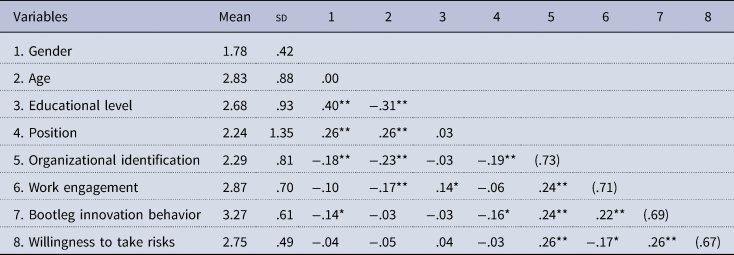
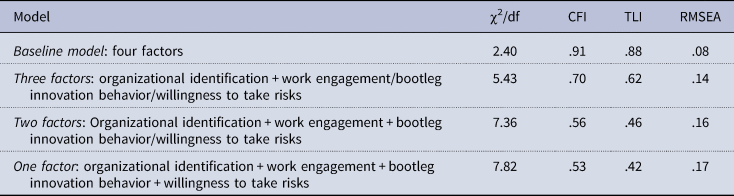
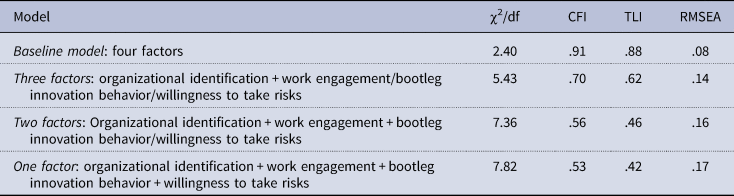
We used SPSS version 21.0 and Mplus version 7.4 to test the reliability and validity of the scales used in our study. The reliability of our measures was determined by internal consistency. Table 1 indicates that the Cronbach’s α of the four scales ranged between .67 and .89, while composite reliability (CR) scores were between .70 and .89, indicating acceptable levels (Hair, Black, Babin, Anderson, & Tatham, Reference Hair, Black, Babin, Anderson and Tatham2006). The validity of our measures was evaluated using convergent validity (average variance extracted [AVE]) and discriminant validity. The AVE values shown in Table 1 (from .45 to .54) demonstrate that the convergent validity is generally acceptable (Acquila-Natale & Iglesias-Pradas, Reference Acquila-Natale and Iglesias-Pradas2020; Darvishmotevali & Ali, Reference Darvishmotevali and Ali2020). First, the Fornell and Larcker approach was utilized to assess discriminant validity (Fornell & Larcker, Reference Fornell and Larcker1981). As shown in Table 2, the square root of AVE for all the variables is not greater than the correlation between the variable and any of the other variables. In addition, to further prove the discriminant validity, we conducted confirmatory factor analyses (see Table 3). The results show that the proposed baseline model fits better than any of these alternatives. These results provide support for our measures’ distinctiveness and further demonstrate the validity of the measurements (Cui, Wang, & Nanyangwe, Reference Cui, Wang and Nanyangwe2022; Liu, Bracht, Zhang, Bradley, & Van Dick, Reference Liu, Bracht, Zhang, Bradley and Van Dick2020).
Reliability and convergent validity

Means, standard and correlations
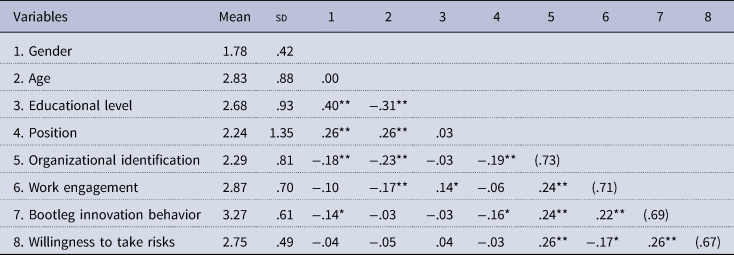
sd, standard deviation.
Gender: 1 = female, 2 = male. The square root of AVE for each variable is shown in the parentheses.
**p < .01, *p < .05.
Fit indices for the measurement model
Common method variance
We performed the Harman’s single factor test and the single unmeasured latent method factor test to analyze the common method bias using SPSS and Mplus (Gu, Tang, & Jiang, Reference Gu, Tang and Jiang2015; Podsakoff et al., Reference Podsakoff, MacKenzie, Lee and Podsakoff2003). Harman’s single factor test: the first unrotated factor accounted for 25.61% of the variance which is not more than the cut-off threshold of 50% (Wohlgemuth & Wenzel, Reference Wohlgemuth and Wenzel2016). Single unmeasured latent method factor test: we found that the fit indices variations were insignificant (ΔCFI = .02, ΔTLI = .02, ΔRMSEA = .01) after comparing two measurement models, one with the addition of an unmeasured latent CMV factor (χ2/df = 2.20, CFI = .93, TLI = .90, RMSEA = .07) and the other without the CMV factor (baseline model) (χ2/df = 2.40, CFI = .91, TLI = .88, RMSEA = .08). In sum, it has been demonstrated that common method variance is not an issue in our sample.
Hypothesis tests
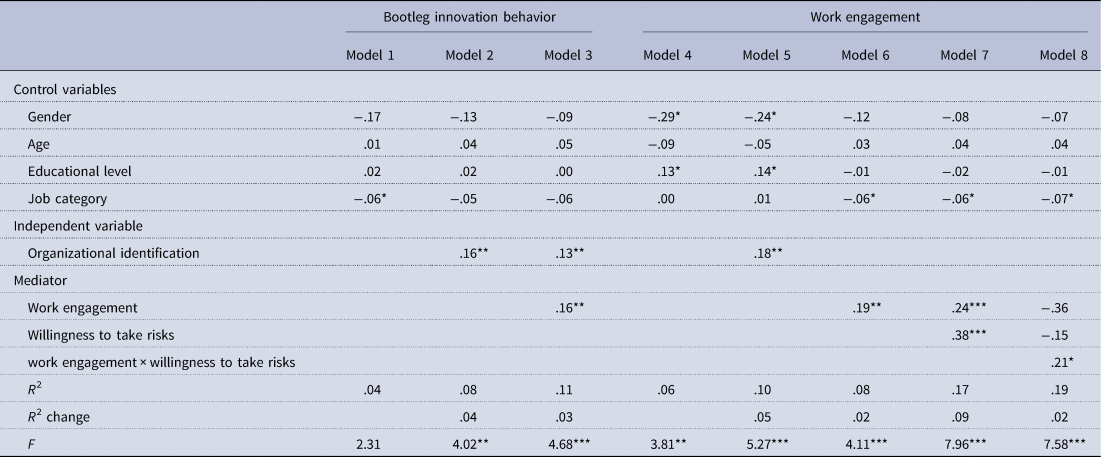
The means, standard deviations and correlations for all the variables are presented in Table 2. Organizational identification correlates positively with bootleg innovation behavior (r = .24, p < .01) and work engagement (r = .24, p < .01). In addition, work engagement relates positively to bootleg innovation behavior (r = .22, p < .01). These results provide initial support for our hypotheses. Then we ran several ordinary least squares regression to test the hypotheses using SPSS. The regression results are displayed in Table 4.
Regression results
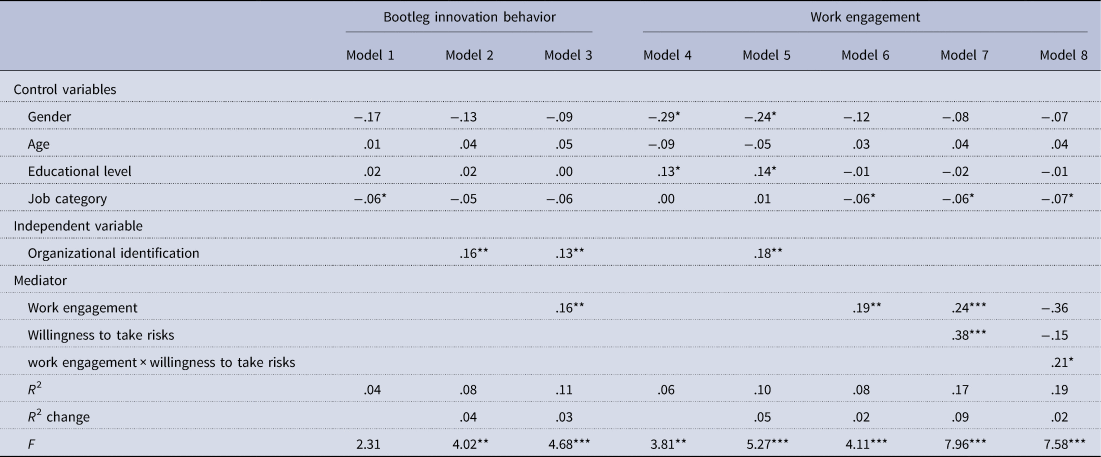
In hypothesis 1, this study predicted a positive relationship between organizational identification and bootleg innovation behavior . Model 2 shows that organizational identification is positively correlated to bootleg innovation behavior (β = .16, p < .01), this means hypothesis 1 is supported.
In hypothesis 2, this study predicted that work engagement mediates the relationship between organizational identification and bootleg innovation behavior. We used Baron and Kenny’s method to prove the mediation effect of our study. Model 5 shows that organizational identification has a positive effect on work engagement (β = .18, p < .01). Additionally, the regression of bootleg innovation behavior on demographic variables, organizational identification and work engagement (model 3) indicates that work engagement positively predicts bootleg innovation behavior (β = .16, p < .01) and the regression coefficient of bootleg innovation behavior on organizational identification is significant (β = .13, p < .01). Thus, it can be deduced that work engagement mediates the organizational identification and bootleg innovation relationship, hypothesis 2 is supported (Baron & Kenny, Reference Baron and Kenny1986).
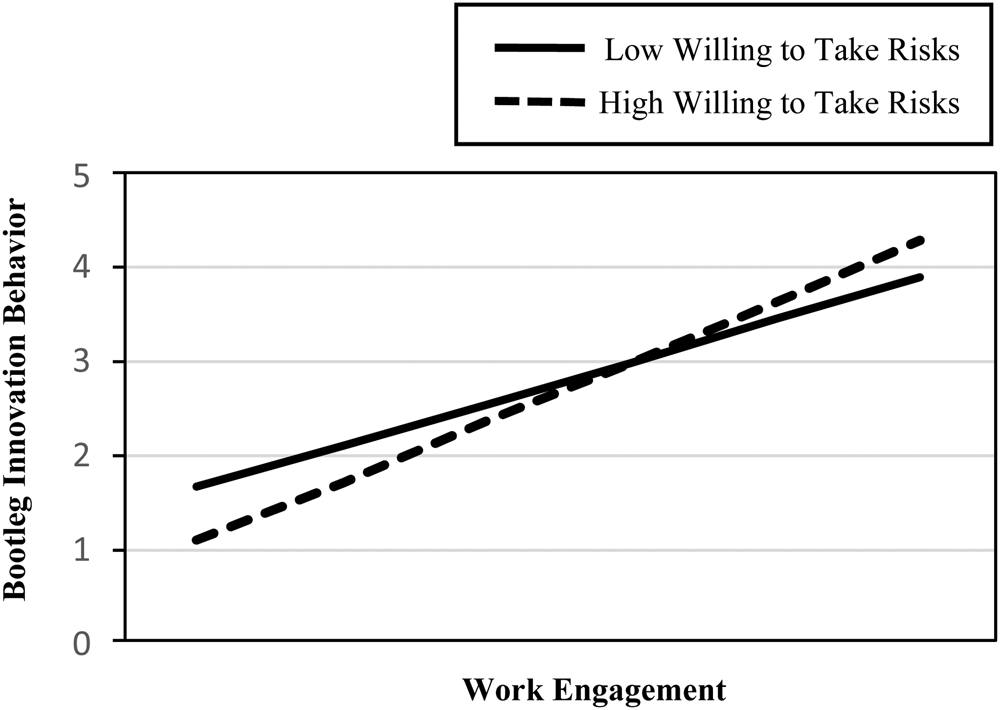
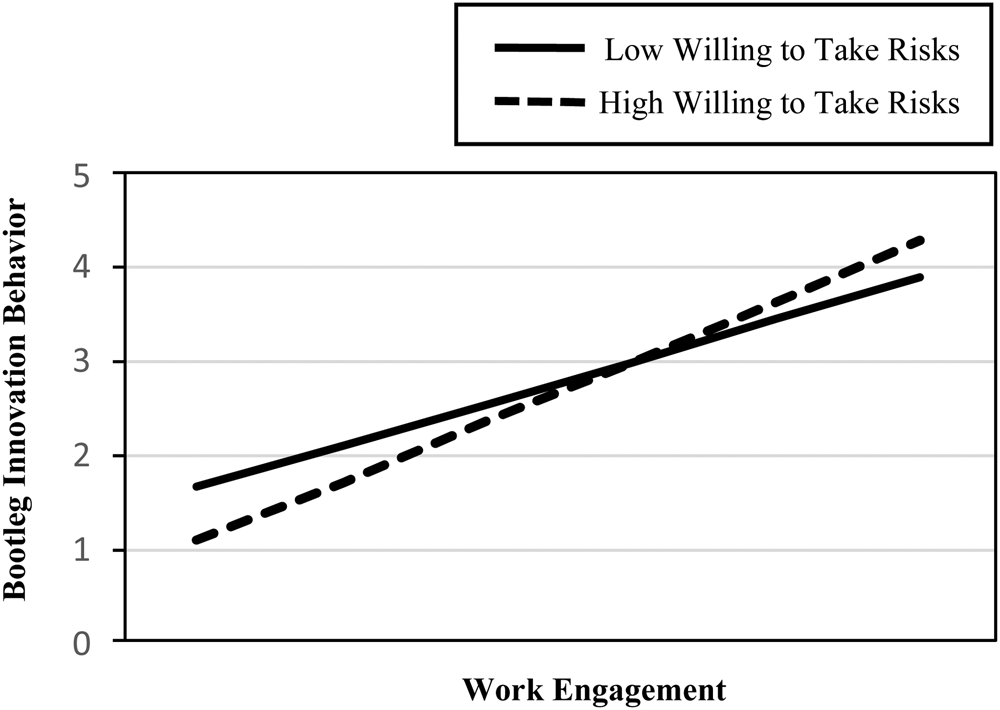
In hypothesis 3, this study predicted that willingness to take risks moderates the relationship between work engagement and bootleg innovation behavior. Model 8 shows that the interaction term between work engagement and willingness to take risks shown is statistically significant (β = .21, p < .05), thus hypothesis 3 is supported. The moderation effect of willingness to take risks is depicted on simple slopes plotted at high (+1 sd) and low (−1 sd) as shown in Figure 1. The positive bond between work engagement and bootleg innovation behavior appears stronger when willingness to take risks is high.
Interaction of work engagement and willingness to take risks on bootleg innovation behavior.
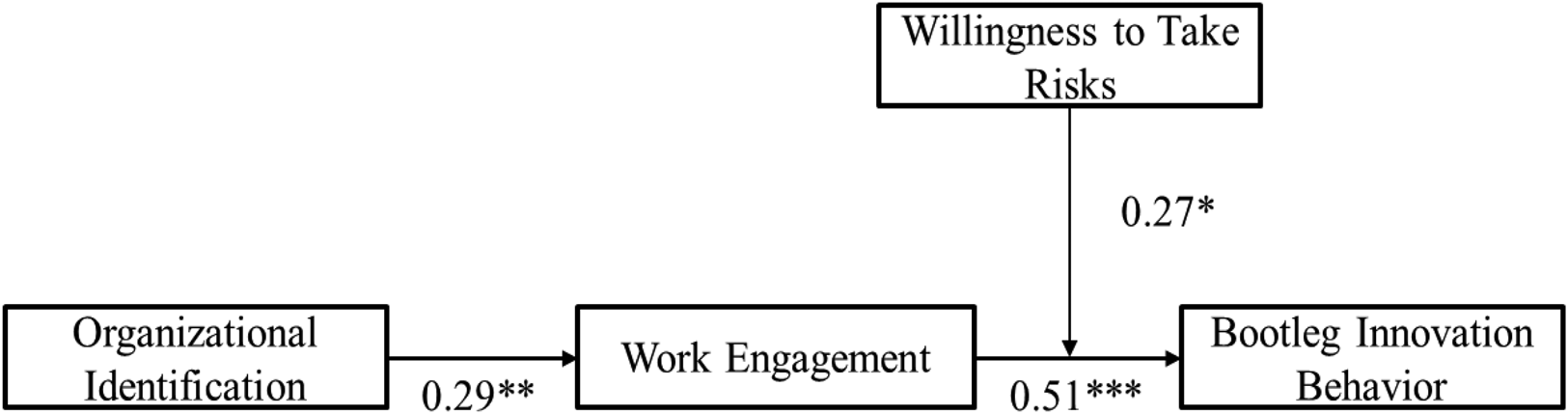
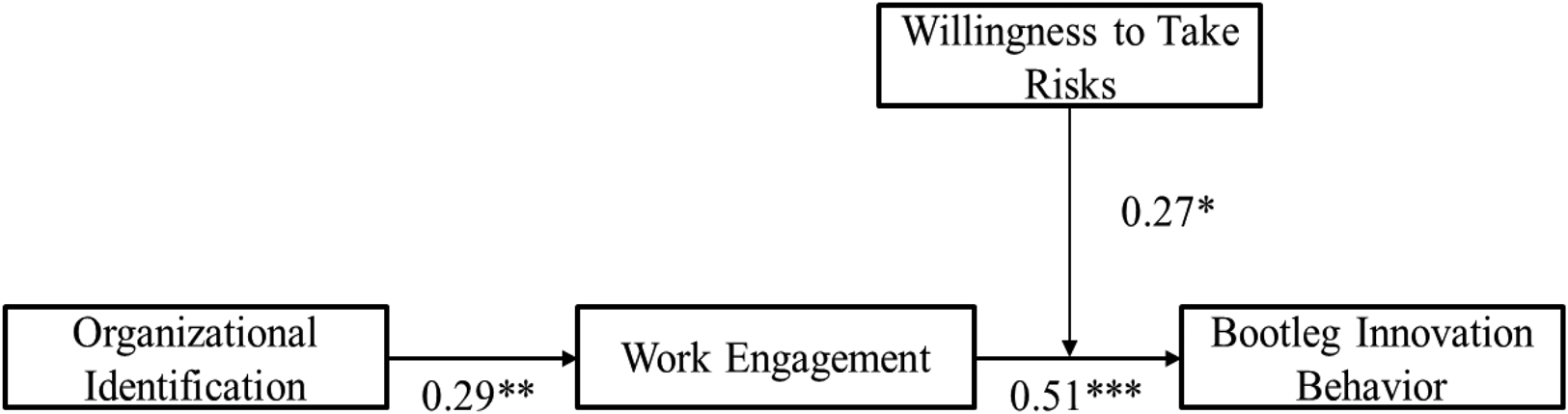
Furthermore, to examine the robustness of the mediation and moderation effects, we constructed a latent structural equation model in Mplus 7.4. The hypothetical model has a good fit: χ2/df = 2.20, CFI = .90, TLI = .86, RMSEA = .07. As shown in Figure 2, the coefficients of the path between organizational identification and work engagement; work engagement and bootlegging are significant (β = .29, p < .01; β = .51, p < .001). To test the significance of the mediation effect, we conducted a bias-corrected bootstrapped test with 1,000 replications to construct confidence interval (CI) (Preacher & Hayes, Reference Preacher and Hayes2008). The indirect effect of organizational identification on bootleg innovation through work engagement is significant (effect = .05, 95% CI = [.02, .12]). Therefore, hypothesis 2 is supported. Meanwhile, the interaction effect of willingness to take risks and work engagement on bootleg innovation behavior is significant (β = .27, p < .05), thus hypothesis 3 is supported again.
Structural model standard parameter estimates.
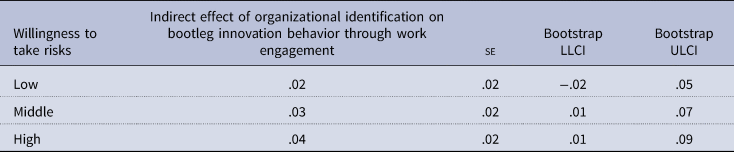
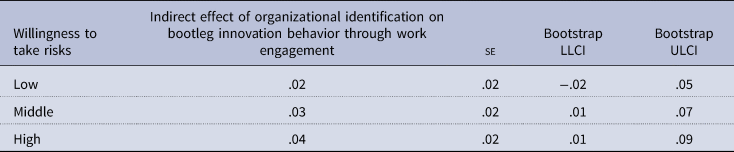
Hypothesis 4 predicted that willingness to take risks moderated the indirect effect of organizational identification on bootleg innovation behavior via work engagement. We tested the moderated mediation effect by utilizing PROCESS macro model 14 (second-stage moderated mediation model). We examined the conditional indirect effects of organizational identification on bootleg innovation behavior via work engagement at high, middle and low levels of willingness to take risks. As shown in Table 5, the indirect effect decreases as willingness to take risks decreases, and when willingness to take risks is at a low level, the indirect effect becomes insignificant (β = .02, 95% CI [−.02, .05]). Thus, hypothesis 4 is supported.
Moderated mediation results
se, standard error; LLCI, lower limit confidence interval; ULCI, upper limit confidence interval.
Note: Bootstrap sample size = 1,000.
Discussion
Using self-concordance theory and the sense-making perspective as guiding frameworks, we explored the mechanism and boundary conditions that explain how organizational identification relates to bootleg innovation behavior using data of 237 Chinese employees collected at two different time periods. It was hypothesized that employees who see membership of their organization as consistent with their personal values and as part of their self-definition will be more engaged in their work and consequently engage in bootleg innovation behavior. Also that employees’ willingness to take risks will strengthen and decrease the work engagement–bootleg innovation behavior bond. Consistent with our hypotheses we found that organizational identification positively impacts bootleg innovation behavior, work engagement partially mediates this relationship, willingness to take risks moderates the work engagement–bootleg innovation behavior link as well as the organizational identification–bootleg innovation link via work engagement. We address key theoretical and practical implications of our research findings below.
Theoretical contributions
First and foremost, the current findings advance bootlegging research, which is still in its infancy and has received little empirical attention. Our findings demonstrate that organizational identification is a driver for bootleg innovation behavior. To date, as far as we know there has been only one other identity based investigation related to bootleg innovation behavior (Nanyangwe, Wang, & Cui, Reference Nanyangwe, Wang and Cui2021). Our results provide evidence that bootleg innovation behavior is driven not just by self-identification with work but also by organizational identification. Taken together, these two studies expand our understanding of bootleg innovation behavior and suggest that identification is a powerful motivational stimulant for this behavior.
Second, the current study advances bootleg innovation behavior research by including self-concordance theory as a theoretical lens for understanding the relationship between organizational identification and bootleg innovation behavior. We extend previous work by identifying work engagement as an important mediator in the organizational identification–bootleg innovation behavior relationship. Organization scholars have mainly associated organizational identification to workplace behavior that conforms to organizational norms. Consistent with Blader, Patil, and Packer’s (Reference Blader, Patil and Packer2017) assertion, our results prove that strongly identified employees will also deviate from typical organizational practices and engage in behavior like bootleg innovation behavior. In this regard, highly identified employees are depicted as ardent and proactive agents who are eager to utilize different means to advance organizational goals and interests, including those that violate organizational norms and traditions (Blader, Patil, & Packer, Reference Blader, Patil and Packer2017).
A third contribution of our study is that it adds to the limited but emerging research investigating the boundary conditions of bootleg innovation behavior. Specifically, we investigate the circumstances under which the relationship between work engagement and bootleg innovation behavior varies. By testing the moderating role of willingness to take risks, this study explains that work engagement is most effective in enhancing bootleg innovation behavior when employees have the willingness to take risks.
Practical implications
Several practical implications arise from the present study. It is clear from previous studies that bootleg innovation behavior has value in the innovation process, especially that innovations often emerge outside the strategically outlined core areas and diverge from what is normative (Augsdorfer, Reference Augsdorfer2005; Criscuolo, Salter, & Ter Wal, Reference Criscuolo, Salter and Ter Wal2014; Koch & Leitner, Reference Koch and Leitner2008). However, researchers have also cautioned that overindulgence in bootleg innovation behavior might interrupt formal organizational processes, divert resources and delay official projects (Criscuolo, Salter, & Ter Wal, Reference Criscuolo, Salter and Ter Wal2014). Our findings demonstrate that organizational identification helps fuel bootleg innovation behavior. This means that increasing employees’ sense of belongingness with the organization is one possible way of engendering bootleg innovation activities. Research indicates that organizations can bolster the identification of employees to the organization by underscoring the distinctiveness of the organization (i.e., its values, beliefs, culture or strategy), by designing jobs that are meaningful, and by giving employees opportunities for self-expression (Ashforth & Mael, Reference Ashforth and Mael1989; Dutton, Dukerich, & Harquail, Reference Dutton, Dukerich and Harquail1994; Karanika-Murray et al., Reference Karanika-Murray, Duncan, Pontes and Griffiths2015).
The results additionally indicate that managers can also influence engagement in bootleg innovation activities by boosting employee work engagement. Organizations can foster employee work engagement through job resources such as social support, skill variety, autonomy and learning opportunities because these job resources satisfy basic human needs, like the needs for autonomy, relatedness and competence (Bakker, Reference Bakker2011; Deci & Ryan, Reference Deci and Ryan1985). This underscores the need for organizations to invest in employee developmental programs, strengthen interpersonal relationships, and increase work discretion. Such programs and practices are expected to heighten work engagement.
Finally, our findings demonstrate that there is a higher chance for engaged employees to conduct bootleg innovation behavior when their willingness to take risks is high as opposed to when it is low. Understanding the conditions that shape bootleg innovation behavior is important for organizations to be able to guide and control this behavior. Hence, in situations where bootleg innovation behavior is desirable, managers can take measures to enhance employees’ willingness to take risks. For example, the cultural risk values of an organization can influence employees risk perception, like emphasis on trying out new and risky ideas can channel employees’ attention on behaviors such as bootleg innovation behavior (Sitkin & Pablo, Reference Sitkin and Pablo1992).
Limitations and directions for future research
As with all research, there are limitations to our study that offer opportunities for future investigations. To start with, our research demonstrated that organizational identification can also be associated with behaviors that depart from organizational norms like bootleg innovation behavior. However, a better understanding of the characteristics that make highly identified employees more motivated to engage in bootleg innovation behavior versus conformity behavior is needed. Therefore, we suggest that future studies explore what conditions when ‘high’ will induce organizational identifiers to engage in bootleg innovation behavior and not conformity behavior and when ‘low’ will induce organizational identifiers to engage in conformity behavior versus bootleg innovation behavior or vice versa.
Similarly, while our theoretical arguments were general and not country specific, the data are based on one specific country (China) which raises valid concerns about culture factors interfering with the empirical results. For example, cultural characteristics like collectivism may affect the extent to which organizational members identify with the organizations to which they belong (Packer, Reference Packer2008). Individuals in a country like China that is typically a collectivist culture (Oyserman & Lee, Reference Oyserman and Lee2008) might be more motivated by the types of needs that can be readily satisfied by membership in groups and they may be better constituted than individualist cultures to satisfy individual needs (Packer, Reference Packer2008). Thus, the potency of identification with the organization should be stronger than in more individualistic or independent societies. In this regard, it would be worthwhile for future studies to compare the ratings of organizational identification and its effect on bootleg innovation behavior across different culture contexts and test our hypotheses using cross-culture samples.
Additionally, we used Criscuolo, Salter, and Ter Wal’s (Reference Criscuolo, Salter and Ter Wal2014) 5-item scale to measure bootleg innovation behavior. Although the authors excluded the item ‘I enjoy tinkering around with ideas that are outside the main projects I work on’ due to its low factor loading (.35), we decided to keep the item in our study because we found a factor loading value of .48. However, we acknowledge that this item might not give a very precise representation of the definition of bootleg innovation behavior as it does not take into account the violation of corporate norms of this activity. Future studies could exclude this item or consider changing the wording of the item, possibly by using Augsdorfer’s (Reference Augsdorfer1994) wording explicitly: ‘innovative activity … without the formal authorization of the responsible management, but for the benefit of the company.’
Furthermore, our single-respondent design might pose a common method variance threat. We attempted to mitigate this threat by collecting data at two time points; a time lag of 4 weeks was used to measure the dependent variable and other focal variables. Nonetheless, it was still difficult to confirm the causality of the relationships suggested in our model. In order to completely rule out that work engagement and bootleg innovation behavior influence organizational identification, longitudinal or experimental research is needed to buttress the causality proposed in our model.
Lastly, this study offers support to the viability of the self-concordance theory and sense-making perspective to understand bootleg innovation behavior. The literature will benefit from exploring what additional factors influence and shape bootleg innovation behavior in the workplace. For example, work investigating the effects of leadership on bootleg innovation behavior could be valuable.
Conclusion
This paper theorized and tested the impact of organizational identification on bootleg innovation behavior. Although these bottom-up innovation activities begin discreetly, they become increasingly integrated with the formal innovation process later (Koch & Leitner, Reference Koch and Leitner2008). Consequently, researchers must be diligent in their efforts to advance our understanding of bootleg innovation behavior in the workplace.
Conflict of interest
The authors have no conflicts of interest to declare.