Introduction
Domestic ruminants concentrate their grazing activities at sunrise and dusk, during which times they exhibit the longest and most intense grazing events (Orr et al., Reference Orr, Penning, Harvey and Champion1997). However, environmental and management factors can alter meal distribution and patterns of grazing behaviour throughout the day (Hodgson, Reference Hodgson1990; Linnane et al., Reference Linnane, Brereton and Giller2001). According to Gregorini et al. (Reference Gregorini, Eirin, Refi, Ursino, Ansin and Gunter2006), milking or the movement of animals to a new paddock provides a stimulus for consumption and the beginning of a new meal. In this way, under rotational stocking management, more frequent allocation of animals to new paddocks may affect grazing behaviour and could increase productivity (Abrahamse et al., Reference Abrahamse, Dijkstra, Vlaeminck and Tamminga2008). Considering patterns of plant dehydration and accumulation of sugar and starch throughout the day, the period when a new paddock is offered to animals can be used as a management tool to alter the frequency, duration and temporal distribution of grazing events, favouring acquisition of nutrients from the pasture (Orr et al., Reference Orr, Rutter, Penning and Rook2001; Abrahamse et al., Reference Abrahamse, Tamminga and Dijkstra2009; Gregorini, Reference Gregorini2012). In tropical regions, significant differences in forage nutritive value have been reported between morning and afternoon periods. De Oliveira et al. (Reference de Oliveira, Paiva, Pereira, Geremia and da Silva2014) observed dry matter and soluble carbohydrate concentrations around 22–85% greater during the afternoon relative to morning in elephant grass (Pennisetum purpureum cv. Napier) pastures. Thus, management strategies that maximize the grazing time and duration during the afternoon could increase dry matter and energy intake (Orr et al., Reference Orr, Rutter, Penning and Rook2001; Griggs et al., Reference Griggs, MacAdam, Mayland and Burns2005). Against this background, the aim of the current study was to evaluate the effect of the time of the day animals are moved to a new paddock on forage nutritive value, grazing behaviour and animal performance of beef cattle grazing rotationally stocked Marandu palisadegrass (Brachiaria brizantha cv. Marandu Syn. Urochloa brizantha cv. Marandu) pastures.
Materials and methods
Experimental site and design
The experiment was conducted at the Faculty of Animal Science and Food Engineering, University of São Paulo (FZEA-USP), Campus Fernando Costa, Pirassununga, São Paulo, Brazil (21°57′S, 47°28′W, 650 m a.s.l.) according to the procedures approved by the Committee on Animal Research and Ethics of the FZEA-USP, process USP number: 2012.1.1561.74.3. During the entire experimental period (182 days), the animals had free access to water and mineral supplement.
The experimental area corresponded to 156 paddocks of 1638 m2 each, for a total of 25.5 ha. Each experimental unit consisted of 26 paddocks and supported 13 tester animals. The main treatments corresponded to the time of the day of allocation of animals to a new paddock: 06.00 h (designated AM) or 15.00 h (designated PM), and were distributed in a randomized complete block design with three replications for a total of six experimental units. The grazing method was intermittent stocking using a variable stocking rate (Mott and Lucas, Reference Mott and Lucas1952). Each grazing cycle corresponded to 1 day of occupation and 25 days’ rest period. From October 2012 to March 2013, six grazing cycles were evaluated, with mean data from the first three grazing cycles comprising the spring and the last three comprising the summer. An additional area with 13 ha was designated to maintain animals used for adjusting stocking rates. Adjustments in stocking rates were made weekly based on estimates of herbage mass, to obtain the same herbage allowance, expressed according to Sollenberger et al. (Reference Sollenberger, Moore, Allen and Pedreira2005), for both treatments.
The pasture was a monoculture of Marandu palisade grass established in 1997 in a Eutric Nitisol. The upper 0–0.2 m layer of the soil was sampled for analysis of fertility, showing the following chemical characteristics: pH (calcium chloride [CaCl2]) 5.4; organic matter 36 g/dm3; phosphorus (P; ion-exchange resin extraction) 9 mg/dm3; sulphur (S) 16 mg/dm3; potassium (K) 2.6 mmolc/dm3; calcium (Ca) 22 mmolc/dm3; magnesium (Mg) 8 mmolc/dm3; aluminium (Al) trace mmolc/dm3; cation exchange capacity (CEC) 55 mmolc/dm3; sum of bases (SB) 33 mmolc/dm.3 Application of 1200 kg/ha of limestone occurred in October 2012. The fertilization programme consisted of 500 kg/ha of commercial fertilizer with the formula 10-20-10 nitrogen (N)-phosphorus pentoxide (P2O5)-potassium oxide (K2O), applied 25 days after liming, and 500 kg/ha of a commercial fertilizer with the formula 20-00-20 (N-P2O5-K2O), applied in December 2012. The climate is CWa (humid sub-tropical) according to the Köppen–Geiger classification (Peel et al., Reference Peel, Finlayson and McMahon2007). The accumulated rainfall during the experimental period was 1400 mm, similar to the historical mean of 1233 mm. The average air temperature, relative humidity and solar radiation during the experimental period corresponded to 24 °C, 71% and 966 w/m2/day, respectively.
Animal evaluations
A total of 180 Nellore heifers with an average age of 15 months, previously classified by live weight (LW) and temperament, were used. In order to obtain similar LW for all the experimental units, 60 heifers with an intermediate weight were grouped in the treatments. Measurements of average daily gain (ADG) were made on ten tester animals per experimental unit (30 heifers per treatment), with the same average initial LW of 230 ± 3.0 kg for AM or PM treatments. The weighing procedures occurred at 07.00 h after fasting (both food and water) for 14 h, at the beginning of the experimental period and at the end of each grazing cycle.
During spring, once per grazing cycle, grazing behaviour was monitored from 05.25 to 18.25 h by visual observation of three animals per experimental unit (nine animals per treatment). Each block was monitored by one evaluator, carrying binoculars and positioned on a scaffolding that was 2 m tall. Animal activities were registered every 5 min and were categorized as grazing (which included time spent selecting, prehension and mastication of forage), rumination and other activities (Mezzalira et al., Reference Mezzalira, Carvalho, Fonseca, Bremm, Reffatti, Poli and da Trindade2011). The data relative to grazing time, rumination time and time in other activities were expressed in minutes.
During summer, once per grazing cycle, the grazing behaviour was monitored for a period of 24 h, using an acoustic method for quantifying the duration of grazing, rumination and other activities of grazing cattle (Da Trindade et al., Reference Da Trindade, Carvalho, Neves, Pinto, Gonda, Nadin and Correia2011). The principles of the method are based on different acoustic patterns which can discriminate each activity. To obtain sound recordings, head collars were fitted with a digital recorder (Sony Brazil Inc, model ICD-PX312, Manaus, AM, Brazil) and a lapel microphone, adjusted for high sensitivity. The recorders were placed at the nape of the neck and the microphone on the heifer's forehead, and animals were adapted previously to the apparatus. The sound recordings were analysed using an audio editing software (Sony Creative Software Inc, Forge™ Pro 10, Madison, WI, USA).
The time for each activity was expressed in two periods (morning [05.25–12.00 h] and afternoon [12.01–18.25 h]) in the spring and three periods (morning [06.00–13.00 h], afternoon [13.01–20.00 h] and night [20.01–05.59 h]) during the summer.
Evaluations of bite rate were taken once per grazing cycle during spring and summer. In order to characterize the diurnal variation in bite rate, bite rate was measured three times a day in each treatment (AM and PM). The bite rate measurements were taken for two consecutive hours each, starting at 06.00, 12.00 and 15.00 h. Each group of animals was monitored by one evaluator, which registered the time for 20 prehension bites. The bite rate was obtained by converting the time for 20 prehension bites in number of bites per minute.
Pasture evaluations
Herbage mass (kg dry matter [DM]/ha) at pre- and post-grazing canopy conditions was assessed every 26 days using a double sampling approach (Wilm et al., Reference Wilm, Costello and Klipple1944), which was based on the correlation between canopy height and herbage mass. The indirect measure (canopy height) was taken from ground level using the ‘leaf horizon’ at the top of the canopy as a reference and the direct measure involved hand clipping all herbage within 0.50 × 0.50 m metallic frames to 3 cm from ground level. To calibrate the correlation, 18 sites (three per experimental unit) were double-sampled each grazing cycle. At each site, canopy height was measured, the herbage clipped, dried at 60 °C for 72 h and weighed. Herbage mass was regressed on canopy height to develop a calibration equation. The equation was used to predict herbage mass using a stick graduated in cm to measure canopy height through 30 systematic readings in each paddock.
To determine morphological composition, in each grazing cycle three sites (0.50 × 0.50 m metallic frames) per experimental unit were hand-clipped to 3 cm from ground level. A sub-sample of approximately 500 g was obtained for manual separation into leaf blade, stem plus sheath and dead material. Morphological components were dried in a forced-air oven at 60 °C by 72 h and weighed to determine morphological composition as proportion of total herbage mass.
Chemical composition and in vitro organic matter disappearance analysis
Samples used for chemical composition and in vitro organic matter disappearance (IVOMD) were hand-plucked (Euclides et al., Reference Euclides, Macedo and Oliveira1992). Samples were taken twice per grazing cycle, every 13 days. In order to obtain the variation in nutritive value through the day, samples were taken at 06.00 and 15.00 h in each treatment (AM and PM) during an occupation day of the grazing cycle. This sampling procedure added one factor (treatment) to the statistical model (hand-plucked hour; a.m. or p.m.), resulting in two types of forage samples per treatments: AMa.m. (sample of AM treatment hand-plucked at 06.00 h), AMp.m. (sample of AM treatment hand-plucked at 15.00 h), PMa.m. (sample of PM treatment hand-plucked at 06.00 h) and PMp.m. (sample of PM treatment hand-plucked at 15.00 h). All sample collections were preceded by at least 1 day with full sunlight during the daytime. Samples were stored in a cooler with ice and taken immediately to the laboratory, divided into two parts (~300 g) and weighed using a precision scale. One of the portions was submitted to a pre-treatment in the microwave (Pelletier et al., Reference Pelletier, Tremblay, Belanger, Bertrand, Castonguay and Michaud2010) before drying in a forced-air oven (AOAC, 2012). The pre-treatment aimed to halt enzymatic activity in order to avoid respiration of non-structural carbohydrates (NSC) and consisted of heating (~75 °C) the sample in a 600 W microwave for 1 min. Another portion was dried directly in a forced-air oven at 60 °C for 72 h and utilized for determination of N and neutral detergent fibre (NDF). All samples were ground in a stationary mill with a 1 mm sieve.
Dry matter, ash and N concentrations were determined according to AOAC (2012) and NDF concentrations according to Van Soest et al. (Reference Van Soest, Robertson and Lewis1991), without the thermostable α-amylase and sodium sulphite treatment. To obtain ash- and N-free NDF (NDFaNf), the ash and N concentrations in NDF (ashNDF and NNDF, respectively) were determined according to AOAC (2012) and NDFaNf was calculated as: NDFaNf = NDF − (ashNDF + NNDF).
The carbohydrates were separated into starch and ethanol-soluble sugars at 80% ethanol (ESC), which represent mono and disaccharides, according to the method described by Hall (Reference Hall2000). Starch concentration was determined from the ethanol-insoluble residue using the gelatinization technique and enzymatic hydrolysis, followed by a colorimetric determination of glucose according to Hall (Reference Hall2000). The sum of ESC and starch fractions was considered as the total NSC (Hall, Reference Hall2003).
The IVOMD was determined using the semi-automated in vitro gas production technique, according to the method of Theodorou et al. (Reference Theodorou, Willians, Dhanoa, McAllan and France1994), modified by Mauricio et al. (Reference Mauricio, Mould, Dhanoa, Owen, Channa and Theodorou1999). Each sample was incubated in two glass bottles with 125 ml volume, which received 1.0 g of sample, 90 ml of buffer and 10 ml of inoculum. The ruminal inoculum was obtained from three castrated Nellore steers, of 36 months of age, average weight of 450 kg, fistulated in the rumen, and maintained on a Marandu palisade grass pasture. After inoculation, the bottles were sealed and maintained in a forced-air oven at 39 °C for 24 h, when fermentation was interrupted. The liquid and residual particles were filtered under vacuum in sintered melting pots with a porosity of 100–160 µm. The organic matter disappearance was obtained by the difference between initial and residue weight after drying at 105 °C and correction for ash in a muffle at 512 °C for 4 h. All analyses were performed in duplicate, except ESC, which was made in triplicate. All results are expressed on DM basis. Samples were chemically analysed by grazing cycle (three grazing cycles for each season) and the data were analysed statistically by season.
Statistical analysis
Analysis of variance of the data was performed using mixed models using the Mixed procedure of the Statistical Analysis System (SAS®), version 9.2 for Windows®. The choice of the covariance matrix (Littell et al., Reference Littell, Henry and Ammerman1998) was made using the results of the likelihood ratio test and Akaike Information Criterion. When appropriate, treatment means were estimated using the ‘LSMEANS’ statement, the significant interactions were assessed using the ‘slice’ procedure. Means were compared with ‘PDIFF’ statement, with treatments considered different when P ⩽ 0.05 and a trend when 0.05 < P ⩽ 0.10.
Data of herbage mass, morphological composition, stocking rate and animal performance (Tables 1 and 2) were analysed considering two factors in the model, new-paddock allocation time (main treatments, AM or PM; 1 D.F.) and season of the year (spring or summer; 1 D.F.), and their interactions (main treatments × season) as fixed effects and blocks (2 D.F.) as random effect. Season was considered as a repeated measurement. The model was:
 $$Y_{ijk} = \mu + a_i + b_j + \gamma ij + c_k + (bc)_{\,jk} + \varepsilon ijk$$
where Y ijk = response variable, μ = mean of all observations, a i = random effect of block, b j = fixed effect of main treatment, γij = (ab)ij = interaction between block and main treatment; error associated with plots, c k = fixed effect of season, (bc)jk fixed effect of interaction between main treatment and season, and εijk = experimental error associated with repeated measures (sub-plots).
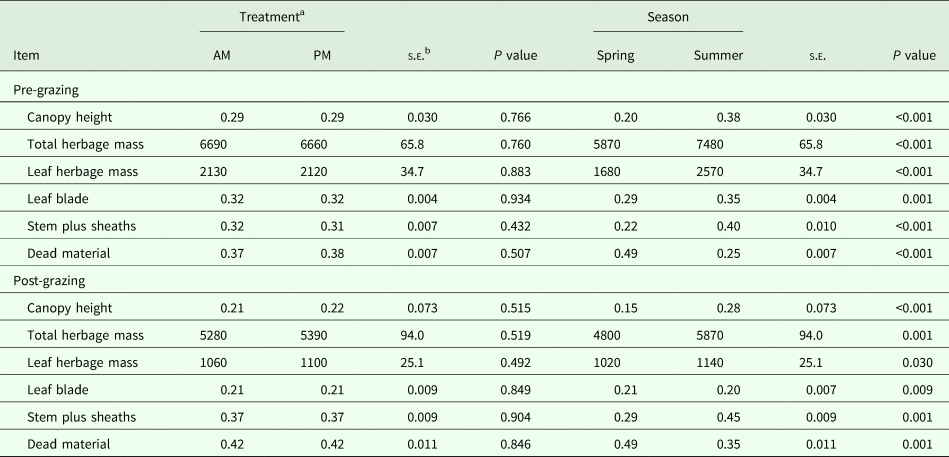
Canopy height (m), total and leaf herbage mass (kg DM/ha) and morphological composition (as proportion of leaf blade, stem plus sheaths and dead material in total herbage mass) at pre- and post-grazing of Marandu palisade grass pasture, subject to rotational stocking management with 1 day grazing period, according the time of the day – 06.00 h (AM) or 15.00 h (PM) – animals are moved to a new paddock, during spring and summer

a Treatments are the time of the day animals are moved to a new paddock at 06.00 h (AM) or 15.00 h (PM).
b Standard error of the mean.
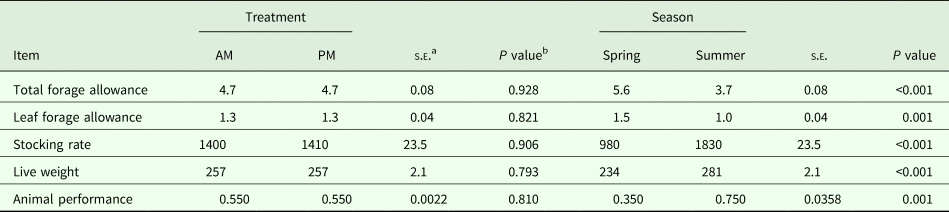
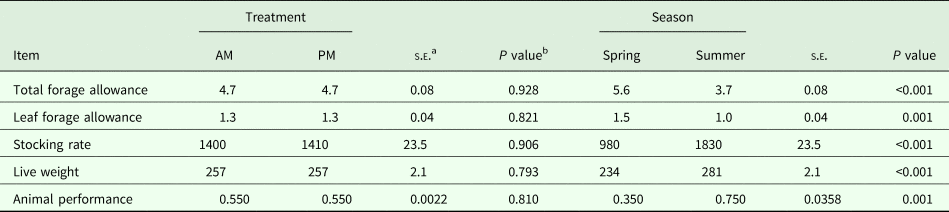
Total and leaf forage allowance (kg DM/kg LW), stocking rate (kg LW/ha), live weight (kg) and animal performance (kg of LW/animal/day) of beef heifers in Marandu palisade grass pasture subject to rotational stocking management with 1-d grazing period, according the time of the day – 06.00 h (AM) or 15.00 h (PM) – animals are moved to a new paddock, during spring and summer
a Treatments are the time of the day animals are moved to a new paddock at 06.00 h (AM) or 15.00 h (PM).
b Standard error of the mean.
Data of chemical composition and IVOMD (Table 3) were analysed considering three factors in the model, main treatments (AM or PM; 1 D.F.), hand-plucked hour (a.m. or p.m. 1 D.F.) and season of the year (spring or summer; 1 D.F.), and their interactions as fixed effects and blocks (2 D.F.) as a random effect. Hand-plucked hour and season of the year were considered repeated measurements. The model was:
 $$\eqalign{Y_{ijkl} & = \mu + a_i + b_j + \gamma _{ij} + c_k + (bc)_{\,jk} + \delta ijk + d_l \cr & + (bd)_{\,jl} + (cd)_{kl} + (bcd)_{\,jkl} + \varepsilon _{ijkl}} $$
where Y ijk = response variable, μ = mean of all observations, a i = random effect of block, b j = fixed effect of main treatment, γij = (ab)ij = interaction between block and main treatment; error associated with plots, c k = fixed effect of hand-plucked hour, (bc)jk = fixed effect of interaction between main treatment and hand-plucked hour, δijk = experimental error associated with sub-plots (measures repeated at first level), d l = fixed effect of season, (bd)jl = fixed effect of interaction between main treatment and season, (cd)kl = fixed effect of interaction between hand-plucked hour and season, (bcd)jkl = fixed effect of interaction between main treatment, hand-plucked hour and season, and ε ijkl = experimental error associated with sub-subplots (measures repeated at second level).
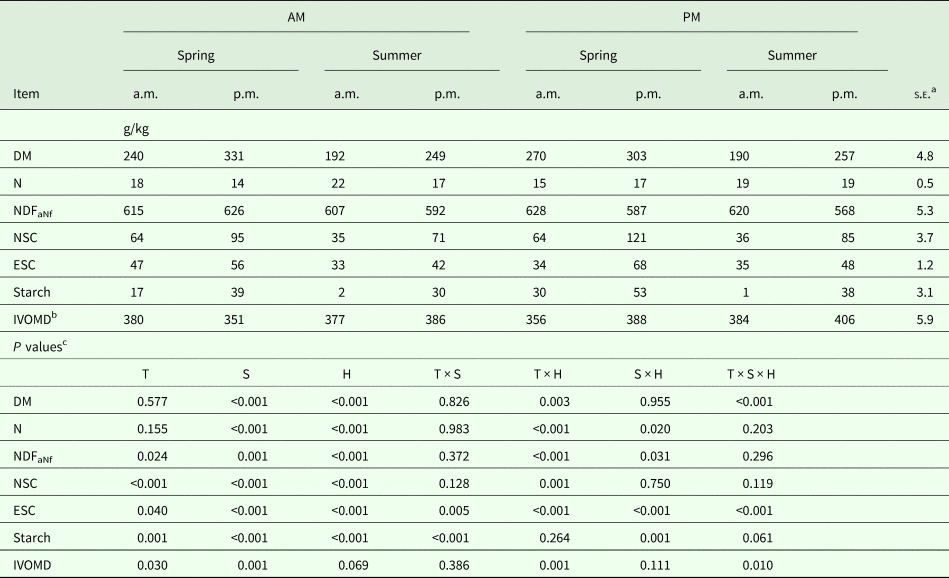
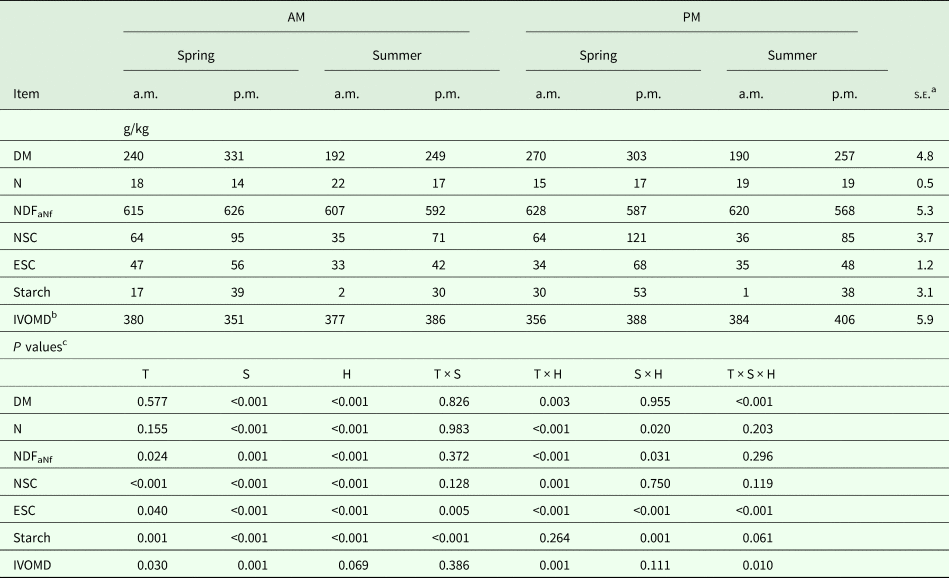
Dry matter (DM), nitrogen (N), neutral detergent fibre ash- and N-free (NDFaNf) and non-structural carbohydrate (NSC = ESC + starch), ethanol-soluble sugars at 80% ethanol (ESC), and starch concentrations and content of in vitro organic matter disappearance (IVOMD) of hand-plucked forage samples of Marandu palisade grass pasture, subject to rotational stocking management with 1 day grazing period, according to the time of the day animals are moved to a new paddock at 06.00 h (AM) or 15.00 h (PM). Hand-plucked forage samples were taken at 06.00 h (a.m.) and 15.00 h (p.m.), during spring and summer
a Standard error of the mean applicable for T × S × H interaction effect.
b 24 h of incubation period.
c P values for main treatment (T, AM or PM), season (S, spring or summer), hand-plucked hour (H, a.m. or p.m.) and their interaction effects.
Data of grazing time, rumination time and other activities (Fig. 1) were analysed separately for each season of the year, considering main treatments (AM or PM; 1 D.F.) and grazing cycles as fixed effects (three grazing cycles per season of the year; 2 D.F.) and blocks (2 D.F.) as random effects. Grazing cycles were considered repeated measurements. The model was:
 $$Y_{ijk} = \mu + a_i + b_j + \gamma ij + c_k + (bc)_{\,jk} + \varepsilon ijk$$
where Y ijk = tested variable, μ = mean of all observations, a i = random effect of block, b j = fixed effect of main treatment, γij = (ab)ij = interaction between block and main treatment; error associated with plots, c k = random effect of grazing cycle, (bc)jk = fixed effect of interaction between main treatment and grazing cycle and εijk = experimental error associated with repeated measures (sub-plots).
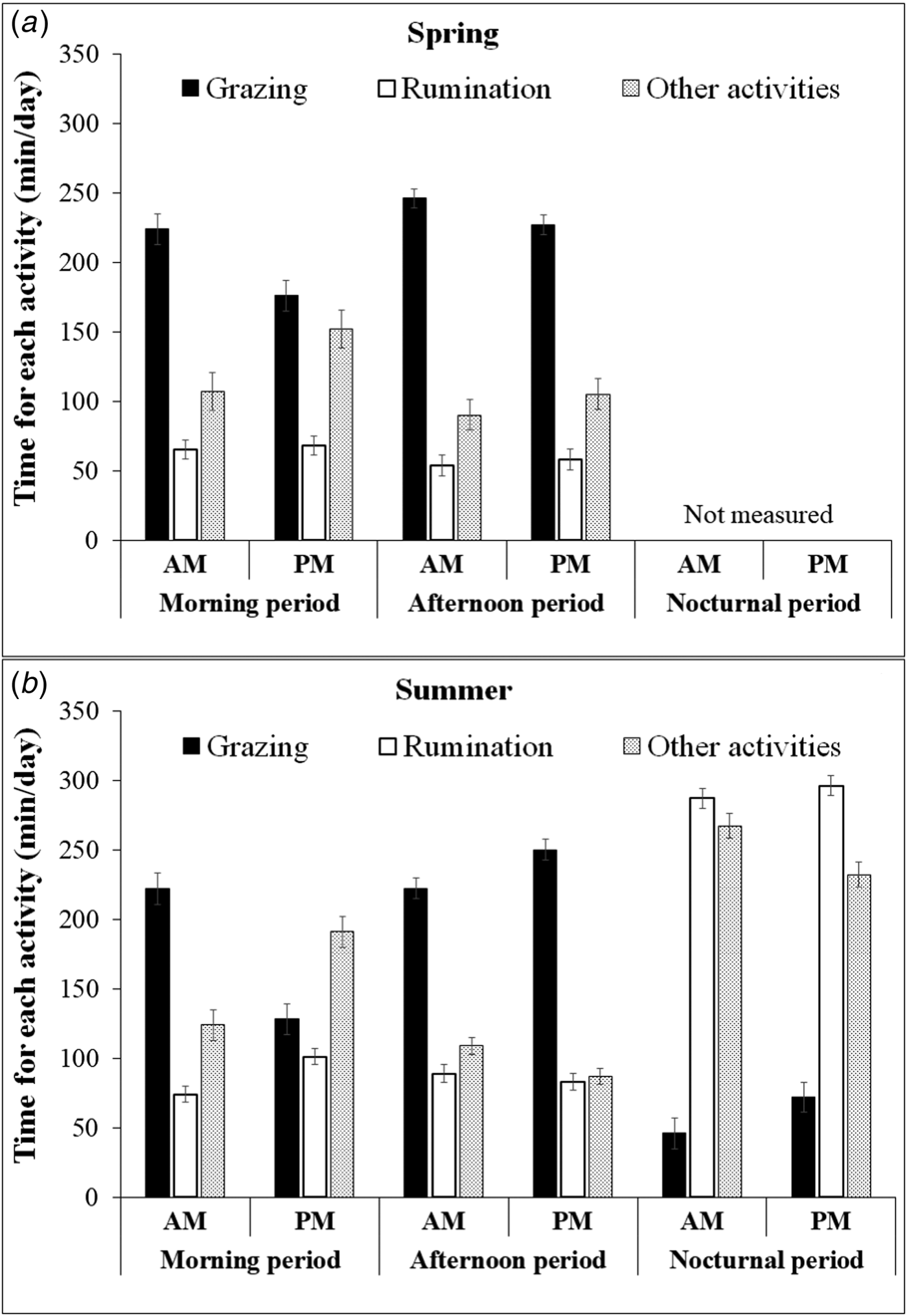
Time spent grazing, rumination and other activities of beef heifers in a Marandu palisade grass pasture subject to rotational stocking management with 1 day grazing period, according the time of the day animals are moved to a new paddock at 06.00 h (AM) or 15.00 h (PM) during spring and summer. (a) Spring: visual evaluations conducted during daylight period. Morning period from 05.25 to 12.00 h; afternoon period from 12.00 to 18.25. (b) Summer: grazing behaviour was monitored for a period of 24 h, morning period from 06.00 to 13.00 h; afternoon period from 13.00 to 20.00 h; nocturnal period from 20.00 to 06.00 h. Due to the use of different methodology, the data were analysed within each season separately (N = 6). Bars indicate standard error of means.

Bite rate data (Fig. 2) were analysed considering three factors in the model, main treatments (AM or PM; 1 D.F.), time of the day (06.00, 12.00 or 15.00 h; 2 D.F.) and season of the year (spring or summer; 1 D.F.), and their interactions as fixed effects and blocks (2 D.F.) as a random effect. Time of the day and season of the year were considered repeated measurements:
 $$\eqalign{Y_{ijkl} & = \mu + a_i + b_j + \gamma _{ij} + c_k + (bc)_{\,jk} \cr & + \delta ijk + d_l + (bd)_{\,jl} + (cd)_{kl} + (bcd)_{\,jkl} + \varepsilon _{ijkl}} $$
where Y ijkl = response variable, μ = mean of all observations, a i = random effect of block, b j = fixed effect of main treatment, γij = (ab)ij = interaction between block and main treatment; error associated with plots, c k = fixed effect of hand-plucked hour, (bc)jk = fixed effect of interaction between main treatment and hand-plucked hour, δijk = experimental error associated with sub-plots (measures repeated at first level), d l = fixed effect of season, (bd)jl = fixed effect of interaction between main treatment and season, (cd)kl = fixed effect of interaction between hand-plucked hour and season, (bcd)jkl = fixed effect of interaction between main treatment, hand-plucked hour and season, and ε ijkl = experimental error associated with sub-subplots (measures repeated at second level).
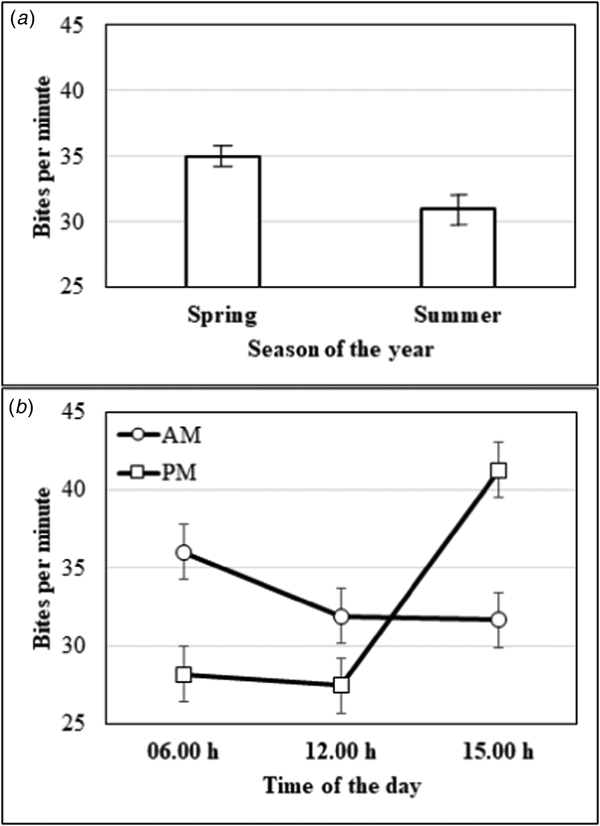
Seasonal (a) and diurnal (b) variation of bite rate (bites per minute) of beef heifers in Marandu palisade grass pasture subject to rotational stocking management with 1 day grazing period, according to the time of the day animals are moved to a new paddock (main treatment) at 06.00 h (AM) or 15.00 h (PM). The bite rate was monitored for 2 h, starting at 06.00, 12.00 and 15.00 h (time of the day), in both treatments (AM and PM), during spring and summer. Main treatment, P = 0.476. Season, P = 0.014. Main treatment × season interaction, P = 0.489. Time of the day, P = 0.002. Main treatment × time of the day interaction, P < 0.001. Time of the day × season interaction, P = 0.318. Main treatment × season × time of the day interaction, P = 0.345. Bars indicate standard error of means.

Results
Herbage mass and canopy structure
Herbage mass and variables related with canopy structure were similar between AM or PM treatments during spring and summer. There was an effect of season of the year for these variables (Table 1). Pre- and post-grazing herbage mass and canopy height were greater during summer compared with spring. In both pre- and post-grazing conditions, total herbage mass and leaf blade mass were, respectively, 1610 and 920 kg/ha, and 1070 and 120 kg/ha greater in the summer relative to spring. During spring, around 0.50 of the pre-grazing herbage mass was comprised of dead material and around 0.25 of stem plus sheaths. During summer, the stem plus sheaths and dead material components represented, respectively, 0.40 and 0.25 of the total pre-grazing herbage mass. Although there was interaction of treatment × season for pre-grazing dead material percentage, mean comparisons did not detect differences between treatments for either season.
The proportion of pre-grazing canopy height removed by animals corresponded to 0.25 and 0.26 during spring and summer, respectively. Herbage mass disappearance corresponded to 0.18 and 0.22 of pre-grazing herbage mass in spring and summer, respectively, and the post-grazing heights were 0.15 and 0.28 m (s.e. = 0.073), respectively. Although total herbage disappearance was similar for both seasons, leaf blade disappearance was 0.38 during spring and 0.56 in the summer.
Animal performance
Herbage allowance, stocking rate and animal performance were similar between treatments (Table 2), but they were affected by season (P < 0.001). Total LW gain per head was 13 ± 1.3 and 8 ± 1.4 kg in the spring and 58 ± 1.3 and 62 ± 1.6 kg in the summer for AM and PM treatments, respectively. The average final values for LW were 301 ± 3.3 and 300 ± 3.5 kg for AM and PM treatments, respectively. Average daily gain in the spring and summer corresponded to 0.350 s.e. = 0.0358 and 0.750 s.e. = 0.0093 kg/animal/day, respectively. Although the stocking rates were around 45% less and the leaf allowance was 50% greater during spring relative to summer (1.5 v. 1.0 kg DM/kg LW; s.e. = 0.04 for both), the ADG during spring was around 0.46 of that observed during summer and animals attained a similar weight by the end of the experiment.
Ingestive behaviour
During the spring, similar values for rumination time were verified between treatments, but animals from AM treatment showed greater grazing time than PM (470 v. 403 min; s.e. = 11.0 for both; P = 0.001), while time spent in other activities was greater for the PM treatment (Fig. 1(a)). Grazing activity was stimulated during the morning period (05.25–12.00 h) in the AM treatment compared with PM (224 v. 176 min; s.e. = 7.1 for both; P < 0.001). The animals in the PM treatment showed greater time spent on other activities during the morning period. Grazing and rumination time were similar between treatments during the afternoon period, but the time spent in other activities was greater for the PM treatment (Fig. 1(a)). It is important to point out that the observations during spring were obtained only for the period of daylight (05.25–18.25 h), and the treatments may have shown different grazing time after this period, at night.
During the summer, animals from the AM treatment had greater daily grazing time than PM (490 v. 450 min; s.e. = 5.4 for both; P < 0.001), and AM animals had less rumination time than PM (453 v. 477 min; s.e. = 5.2 for both; P < 0.001; Fig. 1(b)). Total time spent in other activities did not vary between treatments. Animals of PM treatment spent more time in rumination and other activities during the morning. In contrast, during the afternoon period, PM animals spent more time grazing while AM animals spent more time in other activities. This pattern of activity also carried over to the night period (Fig. 1(b)). As a result, the distribution of total grazing time throughout the day for animals on the AM treatment corresponded to 0.45, 0.45 and 0.09 during the morning, afternoon and night, respectively. The distribution of total grazing time for animals of the PM treatment corresponded to around 0.28, 0.56 and 0.16 during the morning, afternoon and night, respectively.
Bite rate was greater during the spring relative to the summer (P < 0.014; Fig. 2(a)), regardless of treatment or time of the day. There was an interaction between main treatment and time of the day (P < 0.001; Fig. 2(b)). For the AM treatment, greater values (P = 0.040) of bite rate occurred at 06.00 h compared with other times of day (12.00 and 15.00 h). For the PM treatment, greater bite rate (P < 0.001) occurred at 15.00 h compared with other times of day (06.00 and 12.00 h; Fig. 2(b)). The bite rate was greater for the AM than PM treatment at 06.00 h (36 v. 28 bites/min; s.e. = 1.7; P = 0.002) and 12.00 h (32 v. 27 bites/min; s.e. = 1.7; P = 0.036), but it was less for the AM than the PM treatment at 15.00 h (32 v. 41 bites/min; s.e. = 1.7; P < 0.001).
Forage nutritive value
There was a main treatment × season of the year × hand-plucked hour interaction effect for forage DM, ESC (P < 0.001), IVOMD (P = 0.01) and a trend for starch concentration (P < 0.061). Forage DM concentration was greater in hand-plucked samples taken at 15.00 h (p.m.) than 06.00 h (a.m.) for AM or PM treatments in spring and summer (P < 0.001; Table 3). Considering the mean data across hand-plucked hours (a.m. and p.m.), there were no differences between main treatments (AM or PM) in spring and summer (P = 0.577). Regardless of main treatment, hand-plucked samples taken at 06.00 or 15.00 h showed similar DM concentration in summer (P > 0.259). However, in spring, hand-plucked samples taken at 06.00 showed lesser DM concentration in AM than PM treatment (240 v. 270 ± 4.8 g/kg; P < 0.001), while hand-plucked forage samples taken at 15.00 h showed greater DM concentration in AM than PM treatment (331 v. 303 ± 6.7 g/kg; P < 0.001).
The forage ESC concentration was greater in hand-plucked samples taken at 15.00 h (p.m.) than 06.00 h (a.m.) for AM and PM treatments in spring and summer (P < 0.001; Table 3). It is interesting to observe that the ESC increased around 9 g/kg during spring and summer from hand-plucked forage samples taken at 06.00–15.00 h in the AM treatment. Conversely, values decreased around 34 g/kg during spring and 13 g/kg during summer from hand-plucked forage samples taken at 15.00–06.00 h in the PM treatment (Table 3). The differences between AMa.m. and PMp.m. were 21 g/kg in the spring (47 v. 68 ± 1.2 g/kg) and 15 g/kg in the summer (33–48 ± 1.2 g/kg). There was less ESC concentration in PMa.m. samples than in AMa.m. during spring (34 v. 47 ± 1.2 g/kg; P < 0.01). However, similar values of ESC concentration were registered between AMa.m. and PMa.m. treatments during summer (33 v. 35; s.e. = 1.2 g/kg; P = 0.199).
Although there was only a trend for the main treatment × season of the year × hand-plucked hour effect on starch concentration, the interaction was unfolded as this is an important response variable to the current study. Regardless of main treatment, the starch concentration was always greater in hand-plucked forage samples taken at 15.00 h compared with at 06.00 h, during spring and summer (P < 0.001, Table 3). In both seasons, PMp.m. had greater starch concentration than AMp.m. In the spring, starch concentration was similar between AMp.m. and PMa.m., although it was greater in AMp.m. than PMa.m. during the summer. Although the starch concentration increased from 06.00 to 15.00 h in both main treatments, the increase was greater in PM (41.5 and 19.0 g/kg for spring and summer, respectively) than AM (28.0 and 16.0 g/kg for spring and summer, respectively).
In vitro organic matter disappearance was greater in PMp.m. than PMa.m. in both spring (P = 0.002) and summer (P = 0.022). Conversely, IVOMD was greater in AMa.m. than AMp.m. in the spring (P = 0.003), although such was not observed during the summer (P = 0.293). Differences were observed between mean data across AMa.m. and PMp.m. v. AMp.m. and PMa.m. hand-plucked forage samples in spring (384 v. 353 g/kg). During summer, similar values were observed between means across AMa.m. and PMp.m. v. AMp.m. and PMa.m. hand-plucked forage samples (391 v. 385 g/kg).
There were main treatment × hand-plucked hour interactions (P < 0.001) for N, NDFaNf and NSC (Table 3). Nitrogen concentration (N, g/kg) was greater in AMa.m. than AMp.m. (P < 0.001), but similar between PMa.m. and PMp.m. (P = 0.264). Hand-plucked forage samples taken at 06.00 h in the AM treatment had greater N concentration than hand-plucked forage samples taken at 15.00 h in the PM treatment (P < 0.001). There were no differences between forage NDFaNf between AMa.m. and AMp.m. (P = 0.713; Table 3); however, NDFaNf was greater in PMa.m. than PMp.m. (624 and 577 ± 3.8 g NDFaNf/kg).
Regardless of main treatment (AM or PM), NSC concentration was greater in samples taken at 15.00 h than 06.00 h (P < 0.001; Table 3); however, the difference between PMa.m. and PMp.m. was greater than between AMa.m. and AMp.m. ( + 53 v. + 34 g/kg, respectively). At 06.00, forage NSC concentration was similar between AM and PM treatments (49 v. 50, respectively), but at 15.00 h the AM treatment showed lower forage NSC concentration than PM treatment (103 v. 83 ± 2.1 g NSC/kg).
Discussion
The canopy characteristics were similar between AM and PM treatments during spring and summer. However, variations of canopy structure between seasons affected the animal performance. During the spring, pre-grazing canopy height was shorter than recommended values (around 0.25 m) to maximize forage production (Giacomini et al., Reference Giacomini, da Silva, Sarmento, Zeferino, Souza Júnior, da Trindade, del'Alamo Guarda and da Nascimento Júnior2009; Gimenes et al., Reference Gimenes, da Silva, Fialho, Gomes, Berndt, Gerdes and Colozza2011) and herbage intake rates (Da Trindade et al., Reference Da Trindade, da Silva, de Souza Júnior, Giacomini, Zeferino, Guarda and Carvalho2007) for the grass species utilized. Furthermore, lower leaf herbage mass, leaf blade proportion, leaf removal and forage N concentration in spring than summer could reduce animal performance. In addition, during early spring there was a period of reduced precipitation, resulting in a negative balance between tiller appearance and death (Caminha et al., Reference Caminha, Silva, Paiva, Pereira, Mesquita and Guarda2010), increasing accumulation of dead material in the forage mass (Mesquita et al., Reference Mesquita, da Silva, Paiva, Caminha, Pereira, Del'Alamo Guarda and do Nascimento Júnior2010). In this sense, although the leaf forage allowance (1.5 kg DM/kg LW) was adequate, this combination of factors probably limited the harvest of leaves by the animals (Sollenberger and Burns, Reference Sollenberger, Burns, Gomide, Mattos and da Silva2001), resulting in restrictions to nutrient intake and low animal performance in spring (0.350 kg of LW/animal/day). Gimenes et al. (Reference Gimenes, da Silva, Fialho, Gomes, Berndt, Gerdes and Colozza2011) also verified low animal performance during spring in Marandu palisade grass canopy, when the pre-grazing height was 0.25 or 0.35 m, regardless of the nitrogen fertilization rate applied (50 or 200 kg N/ha).
After the nitrogen fertilization in the late spring and, considering the favourable weather conditions during the beginning of the summer, there was a period of rapid forage accumulation and the stocking rates increased by around 86% from spring to summer. Also, forage N concentration in the summer increased compared with spring. These conditions resulted in an average animal performance of 0.750 kg of LW/animal/day, although the leaf herbage mass was relatively similar between the seasons. The animal performance in this experiment was similar to the range reported in Herling et al. (Reference Herling, Pedreira, Luz, Braga, Marchesin, Macedo and De Lima2011) for beef heifers (0.360 v. 0.750 kg of LW/animal/day) when evaluating the effects of forage allowance during the growing season in the same experimental area, and to those reported by Euclides et al. (Reference Euclides, Cardoso, Macedo and Oliveira2000), also during the growing season (around 0.630 kg of LW/animal/day).
The time of the day in which a new paddock was offered to the animals did not affect animal performance during spring or summer. The average initial LW of the tester animals was 230 ± 3.0 kg for AM or PM treatment, and the average final LW were 301 ± 3.3 and 300 ± 3.5 kg for AM and PM treatments, respectively. These results are similar to those reported by Gregorini et al. (Reference Gregorini, Eirin, Refi, Ursino, Ansin and Gunter2006), in which there were no differences in animal gain of beef heifers when a new pasture strip was offered at 07.00 or 15.00 h. However, Gregorini et al. (Reference Gregorini, Eirin, Refi, Ursino, Ansin and Gunter2006) reported that during spring, when the canopy presented a lower leaf-to-stem ratio, the animal daily gain was around 0.55 kg/day greater when the animals were allocated a new pasture during afternoon from the first to the sixth week of evaluation. Also, Orr et al. (Reference Orr, Rutter, Penning and Rook2001) evaluated the timing of allocation of dairy cattle in a new pasture strip of Lolium perenne after either morning (07.00 h) or afternoon (16.00 h) milking over a 10-week period and reported similar initial daily milk production (25.7 v. 26.5 ± 0.36 kg; P = 0.170) between the treatments; however, the values diverged gradually from the fourth week of evaluation onwards. The daily milk production was around 5% greater in animals allocated a new pasture strip after the afternoon milking (21.8 v. 23.1 ± 0.36 kg, respectively, for AM and PM treatments; P = 0.070).
Physiological processes throughout the day result in variation in forage chemical composition. During the afternoon, there is often greater concentration of NSC and DM in the forage. The starch and sugar concentrations observed for the Marandu palisade grass are similar to those obtained in leaves of Brachiaria hybrid cv. Mulato grown hydroponically under controlled conditions (Nanamori et al., Reference Nanamori, Shinano, Wasaki, Yamamura, Rao and Osaki2004). The concentration ranges in NSC (starch plus sugars) and N were around 40% less and the NDFaNf was 40% greater in the current experiment compared with the values observed by Delagarde et al. (Reference Delagarde, Peyraud, Delaby and Faverdin2000) in the upper strata of a Lolium multiflorum canopy. Despite the different cell wall proportions between the species, accumulation of NSC (around 60 g/kg) and DM occurred from 06.00 to 15.00 h and the small decreases in N and NDF are similar to patterns described in Delagarde et al. (Reference Delagarde, Peyraud, Delaby and Faverdin2000), Orr et al. (Reference Orr, Rutter, Penning and Rook2001), Griggs et al. (Reference Griggs, MacAdam, Mayland and Burns2005) and Gregorini et al. (Reference Gregorini, Eirin, Refi, Ursino, Ansin and Gunter2006) for temperate grasses (C3) and De Oliveira et al. (Reference de Oliveira, Paiva, Pereira, Geremia and da Silva2014) in a tropical perennial grass (C4).
This diurnal pattern was not affected by defoliation, for the canopy initially grazed in the morning (AM) also increased its starch, ESC and NSC concentrations in the afternoon. However, the canopy in which grazing started in the morning (AM treatment) showed lower accumulation from 06.00 to 15.00 h compared with those where grazing started in the afternoon (PM treatment). These results represent the canopy depletion throughout the day, particularly for the leaves, when a new paddock is offered to animals in the morning. The PM treatment canopy maintained a greater proportion of leaves throughout the day, which favoured sugar accumulation. These results are different than those reported in Orr et al. (Reference Orr, Rutter, Penning and Rook2001), in which the lesser water-soluble carbohydrates concentration was found in the AMp.m. samples compared with AMa.m. This difference may be related to the greater leaf disappearance from the pre- to the post-grazing of the Lolium sp. canopy (67%) seen in Orr et al. (Reference Orr, Rutter, Penning and Rook2001) compared with the Marandu palisade grass in the current study (39% in the spring and 56% during summer).
This suggests that the process of defoliation throughout the occupation period in the AM treatment allowed greater starch and sugar accumulation in the herbage. According to the simulation of Griggs et al. (Reference Griggs, MacAdam, Mayland and Burns2005) in Dactylis glomerata L., the differences in total NSC between the canopy offered to the animals at 07.00 or 19.00 h are minimal. Griggs et al. (Reference Griggs, MacAdam, Mayland and Burns2005) suggested that, for a given daily herbage intake, the adjustments in short-term herbage intake rates and duration of meals would have greater impact on animal performance than forage NSC concentration. The differences in the proportion of leaves in the herbage mass during herbage utilization and the greater forage NSC concentration at 15.00 h, PM treatment showed greater forage IVOMD compared with AM treatment, especially in summer.
The favourable conditions for herbage intake in the current study may be verified by the distribution of time spent grazing, ruminating and in other activities for both main treatments. The time of day that a new paddock was offered to the animals resulted in differences related to the distribution of meals along the day, as previously reported in Orr et al. (Reference Orr, Rutter, Penning and Rook2001), Trevaskis et al. (Reference Trevaskis, Fulkerson and Nandra2004) and Gregorini et al. (Reference Gregorini, Eirin, Refi, Ursino, Ansin and Gunter2006, Reference Gregorini, Gunter, Masino and Beck2007). There was a long and intense meal until late afternoon when a new paddock was offered at 15.00 h, resulting in the PM treatment having greater forage, especially in summer (406 v. 384 min/day). In the same way, there was a stimulus to begin a long meal at sunrise when a new paddock was offered at 06.00 h (AM treatment), although the grazing activities were distributed similarly between the morning and afternoon periods in the AM treatment. This pattern of distribution of the grazing time along the day resulted in 40 min more grazing during 24 h for the AM relative to the PM treatment. Gregorini et al. (Reference Gregorini, Eirin, Refi, Ursino, Ansin and Gunter2006) and Orr et al. (Reference Orr, Rutter, Penning and Rook2001) observed a similar diurnal grazing time (321 min) and total grazing time during 24 h (462 min) of the groups of animals that grazed a new strip at morning or afternoon. The return to grazing activity during the afternoon period in the AM treatment can be related to the preference of ruminants for forage with greater NSC concentration, which acts as a nutritional stimulus (Fischer et al., Reference Fischer, Mayland and Burns1999, Reference Fischer, Mayland and Burns2002; Ciavarella et al., Reference Ciavarella, Dove, Leury and Simpson2000; Mayland et al., Reference Mayland, Shewmaker, Harrison and Chatterton2000; Burns et al., Reference Burns, Mayland and Fischer2005).
Differences related to the patterns of herbage removal throughout the day between the main treatments (AM or PM) can affect subsequent grazing activities and distribution of meals. Hoogendoorn et al. (Reference Hoogendoorn, Holmes and Chu1992) reported that, under strip grazing, the daily herbage intake was better related to the leaf allowance than total herbage allowance. In fact, the progressive decrease of leaf availability in the canopy resulted in fewer prehension bites, and animals were more selective. Thus, under rotational stocking, the daily herbage intake is widely related to the degree of pasture depletion and leaf availability of each canopy layer to be grazed (Wade et al., Reference Wade, Peyraud, Comeron and Lemaire1995; Orr et al., Reference Orr, Rutter, Penning and Rook2001; Gregorini et al., Reference Gregorini, Eirin, Refi, Ursino, Ansin and Gunter2006).
For both AM or PM treatments, the offering of a new paddock resulted in greater bite rates at the beginning of the grazing period. However, it is important to point out that the animals of the AM treatment were consuming forage with lower DM, sugar and starch concentration, and as a way to compensate for that, the grazing time during the morning period was greater. As the pasture occupation period progressed, bite rates in the AM treatment decreased, probably as a result of leaf depletion and rumen filling (Gregorini et al., Reference Gregorini, Gunter, Masino and Beck2007).
The offering of a new paddock at 15.00 h (PM treatment) provided the animals a canopy with a high proportion of leaves. As a result, the same intake of nutrients and animal performance were reached with less grazing time relative to the animals in which a new paddock was offered at 06.00 h (AM treatment). It was expected that there was a stimulus to the grazing during the morning of the following day in animals of the PM treatment because fill level was less due to the long rumination time at night. However, the occupation period during night and associated trampling and fouling of herbage resulted in a canopy with lower leaf availability the next morning. As a result, PM management resulted in the lowest bite rate, indicating a greater degree of selection. Selective grazing had occurred in the afternoon in the AM treatment, when the canopy had less fouled and trampled forage and forage with greater DM and NSC. The canopy condition explains the lower variation in bite rate in the AM compared with the PM treatment.
The current results show that there are compensatory mechanisms between ingestive behaviour and variations of forage chemical composition driving the diurnal distribution of feed and nutrient intake. However, those compensatory mechanisms can only be expressed if canopy characteristics (canopy height and leaf availability) offer conditions suitable for the required adjustments in bite rate and grazing time during the occupation period.
In summary, the time of day (06.00 or 15.00 h) that animals are moved to a new paddock does not affect herbage mass, morphological composition or stocking rate in Marandu palisade grass canopies rotationally stocked with 1 day grazing period. However, it does affect the patterns of ingestive behaviour throughout the day. Animals concentrate their grazing time and express greater bite rates in the afternoon, a period when the sugar concentration is greater when a new paddock is offered at 15.00 h. There was also a stimulus to begin a long meal at sunrise when a new paddock was offered at 06.00 h, although the grazing activity was evenly distributed between the morning and afternoon periods. Compensatory mechanisms between ingestive behaviour and the variation of forage chemical composition drive the distribution of meals and the herbage intake along the day, generating similar animal performance of beef cattle on rotationally stocked Marandu palisade grass pastures. It is concluded that the time of day when animals are moved to a new paddock can be at the convenience of each farm, without concern regarding herbage intake and animal daily gain.
Author ORCIDs
L. E. T. Pereira, 0000-0002-3022-8423.
Acknowledgements
The authors gratefully acknowledge the Forage and Pastures Study Group for the assistance in data collection and laboratory analyses.
Financial support
This work was founded by São Paulo Research Foundation (FAPESP) (process n°. 2012/05912-5 and 2012/03121-0).
Conflict of interest
None.
Ethical standards
This work conformed to procedures approved by the Committee on Animal Research and Ethics of the FZEA-USP, process USP number: 2012.1.1561.74.3.