Peripherally inserted central catheters (PICCs) are used to deliver medical therapies, ranging between antimicrobials, nutrition, anticancer agents, and inotropes. The use of PICCs has increased in recent years, largely due to the ease of insertion compared to traditional central venous catheters (CVCs). However, PICC complications are common with up to 30% of PICCs associated with serious complications and premature failure.Reference Ullman, Marsh, Mihala, Cooke and Rickard1,Reference Takashima, Schults, Mihala, Corley and Ullman2 These serious, healthcare-associated complications result in treatment delays, high healthcare costs, morbidity, and mortality.Reference Chopra, Anand and Hickner3,Reference Chopra, O’Horo, Rogers, Maki and Safdar4 Central-line–associated bloodstream infection (CLABSI), deep vein thrombosis (DVT), and occlusion are common PICC adverse events and are twice as likely to occur in high-risk patient populations such as those in intensive care units (ICUs) or oncology wards.Reference Ullman, Marsh, Mihala, Cooke and Rickard1,Reference Chopra, Anand and Hickner3 This increased risk is largely due to clinical characteristics (eg, sepsis, neutropenia, or coagulopathy), and therapeutic characteristics (eg, infusate viscosity or administration frequency).
Antimicrobial and antithrombogenic technologies have been incorporated into PICC materials (via coating, impregnation, and integration) as a strategy to prevent specific complications associated with PICC use.Reference Kramer, Rogers, Conte, Mann, Saint and Chopra5 These materials are designed to reduce intraluminal bacterial contamination (via antimicrobial exposure such as chlorhexidine), and catheter occlusion or thrombosis (via hydrophobic/hydrophilic surfaces).Reference Ullman, Bulmer, Dargaville, Rickard and Chopra6 Innovative PICC materials were developed and introduced following the effectiveness of antimicrobial CVCs to prevent CLABSI in critical care. Previous meta-analysis involving CVCs concluded that catheter impregnation, in comparison to plain polyurethane devices, significantly reduced catheter-related BSI (risk ratio [RR], 0.62; 95% confidence interval [CI], 0.52–0.74), with the greatest reduction of catheter-related BSI by minocycline-rifampicin-impregnated CVCs (RR, 0.26; 95% CI, 0.13–0.49).Reference Lai, Chaiyakunapruk, Lai, O’Riordan, Pau and Saint7 However, many of the trials were manufacturer funded, and all were completed prior to the routine use of modern infection prevention practices, such as alcohol-containing chlorhexidine gluconate for skin antisepsis. Thus, the incremental effectiveness of coatings to reduce CLABSI in the modern care setting is less clear.
Observational studies and small randomized controlled trials (RCTs) have highlighted the potential for antimicrobial and antithrombogenic coatings and impregnations to prevent PICC-related CLABSI, thrombosis, and occlusion.Reference Kramer, Rogers, Conte, Mann, Saint and Chopra5,Reference Ullman, Bulmer, Dargaville, Rickard and Chopra6,Reference Kleidon, Ullman and Zhang8 Whether such coated devices will also bring about clinical effectiveness in general and high-risk populations remains unknown. Additionally, each of these new technologies increases healthcare costs, so they may be best targeted at populations at high risk of the complications that they are designed to prevent: antimicrobial for infection prevention and antithrombogenic for occlusion and thrombosis prevention.
To guide clinical decision making, we aimed to compare the performance of PICC coatings to prevent CLABSI, venous thromboembolism (VTE), and occlusion in general and high-risk populations (ie, ICU or cancer care).
Methods
Design, participants, and setting
A cohort study of prospectively collected data was undertaken, via the Michigan Hospital Medicine Safety (HMS) Consortium in the United States. The design and setting of the HMS Consortium have been described previously.Reference Greene, Flanders, Woller, Bernstein and Chopra9-Reference Grant, Greene, Chopra, Bernstein, Hofer and Flanders11 HMS hospitals have been prospectively collecting data on PICC use and outcomes since 2013, using a systematic probability sampling strategy, with oversampling of ICU patients, across 52 hospitals in Michigan. Adult medical patients admitted to a general ward or an ICU of a participating hospital for any reason are eligible for inclusion. Patients were excluded if they (1) were aged ≤18 years; (2) were pregnant; (3) had been admitted to a nonmedical service (eg, general surgery); or (4) had been admitted under observation status. All patients were followed until PICC removal, death, or up to 70 days, whichever occurred first.
Study procedures
Within each hospital, dedicated and trained medical records abstractors use a standardized protocol to collect data directly from medical records of patients that receive PICCs during clinical care. Patients with PICCs are sampled on a 14-day cycle, and data from the first 17 cases that meet eligibility criteria within each cycle are collected and stored within a patient registry.
Data regarding PICC characteristics (eg, gauge or lumens) and indication for PICC placement are obtained directly from insertion notes or the order for PICC placement. Detailed medical history including comorbidities, physical findings, laboratory, and medication data are routinely collected from the medical record at the time of hospital admission. Demographic and diagnostic variables included age, sex, race, body mass index, tobacco use (ie, never, former, current), diagnosis on admission, presence and site of active infection, past or present hematological malignancy, active cancer (defined as receipt of chemotherapy while PICC was in place), and life-threatening illness (defined as the patient having a history of serious life-threatening illness that required care in the ICU (defined using the AHRQ clinical classification scheme (CCS).12 To categorize comorbidity burden, the Charlson comorbidity index score was calculated for each patient. Additionally, treatment characteristics included receipt of hemodialysis, chemotherapy or blood administration during hospitalization, presence of a CVC when PICC was placed (yes or no), use of VTE prophylaxis (ie, receipt of subcutaneous heparin twice or thrice daily regimens, or use of enoxaparin at prophylactic doses, or treatment dose anticoagulation for any reason), use of aspirin, statins, erythropoiesis stimulating agents, and antibiotic therapies. These data were also abstracted directly from medical records. Laboratory values including white blood cell count, haemoglobin, platelet count, and international normalised ratio at the time of PICC placement were collected from the medical record.
Data collection for the overarching HMS Consortium is ongoing, but complete data from January 2013 and October 2019 were included in this analysis.
Definitions and variables
PICCs were defined as vascular access devices inserted in veins of the upper extremity that terminate at the cavo-atrial junction.Reference Scott13-Reference Chopra, Flanders and Saint16 PICC material categorization (antimicrobial or antithrombogenic) were determined based on brand names or device details that indicate (1) coating or impregnation with an antibiotic agent (eg, minocycline/rifampicin) or antiseptic agent (eg, chlorhexidine)Reference Kramer, Rogers, Conte, Mann, Saint and Chopra5 (ie, an antimicrobial PICC) or (2) engineering with a hydrophilic or hydrophobic surface, or use of a biological or medication agent aimed toward prevention of thrombus adherence/accumulation on the PICC surfaceReference Ullman, Bulmer, Dargaville, Rickard and Chopra6 (ie, an antithrombogenic PICC).
Catheter outcomes are recorded in accordance with established definitions. CLABSI was defined as meeting the Centers for Disease Control and Prevention’s National Healthcare Safety Network (NHSN) definition for BSI, removing the PICC with reason for removal documented as “infection,” or documentation of line sepsis or line bacteremia in the medical record.17,Reference Herc, Patel, Washer, Conlon, Flanders and Chopra18 Catheter-associated VTE is defined as upper extremity DVT or pulmonary embolism, presenting symptomatically, and radiographically confirmed (either by positive ultrasound or computerized tomography scan [CT]).Reference Govindan, Snyder, Flanders and Chopra19 Catheter occlusion was defined as either (1) documentation in the medical record by a medical provider or (2) use of tissue plasminogen activator to treat problems suggestive of occlusion (eg, poor blood return, sluggish flow).Reference Smith, Moureau and Vaughn20
The study population was a priori categorized to subgroups according to altered complication risk, specifically PICCs inserted in ICU, PICCs used in oncology settings, and non-ICU, nononcology, general medical hospitalized patients.
Statistical analysis
Analysis was performed using PICCs as the unit of analysis. Missing data were assumed to be missing at random, and missing values were imputed through a 10-fold multiple imputation procedure.Reference De Silva, Moreno-Betancur, De Livera, Lee and Simpson21 Descriptive statistics were first used to summarize characteristics of all, noncoated, antimicrobial, antithrombogenic PICCs, then they were further categorized across predefined populations.
Due to the risk of complications varying across devices and over time, a Cox proportional hazards model was used to examine the presence of an association between complications: PICC-associated CLABSI or VTE and occlusion combined, and PICC coating/impregnation (ie, noncoated, antimicrobial, antithrombogenic).Reference Chopra, Ratz, Kuhn, Lopus, Chenoweth and Krein22,Reference Chopra, Ratz, Kuhn, Lopus, Lee and Krein23 We used a previously published and validated model to select patient, provider, and device factors associated with PICC-related complications.Reference Chopra, Anand, Krein, Chenoweth and Saint24 Characteristics previously published and externally validated to be clinically relevant or predictive of specific PICC complications (PICC-associated CLABSI,Reference Herc, Patel, Washer, Conlon, Flanders and Chopra18 VTE, and occlusionReference Smith, Moureau and Vaughn20,Reference Chopra, Kaatz and Conlon25 ) were included as additional controls in all Cox models. Hospital-level clustering was accounted for using a robust sandwich covariance matrix estimate to account for the intracluster dependence. Results are expressed as hazard ratios (HR) and 95% CI. P < .05 was considered statistically significant.
In addition to the main analyses, we performed 2 sensitivity analyses. First, to control for possible variation in physician documentation of CLABSI, we examined the effect of PICC coating or use of impregnation technology on infection by restricting analyses to the NHSN definition of CLABSI. Second, given the possibility of changes in practices over time, we conducted a sensitivity analysis that added a year fixed effect into our final model for all outcomes of interest. All statistical analyses were conducted using SAS version 9.4 software (SAS Institute, Cary, NC).
Ethical and regulatory oversight
The university’s institutional review board reviewed this study and assigned it a “not regulated” status (no. HUM00078730).
Results
Patient, device, and provider characteristics
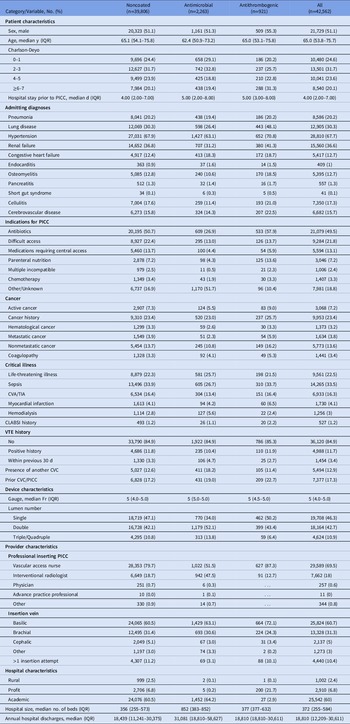
Complete data on 42,562 adult patients with PICCs were available and included in the analysis. Within this cohort, 39,806 PICCs (93.5%) inserted were uncoated polyurethane devices, 2,263 (5.3%) were antimicrobial coated, and 921 (2.2%) were antithrombogenic coated/impregnated. Most PICCs were inserted during admission to general ward settings (n = 28,111; 66.0%), with 12,078 (28.4%) in critical care and 1,407 (3.3%) in oncological settings. The median patient age was 65 years (interquartile range [IQR], 54–76), and 29,323 (51.1%) were male. Intravenous antibiotics were the primary indication for PICC placement (n = 21,079; 50%), followed by difficult access (n = 8,927; 22.4%), medications requiring central access (n = 5,460; 13.7%), and parenteral nutrition (n = 2,878; 7.2%). The median PICC gauge was 5Fr (IQR, 4–5) but 38.5% were 4 Fr and 5.6% were 6 Fr.
With respect to coated catheters, fewer antimicrobial PICCs were single lumen (n = 770; 34.0%) compared with other PICC coatings and/or impregnations (47.1% noncoated; 50.2% antithrombogenic PICCs). Antithrombogenic PICCs were only inserted by vascular access nurses and interventional radiologists, and they were largely inserted in large, academic hospitals (Table 1). The primary indication for a substantial proportion of antimicrobial PICCs was unknown or other (n = 1,170; 51.7%).
Patient, Device and Provider Characteristics for Noncoated, Antimicrobial, Antithrombogenic, and All PICCs (N=42,562)

Note. CLABSI, central-line–associated bloodstream infection; CVA/TIA: cerebrovascular accident/transient ischemic attack; CVC, central venous catheter; Fr, French; IQR, interquartile range; PICC, peripherally inserted central catheter.
Association between antimicrobial materials and CLABSI
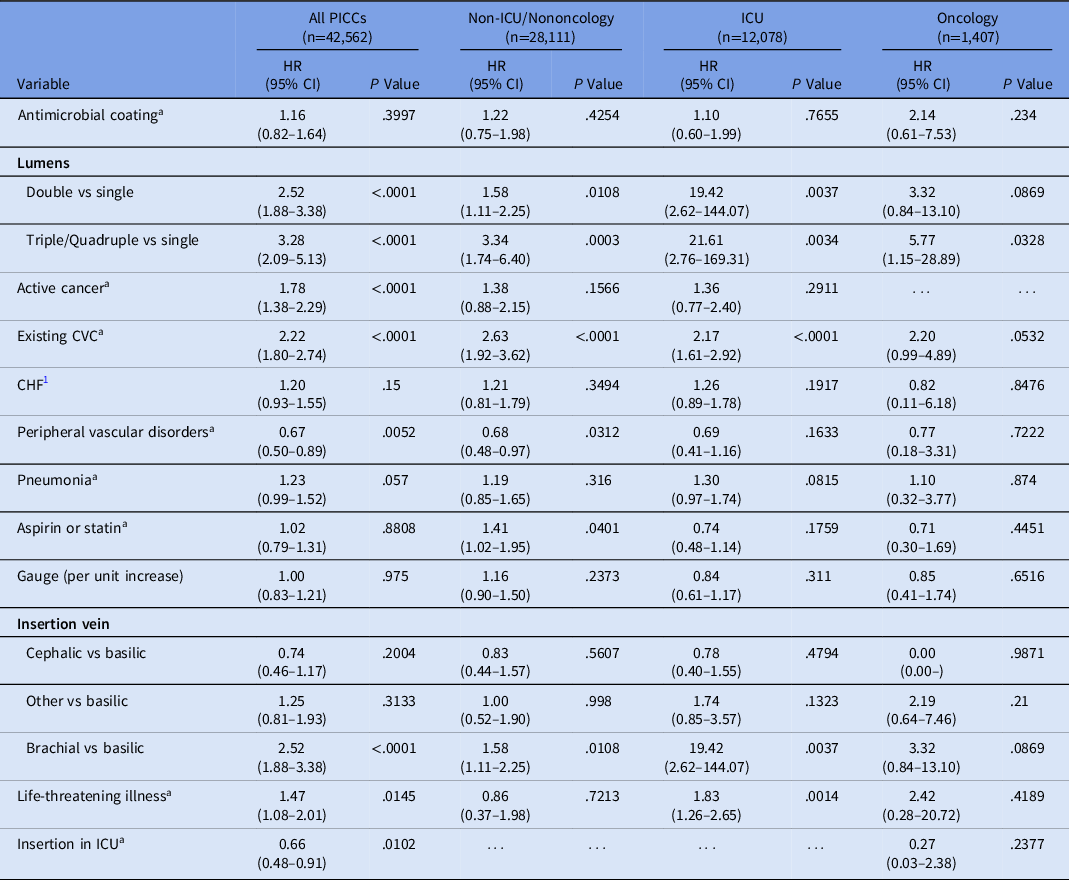
In total, 745 patients (1.8%) met criteria for CLABSI in the data set. Of the patients who developed CLABSI, 2.1% received antimicrobial PICCs (n = 48) and 707 (1.7%) received nonantimicrobial PICCs. CLABSIs occurred an average of 16.5 days after placement for nonantimicrobial PICCs and 20 days after placement for antimicrobial PICCs (P = .146). Following adjustment for patient, provider, and device characteristics, antimicrobial PICCs (n = 2,263) were not significantly associated with reduction in risk of CLABSI (HR, 1.16; 95% CI, 0.82–1.64; P = .40). Findings were similar for PICCs placed in patients that were in the ICU (HR, 1.10; 95% CI, 0.60–1.99; P = .77) and devices placed in patients with cancer (HR, 2.14; 95% CI, 0.61–7.53; P = .23) (Table 2).
Multivariate Cox Model for CLABSI

Note. CLABSI, central-line–associated bloodstream infection; CHF, congestive heart failure; CI, confidence interval; CVC, central venous catheter; HR, hazard ratio; ICU, intensive care unit; PICC, peripherally inserted central catheter.
a Yes versus no.
Association between antithrombogenic materials and VTE and occlusion
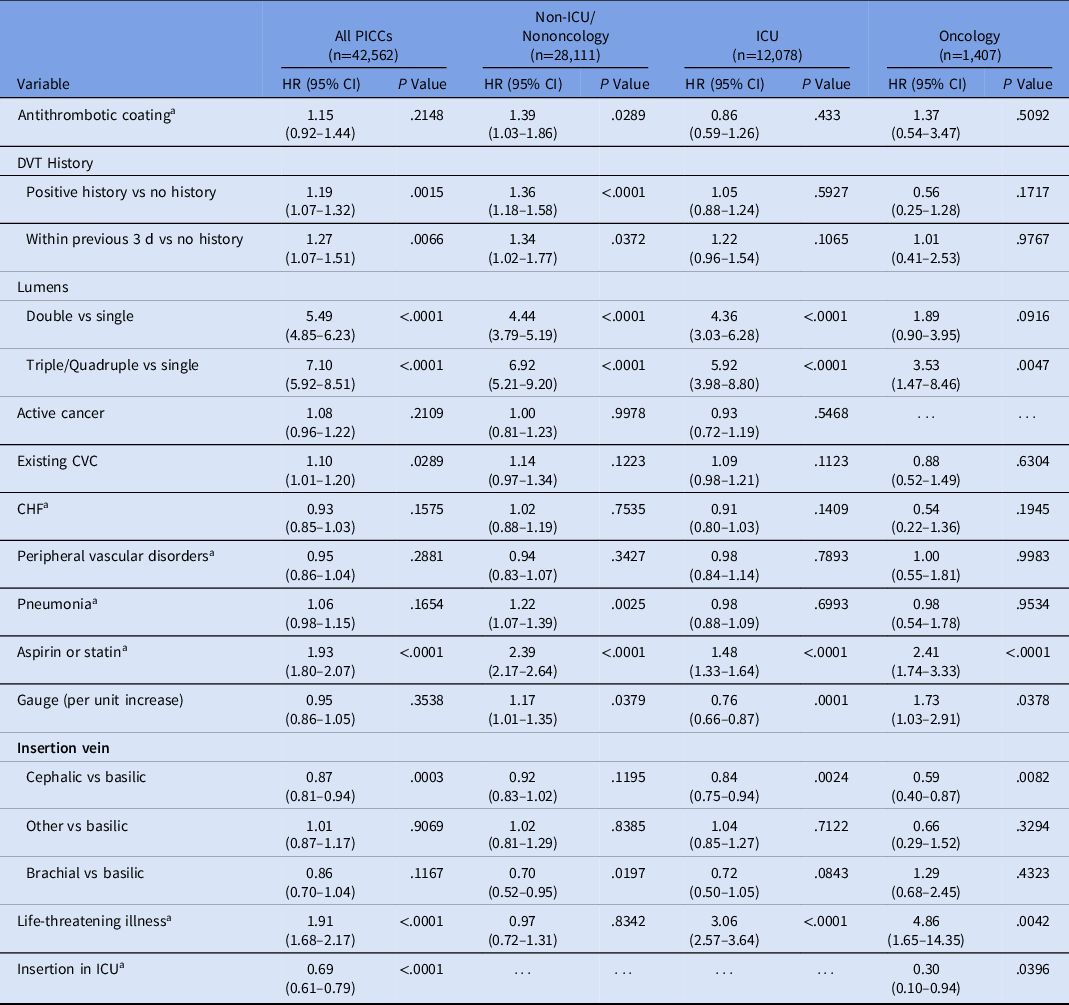
In total, 540 patients (1.3%) met criteria for VTE, and 4,090 (9.6%) developed catheter occlusion. VTE and occlusion occurred in 13.7% of antithrombogenic PICCs (n = 127) and 10.8% of nonantithrombogenic PICCs (n = 4,503). These events occurred an average of 10.8 days after placement for antithrombogenic PICCs and 11.2 days after placement for nonantithrombogenic PICCs (P = .655). After adjustment, patients with antithrombogenic PICCs (n = 921) did not experience a significantly reduced risk of VTE or occlusion (HR, 1.15; 95% CI, 0.92–1.44; P = .21). Similarly, there was no difference in risk of VTE or occlusion between antithrombogenic versus nonantithrombogenic PICCs placed in patients in the ICU (HR, 0.86; 95% CI, 0.59–1.26; P = .43) or in patients with cancer (HR, 1.37; 95% CI, 0.54–3.47; P = .51). However, antithrombogenic PICCs were associated with an increased risk of VTE or occlusion for general hospitalized patients, outside the ICU and oncology (HR, 1.39; 95% CI, 1.03–1.86; P = .03) (Table 3).
Multivariate Cox Model for VTE or Occlusion

Note. CHF, congestive heart failure; CI, confidence interval; CVC, central venous catheter; DVT, deep vein thrombosis; HR, hazard ratio; ICU, intensive care unit; PICC, peripherally inserted central catheter; VTE, venous thromboembolism.
a Yes vs no.
Variation in CLABSI, VTE, and occlusion between patient, provider, and device characteristics
Across the cohort, CLABSI risk was increased with double (HR, 2.52; 95% CI, 1.88–.38; P < .001) and triple-/quadruple-lumen PICCs (HR, 3.28; 95% CI, 2.09–5.13; P < .001) in comparison to single-lumen PICCs. Similarly, risk of CLABSI was greater among patients with active cancer (HR, 1.78; 95% CI, 1.38–2.29; P < .0001) and those with an existing CVC at the time of PICC insertion (HR, 2.22; 95% CI, 1.80–2.74; P < .0001). Within the ICU, sepsis was also associated with increased risk of CLABSI (HR, 1.83; 95% CI, 1.26–2.65; P = .001).
Comparatively, risk of VTE or occlusion was greater with double-lumen PICCs (HR, 5.49; 95% CI, 4.85–6.23; P <.0001) and triple- or quadruple-lumen PICCs (HR, 7.10; 95% CI, 5.92–8.51; P < .0001) than with single-lumen devices. Patients with a history of DVT (HR, 1.19; 95% CI, 1.07–1.51; P= .0015), presence of an existing CVC at the time of PICC insertion (HR, 1.10; 95% CI, 1.01–1.20; P= .0289), or life-threatening illness (HR, 1.91; 95% CI, 1.68–2.17; P < .001) were at a higher risk of VTE and/or occlusion. Although larger PICC gauge was not associated with risk of VTE in the ICU population (HR, 1.38; 95% CI, 0.93–2.03; P = .107), among patients with cancer, PICC gauge was associated with a significantly increased risk of VTE and occlusion (HR, 1.73; 95% CI, 1.03–2.91; P < .038).
Sensitivity analyses
Sensitivity analyses restricting models to NHSN CLABSI only and temporal trend of outcomes were performed. We detected no significant association between antimicrobial PICCs and risk of NHSN CLABSI for all patient groups when examining cases that only met this criterion (Appendix Table 1 online). Similarly, when assessing for a change over time, no significant change in effect size was observed over years for all outcomes (Appendix Tables 2 and 3 online).
Discussion
CLABSI, VTE, and catheter occlusion can cause catastrophic harm to our most vulnerable populations.Reference Ziegler, Pellegrini and Safdar26-Reference Athale, Siciliano, Cheng, Thabane and Chan29 Inventive and concerned clinicians and industry partners are motivated to identify and implement promising technologies to prevent this harm. However, within our large, observational data set, the use of novel PICC coatings, materials, and impregnation technology were not associated with reductions in these major complications. Our findings suggest that although the theoretical value of these innovations is promising,Reference Kramer, Rogers, Conte, Mann, Saint and Chopra5,Reference Ullman, Bulmer, Dargaville, Rickard and Chopra6,Reference Kleidon, Ullman and Zhang8 further research (preferably via RCTs) needs to be undertaken to establish clinical and economic effectiveness when it comes to PICCs.
Our findings were consistent across clinical subgroups, and no reduction in CLABSI, VTE, or occlusion was evident for patients in intensive care or oncological settings. Comparatively, antithrombogenic PICCs were associated with increased risk of VTE and occlusion for general medical, non-ICU, nononcological settings (HR, 1.39; 95% CI, 1.03–1.86; P = .0289). This finding, while nonintuitive, could be related to difficulty with the insertion procedure associated with these ‘newer’ technologies that often change the physical characteristics and handling of the device. A recent pilot RCT evaluated the effectiveness of a hydrophobic PICC in comparison to plain polyurethane PICCs. Reduced PICC inserter satisfaction (median: 7 of 10 [IQR, 5–9] antithrombogenic vs 10 of 10 [IQR, 7–10] uncoated polyurethane) and more ‘difficult’ insertions (20 [36%] of 56 antithrombogenic vs 13 [24%] of 55 uncoated polyurethane) were reported.Reference Gavin, Kleidon and Larsen30 Difficulty and trauma during the PICC insertion procedure has been proposed as an important risk factor for VTE.Reference Chopra, Ratz, Kuhn, Lopus, Chenoweth and Krein22,Reference Liem, Yanit and Moseley31,Reference Carr and Rippey32
Our results differ significantly from a systematic review and meta-analysis evaluating the effectiveness of coated CVCs.Reference Lai, Chaiyakunapruk, Lai, O’Riordan, Pau and Saint7 This difference may be due to the care settings for these nontunneled CVCs, which are inserted and managed in operating rooms and ICU settings for consistent indications and a short dwell time (indicated up to 14 days of therapy).Reference Chopra, Flanders and Saint16 Comparatively, aside from inherent differences in device characteristics, PICCs are inserted and managed across diverse settings (including at home), with varied indications and longer dwell times (no maximum therapy duration).Reference Chopra, Flanders and Saint16 These patient, provider, and device differences likely influence the risk of infective and thrombotic complications. However, these differences might also dilute the impact of a single technology to result in significant, clinical effectiveness to prevent multilayered complications. Importantly, coatings or impregnations are not a panacea; they offer an additional line of defense when it comes to catheter complications, but they may also offer a false sense of security. Meticulous use, care, and management of vascular catheters is critical in preventing complications.
Our findings suggest that catheter material technologies may be reaching a plateau of maturation.Reference Fenn and Raskino33 Early research in critical care highlighted the potential of catheter materials to dramatically change clinical outcomes, inflating broad expectations. The sustainability and impact of these innovations outside specific patient groups and clinical environments are potentially now in question. Moving forward, we need to appropriately target these innovations, via high-quality interventional studies.
Our study has several limitations, primarily those inherent to the observational design, which allowed us to explore associations but not causation. Indications for device use, selection of devices, and care characteristics vary across hospitals, and we were constrained to data documented in the medical record. Our findings are likely to be highly generalizable but perhaps not specific to a particular institution. Second, the interventions under examination are new, so they are not consistently represented in the data set, especially outside academic centers, which affects statistical power and generalizability. Yet, our study also has significant strengths, including the large sample size, broad range of patients, and rigorous outcome assessment. To our knowledge, this remains the largest study on this topic conducted to date. Overall, we have highlighted an area of clinical practice being changed without sufficient evidence but with increases in costs.
Our findings have important policy and clinical implications. Most international clinical practice guidelines have reserved the implementation of the impregnated CVCs after ensuring high-quality baseline practices (eg, education, maximal sterile barrier precautions, chlorhexidine-based skin decontamination).Reference O’Grady, Alexander and Burns34,Reference Loveday, Wilson and Pratt35 Our results support these recommendations being extended to impregnated PICCs. These more expensive and unproven technologies should remain in reserve unless all other practices are optimized and further research is available to establish their effectiveness.
In conclusion, infections and thrombosis associated with PICCs are unlikely to be ‘fixed’ by a single practice or technology, such as implementing new PICC coatings and impregnation technologies. The available research suggests that these adverse events are complex in their origin, requiring multifaceted approaches. However, these new technologies may still be a piece of the CLABSI, VTE, and occlusion prevention puzzle. Further interventional research is required to evaluate their clinical and economic effectiveness. Until then, impregnated and coated PICCs should not be implemented as routine practice to prevent significant complications.
Acknowledgments
We thank the University of Michigan and Griffith University for their financial and in-kind support of this project.
Financial support
Dr. Chopra is supported by grants from the Agency for Healthcare Research and Quality (1-R18-HS-025891).
Conflicts of interest
A.U. reports research grants and speaker’s fees from 3M Medical, BD-Bard, and Cardinal Health. J.S. reports research and educational grants from BD-Bard. T.K. reports research grants and speaker’s fees from 3M Medical, Access Scientific, BD-Bard, Cardinal Health, and Medical Specialties Australia. D.A. reports speaker’s fees from 3M Medical. C.P. has received research and educational grants from BD-Bard and Cardinal Health and consultancy payments form 3M and BD-Bard. V.C. has received grant support from the Agency of Healthcare Research and Quality and the American Hospital Association, as well as royalties from Wolters Kluwer Health and Oxford University Press for authored books. M.O. received grants from Blue Cross and Blue Shield of Michigan and Blue Care Network as part of the BCBSM Value Partnerships. The remaining authors report no conflicts of interest.
Supplementary material
To view supplementary material for this article, please visit https://doi.org/10.1017/ice.2021.141