Introduction
Understanding the dynamics of prey and predator interactions is crucial to the study of ecology, as these relationships fundamentally shape ecosystem structure and function (Sih, Reference Sih, Kerfoot and Sih1987, Reference Sih, Barbosa and Castellanos2005). Within these interactions, density responsiveness, measured in terms of functional response, of predators is pivotal to provide insights into the mechanisms underlying population regulation, ecosystem stability, and efficacy of biological control strategies (Holling, Reference Holling1959a; Jeschke et al., Reference Jeschke, Kopp and Tollrian2002; Murdoch and Oaten, Reference Murdoch and Oaten1975; Novak, Reference Novak2010; Solomon, Reference Solomon1949). As such, functional response research remains a cornerstone of ecological theory and practice (Abrams and Ginzburg, Reference Abrams and Ginzburg2000; Novak, Reference Novak2010; Schmitz, Reference Schmitz2008). Functional responses are typically categorised into three types: Type I, II, and III (Abrams and Ginzburg, Reference Abrams and Ginzburg2000; Hassell, Reference Hassell1978, Reference Hassell2000; Holling, Reference Holling1959b). Each type represents a different pattern of predator behaviour in response to varying prey densities, reflecting how predators allocate time to search, capture and consume prey (Abrams and Ginzburg, Reference Abrams and Ginzburg2000; Ovadia and Schmitz, Reference Ovadia and Schmitz2002; Real, Reference Real1977; Skalski and Gilliam, Reference Skalski and Gilliam2001). These behaviours are influenced by numerous ecological variables, including prey availability, predator foraging efficiency, and environmental conditions (Begon and Townsend, Reference Begon and Townsend2021; Jeschke et al., Reference Jeschke, Kopp and Tollrian2004; Toscano and Griffen, Reference Toscano and Griffen2014).
The study of functional responses is important in predicting the outcomes of predator–prey interactions. A Type II functional response, which is represented by a decelerating prey consumption rate as prey density increases, highlights the limitations imposed by handling time (Bolker, Reference Bolker2008; Holling, Reference Holling1959b). This model is relevant in biological control, where the effectiveness of natural predators in suppressing pest populations depends on their ability to maintain high consumption rates despite fluctuations in prey density (Murdoch, Reference Murdoch1969; Omkar, Reference Omkar2005; Sentis et al., Reference Sentis, Hemptinne and Brodeur2017).
The aphid, Myzus persicae (Sulzer) (Hemiptera: Aphididae) also known as green peach aphid is a prominent agricultural pest with significant economic and ecological implications. Its wide host range and capacity to transmit plant viruses make it a major threat to crop production worldwide (Ali, Reference Ali2023). This pest is capable of causing up to 80% losses in crops (Ali, Reference Ali2023; Blackman and Eastop, Reference Blackman and Eastop2000; Van Emden and Harrington, Reference Van Emden and Harrington2017). In addition, M. persicae has evolved resistance to multiple classes of pesticides, including neonicotinoids, organophosphates, and pyrethroids (Bass et al., Reference Bass, Puinean, Andrews, Cutler, Daniels, Elias, Paul, Crossthwaite, Denholm, Field and Foster2011; Singh et al., Reference Singh, Cordeiro, Troczka, Pym, Mackisack, Mathers, Duarte, Legeai, Robin, Bielza and Burrack2021) making this pest extremely difficult to control with chemicals and necessitates the development of sustainable eco-friendly biological control-based IPM strategies (Ali et al., Reference Ali, Bayram, Mukarram, Zhou, Karim, Hafez, Mahamood, Yusuf, King, Adil and Ma2023).
Among biological control agents, coccinellids are significant natural enemies of M. persicae (Jalali et al., Reference Jalali, Tirry and De Clercq2010). Among different coccinellids, species viz. Scymnus posticalis Sicard (Coleoptera: Coccinellidae), Platynaspis saundersi Crotch (Coleoptera: Coccinellidae), and Pharoscymnus horni Weise (Coleoptera: Coccinellidae) have been found associated with various aphids in various crops of different agroclimatic zones of Himachal Pradesh, India (Poorani, Reference Poorani2002; Sharma et al., Reference Sharma, Chauhan and Sharma2015, Reference Sharma, Verma, Chandel, Chandel and Thakur2017a). However, very meagre literature is available on predatory behaviour like functional response, of these coccinellids and the information on their density responsiveness to M. persicae is lacking. Therefore, in light of the economic importance of M. persicae as a key pest of various agricultural and horticultural crops, the present study was conducted to assess the functional response of selected coccinellid predators against this aphid.
Materials and methods
The current study was conducted at temperature of 25 ± 1°C, relative humidity of 70 ± 5% and photoperiod of 14 L:10D in the Biological Control laboratory of Department of Entomology, Dr. Yashwant Singh Parmar University of Horticulture and Forestry, Nauni (Solan), HP (India).
Rearing of aphid
Myzus persicae was obtained from the experimental farm (30°51ʹ36″N, 77°09ʹ57″E) of Department of Entomology and maintained by rearing in the laboratory on bell pepper (Capsicum annuum L.) cv. Solan Bharpur plants raised in pots (Sharma et al., Reference Sharma, Verma, Sharma and Chandel2022). For using M. persicae in the current study, they were reared for two generations in these plants and then used in the experiments.
Rearing of coccinellids
The predatory coccinellids viz. S. posticalis, P. saundersi, and P. horni adults were obtained from the field (30°51ʹ36″N, 77°09ʹ57″E) and taken to the laboratory and were fed with M. persicae separately. Coccinellids were kept in pairs in separate Petri plates for egg laying. After emergence, the larvae were provided with M. persicae for feeding in Petri plates till it reaches pupal stage and adults were obtained (Chauhan et al., Reference Chauhan, Singh, Verma, Sharma, Chandel, Chandel, Sharma, Semwal and Kalia2024). Adults thus obtained were fed with M. persicae and starvation of 2 days old adults for 24 h was done before using in the present experiments.
Functional response
Different densities of 10 to 13 days old M. persicae viz. 10, 20, 30, 40, 50, and 60 were provided to adults of S. posticalis, P. saundersi, and P. horni in Petri plates of 10 × 1.5 cm (diameter × height) separately. In each Petri plate, a single adult coccinellid predator was provided with a particular prey density over bell pepper leaves. Every density of prey was replicated 10 times, and further data on prey consumption was noted down after 24 h. Further this data was used to estimate type of functional response and other parameters like number of prey eaten (N a), proportion of prey eaten (N a/N), attack rate (a), handling time (T h), attack rate per handling time (a/T h), and theoretical predation efficiency (K) (Chauhan et al., Reference Chauhan, Singh, Verma, Sharma, Chandel, Chandel, Sharma, Semwal and Kalia2024).
Data analysis
For determining the type of functional response, a logistic regression analysis among the proportion of prey eaten and the density of prey given was used. For this, following equation was used:
 \begin{equation*}\frac{{{N_a}}}{{{N_0}}} = \frac{{\exp { }\left( {{p_0} + {p_1}{N_0} + {p_2}N_0^2 + {p_3}N_0^3} \right)}}{{1 + \exp { }\left( {{p_0} + {p_1}{N_0} + {p_2}N_0^2 + {p_3}N_0^3} \right)}}\end{equation*}
where N 0 is the prey density, N a is the number of prey eaten, p 0 is a constant, p 1 is the linear, p 2 is the quadratic, and p 3 is the cubic coefficient. If the value of linear coefficient is smaller than zero (p 1 < 0) that means functional response curve of type II and if value of linear coefficient is larger than zero (p 1 > 0) and quadratic coefficient is smaller than zero (p 2 < 0) shows a type III functional response (Juliano, 2001). Upon determination the type of functional response (which was a type II in each case) the various parameters of functional response like a, T h, a/T h, and K were calculated using Roger’s random predator equation for a type II response (Rogers, Reference Rogers1972).
 \begin{equation*}{N_a} = N\{ 1 - {\text{exp }}[a({T_h}{N_a} - T)]\} \ \ \ \ \ \ \ \ \ \ \ \ \ \qquad \qquad{}\ \ \ \ \ \,\,\,\,\,\,\,\,\,\,\,\,\,\left( {{\text{for type II}}} \right)\end{equation*}
where N a is the number of prey eaten, a is the attack rate, N is the prey density, T is the total duration of the experiment (24 h), and Th is the handling time, i.e. time taken by predator to handle and killing the prey. The statistical calculation of functional response study was done by using softwares viz. Microsoft Office Excel 2007 and IBM SPSS Statistics 20 (IBM Corp. Released, 2020).
Results
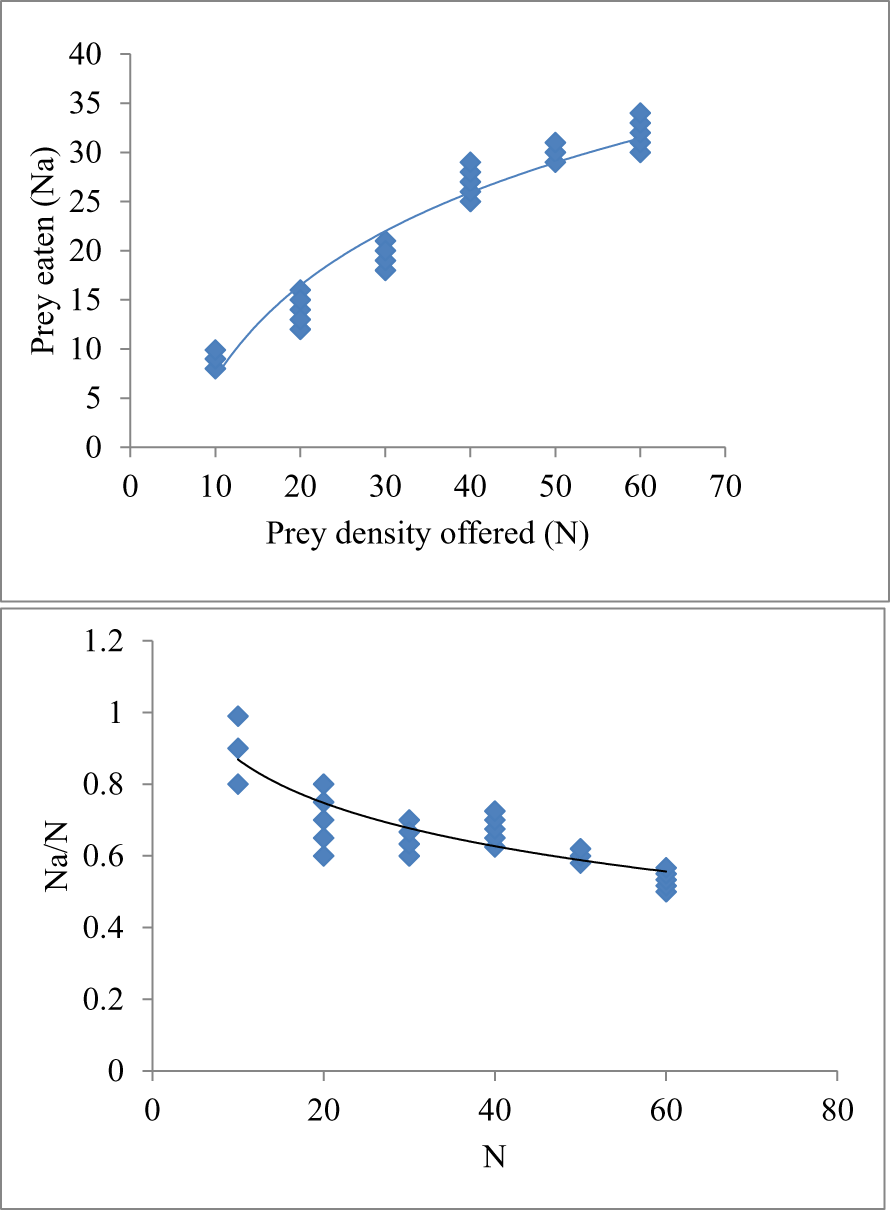
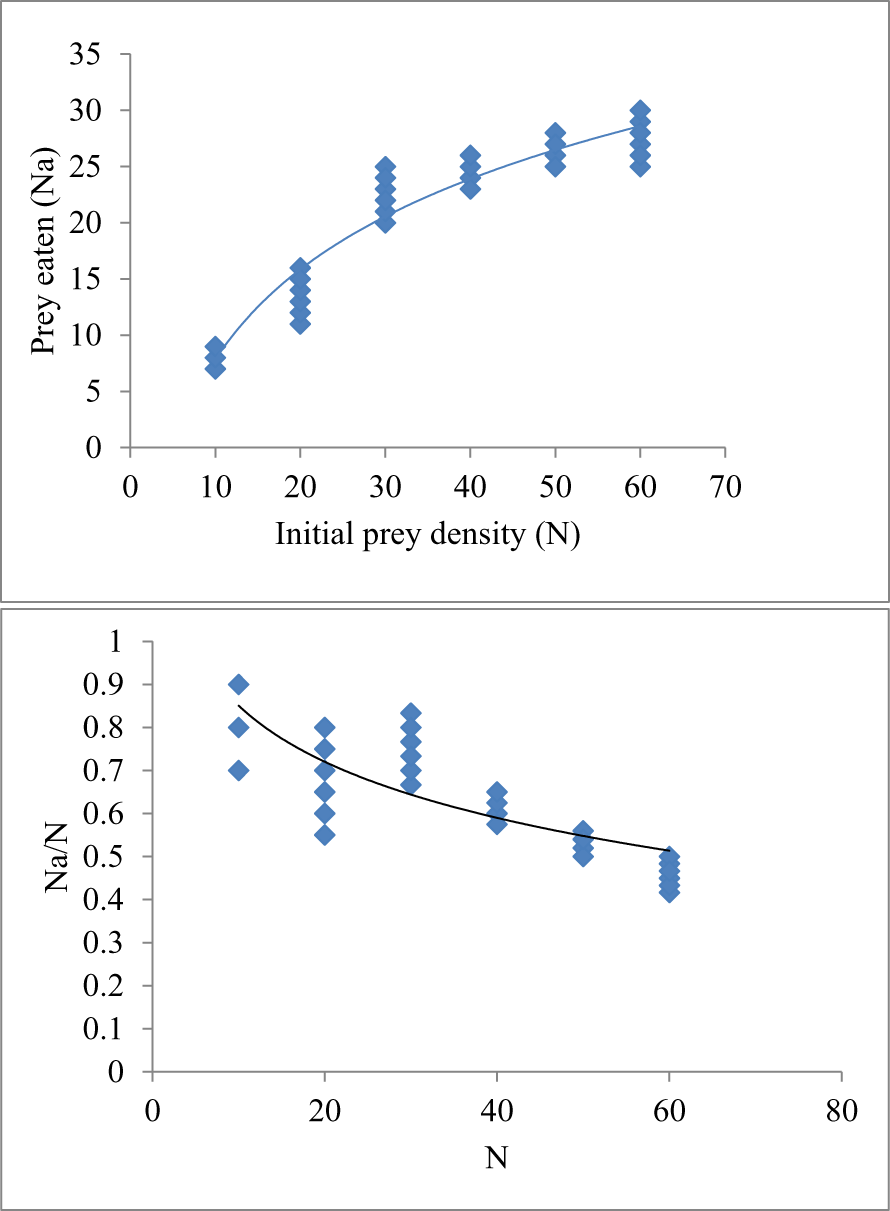
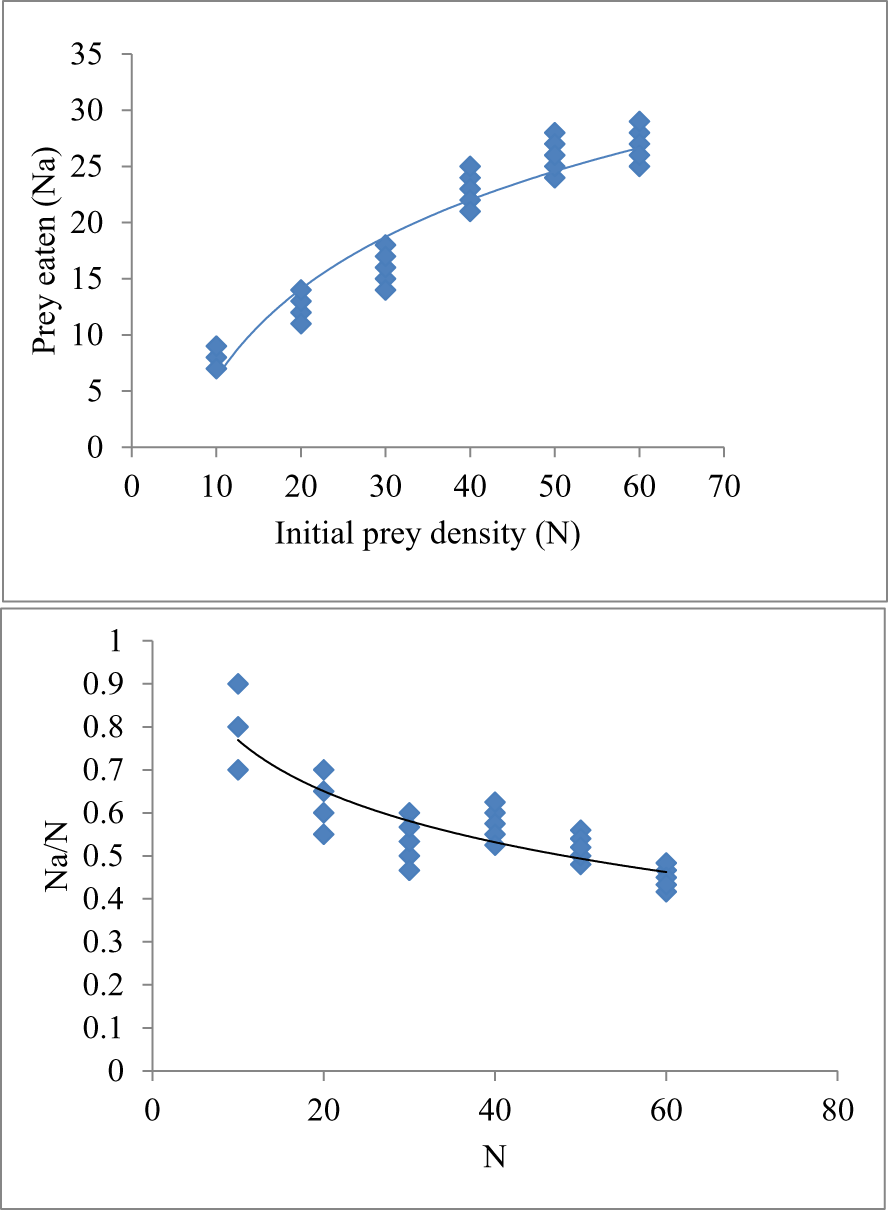
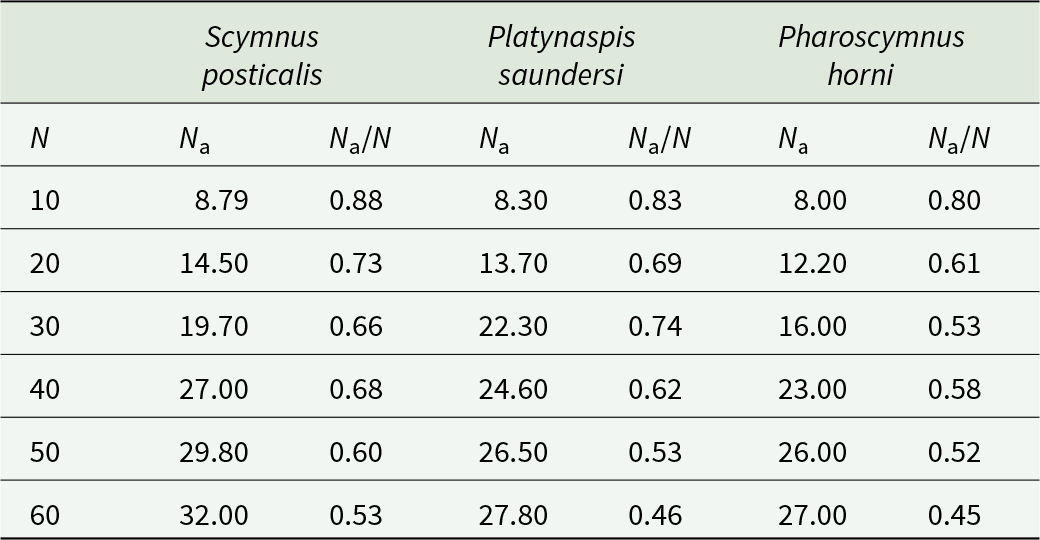
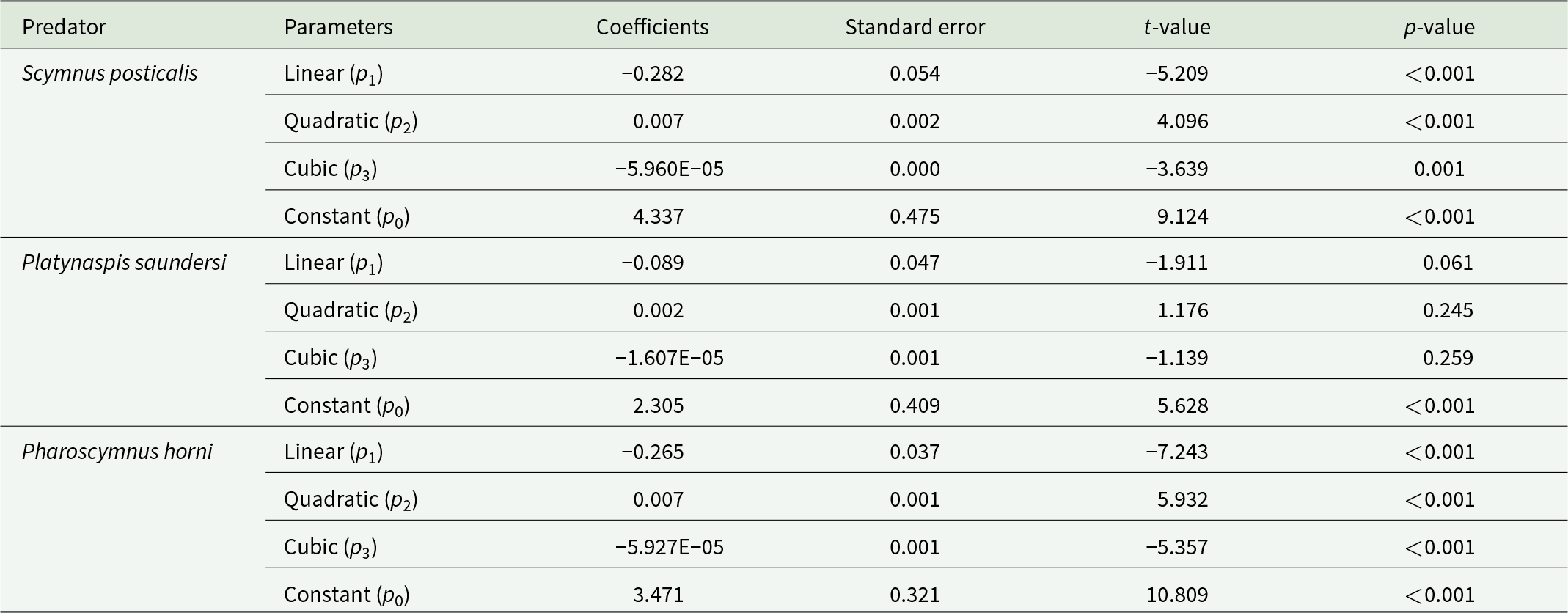
When each predator was offered with M. persicae at different densities of 10, 20, 30, 40, 50, and 60 aphids, S. posticalis consumed 8.79, 14.50, 19.70, 27.00, 29.80, and 32.00 aphids (F = 587.38; df = 5, 54; P < 0.001), P. saundersi consumed 8.30, 13.70, 22.30, 24.60, 26.50, and 27.80 aphids (F = 302.17; df = 5, 54; P < 0.001) and P. horni consumed 8.00, 12.20, 16.00, 23.00, 26.00, and 27.00 aphids (F = 330.39; df = 5, 54; P < 0.001), respectively (Figs. 1–3; Table 1). In each case the prey consumption increased and the proportion of prey consumption decreased with prey density. The proportion of prey consumed at respective prey densities was 0.88, 0.73, 0.66, 0.68, 0.60, and 0.53 for S. posticalis; 0.83, 0.69, 0.74, 0.62, 0.53, and 0.46 for P. saundersi; 0.80, 0.61, 0.53, 0.58, 0.52, and 0.45 for P. horni (Table 1; Figs. 1–3). A logistic regression analysis between initial density of prey and the number of prey consumed was done to obtain p 0 (constant), p 1 (linear), p 2 (quadratic), and p 3 (cubic) coefficients. The value of p 0, p 1, p 2, and p 3 were 4.337, −0.282, 0.007, and −5.960E-05 for S. posticalis, 2.305, −0.089, 0.002, and −1.607E-05 for P. saundersi and 3.471, −0.265, 0.007, and −5.927E-05 for P. horni, respectively (Table 2). This analysis of logistic regression revealed negative linear coefficient for all three coccinellids which confirmed a type II functional response of each predator species to the prey aphid. After determining the type of functional response, parameters like attack rate (searching efficiency against prey), handling time (time needed for attacking, consumption and digestion of prey), maximum theoretical predation efficiency and attack rate per handling time were worked out and presented in Table 3. The highest attack rate of 0.0994 h−1 was found in case of S. posticalis followed by P. saundersi (0.0876 h−1) and P. horni (0.0695 h−1) against M. persicae. The handling time was lowest in case of S. posticalis (0.5016 h) followed by P. saundersi (0.5193 h) and highest in case of P. horni (0.5316 h) against M. persicae. With these parameters, S. posticalis, P. saundersi, and P. horni would predate a maximum of 48.76, 48.27, and 47.97 prey aphids (M. persicae) over a period of 24 h.
Functional response and proportion of prey consumption of Scymnus posticalis to different densities of Myzus persicae.

Functional response and proportion of prey consumption of Platynaspis saundersi to different densities of mMzus persicae.

Functional response and proportion of prey consumption of Pharoscymnus horni to different densities of Myzus persicae.

Functional response of Scymnus posticalis, Platynaspis saundersi, and Pharoscymnus horni against Myzus persicae

N = initial prey density; N a = prey eaten.
Discussion
In the current study, all the three predators namely S. posticalis, P. saundersi, and P. horni exhibited a functional response of type II to M. persicae. The type II functional response appears to be quite frequent in coccinellids and has been reported in various predator and prey interactions viz. Harmonia dimidiata to Aphis gossypii (Sharma et al., Reference Sharma, Verma, Chandel, Shah and Gavkare2017b), Coccinella septempunctata to Aphis gossypii (Kumari et al., Reference Kumari, Verma and Sharma2020), Oenopia kirbyi to Aphis gossypii (Kumari et al., Reference Kumari, Verma, Sharma and Banshtu2021a), Oenopia kirbyi to Macrosiphum rosae (Gaikwad et al., Reference Gaikwad, Verma, Sharma, Chandel, Challa, Yankit and Kedar2022), and Oenopia sauzeti to Brachycaudus helichrysi (Chauhan et al., Reference Chauhan, Singh, Verma, Sharma, Chandel, Chandel, Sharma, Semwal and Kalia2024). Our results are in confirmation with the findings of Seko and Miura (Reference Seko and Miura2008); Cabral et al. (Reference Cabral, Soares and Garcia2009); Jalali et al. (Reference Jalali, Tirry and De Clercq2010); Liu and Zeng (Reference Liu and Zeng2014); Khan et al. (Reference Khan, Liang, Maria and Liu2016); Jalali and Ziaaddini (Reference Jalali and Ziaaddini2017); Yu et al. (Reference Yu, Tang, Xia, Wang, Feng and Liu2020); and Abraços-Duarte et al. (Reference Abraços-Duarte, Ramos, Valente, Borges da Silva and Figueiredo2021) recorded a functional response of type II in predators like Harmonia axyridis; Coccinella undecimpunctata; Adalia bipunctata; Geocoris pallidipennis; Aphidius gifuensis; A. bipunctata; H. axyridis and A. gifuensis; Dicyphus cerastii against M. persicae, respectively. Similarly several studies with different predator and prey have shown a type II functional response, e.g. Menochilus sexmaculatus against Aphis nerii, Diuraphis noxia, and Lipaphis erysimi (Hameed et al., Reference Hameed, Hamid, Ahmad, Sarmad, Zaka, Saeed, Khan, Abbas, Shahzaib and Zakria2021); C. undecimpunctata against Brevicoryne brassicae (Ramzan and Khursheed, Reference Ramzan and Khursheed2023); Oenopia sauzeti against Brachycaudus helichrysi (Chauhan et al., Reference Chauhan, Singh, Verma, Sharma, Chandel, Chandel, Sharma, Semwal and Kalia2024); Oenopia conglobata and Menochilus sexmaculatus against A. gossypii and Agonoscena pistaciae (Ranjbar et al., Reference Ranjbar, Jalali, Ahmadi, Pons, Levi-Mourao and Ugine2024). Present findings are supported by studies of Işikber (Reference Işikber2005), Sabaghi et al. (Reference Sabaghi, Hosseini and Sahragard2011), and Kumari et al. (Reference Kumari, Suroshe, Kumar, Budhlakoti and Yana2021b) who observed a type II functional response of Scymnus levaillanti against A. gossypii; Scymnus syriacus against Aphis fabae; Scymnus coccivora against Phenacoccus solenopsis, respectively. In a type II functional response, the prey consumption increases but the proportion of prey consumed decreases with increase in density of the prey which indicates that the consumption of prey increases but at a decelerating rate with density of prey and eventually reaches the upper asymptote as the predator becomes satiated.
Coefficients of logistic regression between proportion of prey eaten and initial prey density

Functional response parameters of Scymnus posticalis, Platynaspis saundersi, and Pharoscymnus horni against Myzus persicae

Mean values in a column superscripted with same letter do not differ significantly at p = 0.05.
In contrast, type III functional response was observed very rarely in coccinellids like Eriopis connexa to M. euphorbiae (Sarmento et al., Reference Sarmento, Pallini, Venzon, Offd, Molina-Rugama and Oliveira2007) and Nephus includens to A. gossypii (Bayoumy, Reference Bayoumy2011).
Generally, a predator showing a functional response of type III acts positively in a density-dependent manner and is believed to be more efficient in regulating the pest populations as compared to the predators having a type II functional response which acts negatively in a density-dependent manner (Fernández-Arhex and Corley, Reference Fernández-Arhex and Corley2003; Omkar, Reference Omkar2005). A biocontrol agent exhibiting a type II functional response might not be appropriately suitable for the classical biological control programmes; however, it might be better for conservation/augmentative biological control programmes (Schenk and Bacher, Reference Schenk and Bacher2002). Predators with type III functional response show lower prey consumption at low pest densities; however, it increases rapidly as the pest density increases; probably due to the fact that the predators with a type III response require a learning experience initially. On the other hand, predators with a functional response of type II do not need a learning experience and proves more efficient when pest populations are low (Murdoch, Reference Murdoch1969). Considering this hypothesis, it can be inferred that all the three coccinellids under study would be more effective if they colonise the crop early in the season or when the aphid populations are lesser. Furthermore, it is only theoretically that the predators with a type II functional response are considered less efficient to regulate the pest populations, a large number of biocontrol agents with a type II of functional response have been found effective leaving this concept questionable (Fernández-Arhex and Corley, Reference Fernández-Arhex and Corley2003; Hassell et al., Reference Hassell, Lawton and Beddington1977; Oaten and Murdoch, Reference Oaten and Murdoch1975). Based on such inconsistencies, functional response type may not be an appropriate yardstick to evaluate the efficacy of a predator; however, the functional response parameters like handling time, attack rate and theoretical maximum predation rate could be better indicators of predators’ success. For instance, a predator with lower handling time and higher attack rate would predate a higher number of preys in a given period of time (Jeschke et al., Reference Jeschke, Kopp and Tollrian2002). Under these circumstances, the results of such studies could, therefore, be valuable and, in addition, some other biological parameters of the predators may also be studied to achieve an enhanced conclusion regarding the effective performance of the predator (Chauhan et al., Reference Chauhan, Singh, Verma, Sharma, Chandel, Chandel, Sharma, Semwal and Kalia2024; Sharma et al., Reference Sharma, Verma, Chandel, Shah and Gavkare2017b)
In our study, the maximum attack rate (0.0994 h−1); minimum handling time (0.5016 h); highest attack rate per handling time (0.1963); and highest theoretical maximum predation rate (48.76) were in case of S. posticalis and lowest attack rate (0.0695 h−1); highest handling time (0.5316 h); lowest attack rate per handling time (0.1308); and lowest theoretical maximum predation rate (47.97) were in case of P. horni. Superiority of S. posticalis could be attributed to its more efficient foraging behaviour and faster prey processing capabilities compared to the other two species.
Present studies are in corroboration with findings of Chauhan (Reference Chauhan2024) who studied functional response of S. posticalis against different densities of Aphis pomi on different cultivars of apple and recorded the attack rate of adults ranged from 0.126 to 0.065 h−1; handling time ranged from 0.554 to 0.623 h; attack rate per handling time ranged from 0.226 to 0.104; and theoretical maximum predation rate was from 39.025 to 43.413. However, some differences in these values may be due to different species of prey used in the study.
Similarly, Sabaghi et al. (Reference Sabaghi, Hosseini and Sahragard2011) found attack rate ranging 0.478–0.479 h−1, handling time ranging 0.3064–0.3848 h and maximum rate predation of 62.50–to 78.32 for S. syriacus against A. fabae and these differences in the values may be attributed to the different species of predator and prey used in the study.
Kumari et al. (Reference Kumari, Suroshe, Kumar, Budhlakoti and Yana2021b) found attack rate, handling time, and maximum rate of predation ranging from 0.94 to 1.05 h−1, 0.01 to 0.02 h and 66.84 to 90.68 of S. coccivora against P. solenopsis, respectively. These differences may be due to different predator as well as prey species used in these experiments as functional response can be influenced by climate, habitat, and interactions with other species (Mocq et al., Reference Mocq, Soukup, Näslund and Boukal2021).
Seko and Miura (Reference Seko and Miura2008) found attack rate ranging from 0.0623 to 2.5498 h−1 and handling time ranging from 1.00 to 0.0065 h of H. axyridis against M. persicae. Cabral et al. (Reference Cabral, Soares and Garcia2009) reported attack rate of 0.793–0.923 h−1 and handling time ranging 0.013–0.018 h of C. undecimpunctata against M. persicae. This difference in handling time and attack rate of these studies with current study may be due to larger size and more food requirement of H. axyridis and C. undecimpunctata which lead to lower handling time and higher attack rate in comparison to current study.
Studies of functional response are generally conducted in the laboratory conditions using small arena which do not mimic the exact field conditions. Various other factors such as age/stage of both the prey and predator, rearing conditions, crop architecture, etc. can also affect the functional response of a predator towards its prey (Parvez and Mocq et al., Reference Mocq, Soukup, Näslund and Boukal2021; Omkar, Reference Omkar2005). Nevertheless, it is difficult to figure out the efficiency of the predator through its functional response only, some preliminary idea regarding the predator’s abilities to control the target pest can be drawn by determining the functional response parameters. Parameters of functional response estimated in the present investigations indicate the abilities of all the coccinellids under study to attack sufficient number of the prey aphid. Therefore, early colonisation of the crop by these predators followed by a steady rise in population would be effective in lowering the pest population. However, before reaching any final conclusion it is important to study other parameters related to biotic potential and pest kill potential.
This study demonstrates that the coccinellid predators S. posticalis, P. saundersi, and P. horni exhibit a Type II functional response and indicating to be promising biocontrol agents with sufficiently enough high functional response parameters. However, the influence of biotic and abiotic factors in field conditions necessitates further research to fully understand and optimise the use of these predators in integrated pest management strategies.
Acknowledgements
Authors are thankful to the Dr. Yashwant Singh Parmar University of Horticulture and Forestry, Nauni (Solan), HP – 173230 (India) for providing necessary facilities to conduct this research.
Financial support
No funding was received.
Competing interests
Authors declare no conflicts of interest/competing interests