What makes a story timeless? What ensures that a tale is told and retold over centuries, or even millennia? What can an ancient story mean for us, in a world of globalised post-modernity?
The British Museum's new exhibition, ‘Troy: Myth and Reality’, sets out to answer these questions, bringing together a diverse collection of artefacts and artworks relating to the story of the Trojan War. There is a little something here for everyone, from sound effects and storytelling to rare manuscripts and archaeological finds never before exhibited in the UK.
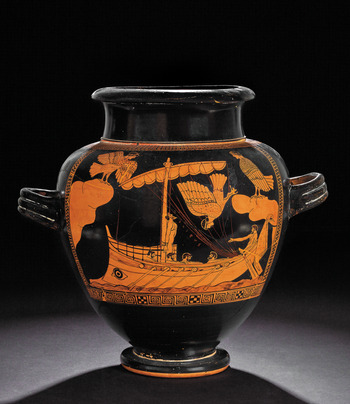
The exhibition is loosely organised into three parts. The first presents the myth of the Trojan War, introducing some of its cast of many characters, and recounting the key elements of each of their stories. Many objects from the British Museum's own permanent collection are used to good effect here—in particular, several red-and-black-figure vases featuring scenes from the Troy story. Examples include the famous amphora attributed to Exekias depicting Achilles killing the Amazonian queen Penthesilea, and the celebrated ‘Siren Vase’ showing Odysseus tied to the mast of his ship (Figure 1). Although readers of Antiquity may have seen some of these vases before, there is certainly a thrill in seeing familiar scenes in a new context, heightened by the dramatic lighting of the display.
Odysseus and the Sirens, Athenian jar, c. 480–470 BC, ceramic (© The Trustees of the British Museum).

What is new, in contrast, is a group of Pompeiian wall paintings on loan from the Archaeological Museum in Naples. These exquisitely detailed scenes serve as wonderful illustrations for the unfolding story, although the subtleties of the Roman, as opposed to the Greek, retelling of the myths are sometimes lost along the way. Another exciting loan item is the famous ‘Cup of Nestor’—an inscribed drinking cup found on the island of Pithekoussai in the Bay of Naples, which demonstrates that the Homeric epics had travelled as far as the Central Mediterranean within a generation of being composed.
The second part of the exhibition focuses on the archaeology of Troy itself, introducing the viewer to the material culture of Anatolia and the Mycenaean Aegean, and presenting the complex excavation history of the site. The highlights of this section are undoubtedly the finds from Troy itself—prime amongst which are several objects from the famous ‘Treasure of Priam’. This collection of precious metal objects was unveiled by Troy's most famous excavator, Heinrich Schliemann, in 1873 and touted as evidence for the fabulous wealth of Homeric Troy. Although we now know that the artefacts are actually much earlier in date than the Homeric period (they belong to the Early Bronze Age, rather than the Late Bronze or Early Iron Ages), their dramatic history continues to fascinate. Smuggled out of the (then) Ottoman Empire by Schliemann, the treasure was displayed in Berlin, from where much of it went missing following the Second World War. It has since surfaced in Moscow, where it is displayed at the Pushkin Museum. The items displayed here in the British Museum's exhibition are, alas, some of the more modest artefacts from Schliemann's assemblage that were left behind in Berlin. They include bronze and silver vessels, as well as bronze pins, but not the golden crowns or delicate jewellery that made the treasure so famous.
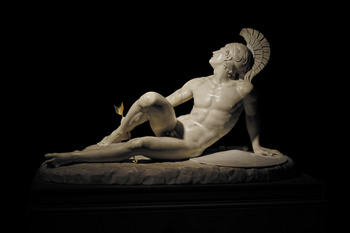
The final section of the exhibition takes up the history of the story of Troy—tracing how the myth has been retold and reinterpreted over the centuries, with a focus on visual art. The striking image of the Albaccini sculpture of the ‘Wounded Achilles’ (Figure 2) that dominates the promotional material sits comfortably alongside the Afro-Caribbean Odyssey painted by Romare Bearden. From Hans Elworth's painting of Elizabeth I as Paris in the judgement of three immortal goddesses, to Spencer Finch's rendering of the ‘Shield of Achilles’ using fluorescent tube lights, the artworks displayed serve to question the viewer's expectations and broaden understandings of the Trojan War myth.
Filippo Albacini (1777–1858), The Wounded Achilles, 1825, marble, Chatsworth House (photograph © The Devonshire Collections, Chatsworth; reproduced by permission of Chatsworth Settlement Trustees.)

The diversity found in this exhibition, featuring items spanning four millennia and three continents, will ensure its broad appeal. Yet this diversity is marshalled by clear and informative text on labels and panels, and by the clear structure and format of the exhibition (I am particularly keen on this structure, having used it in my recent book on Troy). Not only is there something for everyone, there is something new for everyone—even the most avid of art critics and the most meticulous students of myth.