


Introduction
The computational analysis of corpora, a body of ‘naturally occurring language texts chosen to characterize a state of variety of a language’ (Sinclair, Reference Sinclair1991: 171) provided the opportunity to reveal otherwise unobservable features and patterns across varieties, registers and languages. One such language feature is a ‘lexical bundle’ otherwise known as an n-gram. Vague terms in any language variety can often present themselves in the form of not just individual words (e.g. things, plenty, scores, stuff) but as a group of words that tend to co-occur: a lexical bundle (e.g. loads of, stuff like that, and so on, or what have you). In this paper, the function in Hong Kong English (HKE) of the vague n-gram ‘something like that’ will be explored via corpus methodology to account for its observed hyper-usage in Hong Kong society.
The context: Hong Kong and English
Like English in India, Singapore, Bangladesh, West Indies, Canada, Australia, New Zealand and America, HKE exists as an outworking of former British colonial rule (Douglas, Reference Douglas, Kachru, Kachru and Nelson2006: 45). While trade activity beginning in the 17th century between Hong Kong and the British East India Company had created an English-Cantonese pidgin (Leung, Reference Leung2015; Schneider, Reference Schneider2003), it was the 150-year British colonial rule from 1841 to 1997 that made English the only official language in Hong Kong (until Chinese was also made official in 1974). English was the operating language in the topmost levels of business, law and government (Lee & Collins, Reference Lee and Collins2006: 25), even after the 1997 handover. Lee and Collins further reveal that while the current language policy in Hong Kong promotes writing proficiency in both English and Chinese and aural competence in English, Cantonese and Putonghua, there is great debate surrounding Hong Kong's language situation and the status of English. Since it is clear that local Chinese did not use English for ‘intra-ethnic communication’ prior to the handover – and this is also recognised to be the case post-handover (Evans, Reference Evans2016; Lee & Collins, Reference Lee and Collins2006; Ting & Wong, Reference Ting and Wong2019) - there is debate as to the existence of an actual HKE and its state of maturation.
Kachru (Reference Kachru, Quirk and Widdowson1985) classed HKE in his Outer Circle of English. In this bracket of World English classification, territories have emerged from a colonial experience and their English is a prestige marker or the superordinate lexifier of a developed creole seen in many cases as a native language. Li (Reference Li2009), however, argues that Hong Kong – like Japan, Sweden and Korea – belongs in the more outward Expanding Circle, where English is a lingua franca and is a popular foreign language subject. He and other scholars count the evidence: English is not used in regular daily interaction within the native Chinese population, native speaker English norms are deemed better than local features, English seems to be restricted to the most formal of settings, and the use of local English features is prescriptively regarded as evidence of falling English standards in Hong Kong (Bolton, Reference Bolton2003; Evans, Reference Evans2016; Kachru, Reference Kachru, Bolton and Kachru1983; Lee & Collins, Reference Lee and Collins2006; Leung, Reference Leung2015; Li, Reference Li and Kirkpatrick2010).
All of these variables create an unsuitable learning environment for HKE, because a World English variety, or any ‘naturally’ acquired language variety in general, is ‘caught not taught’ (Li, Reference Li2018; Mesthrie, Reference Mesthrie, Kachru, Kachru and Nelson2006: 278–9). These reasons also contribute to Schneider's position that Hong Kong is in the third stage of development, Nativization, with ‘some traces of stage 2 [Exonormative Stabilization] still observable’ (Schneider, Reference Schneider2003: 258–9; Reference Schneider2007). Key to Schneider's determination is the absence of the social factor of acceptance of and identification with emerged local norms – a key determiner of a local variety of English falling into phase 4, endonormative stabilization. Currently, acceptance of HKE is non-existent at worst, and variable and contextual at best (Chan, Reference Chan2013; Evans, Reference Evans2011; Lee & Collins, Reference Lee and Collins2006: 36; Ting & Wong, Reference Ting and Wong2019: 29-30).
Lexical bundles and vague language
Schneider (Reference Schneider2007) has proposed that ‘lexical bundles’ are a recent and relevant developmental area of research made possible by the establishment of corpus linguistics, seemingly implying that this line of inquiry should be applied to HKE (Groves, Reference Groves2012: 41). He argues that ‘PCEs [postcolonial Englishes] are characterized by the emergence of new constructions, new habits of word combinations which are meaningful (only) in a given speech community’ (Schneider, Reference Schneider2007: 88). One aspect of language that can be represented by a lexical bundle is the general class of vague language.
Vague language encompasses words and phrases which express phenomena in a non-explicit way (e.g. things, stuff, about, and stuff, hundreds, or anything, thingy). A fair body of work in this area already exists: (Brazil, Reference Brazil1997; Crystal & Davy, Reference Crystal, Davy and Davey1975; Deese, Reference Deese and Silverstein1974; Dubois, Reference Dubois1987; Kennedy, Reference Kennedy1987; Lakoff, Reference Lakoff1972; Lehrer, Reference Lehrer1975; Peirce, Reference Peirce1902; Sankoff, Thibault & Berubé, Reference Sankoff, Thibault, Berubé and Sankoff1978; Ullmann, Reference Ullmann1962; Wierzbicka, Reference Wierzbicka1986). Cheng and Warren's (Reference Cheng and Warren2001) studyFootnote 1 of interactions between Hong Kong Chinese (HKC) and native English speakers (NES) in English showed both speaker types using vague language to achieve solidarity, disguise deficiencies in linguistic knowledge, and enact face-saving strategies (Cheng, Reference Cheng and Cutting2007: 162). Speakers also used vague language to similar proportions across the top ten vague items the research identifiedFootnote 2, as well as in the business genre. The conversation genre displayed the highest number of vague items, corroborating other research (Crystal & Davy, Reference Crystal, Davy and Davey1975; McCarthy, Reference McCarthy1991; Overstreet, Reference Overstreet1999), that vagueness is acceptable and desired in conversation as a feature of informality and interpersonal emphasis. Cross-cultural conversation and monologues from educated Hong Kong residents in various discourse settings create the best overview of spoken English in Hong Kong, as English is not normally used in intra-cultural communication amongst ethnic Chinese. In that regard, the HKCSE (Cheng, Greaves & Warren, Reference Cheng, Greaves and Warren2005), which is not a learner corpus, is a significant resource of vague English in Hong Kong (Cheng, Reference Cheng and Cutting2007).
More pertinently, the n-gram ‘something like that’ from one of their extracts was described as a phrase utilised when the correct vocabulary item does not come to mind for the speaker. There is a ‘lexical gap’ in knowledge, memory, or the language itselfFootnote 3 (Cheng & Warren, Reference Cheng and Warren2001: 89). Warren (Reference Warren and Cutting2007: 187) labels the nine instances of ‘or something like that’ in his Hong Kong data as ‘vague tags’, after the fashion of Joanna Channell's categorization. Channell (Reference Channell1994), in investigating Standard British English, demonstrated that use of such tags as a follow-up to an exemplar serves to point to a superordinate category of semantically similar items for the listener to access and decode the speaker utterance. These follow the format ‘exemplar + tag’ (e.g. bread + or something/anything (like that), rescue operations + and things like that) and were named ‘vague category identifiers’ (Channell, Reference Channell1994: 131). Three types of categories could be referenced in this way: common categories (known classes with a given name, e.g. furniture), covert categories (known classes without a given superordinate name), and ad hoc/situational categories (Channell, Reference Channell1994: 122-3).
Overstreet (Reference Overstreet1999) refers to such tags as ‘general extenders’ (GE), focusing on their interpersonal function rather than, like Channell (Reference Channell1994) and Dines (Reference Dines1980), their category-identifying function. Terraschke and Holmes (Reference Terraschke, Holmes and Cutting2007) build upon these and define GEs in terms of structure and dual function as ‘forms which serve referentially as expressions of vagueness, and interpersonally to build rapport, and which conform to a specifiable structural pattern’ (emphasis mine) (201). This syntactic pattern, derived from English and German data, is as follows: ‘conjunction (premodifier) vague noun (postmodifier)’. Furthermore, the distinction was made between adjunctive GEs (‘and’ as conjunction) and disjunctive GEs (‘or’ as conjunction) after the fashion of Overstreet (Reference Overstreet1999) where the former is vague in that it points out lack of detail and the latter is vague in that it ‘attenuates the speaker's commitment to the propositional content of the utterance’ (Terraschke & Holmes, Reference Terraschke, Holmes and Cutting2007: 202).
Related to this is Dörnyei and Scott's (Reference Dörnyei and Scott1997) definition of ‘approximation’. They explain it as ‘using a single alternative lexical item, such as a super-ordinate or a related term, which shares semantic features with the target word or structure’ (Dörnyei & Scott, Reference Dörnyei and Scott1997: 188). In such a scenario the word ‘plate’, for example, could be used instead of ‘bowl’ by an L2 learner. Dubois (Reference Dubois1987) describes the phenomenon of diminishing precision, where items such as ‘about’ and ‘something like’, precede numbers on biomedical slides to reduce the specificity of the numerical value. We can observe here that these vague items fit into the environment of dummy nouns like thingy and whatsitsname. They flow out of a verbal phrase minus the article (e.g. I said I would bring a thingy/ I said I would bring something like that). Crystal and Davy (Reference Crystal, Davy and Davey1975) also talk about suffixes such as ‘-like’ and ‘-wise’ which have the effect of putting forward a reduced, vague approximation or characterization, rather than asserting that some phenomenon ‘is’ precisely what is stated (e.g. population-wise, comedic-like). The working theory here is that this category of vague n-gram, ‘approximation’, points to a modified version of a specified referent, rather than pointing to an overarching category in the way vague category identifiers do. Either way, these two groups of vague language are seen to serve the same social functions. Both approximations and vague category identifiers must be deciphered from speaker to hearer through shared experiences, viewpoints, (cultural) reference points and interactional goals.
I have observed that the vague expression and lexical bundle ‘something like that’ occurs markedly more often in the speech of Hong Kong inhabitants than in native English speaker contexts. This research seeks to investigate that hypothesis and explore the presence of a possibly unique feature in HKE by answering three research questions:
1. What are the different ways of using ‘something like that’ in HKE?
2. Is ‘something like that’ a phrase restricted to informal settings; i.e. are there any differences in its use across discourse settings?
3. Is the
a. frequency, and
b. quality of use of this expression peculiar to HKE, an Outer Circle English, when compared to English usage in an Inner Circle context?
This research aims to add to an ever-deepening pool of systematic understanding of English in Hong Kong at every level of language.
Data
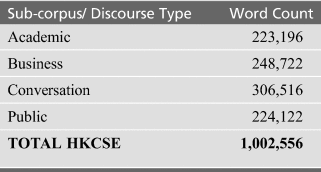
Data for this research comes from the Hong Kong Corpus of Spoken English (HKCSE) (Cheng et al., Reference Cheng, Greaves and Warren2005) This corpus, compiled from the mid–1990s to 2002, consists of 1,002,556 words of naturally occurring monologue and dialogue in four discourse contexts: Academic, Business, Conversation and Public domains. The Academic sub-corpus includes student presentations, lectures, seminars, and workshops for staff and postgraduate research students. The Business sub-corpus includes meetings, informal office talk, service encounters, workplace telephone talk, and job placement interviews. The Conversation sub-corpus comprises casual conversation recorded in a variety of social settings; while speeches, press briefings, discussion forums, and radio announcements make up the Public sub-corpus (RCPCE, 2018). The word count for the corpus is as follows (Table 1):
HKCSE composition

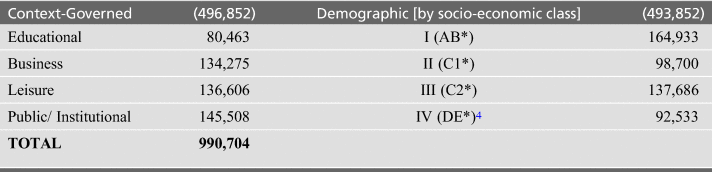
To further understand ‘something like that’ in HKE, the use of the term in a native English corpus – the British National Corpus (BNC) Sampler corpus – is compared. The BNC Sampler (sBNC) was put together in 1994 while the main BNC was still being compiled. The main BNC is a 100-million-word corpus of a vast variety of texts of spoken and written British English (BE) exemplifying late 20th-century Britain. In this way the periods of the HKCSE and sBNC are comparable. The sBNC word count is 2,001,394 words, with its spoken corpus tallying 990,704 words (Table 2) (Document Sampler.htm, 1998):
BNC Sampler Spoken composition

It is the Context-governed spoken data in the sBNC, totalling 496,852 words, which is relevant to this research, as it is subcategorized into the same discourse types as the HKCSE (Oxford Text Archive, 2015). Thus, the general symmetry of the two corpora (HKCSE – sBNC; Academic – Educational; Business – Business; Conversation – Leisure; and Public – Public/Institutional) facilitates the required comparison. Original corpus .txt files were used for both corpora.
Methods and methodology
Corpus linguistics methodology was utilized in this research. Using British linguist Mike Scott's corpus toolkit, Wordsmith 7.0, concordances for the n-gram ‘something like that’ for the whole corpus and each discourse type in the HKCSE were produced. Each n-gram instance was manually examined and classified according to semantic categories emerging from the text. The frequencies of the discourse types and categories were tallied and normalized to 10,000, (Fn [104]/C). Normalized frequencies were rounded off to two decimal places.
To investigate the company the n-gram under investigation keeps in HKE, the collocate showing the strongest syntagmatic attraction within a collocation window of L5-R5 as generated in Wordsmith was also examined. Colligations, i.e. the grammatical environment (of the n-gram), were also explored. Clause and sentence boundaries were ignored in collocation but observed in colligation review.
The sBNC concordance for ‘something like that’ (for the context-governed files) was likewise produced and thereafter analyzed in the same manner as the HKCSE.
Findings
Frequencies and dispersion
First, let's address Research Question 3A – what are the frequencies of the phrase ‘something like that’ in both corpora?
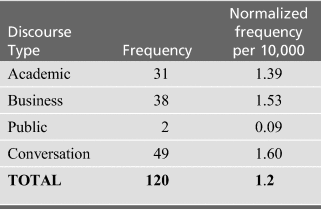
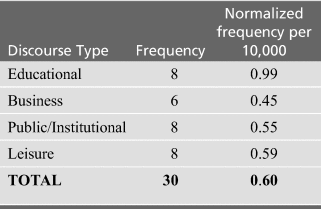
Tables 3 and 4 show that the expression ‘something like that’ is used twice as much overall in the HKCSE than in the sBNC (1.2/0.6). As anticipated, the phrase is used most frequently in the Conversation sub-corpus of HKCSE, the most informal setting (1.6). In the Public forum, arguably the most formal setting, there are only two occurrences of the phrase, with Business and Academic falling in between. These results reflect Cheng's descending hierarchy of ‘something’ occurrences in her HKCSE sample: Conversation – Business – Academic – Public (Cheng, Reference Cheng and Cutting2007: 177).
HKCSE ‘something like that’ non-categorized n-gram frequencies

BNC Sampler ‘something like that’ non-categorized n-gram frequencies

In the sBNC, however, the hierarchy differs: Educational – Leisure – Public/Institutional – Business. Additionally, the Public/Institutional frequency of 0.55, (when compared to the HKCSE Public's 0.09), runs counterintuitively to the hypothesis that the phrase is an informal one. Educational having the higher frequency over Leisure – 0.99 vs 0.55 – also does this. Further light could possibly be shed on these results when we look at the categorizations and collocations of the n-gram.
Classifying the n-gram
Research Question 1 sought to identify the semantic categories of use of the phrase. Manual analysis of the concordance sets produced two distinct classes which I call here ‘Approximations’ and ‘Vague Category Identifiers’ (VCI). ‘Approximations’ here refers to some imprecise, contextual referent or phenomenon, as in I will buy something like that; something close to, or a version of, a described or stated entity/phenomenon. It functions as a null set noun phrase that not only appears as object following/within a verb phrase but also as subject. This class is similar to Dornyei and Scott's approximation except that a backward-referring standard phrase, rather than a semantically related word, replaces the unuttered entity. It also is strongly reminiscent of Dubois’ ‘diminishing precision’, with the difference being that the specific phenomenon being qualified has been detailed before in the flow of discourse and is now replaced by ‘that’. As stated earlier, this paper takes the position that the referent in this case is a specified entity.
Secondly, ‘vague category identifiers’ or ‘VCI’ follows the fashion of Chanell's exemplar + tag structure, where the speaker broadly refers to a category of possibilities by pointing to it with a tag after highlighting one or more examples of that category, as in Prices, cost, something like that. In that way, a superordinate category and its other members are brought into view in order to make sense of the vague n-gram. The point of reference is now a collective rather than a specified entity.
Here are examples of coding from the data set for both categories:
Approximation:
… And something like that I thought would have been a very good solution … ’ (BNC Leisure)
Do you know where to get something like that? (HKCSE Conversation)
… don't say something like that … (HKCSE Conversation)
VCI:
… what's it called minerology or something like that … (HKCSE Conversation)
… let's split it this way something like that … (HKCSE Business)
… to see how energy can be saved something like that … (HKCSE Academic)
We can note here that Channell's tag constructions, and that of other researchers, normally begin with conjunctions ‘and’ or ‘or’. This is not always the case in the HKCSE. Another revelation in this research thus far is that the same expression, ‘something like that’ fits into two different categories of vague language types, as differentiated along semantic and syntactic lines. Previous research usually placed vague items into singular and mutually exclusive categories.
Approximations & lexical gap in HKCSE
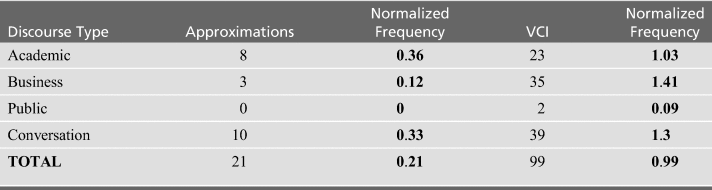
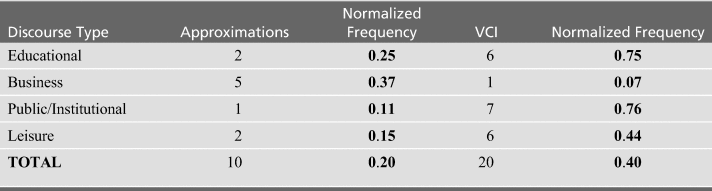
Continuing with Research Question 1, what were the frequencies for each category across the two corpora (Tables 5 and 6)?
HKSCE ‘something like that’ n-gram frequencies in 2 categories

BNC Sampler ‘something like that’ n-gram frequencies in 2 categories

‘Something like that’ as a VCI is the proportionally higher common usage of the term in HKCSE overall (0.21:0.99), when compared to the same Approximation: VCI ratio in the sBNC (0.20:0.40). Both corpora overall favour VCI, with the Approximation: VCI gap being nearly 400% in the HKE and 100% in the sBNC. Note, however, that the sBNC Business, in contrast to the other 7 discourse types across the two corpora, favours the Approximation usage of ‘something like that’ with an Approximation: VCI ratio of 0.37:0.07. Additionally, the striking similarity of frequency across both corpora for Approximations (0.21/0.20) provides a good comparative baseline and gives confidence that any striking differences revealed are meaningful to the definition of HKE.
Collocation
To begin to answer Research Question 3B, which takes a more detailed look at the use of the n-gram across both corpora, the collocates of the node were produced. The conjunction ‘or’ possessed the strongest attraction at the L-1 position in both corpora and only occurred amongst VCI instances. This is significant, as the phrase ‘or something like that’ can be viewed as the more native speaker turn of phrase for VCIs, in line with Channell's, Dines’, and Terraschke & Holmes’ work. We can view ‘or’ + ‘something like that’ as a true lexical collocation (Evert, Reference Evert, Ludeling and Kyto2009) or multiword expression, after the fashion of Palmer's Reference Palmer1933 original definition of a collocate, rather than the later, well-known Firthian one.
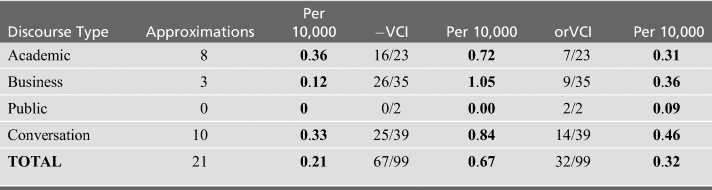
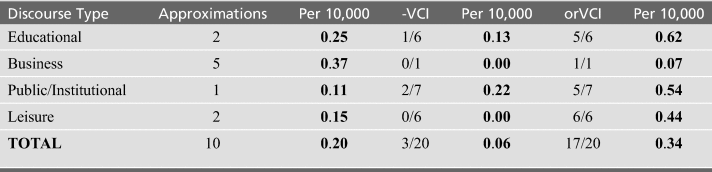
Educationalist Harold Palmer first coined the term ‘collocation’ as ‘a succession of two or more words that must be learnt as an integral whole and not pieced together from its component parts’ (Palmer, Reference Palmer1933). In contrast to the Firthian ‘collocation window’ of meaning, Palmer's collocation can be more precisely deemed an ‘adjacent collocation’, as those collocates ‘occur immediately to the right or to left of the keyword (or sometimes with an empty slot in between)’ and so is ‘closer to real linguistic structures, and not a statistical phenomenon to such a high extent as the ‘window collocations’’ (Lindquist, Reference Lindquist2009: 78). Quite agreeably, in the HKCSE, the collocate ‘or’ also proved to be statistically strongest in collocation strength across four correlation scores: Z score (18.39), Mutual Information (6.53), Mutual Information3 (17.57) and LogL (124.24). When n-gram frequencies are adjusted for this, it becomes clear that there are fundamental differences between the two corpora (Tables 7 and 8):
HKCSE ‘something like that’ n-gram frequencies in 3 categories

BNC Sampler ‘something like that’ n-gram frequencies in 3 categories

With the VCI category now further subcategorised into ‘something like that’ (-VCI) and ‘or something like that’ (orVCI) the distributed use of the n-gram becomes more precise. In the HKCSE, -VCI is overall favoured over orVCI (0.67: 0.32) and in the sBNC the reverse is true (0.06: 0.34). Expressed in a different way, 85% of the sBNC's vague category identifiers use the conjunction, whereas only 32% of the HKCSE's do so. Expressed from the point of view of -VCI, 67% of HKCSE's vague category identifiers are without an ‘or’ collocate, while this holds true for only 15% of the sBNC's vague category identifiers. Though the normalized frequencies of both corpora for Approximations are essentially the same (HKCSE 0.21/BNC Sampler 0.20), the non-collocate VCI ‘something like that’ can be singled out as taking a distinct position in the HKCSE.
Additionally, in the sBNC, though Educational uses 6/8 of its n-grams as VCI, 5/6 of them are actually orVCI. Business’ only VCI utilizes the ‘or’ collocate. The relatively high VCI occurrence in Public/Institutional is also mostly orVCI (5/7) and pointedly, 100% of Leisure's VCI n-grams are orVCI. Altogether then, I make the argument that BE's original usage of ‘something like that’ as a vague category identifier is as part of an ‘or’ collocate which is acceptable across both formal and informal registers. HKE, apart from adopting the n-gram's Approximation usage, has selected it out to be the non-collocated vague category identifier of choice only really unacceptable in the most formal sphere, Public. There is no qualitative difference between -VCI and orVCI, as the syntactic structure ‘exemplar + tag’ applies in all environments. This paper takes the position that the absence of the initial conjunction in HKE's selected tag bears no effect on the pragmatic understanding amongst speakers of accessing a superordinate group.Footnote 5 The adjacent collocation has been split.
The Business discourse in both corpora is worth a second look. In the HKCSE, it has the highest -VCI frequency, surfacing atop Conversation – Academic – Public. In the orVCI group, Conversation regains the top spot over Business. In the sBNC, however, Business’ highest frequency of the n-gram is in the category Approximations, with only one occurrence in orVCI. This ratio is starkly inverse to that of the three other discourse types in the sBNC. It seems then that BE prefers to use diminishing precision in a Business context and not superordinate reference points as favoured in the HKE, if they are used at all.
That observation leads to the broader recognition that, to answer Research Question 2, ‘something like that’ orients toward formality in the British context, but toward informality in the Hong Kong context. Observe the following hierarchies in descending order of normalized frequency (Table 9):
VCI hierarchical frequencies in HKCSE & BNC Sampler

The hierarchies of the two corpora are in virtually perfect reversal from an inter-corpus perspective. From this vantage point, Business reveals its informal orientation in both corpora; or, at the very least, its interpersonal awareness, treated differently in each. The comparative hierarchies also more clearly reveal that the HKCSE and sBNC employ orVCI to near equivalent degrees (0.32/0.34). If orVCI is taken to be original construction from a native speaker context, HKE has also adopted or retained this, along with the frequency of n-gram as Approximation (0.21/020). This reality brings the HKCSE/ sBNC non-collocated tag ratio into prominence – 0.67/0.06. ‘Something like that’ does occur more frequently in HKE as a vague category identifier both intra-corporally as well as in comparison with a native speaker context. Its prevalence as a non-conjunction-initiated tag could be an example of a new, meaningful habit of word combination that is typical of and helps define postcolonial Englishes (Schneider, Reference Schneider2007).
Colligations
To further capture the usage of ‘something like that’ as stated in Research Question 3B, colligational analysis of -VCI in the HKCSE was carried out.Footnote 6
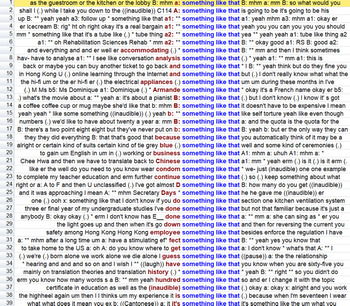
Extract of HKCSE n‑gram concordance

Several interesting colligation patterns around the n-gram emerge:
• Change in speaker: one feature of the HKCSE is that the tag ‘something like that’ many times was uttered by a new speaker following up on the previous speaker's exemplar (lines 4, 5, 13, 17). Channell (Reference Channell1994: 133) also encountered this phenomenon in her study with her conjunction-initiated tags. In other instances, a switch in speaker would also occur after the phrase (lines 1, 7, 24, 31). The phrase therefore functions as a solidarity and turn management tool in conversation, a finding in line with Cheng's (Reference Cheng and Cutting2007) study.
• NP: frequently, the n-gram would follow an attempt at specificity of a concrete or abstract thing or concept (lines 8, 11, 14).
• VP: prior to the researched N -gram HKE speakers would try to describe an action, activity or entire scenario (lines 21, 23).
• AdjP: ‘something like that’ can also be preceded by descriptive lexical items as exemplar, and so point to an overarching (covert) class (line 19).
‘Something like that’ is thus considerably productive in HKE as a -VCI. By comparison, the only three such occurrences in the sBNC are all colligated in an environment of post NP contextualised within one speaker turn:
But if it is something mechanical, like a car, erm, stereo equipment, erm a home computer something like that, a washing machine, it could be a long time … (BNC Sampler Public).
I think it was March to about July something like that. March to July … (BNC Sampler Public).
… how many questions we get on a page but perhaps try for thirty something like that … (BNC Sampler Education).
The colligations of the orVCI group were also observed in both corpora. For the sBNC, ‘or something like that’ was preceded only by NPs and VPs, with the VPs outnumbering the NPs (17/11) and normally describing a scenario:
… obviously if you could help the lady, get a ladder up to the window to get her out of the room or something like that, you would do that, you would help in any way … (BNC Sampler Educational).
In the HKCSE, 11 of the colligations were VPs, also describing scenarios. However, most items, 20 in this case, were NPs, with 1 occurrence of a colligated PP. HKE, therefore, utilises the orVCI tags to similar extents as BE, but in inverse proportions for the colligated environments of NPs and VPs.
Overall, the -VCI tags remain more productive and prevalent in HKE. The presence of both alignment and contrast with BE usage perhaps provides evidence for Schneider's determination (Schneider, Reference Schneider2003, Reference Schneider2007) that HKE is in the Nativization phase, a complex transition phase from external norm referencing to local norm referencing that can only lie on a broad and complex continuum. HKE's vague n-gram may already be at the tail end of that Nativization journey.
Discussion
The research provides evidence that ‘something like that’ is utilised differently in HKE than in a native speaker context. The question remains, however, as to what extent this difference is simply due to intercultural communication factors or perhaps even occasional L2 effects, bearing in mind the nature of English use in Hong Kong. Cheng and Warren (Reference Cheng and Warren2001: 93) discuss accommodation strategies specifically used between native and non- native speakers, such as choosing simpler syntax, and shorter forms and utterances, which may be seen as a deviation from standard norms. While the day-to-day employment of such strategies varies according to many factors, it would be expected for such accommodation to take place indiscriminately across all language items in a category. If ‘something like that’ is treated differently from similar language constructs, the argument builds that the n-gram is a selected characteristic feature of HKE and not simply the result of intercultural accommodation.
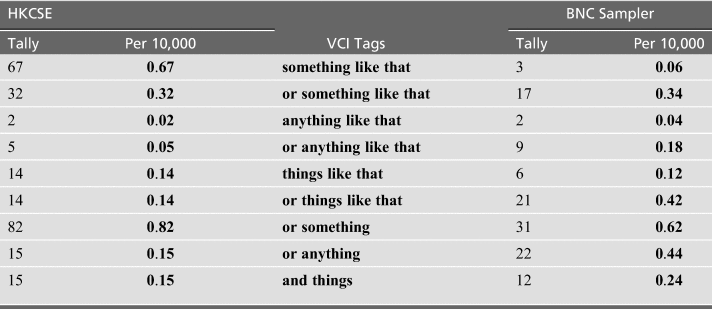
To further test the uniqueness of ‘something like that’ in HKE, other VCI tags as presented by Channell (Reference Channell1994: 131) were tallied within the HKCSE and the sBNC and their normalized frequencies compared (Table 10).Footnote 7
Frequencies of various VCI tags in HKCSE & BNC Sampler

Among the tags that end with postmodifier ‘like that’ the ones that begin with the conjunction ‘or’ in the sBNC are all more prevalent than their non- conjunction counterpart. In the HKCSE, however, only in the ‘something like that/or something like that’ pair is the opposite true, though the ‘things like that/or things like that’ pair notably equalises in the HKCSE. This equalization, however, occurs at significant cost to the general frequency of the ‘or’ collocate moving from sBNC to HKCSE. Such a reduction is near negligible in the ‘or’ collocate of the research n-gram ‘something like that’ in this snapshot of language in time. In fact, the ‘current’ stability of ‘or something like that’ from sBNC to HKCSE (0.34/0.32) further counters the idea that the prevalence of ‘something like that’ in the HKCSE is simply the result of accommodation, in that the increase of ‘something like that’ exists while the rate of use of the original structure remains virtually constant across corpora. This suggests preference for, adaptation, and concretizing of a language feature, a process that could perhaps be in its earlier stages with the ‘things like that/or things like that’ pair. Only further diachronic data can discover this. Finally, even amongst the tags with no postmodifiers, (‘or something’, ‘or anything’, ‘and things’), only ‘or something’ shows an increase in frequency when moving from the BE to HKE, indicating further preference for at least the main lexical item in this bundle.
I must reiterate here that the approach of this research is not to compare a feature of HKE against BE usage from the perspective of error, but rather from the perspective of World English by better describing a feature of HKE through relief with BE. At the same time, any result must be regarded within the context of the limitations of the study. While the study was fortunately able to investigate corpora comparable in size, configuration, date of compilation and discourse types, broader investigation of not only other Inner Circle Englishes – especially those that may have had some influence on Hong Kong over the last few decades (e.g. American English, Australian English) – but also other postcolonial Englishes for the same n-gram would no doubt provide more definitive data on the uniqueness of this aspect of HKE. Additionally, based on the arguments of other scholars on Hong Kong's precise placement in Kachru's circle (Li, Reference Li2009), a close look at comparable corpora from the Expanding Circle should also produce further results, especially in answering the question of whether ‘something like that’ in HKE is behaving in a unique World English way or in the manner of a lingua franca feature that is common across countries in the Expanding Circle. While the two corpora are comparable, any slight differences in text types, (e.g. setting, dialogue vs monologue, etc.) and text type quantities within discourse types, might produce effects on analyses. Finally, without the advantage of discourse intonation data for the corporaFootnote 8 more delicate checks of each n-gram instance in context and categorization could not be explored (Channell, Reference Channell1994; Warren, Reference Warren and Cutting2007: 194–5). Prosodic corpora, for example, could be useful for further research to test the alternative hypothesis that the -VCI group may be, to whatever extent, proportion or degree, a new Approximation construct (exemplified) in HKE. The journey, however, must begin with definitive steps, and this research provides such.
If this is a defining feature of HKE, no longer merely evidenced by anecdoteFootnote 9, how did it emerge? Van Rooy (Reference Van Rooy, Joybrato and Marianne2011), in looking at three features of African Englishes, argues that features of New Englishes, just like features of learner English, may begin as errors of analogy or overextension but may stabilise and conventionalise as language innovations. He proposes two criteria - grammatical stability and community acceptability, or lack thereof - as the determiners of a feature as error or innovation in a New English. Gut (Reference Gut, Joybrato and Marianne2011) corroborates the non-linguistic criteria for language innovation, citing the government establishment of Jamaican Standard English within the space of a decade, from 1989 to 1999. She contends that ‘the labelling of a structure as an error has an attitudinal and political rather than a linguistic basis’. She continues:
Any structure that is not widely spread and used, that is held in low esteem and that is not codified is likely to be classified as an error within and outside the speaker community. Conversely, structures that are widely found throughout a country, that are used by the majority of speakers, that are highly esteemed and are even codified in dictionaries and grammars cannot be called learner errors – however far removed from a Standard variety of English they might be. They constitute innovations of this particular variety of English. (Gut, Reference Gut, Joybrato and Marianne2011: 121-2).
Given the overall norm orientation of Hong Kongers to BE, it is probable that ‘something like that’ emerged as a reduction (diminished use of ‘or’) and overextension (colligation in additional environments instead of just NPs) of British usage. Yet the data paints a picture as complex as the determination of HKE. The data in this research seems to suggest that the lexical bundle has achieved grammatical stability in Hong Kong, yet in looking at its dispersion it appears to still be individually variable in one setting in particular, HKCSE Academic, raising the issue of individual speaker idiosyncrasies, diachronic language change, and whether the phrase has attained the level of general community acceptability required to deem it a true innovation.
Conclusion
Analysis of the HKCSE against the Context-governed spoken component of the BNC Sampler has revealed that the n-gram ‘something like that’ appears to have taken on a life of its own in HKE. Regarding Research Question 1, the n-gram can be used as 1/ an Approximation; 2/ a vague category identifier tag with its top L-1 collocate ‘or’ (orVCI); or 3/ as a vague category identifier tag on its own (-VCI). VCIs generally outnumber Approximations. Research Question 2 revealed that the n-gram is not restricted to informal discourse types in HKE but is instead preferred. Exploring Research Question 3A revealed that frequencies between HKE and BE are a mixed bag. The frequencies of the Approximation and orVCI categories are virtually the same between both corpora but the -VCI category in the HKCSE has a much higher frequency count than its counterpart in the sBNC (0.67/0.06). Hierarchical frequencies in the VCI categories indicate the n-gram having a formal orientation in the sBNC, in contrast with the HKCSE's informal orientation. Further results concerning Research Question 3B and quality of the n-gram across corpora are found in the colligations of the VCI tags where -VCI tags were found in more varieties of colligation environments (NPs, VPs, ADJPs, transition relevance places) in the HKCSE than in the sBNC (3 NPs). The colligated environments of orVCI tags across the two corpora are in contrasting proportions; in the HKCSE, NPs outnumber VPs and in the sBNC VPs outnumber NPs. A closer look at other vague category identifiers in existence in the HKCSE show that ‘something like that’ is preferred in the HKCSE context and does not behave like other n-grams.
Practically, this research can be useful to instruct second language learners on the native use of the vague expression in order to gain more ‘native-like’ prosody, were this the desired objective. However, at odds with that first significance, but reflective of Schneider's interest in lexical bundles as a point of enquiry into New Englishes (Schneider, Reference Schneider2007), these findings point to a tangibly distinctive element of evolving postcolonial English in Hong Kong, which can subsequently be verified, codified, and joined by a body of like enquiry in other territories.
 PATRICE QUAMMIE–WALLEN is a linguist and performing arts practitioner loved by teaching. Her academic pursuits have immersed her in campuses in Trinidad and Tobago, Toronto, Cardiff, and recently Hong Kong, under the Hong Kong PhD Fellowship Scheme. Past hats worn include research assistant for the International Corpus of English (ICE Trinidad), financial customer service representative, Japanese language-learning video project director, faculty valedictorian, postgraduate student faculty board representative, Mercedes in the opera Carmen, and high school volleyball coach. Email: Patrice.quammiewallen@connect.polyu.hk